Proceedings of the
Informatics Education Europe II Conference IEEII 2007
1
The research teaching nexus in the computing
disciplines: a comparative survey
Su White
1, Alastair Irons
21Electronics and Computer Science, University of Southampton, UK [email protected]
2School of Computing, Engineering and Information Sciences, Northumbria University, UK,
Many institutions make claims in strategy documents and official publications that students will receive an education which is research-led, research-informed, or guided by the scholarship of teaching and learning. Academics who teach regularly experience at first-hand the sometimes conflicting demands of research, teaching and supporting learning. Curricula guidelines are unlikely to help in developing any sophisticated understanding of ways in which research and teaching can be symbiotically applied, since such guidelines most typically deal with the content rather than the educational process experienced by our undergraduates. For these reasons an academic’s understanding of the research teaching nexus is more likely to be informed by their own workaday experience of designing and delivering educational experiences than from an analysis of the students’ perspective. If academics in the computing disciplines are to effectively deliver on their institutional missions to be scholarly, research-led or research-informed in their educational approaches, a clearer understanding of the possible meanings and implications of these terms in the context of the typical computing curricula would be of assistance. This paper presents and analyses the results of a survey conducted at two Universities which sought to identify how far their undergraduate curriculum was informed by research. This data is presented alongside qualitative data gathered from academics which explores their attitudes towards, and understanding of, the various terms commonly used to describe a research-informed approach to education in the computing disciplines.
Keywords
CS Curricula, CS Education, Research-Informed Curriculum, Research-Led Teaching
1. Introduction
In the recent past the relationship between teaching and research has been of much concern to educational researchers around the world [1-6]. Such studies have not been specifically related to the informatics/computing disciplines; furthermore, Ernest Boyer’s work, which was probably initially the most influential, has specifically looked at the case of teaching within research intensive institutions [7-9]. Our paper sets out to look at the relationship between teaching and research within the computing disciplines and across both teaching intensive and research intensive institutions. The paper therefore presents research which takes a snapshot of curriculum contents at two different types of UK universities. It uses evidence of curriculum content, educational approaches, and stated learning objectives as a means of exploring how the research teaching nexus is experienced in computer science. Initial discussions of the research objectives are set alongside a review of discussions and debate amongst educationalists which has defined and refined understandings of the components of the research teaching nexus.
Proceedings of the
Informatics Education Europe II Conference IEEII 2007
2
Professors and Heads of Computing promote the importance of Computer Science Research and education through their “Grand Challenges” documents [10, 11], but there are differing views as to the relative importance of research and teaching and much word needs to be done to promote and understanding of the benefits of the research teaching nexus in the disciplines. However, it is apparent that there are a number of possible motivations for seeking a greater understanding of the ways in which research and teaching inter-relate. These include increasing student motivation, enabling the taught curriculum to keep pace with the fast rate of change within the research and development agenda of the discipline and providing an educational experience which encourages student to take deep approaches to their learning, thus effectively preparing them to be independent and life-long learners. Only a few students will go on to be researchers, but many will have professional roles which require them to constantly update their own skills, keep pace with ongoing change, and apply the high level skills associated with design, understanding and analysis which are often associated with a curriculum which successfully integrates teaching and research perspectives.
2. Background
Recently discussion of the relationship between teaching and research has been led by Fasli [12]. In a paper which seeks to raise awareness to the possible relationships between teaching and research, Fasli traces the routes of this work and observes that the potential link between teaching and research was one focus of the Robbins report in the UK in 1963 [13]. Neumann conducted work in the 1990’s to establish and explore a framework for analysis of the relationship between research and teaching – to which she attributed the ermwork has also spent a considerable amount of time considering what in meant by research-led teaching.
While initial work on the teaching research nexus often tended to represent the theoretical perspective of the educationalist, one relatively recent project in the UK set about identifying specific strengths of a research-led approach, and devised a set of tools which were used to evaluate the curriculum [14, 15] taking an educational development viewpoint. It is not uncommon for UK institutions (particularly those which deem themselves to be ‘research intensive’) state in official documents such as mission statements, corporate strategies and learning and teaching strategies that their students will experience research-led teaching/learning or education. Warwick, Southampton and Leeds are examples in case. In this context, institutions which in contrast considered themselves to be ‘teaching intensive’ have strategies and policies which express a commitment to the Scholarship of Teaching and Learning (SoTL). In Boyer’s perspective the motivation for this is clear; “[Teaching is not a] routine function, tacked on, something almost anyone can do. When defined as scholarship, teaching both educates and entices future scholars“ [7].
In the UK, the Higher Education Academy is sponsoring research focussing on the research teaching nexus and has produced a variety of publications which address this agenda from both the strategic and the disciplinary perspective [16, 17]. National direction has been provided through the Teaching quality enhancement fund which specifically earmarks work in the relationship between teaching and research, and some institutions have included modules which address this agenda within their Master’s level programmes for faculty in academic practice.
Proceedings of the
Informatics Education Europe II Conference IEEII 2007
3
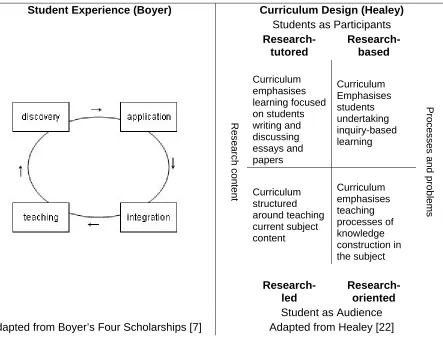
illustrated in figure 1 below. Possibly the best known model is the four scholarships of research that developed for the Carnegie Foundation. The model was revised and revisited, but its main constraint is that it was developed explicitly to apply to teaching within research intensive institutions.
At the same time some UK institutions (particularly those which deem themselves to be ‘research intensive’) have declared in official documents such as mission statements, corporate strategies and learning and teaching strategies that their students will experience research-led teaching/learning or education. Warwick, Southampton and Leeds are examples. In this context institutions which in contrast considered themselves to be ‘teaching intensive’ have declared allegiance to the Scholarship of Teaching and Learning (SoTL). However, there is a need for teaching led institutions in Higher Education to underpin their teaching with appropriate research and scholarship. In every institution, irrespective of the “type” of institution it is important to remember that research and teaching are essential and should be intertwined. However, Hattie and Marsh [2] found no relationship between the quality of research and the quality of teaching. Educational debates have been wide ranging, and the extent of the discourse can be identified by proceedings from symposia in this specialism.
Work which has followed on from this theoretical position has demonstrated that these principles can be applied to the educational experiences provided to undergraduates. Although undergraduates are unlikely to perform fundamental research, their designed learning activities can encompass authentic research tasks which are intrinsic to the scholarship of discovery. The scholarship of application brings theory and practice together developing new processes. Undergraduates can be exposed to activities which require them to apply theory they have encountered or discovered for themselves. The undergraduate curriculum can also be constructed in ways which compel them to incorporate activities which require the learner to integrate prior knowledge into new activities. The scholarship of teaching and learning integrates the other scholarships into the discipline specific scholarships of discover, integration and application, for example with researched, educationally effective practices. In this context undergraduates may themselves be placed in situations where they draw on existing scholarships, engaging in activities such as peer instruction or teaching computing basics to less academically advanced groups.
There are instances where Boyer’s views on the undergraduate curriculum have been cited as motivations for innovations in the computer science curriculum [18, 19]. This research seeks to identify the extent to which such practices can be found in existing curricula taught in differing academic contexts. Two distinct areas of possible focus exist:
Proceedings of the
Informatics Education Europe II Conference IEEII 2007
4
computer science have been developed [24] as have those which enable students to actively generate new knowledge [25].
Student Experience (Boyer) Curriculum Design (Healey)
Students as Participants
Research-tutored
Research-based
Curriculum emphasises learning focused on students writing and discussing essays and papers
Curriculum Emphasises students undertaking inquiry-based learning
Re
sea
rch co
ntent
Curriculum structured around teaching current subject content
Curriculum emphasises teaching processes of knowledge construction in the subject
Processe
s an
d probl
em
s
Research- led
Research-oriented
Student as Audience
[image:4.595.82.525.110.447.2]Adapted from Boyer’s Four Scholarships [7] Adapted from Healey [22]
Figure 1 Two perspectives on the relationship between research and teaching.
3. Method
Two departments in different UK institutions participated in the original survey, the first was research-intensive, the second teaching-intensive.
A desk survey of all modules offered in the undergraduate curriculum was undertaken. Module descriptions and stated learning outcomes were evaluated against Healey’s descriptors, which were then used to build a profile of the curriculum.
Proceedings of the
Informatics Education Europe II Conference IEEII 2007
5
small number of post-graduate research students. The fact remains that the vast majority of the department’s income is derived from teaching.
Research-tutored
eg: classic tutorial structure – typically realised as small group supervisions in the computing disciplines
• Supervision class where students are taken through recent publication(s) and are invited to discuss/debate their understanding of the activity.
• Possible at each level of study, but for organisational/management reasons may only apply in particular years of study.
Research-based
eg: authentic research activities, inquiry/enquiry based learning
• Students are given a task which requires them to use and develop skills (practice and understanding) which are equivalent to those used in authentic research.
• May be practiced at any level of study, but may be more typically found at advanced levels
Research-led
eg: curriculum follows current research
• Most typically advanced level options, • Can also be a component of teaching
at any level, where students are exposed to state of the art research concepts (eg agile programming
Research-oriented
eg: teaching processes of knowledge construction • Typically found in capstone courses
where students undertake some research activity, individually or as a group.
[image:5.595.79.531.112.377.2]• However students at less advanced levels may practice this as part of research based activities
Table 1 – Healey’s different research perspectives in the computing disciplines.
Each module was analysed to determine which (if any) of the various approaches were being utilised. In some cases the module description was explicit in identifying an approach which came from a research perspective.” This course aims to develop critical thinking, effective working within teams, peer-learning and discussion, and individual responsibility as these are transferable skills that are essential within a highly competent technologist, computer scientist, software engineer or researcher” At the same time, academics teaching on the degree programmes were surveyed in order to explore their perceptions of the relationship between research and teaching in their educational practices. They were asked to evaluate which of the four approaches identified by Healey they typically employed in their teaching and to identify any other approaches they adopted. They were also asked to comment on the possible strengths or gains from the relationship between research and teaching, and whether they considered any area of the curriculum was not suitable for such an approach.
3.1 First year
Proceedings of the
Informatics Education Europe II Conference IEEII 2007
6
colleagues expressed the view that there are little or no realistic opportunities at this level of study for the students to be actively involved in producing research results, or undertaking activities which were a proxy for research. In many basic modules colleagues considered that there was no realistic opportunity for teaching to be research related. A number of colleagues did however explain that is some courses (for example data-structures and algorithms) they may typically give examples of their own or others cutting edge research in order to demonstrate concepts and make the subjects covered more interesting to students. Such and approach was also used in order to communicate an excitement for the discipline as a whole. In one example, students were given the opportunity to find out about current research as a task within their professional issues course where they work in groups to investigate a topic and then prepare a presentation. Some colleagues also indicated that they used small group tutorials/supervisions as an opportunity to talk to students about topics which they are currently researching as a means of communicating what is new in the discipline and motivating the students to engage in their studies. One way in which there is a difficulty in achieving an uniform integration of perspectives related to research in the teaching for first year students is a consequence of differing skill levels across the cohort – something which is often most prevalent at entry onto programming modules.
3.3 Second Year
At this stage of their studies students are expected to consolidate their basic skills. Content in this year is often large and may be an obstacle to achieving approaches which bring together research and teaching. Typical teaching approaches continue to concentrate on large lecture classes. Again colleagues indicated that they might relate what they were teaching to current topics of their own and other’s research by way of example of applications of the theory being presented. Assignment may involve reading research papers and postulating new ideas based on the reading. Most UK students undertake group software projects at this level, and the skills they are required to demonstrate are akin to those of researchers working in teams.
Some teaching at this level can explicitly be designed to develop research skills. One of the universities offered a research methods module which focuses on preparing students for study at final year undergraduate University level and to developing the students’ requisite academic skills for completing their studies, in particular research techniques and methods in preparation for final year project and for developing skills in critical analysis and reflection. The other university encourages students to engage with research by getting them to participate in a student conference. Students have to put together an abstract which is peer (and tutor) reviewed, prepare a paper then present at the student conference – an in-house event, but run along the lines of a conference. Students develop their research skills as part of this process.
In smaller optional classes there is a chance for class discussions of directed reading for example “Artificial Intelligence, for the philosophy of AI part, I give students directed reading, which then forms part of their expected background knowledge for the examination. Sometimes the required reading is classic stuff, like Turing's 1950 paper in Mind, but sometimes it is up-to-the-minute commentary, and so could be counted as `research'” In such cases students mimic the behaviours of researchers but they do not generate any actual new knowledge. Other examples of reading courses were offered, although large student numbers often precludes effective group discussion which is a necessary accompaniment to this type of educational approach.
Proceedings of the
Informatics Education Europe II Conference IEEII 2007
7
At final year bachelor’s degree level teaching via large lecture classes is less widespread. A significant part of student learning takes place through the individual project, students take advanced options which are often taught to small groups. Boyer identified this as a capstone experience, consolidating previous taught modules, and enabling the students to develop higher level skills as identified in Bloom’s Taxonomy (design, analysis and synthesis). Having already established the basics, students may have an opportunity to engage in research like behaviours and activities. Colleagues who are active researchers often set students topics for their individual project which relate to research problems they or their post graduate students are facing. Optional courses may also be offered which enable students to undertake activities akin to those in which active researchers engage. One such example, described as a “research-led curriculum” was initiated by one of the authors of this paper and has been reported in detail elsewhere [19].
Modules at this level also sometimes take the form of a reading course. In one example a colleague described their teaching as providing a narrative which provided context to assist students in making sense of the academic papers which to provide the basis for coursework and examination assessments. They also observed that expecting students to learn from academic papers can sometimes be an unrealistic objective since there is too much additional knowledge and understanding which is needed to make the information presented in the paper to be accessible. As with some other examples, this may vary according to the field of study under discussion.
3.5 Masters level
At this level students at both universities are often given tasks and study modules which are explicitly research related. In one example students have a compulsory individual research project where they are expected to review existing literature and undertake a small piece of research which they present in a paper written in a standard journal format. Students peer review each other’s work, revise their papers, prepare a poster and make a short verbal presentation. This is a more elaborate version of a “research-led curriculum” which is offered at the previous level at the same university. Research is evident in the curriculum in student projects where project topics and problems are normally aligned to staff research interests. At one of the universities students are encouraged to join research groups and participate in the activities of that group with the project and dissertation relating to research group activities.
3.6 Other Activities
Students also have opportunities to experience the relationship between teaching and research by means of informal learning which can take place on internships. It is common for research intensive universities to offer internships, but such opportunities are also made available by various large companies who offer places in a research and development context. Such activity is not specifically associated with any particular level of study, although it is most often taken towards the culmination of the period of study. The value of such internships has been recognised by EPSRC who have funded schemes at some UK universities.
4. Discussion
Proceedings of the
Informatics Education Europe II Conference IEEII 2007
8
range of topics which can require them to develop knowledge, skills and understandings which are associated with (in different instances) are associated with both science and engineering. In some cases they are also required to work in social science areas. Healey has pointed out that the ways in which research and teaching can be interlinked will vary according to discipline; the complex nature of the curriculum in the computing disciplines makes this a rather complicated instance.
The survey demonstrated that activities which inter-relate research and teaching exist in at least both examples of a research intensive and teaching intensive institution. In this instance, existing and state of the art discipline based research plays a strong role in educational practices outside of a research intensive academic departments. Anecdotal evidence would suggest that this is to be found elsewhere, however wider data collection is necessary to develop a more authoritative picture across the sector.
Colleagues at both institutions expressed a range of understandings of what was meant by Healey’s four terms. Generally there was a belief that developing the relationship was more easily attained in the third and fourth year. At the research intensive institutions many colleagues responded that of course they related research and teaching – by virtue of their dual roles.
It may be that active curriculum development could be undertaken to enable more widespread linking of teaching and research during the first two year’s of study. In the teaching intensive institution the university explicitly provided a course of study for academics which explored the relationship between research and teaching. Colleagues have commented that students are ill equipped in later years to undertake more intellectually demanding tasks of analysis and critical thinking. Accordingly new activities can be designed for first year work on these skills at a basic level. In one of the institutions such a development is planned this year for the module which addresses professional skills. The problem however in the computing disciplines is often that the early years are already full with technical content which is needed to enable students to undertake higher level technical activities in the latter part of their study.
Examples where students experienced teaching approaches which were drawn from a research perspective tended to be participative rather than didactic, and more highly motivating. It would be interesting to survey students and identify their understandings of how the two aspects inter-relate. One colleague cited feedback from their students from an evaluation questionnaire: “the lecturers, xxx in particular, is able to explore the concepts with clarity and make the content interesting by displaying a genuine passion for the subject"
The colleague concerned commented “I believe this reflects my deliberate use of research related material/knowledge.”
If we are looking at ways in which to bring about change in the student experience because we believe that it will be enhanced by a greater inter-relationship between research and teaching it may even mean that we will need to consider changing the research balance of academics so that it aligns to teaching needs.
Healey’s model excludes the scholarship of teaching and learning from the teaching research nexus, however we believe that CS education is of itself a field of study within the discipline. Colleagues cited examples of how they brought their research into this area into their teaching, and indeed how they made this aspect of their teaching explicit to their students. This approach can be particularly useful when bringing about change in and established curriculum as a means of alerting students to the meta objectives of the activities, and gaining their trust and confidence in the face of introducing them to what may be new methods of learning.
Proceedings of the
Informatics Education Europe II Conference IEEII 2007
9
strategies don’t take teaching seriously and that learning and teaching strategies don’t mention “activities designed to maximise the benefits to undergraduates of research strengths” [26] In order to encourage development of the research teaching nexus, funds have been made available through HEFCE’s Teaching Quality Enhancement Fund (TQEF) in order to support projects.
5. Conclusions and future work
Whilst very few students will go on from any undergraduate degree to become researchers, the knowledge skills and understandings which come from learning how to think and behave like a researcher are ones which will be of use to the graduate throughout their working life. Furthermore, in the UK, there is a desire to ensure a good supply of successful post-graduate students into the pipeline. Giving students experience of activities which they might encounter in research should enable them to make better informed choices about their future career decisions – within which post graduate study can be one option.
In completing the survey and collating the responses it was observed that such an activity could constitute a constructive aspect of programme review. An analysis of the inter-relationship between teaching and research on a module by module basis can serve as a useful tool for educational development within a teaching school or department helping to crystallise colleagues’ understandings of how they might enhance such activities in their teaching.
The survey conducted suggests that it might be worthwhile to conduct further research in this area. Fasli is currently undertaking a survey in conjunction with the Higher Education Academy. Bringing these two pieces of work together would be very useful. If there is to be further development and dissemination of effective approaches then such activities need to be undertaking in conjunction with the professors and heads of computer science. The authors intend to actively pursue this objective through the CPHC Learning Development Group.
Further data could also be gathered in the UK via the CPHC and from a European perspective via existing European curriculum consortia and through the IEEII community. The authors intend to gather data through an initial survey at the 2007 conference, but detailed information will need to be gathered direct from institutions. Further work is required in order to consider appropriate methodologies and techniques to define ways in which to measure the research teaching nexus and as such attempt to quantify the impact that research has on teaching and teaching has on research.
6. Acknowledgments
Thanks are due to colleagues and system support staff at both institutions who contributed to this analysis.
7. References
1 Hattie J, Marsh HW. One journey to unravel the relationship between research and teaching. Research and teaching: Closing the divide? An International Colloquium; 2004 March 18-19, 2004; Winchester; 2004.
2 Hattie J, Marsh HW. The Relationship between Research and Teaching: A Meta-Analysis. Review of Educational Research. 1996;66(4):507-42.
3 Elton L. Research and teaching: symbiosis or conflict? Higher Education. 1986;15:299 - 304.
Proceedings of the
Informatics Education Europe II Conference IEEII 2007
10
5 Brew A, Boud D. Teaching and research: establishing the vital link with learning. Higher Education. 1995;29(3):261-73.
6 Ramsden P, Moses I. Associations Between Research and Teaching in Australian Higher Education. Higher Education. 1992 April 1992;23(3):273-95.
7 Boyer E. Scholarship reconsidered: Priorities of the Professoriate 1990.
8 Boyer Commission on Educating Undergraduates in the Research University. Reinventing Undergraduate Education: A Blueprint for America's Research Universities. New York: Stony Brook: State University of New York at Stony Brook; 1998.
9 Boyer Commission on Educating Undergraduates in the Research University. Reinventing Undergraduate Education, Three Years After the Boyer Report. New York: Stony Brook: State University of New York at Stony Brook; 2002.
10 McGettrick A, Boyle R, Ibbett R, Lloyd J, Lovegrove G, Mander K. Grand challenges in computing education: British Computer Society; 2004.
11 Hoare T, Milner R, eds. Grand Challenges in Computing: British Computer Society 2004.
12 Fasli M. On the Research Teaching Nexus. In: HEA-ICS, editor. 8th Annual Conference of the Subject Centre for Information and Computer Science; 2007 28th – 30th August 2007; University of Southampton: HEA-ICS, University of Ulster; 2007. p. 77-81.
13 Great Britain Committee on Higher Education. Higher Education: Report of the Committee Appointed by the Prime Minister Under the Chairmanship of Lord Robbins, 1961-63. London: HMSO; 1963. 14 Roach M, Blackmore P, Dempster JA. Supporting High-Level Learning through Research-Based
Methods: A Framework for Course Development. Innovations in Education and Teaching International. 2001;38(4):369-82.
15 Dempster JA. Developing and Supporting Research-Based Learning and Teaching Through Technology. In: Ghaou C, ed. Usability Evaluation Of Online Learning Programs. USA.: Information Science Publishing, Idea Group Inc 2003:128-58.
16 Jenkins A, Healey M, Zetter R. Linking of staff disciplinary research and student learning. York: Higher Education Academy; 2007.
17 Jenkins A, Healey M. Institutional Strategies to link teaching and research. York: Higher Education Academy; 2005.
18 Wirth A, Bertolacci M. New algorithms research for first year students. Proceedings of the 11th annual SIGCSE conference on Innovation and technology in computer science education; 2006; Bologna, Italy: ACM Press New York, NY, USA; 2006. p. 128-32.
19 Davis HC, White S. A research-led curriculum in multimedia: learning about convergence. 10th annual SIGCSE conference on Innovation and technology in computer science education 2005; Lisbon, Portugal; 2005. p. 29 - 33.
20 Davy J, Jenkins T. Research-led innovation in teaching and learning programming. ACM ITiCSE. Leeds, Uk: ACM Press New York, NY, USA 1999:5-8.
21 Carter J, Jenkins T. Gender and programming: what's going on? ACM ITiCSE. Leeds: ACM Press New York, NY, USA 1999:1-4.
22 Healey M. Linking research and teaching: exploring disciplinary spaces and the role of inquiry-based learning; 2005.
23 Thomas RC, Mancy R. Use of Large Databases for Group Projects at the Nexus of Teaching and Research. ACM SIGCSE 2004; Portland: ACM; 2004. p. 161-5
24 Strazdins P. Research based education in computer science teaching. Canberra: Australian National University; 2007.
25 Hatch A, Burd L, Ashurst C, Jessop A. Project Management Patterns and the Research-Teaching Nexus. In: HEA-ICS, editor. 8th Annual Conference of the Subject Centre for Information and Computer Science; 2007 28th – 30th August 2007; University of Southampton: HEA-ICS, University of Ulster; 2007. p. 68-71.