I
I
n
n
s
s
t
t
i
i
t
t
u
u
t
t
i
i
o
o
n
n
a
a
l
l
C
C
o
o
l
l
l
l
a
a
b
b
o
o
r
r
a
a
t
t
i
i
o
o
n
n
,
,
L
L
e
e
a
a
r
r
n
n
i
i
n
n
g
g
a
a
n
n
d
d
C
C
o
o
n
n
t
t
e
e
x
x
t
t
:
:
A
A
C
C
a
a
s
s
e
e
S
S
t
t
u
u
d
d
y
y
o
o
f
f
T
T
a
a
s
s
m
m
a
a
n
n
i
i
a
a
n
n
I
I
n
n
f
f
o
o
r
r
m
m
a
a
t
t
i
i
o
o
n
n
T
T
e
e
c
c
h
h
n
n
o
o
l
l
o
o
g
g
y
y
I
I
n
n
s
s
t
t
i
i
t
t
u
u
t
t
i
i
o
o
n
n
s
s
Helen Bound
Submitted in fulfilment of the requirements for the degree of Doctor of Philosophy
Declaration of Originality
Authority of Access
A
BSTRACT
With increasing devolution of governance, collaboration has become ever more important as a means for community groups, regions and institutions to meet their needs. Firms also use a variety of collaborative arrangements to meet their need to compete effectively in local and global markets. However, for all the growth in collaborative activity, there are many fraught or failed attempts suggesting a need to better understand the processes of collaboration. This thesis contributes to our understanding of institutional collaboration, focusing on institutional collaborative activity, learning and context. Collaboration is not considered as a stand-alone activity, but as an activity that is a learning process influenced by context.
Context, institutional collaboration and learning are generally treated as separate components or processes. Furthermore, context is often depicted as that which is external to phenomena, but which impacts on the phenomena. Activity theorists, however, generally recognise context as being intrinsic to activity, noting the mediation of context within the contradictions of the activity. However, Cultural Historical Activity Theory tends not to explore the mediating influence of context as social relations of the mode of production and historical trajectories beyond
acknowledging these influences. Rarely is the mediation of economic, social, political and ideological influences arising from the social relations of production explored in depth. In this thesis, these mediating influences are termed contextual conditions and include the mode of production, dominant discourses, policy, industry development, regional infrastructure and institutional arrangements analysed. The mediating influence of contextual conditions on institutional collaborative activity contributes significantly to our understanding of institutional collaborative activity.
A case study methodology of information technology institutions and their
collaborative activity between 2002 and 2004 in a small regional state of Australia is used in this thesis. Cultural Historical Activity Theory is used to develop data
collection and analytical tool. A focus on a developing Marine Information, Communications and Technology Cluster and the involvement of three key Tasmanian information technology institutions is used to analyse how contextual conditions mediate collaborative activity and learning.
Acknowledgements
All those respondents I interviewed and/or spoke with to make appropriate contacts, or set up observations or participate in industry activities gave generously and freely of their time. Without them there would be no thesis! Thank you.
My supervisor, Doctor Christine Owen, provided constant challenge and support on my journey to complete this thesis while also exhibiting great patience. She
introduced me to new ideas and ways of thinking and writing that resulted in discussions that challenged and developed me. Christine initiated me into research and built my foundational research skills through opportunities to work with her on a number of research projects. Her belief in my ability was critical to my perseverance and development.
I would also like to thank Associate Professor Sue Kilpatrick who provided me with multiple opportunities to work with her on a range of national research projects, giving me confidence in my research skills. Also generous with his time was
Professor Bevis Yaxley who guided me through the final editing process while Doctor Christine Owen was on study leave overseas. Professor John Williamson’s feedback as an academic reader was insightful, resulting in improved clarity of structure and signposting within my writing.
I had many offers from family and friends who also contributed to the final quality of the thesis through critical, careful reading. I would particularly like to thank my sister, Dr Sally Bound and my father, Max Bound.
My husband, Robert Vincent, has been a source, not only of constant encouragement and moral support, but played a critical role in assisting me by being there to critique and challenge. His pride almost outshines my own! My children, Carla Vincent and Vincent Bound, have both been patient and supportive, urging me to complete. Carla’s assistance in using her computer design skills to improve the presentation of my contextual conditions figure is much appreciated.
Contents
Abstract ... 4 Tables... 12 Figures ... 13
Chapter 1 Institutional Collaboration, Learning and ContextError! Bookmark not defined.
1.0 Introduction...Error! Bookmark not defined. 1.1 Background ...Error! Bookmark not defined. 1.1.1 Collaboration...Error! Bookmark not defined. 1.1.2 Learning...Error! Bookmark not defined. 1.1.3 Context...Error! Bookmark not defined. 1.2 Activity Theory...Error! Bookmark not defined. 1.3 Research Design...Error! Bookmark not defined. 1.4 Organisation of the Thesis ...Error! Bookmark not defined.
Chapter 2 Reviewing the LiteratureError! Bookmark not defined. 2.1 Introduction...Error! Bookmark not defined. 2.2 The collaboration Literature ...Error! Bookmark not defined. 2.3 Collective Learning...Error! Bookmark not defined. 2.3.1 The Team Literature ...Error! Bookmark not defined. 2.3.2 Organisational Learning LiteratureError! Bookmark not defined.
2.3.3 Networking Literature ..Error! Bookmark not defined. 2.3.4 Regional and Institutional LearningError! Bookmark not defined.
2.3.5 Socio Cultural and Activity Theoretical Perspectives ...Error! Bookmark not defined. 2.4 Features of Collective LearningError! Bookmark not defined.
2.4.3 Information Flow and Knowledge Creation ...Error! Bookmark not defined.
2.4.4 Common or Shared UnderstandingsError! Bookmark not defined.
2.4.5 Trust and Support ...Error! Bookmark not defined. 2.5 Conclusion...Error! Bookmark not defined.
Chapter 3 Methodology...Error! Bookmark not defined. 3.1 Introduction...Error! Bookmark not defined. 3.2 Judging the Research Process.Error! Bookmark not defined.
3.2.1 Developing Criteria for Judging the Research Process ...Error! Bookmark not defined. 3.3 Methodology ...Error! Bookmark not defined. 3.3.1 The Case Study...Error! Bookmark not defined. 3.3.2 Stages of Data Collection ... Error! Bookmark not defined.
3.3.3 Data Collection...Error! Bookmark not defined. 3.4. Analysis...Error! Bookmark not defined.
3.4.1 Analysis of Data Collected in Stage 2Error! Bookmark not defined.
3.4.2 Analysis of Data Collected in Stage 3Error! Bookmark not defined.
3.5. Limitations...Error! Bookmark not defined. 3.6. Summary...Error! Bookmark not defined.
Chapter 4 The Tasmanian Information Technology IndustryError! Bookmark not defined.
4.1 Introduction...Error! Bookmark not defined. 4.2. The Island State of Tasmania...Error! Bookmark not defined. 4.2.1 The National Information Technology Industry..Error! Bookmark not defined.
4.3 National Policy...Error! Bookmark not defined. 4.3.1 Clusters...Error! Bookmark not defined. 4.4. Conclusion ...Error! Bookmark not defined.
Chapter 5 Collaboration in the Tasmanian Information
5.1. Introduction...Error! Bookmark not defined. 5.2 Tasmanian Information Technology InstitutionsError! Bookmark not defined.
5.2.1 TasIT ...Error! Bookmark not defined. 5.2.2 Intelligent Island Board and Secretariat...Error! Bookmark not defined.
5.2.3 Tasmanian Department of State DevelopmentError! Bookmark not defined.
5.2.4 Information Technology Industry Council ...Error! Bookmark not defined.
5.2.5 Tasmanian Information Technology Industry Training Advisory Board...Error! Bookmark not defined. 5.3. Collaboration Between the Institutions. Error! Bookmark not defined.
5.4 Conclusion...Error! Bookmark not defined.
Chapter 6 Towards a Conceptual Framework: Contextual
conditions and the object of collaborative activityError! Bookmark not defined.
6.1 Introduction...Error! Bookmark not defined. 6.2 Contextual Conditions ...Error! Bookmark not defined.
6.2.1 Contextual Conditions Relevant to the Evolving Marine ICT Cluster ...Error! Bookmark not defined. 6.3 Collaborative Activity and the Object.. Error! Bookmark not defined.
6.3.1 The ‘Boundary Space’ of Collaborative ActivityError! Bookmark not defined.
6.4 Conclusion...Error! Bookmark not defined.
Chapter 7 The Ways in Which Contextual Conditions Influence Collaborative Activity ...Error! Bookmark not defined.
7.1 Introduction...Error! Bookmark not defined. 7.2 The Evolving Object of Institutional Collaboration in the Developing Marine ICT Cluster...Error! Bookmark not defined. 7.3 Contextual Conditions and Collaborative Activity ...Error! Bookmark not defined.
7.5 Conclusion...Error! Bookmark not defined.
Chapter 8 Institutional Collaboration as a Process of Learning ...Error! Bookmark not defined.
8.1 Introduction...Error! Bookmark not defined. 8.2 A Learning Process...Error! Bookmark not defined. 8.2.1 The Connecting PhaseError! Bookmark not defined. 8.2.2 The Interacting Phase..Error! Bookmark not defined. 8.2.3 The Participating and Committing Phases ...Error! Bookmark not defined.
8.3 Conclusion...Error! Bookmark not defined.
Chapter 9 Ways in which Contextual Conditions Mediate Learning in Institutional Collaboration ...Error! Bookmark not defined.
9.1 Introduction...Error! Bookmark not defined. 9.2 Mediation of Learning and ToolsError! Bookmark not defined. 9.3 The Social Relations of Production of Collaborative Activity ...Error! Bookmark not defined. 9.4 Tensions and Contradictions in the Social Relations of Collaborative Activity...Error! Bookmark not defined. 9.5 Contextual Conditions and Learning in Collaborative Activity ...Error! Bookmark not defined.
9.5.1 Making Tensions and Contradictions Visible ...Error! Bookmark not defined.
9.6 Conclusion...Error! Bookmark not defined.
Chapter 10 Conclusion ...Error! Bookmark not defined. 10.1 Introduction...Error! Bookmark not defined. 10.2 Findings ...Error! Bookmark not defined. 10.3 Contributions of this thesis and their implications ...Error! Bookmark not defined.
10.4 Further investigation...Error! Bookmark not defined.
References ...Error! Bookmark not defined.
Appendix 2: Changes in the Research Questions Error! Bookmark not defined.
Research questions ...Error! Bookmark not defined. Focus of the study ...Error! Bookmark not defined. Appendix 4: Interview questions ...Error! Bookmark not defined. Stage one ...Error! Bookmark not defined. Stage two ...Error! Bookmark not defined. Stage three...Error! Bookmark not defined. Appendix 5: Ethics Application ...Error! Bookmark not defined. Appendix 6: Letters of Invitation...Error! Bookmark not defined. Stage one ...Error! Bookmark not defined. Stage 2 ...Error! Bookmark not defined. Stage 3 ...Error! Bookmark not defined. Appendix 7: Consent Forms...Error! Bookmark not defined. Stage one ...Error! Bookmark not defined. Stage Two ...Error! Bookmark not defined. Diverse groups such as Industry Bodies working togetherError! Bookmark not defined.
T
ABLES
2.1 Literature on collaboration 39
2.2 Contributions and
problematic of bodies of collective learning
literatures
48
2.3 The contribution and
problematic of different theoretical orientations
49
2.4 Diversity — contributions
and problematic 57
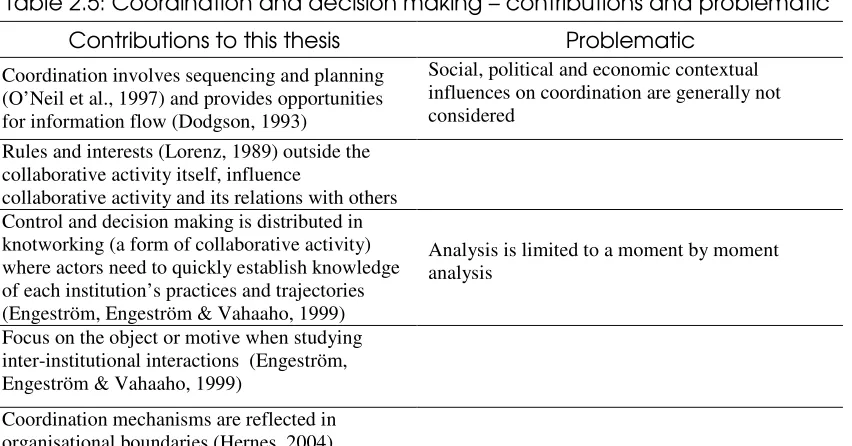
2.5 Coordination and decision making — contributions and problematic
61
2.6 Information flow and knowledge creation — contributions and problematic
64
2.7 Shared understandings — contributions and
problematic
69
2.8 Trust and support — contributions and problematic
72
3.1 Summary of processes used to address authenticity and trustworthiness
76
3.2 Stages of the research 79
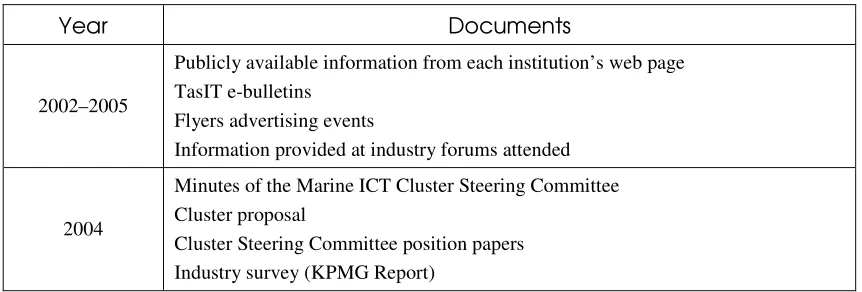
3.3 Documents collected as
data 83
3.4 Interviews and observations
collected over each stage 86 3.5 Framework for initial data
6.1 Ways in which Wertsch’s 10 claims add to an
understanding of mediation
146
6.2 Collaborative and
institutional objects of activity and goals
150
7.1 The evolving object 157
7.2 Collaborative activity and
contextual conditions 164
8.1 Evolving object and phases
of collaborative activity 180
F
IGURES
1.1 Mediated action 30
1.2 Activity system 32
4.1 Map of Australia 99
4.2 Map of Tasmania 100
4.3 Age profile of Tasmanian information technology companies
106
6.1 Contextual conditions 134
6.2 Interacting activity systems 153
8.1 Phases of learning in the collaborative process
182
8.2 Connecting networks 184
9.1 Social relations of production
1
C
HAPTER
1
I
NSTITUTIONAL
C
OLLABORATION
,
L
EARNING AND
C
ONTEXT
1.0
I
NTRODUCTION2 defined as regional by the Australian Bureau of Statistics because of its small, dispersed population.
What is known of each of these concepts of institutional collaboration, learning and context is explored in the review of the literature in Chapter Two. Chapter Three sets out the methodology employed in this study. The fourth chapter provides background information about the State of Tasmania, as well as the national and state information technology industries. Each of the subsequent chapters addresses a research question, and these are followed by the conclusions in the final chapter. The research questions for this study are:
1. What is the experience of collaboration between institutions in the Tasmanian information technology industry?
2. What contextual conditions influence institutional collaboration?
3. In what ways do contextual conditions influence institutional collaboration? 4. How can institutional collaboration be conceptualised as learning?
5. In what ways do contextual conditions mediate learning in institutional collaboration?
What can a study of collaborative activity add to the existing literature on collaboration? Much of the literature on collaboration identifies typical themes such as trust, leadership, communication, coordination, information flow as discussed in Chapter two. This thesis acknowledges these elements as important, but considers the process of identifying elements of collaboration to be one dimensional, not accounting for the mediating influence of the tools of
collaborative activity, and the context of collaborative activity. As indicated in the title of this thesis, this study takes quite a different perspective to existing studies of collaboration. By understanding collaboration as collaborative activity, this study acknowledges and works with the complexity of interactions, appreciating learning as implicit in such activity, exploring how and why learning occurs.
3 providing for the first time a framework in understanding ways in which
contextual conditions mediate activity, actions, and thus also our learning. From the data and literature explored in Chapter six, seven contextual conditions are identified: the mode of production, history, dominant discourses, the process of industry development, government policy, the degree of infrastructure and resources within a region and/or industry, and institutional arrangements. Just as language, stories and historical processes are important aspects of organisational culture, so too is history and the language and stories employed in promulgating dominant discourses. The cultural aspects of language, stories and historical precedent are important in cultural aspects of context. These cultural aspects interact with and mediate modes of production and vice versa, and are evident in government policy. Each contextual condition mediates and is mediated by other contextual conditions. As collaborative activity is important in industry
development, the development of institutional infrastructure and institutional arrangements, and the learning required to develop these conditions, an
understanding of how these contextual conditions mediate collaborative activity is a significant contribution to new knowledge in this field.
This theoretical framework was developed through an analysis of data in conjunction with a range of literature. Vital to this conceptualisation was the activity theoretical approach undertaken in the collection and analysis of data. An activity theoretical approach provides a means for analysing the complexity of interactions in collaborative activity. Current activity theoretical approaches however, are limited in their acuity in relation to the mediation of context in collaborative activity. This thesis develops a framework for understanding and analysing the mediation of contextual conditions in collaborative activity.
4 learning that occurs through these activities. For these movements collaborative activity is essential, just as it is essential in industry and regional development. Such activity is critically important for Australia and Australians now and into the future. As indicated in Appendix one, my participation in these movements, highlighted for me, the influence of context.
1.1
B
ACKGROUNDThere is an increasing need for collaborative work. Collaborative work requires multiple, complex, ever-changing relations across an array of organisational forms and patterns of multi-organisational relations (White, 2001). The increasing need for firms to work as part of a supply chain and/or as part of activity in a regional milieu (Camagni, 1991; Gulati, 1999; Keeble, Lawson, Lawton Smith, Moore and Wilkinson, 1998), for service organisations to interrelate with a range of other bodies and the rise of clusters with ‘traded links’ (buying and selling from each other) and ‘non-traded links with researchers, professional associations, financiers or government agencies’ (Munro, 2003, p. 11) is indicative of the increase in collaborative activity.
5 other collaborative activity is not. To understand these complexities it is necessary to understand the context of institutional collaborative activity.
Institutions ‘structure social and political behaviour, defining the rules of the political game and as such define who can play and how they play’ (Voss, 2004, p. 7562). Institutional collaboration is important because as Castells (1996, p. 152) points out institutions are ‘invested with the necessary authority to perform specific tasks on behalf of society as a whole’. He notes that the restructuring of capitalism has resulted in profound changes, and that institutions have a place in managing relations in a world where there is increased global competition (1996, p. 1). Institutions, be they educational, health care, economic, industry or other institutions are important in the shaping and management of these changes in everyday activity. Institutions have a major role in creating environments for successful change – politically, socially and economically. They are strategically placed to inform and implement policy, shape consultation processes, findings and information sharing. Hence for this thesis, institutions are organisations
representing industry partners or participants or in some way are ‘invested with authority’ to make decisions for and on behalf of an industry. Thus the term ‘institutions’ is used in this thesis to refer to the industry institutions investigated in the Tasmanian information technology industry.
6 economic orthodoxy infecting policy makers at all levels of Australian
governance’ (Wiseman, 1998, p. 20). Government has ‘pulled back from its role as the redistributors of income and key aspects of the economy have become
internationalized’ (Blackler, Crump and McDonald, 2000, p. 277). This is the context in which the knowledge economy has seen the rise of the information technology industry, and the increasing need for collaborative work.
A form of collaborative work increasingly considered as significant by policy makers in today’s knowledge economy, is clusters. Clusters are suggested as an important means to enable small firms and regional economies to ‘attract capital’ and ‘grow’ (Hubert, 2004). Knowledge transfer through the development of clusters in regions is increasingly a basis for OECD regional and national policy development (see OECD, 1999). Regional clusters can successfully be developed with appropriate intervention strategies. Such strategies might include employing existing interaction or the generation of interaction between firms and a range of institutions where interaction did not exist (Tsipouri, 1998, p. 6). While there are many definitions of cluster, as will become evident in later chapters, what is common between definitions is that clusters require extensive linkages and high-level collaborative skills. Understandings of cluster vary from those comprised principally of small to medium enterprises (SMEs); others are conceived as networks in which there are strong exchanges of information between producers and users in a value-adding chain’ including universities, research institutions, knowledge-intensive services, brokers and consultants, and customers (Roelandt and Hertog, 1999, p. 9).
7 conflict. Given the critical role of institutions in today’s capitalist knowledge economy, it is therefore critical to better understand how institutions collaborate, what their sources of tension and conflict are and what they may hold in common.
Institutions may structure social and political behaviour, and ‘define the rules’ (Smelser and Baltes, 2001) but they are not separate from relations of production and its dominant hegemonies. Institutional collaborative activity taking place in the economic relations of capitalism, is imbued with hidden hegemonic
assumptions (Wodak, 1996) and historical precedent (Putnam, 1993; Maskell and Malmberg, 1999). These are all matters that are concerned with ‘context’. Yet, as Seddon reminds us:
Context…is only occasionally a strong focus of inquiry. More often than not it is a ‘throw away term’ which summarizes all that is not of special interest (Seddon, 1994, p. 5).
Not only is context often treated as not being of special interest, but collaboration is often construed as cooperative endeavour, relatively free of tensions and conflict. Yet despite the increase in collaborative activity not only between institutions, but increasingly as a form of governance (White, 2001) there are many failed attempts at collaboration. How can we better understand institutional collaboration in today’s context?
1.1.1
C
OLLABORATIONCollaboration includes an array of organisational forms, involving various patterns of multi-organisational relations (White, 2001). For the purposes of this thesis, a more detailed explanation is required. A dictionary definition of collaboration is cooperating, or working in conjunction with others (Oxford Dictionary, 1972, p. 340), and is generally understood as meaning to work together. Marsick, Bitterman and van der Veen (2000, p. 11) construe collaboration as individual members of a group crossing boundaries to develop and share new knowledge. Crossing
8 Two. It is a useful construct, as it assists in reminding the reader that collaborative activity requires moving to the edges of a known community to interact and work with others from unknown or lesser-known communities. Wenger (1998, p. 140) defines boundary crossing as taking place when activity is carried out across different practices, with different forms of engagement, different histories, different definitions of what matters and different repertoires. For the purposes of this thesiscollaboration is defined as working together at the boundaries where difference is encountered. Further, collaboration and collaborative activity are one and the same; in this thesis, collaboration is understood as a form of activity. This reflects a dialectical materialist epistemology employed in this study.
Collaboration between institutions is a part of their everyday activity. It is an intrinsic part of their practice, necessary for governance. Without collaborative activity, institutions become dysfunctional; they are unable to undertake their work of making or influencing policy, of consulting and working with constituents to determine future directions and to meet needs. The limited research on
collaboration between institutions has meant that this study has relied on the literature of collaboration in its widest sense in order to explore what is already known about collaboration. A useful source of literature to assist in developing an understanding of collaboration is studies of collaboration across boundaries. This literature (e.g. Luff, Hindmarsh and Heath, 2000; Blackler et al., 2000; Engeström, Engeström and Karkkainen, 1995; Wenger, 1998) suggests collaboration at the boundaries is difficult; it of necessity is about encountering difference, it requires distributed learning and that tools can be developed to assist collaborative activity at the boundaries.
1.1.1.1COLLABORATION ACROSS BOUNDARIES
9 suggest this is achieved through the use of tools in collaborative activity and in the process cognitive activities are distributed:
People appear to think in conjunction or partnership with others and with the help of culturally provided tools and implements … The thinking of these individuals might be considered to entail not just ‘solo’ cognitive activities, but distributed ones. In other words, it is not just the solo’ who learns, but the ‘person-plus’, the whole system of interrelated factors (Salomon, 1993, xii-xiii, original italics) (Luff et al., 2000, p. 18).
In working together a whole system learns through tools impregnated with cultural artefacts. But as Blackler et al. note, working across external boundaries is
difficult, more so than achieving horizontal collaboration within organisations:
Collaboration across different systems of activity raises issues concerning priorities, identities and operational methods, as well as questions about relative authority and influence. Horizontal integration across expert communities within an organization can be difficult to achieve, for example, as the shared
understandings of activity and the shared infrastructure of activity that make cooperation the norm within particular communities of activity can act as a barrier to close collaboration with outsiders (Blackler et al., 2000, p. 282).
Working across different practices and histories, often referred to as boundary crossing (Engeström et al., 1995), also requires mutual learning and an ability to recognise meaning in each other. The literature on boundary crossing is key to this thesis, as it suggests that recognising meaning in each other, and understanding others’ perspectives, cultures and tools, contributes to collaborative activity across different histories and practices.
10 collective development depends on the ways in which people deal with tensions. This is an important observation for this thesis as it is this tension and uncertainty that is the site of potential new learning.
However, inhabiting the boundary does not mean that learning for collaborative activity will automatically follow. Barriers to boundary crossing include
‘groupthink’, resulting in limited motivation to consider alternative courses of action (Janis, 1983, p. 9 in Engeström et al., 1995). ‘Groupthink’ can result in stereotyping external groups, further limiting options. A lack of shared mental models can also be a barrier to boundary crossing. Fragmentation of viewpoints makes it impossible for practitioners from different contexts to ‘speak the same language’ and exchange ideas about a problem (Engeström et al., 1995, p. 321). To develop shared mental models requires conscious access to concepts that may be deeply embedded, preventing reflection and the development of shared language and ideas.
Tools identified in the literature that may assist in overcoming such barriers include ‘different types of shared external representation of a problem or domain’ (Engeström et al., 1995, p. 322). These external representations are described by Engeström et al., (1995) as mediating artefacts and by Star (1989) as ‘boundary objects’ and are used to make systemic tensions ‘visible’ (Engeström, 1999). Boundary objects or mediating artefacts may include a physical object, and/or a set of cognitive tools. The boundary objects become the focus of dialogue, of
knowledge construction, of argumentation, of story-telling to make meaning, facilitating shared understanding.
11 understanding. These authors define perspective taking as the process of
examining one’s own assumptions and those of others, and of imagining the point of view of others. Perspective making is defined as the development of more coherent meaning structures (moving from general naming and understanding to more specific understandings and naming) as individual and groups work together. For the process of perspective taking to proceed, the diverse knowledge held by individuals must be made available for others to incorporate in a perspective-taking process – that is, differences are recognised, acknowledged and valued. The unique thought worlds of others need to be made visible and accessible to others. The first step, claim Boland and Tenaski (1995, p. 359), is differentiation. Only after a perspective is differentiated can it be reflected on and represented so the actors from different groups or activity systems have something to integrate. Once a representation has been made of an individual’s knowledge, it becomes a
boundary tool, providing a basis for perspective taking (Boland and Tenaski, 1995). Such an approach assumes highly developed skills in differentiation and in communicating that differentiation appropriately and meaningfully.
Engeström et al. (1995) suggest that if boundary crossing is to result in collective concept formation, and this is not always achieved, then there has to be a
developed or developing practice which supports this collective learning. Boundary crossing is about operating at the peripheries of practices; it is about areas of overlap and connections to possibilities for participation. It is a space for learning within an informal community of support. Shared practice and
12
1.1.2
L
EARNINGLave (1996, p. 6) states that ‘participation in everyday life may be thought of as a process of changing understanding in practice, that is, as learning’. That is, learning takes place though everyday activity. It can be argued that as
collaborative activity takes place, so learning takes place. That learning occurs is not problematic; what is problematic is what is learned (Lave, 1996, p. 8). This approach requires a conception of learning as not only the ‘construction of present versions of past experience for several persons’ (Lave, 1996, p. 8) but as the collective construction of a future trajectory – of possibilities and constraints.
Learning in this thesis is considered to be collective; not as purely psychological, cognitive and individual. This is not to deny that within collective learning, individual cognition is occurring. Collective forms of learning require social relationships that reflect embedded, shared practices. As discussed in Chapters Two, constructivist socio-cultural perspectives of learning are useful, as they are about making meaning of experience as we interact and engage in activity and therefore cognition that is shared and distributed. As Wenger (1998, p. 226) states, learning is a matter of engagement, of the ability to negotiate new meaning and is fundamentally social. Learning through activity and engagement and through the use of cultural, social products referred to by some as tools (Engeström, 1987), is a critical aspect of collective learning. This idea is developed further in Chapter Eight.
13 Engeström argues, much of the literature about collective forms of learning
assumes that learning takes place within existing, established structures and cultures and that knowledge is stable. The focus is on ‘stable, identifiable knowledge and skills, leading to lasting behaviour changes in an individual or organisation’ (Engeström, 1999, p. 6). Yet, as Engeström points out, people and organisations are constantly learning something that is not stable, ‘not even defined or understood ahead of time’ (Engeström, 1999, p. 6). In this thesis
learning is understood as taking place through institutional collaborative activity; it is a collective process. Literature reviewed in Chapter Two identifies that
collective learning involves information flow, tacit knowledge diffusion, and the development of commonly understood rules, norms and problem-solving
heuristics. These are all skills required for effective institutional collaborative activity.
In what ways then, does context mediate institutional collaborative activity and learning? The idea that context is integral to activity has only recently become evident in some bodies of literature. The ways in which researchers have looked at context is outlined briefly below.
1.1.3
C
ONTEXT14 supports the idea that the individual cannot be separated from their social
environment; it is a means of understanding social identity.
Organisational learning theorists are likely to explain context as ‘external’ to an organisation and develop strategies such as Force Field analysis (Lewin, 1951; DeSimone, Werner and Harris, 2002) and SWOT (Strengths, Weaknesses, Opportunities, Threats) analysis to analyse the impact of the ‘external’
environment on the ‘internal’ environment of the organisation (Bradford, Duncan and Tarcey, 1999). In studying collaboration between firms, social economists (Gulati, 1999; Easton, 1992) also understand context as ‘other’, that is, outside the relations between the firms but yet collaboration between firms contributes to an aspect of context, the economy.
In this thesis context is not understood as ‘other’, ‘external’ or situated, requiring an analysis of the situation in which institutional collaborative activity is taking place. Rather context is understood as contextual conditions.
1.1.3.1CONTEXTUAL CONDITIONS
The term ‘contextual conditions’ is grounded in a dialectical materialist epistemology which addresses the dichotomy of the subject-object pattern or stimulus-response pattern (Leontyev, 1977) by understanding that there are relations between object and subject mediated by tools (Vygotsky, 1978). This is understood as activity, the subject is part of relations of society, influencing those relations, just as those relations influence the activity of the subject. In discussing activity and consciousness, Leontyev observes the interrelations between subject, activity and the system of relations of society:
15
production and that cannot be realised except in the activity of specific individuals. It stands to reason that the activity of every individual depends on his [sic] place in society, on his [sic] conditions of life (Leontyev, 1977, p. 3).
The ‘system of relations of society’, that is, production, creates conditions which are part of human existence.
‘Conditions’ is a term also used by Ilyenkov (1960) and Marx (in Fischer, 1968). The contextual conditions identified in this thesis and explicated in Chapter Six, were developed from the analysis of the data and the review of a range of literatures and include:
• The capitalist mode of production and modes of production within capitalism
• History
• Hegemonic discourses
• Government policy
• Regional infrastructure and resources
• Stage of industry development
• Institutional arrangements
Relations of society, institutional collaborative activity and learning merge at the boundaries of institutions involved in collaborative work. Boundary crossing, encountering difference and boundary tools which facilitate the development of shared practices and understandings are key to this thesis and are expanded on in Chapter Six. The boundary-crossing literature does not separate learning from activity. The need to move away from learning as individual to collective, to recognise that learning occurs through activity and is influenced by and through relations in the activity requires a theoretical framework that moves away from the study of single phenomena. A theoretical framework that begins to take into account the ‘system of relations of society’ (Leontyev, 1977) and thus provides a means for the study of context or contextual conditions and their influence on learning and collective activity, is Cultural Historical Activity Theory, or as it is commonly referred to, Activity Theory. In this thesis, the work of activity theorists such as Engeström (1999), Blackler (1995), Leontyev (1977), Vygotsky (1978)
16 this thesis. The following section summarises Engeström’s depiction of Activity Theory.
1.2
A
CTIVITYT
HEORYA brief historical overview of Activity Theory (Vygotsky, 1978; Leontyev, 1981) is provided here, followed by an account of activity systems (Engeström, 1987).
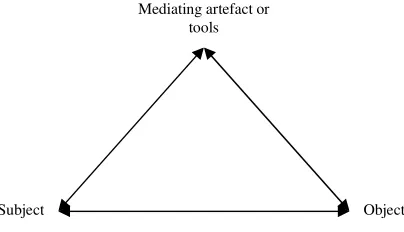
Vygotsky’s (1978) concept of mediated action shown in Figure 1.1 is a
conceptualisation of the process of development and change. Vygotsky (1978) argued that stimulus response between subject and object is mediated by tools (cultural means and signs).
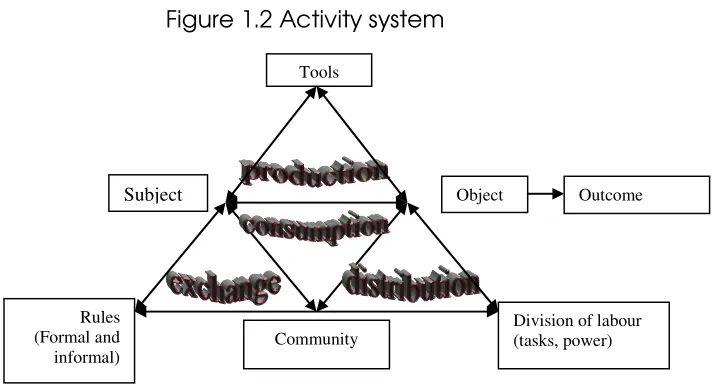
[image:30.595.226.428.586.702.2]Leontyev (1981) further developed the idea of mediation using the concept of the social relations of production where the instrument of production, labour (Marx, 1973, p. 85) is ‘performed in conditions of joint, collective activity’ (Leontyev, 1981, p. 208). Engeström (1987) expanded on these concepts developing a graphic model of an activity system shown in Figure 1.2. An activity system can be any organisational form where there are stable rules and norms, represented from the perspective of the selected subject(s).
Figure 1.1 Mediated action
Source: University of Helsink, http://www.edu.helsinki.fi/activity/pages/chatanddwr/chat/ Mediating artefact or
tools
17 Engeström’s (1987) model represents the relationship between individuals, their work colleagues and the activity in which they are jointly engaged and the factors that mediate these relationships (Blackler, Crump and McDonald, 1999, p. 7). Tools, the division of labour (division of tasks and power), rules (formal and informal – the explicit and implicit norms and conventions of the organisation) and community and the object itself mediate activity. There is constant interaction, renegotiation and movement between these nodes of activity. Need determines the production of objects (Davydov, 1990, p. 130). The object of activity expresses the motive, the purpose of the activity in society (Miettinen, 1998, p. 424).
Engeström (1999, pp. 4–5) summarises Activity Theory with the help of five principles:
1. The prime unit of analysis is the collective artefact-mediated and the object-oriented activity system, in its network of other activity systems. Activity systems realise and reproduce themselves by generating action and operations.
2. Activity systems are multi-voiced. Activity systems are a community of multiple points of view, traditions and interests The activity system carries multiple layers and strands of history embedded in its artefacts, rules and conventions. The mulit-voicedness is a source of tension and change.
3. Historicity is the third principle. Activity systems take shape and get transformed over lengthy periods of time. The history of an activity system will inform its future trajectory.
4. Contradictions are sources of change and development. Contradictions are not the same as problems or conflicts. Contradictions are historically accumulating structural tensions within and between activity systems. The primary contradiction of activities in capitalism is between use value and exchange value of commodities that pervades all elements of activity systems. When an activity system adopts a new element from the outside such as a new technology or a new object, it often leads to an aggravated secondary contradiction where some old elements, such as the rules, or division of labour, come into conflict. This can result in innovative attempts to change or transform the system.
18 Figure 1.2 Activity system
Source: Engeström, 1987, p. 78
Engeström (1987, pp. 87–89) posits that there are four levels or layers of contradictions in the analysis of human activity. Contradictions or tensions develop when there are imbalances in the system. Imbalances will always exist; it is these and the resultant tensions and contradictions that result in change.
Imbalances and tensions occur as a result of different developmental processes. So, for example, a new tool in the form of new technology may be introduced that requires working differently with different ways of organising work. But the rules and the way labour and tasks are distributed in the system remain the same, or do not change at the time of the introduction of the new tool, creating tension between the nodes of tools and rules.
Each of the nodes that compose the activity carries historical experience within them and is reflective of the mode of production. In this way, Activity Theory systematically incorporates context into its frame of analysis.
• The primary (inner) contradiction is within each component of the central activity that is between exchange value and use value within each node of the activity.
• The secondary contradictions are between the constituents of the activity, that is, those appearing between the nodes. The hierarchical division of labour lagging behind and preventing the possibilities opened by advanced instruments is a typical example.
• The tertiary contradiction is between the object/motive of the dominant form of the central activity and the object/motive of a culturally more advanced form of the cental activity.
Tools
Object
Subject
Rules (Formal and
informal) Community
Division of labour (tasks, power)
19
• The quaternary contradictions are between the central activity and its neighbour activities. That is, those activities with which the activity interacts outside of itself but which are also embedded within it. The neighbour activities’ include first of all the activities where the immediately appearing objects and outcomes of the central activity are embedded (object activities). Secondly, they include the activities that produce the key instruments for the central activity (instrument producing activities). Thirdly they include activities like education and schooling of the subjects of the central activity (subject-producing activities). The quaternary contradictions are those that emerge between the central activity and the neighbouring activity in their interaction (Engeström, 1999, p. X).
The strength of an activity theoretical approach is that it is about the study of constantly changing relations of which learning is an integral part. Lektorsky (1980) explains the constantly emergent nature of activity and its object, and the critical nature of tools (‘external naturally emerging object – other man-made objects’) in the mediation of activity.
Marxist philosophy asserts that cognition is founded on practical activity…and must be understood as collective of joint activity, in which the individual enters upon definite relations with other persons, as mediated activity in which man places himself and an external naturally emerging object – other man-made objects – functioning as the implements of activity: And finally as a historically
developing activity carrying in itself its own history (Lektorsky, 1980, p. 259).
A theoretical framework that builds in the mediation of history and of other human activities, on activity itself and cognition has strongly influenced the research design employed in this thesis.
1.3
R
ESEARCHD
ESIGNThis study employs an iterative, qualitative research process, employing activity as the unit of analysis through a case study of collaborative activity to provide
richness and depth of data. As stated earlier in the chapter, the case study is of the Tasmanian information technology industry institutions and their collaborative activity. These institutions include:
• TasIT; an employer lobby group representing employers in the information technology industry and other organisations that are significant users of information technology
• The Department of State Development, a government department responsible for state economic development, including industry development
20
• The Tasmanian Information Technology Industry Training Advisory Board (ITAB), (now defunct). Industry Training Advisory Boards were tripartite bodies of unions, employers and government established to identify industry skill and training needs
• Tasmanian Information Technology Industry Council, a government-appointed body
• Australian Computer Society (ACS), a professional body
• Tasmanian Council of Unions, the peak union body
There is an enormous array of literature that potentially adds to an understanding of collaboration, for example, the literature on social capital, studies of social partnership, literature on the different collective forms of learning and so on. For this reason a sampling approach was taken in selecting literature to be reviewed. The sampling was guided by the research questions that relate to conceptualising institutional collaboration as learning, and the ways in which contextual conditions mediate learning in institutional collaboration. Literatures on collective forms of learning reflecting collaborative activity in various modes, including team work, organisational learning, networking and studies of collaboration have been explored. These literatures add to our understanding of collaborative activity in that they identify a range of elements that are important for successful
collaboration. The limitations of these literatures in relation to this thesis are discussed in Chapter two. It should be noted that some literatures have been explored in greater depth than others. For example, there is little discussion in this thesis of the literature on team work and organisational learning as they are limited in their contribution to the study of collaboration, context and learning. However because the networking literature often also accounts for institutional collaboration and/or collaboration within regions, this literature has been drawn on more
extensively. More recent studies of collaboration have also been explored.
21 review in Chapter two are activity theoretical studies of various forms of
collaborative activity.
Collaborative activity between institutions is conceived of as an actualisation of context in the social relations of production of the evolving collaborative activity. This thesis draws on the work of Marx in unfolding the social relations of
production of a Marine ICT Cluster and three main institutions involved in the evolution of the Cluster. As the Cluster evolves perceptions of tensions and
contradictions is an inevitable process of the mediation of context embedded in the social relations of production. Learning is inherent in these social relations.
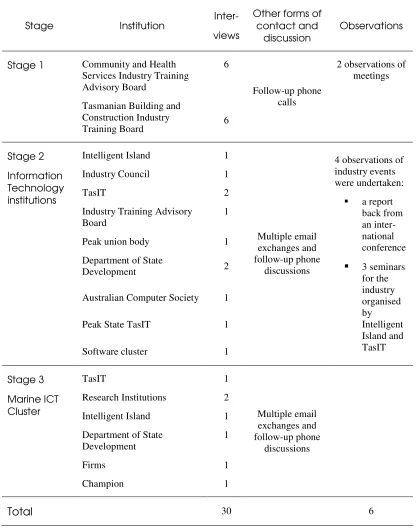
Theory-building takes place though a number of stages, beginning with a study of the literature and a number of cycles of data-gathering and analysis. Data was collected in three stages using semi-structured interviews, some observation and the collection of relevant texts, such as minutes, reports and policy documents. Along with a range of data types, interviews were conducted from key personnel in each institution, providing multiple perspectives.
1.4
O
RGANISATION OF THET
HESIS22 chapters are followed by five findings chapters, with each of these chapters
addressing a research question. These are followed by a concluding chapter.
The first findings chapter, Chapter Five, addresses the first research question describing the institutions in the Tasmanian information technology industry and the history of collaboration between them. Chapter Six addresses the second research question identifying seven contextual conditions and conceptualises institutional collaborative activity as taking place in the ‘boundary space’ shaped by the collaborative object. In Chapter Seven the influence of contextual
conditions is explored through the evolving object and the interaction between institutions, addressing the research question: in what ways do contextual conditions influence institutional collaboration?. The fourth research question: how can institutional collaboration be conceptualised as a learning process? is addressed in Chapter Eight. This chapter suggests there are processes of
institutional collaboration evident in collaborative production and that contextual elements influence these processes in different ways over time. The final research question: in what ways do contextual conditions mediate learning in institutional collaboration? is addressed in Chapter Nine . The concluding chapter, Chapter Ten, summarises each of the findings chapters and briefly explores the
23
C
HAPTER
2
R
EVIEWING THE
L
ITERATURE
2.1
I
NTRODUCTIONLearning, institutional collaboration and contextual conditions and their
24
2.2
T
HE COLLABORATIONL
ITERATURELiterature on collaboration has grown in recent years (Couchman & Beckett, 2006). The increase in the extent of this literature is perhaps attributable to the growing importance of collaboration for social and economic well being. This section of the literature review provides an overview of this literature on
collaboration. The literature analysed here has been categorised into two types of literature; these being literature about managing collaboration and literature about intra and inter organisational collaboration. Table 2.1 summarises the key
characteristics of each of these types of literature and identifies the key contributions and problematic of the literature in relation tot this thesis.
The literature classified as managing collaboration (Barnes, Pashby & Gibbons, 2002; Couchman & Beckett, 2006; Reynolds, McCormack, Ferguson-Patrick, 2005; Scott, 2004; Vangen & Huxham, 2003) provides frameworks and guidelines for leaders managing collaboration in a variety of settings. The literature focuses on what are recurring themes in much of this type of literature on, namely
communication and coordination (Reynolds, et al, 2005; Scott, 2004), establishing trust and issues of power (Barnes, et al, 2002; Vangen & Huxham, 2003);
knowledge exchange (Barnes et al, 2002) and shared objectives or purpose (Barnes et al, 2002; Scott, 2004; Vangen & Huxham, 2003).
25 Table 2.1 Literature on collaboration
Type of
literature Authors Key characteristics Contributions to this thesis
Problematic of the literature in relation to this
thesis
Managing
collaboration Barnes, Pashby & Gibbons, 2002; Couchman & Beckett, 2006; Vangen & Huxham, 2003
This literature provides frameworks and guidelines for leaders for managing collaboration
These authors claim that:
Collaboration provides access to various forms of advantage for the participating organisations e.g. knowledge, technologies, opportunities (Barnes et al, 2002; Couchman & Beckett, 2006; Vangen & Huxham, 2003)
Collaboration enables greater access to knowledge and technologies (Barnes et al, 2002) and solutions to social problems (Vangen & Huxham, 2003) Collaboration is vexed, bringing together diverse organisations inevitably resulting in tensions (Barnes, Pashby & Gibbons, 2002; Couchman & Beckett, 2006; Vangen & Huxham, 2003)
Inward orientation, focusing on recurring themes (in this literature) in collaboration such as objectives, knowledge exchange, decision making processes, trust and power (Barnes, et al, 2002; Couchman & Beckett, 2006; Vangen & Huxham, 2003)
Trust, commitment, planning and experience are key foci (Barnes et al, 2002)
The external environment needs to be managed (Barnes et al, 2002; Vangen & Huxham, 2003)
Collaboration is a tension laden process
Diverse organisations bring into the collaborative activity different cultures and aims and objectives
Political environment is recognised as a factor in collaborative activity Where there is a history of mistrust between
collaborating partners it is noted that this impacts negatively on the collaborative activity
The literature has a different ontological perspective to that taken in this thesis.
This literature recognises collaboration as a developmental process, but does not perceive this development as learning. Thus the literature overlooks the dynamics, complexities and interactions of development and change. For example, when there is tension between the aims of each organisation, rules of engagement and intent and evolving rules of the collaboration.
26
Type of
literature Authors Key characteristics Contributions to this thesis
Problematic of the literature in relation to this
thesis
Intra and inter
organisational collaboration Slaughter & Archerd, 2004 Reed, 2001 Engeström, Engeström & Vähäaho, 1999;
University participants in collaboration with industry display limited conscious awareness of tensions they faced, and their location in the market place Policy contributes to shifts in boundaries and discourses
Challenges to professional norms and values, as a result of working across boundaries, lead to quandaries about professional identities
Trust is a form of control exercised through the structures of collaborative relations through which forms of expert power can be explained
Trust cannot be thought of separately from power Trust is not a coordinating mechanism based on shared values and norms
Asymmetrical power relations between actors in an institutional setting, contribute to tensions
New tools result in tensions between tools and the object of activity
There are three dimensions of knotworking, the socio-spatial, the temporal dimension and the ethical
Provides an example of the relationship between policy and discourses
The extent to which the tensions are experienced by subjects appears to be related to the division of labour (where subjects are in the hierarchy
History, ideology, language and discourses may be factors to consider in a study of collaborative activity, learning and context)
The ethical dimension highlights the constantly changing distribution of power and control, the changing division of labour and the rules of engagement. Notes the contradiction
There is an over generalisation from the experience of the academics interviewed and the extrapolation of this experience to its impact on relations between university, state and market
Ontologically this realist study posits that social structures are enduring. Realism relies on casual explanations which limit an understanding of
collaboration as multi-dimensional, complex with interacting factors.
Although the broader context is noted in the mention of the contradiction between use value and exchange value the
27
Type of
literature Authors Key characteristics Contributions to this thesis
Problematic of the literature in relation to this
thesis
Blackler & Crump, 2000
dimension
Engeström, (1999) note the need for activity theory to explore the “communicative and instrumental aspects of tools and also ways to understand different types of trajectories and the points of small but reflective learning.
Cooperative relations between communities of activity are mediated by the process of ‘perspective taking, perspective making and perspective shaping Blackler et al (2000) notes the need to explore the influence of ‘boarder socio-structural, historical and cultural factors in collective work practices
between use value and exchange value
Blackler et al (2000) provide a lens for uncovering the cultural assumptions people are working with and in. Perspective making etc. may be a useful analytical tool
28 However, in the managing collaboration literature the ontological perspective focuses on recurring issues in collaboration and how to mange these issues. Thus in this literature aspects of learning are overlooked; collaboration is portrayed as developmental, but not as learning. As a result, the literature overlooks the dynamics, complexities and interactions of development and change. Some of the intra (that is, literature on boundary crossing within organisations),and inter organisational literature on collaboration (that is, literature on networking and institutional collaboration across organisations) offers quite a different perspective, as outlined in Table 2.1. Engeström (1999; 1995) for example, conceives of
learning in and across organisations as boundary crossing, which results not only in the exchange and creation of knowledge, but the generation of spaces and encounters for learning. In the process, argues Engeström (1999) the tools used in the process of working towards the object of the work are broadened, as is the object of work itself. In this literature collaboration is constructed as a learning process.
A study of a particular type of collaborative activity that is termed as knotworking Engeström, et al (1999) – when people from different organisations come together to perform a task – elaborates these ideas further. Knotworking is so called
because control is distributed across the knot of actors. Control passes from actor to actor from one point in time to the next depending on the tools being used, and the rules being invoked. Each actor represents their own “collective” or activity system (p.354). Engeström et al (1999) argues that knotworking can be
represented along a number of dimensions. These are the:
• Socio-spatial dimension depicting the different activity systems involved at any point in time (p.354);
• Temporal dimension where participating activity systems move in and out of the knot over time as the steps of the knotworking episode unfold
• Ethical dimension involving “redistribution and reconceptualisation of control, responsibility, and trust” (p.355)
29
part of what has been conceived as the ethical dimension. Also important to this thesis is the collective focus, rather than the individual focus evident in much of the managing collaboration literature (e.g. Barnes et al, 2002; Couchman & Beckett, 2006) and in the work of Slaughter and Archerd (2004) discussed below.
The ethical dimension, note these authors, operates outside the accepted forms of hierarchy and classification to be found in the participating activity systems. The ethical dimension addresses the distribution of power and control, the constantly changing division of labour and the rules that govern the division of labour. In non-stable collaborative activity neither the division of labour nor the rules are ongoing, rather they evolve as required and are in a constant state of flux. The managing collaboration literature conceives of issues of power and control as relating to trust. Trust is highlighted in the managing collaboration literature as critical in the management of collaboration. Trust, however, is not one
dimensional and is more complex than recognising that trust evolves over time. Trust is context specific, related to the particular participating organisations or activity systems, the mediating rules, culture and thus the power dynamics. The object also mediates trust. As indicated in the example above, the ethical
dimension is a constantly moving and evolving dimension; it is not fixed or linear.
In the intra and inter organisational collaboration literature Reed (2001) suggests that trust is a form of control exercised through the structures of collaborative relations through which forms of expert power can be explained. Trust he claims is not a mechanism based on shared values and norms, rather trust cannot be
30 Reed (2001) posits that social structures are enduring, that history, ideology and language contribute to these structures. As a self-proclaimed realist, Reed (2001) also relies on causal explanations. Causal explanations however are problematic as they are limited in their account of the dynamic interactions within collaboration. The dynamic nature of collaboration constantly changes relations within the collaborative activity, making a cause and effect explanation problematic.
Other authors in the intra and inter organisational collaboration literature such as Blackler and Crump (2000) (see Table 2.1) note there is a need to explore the influence of broader socio-structural, historical and cultural factors in collective work practices. In a study of collaboration between academics and industry partners, Slaughter and Archerd (2004) found that changing funding patterns and the role of globalisation and global markets are key factors in the tensions
experienced by academics in their interaction with industry. These tensions, claim these authors, lead to quandaries about identity when researchers work closely with industry, throwing up issues of disclosure versus publication and ownership of intellectual property. This qualitative study across 14 institutions in the United States using semi-structured interviews (n=38) highlights the ways in which policy and discourses mediated relations of collaborative activity. In this study the
31 discussion of identity and tensions within the collaborative activity, to the impact of policy and globalisation, it serves as a useful reminder of the need to investigate the mediating influence of broader contextual factors. Engeström et al (1999) note fundamental societal contradictions, indicative of the broader context; however, these authors do not explicitly explore the ways in which these contradictions mediate the collaborative activity. Rather they focus on the situated context.
In summary, recent literature on collaboration provides useful insights for this thesis of the learning that occurs through collaboration suggesting that
conceptualising institutional collaboration as learning provides a useful lens through which to better understand the processes and complexities of
collaboration. Such a lens would add to the lessons of how to collaborate from the managing collaboration literature by conceptualising the complex and dynamic nature of collaboration as a process of learning. This is addressed in Chapter eight. The literature analysed above also strongly suggests that broader contextual factors mediate collaboration and therefore learning in the collaborative activity. This begs the questions, what contextual conditions mediate institutional
collaboration and in what ways do these conditions mediate the collaborative activity? What contextual conditions mediate collaborative activity is addressed in Chapter six, and chapter seven addresses the question of the ways in which these conditions mediate collaborative activity.
32
2.3
C
OLLECTIVEL
EARNINGThis section identifies a number of characteristics of collective learning, setting up Section 2.3 which gives a more detailed account of each of these characteristics.
As stated in Chapter One, in this thesis learning is construed as collective, because institutions working at the boundary are working collectively. Collective learning is learning in and through a group working across similar or different organisations or groups. Collective learning is core to this thesis and thus it is important to examine what is already known about collective learning in its various
formulations. This review of literature examines literature that involves studies of what is typically thought of as collective in nature; namely teams, organisations, networked firms, regions and institutions. All these types of literature of collective learning have something to contribute to collaborative activity across multiple institutions with different histories, practices and purposes.
This section reviews the networking, regional institutional literature as well as the team and organisational learning literatures which are summarised in Table 2.1. A brief discussion of socio-cultural and activity-theoretical literatures follows. As indicated in Chapter One, these perspectives are critical to this thesis and are summarised in Table 2.2. It should be noted that each type of literature is not discussed in the same level of detail.
2.3.1
T
HET
EAML
ITERATURE33 These characteristics are factors in the development of strong shared mental
models which additionally requires the ability to question assumptions and develop understanding of one another’s viewpoints, roles and experiences (Kline, 2005). Factors to be considered in teams that self-assemble include team size, which affects the degree of support, the proportion of newcomers and the tendency of participants to repeat previous collaborations (Guimera, Uzzi, Spiro and