dairy calf rearing
J.P.T.M. Wagenaar* and J. Langhout
Louis Bolk Institute, Hoofdstraat 24, NL-3972 LA Driebergen, The Netherlands * Corresponding author (fax: +31-343-515611; e-mail: [email protected])
Received 21 December 2006; accepted 19 February 2007
Abstract
The introduction of suckling systems in organic dairy calf rearing has the potential to enhance animal welfare in terms of ‘natural living’ and to live up to consumers’ expectations about organic agriculture. This study describes the implications of suckling systems in a practical organic dairy context. Results show that farmers can successfully develop and implement a suckling system in calf rearing. The con-sumption of mothers’ milk resulted in high weaning weights at 3 months of age. No immediate animal health problems linked to suckling systems occurred. Compared with traditional bucket feeding of milk, suckling systems resulted in increased natural behaviour such as calf–
suckling systems resulted in increased natural behaviour such as calf–
suckling systems resulted in increased natural behaviour such as calf cow bonding, natural sucking behaviour and care-taking behaviour. Some farmers had difficulties accepting negative implications of suckling systems such as stress after weaning and loss of marketable milk. Although suckling of the own mother was seen as the most natural suckling system, farmers adapted their suckling system to calves suckling nurse cows. In order to implement successfully a suckling system, farmers have to step back from control and give calf and cow a chance. In the case of increasing ‘natural living’ through implementation of a suckling system, farmers should be encouraged to take enough time to accomplish this attitude change.
Additional keywords: milk quality, natural behaviour, paratuberculosis, weaning
Introduction
The IFOAM principles health, ecology, fairness and care imply that organic agriculture should sustain and enhance the health of soil, plant, animal, human and planet as an inte-grated whole (Anon., 2005). Animals are an inteinte-grated part of organic farming systems, and are regarded a resource as well as a link between the different parts of the system. Lately, the increased focus on animal welfare has concentrated on ideas about ‘good animal welfare’ as specific goal for organic animal husbandry. Although organic production systems often claim increased animal welfare, this claim cannot always be substantiated
Archived
at
(Rymer et al., 2006). This is due partly to the fact that animal welfare is difficult to assess and partly because it is difficult to reach improved levels of animal welfare.
Lund (2006) defines animal welfare in organic agriculture in terms of ‘natural living’. The ability to express natural behaviour, feed adapted to animal physiology and an environment similar to the biotope natural to the species, are the key aspects of the ‘natural living’ approach. Organic farmers interpret animal welfare primarily in terms of ‘natural living’ (Lund, 2006). They prefer a more natural (and thus less controlled) environment to a well-controlled environment where the animal is protected from dangers but less able to have a ‘natural’ life.
The lives of calves in current organic dairy herds can still be considered to be very ’un-natural’. Like with conventional systems, organic calves are separated from their mothers shortly after birth, they are bucket fed and raised according to a housing concept that reduces contact with animals of other age groups. Old habits, efficiency in terms of feed cost, as well as labour input, and minimizing the risk of disease trans-mission, are the key features. In the case of calf rearing, organic standards only specify minimum requirements for stocking density and space and give specifications to the design of buildings and prohibition of tethering. When confronted with practical calf rearing conditions on (organic) dairy farms, critical consumers find it hard to understand that little attention is paid to animal welfare and natural behaviour.
Triggered by public opinion, but wary of the practical constraints, some farmers realize the importance of trying to make changes to the existing calf rearing method. They experiment with a calf rearing system in which calves are allowed to suckle up to an age of 3 months. The suckling method practised is either single suckling of the own mother with additional machine milking, or multiple suckling of a nurse cow without additional machine milking. In the first option the calf is introduced with its mother into the dairy herd and the mother is milked twice a day. In multiple suckling the calf is removed from its mother to a nurse cow. The nurse cow is housed separately from the dairy herd, not milked but suckled by up to three calves. Nurse cows are selected from cows with proven mothering abilities.
Research on suckling systems in dairy calf rearing has been carried out in the past but has mainly focused on partial aspects of suckling systems under experimental conditions (Weary & Chua, 2000; Vaarst et al., 2001; Jaspar & Weary, 2002). This paper presents the introduction of suckling systems in practical organic dairy calf rearing with the aim to enhance ‘natural living’. The first objective is to describe the process of development and implementation of suckling systems and the way farmers deal with the consequences of ‘natural living’. The second objective is to identify the practical implications and the extent to which suckling systems affect technical results in a practical organic dairy context.
Materials and methods
On-farm system development
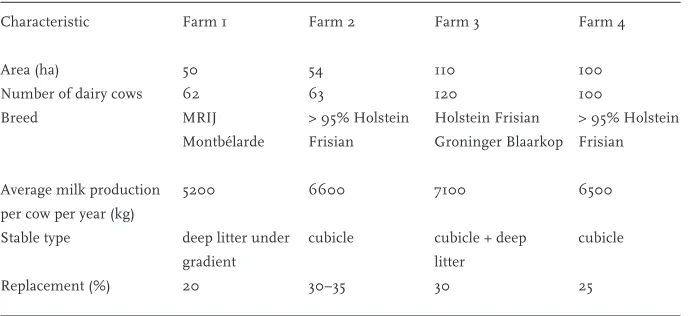
In the period 2002–2004, suckling systems in dairy calf rearing were introduced on two farms (farm 1 and 2). Characteristics of these farms are presented in Table 1. Farmers were allowed to adjust their suckling system during the process of devel-opment. Farms were visited twice a month. During these visits data on animals and information on the practical development of the suckling system were collected. Based on individual calf growth and milk production of mother or nurse cows, the milk consumption of calves was estimated. All animals older than 2 years were tested for paratuberculosis at least every other year. Pooled manure samples were taken by the local veterinarian and diagnostic tests were carried out by GD-Animal Health Service Deventer, The Netherlands. Testing for paratuberculosis was continued during the second phase of the research. In order to support the development of the suckling systems, suckling-, foraging-, and care-taking behaviour of calves in a multiple suckling system was observed during 24 hours per day for one week pre-weaning according to the focal animal sampling method (Martin & Bateson, 1986). Animals were video-recorded using a camera positioned above the calf pen. Behavioural data were tested for normality using the Kolmogorov-Smirnov test. Mainly because of small sample size, behavioural data were not normally distributed. Therefore the non-parametrical Mann-Whitney U test was used to test for statistically significant differences.
On-farm comparison of three calf rearing methods: 2004–2006
[image:3.482.57.402.473.631.2]Based on the experience and results obtained in the period 2002–2004, an on-farm trial was initiated at the end of 2004. In this trial three calf rearing methods were compared at three farms: farm 2, 3 and 4 in Table 1. The calf rearing methods tested were: bucket feeding with milk prepared from milk powder (milk replacer), bucket feeding with bulk farm cow milk (tank milk) and a suckling system. Both bucket fed groups were single housed between birth and 90 days of age. Calves suckled in the
Table 1. Characteristics of the four participating dairy farms.
Characteristic Farm 1 Farm 2 Farm 3 Farm 4
Area (ha) 50 54 110 100
Number of dairy cows 62 63 120 100
Breed MRIJ > 95% Holstein Holstein Frisian > 95% Holstein Montbélarde Frisian Groninger Blaarkop Frisian
Average milk production 5200 6600 7100 6500
per cow per year (kg)
Stable type deep litter under cubicle cubicle + deep cubicle
gradient litter
same period stayed with their mother in the milking herd or in a group with 3 nurse cows and up to 8 calves. Each rearing group involved 5–8 calves per farm. All farms followed identical calf rearing and data collection protocols. All calves were weaned at 90 days of age. In order to assess live weight increase, a weighing scale was installed at all farms. Calves were weighed at 0, 30, 60, 90 and 365 days of age. If calves were not weighed at exactly the right age, live weights were corrected by extrapolating the weight to the exact ages, using the growth rate of individual calves in the period pre-ceding the measurement. Data on calf and cow health were recorded in individual log-books. Recording of milk production was carried out at 4-week intervals. Bacteriology and determination of somatic cell count (SCC) in milk of cows in all the treatments were carried out monthly during routine milk quality controls. Live weight and milk data were analysed with GenStat version 7.2 using an ANOVA based on the General Linear Models procedure of regression analysis.
Results
On-farm system development 2002–2004
Mother and calf
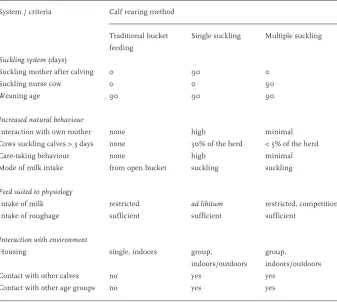
At the start of the research, farmers 1 and 2 decided to rear female replacement calves in a single suckling system. They were of the opinion that compared with a multiple suckling system, suckling of the own mother would result in more natural behaviour and social learning. Table 2 compares traditional bucket feeding with single and mul-tiple suckling for the key aspects of ‘natural living’. The table shows that single suck-ling offers the highest potential for increasing ‘natural living’ in a modern dairy farm operation.
behind in the stable during milking. The kindergarten proved itself to be useful: it cre-ated a safe and peaceful haven where calves happily awaited the return of the milking herd.
Weaning
[image:5.482.59.396.101.403.2]The first results of the single suckling system were encouraging. Farmers did not experience many problems and the calves showed a good live weight gain. When in 2002 farmers had to wean their first suckling calves they were not sure whether they had to do this on the basis of age or live weight. According to organic rules, calves have to be fed organic milk for a minimum of three months. Some calves, however, reached a live weight of more than 100 kg around the age of 2 months, a live weight at which farmers normally would wean. Besides age and live weight, housing availability and the possibility to form groups with calves of the same age determined the age at which individual calves were weaned. Despite all efforts to establish an appropriate weaning practice, many calves showed a low growth rate until about one month after weaning. Separation at weaning resulted in vocalizations by cow and calf. These could last for up to 3 days with varying intensity. Farmers tried to divert stress after weaning
Table 2. Comparison of practical suckling systems according to criteria of ‘natural living’.
System / criteria Calf rearing method
Traditional bucket Single suckling Multiple suckling feeding
Suckling system (days)
Suckling mother after calving 0 90 0
Suckling nurse cow 0 0 90
Weaning age 90 90 90
Increased natural behaviour
Interaction with own mother none high minimal
Cows suckling calves > 3 days none 30% of the herd < 5% of the herd
Care-taking behaviour none high minimal
Mode of milk intake from open bucket suckling suckling
Feed suited to physiology
Intake of milk restricted ad libitum restricted, competition
Intake of roughage sufficient sufficient sufficient
Interaction with environment
Housing single, indoors group, group,
indoors/outdoors indoors/outdoors
Contact with other calves no yes yes
by arranging housing in such a way that mother and calf could still see each other and have contact through a fence. Not all animals responded well to this measure. In some cases space availability inside the milk barn limited optimal calf pen arrangement. Farmers experienced stress around weaning as disturbing, also because they found it hard to come up with an adequate solution. Stress around weaning made farmers move from a single suckling system to a multiple suckling system. Main reasons were: • Gradual weaning. Compared with single suckling, multiple suckling facilitates weaning, because milk intake of individual calves slowly decreases. Farmers found that calves that got used to lower levels of milk intake at the time of weaning had less problems adapting to the post-weaning situation.
• Overview and control. In a single suckling system calves merge with the milking herd. This made it difficult for farmers to keep an eye on calf health and development. Farmers were also afraid that single suckling would result in less domesticated and more difficult-to-handle animals. However, during the research no difficulties were observed other than normal cases of heifers getting used to new situations or individual character-based behaviour. On the contrary, farmers noticed that heifers that had suckled when they were calves, found it easier to find their place in the herd. • Ad libitum milk consumption by calves and incidental poor milk let down resulted in less marketable milk. Farmers also thought that poor milk let down increased the risk of udder problems.
At the end of the first phase of the research programme, the contours became visible of practical suckling systems adjusted to farm specific conditions. Farmer 1 moved from a single suckling system during the stable period to a multiple suckling system. Farmer 2 moved from a single suckling system to a combination of single suckling for the first 2 months after birth followed by multiple suckling for 1 month.
Milk consumption
In the multiple suckling system of farm 1, total milk consumption was estimated at 840 kg per calf. Total milk consumption in the suckling system of farm 2 (2 months single suckling, 1 month multiple suckling) was estimated at 1065 kg per calf. Extra milk consumption was 300 kg per calf for farm 1 and 525 kg per calf for farm 2. Compared with bucket feeding, in which calves get a maximum of 6 kg milk per day for 90 days, milk consumption in suckling systems was considerably higher.
Behaviour observations on feed intake and care-taking
suckling systems, especially single suckling would inhibit roughage intake in young animals, resulting in inferior rumen development and poor growth after weaning. Although no observations were made on bucket-fed calves and exact intake of roughage was not be measured, video observation learned that no difference was found between own calves and foster calves in time spent eating roughage. Farmers observed that suckling methods could even stimulate roughage intake behaviour: calves ate at the feeding rack together with a nurse cow or the mother and started consuming roughage at an earlier age than calves receiving bucket milk.
On-farm comparison of three calf rearing methods 2004–2006
Live weight gain
[image:7.482.56.399.484.619.2]Calves reared in a single suckling system, even if their mother was being milked twice a day, had the potential to grow very fast. Live weight monitoring indicated that more than 1 kilogram growth per calf per day was possible. Table 3 shows the average live weight gain of calves raised with the 3 different rearing methods. Average live weight at weaning (90 days) was 136 kg, 101 kg and 95 kg for suckling, bucket fed tank milk and bucket fed milk replacer groups, respectively. The average pre-weaning growth rate of suckled calves was 1.080 kg per day vs. 0.658 kg per day when bucket fed on tank milk and 0.630 kg per day when fed on milk replacer. Rearing method (PPP < < 0.001) and farm (PPP < 0.01) had a statistically significant effect on pre-weaning growth < 0.01) had a statistically significant effect on pre-weaning growth and live weight at 90 days of age, but had no statistically significant effect on growth between 90 and 365 days. The live weights at 365 days were 343, 316 and 288 kg for suckling, bucket-fed-tank milk and bucket-fed milk replacer groups, respectively, and did differ significantly (PPP < 0.001) from each other. This shows that the higher aver < 0.001) from each other. This shows that the higher average live weight of the suckling group at weaning could be sustained until the age of 1 year.
Table 3. Average pre-weaning liveweights during the period 0–90 days of age and liveweight at 365 days, of calves reared in the three calf rearing groups. Comparison using regression analysis (see chapter Mate-rials and methods). Adapted from Wagenaar & Langhout, 2006.
Rearing group Age (days)
0 30 60 90 365
(kg)
-Milk replacer 40.3 52.1 71.2 94.7 288.3
Tank milk 42.1 58.5 76.5 100.8 315.9
Suckling 39.6 65.0 100.0 136.4 343.1
SE 1 5.2 9.5 12.3 16.5 36.6
P 0.24 < 0.001 < 0.001 < 0.001 < 0.001
P 0.24 < 0.001 < 0.001 < 0.001 < 0.001
P
Milk production and quality
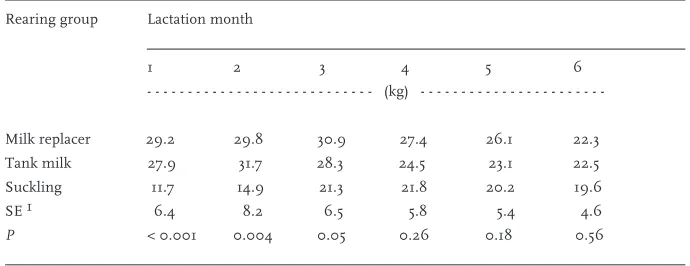
Because data on milk production and somatic cell counts (SCC) were incomplete for farm 3 and 4, only the results for farm 2 are presented. Although milk production in the first 3 months of lactation was significantly lower for cows suckling calves, there was no statistically significant difference in milk production between rearing groups from the fourth month onwards (Table 4). No statistically significant difference was found in SCC between the rearing groups up to 6 months post-partum. SCC levels for the three groups were always below the upper critical value of 400,000. The percentage of milk samples in which no bacteria were found was 63, 80 and 85% for farms 2, 3 and 4, respectively. The highest percentages of positive samples were found just after calving.
Animal diseases in suckling systems
[image:8.482.83.428.487.620.2]Diarrhoea, an important cause of mortality in conventional calf rearing, was found to be a less frequent problem in suckling systems. Farmers observed that suckling calves sometimes drank too much milk, which resulted in a type of diarrhoea that differed from the one farmers observed in bucket-fed calves. According to the farmers most calves learned quickly and stopped consuming too much milk. In the cases where diar-rhoea was a problem, farmers did not observe that calves dirtied their backsides, as is known for diarrhoea of traditionally bucket-fed calves. These cases were spotted relatively late. However, even in these cases diarrhoea did not lead to mortality. During the limited period of observation, suckling calves that grazed together with their mothers or nurse cows showed no signs of problems with intestinal worms. During the research period one out of the four farms tested positive for paratuberculosis. At some point during the research, cross-suckling heifers did occur on all farms, but not to an extent that this could be linked to the use of suckling systems. Initially farmers were worried that calves would run a risk of getting injured by cows lying down or butting on a slippery floor surface or on slatted floors. However, this never happened.
Table 4. Average daily milk production during the first 6 months of lactation of the mother cows of the milk replacer, the tank milk, and the suckling rearing groups. Comparison using regression analysis (see chapter Materials and methods).
Rearing group Lactation month
1 2 3 4 5 6
- - - (kg) - - -
Milk replacer 29.2 29.8 30.9 27.4 26.1 22.3
Tank milk 27.9 31.7 28.3 24.5 23.1 22.5
Suckling 11.7 14.9 21.3 21.8 20.2 19.6
SE 1 6.4 8.2 6.5 5.8 5.4 4.6
P < 0.001 0.004 0.05 0.26 0.18 0.56
P < 0.001 0.004 0.05 0.26 0.18 0.56
P
Discussion and recommendations
Benefits of suckling systems
The results presented in this paper show that farmers could successfully implement suckling systems in calf rearing. The technical performance of the calves was satisfactory. The consumption of mothers’ milk resulted in high weaning weights at 3 months of age. No immediate animal health problems linked to suckling systems occurred. Moreover, suckling systems offered increased opportunities for natural behaviour (Table 2), with calf-cow bonding, natural sucking behaviour and care-taking behaviour being important elements. Housing with the milking herd made social contact possible between the young and adult animals. For farmers the first requirement of a calf rearing method is achieving optimal calf growth and development, resulting in healthy dairy heifers. Nauta (2006) found that the age at first calving was up to 1.7 months higher for organic Holstein heifers than for conventional heifers. This difference can be the result of individual farmers’ feeding regimes and management. However, results pre-sented in this study show that suckling systems can produce well developed heifers, which have the potential to calf down at the same age as traditionally reared heifers.
Disadvantages of suckling systems
Natural aspects can be introduced in animal husbandry systems, but true nature cannot be achieved. It was found that in a modern dairy operation the extent to which farmers can successfully create conditions to achieve a more natural environment for cows and calves is limited. Initially farmers identified single suckling as the best option to incre-ase ‘natural living’. However, single suckling also had negative implications. Stress around weaning was one of the most important ones. Because modern dairy cows produce large quantities of milk and milk consumption by calves is unrestricted, the result is high growth rates. Weaning is a moment at which calves are not only separa-ted from their mother, but also from their feed (milk) and from their housing environ-ment. Although farmers tried to adapt their suckling system in such a way that stress around weaning was avoided, they did not find a satisfactory solution. To some extent weaning stress is unavoidable: it is part of the suckling systems. For some farmers it is difficult to accept this and to step back from trying to control every aspect of their calf rearing system. Instead of single suckling, they switch to multiple suckling. Multiple suckling can be considered a compromise between increased ‘natural living’ and practical and economical implications. However, as calves are raised with nurse cows instead of their own mother, this compromise results in lower levels of ‘natural living’. Nursed calves had to be separated from their own mother and did not drink her milk. Calves were housed away from the herd in separate pens with three nurse cows and up to eight foster calves. Although weaning calves from a nurse cow was consid-ered easier, calves in a multiple suckling system still have to be weaned.
with a high SCC. A high SCC indicates an increased response of bodily functions to fight off pathogens. Some cows with a high SCC can be considered ‘ill’. So if the aim were to increase ‘natural living’ it would be wrong to allow cows with high SCC levels to nurse calves.
Animal health
Using suckling systems in calf rearing demands a different approach to animal health management. In addition to prevention and reduction of contamination, management should be aimed at improving disease resistance. While immunity, resilience and regeneration are key characteristics of organic production (Anon., 2005), traditional animal health management relies on prevention of contamination through individual housing and minimal contact between animals of different age groups. Contamination is inevitable when introducing a suckling system in calf rearing. However, farmers thought that suckling systems had advantages in terms of animal health. They expected that the initial growth and development combined with exposure of calves to a wider range of farm pathogens, would result in a better adaptation to the specific farm con-ditions and a better general resistance.
Theoretically, the risk of contracting a paratuberculosis infection is higher in suckling Theoretically, the risk of contracting a paratuberculosis infection is higher in suckling Theoretically, the risk of contracting a paratuberculosis infection is higher in suck systems. Contact with manure from infected animals is considered a bigger threat than milk. In order to eradicate paratuberculosis in the dairy and beef sector, Kalis (2004) stated the expectation that suckling practices will be banned altogether in the future. Despite the higher risk, the actual number of infected farms (36%) or animals (1.4%) in the Netherlands does not differ between organic and conventional farms (Kijlstra, 2005). In our study some animals on one of the farms were tested positive for paratuberculosis. So the farmer was discouraged from continuing to use suckling systems in calf rearing. He, however, indicated that according to his observations none of his animals showed signs of ill health or performance loss. Because of this he saw no reason to change his calf rearing method.
Mastitis is another important disease in suckling systems. Our study showed that there was no difference in SCC between suckled and non-suckled mothers. In theory suckling can have a curative effect on mastitis because frequent drinking keeps the udder empty. On the other hand, suckling might have a negative effect on mastitis because of cross-contamination. Moreover, frequent drinking can inhibit proper teat closure, which makes it easier for pathogens to enter. However, farmers in our study expected that exposure to a wider range of pathogens in early life would make dairy cows less susceptible to mastitis in later life. In this respect our research is inconclusive for the time being, but the 2007 evaluation of the milk production performance of the calves raised in the different rearing methods will provide useful information.
Public opinion
multi-functional farming (Van Der Ploeg & Renting, 2000). This results in farmers and consumers meeting each other more frequently at farm level. One practice consumers persistently find hard to understand is the separation of mother and calf immediately after birth (Wagenaar & Langhout, 2006). Because farmers realize that binding con-sumers to their farms is an important issue in convincing them to buy organically produced products at a higher price, some farmers are prepared to make the effort to implement an alternative calf rearing method. It is important to realize that the suckling systems described in this study only offered a few calves and their mothers a better life in terms of ‘natural living’. On an annual basis 25% of the calves born stay at the farm and 75% leave the farm within 14 days, often after being housed individually. However, housing requirements and loss of marketable milk make it unrealistic expecting farmers to offer all their calves a better life. Because consumers can be put off by small details it remains a point of attention to clearly explain them the difficulties farmers face when implementing suckling systems.
Future perspectives
Organic dairy farmers are aware of the fact that the current organic calf rearing practices do not substantially differ from conventional practices. Although suckling systems in calf rearing is a popular topic, so far few organic farmers have been prepared to adjust their traditional calf rearing practices. At present an estimated 40 out of 450 organic dairy farmers in the Netherlands apply some kind of suckling system. The reason why not more farmers switch to a suckling system might be that the introduction of suckling systems has many consequences for the dairy farm operation. Although individual experiences are positive, the introduction of suckling systems might not be the most suitable means for the majority of organic dairy farmers to enhance ‘natural living’. Organic farmers are said to value a more natural (and thus less controlled) environment. However, in the case of increasing ‘natural living’ through implementation of a suckling system, farmers should be encouraged to take enough time to step back from control and to give calf and cow a chance.
Conclusion
Acknowledgements
The funding by the Triodos Bank, the Province of North-Holland, and the Dutch Ministry of Agriculture, Nature and Food quality, and the financial participation in the Integrated Project QUALITYLOWINPUTFOOD, FP6-FOOD-CT-2003- 506358 by the European Community under the Sixth Framework Programme for Research, Technological Development and Demonstration Activities are gratefully acknowledged.
Disclaimer
The views expressed in this publication are the sole responsibility of the authors and do not necessarily reflect the views of the European Commission.
References
Anonymous, 2005. The IFOAM Norms for Organic Production and Processing, version 2005. International Federation of Organic Agriculture Movements (IFOAM), Bonn, 132 pp. Jaspar, J. & D.M. Weary, 2002. Effects of ad libitum milk intake on dairy calves. Journal of Dairy
Science 85: 3054–3058.
Kijlstra, A., 2005. No difference in paratuberculosis seroprevalence between organic and conventional dairy herds in the Netherlands. In: M. Hovi, J. Zastawny & S. Padel (Eds), Enhancing Animal Health Security and Food Safety in Organic Livestock Production. Proceedings of the 3rd SAFO Workshop, 16–18 September 2004, Falenty. University of Reading, Reading, pp. 51–56. Kalis, C.H.J., 2003. Diagnosis and control of paratuberculosis in dairy herds. PhD thesis Utrecht
University, Utrecht, 170 pp.
Lund, V., 2006. Animal welfare and ethics in organic agriculture. In: P. Kristiansen, A. Taji & J. Reganold (Eds), Organic Agriculture, a Global Perspective. CSIRO Publishing, Collingwood, pp. 187–196. Martin, P. & P. Bateson, 1986. Measuring Behaviour, an Introduction Guide (2nd edition). Cambridge
University Press, Cambridge, 222 pp.
Nauta, W.J., T. Baars & H. Bovenhuis, 2006. Converting to organic dairy farming: consequences for produc-tion, somatic cell score and calving interval of first parity Holstein cows. Livestock ScienceLivestock ScienceLivestock Science 99: 99: 185–195. Rymer, C., M. Vaarst & S. Padel, 2006. Future Perspectives for Animal Health on Organic Farms: Main
Findings, Conclusions and Recommendations from SAFO Network. Proceedings of the 5th SAFO workshop, 1 June 2006, Odense, 145 pp.
Vaarst, M., M.B. Jensen & A.-M. Sandager, 2001. Behaviour of calves at introduction to nurse cows after the colostrums period. Applied Animal Behaviour Science 73: 27–33.
Van Der Ploeg, J.D. & H. Renting, 2000. Impact and potential: a comparative review of European rural development practices. Sociologia Ruralis 40: 529–543.
Wagenaar, J.P. & J. Langhout, 2006. The potential of suckling systems in calf rearing in Dutch organic dairy farming, practical implementation and liveweight development. In: Proceedings 1st IFOAM Conference on Animals in Organic Production, 23–25 August 2006, St. Paul, Minnesota. International Federation of Organic Agriculture Movements (IFOAM), Bonn, pp. 64–71. Weary, D.M. & B. Chua, 2000. Effects of early separation on the diary cow and calf. 1. Separation at 6 h,