Inductance and Current Distribution
Analysis of a Prototype HTS Cable
Jiahui Zhu1,2, Zhenyu Zhang2, Huiming Zhang2, Min Zhang2,3, Ming Qiu1, and Weijia Yuan2,4
1 China Electric Power Research Institute, China, 2 Department of Electronic and Electrical Engineering, the University of Bath, UK,
3 Department of Engineering, the University of Cambridge, UK
4Corresponding author: E-mail: [email protected]
This project is partly supported by NSFC Grant 51207146, RAEng Research Exchange scheme of UK and EPSRC EP/K01496X/1.
Abstract: Superconducting cable is an emerging technology for electricity power transmission. Since the high power capacity HTS transmission cables are manufactured using a multi-layer conductor structure, the current distribution among the multilayer structure would be non-uniform without proper optimization and hence lead to large transmission losses. Therefore a novel optimization method has been developed to achieve evenly distributed current among different layers considering the HTS cable structure parameters: radius, pitch angle and winding direction which determine the self and mutual inductance. A prototype HTS cable has been built using BSCCO tape and tested to validate the design the optimal design method. A superconductor characterization system has been developed using the Labview and NI data acquisition system. It can be used to measure the AC loss and current distribution of short HTS cables.
Key words: BSCCO, HTS cable, current distribution, structure parameters, self and mutual inductance, optimal design (Some figures in this article are in colour in the electronic version)
I. Introduction
High temperature superconducting (HTS) cables are an emerging and attractive technology for modern power grid transmission due to the rapid decline in available underground space for conventional cable and higher power quality requirements of a growing digital economy nowadays, which encourages utilities to seek for HTS cables as an alternative solution.
An important factor in the design of the HTS cable is the AC loss reduction. Since the high power capacity HTS transmission cables are manufactured in the structure of multi-layer conductors for a large current-carrying capability, the current distribution among the multilayer structure is non-uniform without proper optimization design. The AC loss will be increased if the current is not evenly distributed among the HTS conducting layers. Because of the resistance of the HTS conductors is negligible, the current distribution is dominated by the inductance of each conducting layer. For this reason, the self and mutual inductance of HTS cable are investigated in terms of the cable structural parameters: radius, pitch angle and winding direction.
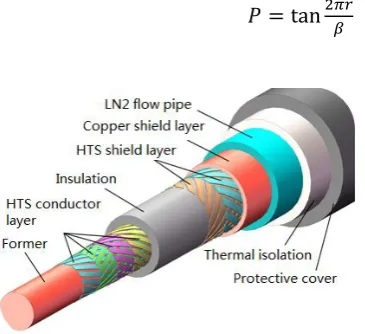
In this paper, a 1 m long, 110 kV/3 kA cold dielectric (CD) HTS cable given in figure 1 has been proposed and mathematically investigated the inductance varying with the radius, pitch angle and winding direction. An optimized short prototype HTS cable has been constructed and current distribution has been tested using Rogowski coils.
II. Inductance calculation method of HTS cable
The structure of the prototype CD HTS cable is consisted of copper former, four HTS conductor layers, electrical dielectric layer and two HTS shielding layers, as shown in the figure 1. Each conductor layer of CD HTS cable is helically wound around on the copper former. Figure 2 gives a schematic diagram of one CD HTS conductor layer in where r is the radius of conductor layer, P is the winding pitch for a single HTS tape, β is the pitch angle of HTS tapes, and w is the width of the HTS tape. From the schematic, it can be seen that the relationship of the winding angle and winding pitch is shown in (1):
[image:2.595.112.295.229.396.2](1)
[image:2.595.107.506.229.425.2]Figure 1. The configuration of CD HTS cable
Figure 2. Schematic diagram of CD HTS cable conductor layer
This kind of structure will cause the inductive characteristics for HTS cable varying with cable geometry. The resistance of each HTS conductor layer can be ignored at operating temperature (77 K for YBCO tapes), and the contact resistance in series with each HTS layer is also ignored in the analysis, hence the inductance of each layer can be considered to be the key factor for determining the HTS cable current distribution.
Each HTS conductor layer has a self-inductance as well as a mutual inductance for multi-layer HTS cable. The formulas of self and mutual inductance can be derived in terms of the Ampere‟s law and enclosed magnetic field energy, which has been published by Olsen[1]. The self-inductance is given by (2)
( ) (2)
mutual inductance is given by (3)
( ) (3)
Where: is the self-inductance of the layer (H/m); is the mutual inductance between layer i and
layer j (H/m); is the permeability of free space (4π× T-m/A); is the radius of conductor layer; is the pitch angle of conductor layer; D is the radius of the shielding layer; i, j is layer number, i, j = 1, 2, 3, 4,
and a current sheet is assumed. It can be seen that the inductance characteristics are only varied with radius, pitch angle and winding direction.
III. The inductance varying analysis of the HTS cable
A. Radius
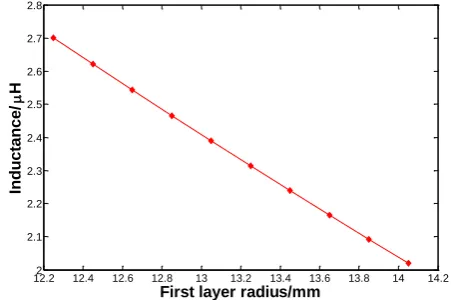
[image:3.595.297.523.288.438.2]For safety reason, the radius of the former can be varied from Rf to 1.2 Rf, and the radii of the other HTS layers are adjusted accordingly. The minimum radius of former is initially set to be 12.25 mm. With an increment step of 0.2 mm, the maximum radius of former is 14.05 mm. The inductance variation of each HTS layer and total inductance of the HTS cable in terms of radius is shown in the figure 3 and figure 4, respectively.
The results show that the self and mutual inductance of each HTS layer are decreasing when the cable radius increases. The total inductance of the HTS cable is linearly decreasing with the cable radius increasing.
Figure 3. Self and mutual inductance varying
with HTS layer radius Figure 4.radius Total inductance of HTS cable varying with
B. Pitch angle
The pitch angle of every HTS layer is initially set to be 270 while the maximum pitch angle is 810 with an increment step of 60 applied to every layer accordingly, so as to investigate the inductance variation in terms of pitch angle at fixed radius and winding direction. Figure 5 gives the result of the inductance of first HTS layer varying with pitch angle. It can be showed that the self and mutual inductances of each HTS layer is increasing with increased pitch angle (The negative mutual inductances are due to the opposite winding direction between the two relevant layers, which results into a negative current component induced in the first layer). The remaining layers have the similar results. Figure 6 shows that the total inductance of HTS cable is increased as approximately quadratic function varied with pitch angle.
C. Winding direction
Table 1 shows the 12 groups of winding direction combination for each HTS layer of the cable („+1‟ means clock-wise direction and „-1‟ means anticlockwise direction). The equation (3) shows that only the mutual inductance varies with different winding directions.
To minimize the cable axial flux, the total HTS layer number should be even and the sum of the winding direction coefficient should be equal to zero. The total cable inductance varying with winding direction shows that adjacent layers with opposite winding directions can minimize the mutual inductance, as shown in the figure 7.
IV. The current distribution optimization for HTS cable
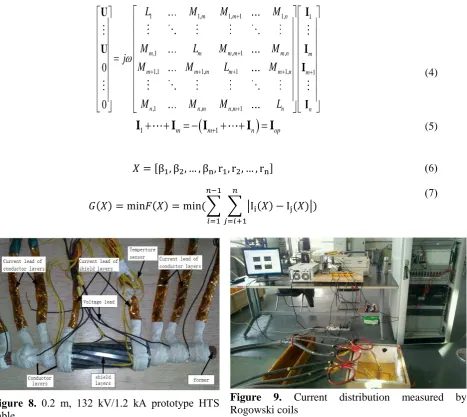
The current distributions in each superconducting layer are calculated. Based on the equivalent circuit [2] of HTS cable in figure 1, the mathematical matrix model of the CD HTS cable is
1 2
3 4
5 6
1 2 3 4 5 6 -0.05 0 0.05 0.1 0.15 0.2
Layer number / n Layer number / n
S
e
lf
a
n
d
m
u
tu
a
l
in
d
u
c
ta
n
c
e
/
H
-0.02 0 0.02 0.04 0.06 0.08 0.1 0.12 0.14 0.16 0.18
12.22 12.4 12.6 12.8 13 13.2 13.4 13.6 13.8 14 14.2
2.1 2.2 2.3 2.4 2.5 2.6 2.7 2.8
First layer radius/mm
In
d
u
c
ta
n
c
e
/
H
[image:3.595.61.268.290.435.2]Figure 5. Self and mutual inductance varying with first HTS layer pitch angle
[image:4.595.317.522.120.262.2]Figure 6. Total inductance of HTS cable varying with pitch angle
Table 1. Winding direction of CD HTS cable
Layer no.
Group no. 1 2 3 4 5 6 1 1 1 -1 -1 1 -1 2 1 1 -1 -1 -1 1 3 -1 -1 1 1 1 -1 4 -1 -1 1 1 -1 1 5 1 -1 1 -1 1 -1 6 1 -1 1 -1 -1 1 7 -1 1 -1 1 1 -1 8 -1 1 -1 1 -1 1 9 1 -1 -1 1 1 -1 10 1 -1 -1 1 -1 1 11 -1 1 1 -1 1 -1
12 -1 1 1 -1 -1 1 Figure 7. Total inductance of HTS cable varying with
winding direction
established in (4)and (5). Where ω is angular frequency, Iop is the RMS values of the total operation
current and U is the voltage drop across each conductor layer.
The current distribution can be optimized by taking pitch angle and radius as variables to obtain a minimum objective function[3]. The designed variables are presented in (6). The objective function for minimization is presented by (7), which represents the current difference in different conductor layers, where: X is a vector containing the pitch angles β and radii r of each HTS conductor layer, n is the number of total layers, i,j=1,2,…n, G(X) is the objective function. Detail of the optimized algorithm can be found in [3].
V. Experimental test of current distribution of CD HTS cable
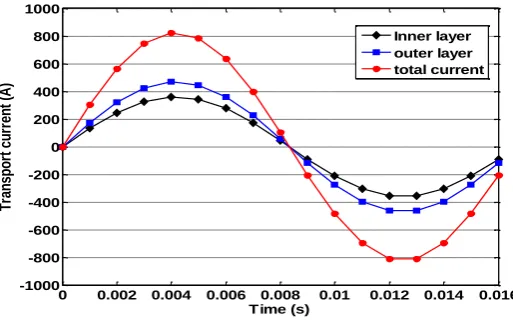
A 0.2 m, 132 kV/1.2 kA prototype HTS two-layer cable has been optimally designed for each of its HTS layer to carry the same transport current, as shown in figure 8. The cable is composed of two BSCCO HTS conducting layers wrapped around a copper former with 9 mm in radius. The pitch angle for each layer is 200 and 110, respectively. The current of each HTS layer can be measured by Rogowski coils wrapped around the copper current leads connected with each HTS layer, shown in the figure 9. The data are recorded by a high accuracy NI acquisition and Labview system. The measurement result is presented in figure 10. [4]
1 2 3 4 5 6
-4 -3 -2 -1 0 1 2 3 4 5 Layer number/n S e lf a n d m u tu a l in d u c ta n c e / H
=27o
=33o
=39o
=45o
=51o
=57o
=63o
=69o
=75o
=81o
30 40 50 60 70 80
2.7 2.8 2.9 3 3.1 3.2 3.3 3.4 3.5 3.6 3.7
Pitch angle / o
In d u c ta n c e / H
0 2 4 6 8 10 12
2.696 2.6965 2.697 2.6975 2.698 2.6985 2.699 2.6995 2.7 2.7005 2.701 group no. In d u c ta n c e / H
[image:4.595.311.538.340.498.2] [image:4.595.37.296.344.523.2]1 1, 1, 1 1, 1
,1 , 1 ,
1,1 1, 1 1, 1
,1 , , 1
0
0
m m n
m m m m m n m
m m m m m n m
n n m n m n n
L
M
M
M
M
L
M
M
j
M
M
L
M
M
M
M
L
I
U
I
U
I
Ι
(4)
1
m m1
n
opI
I
I
I
I
(5)[ ] (6)
∑ ∑ | |
(7)
Figure 8. 0.2 m, 132 kV/1.2 kA prototype HTS cable
Figure 9. Current distribution measured by Rogowski coils
The testing current of each layer is not exactly evenly distributed partly due to the inaccurately controlled pitch angle during the cable constructing process, and the optimizing procedure also introduce errors. The optimized algorithm is based on the self and mutual inductance formulas which the gaps between filaments of each layer is ignored in the inductance calculation.
The contact resistance between the copper current leads and HTS layers is comparable to the inductance of HTS layers in the real constructed cable, hence the contact resistance also causes current distribution unequally.
VI. Conclusions
The self and mutual inductances of multi-layer HTS cables have been investigated in terms of the radii, pitch angles and winding directions of each HTS layer and inductance variation is summarized. It is found that the geometry of the cable is not fully considered regarding to the gaps between filaments, which will introduce errors for accurately optimizing current distribution. Hence, this method can be only used in the approximate current distribution analysis.
[image:5.595.68.536.111.528.2]between the copper current leads and HTS layers.
Figure 10. Current distribution testing results of HTS cable at 60 Hz
References
[1] S. Kriiger Olsen, C. Trieholt, A. Kiihle, 0. Tsnnesen,“Loss and Inductance Investigations in a 4-layer Superconducting Prototype Cable Conductor,” IEEE Trans. Appl. Supercond., vol.9, no.2, pp 833-836, 1999 [2] Zhixuan Wang, et. al., “Design of CD HTS power cable,” International Conference on Trans. Appl.
Supercond. And Electromagnetic Devices. 2009:64-67
[3] Jiahui Zhu, Xuzheng Bao, Lijie Guo, Zhanjun Xia, Ming Qiu, and Weijia Yuan, “Optimal Design of Current Sharing in Transmission Conductors of a 110 kV/3 kA Cold Dielectric Superconducting Cable Consisted of YBCO Tapes,” IEEE Trans. Appl. Supercond., vol.23, no.3, p 5402505, 2013
[4] Jiahui Zhu, Zhenyu Zhang, Huiming Zhang, Min Zhang, Ming Qiu, and Weijia Yuan, “Electric Measurement of the Critical Current, AC Loss, and Current Distribution of a Prototype HTS Cable,” IEEE Trans. Appl. Supercond., VOL. 24, NO. 3, June 2014
0 0.002 0.004 0.006 0.008 0.01 0.012 0.014 0.016
-1000 -800 -600 -400 -200 0 200 400 600 800 1000
Time (s)
T
ra
n
sp
o
rt
c
u
rr
en
t
(A
)
Inner layer outer layer total current
[image:6.595.155.412.159.319.2]