Second Locus
of Bacteriophage P22 Necessary for
the
Maintenance
of
Lysogeny
MICHAEL GOUGH'
DepartmentofHumanGenetics, University of Michigan Medical School,
Aimiz
Arbor, Michigan 48104 Received for publication 19 June 1968A temperature-sensitive allele of a locus of phage P22, known to be involved in
establishmentoflysogeny, has been isolated. This mutant, P22 ts mnt, forms stable
lysogensat 30Cwhich are induced by heating to 43 C. This shows that this locus is involved in the maintenance of lysogeny. The ts mnt locus is about 18
recom-binationunits away fromthe c region. The wild allele, mnt+, is dominant over mnt
and isresponsible for a cytoplasmically diffusible product.
Thefunctioning of the C2 locus ofphage P22
is
required
forthe maintenance oflysogeny (4,
5,9). Zinder (12) described another mutant, P22
Vl, whichis unable to form a stablelysogenwhen
it infects Salmonella typhimurium. As one
ex-planation for the behaviorofP22v,,hesuggested
that itmight be able to initiatelysogeny butlack
theabilitytomaintain it.
A temperature-sensitive (ts) allele of the v,
locushas been isolated. This mutant forms stable
lysogensat temperatures below 30 C, but
eleva-tion of thetemperatureto43 C causes prophage
induction.Therefore,the function ofthe v1locus,
as well as the C2 locus, is required to maintain
lysogeny. Because of its properties and the
ac-cepted use of "v" todesignate virulent mutants, I have renamed the vt locus mnt. Experiments
which show that mnt+ is dominant over mntand
that mnt+ is not repressed byan active c2 locus
in the prophage aredescribed. The tsmntlocus
has beenmapped nearthem3region ofthe P22
chromosome.
MATERIALS AND METHODS
Media. Liquid cultures were grown in M9-CAA medium(9) andplatingsweredoneonindicator agar (1,4) and tryptone agar. All dilutionswere made in bufferedsaline(9). Someexperimentswerescoredon
EMB, (Difco) galactose-agar byusing a lawn ofS.
typhimuriumLT 2Gal7 bacteria. Theseplatingsallow
the determination of infective centers and lysogenic
and sensitive colonies on the same plate (4). The
numberofmaturephagewas determined bydiluting
samplesinto buffered salinecontainingCHCl3before
plating.
Phagestrains. Wild-typeP22, P22c2, P22m3,P22
m3clh2l (4), and P22int [called "P22L" (8, 10)]have
been described. The P22 mnt used as a reference is the
original P22 vi of Zinder (12). The mapping of the
conditional-lethal locits 1.1,and ts 11.1 has been de-scribed (2).
Bacterial strains. ThestrainofS.typhimuriumLT 2 usedin theseexperimentsiswild-typeLT 2 curedof a
defectiveprophage [strain SAl (12)]. A Gal-strain
of LT 2 (4) was usedasplatingbacteria.R.Nagaraja
Rao prepared a P22 ts mntlysogen of S. typhimurium F- pur E66 pro AB47 (6). The normal attachment
site (attIp22) for P22 is deleted inthis strainand the
P22 ts
muit
prophage is integrated at a secondaryattachment site
(att"p,22)
on the S. typhimurium chromosome. S.typhimuriumattttp22
(P22 ts mnt) was crossedwith S. typhimurium Hfr Su576 pur C7 str A attIp22 (P22m3c1h21)
(7) to isolate double lysogens. Purine prototrophs were selected and streaked ontryptone-agar plates which were overlaid with soft
agar containing sensitive bacteria. Recombinants
which were S. typhimurium
atttp22
(P22 m3clh2l)attIIp22 (P22 tsmnt) liberatedphagewhich produced both C and Mnt typeplaques.
Phage crosses. The method ofGough and Levine
(2) was usedforphagecrosses.
RESULTS
Isolation ofP22 ts mnt. H. 0. Smith isolated
40 P22 mntphages from a 5-bromodeoxyuridine
mutagenized phage stock. All 40 displayed the
"bullseye"
plaquemorphology typical
ofv,-type
mutants (12) at 37 C. One produced wild-type
plaques at 25 C. This mutant was designated
ts
mnt.
Different colony morphologies on indicator
agar arecharacteristicof clonesofbacteriawhich
harbor a
stably
orunstably integrated
prophage (10). Stable lysogens producefaster-growing
white colonies which may or may not be
tan-centered. Unstable lysogens produce
slower-992
IPresent address: Department of Microbiology,
Baylor University College of Medicine, Houston,
Tex.77025.
on November 11, 2019 by guest
http://jvi.asm.org/
growing green colonies, or colonies with dark
green areas. Bacteria infected with P22 mnt
yielded green colonies when incubated at any
temperature, whereas LT2
infected
with P22 tsmnt made green colonies at 42 C and white
colonies at 25 C. Thisobservation confirms that
P22 ts mnt makes a stable lysogen only at low
temperatures.
Toconfirm that mnt and ts mnt are in the same cistron,aseries of complementationtests wasrun.
Cellswereinfectedwith mixtures ofphageplated
onindicatoragar ateither 42or25C, andgreen
and white colonieswerescored. Mixed
infections
with P22 ts mnt and P22 wild type, P22 C2, or P22 intproduced white or tan-centered coloniesat both temperatures. Thesameresultswere
ob-tainedwhenP22 mnt wasusedinplace ofP22 ts
mnt. This shows that the mnt function can be
supplied by a mnt+ phage in a mixed infection.
An infection was made with a mixture of P22
mnt and P22 ts mnt and plated at 42 and 25 C.
At 25C, white colonies were obtained. At 25 C, P22 ts mnt supplied the function missing from
P22 mnt. At 42 C, on the other hand, green
colonies were observed. The inability ofP22 ts
mnt to
complement
P22mntat42 Cisconsistentwith thetwomutations
being
in thesamecistron.
Since theisolation
of the P22 ts mnt usedin
thisreport, two more mutants have been found.
They
display
the sameinduction kinetics reported for P22 ts mnt inthis paper, but have not beenfurtherstudied.
Mapping ofthe ts mnt locus. Zinder
(12)
re-portedthat mntmappedabout25unitsawayfrom
the c region of P22. H. 0. Smith (personal
com-munication) located mntnear
m3s.
Phages
carrying
tsmntandm3mutationswerecrossedwith phages
carrying
aconditional lethal ts marker. Lysates from crosses were plated at37 C ontryptone agar to select for
nontempera-ture-sensitive
phage.
Mnt andMnt+ plaques
can bedistinguished
on theseplates
(12). Thedis-tance between ts mnt and the conditional lethal
tsismeasuredasthe
fraction
ofTs+Mnt+
phageat 37 C on these
plates. Ts+
Mnt+plaques
were picked with needles onto indicator agar plates (1,4)
seeded with LT 2 to score M and M+plaque morphology markers. These three
factor
crosses ordered the mnt locus with respect to
three ts loci and
i3.
The four genes ts 1.1-ts11.1-m3-ts
9.1 arelinkedin the order shown inFig.
1(2).
Crosses werecarriedoutinduplicate (Table1).
Cross 1 established that ts mntisto the
right
ofts 11.1. Since mnt+ and
m±
showed more than80% linkage, mnt+ andm+ must haveremained
in parental linkage after the crossover event
between ts 11.1+ and ts mnt+. Two gene orders
'h21
FIG. 1. Linkage ofsome genetic markers ofphage P22.
are
compatible
with thisfinding:
ts 11.1-m f-tsmnt or ts 11.1-ts mnt-m3. In either case, the
conclusionis that the mntlocus istotheright of
ts 11.1.
Cross 2 showed that ts 1.1 is farther from ts
mnt thanis ts 11.1. Thets 1.1 locus isknownto
betotheleft ofts 11.1
(2)
and the orderts1.1-ts 11.1-1.1-ts mnt was established
by
these twocrosses.
Analysis
of thefrequency
ofrecombi-nation betweents mntandm3inthesetwocrosses
leadtotheconclusionthat ts mntis tothe right
of
M3-Ifm3is to the
right
of mnt, thenrecombinants
with ts+ mnt+ m3 genotype would be the result of two crossover events: one between the wild allele oftheconditionallethal tsgeneand
mnt+,
the other between mnt+ and m3. The
frequency
of crossovers in the first interval should have
noeffect onthe
frequency
ofcrossoversbetweents mnt and M3. The
frequency
of crossoversbetween ts mnt and m3 are different in crosses
1 and 2. These results were inconsistent with
the mnt locus
being
located to the left of m3.Ontheother
hand,
if thelinkage
isconditionallethalts-m3-mnt, both ts+
m3mnt+
andts+m+ mnt+ recombinants are the products ofsingle
crossover events. As the distance between the
conditional lethal tsmutationand tsmnt
length-ens, the frequencyofcrossovers
occurring
in them3-ts mnt interval compared to the total
be-tween the conditional lethal ts mutation and ts
mnt will decrease. The
frequency
of crossoversin the
m3g-ts
mntinterval in cross 1 wasgreaterthan that in 2. These data were consistent with
the orderts1.1-ts 11.1-m3--tsmnt.
A third conditional lethal marker ts 9.1 has
been mapped about 5 to 7 units to the
right
ofon November 11, 2019 by guest
http://jvi.asm.org/
[image:2.489.260.451.61.242.2]TABLE 1. Mapping oftsmnt
Ts'Mnt+a MMnt+
Crossno. Phagegenotypes recombinants/total recombinants/M
plaques Mnt+ + M+ Mnt+a
1 tS 11 X M3 ts mnt 162/2,595 (6.2)b 18/104 (17)b
77/965 (8.0)
11/71e
(16)2 ts 1 X m3 tsmit 150/1,038 (14.5) 10/104 (10)
277/2,058 (13.5) 14/156c (9)
3 ts9 X m3 ts mnt 68/4,505 (1.5) 0/23 (<4)
131/4,118 (3.1) 5/132 (4)
aNontemperature-sensitive (Ts+), wild-type plaques (Mnt+) were picked from platings at 37 C on
tryptone-agar.Thesewerestabbed intoindicator agar to score M and M+ phenotypes. bNumbers in parentheses indicate percentages.
cTheprobabilitythat thedifferencebetween 29/175 and 24/260 is due to chance is <0.05.
m3 (unpublishedresults). Cross 3 showed that ts 10
9.1 is to the right of ts mnt. The ts+ mnt+
re-combinants are primarily m+. Because m+ and
mnt+ entered the cross in parental linkage and 5
this linkage was preserved after the crossover
between ts 9.1 and ts mnt, itwas concluded that , , 0
the m3 and ts mnt
linkage
was notdisrupted by
2the crossover between ts mnt+ and ts 9.1+.
Since the
frequency
of crossovers between ts Amnt and ts 9.1 is
only
about 2%, if m3 werebe-tween those markers it should segregate as a
middlemarker and appear in recombinationwith ts mnt much more frequently than it does. This .5
observation reinforces the conclusion that ts E
mntis totheright ofM3.'
Figure 1 shows the location of ts mnt with >
respect to some other markers ofP22.
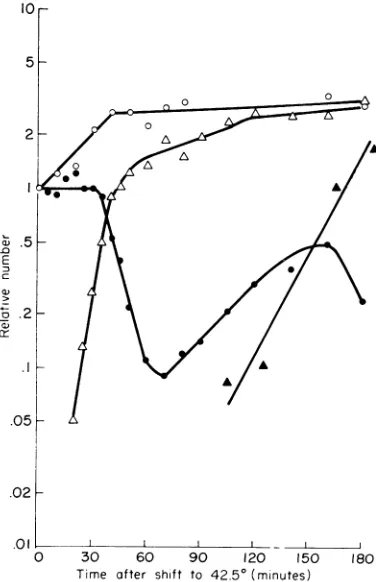
Temperature induction ofLT2 (P22 ts mnt).
The kinetics of thermal induction of LT 2 (P22 .1
ts mnt) are shown in
Fig.
2. LT 2(P22
ts mnt)wasgrown at30 C toabout2 x
108/ml,
treatedwith anti-P22 serum, and diluted into 43 C .05
-medium containing anti-P22 serum (K = 2).
Samples were taken at the indicated times to
determine
colony-formers
and infective centers.r02
The number ofmature
phage particles
wasde-termined in samples from 43 C medium which
contained no antiserum. For determination of .oi
cellnumber, 8 mlofthe 30 Cculturewasdiluted 0 30 60 90 120 150 180
into 8 ml of 56C M9-CAA and put at 43C. Time after shift to
42.50
(minutes)At the indicated
times,
0.5 ml ofculturewasre-moved, added to 1.0 ml of buffered saline con- FIG. 2. Thermal induction of prophage P22ts
mit.
taining 0.01MNaCN, and subsequently counted LT2 (P22 ts mnt) was grown in M9-CAA at 30 C,
withaphasemicroscope. treated with P22-antiserum and diluted into 43 C
me-The numberofcolony-formingunits remained dium. At the indicated times, samples wereplated to
more orlessconstant for about 30 min, then fell determine infective centers
(A)
and colony-formersprecipitously,
at which time the number of in-(@).
Other
samples were dilutedintobuffered
saline fective centers began to increase. The loss of containingCN-
and cells were counted with a phasefclny-formingers
itsgand
theincrea.cverioss
of
microscope (0). Mature phage particles were counted colony-forming units and their conversion to by diluting samples from 43 C medium containing noinfective centers showed that prophage P22 ts antiserum intobufferedsaline containingChCI3,waiting
mntisinducedbythehightemperature. 5min, andplating on indicator bacteria (A).
on November 11, 2019 by guest
http://jvi.asm.org/
[image:3.489.257.445.234.525.2]By120 min,thenumberof infectivecenters was
three times the number of colony-formers at
time-zero. Although there was no threefold
in-crease in colony-formers, microscopic counts
show that the number ofcells in the culture did
increase threefold.Theincreasein cellnumberwas
sufficient to account for the threefold excess of infective centers at 120 min, compared to
colony-formersattime-zero.
The latent period for the induction of P22 ts
mnt, estimated as the time between the
ap-pearance ofinfective centers andmature phage,
wasabout 90 min. Although dataarenotshown
in Fig. 2, the yield of infectious phage particles
was about one per infective center. This small yield is consistent with the report of Israel (3)
thattheyield of infectious
particles
of P22 from inductionofprophage at temperaturehigherthan40 C is less than 1 phage per infective center.
Israel (3) found that the reduced yield of in-fective particles was due to the failure of P22 to produce a sufficient number of tails at high
temperature.
The secondary increase in
colony-formers,
which begins at around 70 to 80 min and
con-tinuestoabout 120to150
min,
hasbeenobserved in all thermal inductions ofprophage
P22 tsmnt. When LT 2
(P22
tsmnt)
was held at 43Cfor 360 min, no other "rounds" of increase of
colony-formers was observed.
However,
the number ofcolony-formers
remained constant atabout0.1 of thatseen attime-zero. In another ex-periment, after 18 hr at 42
C,
the number of colony-formers was still 0.14. Acolony
was picked from platings made at 80 min, 150 min,and 18 hr after a shift from 30 to 43C. Each
colony was grownat 30 C and induced
by
shift-ing to 43 C. All were induced with the same
kinetics
shown inFig.
2.Temperature induction
of prophage
P22 ts mntwhen in thesecondary P22attachmentsite
(att4 22).
Thenormalattachment site for
prophage
P22onthe S.
typhimurium
chromosome is between proAandpro C
(8).
At least onesecondary
attach-mentsite existsonthe LT 2 chromosome (R. N. Rao,
personal
communication).
A strain of LT2 with
prophage
P22 ts mntpresentat the
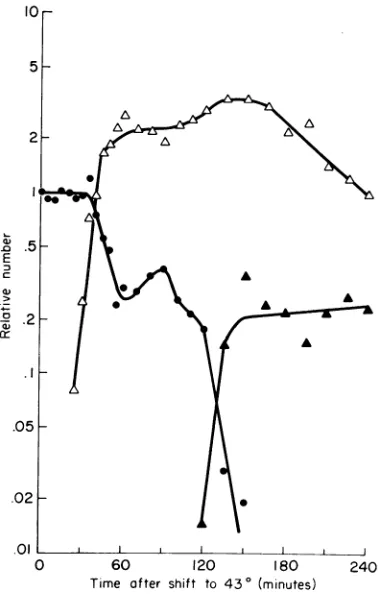
secondary
sitewas grown at 30Cthenshifted to43C. The induction of
prophage
P22 ts mnt at the
secondary
site(Fig. 3)
wassimilartothat seenwhen P22tsmntwaspresent at the
primary
site(Fig. 2).
The number ofcolony-formers
remained almost constant for20to 30min,thenfell
rapidly.
At thesametime,
thenumber of infectivecenters
began
toincreaseand reachedanumber
equal
totwo orthreetimes thecolony-formers
present at time-zero. InL.5
E
a=
L .2 c
.
.05
.02
.01
0 60 120 180
Time after shift to 430 (minutes)
[image:4.489.257.446.66.364.2]240
FIG. 3. Thermal induction of prophage P22 ts mnt present at a secondary attachment site on the LT 2 chromosome. The
experimenit
was run as described for Fig. 1.Symbols: infective centers,(A);colony-formers,(@);
maturephage,
(A).
these respects, the induction was the same as
thatshown inFig. 2.
There was a striking difference between
in-ductions at the two sites, however. At 180 min,
in the experiment shown in Fig. 3, there were
fewer than 0.01 of the colony-formers present at
time-zero. Such extensive loss of colony-formers
has not been observed in any thermalinduction
ofS. typhimurium
attfI22
(P22 ts mnt).Although there are differences between
in-duction of
prophage
P22 ts mnt at the primary and secondary attachment sites, a temperatureshift causesinduction ateither site. Therefore, a
double lysogen is suitable to test whether mnt+
or ts mnt is dominant at high temperature.
Dominanceofmnt+ over ts mnt at high
tempera-ture. The doubly lysogenic strain LT 2
attIP22
(P22
m3c,h2j)
attPg22
(P22 ts mnt) was prepared bycrossing an Hfr attI22 (P22
m3c1h2l)
with anF-attIP22
(P22tsmnt).The two parental strains and the double
lysogen weregrown at 30 C then shifted to 43 C.
995
on November 11, 2019 by guest
http://jvi.asm.org/
Because the parental strainsrequired purines for
growth, thedouble lysogen was grown in medium
withandwithout additionofadenosine. (Fig. 4).
As expected, LT 2
attP22
(P22 ts mnt) wasin-duced by high temperature and the number of
colony-formers decreased while infective centers
wereproduced. Thesingly lysogenic strain LT 2
attp22 (P22
m3clh2l)
grows exponentially andno infective centers are produced. The doubly lysogenic strain containing a ts mnt and a mnt+prophage also grew exponentially in either the
presence orabsence ofpurines andproduced no
infective centers (<0.01 of time-zero colony formers). The presence ofone mnt+ allele inthe
double lysogenwas sufficient toprevent thermal
induction.Therefore,mnt+is dominant.
DISCUSSION
Shifting a culture of S. typhimurium (P22 ts mnt) from 30 to 43 C results in induction of the
prophage. This demonstrates that the mntlocus
isinvolved in the maintenance oflysogeny.
There are twogeneralmodels fortheinduction
of prophage P22 ts mnt at high temperature.
Either the higher temperature (i) causes the ts
mnt tosynthesize a "new"
product
which resultsin induction, or (ii) heat stops the synthesis or functioning ofaproductnormallyprovided bythe
mntlocus. Model2fitsthe results found whena
double
lysogen
is heated(Fig. 4). Heating
P22ts mnt normally results in induction, but the
presence of a mnt+ gene inanother prophage in
the same cell prevents such induction. The
ob-servation that the product from the mnt+ locus
prevents induction of either prophage shows
that it is diffusible and works as a
cytoplasmic
agent. The conclusion that themnt+ cistron
pro-duces a cytoplasmic agent which is necessary for
the maintenance oflysogenyis the basis for the
following discussion of the thermal induction of
prophage P22tsmnt.
After shifting LT 2 (P22 ts mnt) from 30 to
43C, the cell number increases threefold in
about 40 min.Eventhoughcell numberincreases,
not all cells are competent to form colonies, as
shownbyan increasein colony-formers of <1.3
in the same time. I define the loss of ability to
formacolonyas akillingevent.
Three assumptions canbe used to construct a
model for the first 60minafter theshift of LT2
(P22 ts mnt) from 30 to 43 C. (i) There is an
excess of mnt product in lysogenic cells at the
time of the shift. (ii) Synthesis of mnt product
stops immediately at 43 C. (iii) Reduction of the
amount ofmnt product in a cell belowa critical
level resultsin celldeath.
E .5 \
.2
.05
.02
.01 l
0 30 60 90 120
[image:5.489.256.444.56.360.2]Time after shift to 42.50(minutes)
FIG. 4. Failure ofa temperature shift to induce a double lysogen2 LT 2 attIp22 (P22
m3c1h2i)
attlIp22(P22tsmmzt). The experimentwas runasdescribed for
Fig. 1. Symbols: colony formers, LT 2 att'P22 (P22
m3clh2l), 0,LT 2attIp22 (P22m3clh2l) attIIp22 (P22ts
mnt)growniinthe presence, V andinthe absence (Z)
of purine; LT 2 attIIp22 (P22 ts mnt), *; infective
centtersfrom LT 2attIp22(P22tsmnt),A.
When the culture is shifted, synthesis ofmnt
product stops and the preexisting mnt product
segregates between the daughter cells of each
cell division. The distribution ofmnt product is such that, on the average, one daughter ofeach
pair is killed because of a lack ofmnt product.
During this time, the number of colony-formers
will remain constant. The viable cells go on to
divide again, but the amount ofmnt product is
now so reduced that neither daughter receives
enough mnt product to prevent killing. These
conjectures are consistent with the number of
colony-formers remaining constant for 30 min,
while cell number increases three times. By 30
min, the mnt product per cell is so reduced by
the threefold dilution that most cells are killed.
The above model saysnothing aboutinduction,
which is defined here as the production of an
on November 11, 2019 by guest
http://jvi.asm.org/
infective center. It is clear that the killingevent
and induction are temporally separated. The
removal of mnt+ function results in immediate
killing, but atrainofevents, setin motion by the
removal of mnt+ function, requires several
minutes to cause induction. The killing event is
irreversible by a shift to lowtemperature. Since many cells between 0 and 120 min produce
neithercoloniesnor infectivecenters, some
proc-ess necproc-essary for induction must be inhibited by
low temperature. If akilled cell isplated before
the induction is complete at high temperature,
the low temperature would stop the induction
and no infective center would be formed.
How-ever, the cell could not form a colony, since
killingis irreversible. Thismakes understandable
the failure torecover all cells as colony-formers
orinfectivecenters before 120 min.
After 60 min, the continued survival of lyso-genic colony-formers in a culture ofLT 2
attIP22
(P22 ts mnt) cannot be explained on the basis ofany product witha discretehalf-life. Because of the round of secondary growth between 70
and 120 min (Fig. 2), it seems likely that the
lysogeniccellsaredividing butnotall the
daugh-ters are viable. The residualcolony-formers could
be explained if 0.1 of the population at
time-zero had a
completely
stable mnt+ product and thiswas notsynthesized
atthehigh
temperature.However, a
colony-former
picked
froma plating18hrafter the shifttohightemperature, grown at
30C and shifted to 43C, displayed the same
induction kinetics asshown in Fig. 2. Thesame
number of
colony-formers (about
0.1)
sur-vived 360 min at 43C.
Therefore,
if 0.1 of thepopulation
has astable mnt+product,
not allof
theprogeny ofthese cells
produce
suchaproduct
andthe survivorsare not
genetically
determined.Any discussion of residual colony-formers is
complicated, because
essentially
no colony-formers ina culture of LT 2 attI 22(P22
ts mnt) surviveafter 180 minat43 C.The other gene of P22 known to be involved
in maintenance of
lysogeny,
C2, makes the P22repressor
(4,
5,9).
A thermal inducible allele ofC2, ts C2, has been isolated
(5).
When LT 2 (P22tsc2) is shiftedfrom 30 to43
C,
theprophage
isinduced.
Colony-formers
decrease and infectivecenters appear from time-zero. Induction is
essentially
complete
in 20min, when all colony-formersarelost andanumberofinfectivecenters equal to thenumber ofcolony-formers
attime-zero is observed
(Wing, Levine,
andSmith,
inpress and unpublished
results).
These kineticsare
quite
different from thoseobserved with P22 ts mnt. Removal ofC2 function orproduct
maybe a critical step in thermal induction of P22 ts mnt. Experiments are underway to investigate
this possibility.
Atleast five genes are involved in establishment
and maintenance of lysogeny by P22. The three
clear genes, Cl, C2, and c3 (4) are required to
establish lysogeny and C2 is also necessary to
maintain it. The int locus, called "L" (8, 10), is necessary for integration. I have shown a fifth gene mnt, known to be involved in establishment
of lysogeny (12), whichisalsonecessary to
main-tainlysogeny.The three c genes areclustered (4)
andint is near them(10) ontheP22chromosome.
However, mnt is some distance away from int
and at least one "late" gene, ts 9.1, which is the
structural gene for the P22 tail protein (Botstein
et al., unpublished results), is between int and
mnt.
It is nowknownthat atleast fourgenesofP22
areactivein the prophage state: the C2 repressor;
the geneal, whichis responsibleforanantigenic
change in the host (11, 13); sie, which excludes
superinfectingphages (R. N. Rao, in press); and mnt. It will be interesting to find out where sie
maps, and a careful study may reveal that these
three genes, al, sie, and mnt, whichare not under
the control of C2 repression, are clustered. An
intriguing possibilityis that these three genes are
of
hostorigin.
ACKNOWLEDGMENTS
IthankM.Levine,R. N.Rao, and H.0.Smith for
giftsofstrains, time, andadvice.
This studywassupportedby Public Health Service
grants GM 09252-05 and 5T01 GM 00071 from the
NationalInstituteof GeneralMedical Sciences.
LiTERATuRE CITED
1. Bresch, C. 1953. Genetical studies on
bacterio-phage Ti. Ann. Inst. Pasteur 84:157-163.
2. Gough,M., andM.Levine. 1968. Thecircularity
of thephageP22linkagemap.Genetics 58:161-169.
3. Israel,V. 1967. Theproduction ofinactive phage
P22particles following induction.Virology33:
317-322.
4. Levine, M. 1957. Mutations in the temperate
phageP22 andlysogenyin Salmonella.Virology
3:22-41.
5. Levine, M., and H. 0. Smith. 1964. Sequential gene action in the establishment of lysogeny.
Science 146:1581-1582.
6. Myake, T., andM. Demerec. 1960. Proline
mu-tants of Salmonella typhimurium. Genetics 45:755-762.
7. Sanderson, K. E., and M. Demerec. 1965. The
linkage map of Salmonella tvphimurium.
Genetics51:897-913.
on November 11, 2019 by guest
http://jvi.asm.org/
8. Smith,H.0.1968.Defectivephage formation by
lysogens of integration deficient phage P22 mutants.Virology34:203-223.
9. Smith,H.O., and M.Levine. 1964. Two
sequen-tialrepressionsof DNAsynthesis inthe
estab-lishmentoflysogeny by phageP22andits
mu-tants. Proc. Natl. Acad. Sci. U.S. 52:356-363.
10. Smith,H.O., and M. Levine. 1967. AphageP22
gene controlling integration of prophage.
Virology31:207-216.
11. Young, B. G., Y. Fukazawa, and P. E. Hartman. 1964. A P22bacteriophagemutantdefective in antigen conversion. Virology 23:279-283. 12. Zinder, N. D. 1958. Lysogenization and
superin-fection immunity in Salmonella. Virology 5: 291-326.
13. Zinder,N. D. 1959. Genetic interaction between
bacteriophage and bacteria, p. 43-53. In M.
Pollard (ed.), Perspectives in virology, John Wiley and Sons, Inc., New York.