
City, University of London Institutional Repository
Citation: Howe, J. M. and King, A. (2000). Implementing Groundness Analysis with Definite Boolean Functions. Lecture Notes in Computer Science, 1782, pp. 200-214.
This is the unspecified version of the paper.
This version of the publication may differ from the final published version.
Permanent repository link: http://openaccess.city.ac.uk/1698/
Link to published version:
Copyright and reuse: City Research Online aims to make research outputs of City, University of London available to a wider audience. Copyright and Moral Rights remain with the author(s) and/or copyright holders. URLs from City Research Online may be freely distributed and linked to.
City Research Online: http://openaccess.city.ac.uk/ [email protected]
Implementing Groundness Analysis with
Denite Boolean Functions
Jacob M. Howe and Andy King
Computing Laboratory, University of Kent, CT2 7NF, UK
fj.m.howe, [email protected]
Abstract. The domain of denite Boolean functions,Def, can be used
to express the groundness of, and trace grounding dependencies between, program variables in (constraint) logic programs. In this paper, previ-ously unexploited computational properties ofDef are utilised to develop an ecient and succinct groundness analyser that can be coded in Prolog. In particular, entailment checking is used to prevent unnecessary least upper bound calculations. It is also demonstrated that join can be dened in terms of other operations, thereby eliminating code and removing the need for preprocessing formulae to a normal form. This saves space and time. Furthermore, the join can be adapted to straightforwardly imple-ment the downward closure operator that arises in set sharing analyses. Experimental results indicate that the new Def implementation gives favourable results in comparison with BDD-based groundness analyses.
Keywords. Abstract interpretation, (constraint) logic programs,
de-nite Boolean functions, groundness analysis.
1 Introduction
Groundness analysis is an important theme of logic programming and abstract interpretation. Groundness analyses identify those program variables bound to terms that contain no variables (ground terms). Groundness information is typ-ically inferred by tracking dependencies among program variables. These depen-dencies are commonly expressed as Boolean functions. For example, the function
x^(y z) describes a state in whichx is denitely ground, and there exists a
any analysis that can be quickly prototyped in Prolog is particularly attractive. The main drawback of this approach has traditionally been performance.
The eciency of groundness analysis depends critically on the way dependen-cies are represented. C and Prolog based Def analysers have been constructed around two representations: (1) Armstrong et al [1] argue that Dual Blake Canon-ical Form (DBCF) is suitable for representing Def. This represents functions as conjunctions of denite (propositional) clauses [12] maintained in a normal (orthogonal) form that makes explicit transitive variable dependencies. For ex-ample, the function (x y)^(y z) is represented as (x (y_z))^(y z).
Garca de la Banda et al [16] adopt a similar representation. It simplies join and projection at the cost of computing and representing the (extra) transitive dependencies. Introducing redundant dependencies is best avoided since pro-gram clauses can (and sometimes do) contain large numbers of variables; the speed of analysis is often related to its memory usage. (2) King et al show how meet, join and projection can be implemented with quadratic operations based on a Sharing quotient [18]. Def functions are essentially represented as a set of models and widening is thus required to keep the size of the representation manageable. Widening trades precision for time and space. Ideally, however, it would be better to avoid widening by, say, using a more compact representation. This paper contributes to Def analysis by pointing out that Def has impor-tant (previously unexploited) computational properties that enable Def to be implemented eciently and coded straightforwardly in Prolog. Specically, the paper details:
{
how functions can be represented succinctly with non-ground formulae.{
how to compute the join of two formulae without preprocessing the formulae into orthogonal form [1].{
how entailment checking and Prolog machinery, such as dierence lists and delay declarations, can be used to obtain a Def analysis in which the most frequently used domain operations are very lightweight.{
that the speed of an analysis based on non-ground formulae can compare well against BDD-based Def and Pos analyses whose domain operations are coded in C [1]. In addition, even without widening, a non-ground formulae analyser can be signicantly faster than a Sharing-based Def analyser [18]. Finally, a useful spin-o of our work is a result that shows how the downward closure operator that arises in BDD-based set sharing analysis [10] can be plemented straightforwardly with standard BDD operations. This saves the im-plementor the task of coding another BDD operation in C.BDD analysers. Sections 6 and 7 describe the related and future work, and section 8 concludes.
2 Preliminaries
A Boolean function is a function f : Booln ! Bool where n 0. A Boolean
function can be represented by a propositional formula overX where jXj=n.
The set of propositional formulae overX is denoted by BoolX. Throughout this
paper, Boolean functions and propositional formulae are used interchangeably without worrying about the distinction [1]. The convention of identifying a truth assignment with the set of variables M that it maps to true is also followed. Specically, a map X(M) :}(X)!BoolXis introduced dened by: X(M) =
(^M)^(:_XnM). In addition, the formula^Y is often abbreviated asY.
Denition 1.
The (bijective) map modelX : BoolX !}(}(X)) is dened by:modelX(f) = fMX j X(M)j=fg.
Example 1. IfX=fx;yg, then the functionfhtrue;truei7!true,htrue;falsei7!
false,hfalse;truei7!false,hfalse;falsei7!falsegcan be represented by the
formulax^y. Also, modelX(x^y) =ffx;yggand modelX(x_y) =ffxg;fyg, fx;ygg.
The focus of this paper is on the use of sub-classes of BoolX in tracing
groundness dependencies. These sub-classes are dened below:
Denition 2.
PosX is the set of positive Boolean functions overX. A functionf is positive i X 2 modelX(f). DefX is the set of positive functions over
X that are denite. A function f is denite i M\M 0
2 modelX(f) for all
M;M0
2modelX(f).
Note that DefXPosX. One useful representational property of DefX is that
each f 2 DefX can be described as a conjunction of denite (propositional)
clauses, that is,f =^ni
=1(yi Yi) [12].
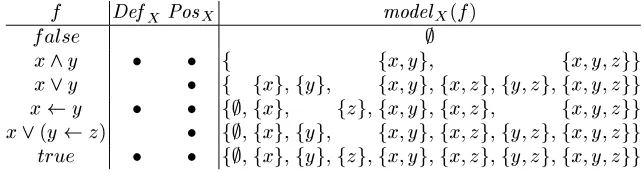
Example 2. SupposeX =fx;y;zgand consider the following table, which states,
for some Boolean functions, whether they are in DefX or PosX and also gives
modelX.
f DefX PosX modelX(f)
false ;
x^y f fx;yg; fx;y;zgg
x_y f fxg;fyg; fx;yg;fx;zg;fy;zg;fx;y;zgg
x y f;;fxg; fzg;fx;yg;fx;zg; fx;y;zgg
x_(y z) f;;fxg;fyg; fx;yg;fx;zg;fy;zg;fx;y;zgg
true f;;fxg;fyg;fzg;fx;yg;fx;zg;fy;zg;fx;y;zgg
Note, in particular, thatx_yis not in DefX (since its set of models is not closed
[image:4.612.146.468.549.635.2]Deffx;yg x^y c c
# # x
x$y y @
@
x y y x
# #
c c
Posfx;yg x^y c c
# # x
x$y y @
@ x y
x_y y x # # c c # # c c
Fig.1.Hasse diagrams
Deningf1_ _f
2=
^ff 2DefXjf 1
j=f^f 2
j=fg, the 4-tuplehDefX;j=;^;_i_ is
a nite lattice [1], wheretrueis the top element and^X is the bottom element.
Existential quantication is dened by Schroder's Elimination Principle, that is,
9x:f =f[x7!true]_f[x 7!false]. Note that if f 2DefX then9x:f 2DefX
[1].
Example 3. If X =fx;ygthenx__(x $y) = ^f(x y);trueg = (x y), as
can be seen in the Hasse diagram for dyadic DefX (Fig. 1). Note also thatx__y =^ftrueg=true6= (x_y).
The set of (free) variables in a syntactic object o is denoted var(o). Also,
9fy
1;:::;yn
g:f(project out) abbreviates9y 1:::::
9yn:fand9Y:f (project onto)
denotes 9var(f)nY:f. Let
1;2 be xed renamings such that X \
1(X) =
X\
2(X) =1(X) \
2(X) =
;. Renamings are bijective and therefore invertible.
The downward and upward closure operators # and " are dened by #f =
model 1
X (f\S j ; S modelX(f)g) and "f = model 1
X (f[S j ; S
modelX(f)g) respectively. Note that#f has the useful computational property
that #f = ^ff 0
2 DefXjf j= f 0
g iff 2 PosX. Finally, for any f 2 BoolX,
coneg(f) = model 1
X (fXnM jM2modelX(f)g).
Example 4. Note that coneg(x_y) = model 1 fx;yg(
ffxg;fyg;;g) and therefore "coneg(x_y) =true. Hence coneg("coneg(x_y)) =true=#x_y.
This is no coincidence asconeg("coneg(f)) =#f. Thereforeconeg and"can be
used to calculate#.
3 Join and downward closure
Calculating join in Def is not as straightforward as one would initially think, because of the problem of transitive dependencies. Suppose f1;f2
2 DefX so
that fi = ^Fi where Fi = fyi 1 Y
i
1;:::;yin
i Yini
g. One naive tactic to
computef1_ _f
2 might beF =
fy Y 1
j ^Y
2
k jy Y
1
j 2F
1
^y Y 2
k 2F
2 g.
Unfortunately, in general,^F 6j=f 1_
_f
2as is illustrated in the following example.
Example 5. Put F1 =
fx u;u yg and F 2 =
fx v;v yg so that
F =fx u^vg, butf 1_
_f
2= (x (u
^v))^(x y)6=^F. Note, however,
that if F1 =
fx u;u y;x yg and F 2 =
fx v;v y;x yg then
F =fx (u^v);x (u^y);x (v^y);x ygso thatf 1_
_f 2=
[image:5.612.201.423.100.192.2]The problem is thatFi must be explicit about transitive dependencies (this idea
is captured in the orthogonal form requirement of [1]). This, however, leads to redundancy in the formula which ideally should be avoided. (Formulae which not necessarily orthogonal will henceforth be referred to as non-orthogonal formulae.)
It is insightful to consider __as an operation on the models off
1andf2. Since
both modelX(fi) are closed under intersection, __ essentially needs to extend
modelX(f1)
[modelX(f
2) with new models M1 \M
2 where Mi
2 modelX(fi)
to computef1_ _f
2. The following denition expresses this observation and leads
to a new way of computing __in terms of meet, renaming and projection, that
does not require formulae to be rst put into orthogonal form.
Denition 3.
The map _g: BoolX 2!BoolX is dened by:f 1_ gf 2= 9Y:f 1 gf 2
whereY=var(f1) [var(f
2) andf1 gf
2=1(f1) ^
2(f2) ^^y
2Yy $(
1(y) ^
2(y)).
Note that _g operates on BoolX rather than DefX. This is required for the
downward closure operator. Lemma 1 expresses a key relationship between _g
and the models off1andf2.
Lemma 1.
Letf1;f22BoolX.M 2modelX(f 1_
gf
2) if and only if there exists
Mi2modelX(fi) such thatM =M 1
\M 2.
Proof. PutX0=X [
1(X) [
2(X).
Let M 2 modelX(f 1_
gf
2). There exists M M
0 X
0 such that M0 2
modelX0(f 1
gf
2). LetMi= 1
i (M0
\i(Y)). Observe thatM M 1
\M 2since
(1(y) ^
2(y)) y. Also observe thatM1 \M
2
Msincey ( 1(y)
^ 2(y)).
ThusMi2modelX(fi) andM=M 1
\M
2, as required.
LetMi2modelX(fi) and putM=M 1
\M
2andM 0=M
[ 1(M1)
[ 1(M2).
ObserveM0
2modelX 0(f
1 gf
2) so that M
2modelX(f 1_
gf 2).
From lemma 1 ows the following corollary and also the useful result that _g is
monotonic.
Corollary 1.
Letf 2PosX. Thenf =fg_f if and only iff 2DefX.Lemma 2.
g_ is monotonic, that is,f1_ gf
2 j=f
0 1_
gf 0
2wheneverfi j=f
0
i.
Proof. LetM2modelX(f 1_
gf
2). By lemma 1, there existMi
2modelX(fi) such
that M =M1 \M
2. Sincefi j=f
0
i, Mi 2modelX(f 0
i) and hence, by lemma 1,
M2modelX(f 0 1_ gf 0 2).
The following proposition states that _gcoincides with __on DefX. This gives a
simple algorithm for calculating __that does not depend on the representation
of a formula.
Proposition 1.
Letf1;f22DefX. Thenf 1_
gf 2=f1_
_f 2.
Proof. SinceX j=f
2 it follows by monotonicity thatf1=f1_ gX j=f
1_ gf
2 and
similarlyf2 j=f
1_ gf
2. Hencef1_ _f
2 j=f
1_ gf
2 by the denition of _ _.
Now letM 2modelX(f 1_
gf
2). By lemma 1, there exists Mi
2 modelX(fi)
such thatM =M1 \M
2
2modelX(f 1_
_f
2). Hencef1_ gf
2 j=f
1_ _f
2.
Downward closure is closely related to _gand, in fact, _gcan be used
repeat-edly to compute a nite iterative sequence that converges to#. This is stated in
proposition 2. Finiteness follows from bounded chain length of PosX.
Proposition 2.
Let f 2 PosX. Then #f = _i1fi where fi
2 PosX is the
increasing chain given by:f1=f andfi+1=fi_ gfi.
Proof. Let M 2 modelX(#f). Thus there exists Mj 2 modelX(f) such that
M = [mj
=1Mj. Observe M 1
\M 2;M3
\M 4;:::
2 modelX(f
2) and therefore
M2modelX(f dlog
2
(m)e). Sincem 2
2 n
wheren=jXjit follows that#f j=f 2
n.
Proof by induction is used for the opposite direction. Observe thatf1 j=#f.
Suppose fi j=#f. Let M 2 modelX(fi
+1). By lemma 1 there exists M1;M2 2
modelX(fi) such thatM = M1 \M
2. By the inductive hypothesis M1;M2 2
modelX(#f) thusM2modelX(#f). Hencefi +1
j=#f.
Finally, _i =1fi
2 DefX since f 1
2 PosX and _g is monotonic and thus
X 2modelX(_i =1fi).
The signicance of this is that it enables#to be computed in terms of existing
BDD operations thus freeing the implementor from more low level coding.
4 Design and implementation
There are typically many degrees of freedom in designing an analyser, even for a given domain. Furthermore, work can often be shifted from one abstract operation into another. For example, Garca de la Banda et al [16] maintain DBCF by a meet that uses six rewrite rules to normalise formulae. This gives a linear time join and projection at the expense of an exponential meet. Conversely, King et al [18] have meet, join and projection operations that are quadratic in the number of models. Note, however, that the numbers of models is exponential (explaining the need for widening). Ideally, an analysis should be designed so that the most frequently used operations have low complexity and are therefore fast.
4.1 Frequency analysis
In order to balance the frequency of an abstract operation against its cost, a BDD-based Def analyser was implemented and instrumented to count the num-ber of calls to the various abstract operations. The BDD-based Def analyser is coded in Prolog as a simple meta-interpreter that uses induced magic-sets [7] and eager evaluation [22] to perform goal-dependent bottom-up evaluation.
has that atom in its body is re-evaluated. Induced magic may not be as ecient as, say, GAIA [19] but it can be coded easily in Prolog.
The BDD-based Def analysis is built on a ROBDD package coded by Arm-strong and Schachte [1]. The package is intended for Pos analysis and there-fore supplies a _join rather than a __join. The package did contain, however,
a hand-crafted C upward closure operator " enabling __ to be computed by
f1_ _f
2= #(f
1 _f
2) where
#f =coneg("coneg(f)). The operationconeg(f) can be
computed simply by interchanging the left and right (true and false) branches of an ROBDD. The analyser also uses the environment trimming tactic used by Schachte to reduce the number of variables that occur in a ROBDD. Speci-cally, clause variables are numbered and each program point is associated with a number, in such a way that if a variable has a number less than that associated with the program point, then it is redundant (does not occur to the right of the program point) and hence can be projected out. This optimisation is important in achieving practical analysis times for some large programs.
The following table gives a breakdown of the number of calls to each abstract operation in the BDD-based Def analysis of eight large programs. Meet, join, equiv, project and rename are the obvious Boolean operations. Join (di) is the number of calls to a joinf1_
_f
2wheref1_ _f
2
6
=f1andf1_ _f
2
6
=f2. Project (trim)
are the number of calls to project that stem from environment trimming. le strips chat parser sim v5-2 peval aircraft essln chat 80 aqua c meet 815 4471 2192 2198 7063 8406 15483 112455 join 236 1467 536 632 2742 1668 4663 35007 join (di) 33 243 2 185 26 177 693 5173 equiv 236 1467 536 632 2742 1668 4663 35007 project 330 1774 788 805 3230 2035 5523 38163 project (trim) 173 1384 770 472 2082 2376 5627 42989 rename 857 4737 2052 2149 8963 5738 14540 103795 Observe that meet and rename are called most frequently and therefore, ideally, should be the most lightweight. Project, project (trim), join and equiv calls occur with similar frequency but note that it is rare for a join to dier from both its arguments. Join is always followed by an equivalence and this explains why the join and equiv rows coincide.
Next, the complexity of ROBDD and DBCF (specialised for Def [1]) oper-ations are reviewed in relation to their calling frequency. Suggestions are made about balancing the complexity of an operation against its frequency by using a non-orthogonal formulae representation.
For ROBDDs (DBCF) meet is quadratic (exponential) in the size of its argu-ments [1]. For ROBDDs (DBCF) these arguargu-ments are exponential (polynomial) in the number of variables. Representing Def functions as non-orthogonal for-mulae is attractive since meet is concatenation which can be performed in con-stant time (using dierence lists). Renaming is quadratic for ROBDDs (linear for DBCF) in the size of its argument [1]. Renaming a non-orthogonal formula is
For ROBDDs (DBCF), join is quadratic (quartic) in the size of its argu-ments [1]. For non-orthogonal formulae, join is exponential. Note, however, that the majority of joins result in one of the operands and hence are unnecessary. This can be detected by using an entailment check which is quadratic in the size of the representation. Thus it is sensible to lter join through an entailment check so that join is called comparatively rarely. Therefore its complexity is less of an issue. Specically, iff1
j=f
2 thenf1_ _f
2=f2. For ROBDDs, equivalence
checking is constant time, whereas for DBCF it is linear in the size of the rep-resentation. For non-orthogonal formulae, equivalence is quadratic in the size of the representation. Observe that meet occurs more frequently than equality and therefore a gain should be expected from trading an exponential meet and a linear join for a constant time meet and an exponential join.
For ROBDDs (DBCF), projection is quadratic (linear) in the size of its ar-guments [1]. For a non-orthogonal representation, projection is exponential, but again, entailment checking can be used to prevent the majority of projections.
4.2 The GEP representation
A call (or answer) pattern is a pairha;fiwhereais an atom andf 2Defvar (a).
Normally the arguments of a are distinct variables. The formula f is a con-junction (list) of propositional Horn clauses in the Def analysis described in this paper. In a non-ground representation the arguments of acan be instanti-ated and aliased to express simple dependency information [9]. For example, if
a=p(x1;:::;x5), then the atomp(x1;true;x1;x4;true) representsacoupled with
the formula (x1 $x
3) ^x
2 ^x
5. This enables the abstraction hp(x
1;:::;x5);f1 ito
be collapsed tohp(x
1;true;x1;x4;true);f2
iwheref 1= (x1
$x 3)
^x 2
^x 5
^f 2.
This encoding leads to a more compact representation and is similar to the GER factorisation of ROBDDs proposed by Bagnara and Schachte [3]. The represen-tation of call and answer patterns described above is called GEP (groundness, equivalences and propositional clauses) where the atom captures the rst two properties and the formula the latter. Note that the current implementation of the GEP representation does not avoid ineciencies in the representation such as the repetition of Def formulae.
4.3 Abstract operations
The GEP representation requires the abstract operations to be lifted from Boolean formulae to call and answer patterns.
Meet
The meet of the pairsha 1;f1iand ha 2;f2
ican be computed by unifying
a1 anda2and concatenatingf1 andf2.
Join
Calculating the join of the pairsha 1;f1iandha 2;f2
iis complicated by the
way that join interacts with renaming. Specically, in a non-ground represen-tation, call (answer) patterns would be typically stored in a dynamic database so that var(a1)
\var(a 2) =
;. Hence ha 1;f1
i (or equivalently ha 2;f2
i) have
to be appropriately renamed before the join is calculated. This is achieved as follows. Plotkin's anti-unication algorithm [20] is used to compute the most specic atomathat generalisesa1anda2. The basic idea is to reformulatea1 as
a pairha 0 1;f
0 1
i which satises two properties:a 0
1 is a syntactic variant ofa; the
pair represents the same dependency information asha 1;true
i. A pairha 0 2;f
0 2
iis
likewise constructed that is a reformulation ofa2. The atoms a, a 0 1 and a
0 2 are
unied and then the formulaf = (f1 ^f
0 1) _
g(f 2
^f 0
2) is calculated as described in
section 3 to give the joinha;fi. In actuality, the computation ofha 0 1;f
0 1
iand the
unicationa=a0
1can be combined in a single pass as is outlined below. Suppose
a=p(t1;:::;tn) anda1=p(s1;:::;sn). Letg0=true. For each 1
kn, one
of the following cases is selected. (1) If tk is syntactically equal tosk, then put
gk =gk 1. (2) Ifsk is bound totrue, then put gk =gk 1
^(tk true). (3) If
sk 2var(hs
1;:::;sk 1
i), then unifyskandtkand putgk =gk
1. (4) Otherwise,
put gk =gk 1
^(tk sk)^(sk tk). Finally, let f 0
1 =gn. The algorithm is
applied analogously to bind variables inaand constructf0
2. The join of the pairs
is then given byha;(f 1
^f 0 1) _
g(f 2
^f 0 2)
i.
Example 6. Consider the join of the GEP pairs ha 1;true
i and ha
2;y1 y2 i
where a1 =p(true;x1;x1;x1) and a2 =p(y1;y2;true;true). The most specic
generalisation ofa1anda2isa=p(z1;z2;z3;z3). The table below illustrates the
construction ofha 0 1;f
0 1
iandha 0 2;f
0 2
iin the left- and right-hand columns.
k case gk k case0 g0
k 0
k
0 true true
1 2 z1 true 4 y1
$z 1
2 4 g1 ^(z
2 $x
1) 1 4 g
0 1
^(y 2
$z 2) 1
3 3 g2
fx 1
7!z 3
g 2 g 0 2
^(z
3 true) 1
4 1 g2 3 2 g
0 3
^(z
3 true) 1
Putting=0 4 4= fx 1 7!z 3
g, the join is given byh(a);(g 4
^true) _g(g 0 4
^
y1 y2)
i = ha;(z
1 true) ^(z
2 $ z
3) _ g(y
1 $ z
1) ^(y
2 $ z
2) ^(z
3
true)^(y
1 y2)
i=hp(z
1;z2;z3;z3);(z1 z2) ^(z
3 z2) i.
Note that often a1 is a variant of a2. This can be detected with a lightweight
variance check, enabling join and renaming to be reduced to unifyinga1anda2
and computingf =f1_ gf
2to give the pair ha
1;f i.
Projection
Projection is only applied to formulae. Each of the variables to be projected out is eliminated in turn, as follows. Supposexis to be projected out off. First, all those clauses withxas their head are found, givingfx Xiji2Ig
set. Thirdly these clauses off are replaced byfy Zi;jji2I^j2J^Zi;j=
Xi[(Yj nfxg)^y 62 Zi;jg (syllogizing). Fourthly, a compact representation
is maintained by eliminating redundant clauses (absorption). By appropriately ordering the clauses, all four steps can be performed in a single pass overf. A nal pass overf retracts clauses such asx trueby bindingxto true and also removes clause pairs such asy z andz yby unifyingy andz.
Entailment
Entailment checking is only applied to formulae. A forward chain-ing decision procedure for propositional Horn clauses (and hence Def ) is used to test entailment. A non-ground representation allows chaining to be imple-mented eciently using block declarations. To check that ^ni=1yi Yi entails
z Z the variables ofZ are rst grounded. Next, a process is created for each clause yi Yi that blocks until Yi is ground. When Yi is ground, the process
resumes and groundsyi. Ifzis ground after a single pass over the clauses, then
(^ni
=1yi Yi)
j=z Z. By calling the check under negation, no problematic
bindings or suspended processes are created.
5 Experimental evaluation
A Def analyser using the non-ground techniques described in this paper has been implemented. This implementation is built in Prolog using the same induced magic framework as for the BDD-based Def analyser, therefore the analysers work in lock step and generate the same results. (The only dierence is that the non-ground analyser does not implement environment trimmed since the representation is far less sensitive to the number of variables in a clause.) The core of the analyser (the xpoint engine) is approximately 400 lines of code and took one working week to write, debug and tune.
In order to investigate whether entailment checking, the join ( _g) algorithm,
and the GEP representation are enough to obtain a fast and scalable analysis, the non-ground analyser was compared with the BDD-based analyser for speed and scalability. Since King et al [18] do not give precision results for Pos for larger benchmarks, we have also implemented a BDD-based Pos analyser in the same vein, so that rmer conclusions about the relative precision of Def and Pos can be drawn. It is reported in [2], [3] that a hybrid implementation of ROBDDs, separating maintenance of deniteness information and of various forms of dependency information can give signicantly improved performance. Therefore, it is to be expected that an analyser based on such an implementation of ROBDDs would be faster than that used here.
The comparisons focus on goal-dependent groundness analysis of 60 Prolog and CLP(R) programs. The results are given in the table below. In this table,
xpoint precision le size abs DefNGDefBDD Pos Def Pos %
The abstracter deals with meta-calls, asserts and retracts following the ele-gant (two program) scheme detailed by Bueno et al [6]. The xpoint columns give the time, in seconds, to compute the xpoint for each of the three analysers (DefNG and DefBDD denote respectively the non-ground and BDD-based Def
analyser). The precision columns give the total number of ground arguments in the call and answer patterns (and exclude those ground arguments for predicates introduced by normalising the program into denite clauses). The % column ex-press the loss of precision by Def relative to Pos. All three analysers were coded in SICStus 3.7 and the experiments performed on a 296MHz Sun UltraSPARC-II with 1GByte of RAM running Solaris 2.6.
The experimental results indicate the precision of Def is close to that of Pos. Although rotate.pl is small it has been included in the table because it was the only program for which signicant precision was lost. Thus, whilst it is always possible to construct programs in which disjunctive dependency informa-tion (which cannot be traced in Def ) needs to be tracked to maintain precision, these results suggest that Def is adequate for top-down groundness analysis of many programs.
The speed of the non-ground Def analyser compares favourably with both the BDD analysers. This is surprising because the BDD analysers make use of hashing and memoisation to avoid repeated work. In the non-ground Def analyser, the repeated work is usually in meet and entailment checking, and these operations are very lightweight. In the larger benchmarks, such as aqua c.pl, the BDD analysis becomes slow as the BDDs involved are necessarily large. Widening for BDDs can make such examples more manageable [15]. Notice that the time spent in the core analyser (the xpoint engine) is of the same order as that spent in the abstracter. This suggests that a large speed up in the analysis time needs to be coupled with a commensurate speedup in the abstracter.
To give an initial comparison with the Sharing-based Def analyser of King et al[18], the clock speed of the Sparc-20 used in the Sharing experiments has been used to scale the results in this paper. These ndings lead to the preliminary conclusion that the analysis presented in this paper is about twice as fast as the Sharing quotient analyser. Furthermore, this analyser relies on widening to keep the abstractions small, hence may sacrice some precision for speed.
6 Related work
Armstrong et al [1] study a number of dierent representations of Boolean function for both Def and Pos. An empirical evaluation on 15 programs suggests that specialising Dual Blake Canonical Form (DBCF) for Def leads to the fastest analysis overall. This representation of a Def function f is in orthogonal form since it is constructed from all the prime consequents that are entailed by f. It thus includes redundant transitive dependencies. Armstrong et al [1] also perform interesting precision experiments. Def and Pos are compared, however, in a bottom-up framework that is based on condensing which is therefore biased towards Pos. The authors point out that a top-down analyser would improve the precision of Def relative to Pos and our work supports this remark.
Garca de la Banda et al [16] describe a Prolog implementation of Def that is also based on an orthogonal DBCF representation (though this is not explicitly stated) and show that it is viable for some medium sized benchmarks. Fecht [15] describes another groundness analyser that is not coded in C. Fecht adopts ML as a coding medium in order to build an analyser that is declarative and easy to maintain. He uses a sophisticated xpoint solver and his analysis times compare favourably with those of Van Hentenryck et al [21].
Codish and Demoen [8] describe a non-ground model based implementa-tion technique for Pos that would encode x1
$ (x 2
^x
3) as three tuples htrue;true;truei, hfalse; ;falsei, hfalse;false; i. Codish et al [9] propose a
sub-domain of Def that can only propagate dependencies of the form (x1 $
x2) ^x
3 across procedure boundaries. The main nding of Codish et al [9] is
that this sub-domain loses only a small amount of precision for goal-dependent analysis.
King et al [18] show how the equivalence checking, meet and join of Def can be eciently computed with a Sharing quotient. Widening is required to keep the representation manageable.
Finally, a curious connection exists between the join algorithm described in this paper and a relaxation that occurs in disjunctive constraint solving [14]. The relaxation computes the join (closure of the convex hull) of two polyhedra
P1 and P2 where Pi =
fx 2 Rn j Aix Big. The join of P
1 and P2 can be
expressed as:
P =
x2Rn
A11( x)B
1 ^A
22( x)B
2 ^
01^x= 1(
x) + (1 ) 2(
x)
which amounts to the same tactic of constructing join in terms of meet (con-junction of linear equations), renaming (1and2) and projection (the variables
of interest arex).
7 Future work
medium term, it would be interesting to apply widening to obtain an analysis with polynomial guarantees. Time complexity relates to the maximum number of iterations of a xpoint analysis and this, in turn, depends on the length of the longest ascending chain in the underlying domain. For both PosX and DefXthe
longest chains have length 2n 1 wherejXj=n[18]. One way to accelerate the
analysis, would be to widen call and answer patterns by discarding the formulae component of the GEP representation if the number of updates to a particular call or answer pattern exceeded, say, 8 [18]. The abstraction then corresponds to anEPosX function whose chain length is linear inX [9]. Although widening for
space is not as critical as in [18], this too would be a direction for future work. In the long term, it would be interesting to apply Def to other dependency analysis problems, for example, strictness [13] and niteness [5] analysis.
The frequency analysis which has been used in this paper to tailor the costs of the abstract operations to the frequency with which they are called could be applied to other analyses, such as type, freeness or sharing analyses.
8 Conclusions
The representation and abstract operations for Def have been chosen by follow-ing a strategy. The strategy was to design an implementation so as to ensure that the most frequently called operations are the most lightweight. Previously unexploited computational properties of Def have been used to avoid expensive joins (and projections) through entailment checking; and to keep abstractions small by reformulating join in such a way as to avoid orthogonal reduced mono-tonic body form. The join algorithm has other applications such as computing the downward closure operator that arises in BDD-based set sharing analysis.
By combining the techniques described in this paper, an analyser has been constructed that is precise, can be implemented easily in Prolog, and whose speed compares favourably with BDD-based analysers.
Acknowledgements
We thank Mike Codish, Roy Dyckho and Andy Heaton for useful discussions. We would also like to thank Peter Schachte for help with his BDD analyser. This work was funded partly by EPSRC Grant GR/MO8769.References
1. T. Armstrong, K. Marriott, P. Schachte, and H. Sndergaard. Two Classes of Boolean Functions for Dependency Analysis. Science of Computer Programming, 31(1):3{45, 1998.
2. R. Bagnara. A Reactive Implementation ofPosusing ROBDDs. InProgramming
Languages: Implementation, Logics and Programs, volume 1140 of Lecture Notes in Computer Science, pages 107{121. Springer, 1996.
4. N. Baker and H. Sndergaard. Deniteness Analysis for CLP(R). InAustralian
Computer Science Conference, pages 321{332, 1993.
5. P. Bigot, S. Debray, and K. Marriott. Understanding Finiteness Analysis using Abstract Interpretation. In Joint International Conference and Symposium on Logic Programming, pages 735{749. MIT Press, 1992.
6. F. Bueno, D. Cabeza, M. Hermenegildo, and G. Puebla. Global Analysis of Stan-dard Prolog Programs. InEuropean Symposium on Programming, volume 1058 of
Lecture Notes in Computer Science, pages 108{124. Springer, 1996.
7. M. Codish. Ecient Goal Directed Bottom-up Evaluation of Logic Programs.
Journal of Logic Programming, 38(3):355{370, 1999.
8. M. Codish and B. Demoen. Analysing Logic Programs using \prop"-ositional Logic Programs and a Magic Wand.Journal of Logic Programming, 25(3):249{274, 1995. 9. M. Codish, A. Heaton, A. King, M. Abo-Zaed, and P. Hill. Widening Positive Boolean Functions for Goal-dependent Groundness Analysis. Technical Report 12-98, Computing Laboratory, May 1998. http://www.cs.ukc.ac.uk/pubs/1998/589. 10. M. Codish, H. Sndergaard, and P. Stuckey. Sharing and Groundness Dependencies
in Logic Programs. ACM Transactions on Programming Languages and Systems, 1999. To appear.
11. M.-M. Corsini, K. Musumbu, A. Rauzy, and B. Le Charlier. Ecient Bottom-up Abstract Interpretation of Prolog by means of Constraint Solving over Finite Domains. In Programming Language Implementation and Logic Programming, volume 714 ofLecture Notes in Computer Science, pages 75{91. Springer, 1993. 12. P. Dart. On Derived Dependencies and Connected Databases. Journal of Logic
Programming, 11(1&2):163{188, 1991.
13. S. Dawson, C. R. Ramakrishnan, and D. S. Warren. Practical Program Anal-ysis Using General Purpose Logic Programming Systems | A Case Study. In
Programming Language Design and Implementation, pages 117{126. ACM Press, 1996.
14. B. De Backer and H. Beringer. A CLP Language Handling Disjunctions of Linear Constraints. InInternational Conference on Logic Programming, pages 550{563. MIT Press, 1993.
15. C. Fecht. Abstrakte Interpretation logischer Programme: Theorie, Implemen-tierung, Generierung. PhD thesis, Universitat des Saarlandes, 1997.
16. M. Garca de la Banda, M. Hermenegildo, M. Bruynooghe, V. Dumortier, G. Janssens, and W. Simoens. Global Analysis of Constraint Logic Programs.
ACM Transactions on Programming Languages and Systems, 18(5):564{614, 1996. 17. M. Hermenegildo, R. Warren, and S. Debray. Global Flow Analysis as a Practical
Compilation Tool. Journal of Logic Programming, 13(4):349{366, 1992.
18. A. King, J.-G. Smaus, and P. Hill. Quotienting Share for Dependency Analysis. In
European Symposium on Programming, volume 1576 ofLecture Notes in Computer Science, pages 59{73. Springer, 1999.
19. B. Le Charlier and P. Van Hentenryck. Experimental Evaluation of a Generic Abstract Interpretation Algorithm for Prolog.ACM Transactions on Programming Languages and Systems, 16(1):35{101, 1994.
20. G. Plotkin. A Note on Inductive Generalisation. Machine Intelligence, 5:153{163, 1970.
21. P. Van Hentenryck, A. Cortesi, and B. Le Charlier. Evaluation of the domain
Prop. Journal of Logic Programming, 23(3):237{278, 1995.
22. J. Wunderwald. Memoing Evaluation by Source-to-Source Transformation. In
![Fig.1.diagramuethende�nedXHassediagramsjf1j=f^f2j=fg,theisthetopelementandbySchr�oder'sEliminationfalse].Notethatiffx__(x$y)=^f(xfordyadicDefX](https://thumb-us.123doks.com/thumbv2/123dok_us/1664563.120017/5.612.201.423.100.192/fig-diagramuethende-nedxhassediagramsjf-theisthetopelementandbyschr-oder-seliminationfalse-notethatiffx-xfordyadicdefx.webp)
