City, University of London Institutional Repository
Citation
:
Komninos, N. and Mantas, G. (2011). PEA: Polymorphic Encryption Algorithm based on quantum computation. International Journal of Systems, Control andCommunications, 3(1), pp. 1-18. doi: 10.1504/IJSCC.2011.039222
This is the unspecified version of the paper.
This version of the publication may differ from the final published
version.
Permanent repository link: http://openaccess.city.ac.uk/2509/
Link to published version
:
http://dx.doi.org/10.1504/IJSCC.2011.039222Copyright and reuse:
City Research Online aims to make research
outputs of City, University of London available to a wider audience.
Copyright and Moral Rights remain with the author(s) and/or copyright
holders. URLs from City Research Online may be freely distributed and
linked to.
City Research Online: http://openaccess.city.ac.uk/ [email protected]
PEA: Polymorphic Encryption Algorithm
Based on Quantum Computation
Nikos Komninos and Georgios Mantas
Algorithms and Security Group
Athens Information Technology
GR-19002 Peania Attiki, Greece
Abstract
In this paper, a polymorphic encryption algorithm (PEA), based on basic quantum computations, is
proposed for the encryption of binary bits. PEA is a symmetric key encryption algorithm that
applies different combinations of quantum gates to encrypt binary bits. PEA is also polymorphic
since the states of the shared secret key control the different combinations of the ciphertext. It is
shown that PEA achieves perfect secrecy and is resilient to eavesdropping and Trojan horse
attacks. A security analysis of PEA is also described.
Keywords. Encryption algorithm, polymorphism, quantum computations, CNOT
and SWAP quantum gates.
1. Introduction
Conventional cryptography consists of two types of cryptosystems; symmetric
key cryptosystems and asymmetric key, or public key cryptosystems. Symmetric
key cryptosystems, as the name implies, use identical keys for encryption and
decryption and both the sender and the receiver share the same key(s). For this
reason, such cryptosystems rely on the secrecy of the key. Otherwise, any
malicious actors can deduce the plaintext from the ciphertext. The major
disadvantage of such cryptosystems is the need of frequent and reliable key
distribution. On the contrary, cryptosystems based on asymmetric key
cryptography use different keys for ciphering and for deciphering. In ciphering,
the key is announced publicly, but in deciphering, the key remains secret. The
generation is based on computational complexity of certain difficult mathematical
problems. However, the main drawback of this cryptosystem is the computational
cost of generating the key pair [19, 20].
In the early 1970s, a new type of Cryptography was proposed by Stephen
Wiesner [10]. He proposed the idea of Quantum Cryptography as he introduced
the concept of quantum conjugate coding at the same year. Quantum
Cryptography is based on quantum computation. In contrast to Conventional
Cryptography that uses digital bits for encoding information, Quantum
Cryptography uses quantum particles (i.e. photons) and their quantized properties
(i.e. photon’s polarization) to do that. Each photon carries one bit of quantum
information, called qubit. A qubit defines not only the two binary eigenstates "0"
and "1" but also the superposition of the two. Furthermore, the security of
Quantum Cryptography is based on fundamental quantum mechanical principles.
It uses the quantum mechanics in order to overcome the key distribution problem
which is the most serious problem in the both types of conventional cryptography
[6, 8, 9 10, 18]. Quantum Cryptography is considered as the basis for next
generation cryptographic systems that may be able to replace the public key
cryptosystems [3, 4, 7, 11, 16].
Conventional cryptosystems are susceptible to advanced technology, as
new more powerful computers (e.g. quantum computers) may be able to override
the burden of computationally complex problems in the future. Thus, no matter
how strong a cryptographic algorithm is, soon or later it will be broken. On the
contrary, Quantum Cryptography is independent of technological advance in the
future as its security is provable information theoretically [4, 5].
During the last two decades, the Quantum Cryptography has focused on three
fields concerned to key sharing between transmitter and receiver. These fields are
the following: quantum key distribution [8], quantum secret sharing [10] and
quantum bit commitment [1]. Furthermore, a new breakthrough appeared
regarding the evolution of quantum encryption algorithms. The concept of this
new field was first introduced by Boykin and Roychowdhury [12] in 2000. Thus,
Quantum Cryptography does not only provide a secure key exchange between two
parties, but also provides a special type of quantum encryption at transmitter and
Moreover, Quantum Cryptography solves the two major practical
problems of one-time pad encryption scheme as it provides secure key distribution
and is also able to generate sets of random numbers at the two communicating
parties,. One – time pad is the only provably unconditionally secure cryptosystem,
which can not be compromised even in the face of unlimited time and
computational power [17, 19, 20]. Therefore, the existing encryption algorithms
for quantum information take the form of one-time pad encryption method.
Several quantum encryption algorithms for classical binary bits from different
aspects were proposed in [2, 13, 14]. A realizable quantum encryption algorithm
for qubits was also presented in [15]. Motivated by these and the challenge of
quantum computing field, we propose a polymorphic encryption algorithm (PEA),
which uses different combinations of quantum CNOT and SWAP gates in order to
encrypt messages without changing the key. The Controlled NOT gate (CNOT) is
the quantum analogue of the XOR gate. It has two input qubits, the first is the
controlled qubit and the second is the target qubit. If the controlled qubit is zero
then the target qubit is intact. If the controlled qubit is one then the target qubit is
flipped. Generally, the notation CNOTx,y, means that the index x is the controlled
qubit and the index y is the target qubit. The quantum SWAP gate has two input
qubits and swaps them. The notation SWAPx,y, means that this gate swaps the
qubit x with the qubit y. The security of the encryption algorithm is analyzed from
several aspects and it is shown that the PEA can prevent quantum and classical
attack.
Following this introduction, the paper is organized as follows. Section 2
describes the polymorphic encryption algorithm along with its encryption and
decryption processes. Section 3, presents a security analysis of PEA and shows
how resilient is to quantum and classical attacks. Finally, we conclude our
algorithm in section 4 and propose future work.
2. Polymorphic Encryption Algorithm
The polymorphic encryption algorithm (PEA) is a symmetric key algorithm based
on quantum computation for encryption of classical messages. PEA requires four
groups of keys to be exchanged between sender and recipient before the
quantum ancilla bits. The second group key is responsible for the choice of the
first level of encryption. The third group key is responsible for the second level of
encryption and finally, the fourth group key is responsible for leading the
encrypted data to non-orthogonality. Hence, the pre-sharing of these keys is
essential as they are used during encryption of PEA. The polymorphism of this
algorithm is based on the pre-shared keys, as they are the factors that designate
the internal paths that the algorithm should follow in order to give the encrypted
[image:5.595.127.523.275.595.2]output.
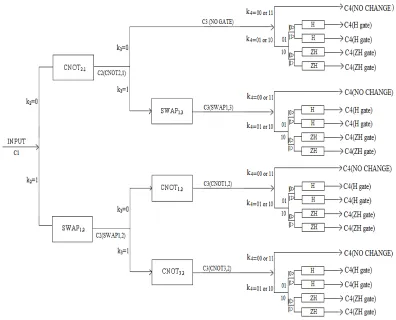
Figure 1. PEA Encryption Algorithm
Generally, the classical message, which is encrypted by PEA, consists of m bits
and for each bit of the message one quantum state, C1, is created based on the
current bit and the key. So, m quantum states are going to be created. As
illustrated in figure 1, the input of PEA is C1, which according to the second group
of key element k2 can follow one of the two paths. If k2 is equal to 0, the quantum
state will go through CNOT2,1 gate. Whereas k2 is equal to 1, the quantum state
will pass either by the path which has no gate or by the SWAP1,3, according to the
third group key element k3. Likewise, the output of SWAP1,2 gate, C2(SWAP1,2),
will pass either by CNOT1,2 gate or by CNOT3,2, according to the third group key
element k3.
2.1. Encryption
The encryption process consists of the following phases: preparation; first and
second level of encryption; and non-orthogonality phases.
Phase 1: Preparation
In Phase 1, the key k1 is used for the definition of the valid quantum states. Let we
define the quantum ancilla state represented as | 12 1 1k
k 〉. The k11and the 2 1
k are two
key elements of the ith key pair in k1. When the classical key element pairs are 00,
01, 10 and 11 we have the corresponding quantum ancilla states |00〉, |01〉, |10〉, | 11〉, respectively. For each bit, m (0 or 1), of the classical message, we have the corresponding quantum state |m〉. Now, the combination of the quantum ancilla state with the corresponding quantum state |m〉 of each bit, will give all valid quantum states. This combination is achieved by using the tensor product which
generates the tensor product state | 12 1 1k
mk 〉. To simplify our calculations, we have assumed an 8-bit classical message as a block size for our algorithm. Thus, we are
going to have the following eight valid quantum states:
|000〉, |001〉, |010〉, |011〉, |100〉, |101〉, |110〉, |111〉.
These valid states can be represented by Equation 1:
} 1 , 0 { , , ,
| 11 12 11 12 1 = mk k > where m k k ∈
C . (0)
Phase 2: First Level of Encryption
In Phase 2, the second key, k2,is responsible for the first level of encryption. The
input to the first level of encryption is one of the eight valid values defined by
Equation 1. According to the values of k2, there is a different path that the input
can follow. When k2 is equal to 0, the input will pass by the CNOT2,1 gate and
CNOT gate defines the second qubit as control and the first qubit as target. Thus,
the CNOT2,1 gate inverts the first qubit when the second qubit is equal to 1.
Likewise, the index 1,2 of SWAP gate defines that the first qubit will be swapped
with the second qubit. We have selected the CNOT2,1 and SWAP1,2 gates to create
diffusion to the data bit found in the first qubit of the quantum states, |mk11k12〉, of Phase 1.
The output C2 that results from CNOT2,1 and SWAP1,2 quantum gates (see
Figure 1), denoted as C2(CNOT2,1) and C2(SWAP1,2) respectively, is represented
by Equation 2:
1 1 2
1 1 1 2
1 1 1 2,1
2(CNOT ) |t k k , where m,k ,k {0,1} andt m k
C = m > ∈ m = ⊕ ,
} 1 , 0 { , , ,
, | ) (SWAP
C2 1,2 = k11m k12> where m k11 k12∈ .
(0)
Based on the second group of key element k2, all possible combinations of
C2(CNOT2,1) and C2(SWAP1,2) states are shown in Table 1:
Table 1. All possible C2 output.
C1 k2 C2(CNOT2,1) k2 C2(SWAP1,2)
|0m00〉 0 |0m00〉 1 |00m0〉
|0m01〉 0 |0m01〉 1 |00m1〉
|0m10〉 0 |1m10〉 1 |10m0〉
|0m11〉 0 |1m11〉 1 |10m1〉
|1m00〉 0 |1m00〉 1 |01m0〉
|1m01〉 0 |1m01〉 1 |01m1〉
|1m10〉 0 |0m10〉 1 |11m0〉
|1m11〉 0 |0m11〉 1 |11m1〉
Phase 3: Second Level of Encryption
In Phase 3, the third key, k3, is responsible for the second level of encryption. In
the second level of encryption, its inputs are the outputs of Phase 2. The outputs,
C2(CNOT2,1) and C2(SWAP1,2), are the inputs to the second level of encryption and
according to the values of k3, there is a different path that each input can follow.
C2(CNOT2,1) will pass either from the path which has no gate, for k3 equal
to 0, or from the SWAP1,3 gate, for k3 equal to 1. When C2(CNOT2,1) follow the
path which has no gate, the output will be the same as the input. The index 1,3 of
SWAP gate defines that the first qubit will be swapped with the third qubit. The
inverted data bit which is found in the first qubit in the quantum states, 12> 1 1 |tmk k
, of Phase 2.
The output C3 that results from the path without quantum gate and the path
with SWAP1,3 quantum gate (see Figure 1), denoted as C3(NO GATE) and
C3(SWAP1,3) respectively, is represented by Equation 3:
11
2 1 1 1 2
1 1 1
3(NOGATE) | , , , {0,1}
C = tmk k > where m k k ∈ andtm =m⊕k , 1 1 2
1 1 1 1
1 2 1 1,3
3(SWAP ) | , , , , , {0,1}
C = k k tm > where m k k ∈ andtm =m⊕k
(0)
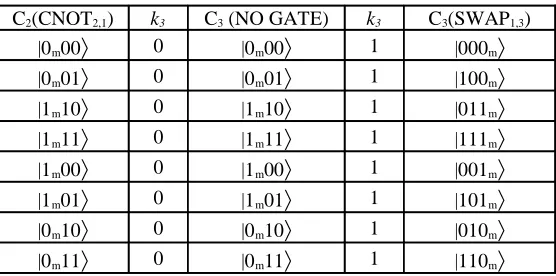
Based on the third group of key, k3,all possible combinations of C3(NO GATE)
[image:8.595.188.466.329.467.2]and C3(SWAP1,3) states are shown in Table 2:
Table 2. All possible C3 output with C2(CNOT2,1) input.
C2(CNOT2,1) k3 C3 (NO GATE) k3 C3(SWAP1,3)
|0m00〉 0 |0m00〉 1 |000m〉
|0m01〉 0 |0m01〉 1 |100m〉
|1m10〉 0 |1m10〉 1 |011m〉
|1m11〉 0 |1m11〉 1 |111m〉
|1m00〉 0 |1m00〉 1 |001m〉
|1m01〉 0 |1m01〉 1 |101m〉
|0m10〉 0 |0m10〉 1 |010m〉
|0m11〉 0 |0m11〉 1 |110m〉
C2(SWAP1,2) will pass either from the CNOT1,2 gate, when k3 is equal to 0 or by
CNOT3,2 when k3 is equal to 1. The index 1,2 of CNOT gate defines the first qubit
as control and the second qubit as target. Thus, the CNOT1,2 gate inverts the
second qubit when the first qubit is equal to 1. Likewise, the index 3,2 of CNOT
gate defines the third qubit as control and the second qubit as target. Thus, the
CNOT3,2 gate inverts the second qubit when the third qubit is equal to 1. We have
selected the CNOT1,2 and CNOT3,2 gates to create diffusion to the data bit which is
found in the second qubit in the quantum states, | 12 1 1mk
k 〉, of Phase 2.
The output C3 that results from CNOT1,2 and CNOT3,2 quantum gates (see
Figure 1), denoted as C3(CNOT1,2) and C3(CNOT3,2) respectively, is represented
by Equation 4:
m k t and k
k m where k
t k
C = m > ∈ m = ⊕
1 1 2
1 1 1 2
1 1 1 1,2
m k t and k
k m where k
t k
C = m > ∈ m = ⊕
2 1 2
1 1 1 2
1 1 1 3,2
3(CNOT ) | , , , , {0,1}
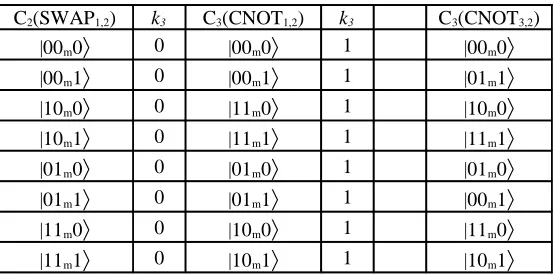
Based on the third group of key element k3, all possible combinations of
[image:9.595.189.466.174.313.2]C3(CNOT1,2) and C3(CNOT3,2) states are shown in Table 3:
Table 3. All possible C3 output with C2(SWAP1,2) input.
C3(CNOT3,2)
k3 C3(CNOT1,2)
k3 C2(SWAP1,2)
|00m0〉
1 |00m0〉
0 |00m0〉
|01m1〉
1 |00m1〉
0 |00m1〉
|10m0〉
1 |11m0〉
0 |10m0〉
|11m1〉
1 |11m1〉
0 |10m1〉
|01m0〉
1 |01m0〉
0 |01m0〉
|00m1〉
1 |01m1〉
0 |01m1〉
|11m0〉
1 |10m0〉
0 |11m0〉
|10m1〉
1 |10m1〉
0 |11m1〉
Phase 4: Non-Orthogonality
In Phase 4, the fourth group key k4 is responsible for leading the encrypted data to
non-orthogonality. The encrypted data derived from the second level of
encryption are states which are orthogonal. However, orthogonality is a property
which should be avoided so that the encrypted data are securely transferred
through the communication channel. Orthogonality permits states to be
distinguished and thus, phase 4 makes the outputs states non-orthogonal.
Non-orthogonality is a preferable property for PEA.
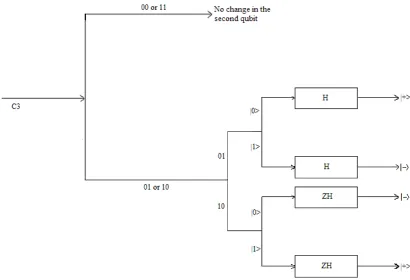
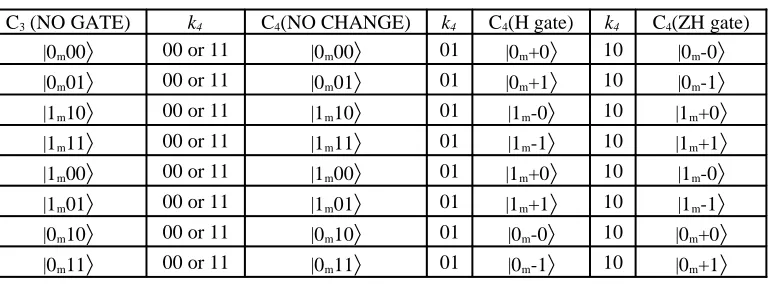
Non-orthogonality is achieved by using the fourth key, k4. According to
the key, k4, we change the second qubit in the following approach: If the key
element is 00 or 11, then we do not change the second qubit of state C3. Thus, the
second qubit remains in the state |0〉 or |1〉. However, when the key element is 01 or 10, then we perform the following computations to the second qubit: when the
key element has value equal to 01, we apply Hadamard (H) gate [10] to the
second qubit and the resulting output state is |+〉 if the input state is |0〉, or |-〉 if the input state is |1〉. If the key element is 10, we apply ZH gate [10] to the second qubit and the resulting output state is |-〉 if the input state is |0〉, or |+〉 if the input state is |1〉. We select the second qubit to be passed by H or ZH gates because in the second qubit there is the quantum representation of a data bit after Phase 3,
The Non-Orthogonality process is shown in Figure 2. For each output
C3(NO GATE), C3(SWAP1,3), C3(CNOT1,2), and C3(CNOT3,2), non-orthogonality
[image:10.595.127.537.156.436.2]is also illustrated in Figure 1.
Figure 2. Non-Orthogonality Process
To prove that the utilization of Hadamard gates and ZH gates offers
non-orthogonality, we need to follow the next steps:
Firstly, it is known that Hadamard gate is given by Equation 5 [10]:
− =
1 1
1 1
2 1 ^
H (0)
It is also known that the matrix representations of the |0〉 and the |1〉 are given by Equation 6 [10]:
= >
0 1 0
| and
= >
1 0 1
| (0)
From equations 5 and 6 we can calculate the following:
> + ≡ > + > =
=
− =
> (|0 |1 ) | 2
1 1 1
2 1 0 1
1 1
1 1
2 1 0 | ^ H
> − ≡ > − > =
− =
− =
> (|0 |1 ) | 2
1 1 1
2 1 1
0
1 1
1 1
2 1 1 | ^ H
(0)
− = 1 1 1 1 2 1 ^ H Z (0) and = > 0 1 0
| and
= > 1 0 1
| . (0)
From equations 8 and 9 we can calculate the following:
> − ≡ > − > = − = − =
> (|0 |1 ) | 2 1 1 1 2 1 0 1 1 1 1 1 2 1 0 | ^ H Z > + ≡ > + > = = − =
> (|0 |1 ) | 2 1 1 1 2 1 1 0 1 1 1 1 2 1 1 | ^ H Z . (0)
For input C3(NO GATE), the output C4 results from not changing the second qubit
of the input C3(NO GATE) or applying H / ZH quantum gates to the second qubit
of the input C3(NO GATE). These results denoted as C4(NO CHANGE), C4(H
gate) and C4(ZH gate) are represented by Equation 11:
11 00 } 1 , 0 { , , , , , | CHANGE)
(NO 11 12 11 12 4
4 m k k where m k k when k or
C = > ∈ =
01 } 1 , 0 { , , , , , | gate)
(H 12 11 12 4
4 = m ± k > where m k k ∈ when k = C 10 } 1 , 0 { , , , , , | gate)
(ZH 2 4
1 1 1 2
1
4 = m k > where m k k ∈ when k =
C ∓ .
(0)
Based on the fourth group of key element k4,all possible combinations of C4(NO
[image:11.595.137.522.535.677.2]CHANGE), C4(H gate) and C4(ZH gate) states are shown in Table 4:
Table 4. All possible C4 output with C3(NO GATE) input.
C3 (NO GATE) k4 C4(NO CHANGE) k4 C4(H gate) k4 C4(ZH gate)
|0m00〉 00 or 11 |0m00〉 01 |0m+0〉 10 |0m-0〉
|0m01〉 00 or 11 |0m01〉 01 |0m+1〉 10 |0m-1〉
|1m10〉 00 or 11 |1m10〉 01 |1m-0〉 10 |1m+0〉
|1m11〉 00 or 11 |1m11〉 01 |1m-1〉 10 |1m+1〉
|1m00〉 00 or 11 |1m00〉 01 |1m+0〉 10 |1m-0〉
|1m01〉 00 or 11 |1m01〉 01 |1m+1〉 10 |1m-1〉
|0m10〉 00 or 11 |0m10〉 01 |0m-0〉 10 |0m+0〉
|0m11〉 00 or 11 |0m11〉 01 |0m-1〉 10 |0m+1〉
For input C3(SWAP1,3), the output C4 results from not changing the second qubit
of the input C3(SWAP1,3), or applying H or ZH quantum gates to the second qubit
of the input C3(SWAP1,3). These results denoted as C4(NO CHANGE), C4(H gate)
11 00 }
1 , 0 { , , ,
, , | CHANGE)
(NO 2 4
1 1 1 1
1 2 1
4 k k m where m k k when k or
C = > ∈ =
01 }
1 , 0 { , , ,
, | gate)
(H 12 11 12 4
4 = k ± m> where m k k ∈ when k = C
10 }
1 , 0 { , , ,
, , | gate)
(ZH 4
2 1 1 1 2
1
4 = k m> where m k k ∈ when k =
C ∓
(0)
Based on the fourth group of key element k4,all possible combinations of C4(NO
[image:12.595.133.522.241.379.2]CHANGE), C4(H gate) and C4(ZH gate) states are shown in Table 5:
Table 5. All possible C4 output with C3(SWAP1,3) input.
C3(SWAP1,3) k4 C4(NO CHANGE) k4 C4(H gate) k4 C4(ZH gate)
|000m〉 00 or 11 |000m〉 01 |0+0m〉 10 |0-0m〉
|100m〉 00 or 11 |100m〉 01 |1+0m〉 10 |1-0m〉
|011m〉 00 or 11 |011m〉 01 |0-1m〉 10 |0+1m〉
|111m〉 00 or 11 |111m〉 01 |1-1m〉 10 |1+1m〉
|001m〉 00 or 11 |001m〉 01 |0+1m〉 10 |0-1m〉
|101m〉 00 or 11 |101m〉 01 |1+1m〉 10 |1-1m〉
|010m〉 00 or 11 |010m〉 01 |0-0m〉 10 |0+0m〉
|110m〉 00 or 11 |110m〉 01 |1-0m〉 10 |1+0m〉
For input C3(CNOT1,2), the output C4 results from not changing the second qubit
of the input C3(CNOT1,2), or applying H / ZH quantum gates to the second qubit
of the input C3(CNOT1,2). These results denoted as C4(NO CHANGE), C4(H gate)
and C4(ZH gate) are represented by Equation 13:
11 00 }
1 , 0 { , , ,
, , | CHANGE)
(NO 11 12 11 12 4
4 k m k where m k k when k or
C = > ∈ =
01 }
1 , 0 { , , ,
, , | gate)
(H 11 12 11 12 4
4 = k ± k > where m k k ∈ when k = C
10 }
1 , 0 { , , ,
, , | gate)
(ZH 11 12 11 12 4
4 = k k > where m k k ∈ when k =
C ∓
(0)
Based on the fourth group of key element k4,all possible combinations of C4(NO
CHANGE), C4(H gate) and C4(ZH gate) states are shown in Table 6:
Table 6. All possible C4 output with C3(CNOT1,2) input.
C3(CNOT1,2) k4 C4(NO CHANGE) k4 C4(H gate) k4 C4(ZH gate)
|00m0〉 00 or 11 |00m0〉 01 |0+m0〉 10 |0-m0〉
[image:12.595.133.522.736.782.2]|11m0〉 00 or 11 |11m0〉 01 |1-m0〉 10 |1+m0〉
|11m1〉 00 or 11 |11m1〉 01 |1-m1〉 10 |1+m1〉
|01m0〉 00 or 11 |01m0〉 01 |0-m0〉 10 |0+m0〉
|01m1〉 00 or 11 |01m1〉 01 |0-m1〉 10 |0+m1〉
|10m0〉 00 or 11 |10m0〉 01 |1+m0〉 10 |1-m0〉
|10m1〉 00 or 11 |10m1〉 01 |1+m1〉 10 |1-m1〉
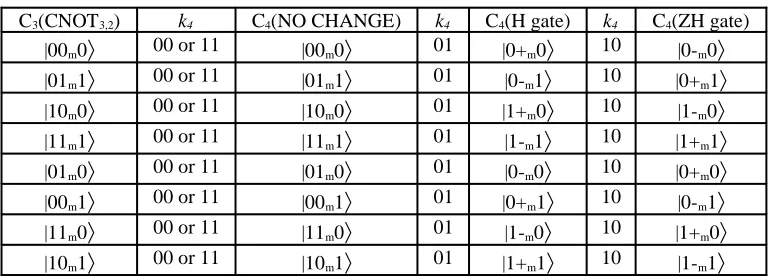
For input C3(CNOT3,2), the output C4 results from not changing the second qubit
of the input C3(CNOT3,2), or applying H / ZH quantum gates to the second qubit
of the input C3(CNOT3,2),. These results denoted as C4(NO CHANGE), C4(H
gate) and C4(ZH gate) are represented by Equation 14:
11 00 }
1 , 0 { , , ,
, , | CHANGE)
(NO 11 12 11 12 4
4 k m k where m k k when k or
C = > ∈ =
01 }
1 , 0 { , , ,
, , | gate)
(H 11 12 11 12 4
4 = k ± k > where m k k ∈ when k = C
10 }
1 , 0 { , , ,
, , | gate)
(ZH 4
2 1 1 1 2
1 1 1
4 = k k > where m k k ∈ when k =
C ∓
(0)
Based on the fourth group of key element k4,all possible combinations of C4(NO
[image:13.595.134.521.456.595.2]CHANGE), C4(H gate) and C4(ZH gate) states are shown in Table 7:
Table 7. All possible C4 output with C3(CNOT3,2) input.
C3(CNOT3,2) k4 C4(NO CHANGE) k4 C4(H gate) k4 C4(ZH gate)
|00m0〉 00 or 11 |00m0〉 01 |0+m0〉 10 |0-m0〉
|01m1〉 00 or 11 |01m1〉 01 |0-m1〉 10 |0+m1〉
|10m0〉 00 or 11 |10m0〉 01 |1+m0〉 10 |1-m0〉
|11m1〉 00 or 11 |11m1〉 01 |1-m1〉 10 |1+m1〉
|01m0〉 00 or 11 |01m0〉 01 |0-m0〉 10 |0+m0〉
|00m1〉 00 or 11 |00m1〉 01 |0+m1〉 10 |0-m1〉
|11m0〉 00 or 11 |11m0〉 01 |1-m0〉 10 |1+m0〉
|10m1〉 00 or 11 |10m1〉 01 |1+m1〉 10 |1-m1〉
2.2. Decryption
All gates (CNOT gates, SWAP gates, H gates, ZH gates) used in the encryption
and non-orthogonality processes are unitary operators. Hence, the decryption is
the inverse process of the encryption using the pre-shared four group keys. The
decryption process takes place at the recipient side. Thus, the decryption process
Phase 1: Inverse process of Phase 4 of Encryption process
In Phase 1, the fourth group key k4 is responsible for the first level of decryption.
The recipient receives the non-orthogonal states (ciphertext) from the sender and
applies the same process with the one applied in the Phase 4 during encryption.
When the key element is 00 or 11 we do not change the second qubit of state C4
and thus, the second qubit remains in state |0〉 or |1〉. However, when the key element is 01 or 10, then we perform the following computations to the second
qubit of the ciphertext: If the key element has value equal to 01, we apply H gate
to the second qubit and the output state is |0〉 when the input state is |+〉, or |1〉 when the input state is |-〉. If the key element is 10, we apply ZH gate to the second qubit and the resulting output state is |0〉 when the input state is |-〉, or |1〉 when the input state is |+〉. Therefore, the output of this phase is the state C3 of the encryption process.
Phase 2: Inverse process of Phase 3 of Encryption process
In Phase 2, the third and second group keys k3, k2 are responsible for the second
level of decryption. The inputs of phase 2 are the outputs of the first level of
decryption. Here the recipient applies the same process with the process applied in
phase 3 during the encryption process. For example, when k2 is equal to 0, state C3
passes either by the path which has no gate for k3 equal to 0, or by SWAP1,3, for k3
equal to 1. When k2 is equal to 1 state C3 passes either by the CNOT1,2 gate for k3
equal to 0, or by CNOT3,2 for k3 equal to 1. Hence, the output of this phase is the
state C2 of the encryption process.
Phase 3: Inverse process of Phase 2 of Encryption process
In Phase 3, the second group of key element k2 is responsible for the third level of
decryption. The inputs of phase 3 are the outputs of the second level of
decryption. Same as before the receiver applies the same process with the one
applied in phase 2 during encryption. For example, when k2 is equal to 0, state C2
passes by the CNOT2,1 gate, but when k2 is equal to 1, state C2 passes by the
SWAP1,2 gate. Hence the output of this phase is the state C1 of the encryption
Phase 4: Acquisition of plaintext
In Phase 4, we obtain all the first qubits of each state that correspond to the
original bits and acquire the bit sequence of the original plaintext.
3. Security Analysis of PEA
To evaluate PEA we have conducted a security analysis to examine its resilience
to Trojan horse and eavesdropping attacks and to study its homogeneity and
perfect secrecy.
3.1. Homogeneity and Perfect Secrecy
It is essential an encryption algorithm to produce homogeneous ciphertexts and
ideally have perfect secrecy, i.e. the ciphertext gives no information about the
plaintext [20]. To prove that our algorithm is homogeneous and achieves perfect
secrecy, it is enough to show that the density matrix of n ciphertexts states related
to the n bits classical message is the identity matrix.
To prove it, let |ψwz〉 be the linear combination of all possible states with equal probability in the ciphertext set Cw (w=1, 2, 3), which corresponds to the zth bit of
message. The density matrices are calculated by Equation 15:
|ψ1z〉 〈ψ1z| = I |ψ2z〉 〈ψ2z| = I |ψ3z〉 〈ψ3z| = I (0)
The density matrix of n ciphertext states |ψ3〉 for a message which consists of n bits is given by Equation 16:
|ψ3〉 〈ψ3| = |ψ31〉 〈ψ31| ⊗|ψ32〉 〈ψ32|⊗|ψ33〉 〈ψ33|. . . ⊗|ψ3n〉 〈ψ3n| (0)
To calculate Equation 16, firstly it is required to calculate the outer product of
each element |ψ3i〉: |ψ31〉 〈ψ31|, |ψ32〉 〈ψ32|, |ψ33〉 〈ψ33|, |ψ34〉 〈ψ34|, |ψ35〉 〈ψ35|, |ψ36
〉 〈ψ36|, |ψ37〉 〈ψ37|, |ψ38〉 〈ψ38|
Then, it is required to calculate the tensor products of the above outer
001〉, |010〉, |011〉, |100〉, |101〉, |110〉, |111〉, can be also represented as vectors. By using vectors we can make simple calculations and prove that the ciphertext is
homogenous. For example, the vector representation of the first states |000〉 is given by Equation 17:
|000〉= |0〉 ⊗|0〉 ⊗|0〉=
0 1
⊗
0 1
⊗
0 1
=
0 0 0 1
⊗
0 1
=
0 0 0 0 0 0 0 1
(0)
Likewise, we can construct the rest of the states |001〉, |010〉, |011〉, |100〉, |101〉, | 110〉, and |111〉 as vectors.
According to Figure 1, when the output is given by C3 (NO GATE) we
[image:16.595.150.516.157.298.2]have the following possible states:
Table 8. C3 (NO GATE) Output.
|0m00〉 |0m01〉 |1m10〉 |1m11〉 |1m00〉 |1m01〉 |0m10〉 |0m11〉
From Table 8, we have:
|ψ31〉=|0m00〉, |ψ32〉=|0m01〉, |ψ33〉=|1m10〉, |ψ34〉=|1m11〉, |ψ35〉=|1m00〉, |ψ36〉=|1m01〉, |ψ37〉=|0m10〉, |ψ38〉=|0m11〉.
Next, the outer products can be calculated by Equation 18:
|ψ31〉 〈ψ31| = |0m00〉 〈0m00| = eeT= E where
e = [1 0 0 0 0 0 0 0]T ,
E = Diag{1, 0, 0, 0, 0, 0, 0, 0}
(18)
Likewise, we can calculate all the outer products |ψ32〉〈ψ32|, |ψ33〉〈ψ33|, |ψ34〉〈ψ34|, | ψ35〉〈ψ35|, |ψ36〉〈ψ36|, |ψ37〉〈ψ37|, and |ψ38〉〈ψ38|.
According to Figure 1, when the output is given by C3(SWAP 1,3) we
have the following possible states:
Table 9. C3 (SWAP 1,3) Output.
From Table 9, we have:
|ψ31〉=|000m〉, |ψ32〉=|100m〉, |ψ33〉=|011m〉, |ψ34〉=|111m〉, |ψ35〉=|001m〉, |ψ36〉=|101m〉, |ψ37〉=|010m〉, |ψ38〉=|110m〉. The outer product of |ψ31〉 〈ψ31| is given by Equation 19:
|ψ31〉 〈ψ31| = |000m〉 〈000m| = eeT= E where
e = [1 0 0 0 0 0 0 0]T,
E = Diag{1, 0, 0, 0, 0, 0, 0, 0}
(19)
Likewise, we can calculate |ψ32〉 〈ψ32|, |ψ33〉 〈ψ33|, |ψ34〉 〈ψ34|, |ψ35〉 〈ψ35|, |ψ36〉 〈 ψ36|, |ψ37〉 〈ψ37|, and |ψ38〉 〈ψ38|.
According to Figure 1, when the output is given by C3(CNOT1,2) we have
the following possible states:
Table 10. C3(CNOT1,2) Output.
|00m0〉 |00m1〉 |11m0〉 |11m1〉 |01m0〉 |01m1〉 |10m0〉 |10m1〉
From Table 10, we have:
|ψ31〉=|00m0〉, |ψ32〉=|00m1〉, |ψ33〉=|11m0〉, |ψ34〉=|11m1〉,
|ψ35〉=|01m0〉, |ψ36〉=|01m1〉, |ψ37〉=|10m0〉, |ψ38〉=|10m1〉.
The outer product of |ψ31〉 〈ψ31| is given by Equation 20:
|ψ31〉 〈ψ31| = |00m0〉 〈00m0| = eeT= E
where
e = [1 0 0 0 0 0 0 0]T ,
E = Diag{1, 0, 0, 0, 0, 0, 0, 0}
(0)
Likewise, we can calculate |ψ32〉 〈ψ32|, |ψ33〉 〈ψ33|, |ψ34〉 〈ψ34|, |ψ35〉 〈ψ35|, |ψ36〉 〈 ψ36|, |ψ37〉 〈ψ37|, and |ψ38〉 〈ψ38|.
According to Figure 1, when the output is given by C3(CNOT3,2) we have
the following possible states:
Table 11. C3(CNOT3,2) Output.
From Table 11, we have:
|ψ31〉=|00m0〉, |ψ32〉=|01m1〉, |ψ33〉=|10m0〉, |ψ34〉=|11m1〉, |ψ35〉=|01m0〉, |ψ36〉=|00m1〉, |ψ37〉=|11m0〉, |ψ38〉=|10m1〉.
The outer product of |ψ31〉 〈ψ31| is given by Equation 21:
|ψ31〉 〈ψ31| = |00m0〉 〈00m0| = eeT = E where
e = [1 0 0 0 0 0 0 0]T ,
E = Diag{1, 0, 0, 0, 0, 0, 0, 0}
(0)
Likewise, we can calculate |ψ32〉 〈ψ32|, |ψ33〉 〈ψ33|, |ψ34〉 〈ψ34|, |ψ35〉 〈ψ35|, |ψ36〉 〈 ψ36|, |ψ37〉 〈ψ37|, and |ψ38〉 〈ψ38|.
We notice that the first output (|00m0〉) given by C3(CNOT1,2) (see Table 10) is the same with the first output (|00m0〉) given by C3(CNOT3,2) (see Table 11). Consequently, the linear combination |ψ31〉corresponds to the state |00m0〉is the same for the both cases. Thus, equation (20) and equation (21) are identical.
According to the assumption that k1, k2, k3, k4, are uniformly distributed
and based on the above matrices of the outer products, we can calculate the tensor
products and obtain the following density matrix:
|ψ3〉 〈ψ3| = |ψ31〉〈ψ31| ⊗|ψ32〉 〈ψ32|⊗|ψ33〉 〈ψ33|. . . ⊗|ψ3n〉 〈ψ3n| = I (0)
Equation 22 demonstrates that the ciphertext is homogeneous and has perfect
secrecy, since the density matrix is equal to the identity matrix.
3.2. Trojan horse attacks tolerance
The Trojan horse attacks are the most serious threats to computer networking
security. However, the proposed algorithm is tolerant against Trojan horse attacks.
If a Trojan horse, denoted as T, has invaded in the sender or the recipient in order
) 1 1 | 0 1 | 1 0 | 0 0 | 1 1 | 0 1 | 1 0 | 0 0 | 0 1 | 0 0 | 1 1 | 1 0 | 1 1 | 1 0 | 0 1 | 0 0 | 1 0 | 0 0 | 1 1 | 0 1 | 1 1 | 0 1 | 1 0 | 0 0 | 1 0 1 | 0 1 1 | 1 0 0 | 0 1 0 | 1 1 1 | 0 0 1 | 1 1 0 | 0 0 0 | 0 1 1 | 0 1 0 | 1 0 1 | 1 0 0 | 1 1 1 | 1 1 0 | 0 0 1 | 0 0 0 | 1 1 0 | 0 1 0 | 1 0 1 | 0 0 1 | 1 1 1 | 0 1 1 | 1 0 0 | 0 0 0 (| 48 1 ) ( | ? || ? ? || || ? || ? || ? ? || || ? || || ? || ? || ? ? || ? ? || ? || ? || ? || || ? || ? || ? ? || ? ? || || ? || || || || || || || || || || || || || || || || || || || || || || || || || || || || || || || || || || || || 4 > + + > − + > + + > − + > − + > + + > − + > + + > − + > − + > + + > + + > − + > − + > + + > + + > − + > − + > + + > + + > − + > − + > + + > + + > + > + > + > + > + > + > + > + > + > + > + > + > + > + > + > + > + > + > + > + > + > + > + > = ⊥ ⊥ ⊥ ⊥ ⊥ ⊥ ⊥ ⊥ ⊥ ⊥ ⊥ ⊥ ⊥ ⊥ ⊥ ⊥ ⊥ ⊥ ⊥ ⊥ ⊥ ⊥ ⊥ ⊥ ⊥ ⊥ ⊥ ⊥ ⊥ ⊥ ⊥ ⊥ ⊥ ⊥ ⊥ ⊥ ⊥ ⊥ ⊥ ⊥ ⊥ ⊥ ⊥ ⊥ ⊥ ⊥ ⊥ ⊥ ⊥ ⊥ ⊥ ⊥ ⊥ ⊥ ⊥ ⊥ ⊥ ⊥ ⊥ ⊥ ⊥ ⊥ m m m m m m m m m m m m m m m m m m m m m m m m m m m m m m m m m m m m m m m m m m m m m m m m i T ψ (0)
In Equation 23, we have used three symbols. The symbol || is the information
obtained by the Trojan horse when the quantum state is |0〉. The symbol ⊥ is the information obtained by the Trojan horse when the quantum state is |1〉. Whereas, the symbol ? is the information obtained by the Trojan horse when the quantum
state is |+〉 or |-〉. It means that when the state is |+〉 or |-〉 due to non-orthogonality that is applied in the fourth phase of encryption process, the Trojan horse can not
decide which the valid state is. Moreover, according to the design of encryption
algorithm, the quantum representation of a data bit can be in the first qubit or in
the second qubit or in the third qubit. Thus, the Trojan horse is able to take any
information related to the plaintext as well as which qubit is related to the ancilla
qubit.
3.3. Eavesdropping attacks tolerance
According to the design of PEA, the ciphertext states are non-orthogonal leading
the ciphertext states to be undistinguishable by an eavesdropping attacker. The
non-orthogonality is applied in the fourth phase of encryption process and we can
prove it by calculating the 〈ψ4i | ψ4i〉. If the value of inner product 〈ψ4i | ψ4i〉 is larger than 0, it means that the ciphertext states are non-orthogonal [10].
represent the states |0+0〉, |0-0〉, |0+1〉, |0-1〉, |1+0〉, |1+1〉, |1-0〉, and |1-1〉 as vectors. For example, the vector representation of |0+0〉is given by Equation 24:
|0+0〉= |0〉 ⊗|+〉 ⊗|0〉=
0 1 ⊗ 2 1 2 1 ⊗ 0 1 = 0 0 2 1 2 1 ⊗ 0 1 = 0 0 0 0 0 2 1 0 2 1 (0)
Likewise, we can calculate |0-0〉, |0+1〉, |0-1〉, |1+0〉, |1+1〉, |1-0〉, and |1-1〉.
Hence, according to Equations 17, 25 and their further calculations we have:
+ + + + = − − + + − − + + = > 1 1 2 1 2 1 1 1 2 1 2 1 16 1 2 1 2 1 2 1 2 1 0 0 0 0 2 1 2 1 2 1 2 1 0 0 0 0 0 0 0 0 2 1 2 1 2 1 2 1 0 0 0 0 2 1 2 1 2 1 2 1 1 1 1 1 1 1 1 1 48 3
|
ψ
4i (0)Next, we can calculate the inner product 〈ψ4i | ψ4i〉 as shown in Equation 26:
[
]
(
2 2)
32 1 1 1 2 1 2 1 1 1 2 1 2 1 1 1 2 1 2 1 1 1 2 1 2 1 256 1 ψ |
ψ4i 4i = +
(
2 2)
0 321
ψ
|
ψ4i 4i >= + >
< (0)
By proving that the value of inner product <ψ4i |ψ4i > is larger than 0, it means that the ciphertext states are non-orthogonal.
4. Conclusion
To our knowledge there are still not many good and feasible quantum encryption
algorithms proposed. With the rapid progress of quantum information theory and
technology, quantum information comes into real life quietly. When the quantum
computers come true some day, it will be necessary and not always possible to
transfer the existing encryption algorithms into quantum information. Based on
the basic principle of quantum computation, a quantum cryptographic algorithm
to encrypt the classical binary bits was proposed. The security of the encryption
algorithm was analyzed in detail. It was shown that the proposed algorithm can
prevent quantum as well as classical attacks.
PEA has several properties. First of all, no quantum state is pre-shared or
stored making PEA possible and efficient in real applications. Second, it achieves
perfect secrecy with the condition that the key is uniformly distributed. Third,
both encryption and decryption are based on simple quantum computation, and
particularly on a combination of the quantum CNOT and SWAP gates. Fourth, its
implementation is feasible with the existing technology. At last, the same
algorithm can be extended to encrypt quantum information.
References
[1] Nanrum Zhou, Guihua Zeng, Yiyou Nie, Jin Xiong and Fuchen Zhu, "A
novel quantum block encryption algorithm based on quantum computation",
Physica A: Statistical Mechanics and its Applications, Volume 362, Issue 2, 1
April 2006, Pages 305-313
[2] Osamu Hirota, Masaki Sohma, Masaru Fuse, Kentaro Kato, "Quantum
stream cipher by the Yuen 2000 protocol: Design and experiment by an
[3] N. Gisin, S. Wolf, "Quantum Cryptography on noisy Channels:
Quantumversus Classical Key-Agreement Protocols", The American Physical
Society, 1999
[4] Rob Pike, "An Introduction to Quantum Computation and Quantum
Communication", Bell Labs, Lucent Technologies, June 23, 2000
[5] Yoshihiro NAMBU and Hideo KOSAKA, "Introduction of Quantum
Cryptography and Its Development", NEC Res. & Develop., Vol 44, No. 3,
July 2003
[6] Emanuel Knill, Raymond Laflamme, Howard N. Barnum, Diego A.Dalvit,
Jacek J. Dziarmaga, James E. Gubernatis, Leonid Gurvits, Gerardo Ortiz,
Lorenza Viola, and Wojciech H. Zurek, "Quantum Information Processing: A
hands-on primer", Los Alamos Science Number 27, 2002
[7] Ari Y. Benbasat, "A Survey of Current Optical Security Techniques", MIT
Media Lab, April 15, 1999
[8] Steven Linton, "Quantum Cryptography-Quantum Key Distribution", July
13, 2003
[9] Dheera Venkatraman, "Methods and implementation of quantum
cryptography", MIT Department of Physics, 27 April 2004
[10] Michael A. Nielsen and Isaac L. Chuang, Quantum Computation and
Quantum Information, Cambridge Press, 2004
[11] X. Y. Li, H. Barnum, "Quantum authentication using entangled states",
International Journal of Foundations Computer Science, Volume 15, Issue 4,
2004, Pages: 609-617.
[12] P.O. Boykin and V. Roychowdhury, "Optimal encryption of quantum
bits", Physics Review A, Vol. 67, 2003.
[13] H. Bechmann-Pasquinucci and N. Gisin, "Intermediate states in quantum
cryptography and Bell inequalities", Physics Review A, Vol 67, 062310, 2003
[14] N. Zhou, G. Zeng, "Progress on Cryptography", The Kluwer
International Series in Engineering and Computer Science, Kluwer Academic
Publishers, Boston, 2004, Pages: 195–200.
[15] N. Zhou, G. Zeng, "A realizable quantum encryption algorithm for
qubits", China Physics, Vol. 14, Issue 2164, 2005
[16] G. Benenti and G. Casatti, Principles of Quantum Computation, vol. I:
[17] Justin Mullins, "Making Unbreakable Code", IEEE Spectrum, May 2002.
[18] A.M. Steane, E.G. Rieffel, "Beyond Bits: The Future of Quantum
Information Processing", IEEE Computer, January 2000.
[19] William Stallings, Cryptography and Network Security Principles and
Practices, Prentice Hall, November 2005.
[20] A. J. Menezes, S. A. Vanstone, and P. C. Van Oorschot, Handbook of