COMPRESSIVE VIDEO SAMPLING
Vladimir Stankovi´c and Lina Stankovi´c
Samuel Cheng
Dept of Electronic and Electrical Engineering University of Strathclyde, Glasgow, UK
phone: +44-141-548-2679
email: {vladimir,lina}[email protected]
Dept of Electrical and Computer Engineering University of Oklahoma, Tulsa, OK, USA
phone: 1-918-660-3234 email: [email protected]
ABSTRACT
Compressive sampling is a novel framework that exploits sparsity of a signal in a transform domain to perform sam-pling below the Nyquist rate. In this paper, we apply com-pressive sampling to significantly reduce the sampling rate of video. A practical system is developed that first splits each video frame into non-overlapping blocks of equal size. Com-pressive sampling is then performed on sparse blocks, de-termined by predicting sparsity based on previous reference frames which are sampled conventionally. The blocks identi-fied as sparse are reconstructed using the orthogonal match-ing pursuit algorithm, whereas the remainmatch-ing blocks are sam-pled fully. Thus, the acquisition complexity and sampling time are reduced, while exploiting the local sparsity, within the DCT domain, of a video stream. Our simulation results indicate up to 50% saving in acquisition for Y-components of video with very small performance loss compared to tra-ditional sampling.
1. INTRODUCTION
Compressive sampling is a statistical technique for data ac-quisition and estimation that aims to sample signals sparsely in transform domains. The process of compressive sampling replaces conventional sampling and reconstruction with a more general linear measurement scheme with an optimiza-tion procedure to acquire a subset of signals within a source at a rate that is significantly below Nyquist. However, it will work only if the source is sparse in the transform domain of choice. Thus, the challenge is to predict which sources are sparse in a particular transform domain.
Conventionally, after acquisition of a scene, Discrete Co-sine Transform (DCT) is performed on the image using val-ues assigned to each pixel. After DCT, many coefficients will be zero or will carry negligible energy; these coefficients are discarded before quantization or/and entropy coding. Hence, though each frame of the image is acquired fully, much of the acquired information is discarded after DCT causing unnec-essary burden on the acquisition process. This makes com-pressive sampling a good candidate for digital image and video applications, where the Nyquist rate is so high that compressing the sheer volume of samples is a problem for transmission or storage.
A number of theoretical contributions have appeared on compressive sampling (see [1, 2, 3]) over the past few years. Yet, only few papers address day-to-day practical situations, for example, analog-to-information converter [4] and one-pixel camera [5]. Recently, we developed practical compres-sive sampling systems for binary image in [6], by using the fact that natural images are sparse in a transform domain. We observed that the background was a good candidate for
compressive sampling, while parts of the image that contain many details were not. Hence, applying compressive sam-pling to the whole image was ineffective. In order to exploit any sparsity within an image, we split the image into small non-overlapping blocks of equal size. Compressive sampling is then performed only on blocks determined to be sparse, i.e., we exploitlocal sparsitywithin an image. Note that, in real-time acquisition, it is not possible to test for sparsity of a block before sampling.
In this paper, we build on our previous work [6] consid-ering acquisition of a video stream. We solve the real-time acquisition limitation by testing the sparsity of a scene on a previously acquired frame, denoted as reference frame. Ref-erence frames are sampled fully, and they are used to predict sparsity of the successive non-reference frames. Each block of the reference frame is tested for sparsity using a compres-sive sampling test. If the block passes the test, it is iden-tified as sparse. All blocks in the successive non-reference frames that spatially correspond to sparse blocks in the pre-vious reference frame will be compressively sampled. Com-pressively sampled frames are reconstructed at the decoder using the orthogonal matching pursuit (OMP) algorithm [7], which is suboptimal but practical due to its relatively lower complexity compared to other proposed reconstruction meth-ods [1, 2, 8, 9].
However, the OMP algorithm is still not practical when carried out over a very large number of samples, e.g., a whole frame. Having split the frames into smaller blocks, the recon-struction time is automatically reduced, such that our overall system operates in real time. Thus, in addition to exploit-ing local sparsity, the proposed system benefits from reduced complexity since the OMP algorithm reconstructs a smaller number of coefficients many times (instead of many coeffi-cients in one go), and hence converges faster.
Our simulation results show that is possible to signifi-cantly reduce the total number of samples using compressive sampling without sacrificing the reconstruction performance. We also observe that only few frames need to be encoded as reference frames especially for video with almost static background. This paper is organized as follows. Section 2 provides an overview of compressive sampling, Section 3 de-scribes our proposed system, simulation results are presented in Section 4, and we conclude and outline our future work in Section 5.
2. COMPRESSIVE SAMPLING
domain. In this section we briefly review compressive sam-pling closely following notation of [3].
Letx={x[1], . . . ,x[N]}be a set ofNsamples of a real-valued, discrete-time random processX. Letsbe the repre-sentation ofxin theΨdomain, that is:
x=Ψs=
N
∑
i=1
siψi, (1)
wheres= [s1, . . . ,sN]is anN-vector of weighted coefficients
si=hx,ψii, andΨ= [ψ1|ψ2| · · · |ψN]is anN×Nbasic ma-trix withψibeing thei-th basic column vector.
Vector x is consideredK-sparse in the domain Ψ, for
K≪N, if only K out of N coefficients ofsare non-zero. Sparsity of a signal is used for compression in conventional transform coding, where the whole signal is first acquired (allNsamples ofx), then theNtransform coefficientssare obtained vias=ΨTx, and thenN−K(or more in the case of lossy compression) coefficients ofsare discarded and the remaining are encoded. Hence severe redundancy is present in the acquisition since large amounts of data are discarded because they carry negligible or no energy.
The main idea of compressive sampling is to remove this “sampling redundancy” by needing only M samples of the signal, whereK<M≪N. Letybe anM-length measure-ment vector given by: y=Φx, whereΦis anM×N mea-surement matrix. The above expression can be written in terms ofsas:
y=ΦΨs. (2)
It has been shown in [1, 2] that signalxcan be recov-ered losslessly fromM≈Kor slightly more measurements (vectoryin (2)) if the measurement matrixΦis properly de-signed, so thatΦΨsatisfies the so-called restricted isometry property [2]. This will always be true if Φ andΨare in-coherent, that is, the vectors ofΦcannot sparsely represent basic vectors and vice versa.
It was further shown in [1, 2, 3] that an independent iden-tically distributed (i.i.d.) Gaussian matrix Φ satisfies the above property for any (orthonormal)Ψwith high probabil-ity ifM≥cKlog(N/K)for some small constantc. Thus, one can recoverNmeasurements ofxwith high probability from onlyM≈cKlog(N/K)<Nrandom Gaussian measurements yunder the assumption thatxisK-sparse in some domainΨ. Note that it is not known in advance whichsicoefficients are zeros, or whichx[i]samples are not needed.
Unfortunately, reconstruction ofx={x[1], . . . ,x[N]}(or equivalently, s= [s1, . . . ,sN]) from vectory ofM samples is not trivial. The exact solution [1, 2, 3] is NP-hard and consists of finding the minimuml0norm (the number of
non-zero elements). However, excellent approximation can be obtained via thel1norm minimization given by:
ˆs=arg min||s′||1, such that ΦΨs′=y. (3)
This convex optimization problem, namely, basis pur-suit [1, 2], can be solved using a linear program algorithm ofO(N3)complexity. In contrast tol
0norm minimization,
thel1norm minimization usually requires more thanK+1
measurements. Due to complexity and low speed of linear programming algorithms, faster solutions were proposed at the expense of slightly more measurements, such as match-ing pursuit, tree matchmatch-ing pursuit [8], orthogonal matchmatch-ing pursuit [7], and group testing [9].
3. PROPOSED SYSTEM
In this section, we describe our system for compressive video sampling using the OMP algorithm [7].
We use an i.i.d. Gaussian measurement matrix forΦand inverse DCT forΨ in equation (2). This choice of Φ en-sures that the restricted isometry property is satisfied. The OMP algorithm is an efficient solution for signal recovery that is easy to implement. It is ofO(MNK)complexity, and requiresM≈2KlogNmeasurements for error-free recovery ofNsamples in 99% of time. The algorithm hasKiterations, and in each iteration it calculatesNinner products between
M-length vectors and finds the maximum. Thus, whenMand
Nare large the algorithm is slow and impractical.
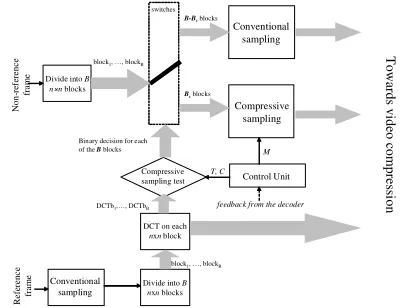
Our proposed system is shown in Figure 1. To reduce the acquisition and reconstruction complexity and exploit lo-cal sparsity within the frame, each frame is split intoB non-overlapping blocks each of sizen×n=Npixels. We define reference and non-reference frames. Each reference frame is sampled fully. After sampling, a compressive sampling test (described below) is carried out to identify which blocks are sparse within the reference frame. The output of the test is binary for each of theBblocks, e.g., true or false.
Reference frames should be inserted regularly in the stream: exactly when reference frames are required can be determined by exploiting decoder feedback. The number of required reference frames depends on the dynamics of the scene, as shown in Section 4.
Let Bs be the number of sparse blocks. Each non-reference frame is sampled in the following way: Bs blocks that spatially correspond to the sparse blocks in the reference frame are compressively sampled; that is, each block is trans-formed into aN×1 vector on which Gaussian measurement matrixΦis applied. The remainingB−Bsblocks are sam-pled in the conventional way. For each of the Bs selected blocks we acquireM<N measurements. The resulting co-efficients can undergo conventional compression in the form of quantization/entropy coding.
Divide into B
n×nblocks
Divide into B
nxnblocks
Conventional sampling
DCT on each
nxnblock
Compressive sampling test
Conventional sampling
Compressive sampling
T
o
w
ar
d
s v
id
eo
c
o
mp
re
ss
io
n
R
e
fe
re
n
c
e
fr
a
m
e
N
o
n
-r
ef
er
e
n
c
e
fr
a
m
e
Control Unit switches
feedback from the decoder
DCTb1,…, DCTbB Binary decision for each of the Bblocks
block1, …, blockB
M T, C
Bsblocks
B-Bsblocks
[image:2.595.324.525.497.651.2]block1, …, blockB
Figure 1: Block diagram of the acquisition process.
Compressive sampling test: Reference frames are
larger than T, the block is selected as a reference for com-pressive sampling.
During reconstruction of compressively sampled blocks, using the iterative OMP algorithm, all sampled coefficients whose absolute value is less thanC are set to zero. Hence, forC>0, the sampling process will always be lossy. The-oretically, as discussed in Section 2, if we haveN−K non-significant DCT coefficients, then at leastM=K+1 samples are needed for signal reconstruction. Therefore,T <N−K.
The choice of values for M, T, andC depends on the video sequence and the size of the blocks. These parameters, as well as the number and position of the reference frames in the stream, can be adjusted using feedback from the decoder. Indeed, during reconstruction, the OMP algorithm can fail (ifMorT is too low) even if the block has passed the com-pressive sampling test. Often, it is possible for the decoder to detect the OMP algorithm failure, for example, by com-paring the result with neighboring blocks/frames, or if all the DCT coefficients are zero, or if division by zero in the OMP algorithm appears. In this case, the decoder can send feed-back to the encoder to adjust its sampling parameters or to encode a reference frame.
Note that, any transform can be applied instead of DCT (e.g., wavelet transform) under the condition that the frame is sparse in the transform domain.
4. RESULTS
In this section we report our experimental results, namely the effect of compressive sampling with different combination of parametersT,M,C, on reconstructed video PSNR and per-ceptual quality. The system described in Section 2 is applied to Y-components of two video sequences: the QCIF Akiyo sequence and CIF Stefan sequence. In all our simulations, a block size ofN=32×32=1024 pixels is used. This block size was observed to provide a good trade-off between com-pressive sampling efficiency, reconstruction complexity, and decoding time.
0 5 10 15 20
200 300 400 500 600 700 800 900 1000
Block Number
Number of Coefficients less than C
[image:3.595.321.521.173.327.2]C=4 C=16
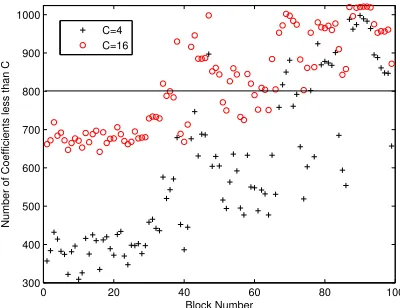
Figure 2: Distributions of the number of coefficients less than
CoverB=20 blocks, each of 32×32 pixels for the first frame of Akiyo sequence.
Figures 2 and 3 show the number of DCT coefficients less thanC for the first frame of the Akiyo and Stefan se-quences, respectively, for two different values ofC. It can be seen from the figures that ifCis large enough, many blocks
have more than 80% of its DCT coefficients<C, and thus can be regarded as sparse. This determines our choice of
T (horizontal line in the figures). The figures show that not all blocks are sparse, and hence the compressive sampling test described in Section 3 is necessary to select blocks on which compressive sampling can be applied to reduce sam-pling rate.
0 20 40 60 80 100 300
400 500 600 700 800 900 1000
Block Number
Number of Coefficients less than C
C=4 C=16
Figure 3: Distributions of the number of coefficients less than
CoverB=99 blocks, each of 32×32 pixels for the first frame of Stefan sequence.
Figure 4 shows results for the 217thframe of the Akiyo sequence, with the first frame used as a reference. The re-sults are shown as PSNR vs the percentage of the collected samples for four different values ofM. We fixT to 800, and show PSNR forC ranging from 2 to 30 with a step size of 2 to obtain different sampling rates. It can be seen from the figure thatM=400 is the best choice for a large range of sam-pling rates. Indeed, forM=400, only about 50% of samples are needed to obtain PSNR of 30 dB. For higher sampling rates (above 85%)M=600 or 800 are the best. This is ex-pected since for a fixedC, larger number of samplesMleads to a better quality. Similar results were obtained for different frames. In our next simulation, we fixedM to 420 and vary
T.
20 30 40 50 60 70 80 90 100 20
25 30 35 40 45 50 55 60
Samples [%]
PSNR [dB]
M=800 M=600 M=400 M=200
C=4
C=16
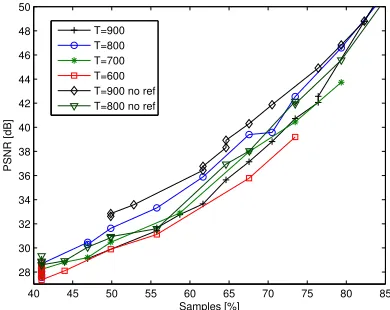
[image:3.595.63.263.504.657.2]Figure 5 shows PSNR between the original frame and the reconstruction as a function of the percentage of the collected samples for three different values ofT. Again,Cranges from 2 to 30 with a step size of 2. It can be seen from the figure thatT=800 is the best choice. Good reconstruction quality is achieved with 50% of the samples only.
40 45 50 55 60 65 70 75 80 85 28
30 32 34 36 38 40 42 44 46 48 50
Samples [%]
PSNR [dB]
T=900 T=800 T=700 T=600 T=900 no ref T=800 no ref
Figure 5: PSNR vs. percentage of the acquired samples for the 217thframe of Akiyo. Either the first frame was used for sparsity prediction or the sampled 217thframe itself (‘no ref’ curves).M=420.
As a benchmark, we include in the figure results (‘no ref’ curve) for the ideal case when the compressive sampling test is carried out on the 217th frame itself. It can be seen, that negligible performance loss (about 1 dB) is incurred in our practical case (withT =800) when the first frame is used as reference compared to the best benchmark case (T =900). Hence, for the Akiyo sequence, we can conclude that it is sufficient to fully sample only the first frame and successive frames can be compressively sampled using the compressive sampling test decision on blocks of the first reference frame.
40 50 60 70 80 90 100 20
25 30 35 40 45 50 55 60
Samples [%]
PSNR [dB]
M=800 M=600 M=400 M=200
C=4
C=16
Figure 6: PSNR vs. percentage of the acquired samples for the 100thframe of Stefan. The first frame was used for spar-sity prediction.T =800.
Results for the 100th frame of the Stefan sequence are shown in Figures 6 and 7. The first frame was used as a ref-erence. From Figure 6 we can observe that M=200,400
[image:4.595.68.263.160.315.2]give the best performance for T =800. In Figure 7, we setM=420 and varyT. We observe that roughly 75% of samples are needed with the proposed system for T=700, whereas in the ideal case (‘no ref’ curve) with T=800 less than 70% of samples will be required to obtain PSNR greater than 30 dB. Note that whenT =900 it is not possible to ob-tain sampling rate below 70% because only few blocks pass the compressive sampling test.
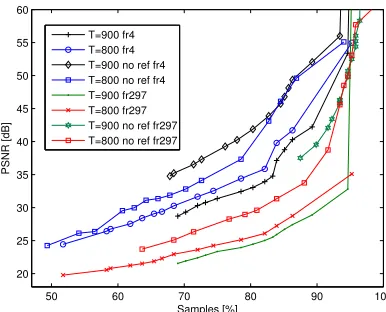
Figure 8 shows results for the 4th frame and the 297th frame, using the first frame as reference. It can be seen that for the 4th frame, roughly 70% of samples are needed to achieve PSNR of 30dB. On the other hand, if we also maintain the first frame as a reference for sampling the 297th frame, more than 90% of samples would be necessary. In this case, results could be improved by inserting another ref-erence frame before the 297thframe.
40 50 60 70 80 90 100 20
25 30 35 40 45 50 55
Samples [%]
PSNR [dB]
[image:4.595.323.521.268.424.2]T=900 T=800 T=700 T=900 no ref T=800 no ref T=700 no ref
Figure 7: PSNR vs. percentage of the acquired samples for the 100thframe of Stefan. Results denoted as ‘no ref’ show the ideal case when compressive sampling test is done on the sampled 100thframe itself.M=420.
[image:4.595.68.263.513.667.2]It is obvious from the above figures that compressive sampling is more efficient with the Akiyo sequence than with the Stefan sequence. This is expected due to increased dy-namics of the scene in the Stefan sequence. Thus for the Ste-fan sequence reference frames will have to be inserted more frequently.
Figure 9 shows the 217thframe of Akiyo compressively sampled withM=200, 400, 600, and 800 with the first frame used as a reference. With T =800 andC=8, there were
Bs=10 compressively sampled blocks, i.e., 50% of the ref-erence frame was deemed sparse. It is clear thatM=200 samples per block (60% of samples are acquired in the whole frame) is too low in this setting for many applications (re-constructed PSNR is 31.94 dB), whereasM=400 (70%),
M=600 (79%), andM=800 (89%), resulting in PSNR of 38.22 dB, 41.41 dB, and 41.42 dB, respectively, would usu-ally be more than enough.
50 60 70 80 90 100 20
25 30 35 40 45 50 55 60
Samples [%]
PSNR [dB]
[image:5.595.323.559.70.265.2]T=900 fr4 T=800 fr4 T=900 no ref fr4 T=800 no ref fr4 T=900 fr297 T=800 fr297 T=900 no ref fr297 T=800 no ref fr297
Figure 8: PSNR vs. percentage of the acquired samples for the 4thand 297thframe of Stefan. Results denoted as ‘no ref’ show the ideal case when compressive sampling test is done on the sampled frame itself (4thor 297th).M=420.
200 samples per block 400 samples per block
[image:5.595.69.262.80.236.2]600 samples per block 800 samples per block
Figure 9: The compressively sampled 217thframe of Akiyo with OMP reconstruction.T=800.
respectively.
In Figures 9 and 10, whenever the decoder detected the error due to the OMP algorithm failure, the whole block was replaced with the spatially corresponding reference block.
5. CONCLUSIONS AND FUTURE WORK
In this paper, we propose a system based on the novel con-cept of compressive sampling to achieve real-time, low com-plexity acquisition of video. Each frame of the video is split into a number of smaller non-overlapping blocks of equal size to reduce the complexity of compressive sampling algo-rithms and exploit the varying sparsity across blocks within a frame. Compressive sampling is performed only on those blocks that satisfy our proposed simple sparsity test, while the remaining blocks are sampled fully. Full sampled refer-ence frames are used to predict sparsity of the blocks within successive frames. Experimental results show great potential for compressive sampling for video acquisition, with up to 50% savings in acquisition with good reconstruction quality.
200 samples per block 400 samples per block
600 samples per block 800 samples per block
Figure 10: The compressively sampled 100thframe of Stefan with OMP reconstruction.T=700.
The main future challenge is to develop a new compression scheme that should follow compressive acquisition.
REFERENCES
[1] D. Donoho, “Compressed sensing,”IEEE Trans. Inform.
Theory,vol. 52, pp. 1289-1306, April 2006.
[2] E. Cand`es, J. Romberg, and T. Tao, “Robust uncertainty principles: Exact signal reconstruction from highly in-complete frequency information,”IEEE Trans. Inform.
Theory,vol. 52, pp. 489-509, Feb. 2006.
[3] R.G. Baraniuk, “Compressive Sensing [Lecture Notes],”
IEEE Signal Processing Magazine,vol. 24, pp. 118–121,
July 2007.
[4] S. Kirolos, J. Laska, M. Wakin, M. Duarte, D. Baron, T. Ragheb, Y. Massoud, and R.G. Baraniuk, “Analog-to-information conversion via random demodulation,”
IEEE Dallas Circuits and Systems Workshop,Oct. 2006.
[5] M. Wakin, J. Laska, M. Duarte, D. Baron, S. Sarvotham, D. Takhar, K. Kelly, and R.G. Baraniuk, “Compressive imaging for video representation and coding,”PCS06,
Beijing, China, April 2006.
[6] V. Stankovi´c, L. Stankovi´c, and S. Cheng, “Compressive sampling of binary images,” CISP08 Congress on
Im-age and Signal Processing, Sanya, Hainan, China, May
2008.
[7] J. Tropp and A.C. Gilbert, “Signal recovery from partial information via orthogonal matching pursuit,” preprint 2005.
[8] M.F. Duarte, M.B. Wakin, and R.G. Baraniuk, “Fast reconstruction of piecewise smooth signals from ran-dom projections,” Proc. SPARS05 Signal Processing
with Adaptive Sparse Structure Representation,Rennes,
France, Nov. 2005.
[9] G. Cormode and S. Muthukrishnan, “Towards an algo-rithmic theory of compressed sensing,” DIMACS Tech.