Full Length Research Article
APPLICATION OF SOLVENT INJECTION METHOD TO DEVELOP STABLE, SUSTAINED RELEASE
SOLID LIPID NANOPARTICLES OF CURCUMIN
1*
Fathy I. Abd-Allah,
1Hamdy M. Dawaba,
1Ahmed M. Samy and
2Mohammad T. Nutan
1
Department of Pharmaceutics and Industrial Pharmacy, Faculty of Pharmacy, Al-Azhar University,
Nasr City, Cairo, Egypt
2
Department of Pharmaceutical Sciences, Irma Lerma Rangel College of Pharmacy, Texas A&M University
Health Science Center, Kingsville, TX, USA
ARTICLE INFO ABSTRACT
Curcumin has a wide spectrum of biological and pharmacological activities such as anti-inflammatory and anti-cancer activities but its main drawbacks (poor bioavailability and rapid metabolism) have restricted its therapeutic applications. The main strategies used to overcome the physicochemical limitations of curcumin in order to improve its bioavailability are based on loading the compound in nanocarriers, such as liposomes, cyclodextrins and solid lipids. Therefore, the purpose of this study was to formulate Solid lipid nanoparticles of curcumin (CSLNs) to overcome its drawbacks. Simple, effective and versatile method (Solvent Injection Method or SIM) was used to prepare the CSLNs. The physicochemical properties of CSLNs formula were investigated as well as the in-vitro release study. The prepared formula showed a mean particle size of 249 nm with Polydispersity Index (PdI) value of 0.185, Zeta Potential value of -31.81 mV and 74.51 % Entrapment Efficiency (EE%). The conducted Differential Scanning Calorimetry (DSC) analysis revealed the amorphous nature of the encapsulated curcumin. The release profile of curcumin showed a sustained release mode after an initial burst following Higuchi diffusion model. The conducted stability methods showed that the prepared CSLN formula was physically and chemically stable. These observations implied that CSLNs formulation could be a promising candidate that can be used in treatment of various diseases.
Copyright © 2014 Fathy I. Abd-Allah et al. This is an open access article distributed under the Creative Commons Attribution License, which permits unrestricted use, distribution, and reproduction in any medium, provided the original work is properly cited.
INTRODUCTION
Curcumin is a polyphonel compound extracted from the root of Curcuma longa linn, commonly known as turmeric that has been used for centuries as a remedy for many ailments (Anand
et al., 2007; Nagarajan et al., 2010; Khalil et al., 2013).
Extensive studies within the last half century have been carried out to investigate the pharmacological functions of curcumin (Kulkarni and Dhir, 2010; Wichitnithad et al., 2011; Zhang et
al., 2011). These studies have revealed that curcumin has
potent anti-inflammatory, anti-oxidant, anti-HIV and most importantly, anti-carcingenic effects (Bansal et al., 2012; Ghosh et al., 2012; Li et al., 2012; Yallapu et al., 2012). However these great pharmacological potentials of curcumin
*Corresponding author: Fathy I. Abd-Allah
Department of Pharmaceutics and Industrial Pharmacy, Faculty of Pharmacy, Al-Azhar University, Nasr City, Cairo, Egypt
and its therapeutic applications are restricted because of the drawbacks the molecule include such as low aqueous solubility at acidic and physiological pH conditions, rapid hydrolysis in alkaline media as well as the light instability, inherent to its chemical composition (Khalil et al., 2013). Furthermore, the hydrophobic character of curcumin results in pharmacokinetic restrictions such as low absorption and bioavailability by oral route, extensive metabolism and rapid elimination (Anand et al., 2007; Sharma et al., 2007). The recent strategies that can be used to overcome the limitations of curcumin in order to increase its bioavailability are based on loading the compound in nanocarriers, such as liposomes (Kunwar et al., 2006), cyclodextrins (Yadav et al., 2010) and solid lipids (Tiyaboonchai et al., 2007). Solid Lipid Nanoparticles (SLNs) were developed as the first generation of Lipid Nanocarriers and are being extensively studied as promising approaches for poorly soluble drugs such as curcumin (Almeida and Souto, 2006; Martins et al., 2007; Nayak et al., 2010). SLNs as drug delivery systems have a
ISSN: 2230-9926
International Journal of Development Research
Vol. 4, Issue, 12, pp. 2734-2742, December, 2014
International Journal of
DEVELOPMENT RESEARCH
Article History:
Received 12thSeptember, 2014
Received in revised form 27thOctober, 2014
Accepted 04thNovember, 2014 Published online 27thDecember, 2014
Key words:
Curcumin,
well known advantages such as good tolerability, lower cytotoxicity, higher bioavailability by oral administration, possibility of controlled release, increase in the drug stability as well as other advantages provided by lipid excipients, such as biodegradability and cost effectiveness promote their use as novel drug carriers (Mukherjee et al., 2007; Nayak et al., 2010). Also they can enhance lymph formation and simultaneously promote lymph flow rate, Therefore transport of drugs through the intestinal lymphatics, via the thoracic lymph duct to the systemic circulation at the junction of the jugular and left subclavian vein, avoids presystemic hepatic metabolism and therefore enhances bioavailability and since they are consisting of physiological and biodegradable lipids, lipid nanoparticles are suitable for the incorporation of lipophilic, hydrophilic, and poorly water-soluble drugs within the lipid matrix in considerable amounts (Bunjes et al., 2001; Suresh et al., 2007).
The preparation of SLNs by the standard production methods (High Pressure Homogenization and precipitation from microemulsions and emulsions containing organic solvents) involves several critical process parameters like high temperatures, high pressures, toxicologically problematic solvents, high emulsifier concentrations, etc. For example, heat and cavitation cause significant thermodynamical and mechanical stress for the resulting product and in contrast, high emulsifier concentrations and residual solvents are more problematic for the application (Schubert and Müller-Goymann, 2003; Shah and Pathak, 2010). Therefore in this study an alternative production method called Solvent Injection Method (SIM) was used to prepare SLNs containing curcumin (CSLNs). SIM was found to be of simple implementation, efficient, productive, versatile and even more offers clear advantages over other existing methods used for SLNs production such as the use of pharmaceutically acceptable organic solvents, no need for high pressure homogenization or technically sophisticated equipments (Schubert and Müller-Goymann, 2003). The Physicochemical characteristics, the in-vitro release study as well as the stability study of the developed CSLNs formula were evaluated.
MATERIALS
Curcumin (C; 98% pure powder and molecular weight = 368.38 D) was purchased from Acros Organics, NJ, USA; Poloxamer 407 (P407) powder from Spectrum Chemicals MFG CORP, CA, USA; Purified Glycerol MonoStearate (GMS) from VWR, West Chester, PA, USA; Phosphate Buffer Saline (PBS; 0.01 M, pH 7.4) powder packets from Sigma-Aldrich Co, St. Louis, MO, USA; Absolute Ethyl alcohol (Ethanol) from Avantor Performance Materials INC., NJ, USA; Methanol HPLC Grade and DeIonized Water (DIW) from EMD chemicals In., NJ, USA. All other chemicals were standard pharmaceutical grade and used without further purification.
METHODS
Preparation of Solid Lipid Nanoparticles of Curcumin (CSLNs)
Solid lipid nanoparticles of curcumin (CSLN) was prepared according to the SIM protocols (Schubert and Müller-Goymann, 2003; Shah and Pathak, 2010). Curcumin (2% of the lipid phase) and the specified amount of GMS (148.79 mg)
were dissolved in the specified volume of Ethanol (1ml) with gentle heating. The resulting solution was rapidly injected into the 10 ml of aqueous phase containing P407 (2% w/v) that was continuously stirred at 400 rpm for 30 min on a magnetic stirrer; 0.1NHCl (4ml) was added to the dispersion and the dispersion then was centrifuged to 10,000 rpm for 30 min at 10°C in Allegra®64R Benchtop centrifuge (Beckman Coulter Inc, Palo Alto, CA, USA), and aggregates were resuspended to 10 ml distilled water containing 4% poloxamer 407 (by weight) as stabilizer with stirring at 1,000 rpm for 10 min and lyophilized in FreeZone®2.5 tabletop Freeze dryer (Labconco Corporation, Kansas city, MO, USA) for 48 hr. A blank SLN formula (BSLN) was prepared under the same conditions without the addition of curcumin.
HPLC analysis method
All the samples were analyzed by the WATERS®HPLC system using Perkin Elmer HPLC column (SPHERI–5 RP – 18, Perkin Elmer LLC, Norwalk city, CT, USA) with the following specifications 5µ m, 4.6mm×250mm Preceded by a guardcolumn (SecurityGurad™, Phenomenex Inc., Torrance,
CA, USA) filled with C18 cartridges (4 x 2.00 mm ID) at room temperature. The mobile phase was Methanol: H2O
(containing 3.6% glacial acetic acid) (73:27, v/v), freshly prepared on the day of use, filtered through a 0.45 µm filter and was degassed by sonication for 15 min (Dandekar and Patravale, 2009). Curcumin was detected at 428 nm with a sample run time of 10 min and a flow rate of 1ml/min.
Physical Characterization of CSLNs formulations
Determination of particle size and Polydispersity Index (PdI)
The particle size and PdI of the CSLN formula were determined by Photon correlation spectroscopy (PCS) employing the ZetaPALs®particle size analyzer (Brookhaven Instruments Corporation, NY, USA) that was fitted with a 4mW He–Ne diode laser operating at 633 nm. An aliquot of the lyophilized CSLN formula was resuspended in DIW prior to measurements to yield a suitable scattering intensity. Analysis was performed at a fixed angle of 90° to the incident light and data were collected over a period of 9 min. The particle size analysis data were evaluated using the hydrodynamic diameter (Nayak et al., 2010).
Determination of Zeta potential
The Zeta potential of CSLN formula was assessed by determining the particle electrophoretic mobility using the ZetaPALs®instrument. An aliquot of the lyophilized CSLN formula was resuspended in DIW prior to measurements and for each sample the measurements were repeated thrice (Nayak et al., 2010).
Determination of the Encapsulation Parameters
were then centrifuged at 13,000 rpm/30 min. The amount of curcumin in the supernatant was determined using HPLC and the encapsulation parameters were determined as follows:
EE % = [(TCU–SCU)/TCU] × 100
LC % = [(TCU–SCU)/TLIPID] × 100
Where TCUstands for the total amount of curcumin added to
the formulation; the SCU for the amount of drug measured in
the supernatant, and the TLIPIDfor the total weight of lipid in
the formulation.
In-Vitro Release Profile of curcumin
The cumulative drug released percent (CDR %) was determined as described earlier with a suitable modification (Nayak et al., 2010; Bisht et al., 2007). Known amount of the lyophilized CSLN formula (100 mg) were dispersed in PBS pH 7.4 and the dispersion was divided into 8 aliquots (1 ml each) in microfuge tubes which were kept in a thermo stable water bath at 37°C. At predetermined time intervals, the dispersion was centrifuged at 200×g for 5min and the resulted pellets were then redissolved in 1ml of methanol. After that, the drug content was determined using HPLC analysis method and the concentration of the released curcumin was calculated using a standard curve of curcumin in methanol.
Release Kinetics of curcumin from SLNs
The kinetic parameters for the in-vitro release of curcumin from the developed SLN formula were determined and then analyzed in order to find the proper order of the drug release using PCP Disso software v3.00 (Pune, India).
Differential Scanning Calorimetry (DSC) analysis
The DSC analysis was performed on the CSLN and BSLN formulae as well as the individual ingredients (i.e. curcumin, GMS and P407) was performed using TA DSC Q200 apparatus (TA Instruments – Waters LLC, New Castle, DE, USA.) where 4–6mg of each investigated samples were loaded within T- zero aluminum pans. A heating scan rate of 10 °C / min was employed to heat up the investigated samples starting from 10 up to 300°C using an empty aluminum pan as reference. The thermal analysis was performed under a nitrogen purge of 50 ml/min and the calorimetric parameters were analyzed using the TA Advantage software v5.1.2.
Stability Studies
Physical Stability Study
The physical stability of the CSLN formula was conducted by storing the CSLN formula dispersion in air-tight well closed amber glass vials stored at refrigeration temperature (4°C), room temperature and 40°C for 6 months (Chen et al., 2006; Lv et al., 2009; Shegokar et al., 2011). The samples were visually inspected every 3 months for clarity, any signs of drug precipitation, phase separation, Gelation, and/or color change. In addition to that the stored samples were evaluated every 3 months regarding the particle size, PdI and zeta potential determinations as mentioned earlier (Tiyaboonchai et al.,
2007; Mulik et al., 2009; Nayak et al., 2010). Furthermore, the physical stability was assessed by performing the centrifugation test where the CSLN dispersion was centrifuged for 30 min at 13,000 rpm at the specified time intervals (Shegokar et al., 2011).
Chemical Stability Study
The chemical stabilities of native curcumin and the CSLN formula were investigated in PBS solution (0.01 M, pH 7.4) according to the methodology described (Mohanty and Sahoo, 2010; Sun et al., 2013). Native curcumin and the CSLN formula at a fixed concentration of 10µg/ml were prepared in PBS solution (0.01 M, pH 7.4) followed by incubation in shaking water bath rotating at 150 rpm at 37°C for 0, 10min, 30min, 1hr, 2hr, 3hr, 6hr, 8hr and 12hr. Native curcumin was dissolved in PBS with the help of methanol (final methanol concentration≤ 5 % v/v). At each predetermined time points,
samples were removed and vortexed immediately for 30s to precipitate the lipids. Afterwards 100µl of solutions (either native curcumin or the CSLN formula) were taken and added to 900µl of methanol to quantify the stability of curcumin with time using HPLC analysis method.
RESULTS
HPLC analysis method
The employed HPLC analysis method gave a sharp peak of curcumin, without tailing, with a retention time of around 6.3 min at 428 nm (Fig 1).
Physical Characterization of CSLN formula
Determination of particle size, PdI and Zeta potential values
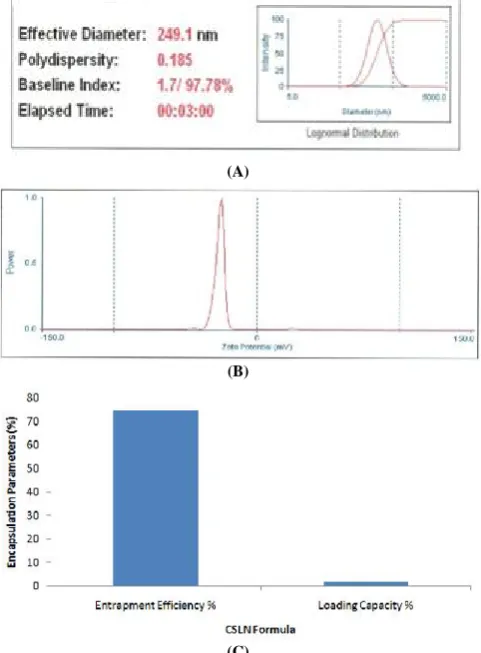
The developed CSLN formula showed a particle size of 249.1 ± 2.9 with a PdI value of 0.185 ± 0.009 and a zeta potential value of - 31.81 ± 1.11 mV. The results obtained were represented in (Fig 2).
Determination of Encapsulation Parameters
The encapsulation parameters investigated (EE % and LC %). The EE % for CSLN formula was 74.51 % ± 0.75 while the LC % was 1.52 % ± 0.75. The obtained results were represented in (Fig 2C).
In-Vitro Release Profile of curcumin and the Kinetic treatment
Figure (3) represented the release profile of curcumin from the developed CSLN formula over a period of 24 hours. Table (1) showed the kinetic treatment of the CSLN formula release data.
Differential Scanning Calorimetry (DSC) analysis
The investigated calorimetric parameters were the melting peaks and the enthalpy energies (∆H) that were described in
(A)
(B)
[image:4.595.69.521.57.396.2](C)
Fig. 2. Physical characterization results of the CSLN Formula: A) Particle size and PdI, B) Zeta Potential and
[image:4.595.43.284.421.748.2]C) Encapsulation Parameters
Fig. 3. The in vitro release of curcumin from the developed CSLN formula over 24 hr
[image:4.595.321.547.424.566.2] [image:4.595.312.555.604.771.2]Stability Studies
Physical stability Study
The visual inspections as well as the physical stability parameters for the CSLN formula at different storage temperatures were represented in table (3).
Chemical Stability Study
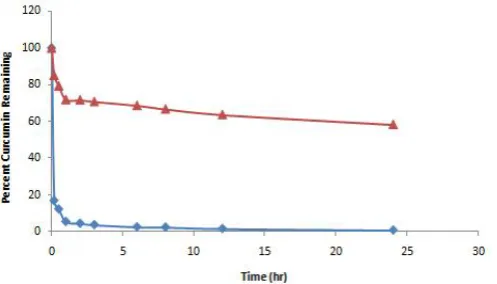
Figure (5) represented the degradation results for native curcumin and the CSLN formula after incubation in PBS solution (0.01 M, pH 7.4) for 24 hr.
Fig. 5. Degradation results for native curcumin ( ) and CSLN Formula ( ) in PBS (0.01 M, pH 7.4)
DISCUSION
Preparation of Curcumin Solid Lipid Nanoparticles (CSLN) formula
CSLN formula was successfully prepared by SIM which gave a yellowish sponge product after freeze-drying. The lyophilized formula was easily redispersed in water and the resultant suspension was subjected to physical characterization tests.
Physical Characterization of CSLN formula
Evaluation of the physical characteristics of the developed CSLN formula is a crucial step in determining the efficiency of the delivery system as they influence the physical stability, cellular uptake, biodistribution and release of the encapsulated drug (Acharya et al., 2009; Mohanty and Sahoo, 2010).
Determination of particle size, PdI and zeta potential values
[image:5.595.58.542.76.117.2]Particle size is a critical determinant for the fate of administered nanoparticles as it governs the distribution of nanoparticles in the body and the small size of particles considered advantageous for passive targeting to tumor tissue by enhanced permeability and retention effect (Mohanty and Sahoo, 2010; Das et al., 2011; Akhtar et al., 2012). The measurement of PdI is very essential as it is considered a measure of the width of the particle size distribution and PdI
Table 1. Kinetic treatment of curcumin release data from the CSLN formula
Formula Model a* b* r* k* t1/2 Mechanism of Release
CSLN Formula
Zero Order 30.064 3.177 0.926 3.177 15.737
Diffusion First Order 2.833 -0.244 -0.913 -0.563 -1.231
[image:5.595.72.527.153.224.2]Diffusion 3.723 20.142 0.972 20.142 6.162 * a = Intercept, b = Slope, r = Regression Coefficient, k = Rate Constant
Table 2. The calorimetric parameters investigated in DSC analysis
Calorimetric Parameters
Onset (°C) Melting point (°C) Enthalpy (J/g)
GMS 70.13 75.37 187.0
P407 53.15 57.24 121.2
Curcumin 172.38 178.32 100.2
B-SLN formula 49.34 53.89 29.22
[image:5.595.46.554.251.442.2]C-SLN formula 49.76 54.86 58.01
Table 3. Physical stability parameters investigated over 3 and 6 months
S to ra g e Te m p er at u re
Physical Stability Parameters 3 months 6 months
C la ri ty T est D ru g P re ci p it at io n P h ase S ep ar at io n G el at io n C o lo r C h an g e C en tr if u g at io n t es t Particle Size
(nm ± SD) PdI ± SD
Zeta Potential (mV ± SD)
Particle Size
(nm ± SD) PdI ± SD
Zeta Potential (mV ± SD)
4 P ass N o n e N o n e N o n e N o n e P
ass 252.6 ± 6.7 0.159 ± 0.01 - 33.13 ± 1.79 266.2 ± 3.3 0.243 ± 0.002 - 37.57 ± 0.95
RT P ass N o n e N o n e N o n e N o n e P
ass 259.9 ± 4.0 0.025 ± 0.03 - 34.23 ± 1.29 273.4 ± 4.6 0.145 ± 0.003 - 38.46 ± 4.27
40 P ass N o n e N o n e N o n e N o n e P
[image:5.595.41.290.602.744.2]was used as an indicator of the uniformity of the size distribution (Nayak et al., 2010; Kovacevic et al., 2011). The PdI value ranges from 0 to 1, a PdI value near to 1 indicates a heterogeneous distribution between sizes of the particles while monodisperse populations yield theoretically a PdI of 0. Very narrow distributed particle populations possess PdI values of about 0.02–0.05 (Salvia-Trujillo et al., 2013). As Shown in figure (2A) the developed CSLN formula showed a particle size of 249.1 ± 2.9 and PdI value of 0.185 ± 0.009 which indicates the homogeneity of the particles. Zeta potential refers to the surface charge of the particles and its value is a useful indicator of particle surface charge, which can be used to predict and control the stability of colloidal suspensions (Das and Chaudhury, 2011). The developed CSLN formula had a zeta potential value of - 31.81 ± 1.11 mV and it is anticipated that these particles will also reveal long-term stability.
Determination of Encapsulation Parameters
The encapsulation parameters investigated (EE % and LC %) were determined by measuring the concentration of free curcumin in the dispersion medium (methanol) after centrifugation of SLN suspension using HPLC analysis method. The EE % for CSLN formula was 74.51 % ± 0.75 indicating relatively good EE % of curcumin while the LC % was 1.52 % ± 0.75. This low LC % is related to the physical characters of curcumin. the poor lipophilicity and the large bulk volume of curcumin will affect the space provided by the GMS crystal lattice so most of the curcumin would be dispersed or dissolved in the coating provided by P407 leading to the formation of core–shell model, drug-enriched shell with a small portion of drug dispersing in the lipid matrix of GMS (Schäfer-Korting et al., 2007; Lv et al., 2009).
In-Vitro Release Profile of curcumin and the kinetic treatment
The investigated CSLN formula showed a biphasic drug release pattern in the in vitro release studies (i.e. a burst release at the initial state followed by a sustained release state) with a total release percent of 85.72 %. The first stage of the release (the burst release or the rapid initial release) was usually attributed to the dissociation of the fraction of drug which is adsorbed onto or nearby the surface of nanoparticles or the polymeric matrix (Nayak et al., 2010; Mohanty and Sahoo, 2010; Shaikh et al., 2009). The second stage of release (sustained release), the release profile will slow down and become sustained due to the time required for the entrapped drug to diffuse from the lipid core into the release medium or might be due to the partition of drug in the hydrophobic core of GMS and subsequently diffusion/erosion of polymeric matrix made the drug released from C-SLNs formulations to the aqueous medium (Nayak et al., 2010; Mohanty and Sahoo, 2010). Table (1) showed the kinetic treatment of the release data of the optimized CSLN formula and it was clear that the release of curcumin followed the Higuchi diffusion model best which came in agreement with many studies (Mulik et al., 2009; Tiyaboonchai et al., 2007).
Differential Scanning Calorimetry (DSC) analysis
DSC analysis is a convenient tool used to investigate the melting and recrystallization behavior of crystalline material like SLNs and DSC measurements offer a valuable tool for
studying the interaction between the drug and the lipid (Jores
et al., 2004; Liu et al., 2005). The investigated calorimetric
parameters were the melting peaks and the enthalpy energies (∆H). The melting process of GMS and P407 took place with
maximum peaks at 75.37°C and 57.24°C, respectively but when they were formulated as SLNs (blank or drug loaded), the endothermic peaks were recorded at a slightly lower temperatures (53.89°C and 54.86°C in case of BSLN and CSLN, respectively). This reduction of the melting point for GMS indicated an increased number of lattice defects onto the lipid matrix, following a lack of uniformity in the crystalline arrangements (Shubert and Müller-Goymann, 2005). For less ordered crystals or amorphous solids, the melting of the substance requires much less energy than crystalline substances that need to overcome lattice forces. Some effect may be due to their nanosize which enhances the surface area/volume basis as described by the Thomson equation or it may be due to the presence of surfactants (Vivek et al., 2007; Teeranachaideekul et al., 2008; Shegokar et al., 2011). Another reason for the decrease in the onset and maximum temperatures of GMS-based lipid nanoparticles is that GMS contains mixtures of mono-, di-, and triglycerides, which increase its lattice defects (Nayak et al., 2010).
The pure curcumin showed a single sharp endothermic peak at 178.32°C corresponds to melting temperature of curcumin. The thermogram of the CSLN formula did not show the melting peak of crystalline curcumin around 178°C. The absence of the melting peak clearly indicates that curcumin encapsulated is in the amorphous or disordered-crystalline phase or in the solid-state solubilized form in the polymeric matrix (Acharya et al., 2009; Das et al., 2011). The possible reason behind that is GMS inhibited the crystallization of curcumin during the nanoparticles formation (Lv et al., 2009). Similar results revealing that drug in SLN were in amorphous state were reported by other researcher groups (Venkateswarlu and Manjunath, 2004; Lv et al., 2009; Liu et al., 2005). The amorphous form was thought to have higher energy with increased surface area, subsequently higher solubility, dissolution rates and bioavailability (Lv et al., 2009; Morissettea et al., 2004). This disordered-crystalline phase of curcumin inside the polymeric matrix helps in sustained release of the drug from the nanoparticles (NPs).
Presence of drug in crystalline form inside NPs hampers its release as such large sized molecules cannot diffuse from the small pores of the NPs. However, if the drug is in amorphous or in disordered-crystalline phase easy diffusion of drug molecules can occur through the polymeric matrix, leading to a sustained release of the encapsulated drug (Mohanty and Sahoo, 2010). Another proof for the state of curcumin encapsulated in the SLN comes from the study of the∆H. The ∆H values for curcumin, B-SLN and C-SLN formulations
were 100.2, 29.22, 58.01 J/g respectively. From these ∆H
besides a certain effect of surfactant (Lv et al., 2009; Jenning
et al., 2000). Therefore, the results proved that the loading of
curcumin provoked no considerable effect on the thermal behavior of lipid matrix under the experimental conditions.
Stability Studies
Physical stability Study
The physical stability results indicated that there was no color change; phase or drug separation; no obvious change of clarity or no degradation was observed as well as no gelation phenomena took place over 6 months storage periods at different temperatures. The centrifuge test was also carried out to assess the physical stability and it proved that the CSLN formula had a good physical stability. Also the physical stability of SLNs dispersions can be investigated by the measurements of particle size, PdI and zeta potential (Das and Chaudhury, 2011). These parameters were investigated as the particle size is a critical safety factor and greatly affects the biodistribution as well as the physical appearance of the product. Since the human eye can only detect light scattered by particles that are greater than ~ 1, the degree of polydispersity can impact particle size growth via Ostwald ripening and can impact the overall drug release kinetics (Pragati et al., 2009). The stability studies conducted at refrigeration, room temperature and 40°C showed only a slight increase in particle size and PdI over the storage periods. The obtained results indicated the investigated formula was found to be stable with very insignificant (P > 0.001) change compared to initial results at each investigated temperature. Also, the results of zeta potential also showed that at various storage conditions the CSLN nanoparticles were stable as there was not much significant change (P > 0.001) in the zeta potential after 3 and 6 months compared to initial results. This good behavior of optimized CSLN imply that the transition of GMS in SLNs from meta-stable forms to stable forms occurred slowly on storage due to small particle size and the presence of emulsifier, and the transition of GMS form in SLNs leaded to drug expulsion from SLNs (Lv et al., 2009; Shegokar et al., 2011).
Chemical Stability Study
One of the major challenges of drug delivery to cancerous tissues is its instability and biodegradation in physiological pH (Mohanty and Sahoo, 2010; Das et al., 2011; Shaikh et al., 2009). In an attempt to study the biodegradation and instability properties of curcumin, we incubated curcumin (native and the CSLN formula) in PBS solution (0.01 M, pH 7.4) and estimated its concentration with time by HPLC. The degradation results for native curcumin and the CSLN formula were graphically represented in figure (5). It was observed that native curcumin underwent rapid degradation in PBS solution (more than 80 % were lost within 10 min and only less than 1 % of curcumin remained intact after 24 hr of incubation). In contrast, the degradation curve for the CSLN formula was relatively flat, indicating that the chemical stability of curcumin had been highly improved and approximately 60 % of curcumin could be detected after 24 hr of incubation.
Conclusion
In the present study, CSLNs were successfully prepared and the developed formula showed a mean particle size of 249 nm with relatively good entrapment efficiency. The CSLN
formula was easily resuspended in DIW producing a homogenous (indicated by the PdI value) and stable (indicated by the high value of Zeta potential) particles. The in-vitro release study indicated that CSLN formula exhibited sustained release after an initial burst release. The DSC analysis performed showed that curcumin is completely entrapped inside the lipid matrix in the amorphous state. The stability studies conducted had proven that CSLN formula is physically and chemically stable. From these results SLNs could serve as a promising delivery system to sustain the release and enhance the solubility of curcumin.
Future Studies
Future studies will be focused on conducting the pharmacokinetic study and efficacy studies of curcumin loaded solid lipid nanoparticles in animal model and ovarian cancer cell lines, respectively.
REFERENCES
Acharya, S., Dilnawaz, F. and Sahoo, S.K. 2009. Targeted epidermal growth factor receptor nanoparticle bio conjugates for breast cancer therapy. Biomaterials, 30(29): 5737-5750.
Akhtar, F., Rizvi, M.A. and Kar, S.K. 2012. Oral delivery of curcumin bound to chitosan nanoparticles cured Plasmodium yoelii infected mice. Biotech. Adv., 30: 310-320.
Almeida, A.J. and Souto, E. 2007. Solid lipid nanoparticles as a drug delivery system for peptides and proteins, Adv.
Drug Deliv. Rev., 59: 478-490.
Anand, P., Kunnumakkara, A.B., Newman, R.A. and Aggarwal, B.B. 2007. Bioavailability of Curcumin: Problems and Promises. Mol. Pharmaceutics, 4(6): 807-818.
Bansal, S.S., Kausar, H., Vadhanam, M.V., Ravoori, S. and Gupta, R.C. 2012. Controlled systemic delivery by polymeric implants enhances tissue and plasma curcumin levels compared with oral administration. Eur. J. Pharm.
Biopharm., 80: 571-577.
Bisht, S., Feldmann, G., Soni, S., Ravi, R., Karikar, C. and Maitra, A. 2007. Polymeric nanoparticle encapsulated
curcumin (“nanocurcumin”): a novel strategy for human
cancer therapy. J. Nanobiotechnol., 5: 3.
Bunjes, H., Drechsler, M., Koch, M.H.J. and Westesen, K. 2001. Incorporation of the model drug ubidecarenone into solid lipid nanoparticles. Pharm. Res., 18: 287-293. Chen, H., Chang, X., Du, D., Liu, W., Liu, J., Weng, T., Yang,
Y., Xu, H. and Yang, X. 2006. Podophyllotoxin-loaded solid lipid nanoparticles for epidermal targeting. J. Cont.
Rel., 110: 296–306.
Dandekar, P.P. and Patravale V.B. 2009. Development and validation of a stability-indicating LC method for curcumin. Chromatographia, 69(9/10):871–877.
Das, S. and Chaudhury A. 2011. Recent advances in lipid nanoparticle formulations with solid matrix for oral drug delivery. AAPS PharmSciTech, 12: 62–76.
Das, S., Ng, W.K., Kanaujia, P., Kim, S. and Tan, R.B.H.
2011. Formulation design, preparation and
physicochemical characterizations of solid lipid nanoparticles containing a hydrophobic drug: Effects of process variables. Col. Surf. B: Biointerfaces, 88: 483-489. Ghosh, D., Choudhury, S.T., Ghosh, S., Mandal, A.K.,
Nanocapsulated curcumin: oral chemopreventive formulation against diethylnitrosamine induced hepatocellular carcinoma in rat. Chem. Biol. Interact, 195: 206-214.
Jenning, V., Thunemann, A.F., Gohla, S.H. 2000. Characterisation of a novel solid lipid nanoparticle carrier system based on binary mixtures of liquid and solid lipids.
Int. J. Pharm., 199: 167–177.
Jores, K., Mehnert, W., Dreshler, M., Bunjes, H., Johann, C. and Mader, K. 2004. Investigations on the structure of solid lipid nanoparticles and oil loaded solid lipid nanoparticles by photon correlation spectroscopy, field flow fractionation and transmission electron microscopy. J.
Cont. Rel., 95: 217.
Khalil, N.M., Frabel do-Nascimento, Casa, D.M., Dalolin, L.F., Cristina de-Mattos A., Hoss, L., Romano, M.A. and Mainardes, R.M. 2013. Pharmacokinetics of curcumin-loaded PLGA and PLGA-PEG blend nanoparticles after oral administration in rats. Col. Surf. B: Biointerfaces, 101: 353-360.
Kovacevic, A., Savic, S., Vuleta, G., Müller, R.H., Keck, C.M. 2011. Polyhydroxy surfactants for the formulation of lipid nanoparticles (SLN and NLC): Effects on size, physical stability and particle matrix structure. Int. J. Pharm., 406: 163-172.
Kulkarni, S.K. and Dhir, A. 2010. Curcumin and Neurological Disorders. Indian J. Pharm. Sci., 72(2): 149-154.
Kunwar, A., Barik, A., Pandey, R. and Priyadarsini, K.I. 2006. Transport of liposomal and albumin loaded curcumin to living cells: An absorption and fluorescence spectroscopic study. Biochim Biophys Acta, 1760: 1513-1520.
Li, X., Nan, K., Li, L., Zhang, Z. and Chen, H. 2012. In vivo evaluation of curcumin nanoformulation loaded methoxy poly(ethyleneglycol)-graft-chitosan composite film for wound healing application. Carbohydrate Polymers, 88: 84–90.
Liu, M., Dong, J., Yang, Y., Yang, X. and Xu, H. 2005. Characterization and release of triptolide-loaded poly (d, l-lactic acid) nanoparticles. Eur. Polym. J., 41: 375-382. Lv, Q., Yu, A., Xi, Y., Li, H., Song, Z., Cui, J., Cao, F. and
Zhai, G. 2009. Development and evaluation of penciclovir-loaded solid lipid nanoparticles for topical delivery. Int. J.
Pharm., 372: 191-198.
Martins, S., Sarmento, B., Ferreira, D.C. and Souto, E.B. 2007. Lipid-based colloidal carriers for peptide and protein delivery—liposomes versus lipid nanoparticles. Int. J.
Nanomed., 2: 595-607.
Mohanty, C. and Sahoo, S.K. 2010. The in vitro stability and in vivo pharmacokinetics of curcumin prepared as an aqueous nanoparticulate formulation. Biomaterials, 31: 6597-6611.
Morissettea, S.L., Almarsson, O., Peterson, M.L., Remenar, J.F., Read, M.J., Lemmo, A.V., Ellis, S., Cima, M.J. and Colin RG. 2004. High-throughput crystallization: polymorphs, salts, co-crystals and solvates of pharmaceutical solids. Adv. Drug Deliv. Rev., 56: 275-300. Mukherjee, S., Ray, S. and Thakur, R.S. 2007. The current
status of solid lipid nanoparticles, Pharmabit., XV(1): 53-60.
Mulik, R.S., Mahadik, K. and Paradkar, A. 2009. Development of curcuminoids loaded poly (butyl)
cyanoacrylate nanoparticles: Physicochemical
characterization and stability study. Eur. J. Pharm. Sci., 37: 395-404.
Nagarajan, S., Kubra, I.R. and Rao L.J.M. 2010. Separation of curcuminoids enriched fraction from spent turmeric oleoresin and its antioxidant potential. J. Food Sci., 75: H158–H162.
Nayak, A.P., Tiyaboonchai, W., Patankar, S., Madhusudhan, B. and Souto, E.B. 2010. Curcuminoids-loaded lipid nanoparticles: Novel approach towards malaria treatment.
Col. Surf. B: Biointerfaces, 81: 263-273.
Pragati, S., Kuldeep, S., Ashok, S. and Satheesh, M. 2009. Solid lipid nanoparticles: A promising drug delivery technology. Int. J. Pharm. Sci. NanoTech., 2(2): 509-516. Salvia-Trujillo, L., Rojas-Graü, M.A., Soliva-Fortuny, R. and
Martín-Belloso, O. 2013. Effect of processing parameters on physicochemical characteristics of microfluidized lemongrass essential oil-alginate nanoemulsions. Food
Hydrocolloids, 30: 401-407.
Schäfer-Korting, M., Mehnert W. and Korting, H. 2007. Lipid nanoparticles for improved topical application of drugs for skin diseases. Adv. Drug Deliv. Rev., 59: 427-443.
Schubert, M.A. and Müller-Goymann, C.C. 2003. Solvent injection as a new approach for manufacturing lipid nanoparticles–evaluation of the method and process parameters. Eur. J. Pharm. Biopharm., 55: 125-131. Shah, M. and Pathak, K. 2010. Development and statistical
optimization of solid lipid nanoparticles of simvastatin by using 23full-factorial design. AAPS PharmSciTech, 11(2): 489-496.
Shaikh, J., Ankola, D.D., Beniwal, V., Singh, D. and Kumar M.N. 2009. Nanoparticle encapsulation improves oral bioavailability of curcumin by at least 9-fold when compared to curcumin administered with piperine as absorption enhancer, Eur. J. Pharm. Sci., 37(3–4): 223-230.
Sharma, R.A., Steward, W.P. and Gescher, A.J. 2007. Pharmacokinetics and pharmacodynamics of curcumin.
Adv. Exp. Med. Biol., 595: 453-470.
Shegokar, R., Singh, K.K. and Müller, R.H. 2011. Production and stability of stavudine solid lipid nanoparticles-from lab to industrial scale. Int. J. Pharm., 416: 461-470.
Shubert, M.A. and Müller-Goymann, C.C. 2005.
Characterization of surface modified solid lipid nanoparticles (SLN): influence of lecithin and non ionic emulsifier. Eur. J. Pharm. Biopharm., 61:77.
Sun, J., Bi, C., Chan, H.M., Sun, S., Zhang, Q. and Zheng, Y. 2013. Curcumin-loaded solid lipid nanoparticles have prolonged in vitro antitumour activity, cellular uptake and improved in vivo bioavailability. Col. Surf. B: Biointerfaces, 111: 367-375.
Suresh, G., Manjunath, K., Venkateswarlu, V. and Satyanarayana, V. 2007. Preparation, characterization, and in vitro–in vivo evaluation of lovastatin solid lipid nanoparticles. AAPS PharmSciTech., 8: E1–E9.
Teeranachaideekul, V., Boonme, P., Souto, E.B., Müller, R.H. and Junyaprasert, V.B. 2008. Influence of oil content on physicochemical properties and skin distribution of Nile red-loaded NLC, J. Cont. Rel., 128: 134-141.
Venkateswarlu, V. and Manjunath K. 2004. Preparation, characterization and in vitro release kinetics of clozapine solid lipid nanoparticles. J. Cont. Rel., 95: 627-638. Vivek, K., Reddy, H. and Murthy, R.S. 2007. Investigations of
the effect of the lipid matrix on drug entrapment, in vitro release, and physical stability of olanzapine-loaded solid lipid nanoparticles. AAPS PharmSciTech., 8: E83.
Wichitnithad, W., Nimmannit, U., Callery, P.S. and Rojsitthisak, P. 2011. Effects of different carboxylic ester spacers on chemical stability, release characteristics, and anticancer activity of mono-pegylated curcumin conjugates. J. Pharm. Sci., 100(12): 5206-5218.
Yadav, V.R., Prasad, S., Kannappan, R., Ravindran, J., Chaturvedi, M.M., Vaahtera, L., Parkkinen, J. and Aggarwal, B.B. 2010. Cyclodextrin-complexed curcumin exhibits anti-inflammatory and antiproliferative activities superior to those of curcumin through higher cellular uptake. Biochem. Pharmacol., 80(7): 1021-1032.
Yallapu, M.M., Jaggi, M. and Chauhan, S.C. 2012. Curcumin nanoformulations: a future nanomedicine for cancer. Drug
Disc. Today, 17(1/2): 71-80.
Zhang, X., Yin, W.K., Shi, X.D. and Li, Y. 2011. Curcumin
activates Wnt/β-catenin signaling pathway through inhibiting the activity of GSK-3β in APPswe transfected
SY5Y cells. Eur. J. Pharm. Sci., 42: 540-546.