In: Advances and Applications of DSmT for Information Fusion (Collected Works). American
Research Press, FIZ Karlsruhe GmbH, pp. 387-409. ISBN 978-1-59973-073-8
http://
strathprints
.strath.ac.uk/
20154
/
Strathprints is designed to allow users to access the research output of the University
of Strathclyde. Copyright © and Moral Rights for the papers on this site are retained
by the individual authors and/or other copyright owners. You may not engage in
further distribution of the material for any profitmaking activities or any commercial
gain. You may freely distribute both the url (
http://
strathprints
.strath.ac.uk
) and the
content of this paper for research or study, educational, or not-for-profit purposes
without prior permission or charge. You may freely distribute the url
(
http://
strathprints
.strath.ac.uk
) of the Strathprints website.
Florentin Smarandache & Jean Dezert
Editors
Advances and Applications of DSmT
for Information Fusion
Collected Works
Volume 3
American Research Press
Rehoboth
(University of Microfilm International) 300 N. Zeeb Road
P.O. Box 1346, Ann Arbor MI 48106-1346, U.S.A.
Phone.: 1-800-521-0600 (Customer Service)
http://wwwlib.umi.com/bod/
The book is also in Amazon Search Inside the Book, in Amazon Kindle, and in Google Book Search. The ISSN 1938-5544 has been assigned by The Library
of Congress, Washington D. C., USA, for this book series.
or downloaded from the web site:
http://www.gallup.unm.edu/~smarandache/DSmT-book3.pdf.
Copyrights 2008 by The Editors, The Authors for their articles and American Research Press, Rehoboth, Box 141, NM 87322, USA.
Download books from the Digital Library of Science
http://www.gallup.unm.edu/~smarandache/eBooks-otherformats.htm
This book has been peer reviewed and recommended for publication by:
1 - Dr. xxxx
2 - Dr. xxxx
ISBN-10: 1-59973-073-1 ISBN-13: 978-1-59973-073-8 EAN: 9781599730738
Printed in the United States of America
This book has been typesetted using LATEX and the memoir class.
Contents
Part I
Advances on DSmT
1
Part II Applications of DSmT
3
Chapter 1 Automatic Goal Allocation for a Planetary Rover
with DSmT 5
by Massimiliano Vasile and Matteo Ceriotti
1.1 Introduction . . . 6
1.2 Plausible and Paradoxical Reasoning . . . 9
1.3 Modelling Interest for a Planetary Rover . . . 10
1.3.1 Modelling of sensor information . . . 10
1.3.2 Definition of the Interest Map . . . 11
1.4 Some Results with DSmT . . . 16
1.4.1 DST applied the generation of the Interest Map . . . 23
1.5 Final Remarks . . . 29
1.6 Acknowledgments . . . 29
1.7 References . . . 30
Biographies of contributors 33
Part I
Advances on DSmT
Part II
Applications of DSmT
Chapter 1
Automatic Goal Allocation for a
Planetary Rover with DSmT
Massimiliano Vasile, Matteo Ceriotti Department of Aerospace Engineering,
University of Glasgow, James Watt South Building,
G12 8QQ, Glasgow, UK
[email protected], [email protected]
Abstract: In this chapter, we propose an approach for assigning an interest level to the goals of a planetary rover. Assigning an interest level to goals, allows the rover to autonomously transform and real-locate the goals. The interest level is defined by data-fusing payload and navigation information. The fusion yields an “interest map”, that quantifies the level of interest of each area around the rover. In this way the planner can choose the most interesting scientific objec-tives to be analysed, with limited human intervention, and reallocates its goals autonomously. The Dezert-Smarandache Theory of Plausi-ble and Paradoxical Reasoning was used for information fusion: this theory allows dealing with vague and conflicting data. In particular, it allows us to directly model the behaviour of the scientists that have to evaluate the relevance of a particular set of goals. This chapter shows an application of the proposed approach to the generation of a reliable interest map.
1.1
Introduction
Based on the experience gathered with past Mars robotic missions, a number of future space missions envisage the use of robots for the exploration of dis-tant planets [1]. All of them have strong scientific requirements but the poor knowledge of the environment where the robots will operate, makes the defini-tion of specific goals dependent on contingent events and observadefini-tions. If the allocation the goals is performed entirely on the ground, the robot will have to wait for new instructions every time a new, unforeseen event occurs or a new set of scientific data is available.
Therefore, it would be desirable to have an autonomous system able to make decisions not only on how to reach a given set of goals but also on which mission goals to select. Furthermore, the persistency of a mission goal may lead the system to repeatedly re-plan in order to meet the goal though the goal is unreachable or has lost its original importance. Goal transformation or goal reallocation is an important feature required in dynamic and rapidly changing environments but can become extremely important also in poorly known environments or when exploration and discovery are the main drivers of a mission [2]. For example, assume that, for a mission to Mars, a set of observations from space is used to define a set of goals for a planetary rover. During the mission, however, the rover may find that the goals are unreachable (e.g. if the goal was to collect a sample of a specific rock, the rock could be unreachable) or not interesting anymore (e.g. a different rock may display more interesting features). Then, the ground control team, together with the scientific community, would have to decide what to do. While the ground control team is devising a new plan and a new set of goals the rover would remain idle waiting for instructions. In order to avoid this waiting time, the idea is to adjust mission goals of the planner in addition to the adjustment of the plans themselves. Previous works on goal transformation addressed terrestrial or military applications [2, 3], and did not include the scientific data coming from the payload in the reallocation process.
1.1. INTRODUCTION 7
planner and the goal transformation algorithm are part of a multi-layer au-tonomous system called Wisdom. The Wisdom system is a non-deterministic, deliberative-reactive system for rover autonomy in harsh, unknown environ-ments. The system was developed and implemented on a six wheeled prototype rover (named Nausicaa) at Politecnico di Milano, as part of a study, supported by the European Space Agency, for the development of advanced systems for space autonomy [5].
In this chapter, we present specifically the approach used in Wisdom to gen-erate an interest value through the data fusion of navigation and payload data for an autonomous planetary rover. The definition of an interest value avoids wild goal sequences for which only an empty set of actions is feasible (a plan with no steps), since only goals that are interesting for the mission can be gen-erated or transformed. In Wisdom, goals are extracted from a pool of high level conceptual directives and are organised into a sequence by using the STRIPS paradigm for planning [6]. Briefly, goals are distributed in a logical sequence from an initial goal to a final one with preconditions and post-conditions, but are not scheduled unless the time is explicitly part of a goal (e.g. reach a given location in a given time). The sequence can be adjusted during execution and is qualified according to the total level of interest of all the goals. The definition of a pool of high level directives limits the set of goals to those for which the au-tonomous system was designed but avoids the persistency of unreachable goals.
Previous attempts to model vague concepts such as interest or curiosity for autonomous agents can be found in the work of Schmidhuber [7], who proposed the use of a co-evolutionary algorithm to evolve curiosity in an artificial intel-ligence system. In this case, however, there is no specific use of instruments or any mission-specific measurements or data to support the decision-making pro-cess. Instead, in this chapter, a full exploitation of scientific data is proposed in order to build an interest map of the surroundings. Pieces of scientific data from different sources are fused with navigation one to yield a single value for each point on the map. The map, then, evolves during the mission depending on the available observations.
The combination of scientific and navigation data requires the fusion of pieces of information coming from physically different sensors. Each sensor measures a different parameter, has its own characteristics, reliability and un-certainty on measurements. Moreover, if each instrument is interpreted as a scientist expressing an opinion, we can associate to each data set an interest level with associated uncertainty. This would mimic the process performed on ground when a new set of scientific data is available. The data fusion process is then required to collect all the different pieces of information, with associated uncertainty, and combine them together [9].
In order to fuse data from the sensors and find the most interesting areas of the surrounding environment, the Dezert-Smarandache theory of plausible and paradoxical reasoning [10] was used. This theory has been successfully applied to many engineering problems, like the estimation of behaviour tendencies of a target [11], or the prediction of the land cover change [12]. In those works, it was proven that this modern theory overcomes the limitations of both fuzzy logic and evidence theory.
The main advantage of the paradoxical reasoning is that it allows dealing simultaneously with uncertain and paradoxical data from different, providing a solution even in the case of conflicting information. A conflict leads to a non-decidable situation that would put the rover into idle mode, waiting for instructions. The conflict could arise when different sources (different instru-ments) are assigning opposite interest values to the same area or when the navigation expert suggests avoiding an area that has a high level of interest. Conflicts on the ground would be resolved through a discussion among the scientists and the mission control team, leading to a new set of goals. An au-tonomous resolution of conflicts by the rover, would reduce the time spent to wait for instructions from the ground station.
1.2. PLAUSIBLE AND PARADOXICAL REASONING 9
1.2
Plausible and Paradoxical Reasoning
The theory of plausible and paradoxical reasoning (or Dezert-Smarandache the-ory, DSmT [10]) is a generalisation of the Dempster-Shafer evidence theory [13], which is in turn a generalisation of the classical probability. The foundation of the DSmT is to abandon the rigid models of the previous theories, because for some fusion problems it is impossible to define or characterise the problem in terms of well-defined and precise and exclusive elements.
Given an experiment, the frame of discernment Θ ={θ1, θ2, ..., θn} is the
set of all possible events. The model on which the DSmT is based allows deal-ing with imprecise (or vague) notions and concepts between elementsθ1of the
frame of discernment Θ. The DSmT includes the possibility to deal with evi-dences arising from different sources of information which do not have access to absolute interpretation of the elementsθi under consideration. This means
that some events may also be overlapped and/or not well defined.
If Θ is the frame of discernment, we can define the spaceDΘ
, called hyper-power set [14], as follows:
1. ∅, θ1, ..., θn∈DΘ;
2. ∀A, B∈DΘ
,(A∪B)∈DΘ
,(A∩B)∈DΘ
;
3. No other elements belong toDΘ
, except those obtained by using rules 1 and 2.
Once DΘ
is defined, we can apply the map m(.) : DΘ
−→ [0,1], called
general basic belief number, or gbba [10], such that:
m(∅) = 0, X
A∈DΘ
m(A) = 1. (1.1)
A set of gbba, referred to the same frame of discernment Θ, is called evi-dence. This approach allows us to model any source that supports paradoxical (or intrinsically conflicting) information. The theory of Dezert-Smarandache defines a rule of combination for intrinsically conflicting and/or uncertain in-dependent sources. If two experts give their opinions in terms of bodies of evidencem1andm2, their combination is given by:
m12(A) = X
B,C∈DΘ
B∩C=A
m1(B)m2(C),∀A∈DΘ
Note that this rule is commutative and associative and requires no nor-malisation procedure. Moreover, it can manage the paradoxical information without any other assumption, thus overtaking some limitations of other prob-ability theories - like the evidence theory - in which the frame of discernment shall be based on a set of exhaustive and exclusive elements. All the pieces of evidence in Eq. 1.2 are then used to give two uncertainty values, the belief and the plausibility:
Bel(A) = X
B∈DΘ|
B⊆A
m(B);
P l(A) = X
B∈DΘ
|B∩A6=∅
m(B). (1.3)
The belief of an event A is the sum of all the prepositions that totally agree with event A, while plausibility sums up all the prepositions that agree with A totally or partially. An estimation through classical probability theory would fall in the interval defined by the values of belief and plausibility.
1.3
Modelling Interest for a Planetary Rover
The high level of autonomy required to a planetary rover demands for the abil-ity to choose the mission goals, without human intervention, once high level mission objectives are defined, in order to maximise the scientific return of the mission. These objectives, such as “look for water”or “look for traces of life”, do not identify exactly where to go and which experiments to perform. The rover should be able to uniquely define what is interesting, by means of the in-formation gathered during the mission, and make decisions without waiting for instructions from the ground station. The collected pieces of information can be incomplete and uncertain. In particular, the Wisdom system uses different sensors to obtain the pieces of evidence required to make a decision. Each in-strument plays the role of a scientist or of a ground control specialist. DSmT is used to model the following situation: each scientist (or specialist) expresses an opinion on the interest of a given object or portion of the surrounding area; the scientist admits no uncertainty but the one that comes from the instruments. On the other hand, every scientist leaves some margin for discussion, accepting the existence of opposite opinions.
1.3.1
Modelling of sensor information
1.3. MODELLING INTEREST FOR A PLANETARY ROVER 11
that give a stereographic view of the surrounding environment (the navigation module). The optical stereo images are used to generate an elevation map of the ground, called Digital Elevation Map or DEM. The DEM is a matrix containing the height of the corresponding point on the ground. The DEM can be a partial reconstruction of the surroundings. Some parts of the terrain may not be in sight, because hidden by other parts (e.g. rocks or hills), and thus it is not possible to have any information about them. Furthermore, the algorithm can fail to determine the height of some points, especially if the image quality is poor. For these reasons, a second matrix is stored together with the DEM: it contains the uncertainty on the elevation of each point in the DEM. Values are between 0 and 1, where the former means total certainty on the elevation. Besides giving information on the elevation of the ground, optical images provide information on the texture of objects and surfaces. A texture map is then created by associating to each point in view an integer value identifying a specific material. Since this information might not be accurate or the image could be poor, a map of uncertainty is associated to the texture map. The payload mounted on Nausicaa generates a thermal map of the environment. This map is analogous to the DEM, but contains the temperature of each visible point. An uncertainty map is then associated to the thermal map, in order to take into account partial information due to occultation or the measurement noise of the infrared sensor. The final step consists of fusing the data of the three maps, to generate a single one: the interest map.
1.3.2
Definition of the Interest Map
The interest map is a matrix in which each element represents the belief that a particular spot on the ground is interesting. A frame of discernment Θ = {I, N I}was defined, where I is the hypothesisinteresting and N I is the hy-pothesisnot-interesting. Interest is a vague concept and is subjective in nature. The associated hyper-power set is defined asDΘ={∅, I, N I, I∪N I, I∩N I},
and gbbas are assigned to the interesting and not interesting hypotheses, but also to:
• I∪N I: uncertain hypothesis. Represents the amount of ignorance, or the lack of knowledge of the expert which is dealing with the gbba assignment. The expert assigns evidence to this hypothesis when the uncertainty on the data is high, due for example to distance, error on the sensor, or even lack of data.
high gbba to the interesting hypothesis while the other assigns a very high gbba to the not interesting hypothesis.
Note that in the classical probability theory, these two additional hypothe-ses do not exist. Furthermore, the difference between the uncertain and the paradoxical cases is that the former expresses uncertainty due to lack of knowl-edge or information, while the latter does not claim any ignorance, but the possibility that both hypotheses could be true at the same time.
As a consequence, the two associated hypotheses are vague, can be over-lapped, and can not be considered as mutually exclusive. The various pieces of information can be conflicting and highly uncertain. These types of infor-mation can be effectively handled through DSmT since it can manage conflicts among various experts and provides a single rule of combination.
The interest map is created point by point (see Fig. 1.2), by fusing all the available pieces of information (or evidence that a point is interesting or not) about each one of the maps as summarised in Fig. 1.1.
1.3. MODELLING INTEREST FOR A PLANETARY ROVER 13
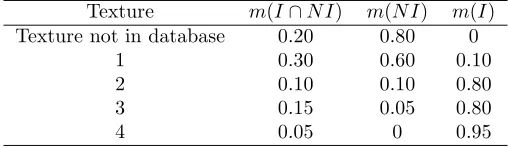
In the same way, the temperature expert assigns interest to some temper-atures (Table 1.2), and the texture expert assigns interest to some specific textures (Table 1.3). Non-dimensional units have been used in these tables. As before, gbba is assigned to the paradoxical hypothesis when the values as-sociated to temperature and texture cannot be used to completely establish whether the point is interesting or not.
Modulus of the
gradient of the DEM m(I∩N I) m(N I) m(I)
[0,1) 0.20 0.80 0
[1,3) 0.30 0.60 0.10
[3,5) 0.10 0.10 0.80
[5,7) 0.15 0.05 0.80
[7,9) 0.05 0.05 0.90
[image:19.595.174.413.289.386.2][9,+∞) 0.05 0 0.95
Table 1.1: Table for the DEM expert.
Temperature m(I∩N I) m(N I) m(I)
[0,20) 0.20 0.80 0
[20,40) 0.40 0.50 0.10
[40,60) 0.05 0 0.95
[image:19.595.191.397.430.504.2][60,80) 0.15 0.05 0.80 [80,100) 0.05 0.05 0.90
Table 1.2: Table for the temperature map expert.
Texture m(I∩N I) m(N I) m(I) Texture not in database 0.20 0.80 0
1 0.30 0.60 0.10
2 0.10 0.10 0.80
3 0.15 0.05 0.80
4 0.05 0 0.95
[image:19.595.166.420.549.623.2]1.3. MODELLING INTEREST FOR A PLANETARY ROVER 15 20 40 60 80 100 20 40 60 80 100 10 20 30 40 50 y DEM x z 5 10 15 20 25 30 35 40 45 50
Figure 1.2: The interest map.
At first no gbba is assigned to the uncertain hypothesis I∪N I; subse-quently, each expert redistributes part of the basic probability associated to the hypothesis I∩N I, N I, I to the hypothesisI∪N I. The gbba are redis-tributed proportionally to the value u of the corresponding uncertainty map associated to each expert map, by using the following classical discounting procedure:
δ(i)←−m(i)·u m(i)←−m(i)−δ(i)
m(I∪N I)←−m(I∪N I) +δ(i)
)
i=I∩N I, N I, I (1.4)
The value ofudepends on the characteristics of the sensor (e.g. measure-ment errors).
The assignment process presented in Eq. 1.4 is applied to each point on the DEM. Given the three sets of evidence by each expert, the general combination rule for paradoxical sources of DSmT is applied, and the combined evidence is computed. The following step is to compute the belief in the hypothesis
interesting,Bel(I). This value gives a pessimistic estimation (lower boundary) of the probability of that point to be actually interesting. Therefore, the in-terest map will contain, for each point on the DEM, the belief that point is interesting, according to the high level mission goals. The planner will then give more importance to those areas that are more likely to be interesting, and will reallocate the goals in order to maximise the cumulative value of interest with the highest reliability. In the following section we will present how each maps are generated and how the belief is computed for a specific test case.
1.4
Some Results with DSmT
1.4. SOME RESULTS WITH DSMT 17 20 40 60 80 100 20 40 60 80 100 10 20 30 40 50 y DEM x z 5 10 15 20 25 30 35 40 45 50
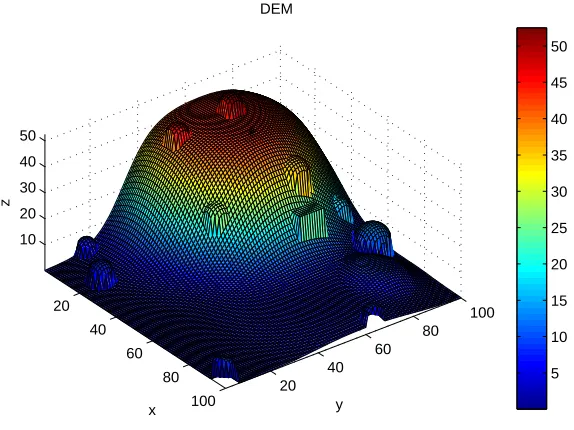
Figure 1.3: DEM of the synthetic landscape: bumped features represent rocks.
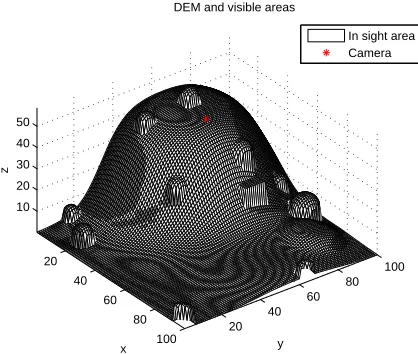
20 40 60 80 100 20 40 60 80 100 10 20 30 40 50 y DEM and visible areas
x
z
In sight area Camera
[image:22.595.172.381.448.625.2]0
10
20
30
40
50
60
70
80
90
100
0 20 40 60 80 100
y unc−dem
x
0 0.1 0.2 0.3 0.4 0.5 0.6 0.7 0.8 0.9 1
Figure 1.5: The resulting uncertainty map associated to the DEM.
The expert that creates the evidence from the DEM first computes the map of the gradient of the terrain, starting from its elevation; then, it assigns high interest to the points which have a high gradient, and low interest to other points (Table 1.1).
1.4. SOME RESULTS WITH DSMT 19 0 10 20 30 40 50 60 70 80 90 100
0 20 40 60 80 100
y Max DEM gradient
x 0 2 4 6 8 10
Figure 1.6: Representation of the absolute value of the gradient of the DEM.
0 10 20 30 40 50 60 70 80 90 100
0 20 40 60 80 100
IR map y x 5 10 15 20 25 30 35 40 45
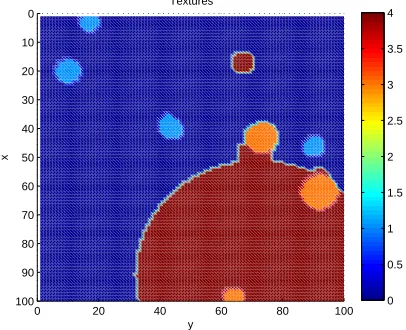
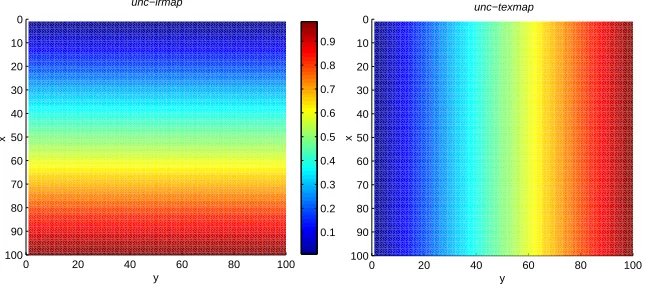
The texture distribution is represented in Fig. ??: four different patterns have been considered, each one corresponding to one colour in the figure. The reference textures with their associated level of interest are stored in a database onboard. The expert of this map assigns the gbba according to the reference values in Table 1.3: it was assumed texture 4 (coloured in brown in Fig. 1.8) has the a greatest probability to be interesting for this particular mission. The experts associated to the texture and infrared maps generate the corresponding uncertainty maps in a similar fashion as the expert of the DEM: they check for visibility of each point and surface in the map. In fact, if the infrared image and optical image are captured simultaneously, without moving the rover, the unknown areas must be the same. However, this yields the same level of un-certainty for the same points on all the three maps. Therefore it was assumed that the uncertainties for the infrared map grows linearly from the bottom end of the map to the upper end of the map, while the uncertainty on the texture grows linearly from the right end to the left end of the map, as shown in Fig. 1.9. Note that this assumption has no particular physical meaning, but it al-lows us to have areas with very different and mixed levels of uncertainties, thus testing properly the proposed data fusion framework. A different distribution of uncertainty, though producing different values, does not change the signifi-cance of the results presented in this chapter. As stated above, in a real case, the uncertainty map would depend on the properties of the instruments and on the level of confidence of the scientists in their own judgement.
0 10 20 30 40 50 60 70 80 90 100
0 20 40 60 80 100
[image:25.595.188.391.496.661.2]y Textures x 0 0.5 1 1.5 2 2.5 3 3.5 4
1.4. SOME RESULTS WITH DSMT 21 0 10 20 30 40 50 60 70 80 90 100
0 20 40 60 80 100
y unc−irmap x 0 10 20 30 40 50 60 70 80 90 100
0 20 40 60 80 100
[image:26.595.134.458.211.353.2]unc−texmap y x 0.1 0.2 0.3 0.4 0.5 0.6 0.7 0.8 0.9
Figure 1.9: The uncertainty associated to the infrared map (left) and to the texture map (right).
Given the maps and the experts, the result of the fusion process, as ex-plained in paragraph 1.3.2, is the interest map shown in Fig. 1.10. The value associated to each point in the map represents the belief that the point is inter-esting. The areas identified by the letters A, B, C, D, E, F, G, H and I in Fig. 1.10, corresponding to rock borders, are marked as very interesting because of the high gradient value. It shall be noted that only the parts in sight of the cameras are interesting (this is particularly noticeable in the case of spots B, C, D and G). Where the rock is hidden, the gradient is high, but its unreliabil-ity is high, as well; thus, the assignment from the expert is uncertain and the associated belief is low. The circular area identified with letter L is considered interesting mainly by the expert of the infrared map but its visibility is high as well as its reliability. In fact, Fig. 1.7 shows that the temperature is high in that area and Fig. 1.9a shows that for that area, the infrared map has a low uncertainty value; thus the information it gives is considered to be very reliable.
Notice how both the infrared and the DEM expert regarded this area as not interesting but both the DEM and the texture experts stated that the reliability of what observed was good while the infrared stated the opposite. Nonetheless, the fused reliability of the texture and of the DEM maps supports the hypothesis that this area is worth a visit and is safe enough; as a conse-quence the associated belief is moderately high. Finally a three dimensional representation of the interest map superimposed onto the DEM can be seen in Fig. 1.11.
0
10
20
30
40
50
60
70
80
90
100
0 20 40 60 80 100
Interest map (Belief of "Interesting" hypothesis)
y
x
0.1 0.2 0.3 0.4 0.5 0.6 0.7 0.8 0.9 1
1.4. SOME RESULTS WITH DSMT 23 20 40 60 80 100 20 40 60 80 100 10 20 30 40 50 y
DEM coloured with belief of "Interesting" hypothesis
[image:28.595.136.453.226.450.2]x z 0.1 0.2 0.3 0.4 0.5 0.6 0.7 0.8 0.9 1
Figure 1.11: Interest map superimposed on the DEM.
1.4.1
DST applied the generation of the Interest Map
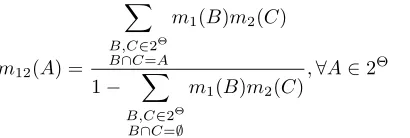
The DSmT can be considered as an extension of the Dempster-Shafer Theory of Evidence (DST), from which it was derived. In fact, the DST is a partic-ular case of the DSmT, in which all the sets of a given frame of discernment are disjoint (i.e., ∀A, B ∈ Θ, A 6= B → A∩B = ∅). As a consequence, the set of possible hypotheses for a frame of discernment Θ = {θ1, θ2} is its power set 2Θ ={∅, A, B, A∪B}. As for the DSmT, we have m(∅) = 0 and P
A∈DΘm(A) = 1 but in this caseD
m12(A) =
X
B,C∈2Θ
B∩C=A
m1(B)m2(C)
1− X
B,C∈2Θ
B∩C=∅
m1(B)m2(C)
,∀A∈2Θ (1.5)
The Belief and Plausibility functions are computed in the same way as in the DSmT, that is using Eq. 1.3, given that the power set 2Θ
shall be con-sidered.The different behaviour of the two theories is evident when conflicting bpas are given by the experts. In particular, the famous Zadeh’s example [10] highlights the counter-intuitive results which the DST can lead to, while the DSmT is able to solve the contradiction in the sources of information quite easily, thank to the presence of the paradoxical hypothesis.
A simple case that brings to quite different results is when the assignments of two different sources are given, as in Table 1.4. In this case, the evidence of the two experts is almost totally conflicting, with a small uncertainty: this situation can happen, for example, when the terrain is flat (then not interesting for the DEM expert) but the texture is very interesting. The fusion through the DST, according to Eq. 1.5, leads to the combined bpa shown in the first column of Table 1.5. The DST combination rule assigns the same amount of evidence to both the hypotheses I and N I. In this framework, the value of
Bel(I) is the same asm(I). In essence, the DST states that the point has the same probability of being interesting or not interesting, which does not allows the rover to take a decision on whether to investigate that point or not. On the other hand, the DSmT assigns most of the evidence to the paradoxical hypothesisI∩N I , which is contributing in the value ofBel(I) .
Expert 1 Expert 2
mi(I) 0.99 0
mi(N I) 0 0.99
[image:29.595.197.402.214.283.2]mi(I∪N I) 0.01 0.01
Table 1.4: Example of conflicting bodies of evidence for two different experts.
1.4. SOME RESULTS WITH DSMT 25
According to these values, the consequent bpas (or gbba) are also shown in the same table.
DST DSmT
m12(I) 0.4975 0.0099
m12(N I) 0.4975 0.0099
m12(I∪N I) 0.005 0.0001
m12(I∩N I) - 0.9801
[image:30.595.222.370.238.313.2]Bel(I) 0.4975 0.99
Table 1.5: Combined evidence and Belief according to DST and DSmT, for evidence provided by the two experts in Table 1.4.
Value m(I∩N I) m(N I) m(I) m(I∪N I) Gradient
of the DEM 6.088 0.15 0.05 0.8 0
Texture 4 0.017 0 0.323 0.66
[image:30.595.145.453.369.431.2]Temperature 10.23 0.162 0.648 0 0.19
Table 1.6: Values of the three maps at point (67, 20), uncertainties, and cor-responding assignments made by the experts.
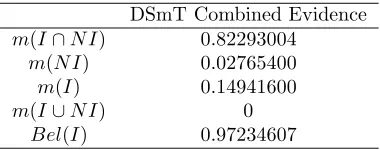
The result of the combination through the DSmT is shown in Table 1.7. In conclusion, according to the DSmT, the point should be highly interesting, as the belief of the Ihypothesis is close to one.
DSmT Combined Evidence
m(I∩N I) 0.82293004
m(N I) 0.02765400
m(I) 0.14941600
m(I∪N I) 0
Bel(I) 0.97234607
Table 1.7: Combined evidence and Belief using the DSmT combination rule, for bodies of evidence given in Table 1.6.
[image:30.595.202.392.526.601.2]I∩N I to the hypothesisI∪N I, as in Table 1.8, since a conflict of opinions would lead to a stall in the decision making process, analogous to a lack of in-formation. Note that, for this case, a different choice of the bpa re-assignment would not change substantially the result obtained with the DST. Applying the DST combination rule, we obtain the evidence in Table 1.9. Then we can state that, using the DST, the belief in the interesting hypothesis is signifi-cantly lower than for the DSmT. The border of the rock will not be a primary objective to analyse for the rover in this case.
m(N I) m(I) m(I∪N I) Gradient of the DEM 0.05 0.8 0 + 0.15
Texture 0 0.323 0.66 + 0.017 Temperature 0.648 0 0.19 + 0.162
Table 1.8: Re-assignment of the gbba of the paradoxical hypothesis to the uncertain hypothesis.
Dempster Combined Evidence
m(N I) 0.2296
m(I) 0.6881
m(I∪N I) 0.0824
Bel(I) 0.6881
Table 1.9: Combined evidence and Belief using the Dempster combination rule, for bodies of evidence given in Table 1.8.
A great number of fusion rules exists, in the DST framework: among those, a set of Proportional Conflict Redistribution rules (PCR) has been studied. The so-called PCR5 is claimed to be the most mathematically exact rule for redistributing the conflicting mass [15]. Since the computation of the combined bpas using the PCR5 becomes quite complicated when more than 2 sources are involved (and in this example they are 3), we decided to show the results of the fusion using the approximated formulation PCR5b. The final masses are obtained in two steps: first, the masses m1(·) and m2(·) relative to experts 1 and 2 are combined using the DSmT classical rule, obtaining m12(·); then the resulting masses are combined again with source 3, givingm123(·). At this
point, the conflicting massm123(A∩B) is redistributed proportionally to the
basic probability assignments of the experts, according to the rule. If we call
mP CR5b{12}3(·) the combined evidence after the redistribution of the conflict,
1.4. SOME RESULTS WITH DSMT 27
mP CR5b{12}3(I) =m123(I) +m3(I)m12(I∩N I)+ m12(I) m12(I)m3(N I)
m12(I) +m3(N I)+m3(I)
m3(I)m12(N I) m3(I) +m12(N I)
mP CR5b{12}3(N I) =m123(N I) +m3(N I)m12(I∩N I)+ m3(N I) m12(I)m3(N I)
m12(I) +m3(N I)+m12(N I)
m3(I)m12(N I)
m3(I) +m12(N I)
mP CR5b{12}3(I∪N I) =m123(I∪N I) +m3(I∪N I)m12(I∩N I)
(1.6)
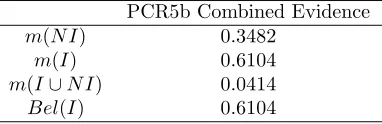
This rule leads to the combined evidence shown in Table 1.10. Although the redistribution of the conflicting masses changed the results slightly with respect to the classical DST combination rule, the difference with the DSmT remains remarkable.
PCR5b Combined Evidence
m(N I) 0.3482
m(I) 0.6104
m(I∪N I) 0.0414
[image:32.595.202.393.407.469.2]Bel(I) 0.6104
Table 1.10: Combined evidence and Belief using the PCR5b combination rule, for bodies of evidence given in Table 1.8.
1.4.1.1 Application of DST to a modified frame of discernment
If the frame of discernment is refined in the following way: Θref = {I ∩
N I, I/(I∩N I), N I/(I∩N I)}, then we can apply DST and obtain a result equivalent to the one computed using DSmT. Given the new refined frame of discernment, the power set is:
2Θref
={∅, X, Y, Z, X∪Y, X∪Z, Y ∪Z, X∪Y ∪Z} (1.7)
where:
X=I∩N I Y =I∪(I∩N I)
Z=N I∪(I∩N I)
Let us denote with prime the bpas referred to the refined frame of discern-ment. If we assign the bpas for each generic expertiin the following way:
m0
i(X) =mi(I∩N I)
m0
i(X∪Y) =mi(I)
m0i(X∪Z) =mi(N I)
m0i(X∪Y ∪Z) =mi(I∪N I)
m0i(A∈2
Θref
, A6=X, X∪Y, X∪Z, X∪Y ∪Z) = 0
(1.9)
and the DST combination rule in Eq. 1.5 is applied, we have that:
1− X
B,C∈2Θref B∩C=∅
m01(B)m02(C) = 1 (1.10)
Computing the bpa, for example, form012(X), we obtain: m012(X) =m10(X)m02(X) +m01(X∪Y)m02(X∪Z)+
m01(X∪Z)m02(X∪Y) +m01(X)m02(X∪Y)+ m01(X)m02(X∪Z) +m01(X)m02(X∪Y ∪Z)+ m02(X∪Y)m02(X) +m01(X∪Z)m02(X)+ m01(X∪Y ∪Z)m02(X)
(1.11)
On the other hand, applying the DSmT combination rule 1.2 to the standard frame Θ ={I, N I}, we obtain form12(I∩N I):
m12(I∩N I) =m1(I∩N I)m2(I∩N I)+
m1(I)m2(N I) +m1(N I)m2(I) +m1(I∩N I)m2(I)+
m1(I∩N I)m2(N I) +m1(I∩N I)m2(I∪N I)+
m1(I)m2(I∩N I) +m1(N I)m2(I∩N I)+
m1(I∪N I)m2(I∩N I)
(1.12)
Eq. 1.11 and Eq. 1.12 are equivalent and return the same value. The same happens form012(X∪Y ∪Z),m012(X∪Z), m012(X). Therefore, the
1.5. FINAL REMARKS 29
hypothesesIandN I without the need for an artificial redefinition of the frame of discernment. Furthermore, it should be noted that DSmT allows the direct treatment of a case in which a source is totally sure about its assignment and therefore cannot assign any probability to the hypothesisI∪N I. In this case assigning a probability to the hypothesisI∩N I would correspond to allowing some room for discussion and opposite opinions as mentioned above.
1.5
Final Remarks
In this chapter, an algorithm for the definition of the level of interest of mission goals for a planetary rover was presented. By fusing navigation data and pay-load data (infrared camera in this specific case), the rover was endowed with the capability to autonomously assign a level of interest to mission goals. The interest level allows the rover to prioritise, reallocate and choose the most ap-propriate set of goals depending on contingent situations. The modern theory of Plausible and Paradoxical Reasoning was used to generate an interest map by which the rover can reallocate its goals autonomously in order to maximise the scientific return of the mission. The theory gives the possibility of dealing with vague quantities, like the degree of interest of an object. In particular, the advantage of DSmT is the possibility to directly assign a level of interest to hypothesisIandN I for each point of the DEM, leaving room for potential disagreements among the scientists or between the scientists and the ground control team. The results showed that the proposed approach is suitable to uniquely identify the interesting zones, given the high level scientific goals of the mission. The goals can be easily modified or tuned, by changing the experts used into the data fusion process.
1.6
Acknowledgments
1.7
References
[1] P. Baglioni, R. Fisackerly, B. Gardini, G. Gianfiglio, A.L. Pradier, A. San-tovincenzo, J.L. Vago, M. van Winnendael, The Mars exploration plans of ESA: The ExoMars mission and the preparatory activities for an inter-national Mars Sample Return mission, IEEE Robotics and Automation Magazine, 13(2), pp. 83-89, 2006
[2] A. Stentz, M. Hebert,A complete navigation system for goal acquisition in unknown environments, Autonomous Robots, 2(2), pp. 127-145, 1995.
[3] M.T. Cox, M.M. Veloso, Goal transformations in continuous planning, Proceedings of the 1998 AAAI Fall Symposium on Distributed Continual Planning, Menlo Park, CA, 1998.
[4] M. Williamson, S. Hanks,Optimal Planning With a Goal-Directed Utility Model, proceedings of the Second International Conference on AI Planning Systems, 1994.
[5] M. Vasile, M. Massari, G. Giardini,WISDOM - An advanced intelligent, fault-tolerant system for autonomy in risky environments, ESA-ITI Final study report, 2005.
[6] M. Veloso, J. Carbonell, A. Perez, D. Borrajo, E. Fink, J. Blythe, Inte-grating planning and learning: the Prodigy architecture, Journal of Exper-imental & Theoretical Artificial Intelligence, 7(1), p. 81, 1995.
[7] J. Schmidhuber,Artificial Curiosity Based on Discovering Novel Algorith-mic Predictability Through Coevolution, Proceedings of the Congress on Evolutionary Computation, Lugano, Switzerland, 1999.
[8] L. Wald, Some terms of reference in data fusion, IEEE Transactions on Geoscience and Remote Sensing, 37(3 pt 1), pp. 1190-1193, 1999.
[9] M. Ceriotti, M. Vasile, G. Giardini, M. Massari,A non-deterministic plan-ner for planetary rover autonomy, Proceedings of the AIAA/AAS Astro-dynamics Specialist Conference and Exhibit, Keystone, CO, USA, 2006.
[10] J. Dezert,Foundations for a new theory of plausible and paradoxical rea-soning, Information & Security, An International Journal, edited by Prof. Tzv. Semerdjiev, CLPP, Bulgarian Acad. of Sci., 9, 2002.
1.7. REFERENCES 31
[12] S. Corgne, L. Hubert-Moy, J. Dezert, G. Mercier,Land cover change pre-diction with a new theory of plausible and paradoxical reasoning, Proceed-ings of the Sixth International Conference of Information Fusion, Cairns, Australia, 2003.
[13] G. Shafer,A mathematical theory of evidence, Princeton University Press, Princeton, 1976.
[14] J. Dezert, F. Smarandache,On the generation of hyper-power sets for the DSmT, Proceedings of the Sixth International Conference of Information Fusion, Cairns, Australia, 2003.
Biographies of contributors
Matteo Ceriotti was born near Milan, Italy, on June 15, 1980. He received the M.Sc. summa cum laude from Politecnico di Milano in 2006 with a thesis on “Non Deterministic Planning and Data Fusion with the Evidence Theory”. The thesis was part of a study for planetary rover autonomy in collaboration with the European Space Agency. At present, he is a Ph.D. candidate at the Department of Aerospace Engineering of the University of Glasgow, United Kingdom. His study is focused on global optimisation for multi-gravity assist interplanetary trajectories. His research interests are space mission analysis, global optimisation, spacecraft autonomy and artificial intelligence.
Address: Department of Aerospace Engineering, University of Glasgow, James Watt South Building, G12 8QQ, Glasgow, UK.
E-mail: [email protected]
Milan Daniel was born in Prague in 1962. He graduated in the Faculty of Mathematics and Physics of Charles University Prague in 1985. He defended his PhD thesis in the Institute of Computer Science of the Academy of Sci-ences of the Czech Republic in 1993. His research activities have been always related to the Institute, the department of Theoretical Computer Science, for-merly the department of Knowledge Based Systems. Author’s current main scientific interests are belief functions, namely combination of belief functions and probabilistic transformations of belief functions. The other interests are uncertainty processing, fuzzy logic and knowledge based systems.
Address: Institute of Computer Science, Academy of Sciences of the Czech Republic, Pod vod´arenskou vˇeˇz´ı 2, CZ - 182 07 Prague 8, Czech Republic. Web page: http://www.cs.cas.cz
E-mail: [email protected]
Jean Dezert was born in l’Hay les Roses, France, on August 25, 1962. He received the electrical engineering degree from the Ecole Fran¸caise de Ra-dio´electricit´e Electronique and Informatique (EFREI), Paris, in 1985, the D.E.A.
BIOGRAPHIES OF CONTRIBUTORS 35
Address: Office National d’´Etudes et de Recherches A´erospatiales (ONERA), D´epartement Traitement de l’Information et Mod´elisation, BP-72, 29 Avenue de la Division Leclerc, 92322 Chˆatillon Cedex, France.
Web page: http://www.gallup.unm.edu/~smarandache/DSmT.htm
E-mail: [email protected],[email protected]
Catholijn M. Jonker obtained her MSc in Computer Science from the Univer-sity Utrecht in 1990 after which she obtained her PhD in Artificial Intelligence from the same university in 1994. After positions at various universities, she currently is full professor Man-Machine Interaction with the faculty of Electri-cal Engineering, Mathematics and Computer Science at the Delft University of Technology. In 2005 and 2006 Prof. Catholijn Jonker was chair of the Young Academy (De Jonge Acedemie) of the Royal Netherlands Academy for Sci-ences (KNAW) in the Netherlands. In 2008 Catholijn Jonker was granted a prestigious national VICI innovation grant for her project called The Pocket Negotiator.
Address: Delft University of Technology, Faculty of Electrical Engineering, Mathematics and Computer Science, Man-Machine Interaction Group, 2628 CD Delft, the Netherlands.
Web page: www.mmi.tudelft.nl
E-mail: [email protected]
Adam Kawalec was born in Poland in 1949. He received his M.Sc. degree in solid state electronics and his Ph.D degree from the Department of Technical Physics, and his D.Sc. degree in electronics, acoustoelectronics from the De-partment of Electronics, Military University of Technology, Warsaw, Poland in 1974, 1980, 2002, respectively. In 1974, he joined the Military University of Technology, Department of Technical Physics, Warsaw, Poland, where he was involved in surface acoustics waves convolvers research. Since 1979, he has tested SAW dispersive delay lines applied in radar pulse compression systems and SAW sensors. He is currently an Associate Professor of the Department of Electronics, Military University of Technology, Warsaw, Poland, where he teaches courses in acoustoelectronics and the basic of telecommunications. Pro-fessor Kawalec is a Head of the Institute of Radioelectronics, Department of Electronics, Military University of Technology, Warsaw, Poland. He is the author and co-author of more then 120 scientific papers published in interna-tional and nainterna-tional journals and conference proceedings and co-inventor of five patents.
E-mail: [email protected]
Ksawery Krenc was born in Poland in 1975. He received his M.Sc. in Auto-matics and Robotics, Faculty of Electronics Telecommunication and Informat-ics from The Technical University of Gdansk in 2001. In 2002, he joined RD Marine Technology Centre, as a program writer. In 2004, he got promoted to the analyst position. He elaborated the specification of data collecting and data fusion applications for Leba-3 (Polish Marine C&C system). Since 2006, he has been publishing solutions related to data (and information) fusion for C&C systems’ purposes. In 2007, he got promoted to the senior analyst posi-tion. Since 2007 up to now, he has been the Sensor Networks research team manager in Polish NEC consortium. He is currently working towards Ph.D. de-gree. His current research interests focus on information fusion for the purpose of C&C systems with a particular emphasis on applying evidential theories like Dempster-Shafer Theory and Dezert-Smarandache Theory.
Address: RS-SD, R&D Marine Technology Centre, Gdynia, Poland. E-mail: [email protected]
Xinde Li was born in Shandong province, China, on September 30, 1975. He graduated from Shenyang institute of chemistry technology, Shenyang, China in 1997 and he received his Master degree from Shandong University, Jinan,China in 2003 and his Ph. D. degree from Huazhong University of Science and Tech-nology, Wuhan,China, in 2007. Currently, he works as a Lecturer in the School of Automation, Southeast University, China. His main research interests in-clude information fusion, robot perception, computer vision, pattern recogni-tion, robot’s map building and localization and multi-robot system.
Address: Institute of Intelligent Robot and Intelligent Control, School of Au-tomation, Southeast University, Si Pai Lou 2#, Nanjing 210096, China. E-mail: [email protected]
Arnaud Martin was born in Bastia, France in 1974. He received the Ph.D. degree in Signal Processing (2001), and the Master degree in Probability (1998) from the university of Rennes, France. Dr. Arnaud Martin worked on speech recognition during three years (1998-2001) at France Telecom R&D, Lannion, France. He worked in the department of statistic and data mining (STID) of the IUT of Vannes, France, as temporary assistant Professor (ATER) during two years (2001-2003). In 2003, he joined the laboratory E3
I2
BIOGRAPHIES OF CONTRIBUTORS 37
the classification of real data and include data fusion, data mining, signal processing especially for sonar and radar data.
Address: ENSIETA E3
I2
Laboratory, 2, rue Fran¸cois Verny, 29806 Brest Cedex 9, France.
Web page: http://www.ensieta.fr/e3i2/Martin
E-mail: [email protected]
Information Fusion in Cairns, Australia.
Address: Dept. of Math., Univ. of New Mexico, 200 College Road, Gallup, NM 87301, U.S.A.
Web page: http://www.gallup.unm.edu/~smarandache/
E-mail: [email protected].
Albena Tchamova is Associate Professor at the Department of Mathematical Methods for Sensor Information Processing, Institute for Parallel Processing, Bulgarian Academy of Sciences. She received M.Sc. degree in Microelectron-ics and Ph.D. degree in Radiolocation and Radionavigation (Target Attributes Identification and Classification on the base of Evidence Reasoning Theory and Fuzzy Logic) from the Technical University of Sofia, Bulgaria, in 1978 and 1998 respectively. She worked as a researcher in numerous academic and industry projects (Bulgarian and international) in the area of Multisensor Multitarget Tracking (MS-MTT) and Data Fusion. She is a member of the IEEE, member of International Society for Information Fusion (ISIF), Association of European Operational Research Societies on Fuzzy Sets (EUROFUSE), Image Recogni-tion Society, BAS. Dr. Tchamova’s current research interests include MS-MTT, Target Identification, Dezert-Smarandache Theory of Plausible and Paradoxi-cal Reasoning, Information Fusion, Decision Making under Uncertainty. Address: Institute for Parallel Processing, Bulgarian Academy of Sciences, “Acad. G. Bonchev” Str.,bl.25-A, 1113 Sofia, Bulgaria.
E-mail: [email protected].
Willem L. van Nordenobtained his MSc Media and Knowledge Engineering in 2005 with the Delft University of Technology. During his active career in the Royal Netherlands Navy he was commissioned on an Air Defense and Com-mand frigate as a System Responsible Officer and Lt. Wilbert van Norden is now commissioned as Business Analyst at Force Vision, the centre for au-tomation of mission-critical system of the Defense Material Organization in the Netherlands. He works in the Planning and Decision Support department, where he focusses on sensor management concepts and automated classifica-tion support. For his MSc thesis titled Intelligent task scheduling in sensor networks: Introducing three new scheduling methodologies Wilbert van Norden received the best thesis award 2005 from the The Hague chapter of the Armed Forces Communications and Electronics Association (AFCEA).
Address: CAMS – Force Vision, MPC 10A, P.O. Box 10000, 1780 CA, Den Helder, the Netherlands.
Web page: www.forcevision.nl
BIOGRAPHIES OF CONTRIBUTORS 39
Massimiliano Vasile received his Master and Ph.D. degrees from the Depart-ment of Aerospace Engineering of Politecnico di Milano, Italy, in 1996 and 2000 respectively. From 2001 to 2003 he worked as Research Fellow in the Ad-vanced Concepts Team of the European Space Agency (ESA), on new methods for Space Mission Analysis and Design and Trajectory Optimization. From 2004 to 2005 he worked as a lecturer in Space System Engineering in the De-partment of Aerospace Engineering of Politecnico di Milano. Since 2005, he has been a Lecturer in the Department of Aerospace Engineering and Head of Research for the Space Advanced Research Team at the University of Glasgow (http://www.aero.gla.ac.uk/Research/SpaceArt). His main research interests are: Space Mission Analysis and Design, Global and Multiobjective Optimiza-tion, Bio-inspired Optimization Methods, Asteroids, Evolutionary Computa-tion, Concurrent Engineering, Multidisciplinary Design, Swarm Intelligence, Formation Flying, Autonomous Robotic Systems. He is member of the IEEE, AIAA and AIRO.
Address: Department of Aerospace Engineering, University of Glasgow, James Watt South Building, G12 8QQ, Glasgow, UK.