RESEARCH ARTICLE
The design of a legacy indicator tool
for measuring climate change related impacts
on built heritage
Cathy Daly
*Abstract
Background: We are experiencing a period of climate change the extent and impact of which is uncertain. In the cultural heritage sector the need for monitoring to inform our understanding is widely agreed, yet there is a lack of consensus over what constitutes ‘monitoring for climate change’. This is due, at least in part, to the extended time-scales involved. In this paper the design and implementation of one solution is described; a sustainable legacy indica-tor tool (LegIT) for the long term tracking of surface weathering effects on built heritage.
Results: The assessment of climate change impacts requires 30–100 years of data collection, equal to the period referred to as the ‘climate norm’ by meteorologists. The LegIT is a sacrificial stone object that registers changes in the severity and/or magnitude of weathering patterns on built surfaces, providing a legacy data source for future decision makers. To ensure its sustainability, careful thought was given to the choice of materials, data retrieval and archiving. The tool aims to track surface changes caused by recession, salt crystallisation and microbiological growth.
Conclusion: The development and installation of the LegIT is the first long-term exposure trial to be initiated at herit-age sites in Ireland and is intended as a legacy for future researchers.
Keywords: Cultural heritage, Management, Climate change, Stone, Weathering, Monitoring, Sustainability, Indicator
© 2016 The Author(s). This article is distributed under the terms of the Creative Commons Attribution 4.0 International License (http://creativecommons.org/licenses/by/4.0/), which permits unrestricted use, distribution, and reproduction in any medium, provided you give appropriate credit to the original author(s) and the source, provide a link to the Creative Commons license, and indicate if changes were made. The Creative Commons Public Domain Dedication waiver (http://creativecommons.org/ publicdomain/zero/1.0/) applies to the data made available in this article, unless otherwise stated.
Background
Although the scientific consensus is that our global cli-mate is changing, there is no certainty about either the scale of that change or its impacts [1]. Undoubtedly, as the climate alters, so too will the nature of its effects on cultural heritage buildings, sites and monuments. To manage this process an evidence base of observations from built heritage will be necessary. This task is com-plicated however, by the fact that distinguishing climate change impacts from those attributable to normal climate variability requires measurements spanning over at least 30 years (the ‘climate norm’). The sustainability of moni-toring procedures for extended periods (vis à vis staffing, equipment and funding for heritage) is therefore crucial in the selection of suitable monitoring solutions [2].
Some of the monitoring methods currently in use1,
both for indoor/outdoor climate and the deterioration of materials requires a level of funding and technical capa-bility that may be difficult for under-resourced heritage
sites to maintain [3, 4]. Computerised environmental
monitoring systems and digital data are also at risk from equipment and/or software obsolescence over the long-term. Responses to interviews with experts in the field indicate that while monitoring is considered highly important, there is a lack of suitable tools available for this task [5].
The use of indicators in cultural heritage as a sustain-able complement to direct monitoring has been pro-posed by the author previously [6]. Indicators are defined as quantifiable variables that, because of an established functional relationship, can be used as proxies for
1 Identified through literature review and interviews with heritage
profes-sionals [5].
Open Access
*Correspondence: [email protected]
processes not directly observable or involving interac-tions over a long period (as in the case of climate change) [7]. Indicators should both quantify and simplify infor-mation about complex phenomenon [8]. A legacy indi-cator tool (LegIT) has been developed as one possible solution, focussed on measuring the weathering of stone surfaces into the far future. The design of the LegIT, for a pilot study at five case study National Monuments in Ire-land, is presented in this paper.
Stone exposure
The exposure of fresh stone allows the study of decay under real-world environmental conditions, without compromising the integrity of historic monuments. Short-term exposure trials using stone samples have been used in many scientific studies for understanding decay patterns and thus predicting future behaviour [9–11]. Most trials have been conducted to investigate pollu-tion effects and have often focused on calcareous stone [12–14].
One of the most extensive exposure trials is that car-ried out by the International Co-operative Programme (ICP) [15, 16]. The ICP exposed standardised materials, including Mansfield sandstone and Portland limestone, at a network of test sites across Europe between 1987 and the present [17]. The British National Materials Exposure Programme (NMEP) ran from 1987–1995 and fed into the ICP programme [18]. The STEP project also placed samples at locations across Europe [14] and again the focus was on Portland limestone. More recent studies at Queen’s University in Northern Ireland have used sand-stone [9]. Unfortunately it can be difficult to compare results between studies given the variety of methodolo-gies employed [19]. The vast majority are also short-term projects, and even in the lengthy ones, the most an indi-vidual sample was exposed for was 8 years [18, 20].
Damage correlation
Estimation of future deterioration can be carried out using damage functions2 that have been established for some specific decay mechanisms. For example, the Lip-fert function calculates dissolution rates of calcareous stone. This formula uses variables, namely rainfall vol-ume and temperature, which can be related to climate change projections. Unfortunately the accuracy of dam-age functions over long time periods is unreliable [21]. Dose–response functions3 offer an alternative approach by looking at whether a process is increasing or decreas-ing, as illustrated by a dosimeter. Dosimeters are devices
2 Damage functions are mathematical equations used to represent the
rela-tionship between damage and the contributing factors.
3 Dose response functions explain the link between change in a dosimeter
and exposure to specific hazard.
that demonstrate exposure through physical change, and are frequently utilised in objects conservation. The Oddy test for corrosion using metal coupons [22] and the blue wool fading standards [23] are two such examples. Designed to provide an early warning signal, they are often composed of materials similar to those of the arte-fact being studied, but which are more sensitive and will react faster [24]. The European Commission have funded a number of projects that developed dosimeters for indoor environmental monitoring including MIMIC, ERA, PROPAINT and SENSORGAN [24]. In general all of these studies take a common approach, comparing samples aged in the laboratory under known conditions with site-exposed samples. Although this process was not replicated with the LegIT, the dosimeter concept of using a sacrificial object to indicate the effects of environmen-tal conditions was central to the tool’s design. Thus the LegIT will illustrate actual weathering as it occurs on heritage sites. Relating this data to long term climate records will enable an understanding of the influence of climate change on deterioration processes.
Methods
Experimental design
Brimblecombe suggests that an embedded tool, capable of gathering and storing data without maintenance or management requirements would be ideal for monitoring climate change impacts on individual heritage sites [25]. The LegIT is an attempt to create one such tool, in this case for the capture of surface and near surface effects. Salt crystallisation cycles, physical and chemical surface recession and microbiological activity are the impacts it aims to capture. These are the issues noted by Noah’s Ark [26] and researchers in Northern Ireland [27, 28] as being of primary concern for heritage in Western Europe under future climate projections.
Once a period of 30 years has elapsed, observed changes in the cubes can be interpreted in relation to cli-mate measurements for the same period. An example of how one such process evolved is the 30 year project at St Paul’s Cathedral on surface erosion and surface change (including accretion) [30–32]. This study uses microero-sion meters4 to measure changes in the surface elevation of a limestone balustrade, concentrating on near-hori-zontal surfaces [30]. The results showed a general decrease in erosion rates attributable to an improvement in air quality in London. Measurements taken in 2010 demonstrated a slight rise however, attributable to micro-biological growth. A pattern was also reported relating to variations in rainfall, although the association between volume and surface loss noted was not a simple linear one [31]. Similarly, it is unlikely that linear relationships between climate variables and weathering processes will be established with the LegIT. The hope and expectation is that long-term data will allow trends and correlations to be determined.
Caution will be required in the interpretation of the results as surface decay and soiling do not tend to a linear progression [18: 228], and a lack of visible degradation can be followed by sudden loss [9, 20]. Surface analysis methodologies for describing changes in the stone, such as surface roughness, overlook internal chemical changes that may in fact be driving decay. To fully understand these, sampling and analysis of the stone would need to be taken at depth. The restricted size (50 mm) of the cubes used on the LegIT means they cannot reflect inter-nal processes present in masonry stone and are more comparable to sculptural stone i.e. artefacts or architec-tural details. The advantage of this is that the cubes are likely to be more responsive to fluctuating temperature and moisture cycles than large blocks. This sensitivity to
4 This method uses a dial gauge to record changes in surface elevation
rela-tive to control points (metallic markers) located on the object. Accurate to 10 µm.
climatic influences should make the LegIT a good early indicator of surface weathering patterns.
Materials characterisation
The relationship between geomorphological properties and weathering processes is highly complex [33]. None-theless, quantification of certain key characteristics is useful in understanding the susceptibility of different materials to weathering. The ‘reference’ cubes (Portland, Peakmoor, brick and concrete) were tested by the Build-ing Research Establishment (BRE) for porosity, saturation coefficient, water absorption and density (results pre-sented in Table 2).
Salt crystallisation cycles
Salt weathering is dependent on fluctuations in tempera-ture and relative humidity (RH). The physical effect of salt crystallisation cycles will depend on the type of salt (crys-tallisation pressure), the pore size and distribution within the substrate, and the depth at which crystallisation occurs [34]. Very small pores do not absorb water, there-fore water absorption characteristics, when combined with porosity and saturation coefficient, can be used to build a picture not only of the quantity of pores but also the pore size [35]. The resistance of stone to salt damage decreases as the proportion of fine pores increases [36]. When considering the characteristics of the tested sam-ples, it would appear that concrete is the material most at risk from salt damage, as it has the highest saturation coefficient and a relatively low absorption. Concrete is an aggregate material however which makes this interpreta-tion less reliable than it would be for natural stone. Of the materials tested (Table 2) brick is by far the most porous yet has a saturation coefficient similar to the other mate-rials, suggesting that many of its pore spaces are large and not likely to be affected by salt crystallisation pressure.
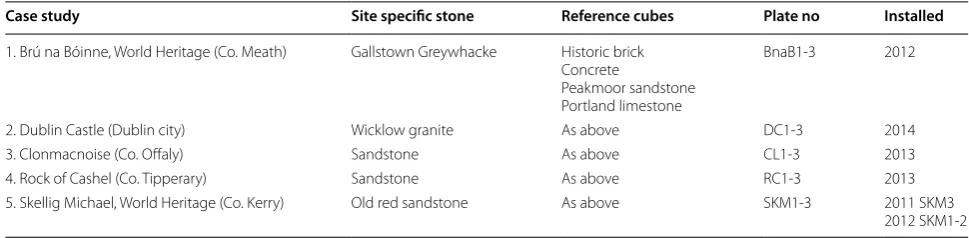
Noah’s Ark used the phase change of sodium chlo-ride (NaCl) that takes place at 75.5 % RH as a means of assessing probable crystallisation cycles in the future Table 1 Composition of LegIT pilot trial at case study sites
Case study Site specific stone Reference cubes Plate no Installed
1. Brú na Bóinne, World Heritage (Co. Meath) Gallstown Greywhacke Historic brick Concrete
Peakmoor sandstone Portland limestone
BnaB1-3 2012
2. Dublin Castle (Dublin city) Wicklow granite As above DC1-3 2014
3. Clonmacnoise (Co. Offaly) Sandstone As above CL1-3 2013
4. Rock of Cashel (Co. Tipperary) Sandstone As above RC1-3 2013
5. Skellig Michael, World Heritage (Co. Kerry) Old red sandstone As above SKM1-3 2011 SKM3
[37]. Using A2 scenario data from the Hadley Regional Climate Model HADCM3 (50 km resolution) Noah’s Ark projected an increase in the frequency of crystalli-sation events in Western Europe due to drier summers. They also predicted an increase in hydration cycles and damage due to transitions of sodium and magnesium sul-phates, which exert a high hydration pressure (Table 3). Sodium sulphate is one of the salts that is commonly implicated in salt weathering of concrete [38]. The Brit-ish Stone List gives results for resistance to salts using a sodium sulphate test (BS EN 12370) and Portland dem-onstrates an extremely low resistance to this form of weathering [39].
Physical and chemical recession
The recession of carbonate stones in rainwater is due to both dissolution (chemical erosion) and mechanical removal of grains (physical erosion) [12]. When pollution reduces the pH of rainwater, this increases the quantity of material lost by dissolution. Higher concentrations of CO2 will also have this effect. Higher temperatures also
slightly favours chemical weathering [18, 40].
Given projections for the shift towards shorter periods of heavy precipitation at the case study sites (see example in Table 4), it is expected that the recession rate caused by the physical action of rain will increase (Table 5). Aspect will be crucial to this as wind driven rain is likely to play a significant role. It is also likely that the effect will be evidenced initially on the softer and less dense materi-als such as Portland, brick and Peakmoor. Harder stones
such as Greywhacke5, concrete (compression strength
25–30 MPa) and Old Red Sandstone will be more resistant.
Microbiological activity
Once microbiological growth (e.g. fungi, algae, lichens) occurs on a stone surface, it tends to encourage the
5 EN1341 tests the abrasion resistance of stone for construction
applica-tions. Values <23.0 are considered suitable for use in heavily trafficked areas i.e. are resistant to abrasion. The abrasion resistance of Peakmoor has been measured at 26.8 and of Portland Base Bed at approximately 25, Gallstown Greywhacke has an abrasion resistance of 11.7.
retention of moisture and therefore further growth,
establishing a positive feedback loop [41] (Table 6).
Sandstone is known to be particularly susceptible to biological colonization as its mineral and pore charac-teristics are especially bioreceptive [42: 167]. Biological activity can be physically and chemically destructive [14], yet there is also evidence of a bioprotective role of some surface growth [28]. Unlike previous short term exposure trials the LegIT will provide an opportunity to study the long-term effects of biological growth, addressing a gap identified by researchers [20: 479]. Test exposures of sandstone have found that aspect plays an important role in algal growth, with rates being highest on north facing surfaces due to moisture retention and solar radiation [10, 43].
Noah’s Ark calculated the relationship between climate and annual growth of biomass on stone using the follow-ing exponential model [44]:
B = biomass per area in mg/cm2, P = yearly mean of
precipitation in mm, T = yearly mean of temperature
in °C.
This equation derives from research in Spain where high temperatures correspond with high evaporation rates and therefore restricted biological growth (Brim-blecombe, pers. comm.). Thus the formula implies that lower temperatures result in greater growth, which is not necessarily the case for northern climates where temper-atures in winter can be low enough to retard growth [45]. Research on algal greening in Belfast did note a negative correlation with the stone surface temperature, but also found that it only explained 14 % of the variance [28]. Moisture levels are likely to be integral to the distribution of algal films but again, the relationship between mois-ture and growth is not straightforward [28]. Growing-season temperature, numbers of warm days or annual time of wetness, are other possible indicators for micro-biological growth in Ireland’s climate.
Preliminary results from the LegIT at the case study site of Brú na Bóinne are that the material initially most affected by microbiological growth is Peakmoor
B=e(−0.964+(0.003P)−(0.01T))
Table 2 Results of materials testing (BR141 1989) conducted by BRE on samples of the reference cube materials (Test Report Number 283806, 2013. Unpublished)
BRE material tests results (BR141 1989) Porosity %
by volume Saturation coefficient Water absorption % by mass Apparent density Kgm−3
Portland limestone (Jordan’s Basebed) 18.35 0.73 6.07 2208
Peakmoor sandstone 12.79 0.66 3.66 2309
Brick 39.19 0.75 17.47 1675
Concrete (CEMEX 20116841 8.00 M3 c25/30 10
sandstone. After 1 year of exposure these cubes exhibited both a large degree of darkening (reduced L* value) and a significant movement towards green on the spectrum (approx 50 % drop in a* value).
Practical design
The LegIT consists of five 50 mm3 cubes attached to a
stainless steel plate (Fig. 1), it is visually unobtrusive and easy to handle. There are five cubes on each plate, four Table 3 Summary of expected outcomes for surface recession/loss from the LegIT caused by salt crystallization pressure Period
Near future (to 2020)
Salts present in fresh stone together with pore size and distribution will determine the initial occurrence of salt weathering. Most susceptible are likely to be Portland and brick
Medium term (to 2050)
Surface porosity of stones is likely to alter due to weathering; salt loading from the atmosphere will also change the availability of soluble salt. Salt action is likely to increase in this period
Far future (to 2101)
The REMO modeling by climate for culture (C4C) provided to the author for the case study sites [5] suggests a slight reduction in NaCl crystallization while projections by Noah’s Ark and research into deep wetting at Queens suggest salt damage will increase. The outcome remains uncertain
Table 4 Precipitation change at two case study sites between reference period (1960–1991) and far future (2070–2101); REMO model projections provided by Max Plank Institute and C4C
Case study Precipitation volume Intense precipitation (No. of days ppt. >5 mm/hr)
Brú na Bóinne 1.6 % increase projected for far future 90 % increase projected for far future (from 84 to 159 days) Skellig Michael 0.26 % increase projected for far future 38 % increase projected for far future (from 344 to 474 days)
Table 5 Summary of expected outcomes for surface recession from mechanical and chemical action of rainfall for period 2012–2101
Period
Near future (to 2020)
Fresh cut stone erodes quickly when first exposed, and then comes towards equilibrium Medium term (to 2050)
Rate of loss likely to stabilise after initial exposure. Weathering tests by Albion Stone under current climatic conditions give a recession rate for Port-land (Jordan’s basebed) limestone of 3–4 mm every century (http://www.albionstone.com/portland-stone/beds/jordans-basebed/. Accessed 25 Sep 2012)
Far future (to 2101)
Projected increase in the intensity of precipitation likely to be reflected in an increased rate of recession due to the mechanical action of rain, espe-cially where exposed to predominant winds. The projected increase in rain volume is negligible for most of Ireland thus the Karst effect (clean rain dissolution) is unlikely to increase
Table 6 Summary of expected outcomes for microbiological activity for period 2012–2101 Period
Near future (to 2020)
Colour change was found on a sample of cubes measured after 1 year exposure, indicating algal growth. Sandstone exhibited highest colonization as did north facing surfaces. In N. Ireland lichens on rural samples were noted by end of second year [43]
Medium term (to 2050)
Weathering will make less porous rocks vulnerable to colonization. North facing surfaces should continue to experience most rapid growth. With increased temperature and precipitation, the rate of microbiological growth is likely to increase during winter/autumn
Far future (to 2101)
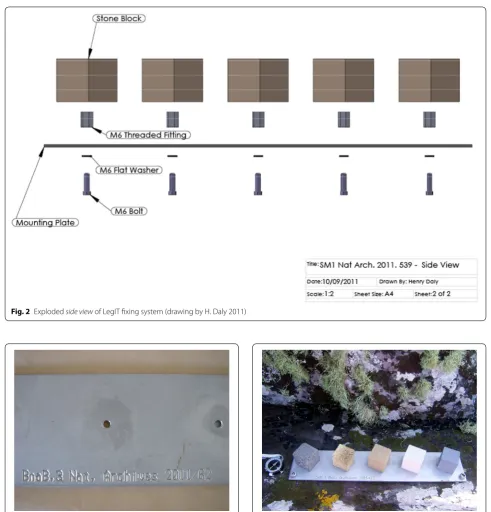
reference cubes common to all sites and one site-specific cube. An inert mounting system was required for the cubes which would not interfere in any way with weath-ering mechanisms and which would remain stable over 100 years. A high strength corrosion resistant stainless steel, grade 316, was chosen for both support and fixings. The cubes were attached to the base plate using a 316 nut and bolt (Fig. 2). The nut was held with adhesive in a hole drilled into the base of the stone and the block could then be bolted to the plate. Using this system the cubes are completely demountable and there is no internal pressure from the fixing.
Araldite 2014 epoxy resin was recommended to pro-vide the bond between the stone and metal nut (Chou-vet6, pers. comm.), it has a lap shear strength of >20 Mpa on stainless steel joints and a high glass transition tem-perature (Tg) of 85 °C. Unlike most epoxies it also
6 By Email; Laurent Chouvet, field promotion and technical support,
adhe-sives, composites and tooling, Huntsman advanced materials, Basel, Swit-zerland (31.8.2011).
exhibits a good resistance to water, crucial in a temperate climate (Huntsman Advanced Materials, 2009). As com-mercial resins are only tested for industrial purposes, there is no data available on aging properties. While only guaranteed for 20–30 years the resins are likely to func-tion well much beyond that however, especially when not placed under severe stress (Baines7, pers. comm.).
To ensure longevity for the supporting data, and main-tenance of its link with the object into the future, the associated documentation was lodged with the National Archives of Ireland. The National Archives accession number, together with a unique site and plate number, was then engraved onto each steel plate (Fig. 3).
Each of the five cubes is of a different material, four ‘reference’ materials are common to all plates; the fifth is unique to each site. The reference cubes will act as a control for the site-specific stone and also allow compari-sons between different locations. The site specific cubes
7 By phone; Paul Baines, specialist sales engineer, Huntsman advanced
were made from stone the same or similar to that used by the original builders (Table 1). At each of the monuments three plates were fixed onto a horizontal surface, for con-sistency an East West alignment was used (Fig. 4).
The stone reference cubes chosen were Portland lime-stone and Peakmoor sandlime-stone, both of which have
previously been used in weathering research [9, 18,
19]. The manufactured reference cubes selected were a poured concrete and a machine-made historic brick from the Dolphin’s Barn Brick and Tile Co. Dublin. These two man-made materials will offer an interesting contrast with the natural stone as they have different sensitivities Fig. 2 Exploded side view of LegIT fixing system (drawing by H. Daly 2011)
Fig. 3 Engraved label on Brú na Bóinne stainless steel plate: abbrevi-ated site name (BnB), plate number (3) and National Archives refer-ence number (2011/62)
to weathering [46]. Concrete also provides a standardis-able sample and, unlike natural stone, the degradation of cement tends to a linear path [47].
Case studies
The LegIT was installed on five National Monuments across Ireland (Table 1). Selected in conjunction with the
Office of Public Works they represent built heritage sites of high importance (including Ireland’s two World Her-itage properties) and range in date from the Megalithic to Post-Medieval. In addition they provide a diversity of environments including rural (Brú na Bóinne and Clon-macnoise), semi-urban (Rock of Cashel), urban (Dublin Castle) and coastal (Skellig Michael) (Fig. 5).
Periodic measurements
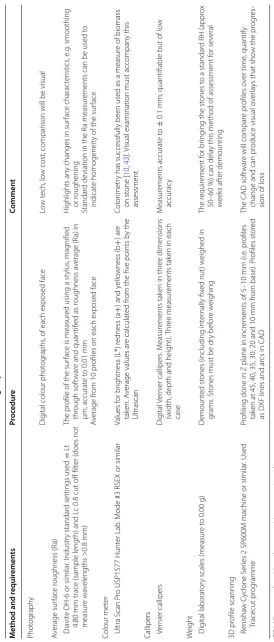
The cubes were measured prior to exposure of the LegIT on the case study sites and will be demounted every 3–5 years to monitor surface change. This period was selected on the basis that higher frequency meas-urements would be of limited value over the long-term (and hard to maintain), while gaps of greater than 5 years risked losing detail in the progression of weathering. If this regime is interrupted or abandoned however, assess-ment can begin again at a far-future date utilising the archived data for comparative purposes.
Comparison between measured change in the cubes and atmospheric climate for the same period will give an indication of climatic impacts, both on and between sites. Ideally, as in the case of Clonmacnoise, site based climate recording will be carried out. Where this is not pos-sible data from local weather stations can be used. The Irish Meteorological Service (Met Eireann) collects and archives climate data from the national network of sta-tions securing the data for researchers in years to come.
In a further attempt to future-proof the tool a combi-nation of low and high tech measurement methods were
employed (Table 7). These methods provide a series of
complementary, non-destructive measurements of sur-face properties. With the exception of the 3D profiling all the techniques are also achievable on a low budget and require little operator expertise or high-tech equipment.
Results
The LegIT was installed on the case study sites between 2011 and 2013 and the first full set of measurements is due in 2016. Issues experienced during this initial exposure period have highlighted areas in design and implementa-tion that could be improved. One concrete cube disinte-grated in position, possibly the result of a weakness in the poured block due to its small size. Either the use of con-crete or the aggregate dimensions may need to be revisited. More seriously, after 1 year of weathering several stone cubes exhibited cracks, thought to be stress fractures, radi-ating from the drilled hole. The cracks were consolidated by localised injection of a low viscosity epoxy resin but an alternative low-vibration drill or redesign of the fixing sys-tem is now a priority. Lastly, although clearly of no inher-ent value a cube was stolen from a LegIT at Brú na Bóinne in 2012. A replacement was put in its place, but resulted in a loss of continuity in the data sequence. Security of situa-tion is therefore another priority for future development.
Discussion
In the interpretation of measured and observed changes in the cubes disentangling causality will be a challenge and there is a need to account for the contribution of
factors other than those of direct interest [48]. The cross comparison of results between case studies is one way this can be approached. For example, comparisons between rural and urban locations should help in inter-preting the contribution of pollution, including NOx
lev-els, to changes in microbiological growth. Extrapolating from a dosimeter to a heritage object is a challenge faced by all studies where, for ethical reasons, the original fabric is not used. Each material reacts differently and within stone types, even within single blocks, structural and mineralogical variations can be significant [49, 50]. Averaging of results and the collection of long-term data sets will smooth out some of the variables but it remains a challenge for the study. Despite these shortcomings it is anticipated that over time useful results will be gained. It is also intended that feedback from experts and end-users should go towards improving the design of the tool.
Conclusions
The short-term exposure of fresh stone is a common method for determining initial rates of weathering, when processes are at their most rapid;
Exposure trials provide an important link between knowledge of decay processes derived from laboratory -based experimentation and observed decay of stone build-ings and monuments [9: 1205].
Alternatively, long-term studies of weathering rates tend to be based on dateable historic samples such as gravestones. The newly created LegIT attempts to com-bine these two traditions by creating a fresh baseline for long-term measurements.
To ensure sustainability, careful thought was given to the choice of materials, design of the tool and the man-ner of data retrieval and archiving. Surface recession, salt crystallisation and microbiological growth are the dete-rioration mechanisms the tool aims to track. Although based on the existing scientific tradition of using exposed samples, the LegIT is original in that it has been designed for the measurement of long-term exposure. It is also original in its use of multiple materials (including man-made) and in being embedded in at heritage sites. The main threat to the sustainability of the LegIT, as expe-rienced during the first year of exposure, is human interference. A second design issue, relating to stress fractures caused by the drilling of certain stone types, can be addressed in future by altering the manufacturing method.
Table 7 M easur emen ts c
arried out on cub
es b ef or e and during e xp osur e trial
CIE LAB sy
st
em wher
e L* can ha
ve a positiv
e or nega
tiv e v alue M ethod and r equir emen ts Pr oc edur e Commen t Phot og raph y Dig
ital colour phot
og
raphs
, of each exposed face
Lo
w t
ech, lo
w cost; compar
ison will be visual
A verage sur face r oughness (R a) Dia vit
e DH-6 or similar
. I
ndustr
y standar
d settings used
=
Lt
4.80
mm trace (sample length) and L
c 0.8 cut off filt
er ( does not measur e wa velengths >0.8 mm) The pr
ofile of the sur
face is measur
ed using a st
ylus , mag nified thr ough sof twar
e and quantified as r
oughness a verage (R a) in µm, accurat e t o 0.01 mm A verage fr
om 10 pr
ofiles on each exposed face
H
ighlights an
y changes in sur
face charac ter istics , e .g . smoothing or r oughening Standar d de
viation in the R
a measur
ements can be used t
o
indicat
e homogeneit
y of the sur
face
Colour met
er
Ultra S
can P
ro USP1577 Hunt
er Lab
. M
ode #3 RSEX or similar
Values f
or br
ightness (L*) r
edness (a
+
) and y
ello wness (b + ) ar e tak en. A
verage values ar
e calculat
ed fr
om the fiv
e points b
y the
Ultrascan
Color
imetr
y has successfully been used as a measur
e of biomass
on st one [ 10 , 43 ].
Visual examination must accompan
y this
assessment
Callipers Ver
nier callipers Dig ital Ver nier callipers . M easur ements tak
en in thr
ee dimensions
(width, depth and height).
Thr
ee measur
ements tak
en in each
case M easur ements accurat e t o ± 0.1
mm; quantifiable but of lo
w
accurac
y
W
eight Dig
ital laborat
or
y scales (measur
e t o 0.00 g) D emount ed st
ones (including int
er
nally fix
ed nut) w
eighed in
grams
. St
ones must be dr
y bef or e w eighing The r equir ement f or br ing
ing the st
ones t
o a standar
d RH (appr
ox
50–60
%) can dela
y this method of assessment f
or se veral w eeks af ter demounting 3D pr ofile scanning R enisha w C yclone S er
ies 2 SP600M machine or similar
. Used
Tracecut pr
og
ramme
Pr
ofiling done in Z plane in incr
ements of 5–10
mm (i.e
. pr
ofiles
tak
en at 45, 40, 35, 30, 20 and 10
mm fr
om base). P
rofiles st
or
ed
as D
XF lines and ar
cs in CAD
The CAD sof
twar
e will compar
e pr
ofiles o
ver time
, quantify
change and can pr
oduce visual o
ver
la
ys that sho
w the pr
og
res
resource for conservators and heritage managers of the future wishing to understand in real terms how climate change is affecting the sites and monuments in their care.
Author’s information
Cathy Daly is a Lecturer in Conservation in the School of History and Herit-age at the University of Lincoln and has a research interest in conservation management. In 2010 Cathy was lead author on Monitoring Impacts of Climate Change on Built Heritage, a report commissioned from ICOMOS Ireland by the Department of Environment Heritage and Local Government. In 2013 she completed her Ph.D. with the Dublin Institute of Technology. In this research transferable methodologies for the site level assessment and measurement of climate change vulnerabilities were developed and applied in practice at Ireland’s two World Heritage sites.
Acknowledgements
I owe my thanks to the many people that helped in the design, manufacture, installation and evaluation of the LegIT. Special thanks are due to: Conor Dore, Ger Reilly, Ray Ekins, Mark Barry and Derek McEvoy of DIT; Neil Kearney, Geology Department Trinity College; Peter Cox of Carrig Conservation; David Weldon; Prof Bernie Smith; Henry Daly; Susan Roundtree; Paul Allen, Teagasc Ashtown and Albion Stone. Also to the OPW staff for the sites of Brú na Bóinne, Clonmacnoise, Dublin Castle, Rock of Cashel and Skellig Michael. I would also like to acknowledge the financial support of the Department of Arts Heritage and the Gaeltacht (formerly Environment) under the Environ-ment Fund 2011. Finally I would like to thank Dr. Lynda Skipper and the journal reviewers for comments and suggestions which greatly improved this paper.
Competing interests
The author declares that they have no competing interests.
Received: 1 February 2016 Accepted: 12 May 2016
References
1. Stocker TF, Qin D, Plattner GK, Tignor M, Allen SK, Boschung J, Nauels A, Xia Y, Bex V, Midgley PM. IPCC, 2013: summary for policymakers in climate change 2013 the physical science basis, contribution of working group I to the fifth assessment report of the intergovernmental panel on climate change. Cambridge, New York: Cambridge University Press; 2013. 2. Daly C, Cox P, Cuffe-Fitzgerald A, Dubs B, Pickerill T. Monitoring impacts of
climate change on built heritage. Report for the department of environ-ment heritage and local governenviron-ment by ICOMOS Ireland; 2010. http:// www.icomosireland.ie. Accessed 2 June 2013.
3. Dore C, Murphy M. Integration of HBIM and 3D GIS for digital heritage modelling, Digital documentation, 22–23 October 2012. Edinburgh, Scot-land: 2012. http://arrow.dit.ie/beschreccon/71/. Accessed 20 Oct 2013. 4. Meneely J, Smith B, Viles H, Gomez-Heras M. In situ monitoring of
lime-stone buildings in Oxford. In: Tiano P, Pardini C, editors. In situ monitoring of monumental surfaces. Florence: CNR; 2008. p. 327–34.
5. Daly C. A cultural heritage management methodology for assessing the vulnerabilities of archaeological sites to predicted climate change, focus-ing on Ireland’s two World heritage sites. PhD thesis. Dublin Institute of Technology; 2013.
6. Daly C. The potential for indicators in the management of climate change impacts on cultural heritage. Cultural heritage preservation; Proceedings of the European workshop on cultural heritage protection, Berlin. http:// www.arrow.dit.ie/beschreccon/7/. Accessed 26–28 Sept 2011. 7. Schröter D, Polsky C, Patt AG. Assessing vulnerabilities to the effects of
global change: an eight step approach. Mitig Adapt Strateg Glob Change. 2005;10:573–96.
8. Berger AR. The geoindicator concept and its application: an introduction. In: Berger AR, Iams WJ, editors. Geoindicators: assessing rapid environ-mental changes in earth systems. Rotterdam: AA Balkema; 1996. p. 978.
9. Turkington AV, Martin E, Viles HA, Smith BJ. Surface change and decay of sandstone samples exposed to a polluted urban atmosphere over a 6 years period: Belfast, Northern Ireland. Build Environ. 2003;38:1205–16. 10. Young ME, Urquhart D. Algal and non-algal soiling rates of some Scottish
building sandstones. In: Jones MS, Wakefield RD, editors. Stone weather-ing and atmospheric pollution network 97: aspects of stone weatherweather-ing, decay and conservation. London: Imperial College Press; 1998. p. 114–24. 11. Tiano P. Effects of the weathering on stone materials: assessment of their mechanical durability. In: Drdácký M, Chapuis M, editors. Proceedings of the 7th European Conference “Sauveur” safeguarded cultural heritage understanding and viability for the enlarged Europe. Prague: Institute of Theoretical and Applied Mechanics of the Academy of Sciences of the Czech Republic; 2006b. p. 181–82. http://www.arcchip.cz/ec-conference/ download/A-1_182.pdf. Accessed 12 Jan 2012.
12. Baedecker PA, Reddy MM. The erosion of carbonate stone by acid rain. J Chem Educ. 1993;70(2):104.
13. EUREKA project: 496 euromarble; 2000. http://www.eurekanetwork.org/ project/-/id/496. Accessed 8 July 2012.
14. Cooper TP, Bell E, Duffy A, Lyons F, O’Brien P, Dowding P, Dillon-Malone P, Lewis JO, Mulvin L, O’Daly G, Murphy C. Effects of air pollution on historic buildings and monuments. Final report to the EC for research contract EV4V-0048-IRL; 1991.
15. Swerea Kimab AB. ICP materials. http://www.corr-institute.se/ICP-Materi-als/web/page.aspx?pageid=59259. Accessed 3 Nov 2011.
16. Tidblad J. Technical manual for the trend exposure programme 2008–2009. Convention on long-range transboundary air pollution international co-operative programme on effects on materials including historic and cultural monuments. Stockholm: Swerea KIMAB AB; 2009. 17. ICP materials programme centre: trends in corrosion and air pollution 1987–2003. Report prepared by the programme centre of the interna-tional cooperative programme on effects of airpollution on materials, including historic and cultural monuments. (ICP Materials) United Nations Economic and Social Council, Executive body for the convention on long-range transboundary air pollution; Working Group on Effects Twenty-fifth session Geneva, 30 August–1September 2006; 2006. http:// www.corr-institute.se. Accessed 17 May 2016.
18. Viles HA, Taylor MP, Yates TJS, Massey SW. Soiling and decay of N.M.E.P. limestone tablets. Sci Total Environ. 2002;292:215–29.
19. Yates TJS. Long term weathering studies of stone and metal in the UK as a basis for predicting futures trends in Eastern Europe and the former Soviet Union. In: Proceeding of the international conference on modern methods of corrosion monitoring for estimation of substantial losses and costs, Jurata, Poland; 2003.
20. Inkpen RJ, Viles HA, Moses C, Baily B. Modelling the impact of chang-ing atmospheric pollution levels on limestone erosion rates in central London, 1980–2010. Atmos Environ. 2012;61:476–81.
21. Brimblecombe P. Functional descriptions of damage to heritage. In: Lefevre RA, Sabbioni C, editors. Climate change and cultural heritage. Bari: Edipuglia; 2010. p. 43–72.
22. Art conservation research center. Oddy test. Pittsburgh: Carnegie Mellon University; 2009. http://www.cmu.edu. Accessed 10 Jan 2012.
23. Methods of test for colour fastness of textiles and leather. Blue wool standards. Reference standard No. 3. BS 1006:B01C:LFS3:1989.
24. Rosenberg E, De Santis F, Kontozova-Deutsch V, Odlyha M, Van Grieken R, Vichi F. Measuring gaseous and particulate pollutants; Instruments and instrumental problems. In: Camuffo D, Fassina V, Havermans J, editors. Basic environmental mechanisms affecting cultural heritage; under-standing deterioration mechanisms for conservation purposes. Cost action D42: chemical interactions between cultural artefacts and indoor environment (ENVIART). Firenze: Nardini editore; 2010. p. 115–33. 25. Brimblecombe P. Monitoring the future. In: Lefevre R A, Sabbioni C,
editors. Vulnerability of cultural heritage to climate change. Strasbourg, 20 November 2008 AP/CAT European and Mediterranean Major Hazards Agreement(EUR-OPA); 2010b. https://www.coe.int/t/dg4/majorhazards/ activites/2009/Ravello15-16may09/Ravello_APCAT2008_44_Sabbioni-Jan09_EN.pdf. Accessed 17 May 2016.
27. Adamson CS, McCabe S, McAllister D, Smith BJ, Warke PA. Mapping the spatial distribution of precipitation, biological soiling and decay on monuments in Northern Ireland: towards understanding long-term stone response to moisture. Congr Carpath Balk Geol Assoc Thessalon Greece. 2010;99:183–90.
28. Cutler NA, Viles HA, Ahmad S, McCabe S, Smith BJ. Algal ‘greening’ and the conservation of stone heritage structures. Sci Total Environ. 2013;442:152–64.
29. Grontoft T. How can we monitor the impact of climate change on cul-tural heritage? Climate change and culcul-tural heritage workshop. Ravello: European Centre for Cultural Heritage; 2009.
30. Inkpen RJ, Viles HA, Moses C, Baily B, Collier P, Trudgill ST, Cooke RU. Thirty years of erosion and declining atmospheric pollution at St. Paul’s Cathe-dral, London. Atmos Environ. 2012;62:521–9.
31. Trudgill ST, Viles HA, Moses C, Gosling W, Yates T, Collier P, Smith DI, Cooke RU. Twenty-year weathering remeasurements at St. Paul’s Cathedral, London. Earth Surf Process Landf. 2001;26:1129–42.
32. Trudgill ST, High CJ, Hanna FK. Improvements to the micro erosion meter. British geomorphological research group, technical bulletin. London, No 29; 1981. p. 3–17.
33. Přikryl R, Smith BJ. Building stone decay: from diagnosis to conservation. London: Geological Society; 2007.
34. Oguchi CT, Matsukura Y, Shimada H, Kuchitsu N. Application of weather-ing susceptibility index to salt damage on a brick monument. In: Fort R, editor. Heritage weathering and conservation. London: Taylor & Francis; 2006. p. 81–91.
35. Winkler EM. Stone in architecture: properties, durability. Berlin: Springer-Verlag; 1997.
36. Clifton JR. Stone consolidating materials: a status report. 2008. http:// www.cool.conservation-us.org/byauth/clifton/stone/stone2.html. Accessed 15 Apr 2013.
37. Grossi CM, Brimblecombe P, Menéndez B, Benavente D, Harris I, Déqué M. Climatology of salt transitions and implications for stone weathering. Sci Total Environ. 2011;409:2577–85.
38. Aggregate research: factors affecting durability of concrete. 2010. [http:// www.aggregateresearch.com/articles/18278/. Accessed 20 Sept 2012. 39. Building research establishment: the BRE British stone list; technical data
sheets. 2001. http://www.projects.bre.co.uk. Accessed 19 Feb 2013.
40. Bortz SA, Wonneburger B. Weathering and durability testing of dimension stone. In: Evans JD, Ketola WD, editors. Durability 2000; accelerated and outdoor weathering testing. West Conshohocken: American Society for Testing and Materials; 2000. p. 153–68.
41. McCabe S, Smith BJ, Warke PA. An holistic approach to the assessment of stone decay: Bonamargy Friary, Northern Ireland. In: Prikryl R, Smith BJ, editors. Building stone decay: from diagnosis to conservation. London: Geological Society; 2007. p. 77–86.
42. McCabe S, Smith BJ, Adamson C, Mullan D, McAllister D. The, “Greening” of natural stone buildings quartz sandstone performance as a second-ary indicator of climate change in the British Isles? Atmos Clim Sci. 2011;1(4):165–71.
43. Adamson C, McCabe S, Warke PA, McAllister D, Smith BJ. The influence of aspect on the biological colonization of stone in Northern Ireland. Int Biodeterior Biodegrad. 2012;1–10. doi:10.1016/j.ibiod.2012.05.023. 44. Gómez-Bolea A, Llop E, Ariño X, Saiz-Jimenez C, Bonazza A, Messina P,
Sabbioni C. Mapping the impact of climate change on biomass accumu-lation on stone. J Cult Herit. 2012;13(2012):254–8.
45. Haugen A, Mattson J. Preparations for climate change’s influences on cultural heritage. Int J Clim Change Strateg Manag. 2011;3:386–401. 46. Chandler I. Repair and refurbishment of modern buildings. London: B. T.
Batsford Ltd; 1991.
47. Gaspar PL, De Brito J. Quantifying environmental effects on cement-ren-dered facades: a comparison between different degradation indicators. Build Environ. 2008;43:1818–28.
48. Inkpen RJ, Cooke RU, Viles HA. Processes and rates of urban limestone weathering. In: Robinson DA, William RBG, editors. Rock weathering and landform evolution. Chichester: Wiley; 1994. p. 119–30.
49. McKinley JM, Warke PA. Controls on permeability: implications for stone weathering. In: Prikryl R, Smith BJ, editors. Building stone decay: from diagnosis to conservation. London: Geological Society; 2007. p. 225–36. 50. Warke PA, Smith BJ, McKinley J. Complex weathering effects on the