City, University of London Institutional Repository
Citation
:
Ye, X., Siddique, M., Douiri, A., Beddoe, G. and Slabaugh, G. G. (2009). Image segmentation using joint spatial-intensity-shape features: Application to CT lung nodule segmentation. Progress in Biomedical Optics and Imaging - Proceedings of SPIE, 7259, 72594V. doi: 10.1117/12.811151This is the accepted version of the paper.
This version of the publication may differ from the final published
version.
Permanent repository link:
http://openaccess.city.ac.uk/4384/Link to published version
:
http://dx.doi.org/10.1117/12.811151Copyright and reuse:
City Research Online aims to make research
outputs of City, University of London available to a wider audience.
Copyright and Moral Rights remain with the author(s) and/or copyright
holders. URLs from City Research Online may be freely distributed and
linked to.
Image Segmentation using Joint Spatial-Intensity-Shape Features:
Application to CT Lung Nodule Segmentation
Xujiong Ye, Musib Siddique, Abdel Douiri, Gareth Beddoe, Greg Slabaugh
Medicsight PLC, 66 Hammersmith Road, London W14 8UD, United Kingdom
ABSTRACT
Automatic segmentation of medical images is a challenging problem due to the complexity and variability of human anatomy, poor contrast of the object being segmented, and noise resulting from the image acquisition process. This paper presents a novel non-parametric feature analysis method for the segmentation of 3D medical lesions. The proposed algorithm combines 1) a volumetric shape feature (shape index) based on high-order partial derivatives; 2) mean shift clustering in a joint spatial-intensity-shape (JSIS) feature space; and 3) a modified expectation-maximization (MEM) algorithm on the mean shift mode map to merge the neighboring regions (modes). In such a scenario, the volumetric shape feature is integrated into the process of the segmentation algorithm. The joint spatial–intensity-shape features provide rich information for the segmentation of the anatomic structures or lesions (tumors). The proposed method has
been evaluated on a clinical dataset of thoracic CT scans that contains 68 nodules. A volume overlap ratio between each
segmented nodule and the ground truth annotation is calculated. Using the proposed method, the mean overlap ratio over all the nodules is 0.80. On visual inspection and using a quantitative evaluation, the experimental results demonstrate the potential of the proposed method. It can properly segment a variety of nodules including juxta-vascular and juxta-pleural
nodules, which are challenging for conventional methods due to the high similarity of intensities between the nodules
and their adjacent tissues. This approach could also be applied to lesion segmentation in other anatomies, such as polyps in the colon.
Keywords: Mean shift, Modified expectation-maximization (MEM), Pulmonary nodules, Shape index, Segmentation
1.
DESCRIPTION OF PURPOSE
Accurate and automatic segmentation of medical images is often an essential component of a computer-aided diagnosis (CAD) system. However, medical image segmentation is typically a difficult task due to noise resulting from the image acquisition process, as well as the characteristics of the object itself and its neighborhood, particularly when the object has low contrast, a small size, or is located within an area of complicated anatomy. These issues bring critical challenges to automatic segmentation methods. For example, the intensities of lesions (e.g. juxta-vascular nodules, juxta-pleural nodules) are usually very similar to their adjacent tissues (e.g. blood vessel or pleural wall). In this case, traditional intensity-based or model-based segmentation methods may fail to properly segment the object [1-2].
To address this challenge, we have developed a novel segmentation method that combines mean shift clustering and volumetric shape index to automatically segment lesions. The proposed algorithm has following steps: (1) calculating volumetric shape index (SI) at each voxel; (2) combining the SI with the intensity and the spatial position (x, y, z) to form a 5-dimentional feature vector; (3) grouping the 5-dimentional feature vectors into clusters using the mean shift framework; (4) employing modified expectation-maximization algorithm (MEM) to merge the neighbouring regions using the intensity mode map from the mean shift clustering. The joint spatial–intensity-shape (JSIS) feature provides rich information for the segmentation of the anatomic structures of interest, such as lesions (tumors). The experimental results on a CT lung nodule dataset demonstrate the high performance of the proposed method. Most of the nodules are properly separated from the lung parenchyma or other attached tissues (e.g. vessel or lung wall). An accurate segmentation provides a solid base for detection, feature calculation, classification in a CAD system.
2.
METHODOLOGY
Meer ([4]). It is a non-parametric estimator of the density gradient and does not require prior knowledge of the number of clusters, nor does it constrain the shape of the clusters. In this paper, a volumetric shape index feature is calculated at each voxel and combined with the intensity and the spatial position. This JSIS feature is clustered using the mean shift framework. A modified expectation-maximization algorithm (MEM) that considers a spatial constraint on the mean shift mode map is then used to merge the neighbouring regions (modes). Unlike prior methods that compute features from an existing segmentation, our method integrates the features (e.g. intensity and shape) into the process of segmentation algorithm itself. We demonstrate that by using this feature-guided segmentation, accurate object boundary delineation can be obtained.
2.1 Volumetric shape index: a 3D geometric feature
Volumetric shape index (SI) is a very useful geometric feature. Theoretically, it represents the local shape feature at each voxel while being independent of the image intensity. Every distinct shape, except for the plane, corresponds to a unique shape index. For example, a shape index value of 1.00 indicates a spherical shape (e.g. lung nodule), and 0.75 indicates a cylindrical shape (e.g. vessel).
The volumetric shape index at voxel p(x,y,z)can be defined as:
( )
( )
( )
( )
( )
p k p k p k p k p SI 2 1 2 1 arctan 1 2 1 − + − =π (1)
where k1
( )
p and k2( )
p are the principal curvatures [5-6] at voxel p, which are defined as:( )
p H( )
p H( ) ( )
p K pk = + 2 −
1 , k2
( )
p =H( )
p − H2( ) ( )
p −K pwhereK
( )
p and H( )
p are the Gaussian and mean curvatures.The calculation of the Gaussian and mean curvatures are based on the first and second fundamental forms of
differential geometry. A practical approach for computing the first and second fundamental forms at each voxel p is to
use the smoothed first and second partial derivatives of the image with respect to x, y, z, as described in [7].
Based on the definition, volumetric shape index directly characterizes the topological shape of an iso-surface in the vicinity of each voxel without explicitly calculating the iso-surface. This feature provides rich information for automated segmentation of anatomical structures or tumors (lesions) in medical images, where the region of interest is within an area of complicated anatomy and image intensities of different shapes are very similar to each other (such as the adjoining lung nodule).
2.2 Combination of shape index feature into mean shift framework
For each voxel, 3D spatial location, intensity and volumetric shape index features are concatenated in the joint
spatial-intensity-SI domain of dimension d=5. Given n data pointsxi, i=1,…,n on a 5-dimensional space R5, (where n is the
total number of voxels in the image), the multivariate kernel is defined as the product of three radially symmetric kernels:
( )
⎟
⎟
⎠
⎞
⎜
⎜
⎝
⎛
⋅
⎟
⎟
⎠
⎞
⎜
⎜
⎝
⎛
⋅
⎟
⎟
⎠
⎞
⎜
⎜
⎝
⎛
=
2 2 2 5 , si si r r s s k h h hh
x
k
h
x
k
h
x
k
c
x
K
s r si (2)where
c
k,5is a normalization constant which assures K(x) integrates to 1. xsis the spatial location, xris the intensityand xsiis the shape index feature;
k
(
x
)
is the common profile used in all the domains; hs, hrand hsiare the kernelwindow size for spatial, intensity and shape index kernel function, respectively. The normal kernel is used in this paper,
where
( )
⎟⎠ ⎞ ⎜
⎝ ⎛−
= − /2 2
2 1 exp ) 2 ( x x
k π d .
By using the mean shift framework, the shape index feature can be combined with the intensity for object
( )
i n i si si r r s s n i si si r r s s i i h h h x h x g h x g h x g h x g h x g h x g x xm s r si −
⎟ ⎟ ⎟ ⎠ ⎞ ⎜ ⎜ ⎜ ⎝ ⎛ ⋅ ⎟ ⎟ ⎟ ⎠ ⎞ ⎜ ⎜ ⎜ ⎝ ⎛ ⋅ ⎟ ⎟ ⎟ ⎠ ⎞ ⎜ ⎜ ⎜ ⎝ ⎛ ⎟ ⎟ ⎟ ⎠ ⎞ ⎜ ⎜ ⎜ ⎝ ⎛ ⋅ ⎟ ⎟ ⎟ ⎠ ⎞ ⎜ ⎜ ⎜ ⎝ ⎛ ⋅ ⎟ ⎟ ⎟ ⎠ ⎞ ⎜ ⎜ ⎜ ⎝ ⎛ =
∑
∑
= = 1 2 2 2 1 2 2 2 (3)where
g
( )
s
=
−
k
'
( )
s
.The joint spatial-intensity-shape index mean shift procedure estimates the modes (the densest regions) of the multivariate distribution underlying the feature space. The set of points that converge to the same mode is defined as the attraction basin. Mean shift maps all the data samples to the local maxima of their corresponding attraction basin.
2.3 Modified expectation-maximization considering spatial information
The mode map (Mi) obtained by the above joint spatial-intensity-shape index mean shift algorithm expresses the local
structure of the data in a given region of the feature space. The number of modes depends on the kernel window size and the data structure. Although this number is a large compression of the initial data, sometime it is still larger than the targeted number of classes. Next, a mixture Gaussian model with expectation-maximization (EM) that considers the spatial information is applied to the mode map to merge neighboring modes. Based on the Bayesian probability theory, for each mode, the probability of the mode belonging to one class is defined as:
(
)
(
)
( )
( )(
)
( )
( ) l mp M p p M p M p l i l l i l i l l i l i
l =1,2,...,
⋅ ⋅ =
∑
ϕ ϕϕ ϕ
ϕ (4)
where, m is the total number of the modes in the mean shift mode map, pl
(
Miϕl)
is lth Gaussian model with parameter) ,
( l l
l µ σ
φ = (mean µl and standard deviation σl), and p
( )
ϕl( )i is a spatial prior probability.Each mode is assigned to the Gaussian component that has the highest likelihood,
(
l i)
l
i p M
l* =argmax ϕ .
It is noted that the spatial prior probability p
( )
ϕl( )i plays an important role in Eq.(4). The spatial constraint can beimposed by a Markov Random Field (MRF) and Gibbs Random Field (MRF-GRF) [8].
[image:4.595.55.327.483.647.2]
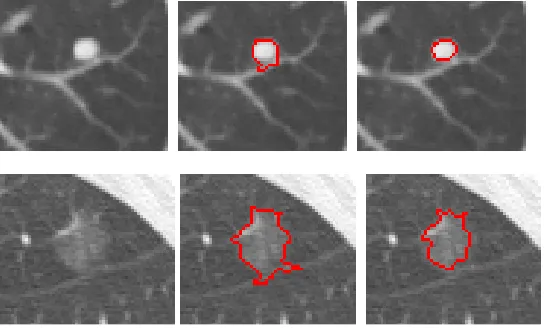
Fig.1. Two examples of nodule segmentation. 1st column: original
sub-image; middle column: segmentation results based on mean shift without the shape feature; 3st column:
[image:4.595.338.540.487.638.2]segmentation results based on the proposed method.
Fig.2. Volume overlap ratio based on the two different methods. The mean overlap ratio over the whole dataset for the proposed method is 0.80; and 0.71 for using MEM on the mean shift map without shape feature.
Volume overlapping ratio
0 0.1 0.2 0.3 0.4 0.5 0.6 0.7 0.8 0.9 1
0 10 20 30 40 50 60 70 80 nodule number
ra
tio
3.
RESULTS
The proposed segmentation algorithm has been evaluated with a database of clinical chest CT scans, containing 68 nodules. The size of the nodules ranges between 5mm to 20mm in diameter. For comparison, a second experiment was performed, for which the MEM was applied on the mean shift mode map without the shape index feature.
Fig. 1 shows two examples of nodule segmentation based on the two different methods. It can be seen that, by combining the shape index feature into mean shift framework, the target lung nodule is properly delineated from the background lung parenchyma despite the presence of other non-target structures such as vessels.
To give the overall performance of the proposed algorithm, each nodule is segmented and compared with a ground truth segmentation that was manually delineated by an experienced radiologist. An overlap ratio between the segmented nodule and the ground truth annotation is calculated. Fig. 2 shows the overlap ratios based on the proposed method with and without shape index feature, respectively. It is noted that, without shape index combined into mean shift framework, the mean overlap ratio for the whole dataset is 0.71. However, it has been increased to 0.80 by using the proposed method. This demonstrates the potential of the proposed method for accurate nodule segmentation.
4.
NEW OR BREAKTHROUGH WORK TO BE PRESENTED
This paper proposes a novel approach to lesion segmentation. To our knowledge, this is the first paper to utilize the volumetric shape index in the mean-shift framework for image segmentation. By employing 5-dimensional JSIS feature, our method can successfully segment lesions adjacent to structures of similar intensity but different shape. In addition, we apply a modified expectation-maximization algorithm to the intensity mode map from the mean shift clustering to merge the neighboring regions (modes). Qualitative and quantitative analysis of the segmentation results demonstrate the effectiveness of the proposed method.
5.
CONCLUSION
Volumetric shape index is a very useful geometric feature. The joint spatial–intensity-shape feature provides rich information for the lesion segmentation. This is particularly useful when the region of interest is within an area of complicated anatomy for which the image intensities of the lesion is similar to its neighboring tissues but has a different shape (such as juxta-vascular nodules and juxta-pleural nodules). Both of visual inspection and quantitative measurement
on a clinical dataset of thoracic CT scans confirm high performance of the proposed method. The approach can also be
applied to lesion segmentation in other anatomies, such as polyps in the colon.
6.
CLAIMS ON FIRST-TIME SUBMISSION
We herein confirm that this submission is our latest research work and we have not published and presented it elsewhere.
REFERENCES
[1] I.Sluimer, A.Schiham, M.Prokop, and B.V.Ginneken, “Computer analysis of computed tomography scans of the
lung: A survey,” IEEE Trans. Medical Imaging, vol. 25, no.4, pp.385-405, 2006.
[2] J.Dehmeshki, H.Amin, and X.Ye, “Segmentation of Pulmonary Nodules in Thoracic CT scans: A Region Growing
Approach,” IEEE Trans. Medical Imaging, vol.27, no.4, 2008.
[3] K.Fukunaga and L.D.Hostetler, “Estimation of the gradient of a density function with applications in pattern
recognition,” vol.IT-21, pp.32-40, 1975.
[4] D.Comaniciu and P.Meer, “Mean shift: A robust approach toward feature space analysis,” IEEE Transactions on
Pattern Analysis and Machine Intelligence, vol.24, pp.603-619, 2002.
[5] O.Faugeras, “Three-dimensional computer vision: A geometric view-point”. Cambridge, MA: MIT press; 1993.
[6] O.Monga and S. Benayoun, “Using partial derivatives of 3D images to extract typical surface features,” Computer
Vision and Image Understanding, vol.61, pp.171-189, 1995.
[7] H.Yoshida and J. Nappi, “Three-dimensional computer-aided diagnosis scheme for detection of colonic polyps,”
IEEE Trans. Medical Imaging, vol.20, no.12, pp.1261-1273, 2001.