On the Discovery of Brokers in Distributed Messaging Infrastructures
Shrideep Pallickara, Harshawardhan Gadgil and Geoffrey Fox
{spallick, hgadgil, gcf}@indiana.edu
Community Grids Laboratory, Indiana University
Abstract
Increasingly messaging infrastructures are being used to support the communication requirements of a wide variety of clients, services, and proxies thereto. Typically, for various reason this messaging infrastructure is a distributed one with multiple constituent brokers. In the paper we present our scheme for the discovery of brokers in distributed messaging infrastructures based on the publish/subscribe paradigm. We also include empirical results from our experiments related to the implementation of our scheme.
1 Introduction
Increasingly messaging infrastructures are being used to support the communication
requirements of a wide variety of clients, services, and proxies thereto. Typically, the messaging
infrastructure is a distributed one with multiple constituent brokers, where we avoid the term servers to distinguish them clearly from application servers. While a distributed messaging infrastructure addresses issues such as scaling and availability, while eliminating single point of
failures it is also important for an entity to be able to discover the broker which maximizes its
ability to leverage services provided by the broker network. Simple solutions which rely on an
entity accessing a certain known remote broker, can sometimes lead to bandwidth degradations
discovery of brokers in distributed messaging infrastructures based on the publish/subscribe
paradigm.
The publish/subscribe paradigm is a powerful one and one in which there is a clear
decoupling of the message producer and consumer roles that interacting entities/services might
have. The routing of messages from the publisher to the subscriber is within the purview of the
message oriented middleware (MOM), which is responsible for routing the right content from the
producer to the right consumers. In publish/subscribe systems a subscriber registers its interest in
events by subscribing to topics. In its simplest form these topics are typically “/” separated
Strings, these have sometimes also been referred to as subjects. When a publisher issues events on a specific topic the middleware substrate routes the events to the subscribers that have
registered an interest in this topic.
In this paper we also include empirical results from our experiments related to the
implementation of our scheme. We have performed these experiments in the context of our
system NaradaBrokering [1-7] which is a distributed messaging infrastructure based on the publish/subscribe paradigm. The scheme presented here can also be leveraged by other systems
that are based on the publish/subscribe paradigm.
NaradaBrokering [1-7] is a distributed messaging infrastructure and provides two closely related capabilities. First, it provides a message oriented middleware (MoM) [1,2] which facilitates communications between entities (which includes clients, resources, services and
proxies thereto) through the exchange of messages. Second, it provides a notification framework
[4] by efficiently routing messages from the originators to only the registered consumers of the message in question. Communication within NaradaBrokering is asynchronous and the substrate
events or the number of entities present in the system. Events encapsulate expressive power at
multiple levels (transport, protocol, service and application). Where, when and how these events
reveal their expressive power is what constitutes information flow: the NaradaBrokering
substrate manages this information flow. NaradaBrokering includes services such as reliable
delivery [5], replays, (de)compression of large payloads, fragmentation and coalescing of large datasets [6], support for the timestamps based on the Network Time Protocol [7] and support for Grid/Web Services [2, 3]. Additional information regarding these capabilities is available at the project web site (http://www.naradabrokering.org) or in the works that have been referenced. 1.1 Problem Statement
A broker network comprises of a large number of cooperating brokers facilitating and
mediating access to hosted services and functionalities. Once connected to a broker an entity has
access to a wide variety of services. Similarly, an entity may wish to add a broker to this
network. In both these cases it is essential for the entity to discover a broker. The problem of discovering brokers has two key components. First, the discovery process must return a valid and
non-empty set of brokers. Second, the brokers contained within this subset should maximize the
added client or broker node’s ability to access and mediate accesses to services hosted on the
broker network.
1.2 Why a solution is needed
The brokering environment, that we see NaradaBrokering operate in, is a very dynamic and
fluid system where broker processes may join and leave the broker network at arbitrary times
and intervals. It is thus not possible for any entity to assume that a given broker may be available
indefinitely or at all times. Static solutions to this problem might result in a certain known
bandwidth utilizations. Brokers added to assuage availability and scaling constraints may not be
utilized efficiently within this framework.
1.3 The characteristics that should be part of the solution
The discovery of broker thus needs to be a dynamic process which operates on the current
state of the broker network. This would ensure that newly added brokers within the system are
assimilated faster since the discovery process would operate on them. The discovery process
itself might be subjected to the failures and other faults that exist within the brokering system.
The discovery process should perform its function in such environments. The broker discovery
process should result in a better utilization of the network and networked resources. This is
predicated on the fact that the broker returned is the “nearest” available broker, where “nearest”
corresponds to network distances or latencies.
The remainder of this paper is organized as follows. In section 2 we describe specialized nodes — broker discovery node (BDN) — that are incorporated into the substrate to facilitate
discovery. We then discuss the process of issuing discovery requests (section 3), the processing of these discovery requests (section 4) and subsequently the generation of responses (section 5). In section 6 we then describe the process of broker selection based on the discovery responses. Section 7 outlines the fault-tolerant aspects of this approach and security considerations within the system. Section 8 presents the advantages of our approach. We present the experimental results inSection 9and the related work inSection 10. Section 11is the conclusion.
2 Broker Discovery Nodes (BDNs)
Broker Discovery Nodes are registered nodes that facilitate the discovery of brokers within
the broker network. BDNs maintain information regarding broker nodes within the system. Here
information with the BDN while some do not. In our scheme we have multiple broker discovery nodes (BDNs)(gridservicelocator.org, gridservicelocator.com etc.). We do not place any
constraints on the number of BDNs within the system. However, in most cases the number of
BDNs will be significantly smaller than the number of available brokers within the network. A
given BDN may maintain active connections to one or more broker nodes within the broker
network.
2.1 Brokers and Broker Advertisements
Brokers – when they are configured within the broker network – advertise and register their
presence with one or more of these BDNs. In our scheme it is not necessary for every broker to
be registered with at least one BDN, nor is it necessary for multiple BDNs to maintain identical
information about brokers within the broker network. Our scheme will work even if a single
broker is registered with a given BDN.
2.2 The anatomy of a Broker Advertisement
When a broker advertises itself with the BDN the advertisement contains information
regarding the hostname, transport protocols supported and communication ports, NB logical
address and, if provided, geographical and institutional information.
2.3 Dissemination of Broker Advertisements
Broker Advertisements could be disseminated in two forms. First, by sending this
advertisement directly to the BDNs that are listed in the broker’s configuration file. Second, the
broker may send this information to a topic that other BDNs might be subscribed to. Or the
broker might send this advertisement over a public topic such as
Services/BrokerDiscoveryNodes/BrokerAdvertisement which all BDNs within the
store the advertisement or ignore it if the BDN is interested in specific advertisements: for e.g. a
BDN in the US may be interested only in broker additions in North America.
2.4 Adding private BDNs within the broker network
A need may sometimes arise to setup private BDNs within the broker network. In this case the
private BDN must advertise its services to brokers within the broker network. Individual brokers
may have the option to re-advertise their information at this newly added BDN. Of course
different BDN implementations may have different policies regarding the management of broker
advertisements and the responses to discovery requests. A private BDN must also require the
presentation of appropriate credentials before it decides whether it will disseminate the broker
discovery request.
3 Initiating Discovery
When a new node arrives into the system it issues a broker discovery request. The broker
discovery request signifies that the entity is interested in connecting to the nearest available
broker. The broker discovery request includes information regarding the requesting node process
such as hostname, ports and transports protocols for facilitating communications and sometimes
also includes credentials for authorized accesses. A broker discovery request also contains a
UUID which uniquely identifies the request.
The simplest way to issue a broker discovery request is to forward this request to a publicly
known BDN. A node’ configuration file contains information regarding a set of BDNs that can
manage its broker discovery request. This includes BDN’s running at locations such as
gridservicelocator.org (.com, .net and .info). A client can add information regarding any other
privately run BDN within its configuration file too. It should be noted that our scheme for broker
discovery can work even if there are no BDNs up and running. This would be discussed in a
The transport protocol for communications with the BDN could be reliable connection
oriented protocol such as TCP or it could be based on UDP. A BDN is expected to acknowledge
the receipt of a discovery request in a timely manner. Multiple requests forwarded to the same
BDN would be idempotent.
4 Processing Broker Discovery Requests
As mentioned earlier a BDN maintains active concurrent connections to one or more brokers
within the broker network. Upon receipt of a receipt of a broker discovery request from the
requesting node, the BDN will propagate this broker discovery request through the broker
network. To facilitate faster disseminations within the broker network the BDN may inject this
request from multiple broker nodes within the broker network. An efficient scheme to do so may
be based on the network distances, which separates the BDN from the brokers, within the broker
network. This information could easily be constructed by issuing ping request to brokers and
computing the delays from the issued responses. Once this information is available, the broker
discovery request would be issued simultaneously to the brokers that are closest and farthest
from the BDN. This would ensure that the broker discovery request propagates faster through the
broker network.
Every broker discovery request has a UUID associated with it. Every broker keeps track of
the last 1000 (this number can be configured through the broker configuration file) broker
discovery requests so that additional CPU/network cycles are not expended on previously
processed requests.
5 Broker Discovery Response
Timestamps in NaradaBrokering are based on the Network Time Protocol (NTP) which
nodes are initialized during node initializations and generally take between 3-5 seconds before
the local clock offsets are computed by the NTP service initialization.
It should be noted that not every broker within the broker network needs to respond to broker
discovery requests. A broker’s response policy may predicate responses based on the
presentation of appropriate credentials. Furthermore the policy may also dictate that responses be
issued only if the request originated from within a set of pre-defined network realms.
5.1 Constructing a discovery response
Once a broker decides to respond to a broker discovery request it constructs a broker
discovery response. The broker discovery response includes the UUID associated with the
discovery request. The discovery response also includes three other key pieces of information
(a) The current timestamp – This is based on the NTP protocol
(b) The broker process information – This includes information regarding the
hostname/IP-address of the responding broker, the communication protocols supported and port
information associated with each of these supported protocols.
(c) Usage metric information – This indicates the load currently at the broker. This includes
information regarding the total number of active concurrent connections to the broker, the
CPU and memory utilizations at the broker.
The timestamp information is used to give an idea regarding the network delays that would be
associated with communications between the broker and the requesting node. The broker process
information facilitates communications with the broker. Finally, the usage metric facilitates
5.2 Issuing the discovery response
The responding broker gleans information regarding the requesting node and issues the
constructed response to the requesting node. The communication protocol used for transporting
this response is UDP. The reasons for this are two fold
a) Since it is based on a connectionless protocol the network resources utilized by the
requesting node remain low and invariant irrespective of the number of responding
brokers. If a connection oriented protocol such a TCP were used for communications a
local socket (conceivably managed in a separate thread) would need to be setup for each
response. Since these sockets wouldn’t live beyond the issued response there would also
be a garbage collection cost associated with disposing these resources.
b) Since UDP packets can be lost, the response’s arrival or the lack thereof provides a good
indicator of the underlying response. If the responses were to traverse over multiple
router hops the chances that the packets would be lost would be higher. This would
ensure that requesting node wouldn’t be aware of such remote brokers which would be a
prevent it from initiating a connection to the responding remote broker.
6 Processing the discovery response
A requesting node will receive responses from one or more brokers within the broker
network. From this set of broker discovery responses the requesting node creates a subset of
target brokers, from which it would select the broker to connect to. We first describe the process
of creating the target set and then the process of arriving at the target broker.
As mentioned earlier, every node in NaradaBrokering computes offsets to its underlying clock
to arrive at the UTC time based on the NTP protocol. Since every response received at the broker
also includes the UTC time at which it was issued, we can have a very good estimate of the
time contained in the discovery response. This is performed over all responses received within a
certain period of time typically 4-5 seconds (this can be configured depending on the accuracy
that we seek to achieve).
Based on this information we can now sort the discovery responses according to the delays
associated with their responses. The discovery responses also contain usage metrics within them.
Based on the computed delays and usage metrics we arrive at our targeted set of brokers. This
targeted set of broker typically comprises of around 10 brokers. For the discovery process to
complete we need to arrive at the target broker.
Note that since the UTC time would be within 1-20 msecs the network delays that we
computed where a very good estimate. In order to arrive at the target broker we need to know the
precise network delay. To compute this we send ping requests to individual brokers (based on the
information supplied in the broker responses). This ping request contains the timestamp at the
requesting node at the instant the ping request is sent. The delay in the responses can easily be
computed by the subtracting the timestamp contained in the ping response. The ping requests and
responses will also be sent using UDP for the reasons outlined earlier in the discovery response
section. The requesting node decides on the target node based on the lowest delay associated
with the ping requests.
7 Fault tolerant aspects of this approach and Security Considerations
The approach we have described needs only 1 functioning BDN to work. In fact the approach
could work even if none of the BDNs within the system are functioning. This can be achieved by
sending the discovery request using multicast. Even if one of the brokers within the broker
network is accessible, from the requesting node, using multicast the discovery request would be
Every node keeps track of the its last target set of brokers. If the requesting is arriving after a
prolonged disconnect, and if none of the BDNs are available, the requesting node can issue a
broker request to one or more of the nodes in the target set and then process discovery responses
as described in the earlier section to arrive at the best available broker. The scheme outlined
sustains loss of both the discovery requests (retransmission after predefined period of inactivity)
and discovery responses. Similarly, broker advertisements may also be lost in transit to the
BDNs.
In our scheme a broker can setup its response policy. This includes requiring that a client
present the right credentials in its requests to responding only to those requests that originate
within specific network realms. It may be argued if the knowledge of brokers within the broker
network could facilitate a denial of service attack. However, the security of any system cannot be
predicated on keeping the information about broker processes secret. Means to thwarting denial
of service attacks are discussed in a companion paper.
8 Advantages of this approach
There are several advantages to the scheme that we have outlined in this paper. We enumerate
these below.
1. Efficient discovery: Brokers are discovered very efficiently. Furthermore, this approach
ensures that the broker will be connected to one of the closest available brokers if it does
indeed possess the right credentials that these brokers might need.
2. No single point of failure: There is no single point of failure within the system. The system
can sustain a variety of failures (outlined in previous section) and can also sustain a variety of
3. Incorporation of brokers: The scheme that we have outline can incorporate new broker nodes
efficiently into the system. Since broker discovery responses include the usage metric, a
newly added broker within a cluster would be preferentially utilized by the discovery
algorithms.
4. Private BDNs: It is very easy to set up private BDNs within this scheme.
9 Experimental Results
To test the performance of the system we consider various topologies formed using five
distributed brokers. We have selected nodes which are separated by significant network
distances. Based on the results we can fairly conclude that broker discovery in local networks (brokers separated by very small network distance such as in the same institution) would be as worse as the tests indicate or better.
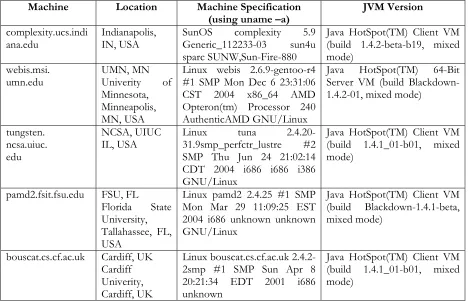
The various machines used are summarized in Table 1.
Machine Location Machine Specification
(using uname –a) JVM Version complexity.ucs.indi
ana.edu Indianapolis, IN, USA SunOS complexity 5.9 Generic_112233-03 sun4u sparc SUNW,Sun-Fire-880
Java HotSpot(TM) Client VM (build 1.4.2-beta-b19, mixed mode)
webis.msi.
umn.edu UMN, MN Univerity of Minnesota,
Minneapolis, MN, USA
Linux webis 2.6.9-gentoo-r4 #1 SMP Mon Dec 6 23:31:06 CST 2004 x86_64 AMD Opteron(tm) Processor 240 AuthenticAMD GNU/Linux
Java HotSpot(TM) 64-Bit Server VM (build Blackdown-1.4.2-01, mixed mode)
tungsten. ncsa.uiuc. edu
NCSA, UIUC
IL, USA Linux tuna 2.4.20-31.9smp_perfctr_lustre #2 SMP Thu Jun 24 21:02:14 CDT 2004 i686 i686 i386 GNU/Linux
Java HotSpot(TM) Client VM (build 1.4.1_01-b01, mixed mode)
pamd2.fsit.fsu.edu FSU, FL
Florida State University,
Tallahassee, FL, USA
Linux pamd2 2.4.25 #1 SMP Mon Mar 29 11:09:25 EST 2004 i686 unknown unknown GNU/Linux
Java HotSpot(TM) Client VM (build Blackdown-1.4.1-beta, mixed mode)
bouscat.cs.cf.ac.uk Cardiff, UK Cardiff
Univerity, Cardiff, UK
Linux bouscat.cs.cf.ac.uk 2.4.2-2smp #1 SMP Sun Apr 8 20:21:34 EDT 2001 i686 unknown
[image:12.612.66.534.403.704.2]Java HotSpot(TM) Client VM (build 1.4.1_01-b01, mixed mode)
To test our system we consider three broker network topologies. The first topology is
[image:13.612.122.491.156.344.2]unconnected broker network (Figure 1). Here there exist brokers registered in the Broker Discovery Node (BDN), however they may or may not be connected with each other.
[image:13.612.73.542.395.637.2]Figure 1 Unconnected Topology
Figure 2 Percentage of time spent in various sub-activities of Broker Discovery in Unconnected Topology
Note that in this case the BDN has to distribute the discovery request to each registered
discovery requests. We observe (Figure 2) that maximum time (about 83 %) is spent by the client in waiting for the initial responses. This test was carried out by running the broker discovery
client in Bloomington.
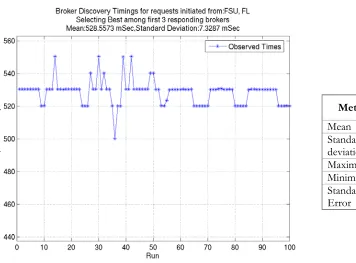
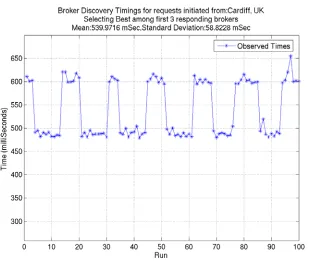
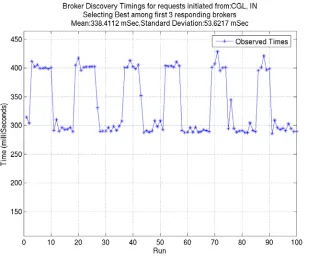
We also noted the total discovery times required to find the best broker for the above topology
when the discovery process is initiated from different sites. Figure 3 thru Figure 7 show the corresponding results. The discovery process was carried out 120 times and the first 100 results were selected after removing outliers.
Metric (MilliSec)Time
Mean 528.5573 Standard
deviation 7.3287 Maximum 550.421 Minimum 500.283 Standard
[image:14.612.101.457.260.523.2]Error 0.73287
Metric (MilliSec)Time
Mean 539.9716 Standard
deviation 58.8228 Maximum 654.811 Minimum 478.899 Standard
[image:15.612.94.413.95.357.2]Error 5.8823
Figure 4 Time required for discovery with Client in Cardiff, UK
Metric (MilliSec)Time
Mean 1306.393 Standard
deviation 13.3551 Maximum 1351.214 Minimum 1285.102 Standard
[image:15.612.91.411.419.671.2]Error 1.3355
Metric (MilliSec)Time
Mean 410.0891 Standard
deviation 10.5804 Maximum 440.121 Minimum 399.973 Standard
[image:16.612.93.414.71.327.2]Error 1.058
Figure 6 Time required for discovery with Client in NCSA, UIUC, IL
Metric (MilliSec)Time
Mean 338.4112 Standard
deviation 53.6215 Maximum 428.884 Minimum 286.026 Standard
Error 5.3622
[image:16.612.94.412.412.668.2]Our next topology shows the behavior of the system in presence of a star topology. The
[image:17.612.134.496.153.355.2]system is illustrated in Figure 8. Here the broker network is responsible for disseminating the broker discovery requests to other existing brokers in the network.
Figure 8 Star Topology
It was observed that the time required for waiting for the initial set of responses decreased
significantly. The results are shown in Figure 9.
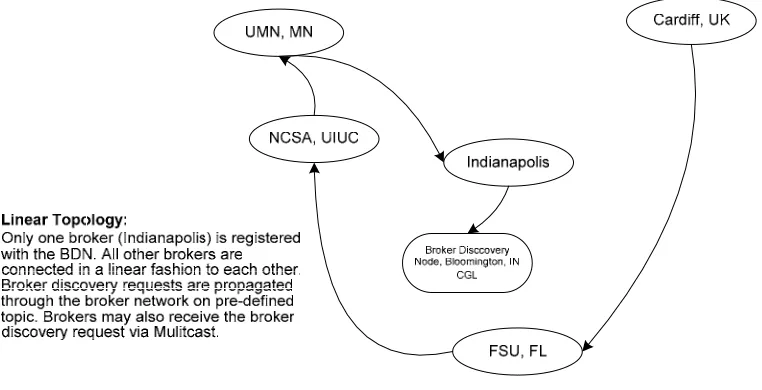
[image:17.612.77.477.442.640.2]Our final topology is the linear topology wherein only one broker is registered with the BDN. All
other brokers are connected to each other in a linear fashion. Our choice for selecting the links
for this topology was arbitrary and we believe that any other variation of the scheme would
[image:18.612.118.499.185.380.2]produce similar results. The topology is shown in Figure 10.
Figure 10 Linear Topology
It was observed that the time spent in waiting for the initial set of responses although better than
the first case was still poor compared to the second case. We conclude that the performance is
improved over the unconnected topology because the brokering network uses optimized routing
to disseminate request within the brokering network, however it still takes finite amount of time
for the request to reach the last broker in the chain. Figure 11 shows the relative percentage of the times required for various steps involved in the discovery process.
From the above results we note that in each case, the maximum time is spent in waiting for the
initial responses. As the number of brokers increases we face the problem of scalability as
waiting for more brokers would badly affect the total time in making a decision on the best
broker to connect to. To address this problem we introduce a timeout period before proceeding to
client is willing to wait to gather discovery responses. A small timeout period would decrease the total time in arriving at a decision, however we risk collecting only few broker responses depending on when the discovery request reaches the broker and the broker decides to reply. A large timeout value implies more time is spent waiting for responses to arrive. This might unnecessarily increase the time of discovery process if fewer brokers exist in the system or only a few brokers respond to the discovery request than the minimum number of responses specified.
Figure 11 Percentage of time spent in various sub-activities of Broker Discovery in Linear Topology
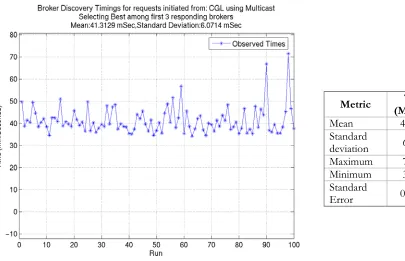
This problem may be partially solved by also multicasting the request so that the brokers in the
local networks would get the request directly rather than being forwarded through some broker
discovery node. The multicast scheme may not work if some brokers choose to listen on a
different multicast address or port or if the multicast service is disabled for a particular set of
Metric (MilliSec)Time
Mean 41.3129 Standard
deviation 6.0714 Maximum 71.416 Minimum 34.303 Standard
[image:20.612.99.504.70.331.2]Error 0.60714
Figure 12 Broker Discovery times using ONLY multicast
We also introduce the maximum responses a client is willing to consider and the broker target set
size. Usually a client might be willing to risk more timeout period but specify that only the first
N responses must be considered. We then shortlist the set of size N to arrive at a broker target
set, T, such that size(T) <= size(N).
The target set is decided based on the BrokerDiscoveryResponse. The BrokerDiscoveryResponse
contains the total memory available to the broker, the total amount of used memory, the number
of links the broker is connected to and possibly the CPU load at the broker. We weigh each of
these metrics and compute the weight associated in selecting a particular broker. The values for
weighing various factors are configurable and will help the client to give preference for a
specific metric with respect to other factors. For instance the weighing may be done as follows
// Initialize weight double weight = 0.0;
weight += (freeMem / totalMem) * WEIGHTAGE_FREE_TO_TOTAL_MEMORY; weight += (totalMem / (1024 * 1024)) * WEIGHTAGE_TOTAL_MEMORY;
// Lower the better
weight -= numLinks * WEIGHTAGE_NUM_LINKS;
// OTHER factors may be similarly added to compute the weight The received results are then sorted using the weights and we select the first size(T) brokers
to arrive at the broker target set.
9.1 Security Considerations
Discovery operations usually entail giving broker details which might be used by a malicious
user to launch attacks against the broker network. In order to secure the discovery process
against such attacks, a discovery request and response may be secured by sending credentials
verifying the authenticity of the clients and also encrypting the discovery request and response.
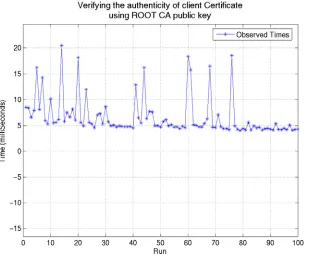
Metric (MilliSec)Time
Mean 6.6104 Standard
deviation 3.7214 Maximum 20.51 Minimum 4.0390 Standard
[image:21.612.95.407.362.619.2]Error 0.3721
Figure 13 Time required in validating a X.509 Certificate
Although our initial prototype does not incorporate any security schemes, the broker and client
and response messages. We carried out tests to estimate the cost associated with such a scheme.
Figure 13 shows the time required to verify a client’s identity. We also time the cost associated with signing and encrypting a broker discovery request and decrypting it (Figure 14). These tests were performed on a Pentium M 2.0 GHz machine with 512 MB RAM. The Java virtual machine used was Java Standard Edition HotSpot(TM) Client VM (build 1.4.2_06-b03, mixed mode). We note from the timings that these costs are acceptable in most systems which would require such a feature.
Metric (MilliSec)Time
Mean 25.9497 Standard
deviation 2.7311 Maximum 22.862 Minimum 35.428 Standard
[image:22.612.100.402.265.518.2]Error 0.27311
Figure 14 Time required to digitally sign and encrypt and later extract the BrokerDiscoveryRequest
10 Related Work
In this section we summarize related work pertaining to the discovery of nodes in distributed
systems. IDMaps [8] examines the network distance prediction problem from a topological point of view. In this approach special HOPS servers maintain a virtual topology map of the Internet,
is then estimated as the distance between A and it’s nearest Tracer T1, plus the distance between B and it’s nearest Tracer T2, plus the shortest path distance between the Tracers T1 and T2 over the Tracer virtual topology. The prediction accuracy improves with the growing number of
tracers. This approach however requires Internet-wide deployment of measurement entities. Hotz [9] approach requires limited infrastructure support and uses a small set of measurement reference points called landmarks or beacons. The distance between each application peer and
landmarks is measured, and processed to obtain the nearest peer using triangulation methods.
The JXTA P2P system [10] uses rendezvous peers to locate peers with matching resource availability constraints. This scheme however assumes knowledge of existence of rendezvous
peers in the network and the means to connect to at least one of these peers. The Tiers [11] approach uses hierarchical grouping of peers for improving the scalability of the system. Our
approach to locating nearest brokers is different from the above approaches in that, we do not
place any constraints on the existence of Broker Discovery Nodes (BDNs). In the absence of
BDNs the request may optionally be also propagated using multicast to nearest brokers. The
brokers also propagate discovery requests on a predefined topic thus guaranteeing that the
request can reach each broker connected in the network. In the Global Network Positioning (GNP)[12] approach the network distances are predicted using a distance function over a set of coordinates that characterizes the location of the peer in the Internet. In our system we only compute the distances using UDP PING to each of the brokers in target broker set. This PING
operation may be repeated multiple times to compute the average network Round Trip Time (RTT) between the peer and the broker in question. Usually the broker target set is limited to a very small number, between 5 and 20, and is configurable. In publish/subscribe systems Sienna
that those subscribers are interested in. A related work Ref [14] employs strategies to make sure brokers that manage similar subscriptions are clustered together.
11 Conclusions
In this paper we have outlined our strategy for discovering brokers in distributed settings. We
have also included results from our experiments in WAN (Wide Area Network) settings. The
results have demonstrated the feasibility of using our scheme in distributed settings. The
advantages of our scheme have been outlined in section 8. Acknowledgements
The authors would like to thank Dr. Gordon Erlebacher, Ben Kadlec and Dr. Mary Thomas for
granting us computer system accounts in FSU, UMN and SDSU. The authors would also like to
thank our colleagues in NCSA and Cardiff for granting us host access.
References
1. Shrideep Pallickara and Geoffrey Fox. NaradaBrokering: A Middleware Framework and Architecture for Enabling Durable Peer-to-Peer Grids. Proceedings of ACM/IFIP/USENIX International
Middleware Conference Middleware-2003.
2. Geoffrey Fox, Shrideep Pallickara, Marlon Pierce, Harshawardhan Gadgil. Building Messaging Substrates for Web and Grid Applications. (To appear) in the Special Issue on Scientific Applications of Grid Computing in the Philosophical Transactions of the Royal Society of London 2005.
3. Geoffrey Fox and Shrideep Pallickara. Deploying the NaradaBrokering Substrate in Aiding Efficient Web & Grid Service Interactions. Special Issue of the Proceedings of the IEEE on Grid Computing. Vol 93, No 3. pp 564-577. March 2005.
4. Shrideep Pallickara and Geoffrey Fox. On the Matching Of Events in Distributed Brokering Systems. Proceedings of IEEE ITCC Conference on Information Technology. April 2004. pp 68-76 Volume II. 5. Shrideep Pallickara and Geoffrey Fox. A Scheme for Reliable Delivery of Events in Distributed
Middleware Systems. Proceedings of the IEEE International Conference on Autonomic Computing. New York, NY. pp 328-329
6. Geoffrey Fox, Sang Lim, Shrideep Pallickara and Marlon Pierce. Message-Based Cellular Peer-to-Peer Grids: Foundations for Secure Federation and Autonomic Services. Journal of Future Generation Computer Systems. Volume 21, Issue 3, pp 401-415 (1 March 2005). Published by Elseiver.
7. Hasan Bulut, Shrideep Pallickara and Geoffrey Fox. Implementing a NTP-Based Time Service within a Distributed Brokering System. 2004 ACM International Conference on the Principles and Practice of Programming in Java. pp 126-134.
8. P. Francis et. al. IDMaps: A Global Internet Host Distance Estimation Service. In IEEE/ACM Transactions on Networking Oct. 2001
9. Steven Michael Hotz. Routing information organization to support scalable interdomain routing with
heterogeneous path requirements PhD Thesis, University of Southern California, Los Angeles, CA,
10. Sun Microsystems. The JXTA Project and Peer-to-Peer Technology http://www.jxta.org
11. Suman Banerjee, Christopher Kommareddy, Bobby Bhattacharjee Scalable Peer Finding on the
Internet, To appear in Proceedings of Global Internet Symposium, Globecom 2002, Taipei, Taiwan,
November 2002.
12. T.S. Eugene Ng, Hui Zhang Predicting Internet Network Distance with Coordinates-Based
Approaches, In Proceedings of IEEE INFOCOM, pages 170--179, New York, NY, USA, June 2002.
13. Antonio Carzaniga, David S. Rosenblum, and Alexander L. Wolf. Achieving scalability and expressiveness in an internet-scale event notification service. In Proceedings of the 19th ACM Symposium on Principles of Distributed Computing, pages 219–227, Portland OR, USA, 2000. 14. Roberto Baldoni, Roberto Beraldi, Leonardo Querzoni, Antonino Virgillito: Subscription-Driven