International Journal of Innovative Technology and Exploring Engineering (IJITEE) ISSN: 2278-3075, Volume-8 Issue-7 May, 2019
Abstract :In-vehicle communication technologies has been making rapid progress. Today's vehicles networks used field busses to interconnect the various electronic control devices. However, in next generation of vehicles, there is a problem of transmission order between each sensor and bandwidth requirements that exceed capacity in order to interconnect the various sensors. Thus, to cope with the increasing demand for bandwidth in the future, many studies have recently used switched Ethernet networks. Switched Ethernet networks is the most promising candidate to solve this problem, providing a wide bandwidth and unlimited connect to the number of node. IEEE 802.1 audio video bridging (AVB) protocol suite is a protocol that provides low latency and time sensitive streaming applications among switched Ethernet networks. In this paper, we propose an extended IEEE 802.1 AVB for handling control data that occur intermittently considering the characteristics of the data generated in the vehicle. By using the proposed scheme, it is possible to transmit the control data in real time, and IEEE 802.1 AVB can be used more reliably.
Keywords: Vehicle networks, In-car networks, Ethernet, Real-time transmission, IEEE 802.1AVB
I.INTRODUCTION
Automotive manufacturers have a variety of advanced driver assistance systems (ADAS) for the convenience of the driver. ADAS requires many sensors such as light detection and ranging (Lidar), radar, ultrasonic and camera. These sensors produce large amounts of data. Since these sensors with various functions are attached to the vehicle, the bandwidth requirements of the vehicle electronic system are greatly increasing. The bandwidth of controller area network (CAN), local interconnect network (LIN), FlexRay, which is the existing vehicle network technology, is 1Mbps, 20kbps, 20Mbps, respectively, which are insufficient to transmit large amount of sensor data [1].
The main difference between the classical vehicle networks and currently developing vehicle networks, is that multiple traffic type are generated or required by distributed cameras, infotainment devices and sensors [1]. Due to bandwidth and multiple traffic collisions, classical vehicle networks can’t handle these many bandwidth demands and collisions [2]. Thus, future networks need new networking solutions. An important feature of switched Ethernet networks is not only high bandwidth, but also efficient utilization. The classical bus vehicle networks are broadcasts the signal, but the switched Ethernet networks allows parallel multicast communication.
Revised Manuscript Received on May 06, 2019
Jinyeong Um, Department of Computer Science & Engineering, Dongguk University, Seoul, South Korea
To address congestion issue to ensure retransmission (due to overflow), limited latency, and jitter, dedicated quality of service (QoS) mechanisms need to extend legacy switched Ethernet networks. IEEE 802.1 AVB consists of a set of IEEE standard and features, some of which are suitable as extensions to meet in-vehicle network requirements. For this reason, this study proposes an algorithm for solving the problems that may occur in the advanced driver assistance system (ADAS) and infotainment domain when using switched Ethernet network, i.e., the IEEE AVB standard family [3][14].
IEEE 802.1 AVB is designed to provide QoS mechanisms for low-latency communications, especially time-sensitive flows with latency that can be controlled by a set of IEEE standards. The IEEE 802.1 AVB provides the priority based selection algorithm (PQ) algorithm for QoS and the credit based shaper (CBS) algorithm for fair data transmission [2][4]. That is, as the number of sensors for a multimedia systems increases in in-vehicle network environment, IEEE 802.1 AVB research to handle the various traffic generated by sensors and to cope with the increasing bandwidth demand [5][6][7]. However, since the real-time transmission of control data intermittently generated in the vehicle is not ensured, it is difficult to apply to a vehicle. For reference, the control data generated in the vehicle is intermittently generated by the surrounding environment during driving. The information contained in the control data is time limited because it is important data that is directly related to safety when driving.
There are many type of devices that are common in today’s automotive networks. And each device has different requirements for data traffic. There are many kinds of data in the vehicle, but in this paper, we simply look at four parts, such as control data, safety data, information data, and driver assistance camera. Each type and device to be generated is explained. The control data in this paper refers to data generated in a real-time control application that is closely related to safety.
In this paper, we add a new class to the three data classes defined in the existing IEEE 802.1AVB standard to ensure real-time transmission of control data occurring intermittently. We also propose a scheduling policy between the queues used on the output ports of the switch. The composition of this paper is follows. Section II deals with related work, and section III explains the proposed method. Finally section Ⅳ describes the conclusions and future research topics.
A Extending CBS algorithm in IEEE 802.1 AVB
for time critical traffics
II. RELATEDWORK
2.1. Automotive Network Traffic
There are many type of devices that are common in today’s automotive networks. And since the data types that occur in each device are different, the communication requirements are different. To simplify the classification, it is generally divided into the various categories described below [15][16].
Control Data
- Low Bandwidth Control Applications : In-vehicle control subsystems requiring low bandwidth and low QoS requirements. This includes systems that control the sides of non-safety critical vehicle (e.g. comfortable subsystems such as electronic control seats and mirrors)
- Real-time Control Applications : They have relatively low bandwidth requirements but are in-vehicle systems with real-time QoS requirements such as suspension and braking systems, ABS and traction control. Generally, in modern vehicles, these systems use CAN networks that provide low bandwidth but high reliability.
Safety Data
Nowadays, the number of built-in driver safety systems for driver safety are increasing in vehicles. This includes adaptive cruise control using Lidar or radar sensors, parking sensors, and night pedestrian detection using infrared sensors.
Infortainment Data
Infortainment data represents all data generated in the in-vehicle entertainment and driver information systems. This includes various network traffic such as global positioning system (GPS), audio and visual entertainment, and Internet connection traffic.
Driver Assistance Cameras
Driver Assistance Cameras are becoming popular in vehicles. Bandwidth and QoS requirements vary depending on the type of application.
2.2. IEEE 802.1 AVB
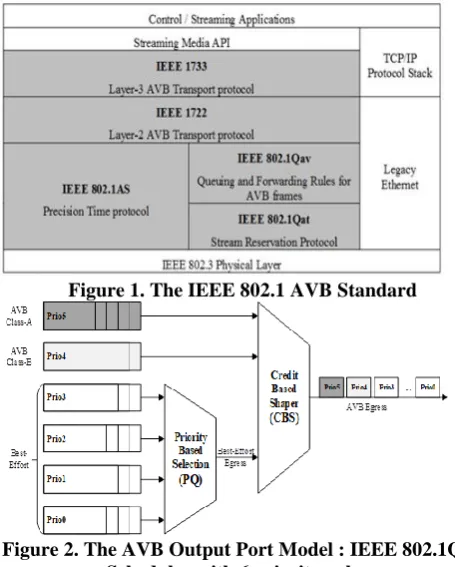
The IEEE 802.1 Audio/Video Bridging Task Group [8][9] defines several mechanisms that enable streaming service with low latency and time-synchronization using existing 802 networks. These multiple mechanisms are based on the medium access control (MAC) layer and therefore support guaranteed QoS in the switched Ethernet network specified in the following sub-standards[10][11][12]. Figure 1 shows the IEEE 802.1 AVB standard. The shaded area in Figure 1 represents the AVB protocol. The IEEE 802.1AVB standard consists of several sub-standards that are required to ensure coexistence with existing Ethernet nodes as well as latency and time synchronization performance.
IEEE 802.1AS specifies a scheme for time synchronization of distributed nodes on a network.
IEEE 802.1Qat defines a type of data to be transmitted in a network using IEEE 802.1AVB and specifies a bandwidth allocation scheme to guarantee their time requirements.
IEEE 802.1Qav specifies the behavior of the output port for stream data transmission.
If different types of traffic, such as time critical and best-effort traffic, have different priorities, then data packets must be transmitted differentially to match their characteristics. The
[image:2.595.305.533.112.396.2]IEEE 802.1Qav standard was introduced for this purpose. An AV bridges include multiple I/O ports to give different priorities depending on the type of data. Figure 2 shows the AVB output port model. This model is designed to handle time sensitive and best effort traffic separately [4].
Figure 1. The IEEE 802.1 AVB Standard
Figure 2. The AVB Output Port Model : IEEE 802.1Qav Scheduler with 6 priority values
International Journal of Innovative Technology and Exploring Engineering (IJITEE) ISSN: 2278-3075, Volume-8 Issue-7 May, 2019
Algorithm 1. priority Queueing (PQ) 1: loop
2: for i = NumofTrafficClasses; i ≥ 1; i++ do
3: if Queue(i) ≠empty then 4: frame = Queue(i).pop() 5: SendFrame(frame)
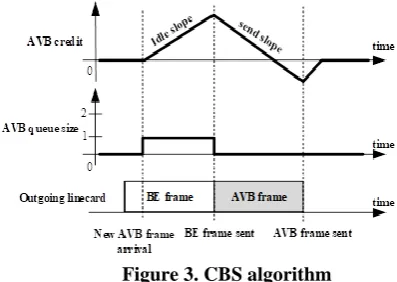
The second algorithm is CBS, which all bridges can support in addition to the priority to provide a low latency and fair data transmission service [4]. It is the goal of AVB to delay traffic of the highest AVB priority (SR class A) no more than 2 ms over 7 hops and of the second highest AVB priority (SR class B) no more than 50 ms over 7 hops. More hops result in corresponding longer delays. In order to achieve these goals the CBS was standardized.
[image:3.595.60.259.429.570.2]Using CBS guarantees some of the port transfer rate over time. Figure 3 shows the behavior of the CBS algorithm using an example. The CBS algorithm for SR class A and class B are based on credit values. AVB frame is transmitted only when the credit value is greater than or equal to zero. When the AVB frame is transmitted, the credit value increases according to the idle slope. If the transmission of the AVB frame is interrupted by another frame, the credit value will be greater than zero. Since SR classes have the highest priority, AVB frames are sent when the line card is idle. Credit value decreases with transmission slope. If the credit value is negative at the end of the AVB frame transmission, the credit value increases again with the idle slope until it becomes zero [5].
Figure 3. CBS algorithm
In case where both of the SR classes are not able to transmit frames (e.g. due to the negative credits or an empty queue), the best effort queue with legacy Ethernet frames is selected for the transmission [14]. The credit value is set to zero when no frames exist for transmission for a given SR class queue so that the algorithm has to wait for the next transmission. Despite these properties and its successful transmission of audio/video streaming, there are applications in the industrial and vehicle control field characterized by time-sensitive requirements that cannot be met by the current IEEE 802.1 AVB standard. Studies in [4] and [6] proved that, although AVB can determine the worst case latency for all real-time message classes, the fact that needs more improvements for use in industrial automation is evidenced. Because the credit-based fair queueing (CBFQ) used in AVB for traffic shaping uses non-preemptive scheduling, in the worst case a real-time frame might be delayed on all bridges by the
ongoing transmission with a maximum frame size of zero. Time-aware blocking shapers (TABS) have been proposed in [13] to isolate class A streams from the interference caused by other traffic types within the IEEE 802.1 Working Group. TABS blocks the transmission of lower priority traffic than class A, which prevents transmission of upcoming SR class A traffic. For instance, if a given non-SR class A queue has a frame ready, but the transmission of such a frame, if allowed would delay the start time of the next transmission of SR class A traffic, such a transmission is not allowed.
Because IEEE 802.1AS standard in IEEE 802.1AVB is time-aware already, the changes required to implement TABSs are mechanisms for inhibiting/allowing transmission at time intervals and configuring shapers via a management information base. However, the approaches proposed in [13] map all the time-sensitive flows on the same class irrespective of their heterogeneous sizes and time constraints. Such a choice is not beneficial to low latency, small-size traffic, which should not be handled in the same queue as large AV frame due to the priority blocking and shaper blocking effects that affect the AVB worst case latency [7].
III. ASCHEME FOR REAL-TIME DATA CONTROL
We describe the problems that can occur on the switches when transferring data between domains. The vehicle has intermittent control data depending on the situation. This data moves between domains on the switch. However, control data can be delayed by other data. These delayed control data can pose a serious risk to vehicle safety. In this paper, control data refers to real-time control application data that is closely related to safety and must be transmitted quickly.
For example, assume that an automatic emergency braking system (AEBS) has been activated by an object suddenly appearing in front of a vehicle in motion. After that, it recognizes that the ADAS domain is in a state of sudden braking and transmits the control data to the chassis domain and powertrain domains. However audio/video data is being transmitted between the information domain and the body domain, and this control data may be delayed, posing a serious risk to vehicle safety.
To solve this situation, we need to define a new data class for intermittent control data. This means that the scheduling policy for selecting the data to be transmitted in the switch should be extended. Cause the scheduling policy is based on the type of queue.
Figure 4. The Extended AVB Output Port Model : Modified IEEE 802.1Qav Scheduler with 7 priority
values - Add a control class
The characteristics of the control data are as follows. The control data generated in the vehicle is intermittently generated by the surroundings of the vehicle while driving. The information in the control data is time critical because it is important related to safety when the moving the vehicle. The maximum transmission delay time of the control data in the vehicle should be 1μs [18]. Therefore, the class used in IEEE 802.1AVB is defined as flows considering these characteristics. As shown in Figure 4, it is proposed to add a control class for transmitting control data related to safety without delay.
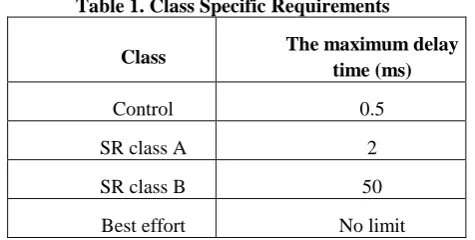
Table 1. Class Specific Requirements
Class The maximum delay
time (ms)
Control 0.5
SR class A 2
SR class B 50
[image:4.595.52.290.237.357.2]Best effort No limit
Table 1 shows the maximum delay time for each class of the extended IEEE 802.1AVB. The control class has the highest priority among the IEEE 802.1AVB. Therefore, the control class overrides SR class A, which has the highest priority in the standard. For reference, the priority order is control class > SR class A > SR class B > best effort class.
- Transmission data scheduling scheme in switches
To use the newly defined control class, we need to change the scheduling policy on the egress port. Control data should be transmitted first. Since control data is safety-relevant, it must be transmitted immediately upon entering the queue. If other data is being transmitted using the output port, the control data transmission must be transmitted immediately after the transfer of the other data is completed.
However, because of the use of the CBS algorithm, multiple data streams can continue to be transmitted until the credits is less than 0. In this situation, control data transmission delay occurs. If the control data is queued while the SR class is still being transmitted, no transmission delay occurs, the transmission of the existing SR class should be stopped and the CBS algorithm policy should be modified so that control data transmission can be performed.
Therefore, when using the proposed extend CBS algorithm, the conditions under which output ports can be used in other classes are as follows. 1) When there is data to transmit, 2) when the credit is 0 or more, 3) output port is not in use, and 4) there is no control data to transmit. When all of these conditions are satisfied, it is possible to transmit data other than control data.
IV.CONCLUSION AND FUTURE WORK
In this paper, we describe the recent trends of in-vehicle network requirements and describe the IEEE 802.1AVB,
which is attracting attention as a next generation in-vehicle network. In addition, I introduced related research to use IEEE 802.1 AVB as in-vehicle network. We propose an extended AVB for handling intermittent control data considering the characteristics of the data generated in the vehicle. By using the proposed scheme, it is possible to transmit the control data in real time which had to be solved to use IEEE 802.1 AVB as in-vehicle network. We will improve the reliability of the proposed algorithm by conducting mathematical verification and simulation for the proposed model.
ACKNOWLEDGEMENTS
This research was supported by Basic Science Research Program through the National Research Foundation of Korea (NRF) funded by the Ministry of Education (No. 2017R1D1A1B03032736).
REFERENCES
1. TUOHY, Shane, et al. Intra-vehicle networks: A review. IEEE Transactions on Intelligent Transportation Systems, 2015, 16.2: 534-545.
2. HE, Feng; ZHAO, Lin; LI, Ershuai. Impact analysis of flow shaping in ethernet-avb/tsn and AFDX from network calculus and simulation perspective. Sensors, 2017, 17.5: 1181.
3. ALDERISI, Giuliana, et al. Simulative assessments of IEEE 802.1 Ethernet AVB and time-triggered Ethernet for advanced driver assistance systems and in-car infotainment. In: Vehicular Networking Conference (VNC), 2012 IEEE. IEEE, 2012. p. 187-194.
4. IMTIAZ, Jahanzaib; JASPERNEITE, Jürgen; HAN, Lixue. A performance study of Ethernet Audio Video Bridging (AVB) for Industrial real-time communication. In: Emerging Technologies & Factory Automation, 2009. ETFA 2009. IEEE Conference on. IEEE, 2009. p. 1-8.
5. MEYER, Philipp, et al. Extending IEEE 802.1 AVB with time-triggered scheduling: A simulation study of the coexistence of synchronous and asynchronous traffic. In: Vehicular Networking Conference (VNC), 2013 IEEE. IEEE, 2013. p. 47-54.
6. IMTIAZ, Jahanzaib; JASPERNEITE, Jürgen; SCHRIEGEL, Sebastian. A proposal to integrate process data communication to IEEE 802.1 Audio Video Bridging (AVB). In: Emerging Technologies & Factory Automation (ETFA), 2011 IEEE 16th Conference on. IEEE, 2011. p. 1-8.
7. CUMMINGS, Rodney, et al. Exploring use of Ethernet for in-vehicle control applications: AFDX, TTEthernet, EtherCAT, and AVB. SAE International Journal of Passenger Cars-Electronic and Electrical Systems, 2012, 5.2012-01-0196: 72-88.
8. IEEE 802.1 AVB TG, IEEE 802.1 Audio NideoBridging (AVB), http://www.ieee802.orgll/pages/avbridges.html.
9. IEEE 802.1 AVB TG. IEEE p802.1 ba - Audio Video Bridging (AVB)
Systems, [online] Available:
http://www.ieee802.org/1/pages/802.1ba.html.
10. IEEE 802.1 AVB TG. IEEE p802.1as/d7.0 - timing and synchronization for time-sensitive applications in bridged local area networks, 2009, [online] Available: http://www.ieee802.org/1/pages/802.1as.html. 11. IEEE 802.1 AVB TG. IEEE p802.1qat/d6.1 - virtual bridged local area
networks-stream reservation protocol, 2009, [online] Available: http://www.ieee802.org/1/pages/802.1at.html
12. 802.1 AVB TG, 802.1Qav - Forwarding and Queuing Enhancements for Time-Sensitive Streams, http://www.ieee802.org/1/pages/802.1av.html. 13. PANNELL, Don. Avb-generation 2 latency improvement options. In:
802.1 AVB Group Meeting. 2011.
International Journal of Innovative Technology and Exploring Engineering (IJITEE) ISSN: 2278-3075, Volume-8 Issue-7 May, 2019
15. TUOHY, Shane, et al. Intra-vehicle networks: A review. IEEE Transactions on Intelligent Transportation Systems, 2015, 16.2: 534-545.
16. CUALAIN, D. O., et al. Automotive standards-grade lane departure warning system. IET Intelligent Transport Systems, 2012, 6.1: 44-57. 17. QUECK, Rene. Analysis of ethernet avb for automotive networks using
network calculus. In: Vehicular Electronics and Safety (ICVES), 2012 IEEE International Conference on. IEEE, 2012. p. 61-67.
18. KIM, Yong. Very low latency packet delivery requirements and problem statements. In: IEEE 802.1 AVB Task Group Interim Meeting. Atlanta, GA USA, Nov 2011. 2011.
AUTHORSPROFILE