The influence of soil properties and nutrients on conifer forest
growth in Sweden, and the first steps in developing a nutrient
availability metric
Kevin Van Sundert1, Joanna A. Horemans1, Johan Stendahl2, and Sara Vicca1
1Centre of Excellence PLECO (Plants and Ecosystems), Biology Department,
University of Antwerp, Wilrijk, 2610, Belgium
2Department of Soil and Environment, Swedish University of Agricultural Sciences,
P.O. Box 7014, Uppsala, 75007, Sweden
Correspondence:Kevin Van Sundert ([email protected]) Received: 30 August 2017 – Discussion started: 2 November 2017
Revised: 10 May 2018 – Accepted: 28 May 2018 – Published: 13 June 2018
Abstract. The availability of nutrients is one of the factors that regulate terrestrial carbon cycling and modify ecosys-tem responses to environmental changes. Nonetheless, nutri-ent availability is often overlooked in climate–carbon cycle studies because it depends on the interplay of various soil factors that would ideally be comprised into metrics applica-ble at large spatial scales. Such metrics do not currently exist. Here, we use a Swedish forest inventory database that con-tains soil data and tree growth data for > 2500 forests across Sweden to (i) test which combination of soil factors best ex-plains variation in tree growth, (ii) evaluate an existing met-ric of constraints on nutrient availability, and (iii) adjust this metric for boreal forest data. With (iii), we thus aimed to provide an adjustable nutrient metric, applicable for Sweden and with potential for elaboration to other regions. While tak-ing into account confoundtak-ing factors such as climate, N de-position, and soil oxygen availability, our analyses revealed that the soil organic carbon concentration (SOC) and the ra-tio of soil carbon to nitrogen (C : N) were the most impor-tant factors explaining variation in “normalized” (climate-independent) productivity (mean annual volume increment – m3ha−1yr−1) across Sweden. Normalized forest produc-tivity was significantly negatively related to the soil C : N ra-tio (R2=0.02–0.13), while SOC exhibited an empirical opti-mum (R2=0.05–0.15). For the metric, we started from a (yet unvalidated) metric for constraints on nutrient availability that was previously developed by the International Institute for Applied Systems Analysis (IIASA – Laxenburg, Aus-tria) for evaluating potential productivity of arable land. This
1 Introduction
Nutrients determine structure and functioning at all levels of biological organization. The availability of mineral ele-ments influences plant growth (von Liebig, 1840), patterns of biodiversity (Fraser et al., 2015), and ecosystem processes (e.g., Janssens et al., 2010; Vicca et al., 2012; Fernández-Martínez et al., 2014). Moreover, nutrient availability can modify ecosystem responses to global atmospheric and cli-matic changes, such as nitrogen (N) deposition (Nohrstedt, 2001; Hyvönen et al., 2008; Vadeboncoeur, 2010), increasing CO2levels (Norby et al., 2010; Terrer et al., 2016), warming
(Dieleman et al., 2012), and drought (Friedrich et al., 2012). Given the crucial role of nutrients in terrestrial carbon cy-cling and in shaping the magnitude and direction of its feed-backs to climate change, nutrient availability should be taken into account in global analyses and in Earth system models (Goll et al., 2012; Thomas et al., 2015; Wieder et al., 2015). This is, however, not yet common practice because we often lack the soil data and metrics needed to accurately account for nutrient availability.
Comparing nutrient availability among terrestrial ecosys-tems is difficult for two reasons: comprehensive and harmo-nized data on soil properties and nutrients are not usually available from experimental and observational sites, and no standardized quantitative metric exists to compare the nutri-ent statuses of terrestrial ecosystems at the global scale, or even at a national scale (e.g., for Sweden, which is consid-ered in this study). In the absence of a standardized nutrient availability metric, studies comparing nutrient availability across sites commonly use soil-fertility-related approxima-tions such as the height of 100-year-old trees (which, how-ever, also depends on other factors such as soil depth and hy-drology – Hägglund and Lundmark, 1977) or manually clas-sify sites as low, medium, and high nutrient availability based on existing site information (Vicca et al., 2012; Fernández-Martínez et al., 2014). The absence of a more nuanced ex-pression impedes elucidating the role of nutrient availabil-ity in ecosystem processes and functioning (Cleveland et al., 2011) and how these respond to global change, and it pre-cludes investigating nonlinear effects of nutrient availability. Although various proxies exist to estimate soil N and phos-phorus (P) availability at the local scale (e.g., “snapshots” of extractable pools), no perfect method exists to quantify N and P availability in a comparable way across ecosystems (Binkley and Hart, 1989; Holford, 1997; Neyroud and Lis-cher, 2003). This limits the potential for inter-site compar-isons based on these data alone (Cleveland et al., 2011). Soil properties like soil texture, soil organic matter (SOM) quan-tity and quality, and pH, however, are more indicative of the general nutrient status because together with environmental factors (temperature and moisture – Binkley and Hart, 1989), they control (1) the total amount of nutrients in soil solu-tion, (2) ion exchange sites, and (3) unavailable pools of soil nutrients, as well as fluxes among these three (Roy et al.,
2006). For instance, a high clay fraction corresponds to a high cation exchange capacity (CEC), i.e., the soil’s poten-tial to retain positively charged, exchangeable ions such as NH+4, K+, Ca2+, and Mg2+(Chapman, 1982; Chapin et al., 2002), while SOM has a positive influence on nutrient avail-ability by acting as a nutrient reserve (Grand and Lavkulich, 2015) and provides cation as well as anion exchange sites (IIASA and FAO, 2012). Finally, soil pH strongly influences availability of P and base cations (K+, Ca2+, and Mg2+). At low pH, P is bound to Fe and Al oxides, while at high pH, P is typically unavailable because of complex formation with Ca. P availability is thus maximal at intermediate pH (Chapin et al., 2002; Bol et al., 2016), while enhanced leach-ing of base cations occurs in acidic soils, thus reducleach-ing TEB (i.e., the cation equivalent of summed K, Ca, Mg, and Na – IIASA and FAO, 2012). Hence, unlike temperature or precip-itation, nutrient availability cannot be assessed by measuring one single parameter. It is determined by the interplay of var-ious nutrients and soil properties. A nutrient availability met-ric should thus combine critical soil properties and nutrients, while considering important nonlinearities. To be widely ap-plicable, such a metric is preferably constructed only of easy-to-obtain variables.
Only a few exploratory attempts to find an expression for nutrient availability at the global scale have been made. The most recent one was developed by IIASA and FAO, who pro-vide a simple index in their Global Agro-ecological Zones report of 2012 (IIASA and FAO, 2012). It is a worldwide-applicable metric for constraints on nutrient availability, principally meant for agricultural purposes. This metric rep-resents, for a particular crop species, the percentage of the maximum attainable productivity that could be reached given constraints imposed by environmental characteristics such as climate, rooting conditions, and soil oxygen availability but absent nutrient limitation:
actual productivity
= metric score[%] ·attainable productivity
100 . (1)
The species-specific score of the metric depends on four measurable soil variables, related to soil fertility: SOC (%), soil texture, TEB (cmol+kg−1dw), and pH measured in wa-ter (pHw). The metric score combines the scores of each of
these four attributes (provided in a lookup table), but giv-ing more weight to the attribute with the lowest score. To-gether with the nonlinear relationships (e.g., for pH and SOC – see Sect. 2), this increases the realism of the metric (see Liebig’s law of the minimum (von Liebig, 1840); e.g., at op-timal pH, the limiting effect of low SOC on plant growth will be stronger than in soils with very low or high pH in which plant growth becomes more likely to be P limited).
> 2500 conifer forest plots and thus provides sufficient statis-tical power for an evaluation of the metric – is provided by the Swedish forest inventory service. Moreover, it contains additional variables of interest related to N availability, such as total soil N stock and concentration, and especially the soil C : N ratio, which we expected to be an important fac-tor in explaining variation in nutrient availability. This large dataset also allows the evaluation of our country-scale find-ings against local gradients in nutrient availability that avoid confounding effects of covarying factors such as climate and N deposition.
Specifically, we used the Swedish dataset to address the following questions:
Question 1: Which single soil variables can explain
varia-tion in normalized (i.e., climate-independent) produc-tivity across Sweden? Which combination of soil fac-tors best explains variation in normalized productivity?
Question 2: Can the IIASA metric of constraints on nutrient
availability explain variation in normalized productiv-ity? Are the soil variables already included in the metric (SOC, soil texture, TEB, and pHw) accurately
imple-mented?
Question 3: Can the IIASA metric be adjusted to
character-ize nutrient availability in Swedish forests?
2 Methods
2.1 The Swedish forest and soil inventories (national database)
We combined a Swedish forest soil (Olsson, 1999; Lundin, 2011) and inventory database for the period 2003–2012 (Lundin, 2011) with a database for soil texture and cli-mate information across Sweden. Precipitation data were ex-tracted from the European Commission Joint Research Cen-tre Monitoring Agricultural Resources dataset (EC–JRC– MARS, based on ECMWF model outputs and a reanalysis of ERA-Interim; see http://spirits.jrc.ec.europa.eu/; last access: 7 June 2018) based on the geographic location of each site. The dataset’s spatial resolution is 0.25◦ and averages were calculated for the period 1989–2012. The resulting data col-lection thus incorporated information on location, climate, soil, and vegetation for about 2500 forested plots (n=1099 for spruce,n=1422 for pine) spread over Sweden (Table 1).
growing season temperature sum (TSUM) following a re-cently reparameterized version of the equation given in Odin et al. (1983), available on https://www.skogskunskap.se/; last access: 7 June 2018.
TSUM(◦C days)
= 4203.212488−40.21083·latitude(◦N) −2.564434·elevation(m)
+0.030492·latitude(◦N)·elevation(m) −0.117532·latitude2(◦N)
+0.00188·elevation2(m)
−0.000000556·latitude2(◦N)·elevation2(m) (2) In order to facilitate comparisons among sites and to allow the calculation of the nutrient availability metric, we con-verted the soil measurements (SOC, soil texture, TEB, pHw,
pHKCl, total nitrogen concentration (TN), and soil C : N
ra-tio) taken per horizon to values representative of the upper 10 cm (i.e., the 0–10 cm layer) and the upper 20 cm (i.e., the 0–20 cm layer) of the soil, including the organic layer. To this end, we first calculated bulk densities (BDs) as
BDorganic horizon(kg m−3)
= organic layer stock(kg m
−2)
organic layer depth(m) (3)
for the organic horizons and
BDmineral horizon(kg m−3) = 1546.3
·exp−0.3130·ptotal carbon(%) (4) for the mineral soil (Nilsson and Lundin, 2006).
Conversions of soil data (“variables”) per horizon to data per depth interval (layer x–ycm) were then per-formed as follows (soil mass per m2 (kg m−2)=BD (kg m−3)·thickness
horizon or layer(m)):
Variablex−ycm = soil masshorizon1/soil massx−ycm
·variablehorizon1
+ soil masshorizon2/soil massx−ycm
·variablehorizon2+. . . (5)
TEB, and pHw) that can be assigned to a soil (IIASA
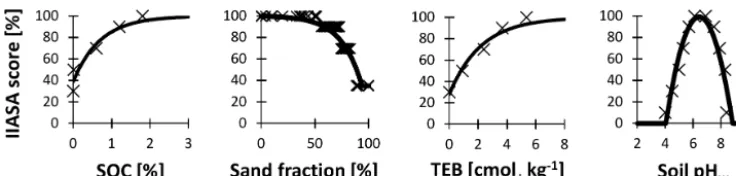
and FAO, 2012). These scores, which can be found in lookup tables (http://webarchive.iiasa.ac.at/Research/LUC/ GAEZv3.0/soil_evaluation.html; last access: 7 June 2018), were derived from crop growth data on different agricul-tural soils. Given that we consider boreal forests and not crops, we averaged the scores of the different crop species for each of the four soil properties. We thus removed crop-specific requirements, but generally known relationships be-tween the soil variables and plant performance (not only valid for agroecosystems), such as an optimum for pH, re-mained. In addition, we replaced the lookup-table-derived step functions with continuous empirical formulas to facil-itate their calculation as well as their modification (Fig. 1): SOC Score[%] =38.94+(100−38.94)
·(1−exp(−1.4192·SOC[%])) , (6) Soil texture Score[%] =max(100+0.4911
·(1−exp(0.0522·SAND[%])) ,35) , (7) TEB Score[%] =28.05+(100−28.05)
·1−exp−0.4508·TEBhcmol+kg−1 i
, (8)
pH Score[%] =max −17.228·(pHw−4.04)·(pHw−8.84),0
=max−17.228· pHw−6.442+99.32,0. (9) The total score for nutrient availability, which can be in-terpreted as the expected actual yield (i.e., aboveground pro-ductivity) proportional to the maximum attainable yield (i.e., without nutrient constraints), was then calculated as follows (IIASA and FAO, 2012):
total IIASA score(%)=0.5·lowest score
+0.5·average of other scores. (10)
2.2 General approach
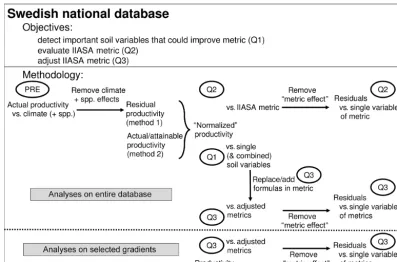
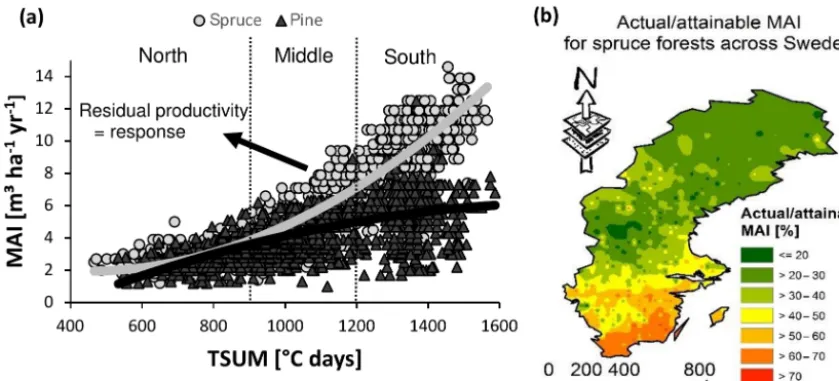
Forest productivity across Sweden depends not only on soil nutrient availability but also on climate, soil wetness, and N deposition. Before evaluating the metric, we removed the in-fluence of climate on forest productivity (“PRE” in Fig. 2). The influence of soil moisture and N deposition are consid-ered in further analyses (see Sect. 2.3.1). Normalized pro-ductivity was calculated in two alternative ways: (1) as the residuals of the regression model (of PRE; from here on re-ferred to as “method 1”; Figs. 3a and S1a, b, Tables S1 and S2, and Eq. S1) and (2) as the ratio of the original produc-tivity relative to the theoretical maximum producproduc-tivity (from here on referred to as “method 2”; Figs. 3b and S1b, c). This theoretical maximum productivity, which was extracted from a map provided by Bergh et al. (2005) with ArcGIS (ESRI, 2011), indicates the productivity that could be obtained un-der non-nutrient-limited conditions and is further referred to
as attainable productivity. The second method is thus very similar to the IIASA approach (see Eq. 1), but because an estimate for attainable productivity was only available for spruce, it could only be applied for this species. The two alternative methods for normalizing productivity were used to verify the robustness of the analyses, and because each method has its own advantages and disadvantages. The main disadvantage of method 1 is that not only the direct influ-ence of climate on productivity is removed but also its indi-rect effect through nutrient availability, so that only effects of regional variation in nutrient availability on productivity remain. Method 2, however, involves an extrapolation based on the results of only a few fertilization experiments and thus comes with high uncertainty on the estimates of attainable productivity.
Regression analysis was then used to elucidate how the different soil variables were related to normalized productiv-ity (Question 1). In addition, normalized productivproductiv-ity was fit-ted against the IIASA metric to test its performance. The cor-relation between the residuals of this cor-relationship and each of the four variables of the metric then indicated whether or not the variables were well implemented (Question 2). Finally, the associations found in Question 1 indicated how the metric could be adjusted (Question 3). Two adjusted metrics were then evaluated in the same way as the original IIASA met-ric in Question 2, and by investigating if they could explain variation in productivity for five local gradients in nutrient availability. An overview of the methodology is presented in Fig. 2.
2.3 Data analyses
As explained in the paragraphs above, productivity was nor-malized using two methods. Method 1 considers the resid-uals to reflect deviations in productivity imposed by spatial variation in nutrient availability and in the absence of cli-mate effects. However, residuals deviated more strongly from zero towards the warmer south (Fig. 3a), thus causing het-eroscedasticity and a potential bias in the further analyses if not properly accounted for. For further analyses, we therefore split the database into three TSUM groups (north, middle, and south; Fig. 3a). For method 2, considering the ratio of actual to attainable productivity, this separation of different regions was not required.
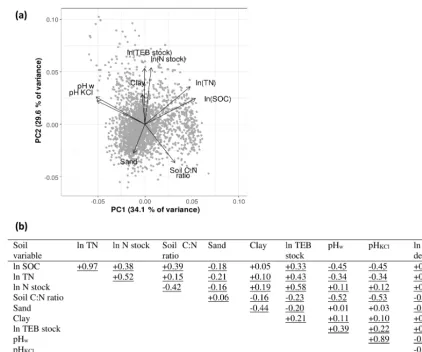
2.3.1 Identifying potentially confounding factors In order to understand the correlation structure of the database, and avoid multicollinearity in the subsequent anal-yses, we examined correlations among the soil variables (SOC, TN, total N stock, soil C : N ratio, sand fraction, clay fraction, TEB, pHw, and pHKCl). We performed a
Figure 1.IIASA soil scores for soil organic carbon concentration (SOC), texture, total exchangeable bases (TEB), and pH measured in
water (pHw). The curves were drawn based on approximate functions through the points, which were derived from crop-specific scores in a
lookup table (http://webarchive.iiasa.ac.at/Research/LUC/GAEZv3.0/soil_evaluation.html; last access: 7 June 2018, IIASA and FAO, 2012) and averaged over all crop species in the table.
Table 1.Overview of variables of the database used in the current study. Each plot for soil and vegetation analyses had a 10 m radius and was sampled once during the period 2003–2012. The (mostly managed) forests in the inventory represent a random sample of Swedish forests. Abbreviations: MAP: mean annual precipitation; TSUM: growing season temperature sum; SOC: soil organic carbon concentration; TEB:
total exchangeable bases; pHw: pH measured in water; pHKCl: pH measured in KCl solution; TN: total nitrogen concentration; soil C : N
ratio: soil carbon-to-nitrogen ratio.
Available Location Climate Soilb Vegetation
Data Latitude (◦N) MAP (mm) Horizon thickness (cm) Agef(yr),
Longitude (◦E) TSUMa(◦C days) Organic layer stock (t ha−1) Tree species composition (%) productivityg
Elevation (m) Organic layer depth (cm) (m3ha−1yr−1)
SOC (%)
Texturec(% sand, silt, clay)
TEB (cmol+kg−1or cmol+m−2)
pHw, pHKCl
TN [%], soil C : N ratio,
Soil moistured(classified)
Soil typee(classified)
aTSUM was calculated for each data point based on its latitude, longitude, and elevation.bn=3; soil variables were determined using standard sampling and laboratory procedures (e.g., Olsson et al., 2009; Stendahl et al., 2010).cIn an earlier version of the database, percentages of sand, silt, and clay were approximated from field-based soil texture class.dSoil moisture was determined in the field based on indicators (e.g., groundwater depth, moisture at the surface, ground vegetation, elevated tree trunks). The classification is representative of the average moisture conditions during the growing season (Olsson, 1999; Olsson et al., 2009).eTaxonomic soil classification is based on the World Reference Base for Soil Resources.fStand age ranged between 1 and 350 years, with an average of 65 years.gProductivities (site quality) or mean annual volume increments (MAIs) over a full rotation were estimated based on height development curves. In situ productivities may be lower, depending on the management.
matrix with Pearson’s r as correlation coefficients for each variable pair.
Soil moisture and soil type (available as categorical vari-ables) may act as confounding factors for associations be-tween productivity and other soil properties (e.g., in wet soils, the rooting environment is anoxic and decomposition is inhibited (Olsson et al., 2009), leading to reduced pro-ductivity and accumulation of SOM). We therefore tested if the selected soil variables and normalized productivity dif-fered among soil moisture classes (dry, fresh, fresh-moist, and moist, as available from the database and derived from a combination of indicators such as groundwater depth – Olsson, 1999; Olsson et al., 2009) and the most common World Reference Base for Soil Resources-based soil types (Histosols, Gleysols, Regosols, Leptosols, and Podzols) us-ing two-way ANOVA with soil moisture or type and tree species as fixed factors.
[image:5.612.47.552.291.429.2]Figure 2.Objectives and methods followed in the current paper. PRE refers to a regression model of productivity vs. climate and species (spp.); Question 1, Question 2, and Question 3 refer to the research questions. Performance of the adjusted nutrient metrics was evaluated against the entire database, and against five nutrient availability gradients, selected from the database (Fig. S2).
soil variables, using Pearson’s correlation coefficient (r), and performed regression analyses on normalized productivity vs. N deposition, stratified by soil moisture and type.
2.3.2 Question 1 – normalized productivity vs. single and combined soil variables
Simple regression analysis was used to determine the rela-tionship between single soil variables and normalized pro-ductivity. To test the robustness of the observed relation-ships in the absence of potentially confounding effects of soil moisture and type, we performed these analyses on all data, and on the data stratified by soil moisture and soil type. Then, we tested which combination of continuous soil variables best explained variation in normalized productivity across Sweden (multiple regression analysis). Starting from the full model containing all explanatory variables, the least signifi-cant term was removed, resulting in a simplified model. Per-formance of the full and simplified models was then com-pared using the mean squared error (mse), based on cross validation (package DAAG – Maindonald and Braun, 2015). We repeated this model simplification procedure until mse stopped decreasing. Interaction effects up to the first order were added if suggested by regression trees (package tree – Ripley, 2015). For method 1 (Fig. 3), first-order interac-tions of continuous variables with region as a factor (levels:
N, M, S) were included in the selection procedure (i.e., an ANCOVA was used for this approach).
2.3.3 Question 2 – evaluation of the IIASA metric Irrespective of the method applied, a well-functioning nutri-ent availability metric would be recognized by a clear, pos-itive relationship with productivity. We used linear model analysis to test the significance of the relationship between the metric and normalized productivity, and to determine its explanatory power (R2). To test whether the variables in-cluded in the metric were accurately implemented, we also examined the correlation between the residuals of this lin-ear model and each of the variables included in the metric (SOC, soil texture, TEB, and pHw). A significant correlation
suggests that the soil variable under consideration is not op-timally implemented in the metric.
Figure 3.Normalized productivity was calculated in two alternative ways.(a)In method 1, residual values were taken from a regression model, explaining variation in mean annual increments (MAIs) by climate (growing season temperature sum or TSUM and precipitation) and species. The selection procedure, equation, and parameter estimates are given in the Supplement (respectively Tables S1 and S2 and
Eq. S1 in the Supplement). In order to avoid heteroscedasticity-induced artifacts, the dataset was split into northern (TSUM < 900◦C days),
middle (900◦C days < TSUM < 1200◦C days), and southern (TSUM > 1200◦C days) regions for this approach.(b)In method 2, actual
productivities for spruce were divided by theoretically attainable productivities, provided by Bergh et al. (2005).
additional soil variables to improve performance of the met-ric. Two new metrics were developed: “adjusted metric 1” and “adjusted metric 2”, referring to the respective methods of normalizing productivity (Fig. 3). As a starting point for adjusted metric 1, half of the dataset from southern Sweden (where productivity varied most; see Fig 3a) was used as a calibration set to derive regression equations, while half of the complete national dataset for spruce served as a calibra-tion set for adjusted metric 2. The best predictors of normal-ized productivity as indicated by the analyses in Question 1 were then adopted as partial metric scores (see the origi-nal Eqs. 6–9). Moreover, for adjusted metric 1, the minimum and maximum normalized productivities observed in south-ern Sweden were included as lower and upper boundaries to the partial metric scores to avoid possible unrealistic val-ues for future applications to other datasets. For method 2, the minima and maxima were, as in the IIASA metric, set to 0 and 100 %, respectively (units for this metric (%) re-mained the same as in the original IIASA metric, while for new metric 1, the unit was (m3ha−1yr−1)). Finally, the two
improved metrics for nutrient availability were calculated as in Eq. (10).
Performance of the adjusted metrics was evaluated by (i) testing normalized productivity in the database against the metrics and inspecting the implementation of the variables, and by (ii) testing productivity against the metrics and ex-amining variable implementation for five manually selected local gradients in nutrient availability. For (i), the metrics were thus evaluated as described for the IIASA metric un-der Question 2, with the exceptions that validation datasets
were used (i.e., the data that were used for developing the metrics were not included for the evaluations) and that the same analyses were also performed after stratifying by soil moisture and type to assess robustness. For (ii), two gradi-ents with spruce, and three gradigradi-ents with pine (locations in-dicated in Fig. S2) were selected in ArcGIS (ESRI, 2011). Each of these gradients included at least 40 data points from the Swedish database that (i) were located in the same re-gion, without showing substantial spatial variation in climate and (ii) showed high spatial variation in soil moisture, TEB, or productivity (we also searched specifically for clear soil C : N gradients, but found none for which climate did not vary; variables like soil C : N or SOC did however sufficiently vary within the five selected gradients:≤16.8–≥32.2 and ≤1.6–≥48.5 %, respectively). We thus not only evaluated the adjusted metrics against normalized productivity across the complete database but also tested their performance for local gradients, which offered the advantage that no normal-ization of productivity for climate was needed.
infla-Figure 4.Correlation structure of a set of potential key soil variables for a soil depth of 0–20 cm. Panel(a)shows the principal component
analysis (PCA) biplot (SD for PC1=1.75, SD for PC2=1.63); panel(b)shows the correlation matrix, showing Pearson’srfor the variable
pairs, including correlations with nitrogen deposition. Underlined correlations were significant. Abbreviations: SOC: soil organic carbon
concentration (%); TN: soil total nitrogen (%); N stock: amount of nitrogen in the layer (g m−2); Soil C : N ratio: soil carbon-to-nitrogen
ratio; Sand: percentage of sand in the mineral soil; Clay: percentage of clay in the mineral soil; TEB: total exchangeable bases (cmol+m−2);
pHw: pH measured in water; pHKCl: pH measured in KCl solution; N dep: nitrogen deposition.
tion factor (package car – Fox and Weisberg, 2011) assessed possible multicollinearity. Whenever confidence intervals are given, they represent standard errors of the mean (s.e.m.). For all analyses,α=0.05 was taken as the significance level, whereasP values between 0.05 and 0.10 were considered to be borderline significant.
3 Results
3.1 Identifying potentially confounding factors
Correlations among soil properties and nutrients were inves-tigated to verify if any of the variables could be excluded in the subsequent analyses due to redundancy. In this database, pHwand pHKClwere strongly correlated. As pHKClhas the
practical advantage of showing less seasonal variation than pHw(Soil Survey Staff, 2014), we opted to use only pHKCl
in the analyses for research Question 1. Similarly, TN and SOC largely shared the same information. We included SOC in the analyses and discarded TN because SOC is a compo-nent of the IIASA metric of constraints on nutrient availabil-ity. Moreover, soil organic matter acts as a nutrient store and provides cation and anion exchange sites, while TN is merely correlated to SOM but only a (small) proportion of total N is available to the plants. Collinearity among other variables was minor (|Pearson0sr|<0.65; Fig. 4), and they were thus all included in the analysis.
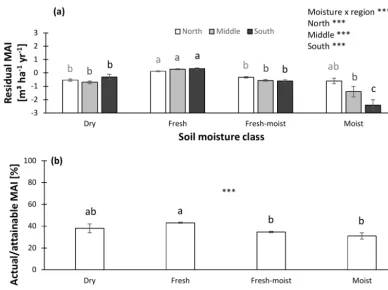
[image:8.612.80.502.63.414.2]char-Figure 5.Normalized productivity per soil moisture class.(a)Productivity normalized following method 1 (residual mean annual increment –
MAI) vs. soil moisture.(b)Productivity normalized following method 2 (actual/attainable mean annual increment – MAI) vs. soil moisture.
In panel(a), separate analyses were performed for northern, middle, and southern Sweden, as the moisture effects differed among regions.
∗∗∗
Indicates significant differences at theP< 0.01 level. Error bars represent the standard error of the mean (s.e.m).
acteristics. In the database, each forest was originally as-signed to a soil moisture category. Using these categories, we found that SOC and the soil C : N ratio increased from dry to moist. A similar trend was observed for TEB, while the sand fraction and pHKCl decreased from dry to moist.
For clay, no significant differences among soil moisture classes occurred (Fig. S3). Lastly, normalized productivity was highest in the fresh soil moisture class and lowest for the wettest forests (Fig. 5). This pattern was most pronounced in southern Sweden (north –F3,568=22.43,P< 0.01; middle – F4,844=39.47,P < 0.01; south –F4,1056=35.23,P< 0.01;
moisturexregion –F7,2468=3.77,P< 0.01).
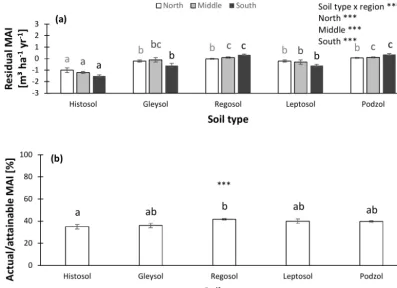
Soil properties not only differed among soil moisture classes, but also among soil types. Especially Histosols and Podzols could be distinguished from the other soils: His-tosols (which largely overlapped with the wet soil moisture classes) were characterized by a low pHKCl and high SOC
and soil C : N ratio, while Podzols were sandy and had a low TEB stock (Fig. S4). Differences in normalized productivity among soil types were observed as well. Histosols in par-ticular showed reduced productivities compared to other soil types (Fig. 6). Hence, the wetness of a site and its type of soil (partly in parallel with wetness) could confound observed patterns in productivity associated with the soil variables and
are therefore taken into account in further analyses and their interpretation.
[image:9.612.100.488.62.352.2]Figure 6.Normalized productivity per soil type.(a)Productivity normalized following method 1 (residual mean annual increment – MAI)
vs. soil type.(b)Productivity normalized following method 2 (actual/attainable mean annual increment – MAI for spruce) vs. soil type.
In panel(a), separate analyses were performed for northern, middle, and southern Sweden, as the soil type effects differed among regions.
∗∗∗Indicates significant differences at theP< 0.01 level. Error bars represent the s.e.m.
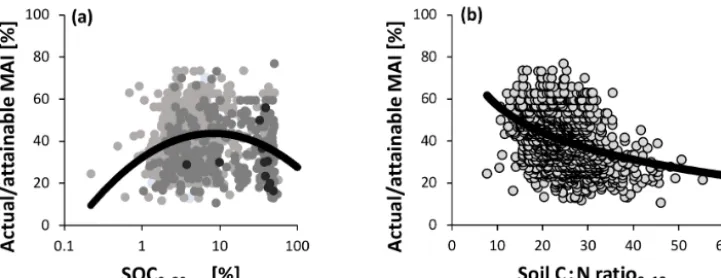
Figure 7.Relationship between normalized productivity following method 1 (residual mean annual increment – MAI);(a)log-transformed
soil organic carbon concentration (SOC);(b)soil carbon-to-nitrogen (C : N) ratio at a depth of 0–20 cm. Separate analyses were performed for
northern, middle, and southern Sweden, as the SOC and C : N effects differed among regions. Point darkness in(a)represents soil moisture
[image:12.612.113.481.428.622.2]Figure 8.Relationship between normalized productivity following method 2 (actual/attainable mean annual increment – MAI for spruce);
(a)log-transformed soil organic carbon concentration (SOC);(b)soil carbon-to-nitrogen ratio (C : N). Point darkness in(a)represents soil
moisture (darker: moister). Statistics corresponding to the panels are presented in Table 2. Note that the horizontal axis for SOC covers a broader range here than in Fig. 1, as SOC varied widely in the Swedish database. Also note that the C : N ratio of the upper 10 cm was used instead of the upper 20 cm here, owing to a better description of variation in the response variable. Even though the C : N ratio roughly
decreased southwards (Fig. S1d), it was only weakly correlated with the growing season temperature sum (r= −0.13 for C : N0−20 cmand
r= −0.28 for C : N0−10 cm).
3.2 Question 1 – normalized productivity vs. single and combined soil variables
In order to elucidate how soil variables affect nutrient avail-abilities across Sweden, we used their single and combined relationships with normalized productivity. For method 1, we found that most single soil variables were significantly re-lated to normalized productivity (Table 2;R2ranged between 0.002 and 0.146). For both SOC (Fig. 7a) and pHKCl, the
re-lationship with normalized productivity showed an optimum (i.e., an empirical quadratic relationship fit better than a lin-ear model). Normalized productivity was significantly nega-tively correlated with the soil C : N ratio (Fig. 7b), for which the effect became more pronounced towards the south (i.e., slopes andR2values increased;F2.2274=34.23,P< 0.01).
Finally, associations with soil N stocks and clay were weak (but significantly positive). The strongest relationships were found for normalized productivity versus SOC, pHKCl, and
soil C : N ratio and consequently these were among the vari-ables selected for the model with multiple covariates (Table 3).
Results of method 2 were qualitatively similar to those of the other approach for SOC (Fig. 8a), N stock, soil C : N ra-tio (Fig. 8b), clay fracra-tion, and TEB, although the N stock ex-plained a larger proportion of the variation here and the curve for actual/attainable productivity decreased logarithmically rather than linearly with increasing C : N ratio. However, the function for pHKCl did not show an optimum, but was
lin-ear with a significantly positive slope (Table 2). In summary, SOC and the soil C : N ratio were the only soil factors that showed a similar trend, according both methods with anR2
of at least a few percent, and were thus included in the multi-ple regression models for both methods 1 and 2 (these
mod-els also included other variables resulting from the stepwise regression analysis; Table 3).
Since soil moisture and soil type influenced both soil prop-erties and normalized productivity, we also stratified the anal-yses above by these factors. In general, these separate analy-ses confirmed the robustness of the observed patterns across the database (despite lowR2s), as the results and parameter estimates were similar to those of the previous analysis (Ta-bles S5 and S6).
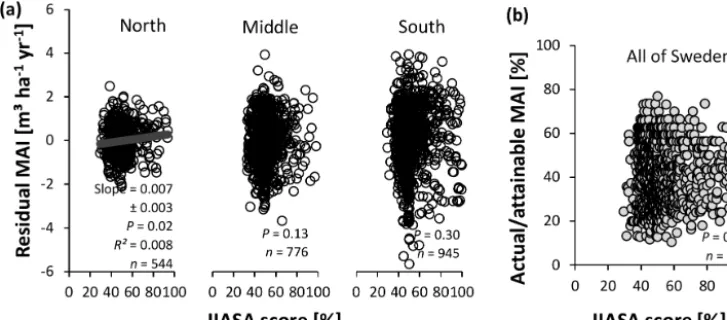
3.3 Question 2 – evaluation of the IIASA metric Both methods agreed on the poor performance of the IIASA metric to elucidate patterns in nutrient availability, as the weakly positive correlation between normalized productiv-ity and the metric was rarely significant, and explained < 1 % of the variation in normalized productivity in northern Swe-den for method 1 (Fig. 9). Residual values of the relationship between normalized productivity of method 1 and the metric score (Fig. 9a) were significantly associated with all four in-put variables of the metric (SOC, soil texture, TEB, and pHw
– Table S9). SOC and TEB correlated negatively with these residuals, while sand was significantly positively related to these same residuals, and productivities at low pHw were
overestimated (the empirical quadratic functions were con-cave; not shown in Table S9). Residuals of method 2 (Fig. 9b) confirmed the negative trend with TEB but showed no sta-tistically significant relationship with SOC, texture, or pHw
Figure 9.Evaluation of the IIASA metric of constraints on nutrient availability for Swedish conifer forests.(a)Method 1 – association with residual mean annual increments (MAIs) of the productivity–climate regression model (Fig. 3a, Eq. S1 and Table S2), distinguishing
northern, middle, and southern Sweden.(b)Method 2 – association with actual/attainable MAI for the entire Swedish land area (Fig. 3b).
[image:14.612.85.513.300.488.2]Full line: significant slope (P< 0.05).
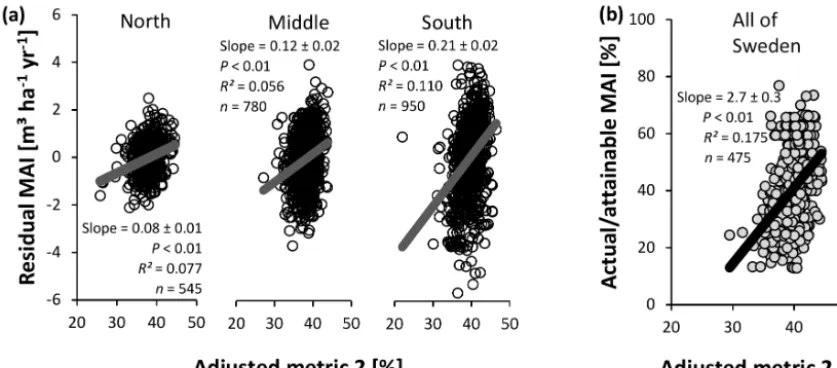
Figure 10.Evaluation of adjusted nutrient availability metric 1 for Swedish conifer forests.(a)Method 1 – association with residual mean annual increments (MAIs) of the productivity–climate regression model (Fig. 3a, Eq. S1 and Table S2), distinguishing northern, middle, and
southern Sweden.(b)Method 2 – association with actual/attainable MAI (Fig. 3b) for the entire Swedish land area. Full line: significant
slope (P< 0.05).
3.4 Question 3 – adjustments of the IIASA metric From the statistical analyses for Question 1, we deduce that SOC, soil C : N, and pH each play a role in influencing nu-trient availability in Sweden. Based on their relationships with normalized productivity in southern Sweden according to method 1 (Table S10), and in all of Sweden according to method 2 (Table S11), the following formulae were imple-mented in two adjusted nutrient availability metrics (Figs. S5 and S6):
SOC Score hm3ha−1yr−1i
= max
−0.18·(ln(SOC0−20 cm[%])
−ln(2.3))2+0.525,−5.65
, (11)
Soil C : N Scorehm3ha−1yr−1i
= max(−0.08·C : N0−20 cm+2.1,−5.65) , (12)
pH Scorehm3ha−1yr−1i = max
−0.9· pHw,0−20 cm−4.67
2
+0.6,−5.65
Figure 11.Evaluation of adjusted nutrient availability metric 2 for Swedish conifer forests.(a)Method 1 – association with residual mean annual increments (MAIs) of the productivity–climate regression model (Fig. 3a, Eq. S1 and Table S2), distinguishing northern, middle, and
southern Sweden.(b)Method 2 – association with actual/attainable MAI (Fig. 3b) for the entire Swedish land area. Full line: significant
slope (P< 0.05).
for the metric based on method 1 (adjusted metric 1), and
SOC Score[%] = max
−2.8·(ln(SOC0−20 cm[%]))
(−ln(8.1))2+43.5,0
, (14)
Soil C : N Score[%]
= max(−19·ln(C : N0−10 cm)+102,0) , (15)
pH Score[%] = max 2·pHw,0−20 cm+31,0
, (16)
for the metric based on method 2 (adjusted metric 2). In the same way as for the IIASA metric, Eqs. (11)–(13) and (14)–(16) were combined in Eq. (10) to calculate the fi-nal nutrient availability score for each metric. Soil texture and exchangeable bases were not included here, as their em-pirical relationships with normalized productivity showed opposite trends compared to their implementation in the IIASA metric (Fig. 1 vs. Tables 2 and S9), likely due to indi-rect effects of soil moisture and related organic matter accu-mulation.
In contrast to the IIASA metric of constraints on nutrient availability, the adjusted metrics were significantly related with normalized productivity (Figs. 10 and 11), albeit with lowR2values. The same analyses stratified by soil moisture (Tables S12 and S14) gave similar results for the intermedi-ate fresh and fresh-moist moisture classes (i.e., those with the majority of data points), while stratification by soil type gen-erally weakened relationships between the metrics and nor-malized productivity (only for Podzols and Regosols, could the metrics always describe variation; Tables S13 and S15). Only on a few occasions did the soil variables included in metric 1 show a (borderline) significant correlation with the
residuals of the relationship between normalized productivity and the adjusted metrics (and the associatedR2values were always low (≤0.005); Table S16). We therefore conclude that SOC, soil C : N, and pH are generally well implemented in this adjusted metric, at least for the database considered here. For adjusted metric 2, however, significant associations with higherR2values emerged, thus indicating suboptimal implementation of the variables in the metric, but the sign of the significant slope differed depending on whether normal-ization method 1 or 2 was used (Table S17).
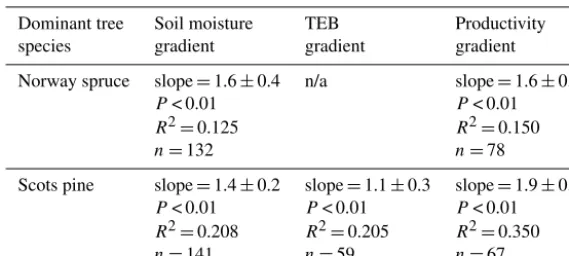
Five nutrient availability gradients were selected to evalu-ate the performance of the adjusted metrics in the absence of confounding climate and N deposition effects (Fig. S2). Both metrics were capable of describing variation in productivity for all gradients, with R2 values of 0.092–0.383 (Tables 4 and 5). Variable implementation was generally good, except for SOC in adjusted metric 2. There, SOC was significantly negatively associated with the residuals of the productivity– metric relationship (for four out of five gradients; Tables S18 and S19). Both the results of the national database and the gradients thus indicate that the adjusted metrics explain part of the spatial variation in productivity, and that adjusted met-ric 1 performs better than adjusted metmet-ric 2. Further adjust-ments, for example with other soil variables, may be needed to increase their performance.
4 Discussion
4.1 Identifying potentially confounding factors
Table 4. Evaluation of adjusted nutrient availability metric 1 for selected nutrient availability gradients in Sweden (Fig. S2). Statistics
indicate the relationship between productivity (mean annual increment – m3ha−1yr−1) and the metric. For (near) significant variables (i.e.,
P <0.10), parameter estimates±s.e.m. and the proportion of variation explained (R2) are given. For Norway spruce, no TEB gradient without substantial variation in climate was found, so that only for Scots pine was there a gradient in TEB. Abbreviations: TEB: total exchangeable bases. Error bars represent the s.e.m.
Dominant tree Soil moisture TEB Productivity
species gradient gradient gradient
Norway spruce slope=1.6±0.4 n/a slope=1.6±0.4
P< 0.01 P< 0.01
R2=0.125 R2=0.150
n=132 n=78
Scots pine slope=1.4±0.2 slope=1.1±0.3 slope=1.9±0.3
P< 0.01 P< 0.01 P< 0.01
R2=0.208 R2=0.205 R2=0.350
n=141 n=59 n=67
N/a: not applicable
soil properties and (normalized) productivity. Across our database, we indeed observed that certain soil properties (SOC, soil C : N ratio, TEB) were related with soil moisture (Fig. S3), and also normalized productivity depended on soil wetness (Fig. 5): productivity was highest for intermediate soil moisture levels, and was significantly reduced for the most dry and wet soils. The influence of soil moisture on productivity can be explained as follows: at high water con-tent, the anoxic rooting environment inhibits root and micro-bial respiration. Tree productivity is thus suppressed, both directly due to the lack of oxygen for the tree itself and be-cause nutrient supply is limited due to the inhibition of min-eralization (Gorham, 1991). For relatively dry soils, however, productivity is reduced because of water limitation (which has been shown to occur in southern Sweden – Bergh et al., 1999), lower nutrient inputs through groundwater, fewer pe-riods with easily available nutrients in the soil solution (Qian and Schoenau, 2002), and lower retention (Larcher, 2003; Roy et al., 2006) and supply (Binkley and Hart, 1989) of nu-trients by organic matter. In summary, any associations be-tween a soil variable and productivity should be interpreted in view of the fact that soil moisture may act as a factor in-fluencing both this soil variable and productivity. We there-fore performed our analyses not only for the complete set of data but also for the data stratified by soil moisture to assess whether relationships between soil properties and productiv-ity would change.
In the same way as for soil moisture, stratification by soil type might help in resolving nutrient–productivity relation-ships. Soil properties and productivity differed among the five most common soil types in the database (i.e., Histosols, Gleysols, Regosols, Leptosols, and Podzols – Fig. S4). To some extent, these differences among soil types overlapped with those observed for soil moisture classes (e.g., wet His-tosols had the highest SOC, soil C : N, and the lowest
produc-tivity), but additional patterns emerged as well (e.g., Podzols had a particularly low TEB stock). Although actual differ-ences in nutrient availability among soil types will in part underlie the variations in productivity, other factors related to soil type (e.g., wetness, soil depth, or the rooting envi-ronment) may also influence productivity (Binkley and Hart, 1989). The main analyses of the current study were therefore stratified by both soil moisture and type to test the robustness of associations between nutrient-related soil properties and normalized productivity.
N concentrations at low C : N, increased productivities with decreasing C : N ratio can follow from its influence on litter decomposition and mineralization, and thus on nutrient avail-ability: when the ratio in organic matter is high, microbes more strongly immobilize N to adjust their internal C to N stoichiometry. As a consequence, N is not easily released and made available for plant uptake. A low C : N ratio, however, facilitates N mineralization (Roy et al., 2006) and thus en-hances N availability (Wilkinson et al., 1999).
The relationship of ln SOC with normalized productiv-ity, which showed an optimum (Figs. 7a and 8a), is partly explained by the role of SOM in storing and exchanging nutrients, but also partly by the confounding effect of soil moisture. At high moisture levels, SOC most likely increases because decomposition is reduced in water-saturated soils, leading to organic matter accumulation (Fig. S3a). Anoxic soils impede productivity because of the aforementioned pre-vention of root respiration and reduced supply of newly avail-able nutrients through mineralization. At low SOC, however, productivity supposedly decreases with decreasing SOC be-cause of water limitation and low availability of organic mat-ter, which acts as a nutrient store. Together, these results sug-gest that the empirical relationship between SOC and pro-ductivity might have an optimum below which soil fertility is reduced due to a lack of sufficient organic matter, and above which high SOC indicates hostile rooting conditions and lim-ited nutrient supply through slow mineralization. The first as-pect is thus included in the IIASA metric (Fig. 1), while the decreasing part of the curve should be included in the empiri-cal relationship of SOC with nutrient availability if the effect of reduced decomposition is not captured by any of the other soil variables in an updated metric.
Soil factors other than the soil C : N ratio and SOC either exhibited only a marginal influence on normalized produc-tivity or their effect depended on the approach (Table 2). N stocks could explain variation across both methods, but their explanatory power was rather modest for method 1. We an-ticipate that if we aim to develop metrics applicable beyond the boreal biome, including N stock will be of limited value, as this variable is only loosely related to N availability (Hög-berg et al., 2017).
Mineral soil clay fractions had a weak but significantly positive effect on normalized productivity. Even though clay particles can protect SOM from decomposition (Xu et al., 2016), clay soils in the Swedish database in all likelihood positively influence nutrient availability by means of their negative charges that serve as cation exchange sites (i.e., for
determinants of nutrient availability in northern coniferous forests. Qualitatively considered, associations of C : N ratio (−), SOC (concave quadratic after log transformation), N stock (+), and clay fraction (+) with normalized productiv-ity were consistent for both approaches (Table 2). Together with their abilities to explain variation, the consistent effects of soil C : N and SOC suggest these soil variables have the most potential for inclusion in an improved nutrient avail-ability metric.
4.3 Question 2 – evaluation of the IIASA metric Although the IIASA metric of constraints of nutrient avail-ability was originally designed for arable lands, we opted to start with this metric for a few reasons. Apart from the fact that to our knowledge it represents the only attempt so far to develop a generic nutrient metric, the structures of its for-mulas (Eqs. 6–9) reflect general mechanisms that link soil properties to nutrient availability, which are also valid for nonagricultural ecosystems. Soil pH for example shows a typical optimum effect on nutrient availability, while SOC and TEB have a direct positive nonlinear influence (IIASA and FAO, 2012). The final weighing of the four partial scores (Eq. 10) finds its rationale in the idea that if a certain soil property is particularly suboptimal, it will be the most impor-tant nutrient-related determinant of productivity, with less in-fluence of the other soil properties that are closer to or within their optimal range. This way of weighing can be considered a type of interaction, but one that cannot be implemented in a simple linear regression model. Hence, our main reason for adopting the IIASA metric as a starting point is that, in spite of its simplicity, it is based on theoretical considerations. Moreover, adopting this structure allows for updating with other datasets – something that can probably not be achieved with multiple regression equations (see Sect. 4.4).
The IIASA metric of constraints on nutrient availability does not clarify much variation in normalized productivity among Swedish forests. Moreover, SOC, soil texture, TEB, and pHwwere apparently not optimally implemented. A low
Table 5. Evaluation of adjusted nutrient availability metric 2 for selected nutrient availability gradients in Sweden (Fig. S2). Statistics
indicate the relationship between productivity (mean annual increment – m3ha−1yr−1) and the metric. For (near) significant variables
(i.e.P <0.10), parameter estimates±s.e.m. and the proportion of variation explained (R2) are given. For Norway spruce, no TEB gradient
without substantial variation in climate was found, so that only for Scots pine was there a gradient in TEB. Abbreviations: C : N: soil carbon-to-nitrogen ratio; TEB: total exchangeable bases. Error bars represent the s.e.m.
Dominant tree Soil moisture TEB gradient Productivity
species gradient gradient
Norway spruce slope=0.31±0.08 n/a slope=0.36±0.08
P <0.01 P <0.01
R2=0.092 R2=0.188
n=132 n=78
Scots pine slope=0.28±0.05 slope=0.23±0.06 slope=0.52±0.08
P <0.01 P <0.01 P <0.01
R2=0.177 R2=0.213 R2=0.383
n=141 n=59 n=67
N/a: not applicable
and in addition, the database contains wet-soil forests, while arable soils are typically not water saturated.
4.4 Question 3 – adjustments of the IIASA metric
Based on results of the analyses for Question 1, the nutrient availability metric was adjusted by (i) including an empirical optimum in the influence of SOC on normalized productivity, and (ii) including soil C : N, thus more explicitly incorporat-ing the availability of N. In the current analysis, soil texture and TEB were excluded from the metrics, as they exhibited negative instead of the expected positive associations with normalized productivities (IIASA and FAO, 2012), probably due to indirect effects of low soil oxygen, reduced decompo-sition, and suppressed productivity where the proportion of sand is low and TEB is high.
In contrast to the original metric developed by IIASA, the adjusted metrics described some variation across all ap-proaches using the full database (Figs. 10 and 11). Variables were generally properly implemented, at least for the ad-justed metric 1 (Table S16). For metric 2, significant (but normalization-method-dependent) associations emerged be-tween residuals of normalized productivity and SOC and pH (Table S17). The stratified analyses confirm that the metrics are an improvement, at least for those soil moisture classes and soil types with sufficient data points (Tables S12–15). Moreover, each metric could describe spatial variation in pro-ductivity for five manually selected local nutrient availability gradients (Tables 4 and 5). The coefficients of determina-tion were generally higher for these gradients than for the database analyses, likely because the gradients did not re-quire a normalization for climate (the latter increased the un-certainty on the response variable; see Sect. 4.5 on sources of uncertainty and future challenges). Lastly, the gradients gen-erally confirmed the correct implementation of soil variables
in adjusted metric 1 (Table S18), whereas for metric 2, scores for high SOC might be overestimated (Table S19).
Variation in normalized productivity explained by the ad-justed metrics (R2=0.03–0.21 and R2=0.06–0.18) was similar to the variation explained by multiple regression equations (R2=0.18–0.22) that contained the same (and more) soil variables as the metrics. The metrics, however, have the advantage that they can be updated more easily than equations from multiple regressions, especially if additional soil parameters need to be included for other ecosystems. Moreover, the interaction effect – with the highest weight for the least optimal soil parameter – cannot be mimicked with a multiple regression approach. In order to further ad-just the metrics, and to test to what extent they can already describe variation in nutrient availability outside of Swedish conifer forests, additional datasets with productivity and soil information are needed. Such datasets include large-scale in-ventories such as the one considered in the present study, but also local gradients and nutrient manipulation experiments. The latter two have lower generalizability, but offer the ad-vantage that normalization for climate is not needed.
4.5 Sources of uncertainty and future challenges
Even though normalized productivity was significantly re-lated to soil properties, and to our adjusted metrics, much of the variation in normalized productivity remains unex-plained. The considerable unexplained variation may have multiple reasons. Apart from a possible lack of soil and nutri-ent data more closely related to N availability than the ones available in our database, another possible factor reducing
for by also performing analyses on split datasets). However, there is also uncertainty related to the normalization for cli-mate: by taking residuals of the productivity vs. climate re-gression model (method 1), we for instance unintentionally removed not only the direct effect of climate on productiv-ity but also its indirect effect through nutrient availabilproductiv-ity. Normalized productivity based on this method thus mainly represents productivity as influenced by regional variation in nutrient availability. The approach taking actual/attainable productivity as a response variable (method 2) does not suf-fer from this issue, but there the estimates of attainable pro-ductivity come with a high uncertainty, as they were based on only limited experimental data to establish a relationship between productivity and intercepted radiation. As a conse-quence, the lowR2values are partly due to shortcomings of the normalization procedure that can only be overcome by using datasets in which climate does not vary but nutrient availability does. Such datasets are provided by local gradi-ents, such as the five local nutrient availability gradients that we selected from our database for additional evaluation of our adjusted metrics.
The similar and significant results for the different meth-ods (1 and 2) and subsets of the database (regions, soil mois-ture classes, and soil types) indicate that the findings about the soil properties and nutrients are generally robust. The ad-justed metrics explained up to 21 % of the variation in nor-malized productivity. It is unclear to what degree the influ-ence of nutrient availability is covered by this percentage. Future studies, in which additional soil data (e.g., P) can be included, will need to verify this. In any case, the significant relationships with normalized productivity, the better imple-mentation of the soil variables, and the capability of the met-rics to explain up to 38 % of the variation in productivity across different gradients imply a significant improvement compared to the original IIASA metric for this database.
A key challenge in the further development of a metric de-scribing spatial variation in nutrient availability both within and outside the boreal biome is differential nutrient limita-tion. Eventually, we want to be able to compare for example N-limited and P-limited systems. The original structure of the IIASA metric, which was kept in our adjusted metrics, facilitates this by allowing the inclusion of multiple soil vari-ables such as soil C : N (mainly relating to N availability), pH (among others a critical factor controlling P availability), and TEB in one single metric. In fact, the IIASA metric is partic-ularly useful in this regard, as it gives more weight to the soil factor with the lowest score. This corresponds to reality and
5 Conclusions
In our database, the soil properties explaining most varia-tion in tree productivity across Swedish conifer forests were SOC and the soil C : N ratio. The empirical relationship be-tween SOC and normalized productivity showed an opti-mum, reflecting the soil characteristic’s direct positive effect on nutrient availability only at low soil carbon concentra-tions, whereas at high SOC, its effect was masked by other environmental factors (soil moisture and oxygen, and tem-perature), affecting both SOC and productivity through their role in regulating organic matter formation and decompo-sition rates. The soil C : N ratio showed the expected neg-ative correlation with normalized productivity in the present database. Based on the resulting regression equations, we ad-justed the IIASA metric for Swedish conifer forests by modi-fying the relationship between SOC and nutrient availability, and by incorporating soil C : N.
The current nutrient availability metrics were developed based on data from Swedish conifer forests only, and can therefore not be extrapolated outside the boreal biome. In or-der to verify if development of a metric that compares the nu-trient status across sites also beyond the boreal biome is fea-sible, the adjusted metrics developed in this study will need to be validated (and if necessary further modified) based on other forests elsewhere for which the necessary soil informa-tion is available. In a later stage, this approach can then be expanded to other ecosystem types.
Code and data availability. The Swedish national database
and R scripts with statistical analyses are available at
https://www.dropbox.com/s/llbz1p6rtkrccjh/KevinVanSundert_ etal_Biogeosciences_2018.7z?dl=0 (Van Sundert et al., 2018).
Supplement. The supplement related to this article is available online at: https://doi.org/10.5194/bg-15-3475-2018-supplement.
Author contributions. SV and KVS conceived the study. KVS per-formed the analyses and wrote the paper. JAH provided statistical advice and JS provided data. All authors contributed to the discus-sions and the writing of the paper.
Acknowledgements. This research was supported by the Fund for Scientific Research – Flanders (FWO aspirant grant to KVS; FWO postdoctoral fellowship to SV) and by the European Research Council grant ERC-SyG-610028 IMBALANCE-P. We also ac-knowledge support from the ClimMani COST Action (ES1308). The Swedish Forest Soil Inventory is part of the national environ-mental monitoring commissioned by the Swedish Environenviron-mental Protection Agency. EC–JRC–MARS provided precipitation data. We thank Ivan Janssens for his valuable comments on earlier versions of the paper. Published with support from the Belgian University Foundation.
Edited by: Edzo Veldkamp
Reviewed by: three anonymous referees
References
Bergh, J., Linder, S., Lundmark, T., and Elfving, B.: The ef-fect of water and nutrient availability on the productivity of Norway spruce in northern and southern Sweden, For-est Ecol. Manag., 119, 51–62, https://doi.org/10.1016/S0378-1127(98)00509-X, 1999.
Bergh, J., Linder, S., and Bergstrom, J.: Potential production of Norway spruce in Sweden, Forest Ecol. Manag., 204, 1–10, https://doi.org/10.1016/j.foreco.2004.07.075, 2005.
Binkley, D. and Hart, S. C.: The components of nitrogen availability assessments in forest soils, Adv. Soil S., 10, 57–112, 1989. Binkley, D. and Högberg, P.: Tamm review: revisiting the influence
of nitrogen deposition on Swedish forests, Forest Ecol. Manag.,
368, 222–239, https://doi.org/10.1016/j.foreco.2016.02.035,
2016.
Bol, R., Julich, D., Brödlin, D., Siemens, J., Kaiser, K., Dippold, M.A., Spielvogel, S., Zilla, T., Mewes, D., von Blanckenburg, F., Puhlmann, H., Holzmann, S., Weiler, M., Amelung, W., Lang, F., Kuzyakov, Y., Feger, K-H., Gottselig, N., Klumpp, E., Missong, A., Winkelmann, C., Uhlig, D., Sohrt, J., von Wilpert, K., Wu, B., and Hagedorn, F.: Dissolved and colloidal phosphorus fluxes in forest ecosystems – an almost blind spot in ecosystem research, J. Plant Nutr. Soil Sc., 179, 425–438, 2016.
Chapin, F. S., Matson, P. A., and Mooney, H. A.: Principles of Ter-restrial Ecosystem Ecology, Springer-Verlag, New York, USA, 2002.
Chapman, H. D.: Cation exchange capacity, in: Methods of Soil Analysis Part 2: Chemical and Microbiological Properties, 2nd Edn., edited by: Pace, A. L., Miller, R. H., and Keeney, D. R., American Society of Agronomy and Soil Science Society of America, Madison, Wisconsin, USA, 891–901, 1982.
Cleveland, C. C., Townsend, A. R., Taylor, P., Alvarez-Clare, S., Bustamante, M. M. C., Chuyong, G., Dobrowski, S. Z., Grierson, P., Harms, K. E., Houlton, B. Z., Marklein, A., Parton, W., Porder, S., Reed, S. C., Sierra, C. A., Silver, W. L., Tanner, E. V. J., and Wieder, W. R.: Relationships among net primary productivity, nutrients and climate in tropi-cal rain forest: a pan-tropitropi-cal analysis, Ecol. Lett., 14, 939–947, https://doi.org/10.1111/j.1461-0248.2011.01658.x, 2011. de Vries, W., Du, E., and Butterbach-Bahl, K.: Short and
long-term impacts of nitrogen deposition on carbon sequestration
by forest ecosystems, Curr. Opin. Env. Sust., 9/10, 90–104, https://doi.org/10.1016/j.cosust.2014.09.001, 2014.
Dieleman, W. I. J., Vicca, S., Dijkstra, F. A., Hagedorn, F., Hov-enden, M. J., Larsen, K. S., Morgan, J. A., Volder, A., Beier, C., Dukes, J. S., King, J., Leuzinger, S., Linder, S., Luo, Y., Oren, R., De Angelis, P., Tingey, D., Hoosbeek, M. R., and Janssens, I. A.: Simple additive effects are rare: a quantitative review of plant biomass and soil process responses to combined manipulations
of CO2and temperature, Glob. Change Biol., 18, 2681–2693,
https://doi.org/10.1111/j.1365-2486.2012.02745.x, 2012. ESRI: ArcGIS Desktop: release 10, Environmental Systems
Re-search Institute, Redlands, California, USA, 2011.
Fernández-Martínez, M., Vicca, S., Janssens, I. A., Sardans, J., Luyssaert, S., Campioli, M., Chapin, F. S., Ciais, P., Malhi, Y., Obersteiner, M., Papale, D., Piao, S. L., Reichstein, M., Roda, F., and Penuelas, J.: Nutrient availability as the key regulator of global forest carbon balance, Nature Climate Change, 4, 471– 476, https://doi.org/10.1038/NCLIMATE2177, 2014.
Fraser, L. H., Pither, J., Jentsch, A., Sternberg, M., Zobel, M., Askarizadeh, D., Bartha, S., Beierkuhnlein, C., Bennett, J.A., Bittel, A., Boldgiv, B., Boldrini, I. I., Bork, E., Brown, L., Cabido, M., Cahill, J., Carlyle, C. N., Campetella, G., Chelli, S., Cohen, O., Csergo, A. M., Díaz, S., Enrico, L., Ensing, D., Fidelis, A., Fridley, J. D., Foster, B., Garris, H., Goheen, J. R., Henry, H. A. L., Hohn, M., Jouri, M. H., Klironomos, J., Koorem, K., Lawrence-Lodge, R., Long, R., Manning, P., Mitchell, R., Moora, M., Müller, S. C., Nabinger, C., Naseri, K., Overbeck, G. E., Palmer, T. M., Parsons, S., Pesek, M., Pillar, V. D., Pringle, R. M., Roccaforte, K., Schmidt, A., Shang, Z., Stahlmann, R., Stotz, G. C., Sugiyama, S., Szentes, S., Thompson, D., Tungalang, R., Undrakhbold, S., van Rooyen, M., Wellstein, C., Wilson, J. B., and Zupo, T.: Worldwide evidence of a unimodal relationship between productivity and plant species richness, Science, 349, 302–305, https://doi.org/10.1126/science.aab3916, 2015. Friedrich, U., von Oheimb, G., Kriebitzsch, W. U., Schlesselmann,
K., Weber, M. S., and Hardtle, W.: Nitrogen deposition increases susceptibility to drought – experimental evidence with the
peren-nial grassMolinia caerulea(L.) Moench, Plant Soil, 353, 59–71,
https://doi.org/10.1007/s11104-011-1008-3, 2012.
Goll, D. S., Brovkin, V., Parida, B. R., Reick, C. H., Kattge, J., Re-ich, P. B., van Bodegom, P. M., and Niinemets, U.: Nutrient lim-itation reduces land carbon uptake in simulations with a model of combined carbon, nitrogen and phosphorus cycling, Bio-geosciences, 9, 3547–3569, https://doi.org/10.5194/bg-9-3547-2012, 2012.
Gorham, E.: Northern peatlands – role in the carbon cycle and prob-able responses to climatic warming, Ecol. Appl., 1, 182–195, https://doi.org/10.2307/1941811, 1991.
Grand, S. and Lavkulich, L. M.: Short-range order mineral phases control the distribution of important macronutrients in coarse-textured forest soils of coastal British Columbia, Canada, Plant Soil, 390, 77–93, https://doi.org/10.1007/s11104-014-2372-6, 2015.
Hägglund, B. and Lundmark, J. E.: Site index estimation by means of site properties, Studia forestalia Suecica 138, Technical Re-port, Swedish University of Agricultural Sciences, Stockholm, Sweden, 1977.
IIASA and FAO: Global Agro-ecological Zones (GAEZ v3.0), In-ternational Institute for Applied Systems Analysis, Laxenburg, Austria and Food and Agricultural Organization of the United Nations, Rome, Italy, 2012.
Janssens, I. A., Dieleman, W., Luyssaert, S., Subke, J. A., Re-ichstein, M., Ceulemans, R., Ciais, P., Dolman, A. J., Grace, J., Matteucci, G., Papale, D., Piao, S. L., Schulze, E. D., Tang, J., and Law, B. E.: Reduction of forest soil respiration in response to nitrogen deposition, Nat. Geosci., 3, 315–322, https://doi.org/10.1038/ngeo844, 2010.
Larcher, W. (Ed.): Physiological Plant Ecology, Springer-Verlag, Berlin, Germany, 2003.
Laubhann, D., Sterba, H., Reinds, G. J., and de Vries, W.: The impact of atmospheric deposition and climate on for-est growth in European monitoring plots: an individual tree growth model, Forest Ecol. Manag., 258, 1751–1761, https://doi.org/10.1016/j.foreco.2008.09.050, 2009.
Lundin, L.: MarkInfo, available at: http://www-markinfo.slu.se/ eng/index.html, last access: 23 March 2017, 2011.
Maindonald, J. H. and Braun, W. J.: DAAG: data analysis and graphics data and functions, available at: http://CRAN.R-project. org/package=DAAG (last access: 7 June 2018), 2015.
Minderma, G.: Addition decomposition and accumulation of or-ganic matter in forests, J. Ecol., 56, 355–362, 1968.
Neyroud, J.-A. and Lischer, P.: Do different methods used to esti-mate soil phosphorus availability across Europe give comparable results?, J. Plant Nutr. Soil Sc., 166, 422–431, 2003.
Nilsson, T. and Lundin, L.: Uppskatning av volymvikten i svenska skogsjordar från halten organiskt kol och markdjup, Prediction of bulk density in Swedish forest soils from the organic carbon content and soil depth, Department of Forest Soils, Swedish Uni-versity of Agricultural Science, Uppsala, Sweden, 2006.
Nohrstedt, H. O.: Response of coniferous ecosystems
on mineral soils to nutrient additions: a review of
Swedish experiences, Scand. J. Forest Res., 16, 555–573, https://doi.org/10.1080/02827580152699385, 2001.
Norby, R. J., Warren, J. M., Iversen, C. M., Medlyn, B. E., and
McMurtrie, R. E.: CO2enhancement of forest productivity
con-strained by limited nitrogen availability, P. Natl. Acad. Sci. USA, 107, 19368–19373, https://doi.org/10.1073/pnas.1006463107, 2010.
Novotny, R., Burianek, V., Sramek, V., Hunova, I., Skorepova, I., Zapletal, M., and Lomsky, B.: Nitrogen deposition and its im-pact on forest ecosystems in the Czech Republic – change in soil chemistry and ground vegetation, Iforest, 10, 48–54, 2015. Odin, H., Eriksson, B., and Perttu, K.: Temperaturklimatkartor
för svenskt skogsbruk, Temperature climate maps for Swedish forestry, Department of Forest Soils, Swedish University of Agri-cultural Science, Uppsala, Sweden, 1983.
Olsson, M.: Soil Survey in Sweden, European Soil Bureau, Ispra, Italy, 1999.
puting, R Foundation for Statistical Computing, Vienna, Austria, available at: https://www.R-project.org/ (7 June 2018), 2015. Roy, R. N., Finck, A., Blair, G. J., and Tandon, H. L. S.: Plant
nutri-tion for food security – A guide for integrated nutrient manage-ment, FAO, Rome, Italy, 2006.
Soil Survey Staff (Eds.): Keys to soil taxonomy, 12th Edn., USDA-National Resources Conservation Service, Washington DC, USA, 2014.
Solberg, S., Dobbertin, M., Reinds, G. J., Lange, H., Andreassen, K., Garcia Fernandez, P., Hildingsson, A., and de Vries, W.: Analyses of the impact of changes in atmospheric deposition and climate on forest growth in European monitoring plots: a stand growth approach, Forest Ecol. Manag., 258, 1735–1750, https://doi.org/10.1016/j.foreco.2008.09.05,2009.
Stendahl, J., Johansson, M. B., Eriksson, E., Nilsson, A., and Lang-vall, O.: Soil organic carbon in Swedish spruce and pine forests – differences in stock levels and regional patterns, Silva Fenn., 44, 5–21, https://doi.org/10.14214/sf.159, 2010.
Swedish Meteorological and Hydrological Institute.: 2015 års
totaldeposition av Ammonium Kväve (mg N/m2), available at:
http://www.smhi.se/sgn0102/miljoovervakning/kartvisare.php? lager=15DTOT_NHX___, last access: 7 June 2018.
Swedish Meteorological and Hydrological Institute.: 2015 års
totaldeposition av Oxiderat Kväve (mg N/m2), available at:
http://www.smhi.se/sgn0102/miljoovervakning/kartvisare.php? lager=15DTOT_NOY___, last access: 7 June 2018.
Terrer, C., Vicca, S., Hungate, B. A., Philips, R. P., and Prentice, I. C.: Mycorrhizal association as a primary
con-trol of the CO2 fertilization effect, Science, 353, 72–74,
https://doi.org/10.1126/science.aaf4610, 2016.
Thomas, R. Q., Brookshire, E. N. J., and Gerber, S.: Ni-trogen limitation on land: how can it occur in Earth
system models?, Glob. Change Biol., 21, 1777–1793,
https://doi.org/10.1111/gcb.12813, 2015.
Vadeboncoeur, M. A.: Meta-analysis of fertilization exper-iments indicates multiple limiting nutrients in northeast-ern deciduous forests, Can. J. Forest Res., 40, 1766–1780, https://doi.org/10.1139/X10-127, 2010.
Van Sundert, K., Horemans, J. A., Stendahl, J., and Vicca, S.: Data and statistics supporting “The influence of soil prop-erties and nutrients on conifer forest growth in Sweden, and the first steps in developing a nutrient availability met-ric”, available at: https://www.dropbox.com/s/llbz1p6rtkrccjh/ KevinVanSundert_etal_Biogeosciences_2018.7z?dl=0, last ac-cess: 7 June 2018.
Venables, W. N. and Ripley, B. D. (Eds.): Modern applied statistics with S, 4th Edn., Springer, New York, USA, 2002.
effi-ciently, Ecol. Lett., 15, 520–526, https://doi.org/10.1111/j.1461-0248.2012.01775.x, 2012.
von Liebig, J.: Die organische Chemie in ihrer Anwendung auf Agrikultur und Physiologie, Friedrich Vieweg Sohn, Braun-schweig, Germany, 1840.
Wang, R., Goll, D., Balkanski, Y., Hauglustaine, D., Boucher, O., Ciais, P., Janssens, I. A., Penuelas, J., Guenet, B., Sardans, J., Bopp, L., Vuichard, N., Zhou, F., Li, B., Piao, S., Peng, S., Huang, Y., and Tao, S.: Global forest carbon uptake due to nitro-gen and phosphorus deposition from 1850 to 2100, Glob. Change Biol., 23, 4854–4872, https://doi.org/10.1111/gcb.13766, 2017. Wieder, W. R., Cleveland, C. C., Smith, W. K., and Todd-Brown,
K.: Future productivity and carbon storage limited by terrestrial nutrient availability, Nat. Geosci., 8, 441–444, 2015.
Wilkinson, S. R., Grunes, D. L., and Sumner, M. E.: Nutrient inter-actions in soil and plant nutrition, in: Handbook of Soil Science, edited by: Sumner, M. E., Taylor and Francis, Leiden, the Nether-lands, 89–112, 1999.
Wood, S. N.: Generalized additive models: an introduction with R, Chapman and Hall/CRC, Leiden, the Netherlands, 2006. Xu, X., Shi, Z., Li, D. J., Rey, A., Ruan, H. H., Craine,