International Journal of Innovative Technology and Exploring Engineering (IJITEE) ISSN: 2278-3075, Volume-8 Issue-12, October 2019
Abstract: In the ongoing years, Wireless Sensor Networks (WSN) is getting consideration among analysts because of its wide scope of uses in real world applications. A WSN comprises of huge number of Sensor Nodes (SNs) that are conveyed all through the area to detect environment. SNs have constrained assets; as far as energy, Power processing, preparing force and data transfer capacity: so the basic viewpoint is the manner by which to lessen the energy utilization of SN so as to improve Network Lifetime. Numerous Energy Efficient systems like information conglomeration, duty cycling, cluster based grouping and deficiency tolerant routing convention has been proposed in writing for improving energy preservation of WSN. In this proposition energy productive structure for processing in WSN by considering all of above energy proficient techniques is given. In WSN, information gathered by SNs should be accessible at Base Station (BS) where it is prepared, dissected and utilized for some reason. Transmitting huge measure of information towards BS devours more energy so it is desirable over neighborhood procedure or total information at network before transmitting to BS. Information accumulation is strategy to total information of SNs so as to decrease traffic towards BS subsequently lessening correspondence energy.
Keywords: Wireless Sensor Network, Source Nodes, Base Station, Energy, Network.
I. INTRODUCTION
Since the improvement of wireless innovation and the little size networks called Sensor Nodes (SNs), Wireless Sensor Networks (WSN) is the main issue of research for scientists. This innovation is developing quickly as of late. The network comprises of SNs having constrained energy or battery control. So the arrangements intended for conventional wired network are not adequate for asset obliged WSN[5]. There is as yet a degree for wide examine in the field of planning energy effective structures for WSN.
Revised Manuscript Received on October 05, 2019
Shashi Bhushan, Assistant Professor- Krishna Engineering College, Ghaziabad. Research Area- Wireless Sensor Network Membership- IEEE, ACM
Anuj Kumar Singh, Assistant Professor- Krishna Engineering College, Ghaziabad. Research Area- Wireless Sensor Network
Membership- IEEE, ACM
Bhim Singh Bohara, Assistant Professor- Krishna Engineering College, Ghaziabad. Research Area- Wireless Sensor Network
Membership- IEEE, ACM
Pramod Kumar, Professor- Krishna Engineering College, Ghaziabad. Membership-SM IEEE, ACM,IETE
Outline of WSN
[image:1.595.306.548.211.333.2]WSNs comprise of the little size battery worked networks that have detecting, calculation and correspondence abilities.
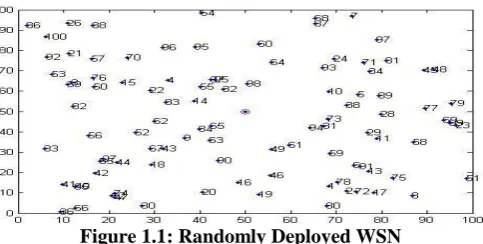
Figure 1.1: Randomly Deployed WSN
For the reason of these capacities, WSN can screen nature and figure straightforward assignments and trade information with Base Station (BS) and among themselves. Because of its detecting capacity, WSNs is utilized in the wide scope of utilizations including natural surroundings observing, thick timberland fire announcing, war zone observation, volcanic fields checking and untamed life supervision and so on. Regardless of having gigantic applications WSN varies from customary wireless networks as far as calculation power, memory and transfer speed limit [1].
The networks in network are asset obliged having constrained battery control, calculation control, less memory and transmission ranges. When the battery of network is dead, SN is futile which may cause decreasing Network lifetime, Network parcel, Holes in Routing Paths, Frequent Flooding of Control Packets for Link State Maintenance and Network Failure if there should arise an occurrence of disappointment of basic networks.Typically the enormous quantities of SNs are sent in unattended condition as appeared in Figure 1.1 Where it's unrealistic to supplant or revive the battery of networks.So using the current battery intensity of SNs in a superior manner is a significant issue to improve energy. Aims And Objective
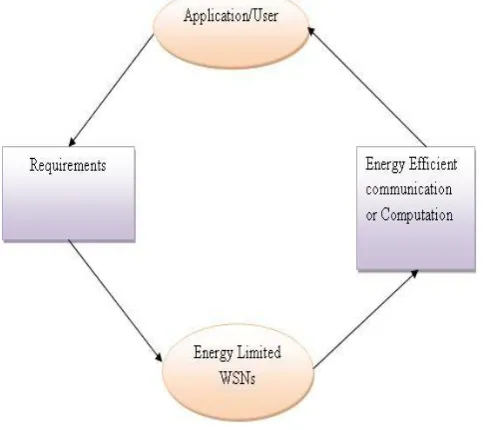
WSN offers conspicuous gathering of detecting, registering and correspondence ability. WSN innovation vows to on a very basic level change the manner in which people see and connect with the physical world. To acknowledge such perception, proficient processing is important as appeared in Figure 2.1.
Area 3.1 illuminates inspiration driving examination work. Research goals are examined in Section 2.2. Area 3.3 talks about the network lifetime; the most significant energy related issue in WSN which legitimately influences the exhibition of WSN.
A Newly Designed Framework for Computing in
Wireless Sensor Network
NEED OF ENERGY EFFICIENT COMPUTING IN WSN:
[image:2.595.46.289.127.342.2]Energy of SN is devoured for three purposes in WSN: information transmission, preparing, and equipment activity. Procedure of sign handling and information correspondence must be streamlined so as to save energy of SNs.
Figure 2.1: Energy Efficient Computing Framework These can be advanced by energy proficient systems, for example, accumulation, obligation cycling conventions and versatile routing conventions appeared in Figure 3.2. Characterized look into goals give energy effective structure to WSN by adopting the majority of the above strategies into thought. The principle objective of information conglomeration is to gather and total information productively with the goal that network lifetime is improved and to dispose of the repetition, as transmitting enormous number of parcels devours more energy of SNs. One more favorable position of information accumulation is that if information is prepared as it is gone through the network; it gets packed and requires less transmission capacity of the channel. In this manner, energy effective information accumulation can be considered as an exceptionally testing issue in WSN. Obligation Cycling Protocols have their own particular manners to monitor energy of SNs by keeping a portion of the networks in rest state and rest in dynamic. Obligation cycling is where a SN is occasionally set into the rest and dynamic mode which is a viable strategy for decreasing energy dissemination and repetition in WSN. Obligation cycling additionally gives the energy proficient system to figuring and correspondence in WSN. Numerous WSN applications achievement is needy upon the dependable conveyance of data from many dispersed SNs to at least one sink networks. Specifically, WSN must be flexible and self-versatile to connection or network disappointment by giving proficient components to information transmission particularly in the multi-jump situation. In this way, energy productive directing component for course quality mindfulness in WSNs has been proposed. Grouping is another approach to diminish energy utilization by separating network into bunches. Each group has its CH which transmits information of its SNs to BS. Many Network test systems are accessible free for actualize WSN like NS2 (17), GloMoSIM
(18), OMNET++ (19), J-Sim (10). Yet, all test systems bolster restricted conventions and learning test system takes part of time, so individuals like to utilize MATLAB programming language instead of test system for reenactment. This exploration for the most part centers on the plan and usage of the conventions to give the energy proficient structure to correspondence and calculations procedures in WSN. This proposal attempts to meet the accompanying targets to perform energy proficient figuring in WSN. A concise outline of the goals is as per the following:
Detailed investigation of Energy related issue for WSN. II. ENERGYEFFICIENTHYBRIDSCHEMEFOR
DATAAGGREGATION
Energy productivity is primary issue in WSN that can be accomplished by information conglomeration systems. Information Aggregation is the way toward gathering information from neighbors by expelling repetitive data so as to lessen number of bundle to be sent to BS with the goal that network lifetime can be improved. Information Aggregation is characterized into Tree-Based, Cluster-Based, Grid-Based, Chain-Based and Hybrid-Based collection. Energy proficiency is accomplished by building chain based information total for lattice based WSN in this proposition. The remainder of the sections is composed as pursues:
Data Aggregation System Model of Energy Efficient Hybrid Figure 2.2: Energy Efficient Techniques
Scheme for Data Aggregation (E2HSDA) convention. Information Aggregation Algorithm is depicted in Section 4.2
and Simulations and results are talked about in Section 4.3.Section 4.4 abridges the part.
A. Frame Model
International Journal of Innovative Technology and Exploring Engineering (IJITEE) ISSN: 2278-3075, Volume-8 Issue-12, October 2019
B. Presumptions
Following presumptions are considered in lattice chain based E2HSDA convention:
• The SNs know about their area and every network knows its neighbor.
• The SNs have one of a kind character.
• The SN can modify its speaker power dependent on its good ways from beneficiary.
C. Working of E2HSDA is partitioned into three stages: a. Grid Formation
b. Query Forwarding c. Route Formation
a. Grid Formation
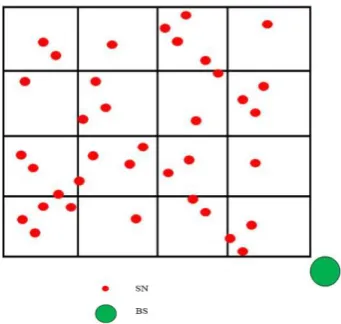
[image:3.595.91.262.291.453.2]The initial phase in E2HSDA is to build lattice to perform total as appeared in Figure 3.1. The SNs are consistently conveyed in randomized way all through the district. The sleep and awake example changes at customary interim. Additionally, the BS has the data pretty much all waking networks in the network.
Figure 3.1: Grid Formation in WSN b. Query Forwarding
[image:3.595.63.237.575.751.2]The information social event procedure is started by the BS and is delineated by a calculation as appeared in Algorithm. At whatever point BS is intrigued for getting data it communicates an inquiry message which contain source network ID into network as in Figure 3.2. The network whose ID matches with the ID in parcel turns into the source network.
Figure 3.2: Query Forwarding Algorithm: Select Path (E, W)
Begin
1. Initialization of energy(E); 2. Transmit(Inquiry Text)
3. Each node present in network {n/n N} do 4. Receiver add (Inquiry Text)
5. If (node[n]= Inquiry Text[Sender add] 6. Finalized source=n;
Establish select Path (sender); End
Algorithm 3.1: Generate Optimal Path c. Route Formation
The source network finds the contiguous dynamic network y of x which is nearest, is in wakeful state is shown through Algorithm. At the point when network x finds dependable network y, it sends detected estimation from x to y , transmit sense an incentive from network x to network y. At network y, the conglomeration work after getting the sense estimation of network x, contrasts its sense worth and estimation of network x. On the off chance that both are equivalent, network y worth isn't added to total parcel to keep away from excess as appeared in Algorithm 3.3. The course development procedure is delineated in Figure 3.3.
Begin
1. Initialized Least path = Highest value 2. While (x!= Nearest hope to BS), do 3. For each node which is adjacent to [x] do
4. If(((sleep[y]=0) && (Length of path between [x][y] < Least value of distance)
5. &&(Energy[y]>Threshold value of sleep))
6. Set least value of distance = Length of path between [x][y];
7. End of Iteration.
8. Next (value of sensor [x], belongs to x,y);
9. Calculate transaction of energy with respect to (x,y) 10. Agg (value x, value y);
11. Call select Path(y);
12. If(x= nodes nearest to Base Station) 13. Send Packet (Agg);
End
Algorithm 3.2: Send/Transmit Packet
Algorithm: Agg (x, y)
1. Initialized Agg[0]=s.value[s]; 2. If(v.x is not equals to v.y) 3. Agg[]=v.y;
4. Jump to Agg;
End
Algorithm 3.3: Calculate Aggregate Value Algorithm: Forward (s.value v, x, y)
1. send s.value v from x towards y 2. send packet[x]=send s.packet[x]+1; 3. Acknowledge p.y= acknowledge p.y+1
End
Algorithm 3.4: Forward Packet
D. ENERGY CALCULATIONS
a. Energy to Transmit and Receive a bundle: ETR (P, q) as in Equation 3.1 and 3.2 is energy devoured by a network to transmit P bit bundle at separation q. Condition3 shows accepting energy ERX for example energy scattered by a network to got L bit bundle.
ETR (P,q)= P*Eelec + P*€ FS * q4 if q>=q0 ---(3.1) P*Eelec + P*€ FS * q2 if q< q0--- (3.2) ERX = P*Eelec --- (3.3) Energy in Sleep Mode:
To lessen energy utilization of WSN, rest/alert planning is utilized in which roughly 50% of the networks in network are in rest and rests are in wakeful. So all out number of conscious networks that are excluded in information transmission per round will be given by Equation 3.4 that is less when contrasted with without utilizing rest/alert example.
N awake = (N-N Sleep- N Path) --- (3.4)
Energy utilization required for information transmission per inquiry is determined utilizing Equation 3.5 which is aggregate of energy required for transmitting question from source to BS and absolute energy utilization of rest and dynamic networks that are excluded in routing .
EC Sleep = RE+ (N awake * Time * E awake) + (N sleep * Time * E
Sleep) --- (3.5)
Energy without Sleep/Awake mode:
As without utilization of rest/conscious example all SNs will be in dynamic express that are on the whole occasions as in Equation 3.6 so absolute transmission energy is high for example determined utilizing Equation3. 7.
N awake = N- N Path--- (3.6)
EC awake = RE + (N awake * Time * E awake) --- (3.7)
a. Network Lifetime:
The network lifetime is characterized as far as normal number of rounds up to which network can transmit information to BS as appeared in Equation 3. 8.
Rounds= (N* E i )/ avg energy ---(3.8) Avg energy = normal transmission energy for one round.
b. Implementing Aggregation:
Fundamental thought behind information collection is to lessen the quantity of parcels to be transmitted to BS. InE2HSDA convention each network contrast its worth and estimation of past network in chain and the two qualities are included the bundle in the event that they are distinctive in this way decreasing the accumulated parcel size to roughly half. So energy required for sending amassed parcel as per
Equation 3.9 is less as opposed to without utilizing information conglomeration as in Equation 3.10.
Energy aggregation = (n/2) avg energy --- (3.9) Energy without-aggregation = n*avg energy --- (3.10)
[image:4.595.303.540.236.347.2]III. SIMULATIONANDRESULTANALYSIS Execution of E2HSDA convention is assessed by giving an examination the current one of the prominent chain based directing convention PEGASIS (15) and mimicking the outcomes in JAVA (Appendix A) by utilizing reenactment parameters as in Table 4.1. Energy utilization of convention with and without rest/conscious mode has been thought about. Likewise the impact of accumulation is examined that demonstrates the improved effectiveness and expanded lifetime of network.
Figure 4.1: No. of Nodes Vs Average Transmission Energy
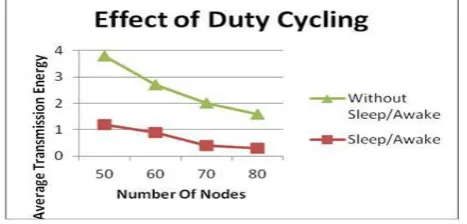
[image:4.595.311.545.428.540.2]Figure 4.2 outlines that less energy utilization is required in rest/conscious mode when contrasted with without rest/wakeful mode. The outcomes demonstrate that for a huge network with thick number of networks, it is futile to use every one of the networks for detecting.
Figure 4.2: Utilization of Power in Sleep/Awake Vs without Sleep/Awake Mode
Figure 4.3 demonstrates the examination of E2HSDA convention with PEGASIS as far as network lifetime. In E2HSDA convention the complete number of expired networks gets diminished which straightforwardly impacts the loss of energy.
[image:4.595.304.545.624.716.2]International Journal of Innovative Technology and Exploring Engineering (IJITEE) ISSN: 2278-3075, Volume-8 Issue-12, October 2019
IV. CONCLUSION
This paper introduces E2HSDA convention which depends on Sleep/awake mode design. It improves network lifetime by utilizing chain based correspondence rather than single jump for improving the network lifetime. Information is amassed aimlessly point in the current conglomeration conventions. In any case, E2HSDA plays out the conglomeration at solid (network having adequate measure of energy to perform information total work) SNs. Further existing information accumulation techniques utilize variable bunch sizes which include additional overhead. In any case, E2HSDA utilizes a fixed and straightforward network based topology. In the following part, circulated bunching based information accumulation has been introduced that defeats the issue of brought together grouping in the network.
Table 4.1: Simulation Parameters
REFERENCES
1. Jain A, Sharma D, Goel M, Verma AK. “Conventions for Network and Data Link Layer in WSNs: A Review and Open Issues”. In Advances in Networks and Communications 2011 Jan 2 (pp. 546-555). Springer Berlin Heidelberg.
2. Demirkol I, Ersoy C, Alagoz F. “Macintosh conventions for remote sensor arranges: a study”. IEEE Communications Magazine. 2006 Apr 1;44(4):115-21.
3. Tilak S, Abu-Ghazaleh NB, Heinzelman W. “A scientific categorization of remote miniaturized scale sensor system models”. ACM SIGMOBILE Mobile Computing and Communications Review. 2002 Apr 1;6(2):28-36.
4. Heinzelman WR, Chandrakasan A, Balakrishnan H. “Energy proficient correspondence convention for remote microsensor systems” InSystem sciences, 2000. Procedures of the 33rd yearly Hawaii universal gathering on 2000 Jan 4 (pp. 10-pp). IEEE. 5. Lindsey S, Raghavendra CS. PEGASIS: “Power-proficient
assembling in sensor data frameworks. InAerospace gathering procedures”, 2002. IEEE 2002 (Vol. 3, pp. 3-1125). IEEE
6. Fasolo E, Rossi M, Widmer J, Zorzi M. “In-organize accumulation methods for remote sensor arranges: an overview”. Remote Communications, IEEE. 2007 Apr;14(2):70-87.
7. Solis I, Obraczka K. “The effect of timing in information total for sensor systems”, InCommunications, 2004 IEEE International Conference on 2004 Jun 20 (Vol. 6, pp. 3640-3645). IEEE. 8. Madden S, Franklin MJ, Hellerstein JM, “Hong W. TAG: A modest
total administration for specially appointed sensor system”. ACM SIGOPS Operating Systems Review. 2002 Dec 31;36(SI):131-46. B. Smith, “An approach to graphs of linear forms (Unpublished work style),” unpublished.
9. Intanagonwiwat C, Govindan R, Estrin D. “Coordinated dispersion: an adaptable and hearty correspondence worldview for sensor systems”. In Proceedings of the sixth yearly universal meeting on Mobile registering and systems administration 2000 Aug 1 (pp. 56-67). ACM.
10. Tan Hö, Körpeoǧlu I “Power proficient information social occasion and collection in remote sensor systems”. ACM Sigmod Record. 2003 Dec 1;32(4):66-71.
11. Lee WN. “A mind-blowing development saving tree for information accumulation in remote sensor systems” (Doctoral paper, University of British Columbia).
12. Eskandari Z, Yaghmaee MH, Mohajerzadeh A. “Energy effective spreading over tree for information collection in remote sensor systems” In Computer Communications and Networks, 2008. ICCCN'08. Procedures of seventeenth International Conference on 2008 Aug 3 (pp. 1-5). IEEE.
13. M, Wong VW. “An energy mindful traversing tree calculation for information conglomeration in remote sensor systems”. In Communications, Computers and sign Processing, 2005. PACRIM. 2005 IEEE Pacific Rim Conference on 2005 Aug 24 (pp. 300-303). IEEE.
14. WR, Chandrakasan A, Balakrishnan H. “Energy productive correspondence convention for remote microsensor systems”. In System sciences, 2000. Procedures of the 33rd yearly Hawaii universal meeting on 2000 Jan 4 (pp. 10-pp). IEEE.
15. Koucheryavy A, Salim An, Osamy W. “ Improved LEACH convention for remote sensor systems”. St. Petersburg University of Telecommunication. 2009.
16. Heinzelman WB, Chandrakasan AP, Balakrishnan H. “An application-explicit convention design for remote microsensor systems”. Remote Communications, IEEE Transactions on. 2002 Oct;1(4):660-70.
17. Biradar RV, Sawant SR, Mudholkar RR, Patil VC. “Multihop routing in self-sorting out remote sensor systems”. IJCSI International Journal of Computer Science Issues. 2011 Jan;8(1):155-64
18. Yao Y, Gehrke J. “The cougar way to deal with in-organize question preparing in sensor systems”. ACM Sigmod Record. 2002 Sep 1;31(3):9-18
19. Younis O, Fahmy S. “Regard: a half breed, energy effective, disseminated bunching approach for specially appointed sensor systems”. Portable Computing, IEEE Transactions on. 2004 Oct;3(4):366-79.
20. D.Suresh and K.Selvekumar, "Twofold Cluster Head based Reliable Data Aggregation", in procedures of World Engineering and Applied Sciences Journal, Vol. 6 ,No. 3, pp. 136-146, 2015.
21. Wang NC, Chiang YK, Hsieh CH, Chen YL. “Lattice Based DataAggregation for Wireless Sensor Networks”. J. Adv. Comput. Netw.2013 Dec;1.
AUTHORSPROFILE
Shashi Bhushan , B.E.(CSE) , M.Tech ( CSE), PhD * (CSE), Assistant Professor- Krishna Engineering College, Ghaziabad. Research Area- Wireless Sensor Network
Membership- IEEE, ACM
Anuj Kumar Singh , B.Tech.(CSE) , M.Tech ( CSE), PhD * (CSE), Assistant Professor- Krishna Engineering College, Ghaziabad. Research Area- Wireless Sensor Network
Membership- IEEE, ACM
Bhim Singh Bohara , B.E.(CSE) , M.Tech ( CSE)
Assistant Professor- Krishna Engineering College, Ghaziabad. Research Area- Wireless Sensor Network
Membership- IEEE, ACM
Prof.(Dr) Pramod Kumar , M.Tech ( CSE), PhD (CSE), Professor- Krishna Engineering College, Ghaziabad.
Membership-SM IEEE, ACM,IETE
Branch Counselor of IEEE Student Chapter of Krishna Engineering College (STB18061), Executive Committee member of IEEE UP Section & Convener of IEEE UP Section Educational Activities.
Organizing Chair- ( ICACCE-2015,ICACCA-2016(Spring), ICACCA-2016 (FALL) , ICACCA-2017 , IOT-SIU-2018, IOT-SIU-2019, ICACCA-2018, ICACCA-2019), Organizing Secretary,WIECON-2017
Simulation Parameter Value
Topology Size 120x120 m2
Nodes(n) 40-70
Begin with Energy 0.5 J
Electrical Energy 40nJ/bit
Free Space 10pJ/bit/m2
Frequent Path 10 pJ/bit/m4
Minimum Threshold Energy Value 0.002J