International Journal of Innovative Technology and Exploring Engineering (IJITEE) ISSN: 2278-3075, Volume-8, Issue-9S, July 2019
Abstract: Wireless sensor networks (WSNs) consist of self-governing sensors that sense as well as monitor the area in which these nodes are deployed and distribute this information in a distributed manner. Presently, the WSN with long life and minimum energy consumption are in demand. To overcome this problem, Low Energy Adaptive Clustering Hierarchy (LEACH) is presented with the addition of Cuckoo Search (CS) and Support Vector Machine (SVM) concept. The problem of LEACH protocol like which node is considered as Cluster Head (CH) is overcome by CS. On the basis of healthy function, the nodes property such as energy consumed by each node is categorized. Those nodes that have higher energy compared to the defined function are put in one category and remaining in another category. These two categories of nodes are provided as an input to SVM and train the system. Therefore, the best node having the highest energy is considered as CH and hence enhanced the lifetime by saving the energy upto 21.86 %.
Index Terms: WSN, LEACH, CS, SVM, CH.
I. INTRODUCTION
WSNs are made up of many sensors nodes that are powered with a small battery. The geometric configuration of this network consists of a number of sensor nodes with different processing elements and power resources. The performance of these networks is affected by environment conditions [1]. In the modern era, WSN is considered as an important technique, which is mostly used by doctors, military and for the detection of environmental conditions. The communicating elements used in WSN have the benefits as the size as well as the cost is small. These devices are powered by a small battery [2].After the implementation of these devices in the field, the battery cannot be replaced. Therefore, the long life of these networks is limited by the limited energy. To save energy becomes a current topic of research. The general diagram of WSN is shown in fig. 1[3].
Revised Manuscript Received on June 15, 2019. .
Navjot Kaur, CSE, Chandigarh Engineering College, Mohali, Punjab. Dr. Manish Mahajan, CSE, Chandigarh Engineering College, Mohali, Punjab.
Rajeev Sharma, CSE, Chandigarh Engineering College, Mohali, Punjab.
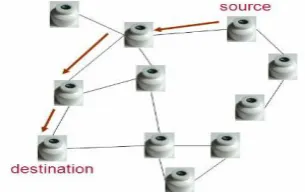
The nodes deployed in the network are indicated by a circle, which is known as the sensor field. Whenever the nodes want to transmit data, the node forms a route using some routing protocol as indicated by a dark circle and the direction of transmission is represented by an arrow [4].
The problem of energy consumption and hence to increase the lifetime of the network, the available communication protocols need to be modified. The available routing protocols are categorized into two types named as plane routing and layered routing. Since the plane routing protocols suffer from the disadvantages that these cannot be applied to the larger area as this required larger space and hence consume more energy [5]. The layered routing protocols might be used in large area networks; an example of these routing protocols is LEACH.It works on the principle of cluttering so that the data can be transmitted to the cluster head near to it without forwarding messages to the nearby node and hence save energy [6].
Also, to enhance or balance the energy, LEACH routing protocol in combination with CS and SVM as a classification algorithm has been used.
Table1: Issue in WSN
Issues Description
Range & Connection
Sensor nodes used smaller bandwidth with less low power Location &
synchronization
The position of sensor nodes is very important as the user can know about the state of nodes such as active or sleep node Power
Management
It is very necessary as it decides the lifetime of the network Low latency As the network has to deal with
the event occurred in the network urgently, therefore the network
must have a process that event with less delay
II. ROUTING IN WSN
Routing is the process to search route between the source and the destination node. Routing also helps for the transmission of data from one node to another node [8]. In WSN, routing is mainly categorized into three types as shown in the figure below.
An Enhanced LEACH in Wireless Sensor
Network
A. Location Based
[image:2.595.48.290.57.155.2]In location-based routing protocol, it is assumed that all nodes know along with source node knows its location as well as the neighbours’ location. In this scheme, the data is forwarded as per the greedy forwarding approach. In this approach, the node forward data all the time to the node whose Euclidean distance is smaller [9]. An example of location-based routing is shown in figure 3.
Fig 3. Location Based Routing
B. Flat Routing
It is a network communication protocol which is implemented by a router, in which all routers are interconnected to each other. Also, the information is provided by these routers without following any organization structure [10].
C. Hierarchical Routing Protocol
Hierarchal routing protocol effectively utilizes data aggregation to reduce the amount of network data streams. With hierarchical multi-hop routing algorithms, the sensor node accepts different roles that can be changed over time. It is also known as cluster-based routing that can be utilized to reduce the energy consumed by sensor nodes. During this process, the nodes having higher energy are used for the data transmission whereas the nodes with low energy are used to sense the data only. The LEACH is the example of Hierarchical routing algorithm [11].
III. LEACH PROTOCOL
It is the first energy efficient protocol that is used to create a route on the basis of energy consumed by the node. In LEACH, the network is divided into clusters as shown in fig. 2.
Fig 3. Leach Architecture
The entire network comprises of four different clusters each includes sensor nodes with cluster head (CH). CH is the heart of the route formation, through which the data transmission is possible, the remaining nodes are known as cluster members. The route is formed through two phases: Set up phase and Steady-state phase [7].
A. Setup phase
In this phase, the selection of CH is performed. Initially, the entire network nodes choose a number between 0 & 1. The selected number is then compared with the formula written below.
Here, m is a random number lies between 0 and 1 Prob- is the probability of cluster head
Grp is the group of nodes that were not clustered heads in the previous rounds
is the threshold value
The node whose value is less than the threshold number is defined as CH for that particular round [8].
B. Steady State Phase
In this phase, the data is transmitted to the base station with the minimization of overload. Also, the time required in the set-up phase is more than the time required in the steady-state phase [9].
Some of the LEACH protocols based on enhancements are as given below:
Table2: LEACH Protocols Protocol
Name
Description
F-LEACH A protocol forsecuring node to node
communication in LEACH-basednetwork. It used random key pre-distribution scheme withsymmetric key cryptography to enhance security inLEACH. FLEACH provides authenticity, integrity,confidentiality and freshness to node-to-nodecommunication. But it is vulnerable to node capturingattack [4].
SLEACH This is the first modified secure version
of LEACHcalled SLEACH, which
investigated the problem of addingsecurity to cluster-based communication protocol forhomogeneous wireless sensor networks consisting of sensornodes with severely limited resources.
SHEER a secure hierarchical energyefficient
[image:2.595.93.246.275.371.2]International Journal of Innovative Technology and Exploring Engineering (IJITEE) ISSN: 2278-3075, Volume-8, Issue-9S, July 2019
Sec-LEACH Sec-LEACH provides an efficient
solution for securingcommunications in LEACH. It used random-keypredistribution and TESLA for secure hierarchical WSNwith dynamic cluster formation. Sec-LEACH appliedrandom key distribution to LEACH, and introducedsymmetric key
and one way hash chain to
provideconfidentiality and freshness. Sec-LEACH providesauthenticity, integrity,
confidentiality and freshness to
communications.
SS-LEACH a secure hierarchical protocolcalled
SS-LEACH, which is the secure version of LEACH.SS- LEACH improves the method of electing cluster headsand forms dynamic stochastic multi-paths cluster headschains to communicate to the base station, In this way itimprove the energy-efficiency and hence prolong thelifetime of the network.
RLEACH Secure solution for LEACH has been
introduced calledRLEACH [4] in which
cluster are formed dynamically
andperiodically. In RLEACH the orphan node problem israised due to random pair-wise key scheme so they haveused improved random pair-wise key scheme to overcome.RLEACH has been used the one way hash chain,symmetric and asymmetric cryptography to providesecurity in the LEACH Hierarchical routing protocol.
IV. RELATED WORK
A number of researchers have used LEACH protocol to enhance the performance of the network. A few of work presented by different researchers in this area has been discussed in this section.[10][11]
Heinzelman et al. (10, 2002) have used LEACH protocol for the data transmission. The authors have considered the amount of remaining energy while selecting the CH. There is an reduction of about 40 % in the energy with the increase in
the speed of data transmission has been
obtained.Muruganathan, et al (11, 2005) a centralized approach has been used, which distributed the energy among the entire nodes deployed in the network. In this paper, the authors have used the base stations that are powered with high energy in order to accomplish the higher energy task.Ghasemzadeh (12, 2014) have used Bayesian Network model to select the CH. This model has worked on the basis of three different parameters such as the distance to base station, residual energy as well as the density. The probability of each CH has been calculated. The dynamic zoning method along with a greedy mechanism has been used to distribute CH uniformly, which results in increase in the lifetime of the network.[12]Wang et al. (13, 2012) the concept of relaying node has been considered to enhance the selection of CH.Also have considered the residual energy of the node during the selection of the cluster head, the possibility of selecting the low energy node as the cluster head is reduced. Based on the remaining energy and the distance to the base station, the relay node is selected from the CH to become a relay node between the base station and other CH’s. The simulation results have shown that the LEACH-R protocol
balancedthe network energy consumption and increase the network life cycle with high efficiency.[13][14]
Referen ces Proposed work Technique used Findings
Xu et al. (14, 2012)
The remaining
power of the
sensor nodes has been utilized for the network load balancing.
E-LEACH The network
lifetime up to 40
% has been
increased.
Manjes hwar, A., & Agrawal, D. P. (15, 2001)
The network
has been divided as per the nodes’ functioning such
as active and
passive. The
performance of
TEEN algorithm
has been
measured in the re-active network. Threshold sensitive Energy Efficient sensor Network protocol (TEEN)
The outcome
in terms of
energy
dissipation, a
number of the
alive nodes,
number of dead
nodes with
respect to time
has been
measured.
From the
experiment, it
has been
analyzed that
the TEEN
protocol performs well in
terms of
response time as well as energy consumption.
Wang et al. (16, 2018)
The main aim of this paper is to divide the entire network into a number of the grid.
The coverage area of each grid is decided as per
the energy
consumed by
each grid. Particle Swarm Optimization (PSO) The average energy consumed by the nodes of about 1
J has been achieved
Sarkar, A., &Murugan
, T. S. (17, 2019)
In this paper, the CH selection approach is used, which helps in the
reduction of
energy utilization. CH selection with Firefly algorithm
Using the
firefly algorithm
the distance
among the nodes
becomes small
and hence the possibility of the number of alive
nodes has
increased. Karabo ga, D., Okdem, S., &Ozturk, C. (18, 2012)
In this
research, the
information is
collected from the
network in a
particular time slot.
LEACH with ABC
The energy
Kovend an et al. (19, 2018)
ANN is used to select the route which consumes minimum energy
LEACH with ANN
The performance in
terms of
throughput,
energy and
Packet delivery ratio has been determined.
The Average
of energy,
throughput and PDR are about 300mJ, 50 and 0.55 has been achieved.
Moham med Omari ; So umiaLarou i(2015)
Different clustering
protocols have
been
implemented by them.
LEACH, LEACH-C, LEACH-1R, and HEED
The performance of
LEACH-1R is
better than
other clustering
protocols in
terms of
network lifetime. Ningbo
Wang ; Ha o Zhu(2012)
They have
added energy
constraint to
improve the
lifetime of
wireless sensor
network and to
analyse the
performance of
leach protocol.
LEACH-R Energy
consumption and lifetime is
improved by
using LEACH-R protocol
V. METHODOLOGY
[image:4.595.40.291.51.402.2]The LEACH protocol suffers from the disadvantage that the remaining energy of every node has not been considered. Also, the time in which each node has to be selected as a CH is also not considered. [15][16] In case, if the low energy node has been considered as a CH then it decreases the lifetime of the network. To resolve this problem, Cuckoo search as an optimization algorithm has been used. CS helps to categorize the nodes on the basis of their energy consumption; these categories are then provided as an input to the SVM in order to train the system. Therefore, SVM classified the nodes and hence allocate data to that node which has higher energy or is a genuine node.
Fig 4: Dividing the entire network into different clusters The entire network is divided into six different clusters namely CH1, CH2, CH3, CH 4, CH5 and CH 6 respectively. The CH using LEACH protocol has been selected that contains maximum energy and represented by different
colours.The source node and the destination nodes are denoted by yellow and orange colours and are presented inthe CH4 and CH3 respectively.Source node createsa route using LEACH protocol by transmitting the data to its nearby CH, the route formation is depicted in fig. 3.
Fig 5: Route Formation using LEACH
[image:4.595.313.539.424.549.2]Using LEACH protocol the data is transmitted between CH’s, but the problem is like, it does not differentiate between genuine node or malicious node and also do not consider that the node has enough energy to behave like a CH. To resolve this problem, CS as an optimization scheme has been used with a healthy function. On the basis of healthy function, the properties of the node are differentiated and a list is made that contains the node with higher energy and lower energy respectively.On the basis of these properties, SVM is trained and the trained architecture of SVM is shown in the fig. 5.
Fig 6: Trained SVM
SVM helps to select as appropriate CH that contains the highest energy within the cluster and hence increase the lifetime of the network.[18] At last, the performance of the network is computed, the results are discussed in the subsequent section.
VI. RESULT AND DISCUSSION
[image:4.595.56.286.596.728.2]International Journal of Innovative Technology and Exploring Engineering (IJITEE) ISSN: 2278-3075, Volume-8, Issue-9S, July 2019
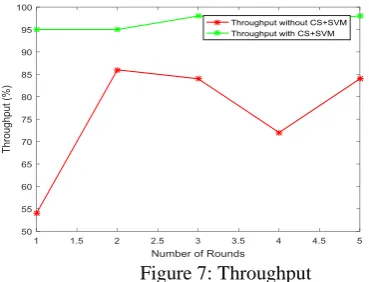
Figure 7: Throughput
[image:5.595.54.239.57.198.2]The throughput represents the number of packets delivered to the destination node compared to the total packets transmitted from the source node. The green and the red line represent the throughput with (CS & SVM) and without (CS & SVM) respectively. From the fig.6, it is clear that in case of only LEACH protocol the throughput increased upto 2 iterations and then starts decreasing to 4 iterations and again increases from 4th to 5 the iterations. This is due to the improper selection of CH. When CS and SVM have applied the node with higher energy has been considered and the throughput is increases for the entire cycle. The average value of throughput examined for the network with and without CS &SVM are 76 % and 96.6 % respectively. Thus the enhancement in throughput of about 27.11% has been analyzed.
Table 4 Throughput Number of
Rounds
Without CS +SVM
With CS +SVM
1 54 95
2 86 95
3 84 98
4 72 97
[image:5.595.312.545.230.363.2]5 84 98
Figure 8: Energy Consumption
The energy consumed by the sensor nodes with LEACH protocol and when enhanced LEACH using (CS &SVM) have been used is represented in fig. 7.It is seen that using CS &SVM with LEACH protocol, the energy consumption is less compared to the energy consumption analyzed using LEACH protocol. The values examined are listed in table 2.
Table 5: Energy Consumption (J)
Number of Rounds
Without CS +SVM
With CS +SVM
1 5.8457 3.7376
2 9.9387 5.8306
3 14.2044 12.0963
4 18.4640 13.3558
5 22.7296 20.6215
The average energy consumption examined with or without CS +SVM technique are14.23 J and 11.12 J respectively. Thus there is a reduction of 21.86 % in the energy consumption has been observed.
Figure 9: Delay
The delay rate represents the time gap in which the data is received at the receiver end. There is a very minor change exists in the delay value examined with CS &SVM as well as without CS & SVM. The values of delay are listed in table 3.
Table 6: Delay (ms) Number of
Rounds
Without CS +SVM
With CS +SVM
1 24.9555 19.8598
2 204.2050 199.1092
3 280.7406 279.6449
4 357.3775 354.2817
5 434.0617 431.9660
Figure 10 Comparison of proposed work withGupta &Doja (2018)
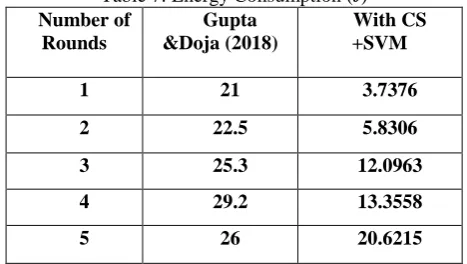
[image:5.595.45.297.384.677.2] [image:5.595.197.554.389.684.2]existing hybrid LEACH presented by Gupta &Doja (214, 018). The average value examined for five numbers of rounds for proposed as well as for existing work is shown in fig. 9.
Table 7: Energy Consumption (J) Number of
Rounds
Gupta &Doja (2018)
With CS +SVM
1 21 3.7376
2 22.5 5.8306
3 25.3 12.0963
4 29.2 13.3558
5 26 20.6215
Gupta &Doja (10, 2018) have presented a hybrid LEACH protocol. This protocol selects CH dynamically by using the information related to the particular area as well as the node’s co-ordinates location. The cluster formation has been done on the basis of this information. The network is divided into multiple zones and the CH has been performed in such a way so that the energy is balanced.[21]
The values examined for proposed and existing work are 11.12 J and 24.8 J respectively. Therefore, there is a reduction of 55.16 % of the existing work. This is due to the proper selection of CH using optimization with a classification scheme.
VII. CONCLUSION
From the experimental results discussed above, it is clear that by proper selection of CH using the concept of cuckoo search with SVM results into a minimization of energy consumption for the WSN. To show the efficiency of the proposed work, comparison between the LEACH protocol and when LEACH with CS and SVM is used in the network have been provided.[22] Using CS, the properties of nodes on the basis of their energy consumption rate has been classified and is used to train SVM.[24] Therefore, while creating a route, SVM matched the properties of the node with the stored properties and hence identify an appropriate and best CH, which has higher energy and hence enhance the lifetime. From the comparison, it has been clear that the energy using CS with SVM upto 55.16 % has been saved.[25]
REFERENCES
1. Zhang, W. H., Li, L. Y., ZHANG, L. M., & WANG, X. Z. (2008).
Energy consumption balance improvement of LEACH of WSN. Chinese
Journal of Sensors and Actuators, 11, 1918-1922.
2. J. Wang, J. Cao, S. Ji, & J. H. Park, “Energy-efficient cluster-based dynamic routes adjustment approach for wireless sensor networks with mobile sinks,” The Journal of Supercomputing, Vol.73, no.7, 2017, pp.3277-3290.
3. A Bouyer, A. Hatamlou, & M. Masdari, “ A new approach for decreasing energy in wireless sensor networks with hybrid LEACH protocol and fuzzy C-means algorithm,” IJCNDS, Vol.14, No.4, pp. 2015 400-412.
4. C. Gherbi, Z. Aliouat, & M. Benmohammed, An adaptive clustering approach to dynamic load balancing and energy efficiency in wireless sensor networks,” Energy, Vol.114, 2016, pp. 647-662.
5. D. Jiang, Z. Xu, Li, W., & Z. Chen, “Network coding-based energy-efficient multicast routing algorithm for multi-hop wireless networks,” Journal of Systems and Software, Vol.104, 2015, pp.152-165. 6. S. K. Gupta, & P. K. Jana, “Energy efficient clustering and routing algorithms for wireless sensor networks: GA based approach,” Wireless Personal Communications, Vol. 83, No. 3, 2015., pp.2403-2423.
7. J. A. Khan, H. K. Qureshi, & A. Iqbal, “Energy management in wireless sensor networks: A survey,” Computers & Electrical Engineering, Vol. 41, 2015, pp.159-176.
8. J. Kaur, S. Randhawa, & S. Jain, “A novel energy efficient cluster head selection method for wireless sensor networks,” Int. J. Wireless Microwave Technol, Vol. 8, No. 2, 2018., pp.37-51.
9. J. N. Al-Karaki, & A. E. Kamal, “Routing techniques in wireless sensor networks: a survey,” IEEE wireless communications, Vol. 11, No. 6, 2004, pp. 6-28.
10. Heinzelman, W. B., Chandrakasan, A. P., &Balakrishnan, H. (2002).
An application-specific protocol architecture for wireless microsensor
networks. IEEE Transactions on wireless communications, 1(4), 660-670.
11. Muruganathan, S. D., Ma, D. C., Bhasin, R. I., &Fapojuwo, A. O. (2005). A centralized energy-efficient routing protocol for wireless sensor
networks. IEEE Communications Magazine, 43(3), S8-13.
12. Ghasemzadeh, H., Rezaeian, M., Touranposhti, F. D., &Ghasemian, M. M. (2014, September). BN-LEACH: an improvement on LEACH protocol using Bayesian networks for energy consumption reduction in
wireless sensor networks. In 7'th International Symposium on
Telecommunications (IST'2014) (pp. 1138-1143). IEEE.
13. Wang, N., & Zhu, H. (2012, March). An energy efficient algrithm based on leach protocol. In 2012 International Conference on Computer Science and Electronics Engineering (Vol. 2, pp. 339-342). IEEE.
14. Gupta, V., &Doja, M. N. (2018). H-leach: Modified and efficient leach
protocol for hybrid clustering scenario in wireless sensor networks. In Next-generation networks (pp. 399-408). Springer, Singapore. 15. Omari, M., &Laroui, S. (2015). Simulation, comparison and analysis of Wireless Sensor Networks protocols: LEACH, LEACH-C, LEACH-1R, and HEED. 2015 4th International Conference on Electrical Engineering (ICEE).
16. Leach Protocol in Wireless Sensor network (2017) International
Journal of Science and Research, 6(12), 808-813.
17. Ma, Z., & Li, G. (2017).Improvement on LEACH-C Protocol for
Wireless Sensor Network. Artificial Intelligence Science and Technology.
18. Katiyar, V., Chand, N., Gautam, G. C., & Kumar, A. (2011).
Improvement in LEACH protocol for large-scale wireless sensor networks. 2011 International Conference on Emerging Trends in Electrical and Computer Technology.
19. A Survey on LEACH Protocols in Wireless Sensor Networks.
(2019). International Journal of Recent Trends in Engineering and Research,5(1), 20-23.
20. Improved Clustering Based Routing Protocol for Wireless Sensor
Networks. (2016). International Journal of Science and Research (IJSR),5(2), 247-250.
21. Manjunatha, P., Verma, A. K., &Srividya, A. (2010). Fuzzy Based Optimized Routing Protocol for Wireless Sensor Networks. Lecture Notes in gineeringAdvancesElectricalEn in Wireless Sensors and Sensor Networks,273-282
22. Luo, Z., &Jannett, T. C. (2012). A multi-objective method to balance
energy consumption and performance for energy-based target localization in wireless sensor networks. 2012 Proceedings of IEEE Southeastcon.
23. Yan, F. (2011). Wireless sensor networks hierarchical routing
algorithm based on nodes energy balance. 2011 International Conference on Electric Information and Control Engineering.
24. Pawar, S., &Kasliwal, P. (2012). Design and Evaluation of
En-LEACH Routing Protocol for Wireless Sensor Network. 2012 International Conference on Cyber-Enabled Distributed Computing and Knowledge Discovery.
25. Kai, L. (2009). A Mine-Environment-Based Energy-Efficient Routing
International Journal of Innovative Technology and Exploring Engineering (IJITEE) ISSN: 2278-3075, Volume-8, Issue-9S, July 2019
AUTHORSPROFILE
Navjot Kaur, received my B.Tech degree in Computer Science and Engneering from CGC Landran,Mohali,Punjab in 2017.I am currently Pursuing M.tech in computer Science and engineering at Chandigarh Engneering College (CEC),Landran,Mohali,Punjab. Her Research Interest include computer networking.
Mr.Rajeev Sharma, received his Bachelor’s degree in Computer Science and Engneering from Desh Bhagat Engg. college , Mandi Gobindgarh, India.Mtech from Guru Nanak Dev Engg. college, Ludhaina, Punjab, India. Pursuing Phd from Chandigarh University .