Effectiveness of Problem Based Learning Model
toward Biology Learning Outcomes
Nadya Treesna Wulansari*, I Putu Gede Sutrisna, Ni Wayan Kesari Dharmapatni Sekolah Tinggi Ilmu Kesehatan Bali, Renon, Denpasar, Bali
Abstract. This study aimed to analyze the effectiveness Problem Based Learning toward Biology learning outcomes in the subject of Basic Nursing Science I. The research design was true experimental design. The population in this study was the first-grade students in Nursing Sciences Study Program in Sekolah Tinggi Ilmu Kesehatan Bali. Purposive sampling technique was applied to select the sample size in experimental and control group. There were 162 respondents included in this study. The data were analyzed using descriptive statistic and independent sample T-Test. The result showed that the average of post-test in control group was 67.01 ± 7.53 and average of post-test in the experimental group was 80.16 ± 5.92 (p < 0.05). It could be concluded that Problem Based Learning Model is more effective than a conventional model. It can be used for the alternative model in learning which can improve student’s ability in critical thinking and the learning outcomes of Biology in subject Basic Nursing Science I.
Keywords: Biology, Learning Outcomes, Problem Based Learning
INTRODUCTION
Professionalism in nursing requires a good understanding of nursing science. According to Nursalam [1] in 2015 the purpose of nursing science is as a basis for nursing practice, commitment in nursing practice toward the development and basic problem solving of nursing science also the acceptance of nursing intervention according to scientific and rational by other health professions and community. A good understanding of nursing science is gained from the educational system and academic teaching. Based on Ners Profession Program of Education Curriculum (2015), Basic Nursing Science I is one of the subjects that must be understood by nursing students to complete the understanding of nursing problems. One of the learning achievements in this subject is to apply the concept of Biology cell and genetics as an approach in solving nursing problems, supporting the provision of nursing care during nursing practice, which is called Basic of Nursing Science [1,2].
been prepared effectively; it is a failure to provide continuous nursing care, and failure to provide patient understandable instructions. Handling errors in the patient during practice are closely related to the application of the classroom learning model.
Based on preliminary observations which were conducted on the first semester students of Nursing Science Program, the learning process was still dominated by conventional model and it caused the learning is one-way learning. It means that the students tend to only listen to the explanation given by the lecturer. This learning process makes the students less able to be active in class. There are some causes of students problem through one way learning, (1) the lecturer role is still dominant and tend to be the main determinant in learning process, (2) most of the lecturers relatively use similar learning strategy and rarely use the approach which involves student activities, so it less motivating students to study [5]. In addition, based on preliminary data that researchers obtained, the quiz score given during the learning process was insufficient, most of the student’s score was below 68. This indicated that the average score was still insufficient. Based on these data, an action is needed that can improve student learning outcomes.
Based on the research problem, the study about the effect of Problem Based Learning (PBL) in improving Biology learning outcomes in the study of Basic Nursing Science I in the faculty of Nursing Study Program at Sekolah Tinggi Ilmu Kesehatan (STIKES) Bali. PBL is one of the learning models based on current issues with problem-solving based on theories and concepts that have been studied.
In addition, implementation of PBL on medical teaching concept can improve student learning outcomes [6]. Moreover, learning process with PBL obtained higher learning achievement compared with direct learning strategy on Nursing Clinical learning [5]. Yulianti [7] in 2016, observed the application of PBL model used to scientific approach based worksheet for physics can increase cognitive and psychomotor learning outcomes of students. Besides, PBL model can improve student learning outcomes in science lessons especially in chemistry [8]. However, the study on the effect of the implementation of PBL on Biology on the subject of Basic Nursing Science I in nursing student has not been conducted. The implementation of PBL is appropriate as a teaching strategy in applied subjects to facilitate students in making clinical decisions and ready to work, especially in nursing practice [9].
RESEARCH METHOD
The design of this study was true experiments with post-test of control group design [10]. In addition, purposive sampling technique was used in this study in which class A was a PBL group and class B was a control group that the lectures were given by the conventional model. The sample of this research is first semester students in the faculty of Nursing Study Program that was consisted of 81 students which every group. Furthermore, the data were analyzed by using Independent Sample T-Test [11].
RESULT AND DISCUSSION
been prepared effectively; it is a failure to provide continuous nursing care, and failure to provide patient understandable instructions. Handling errors in the patient during practice are closely related to the application of the classroom learning model.
Based on preliminary observations which were conducted on the first semester students of Nursing Science Program, the learning process was still dominated by conventional model and it caused the learning is one-way learning. It means that the students tend to only listen to the explanation given by the lecturer. This learning process makes the students less able to be active in class. There are some causes of students problem through one way learning, (1) the lecturer role is still dominant and tend to be the main determinant in learning process, (2) most of the lecturers relatively use similar learning strategy and rarely use the approach which involves student activities, so it less motivating students to study [5]. In addition, based on preliminary data that researchers obtained, the quiz score given during the learning process was insufficient, most of the
student’s score was below 68. This indicated that the average score was still insufficient. Based on these data, an action is needed that can improve student learning outcomes.
Based on the research problem, the study about the effect of Problem Based Learning (PBL) in improving Biology learning outcomes in the study of Basic Nursing Science I in the faculty of Nursing Study Program at Sekolah Tinggi Ilmu Kesehatan (STIKES) Bali. PBL is one of the learning models based on current issues with problem-solving based on theories and concepts that have been studied.
In addition, implementation of PBL on medical teaching concept can improve student learning outcomes [6]. Moreover, learning process with PBL obtained higher learning achievement compared with direct learning strategy on Nursing Clinical learning [5]. Yulianti [7] in 2016, observed the application of PBL model used to scientific approach based worksheet for physics can increase cognitive and psychomotor learning outcomes of students. Besides, PBL model can improve student learning outcomes in science lessons especially in chemistry [8]. However, the study on the effect of the implementation of PBL on Biology on the subject of Basic Nursing Science I in nursing student has not been conducted. The implementation of PBL is appropriate as a teaching strategy in applied subjects to facilitate students in making clinical decisions and ready to work, especially in nursing practice [9].
RESEARCH METHOD
The design of this study was true experiments with post-test of control group design [10]. In addition, purposive sampling technique was used in this study in which class A was a PBL group and class B was a control group that the lectures were given by the conventional model. The sample of this research is first semester students in the faculty of Nursing Study Program that was consisted of 81 students which every group. Furthermore, the data were analyzed by using Independent Sample T-Test [11].
RESULT AND DISCUSSION
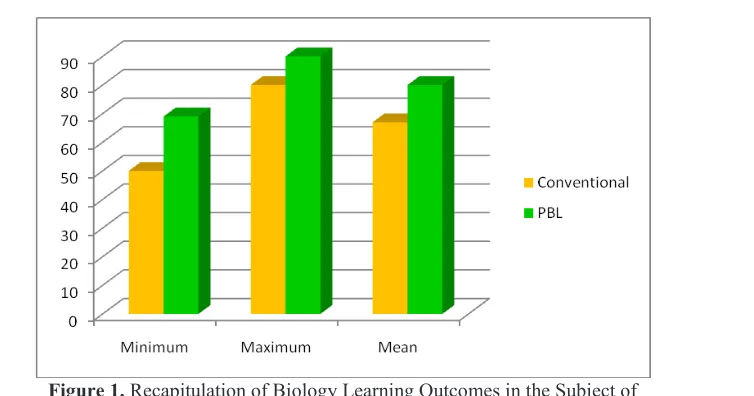
[image:3.482.70.447.60.258.2]The nursing students of class A and B were involved in this study in which every group consisted of 81 students. In addition, control class was taught by using conventional model. Independent Sample T-Test analysis found there is a significant difference between learning outcomes of Biology using PBL and conventional model (p < 0.05).
Figure 1. Recapitulation of Biology Learning Outcomes in the Subject of
Basic Nursing Science I
Based on Figure 1, the minimum and maximum score of the PBL group were higher than the conventional group. The result of the mean of post-test in conventional group was 67.01 ± 7.53 and the mean of post-test in PBL group was 80.16 ± 5.92 (p < 0.05). It means that there was a significant difference in the implementation of PBL model compared with conventional model to the learning outcomes of Biology in the subject of Basic Science of Nursing I. Based on that results, so it concluded that PBL model is more effective than conventional toward Biology learning outcomes in the subject of Basic Nursing Science I. The results of this study supported by Mergendoller [12] in 2006,observed that the learning outcomes of students who were taught by using PBL model is higher than the improvement of students' learning outcomes who were taught by conventional learning model.
PBL is a learning model that requires the students to learn by solving the problems. The problem is given as a stimulus in creating two-way learning. A problem provision is also as a simulation which is used to activate the curiosity of students in learning the subject and as a trigger in improving the knowledge and understanding of a teaching material. Problem-based learning (PBL) process consists of the following stages: (1) the problem; (2) problem analysis and generation of learning issues; (3) discovery and reporting; (4) solution presentation and reflection; and (5) overview, integration, and evaluation [13]. The students will collaborate with their group to hold discussions and negotiation to achieve the solution of the problems.
The implementation of PBL in learning can make the students think critically as an effort to solve the problems given [14,15]. In addition, the student’s ability in analyzing
becomes very good and positive to the problem in the learning process. The results of this study supported by Graaff & Kolmos [16] in 2003 who conveyed that PBL is a problem-oriented learning model that stimulates the occurrence of an analytically complex level of comprehension through the project work, which would not be possible in conventional classes. The focus of learning is a real problem that is given to students and they should find for solutions by a series of assessments and investigations based on theories and concepts that they have learned [17].
confidence to solving the problems and students self-efficacy [18]. PBL activities help the students grasp more than just a concept but they will gain an understanding of how, and why, to use that concept [19].
The similar study was conducted by Forbes [20] in 2000 who stated that the average of nursing student achievement is higher by using PBL model. Another study was also conducted by Halla and Neamat [21] in 2011, who stated that by the implementation of PBL the ability of nursing students become higher than the implementation of the conventional model. Celik [22] in 2011 also compare between those models that the implementation of PBL more increased the learning outcome of the students in a physics course.
There are some implications of this study; First, it gives problems to the Biological concepts related to nursing in supporting the exploration of student's knowledge. Second, the purpose of learning should not only understand how the student’s concept, but it must consider the attitude of thinking owned by students. Third, PBL can be used as an alternative learning model in order to improve the ability of critical thinking and student learning outcomes in the learning of Biology in the study of Basic Nursing Science I.
Based on the result and discussion on the implementation of PBL and conventional models to the learning outcomes of Biology in the study of Basic Nursing Sciences I, it found that PBL is more effective and the student learning outcomes were better than a conventional model. This is due to PBL based on the philosophy of constructivism, this learning model centered on the learner. In addition, the process of discussion is in the problem solving, PBL requires students not only concerned with the activity in private but more emphasized in groups. It can train and teach students to be able to think critically and responsibly to be able to solve the problems given. A critical thinking and responsibly are the things that students need and they can use in working place in the future.
CONCLUSION
Problem Based Learning model is more effective than conventional model toward learning outcomes of Biology in the subject of Basic Nursing Science I and the implementation of problem-based learning model need to be considered by educators as one of the innovative learning models if the lecturer wants to improve Biology learning outcomes.
ACKNOWLEDGEMENT
The authors are grateful to the research institute and community service in STIKES Bali.
REFERENCES
1. Nursalam. Metodologi Penelitian Ilmu Keperawatan Pendekatan Praktis (2005) 2. AIPNI. Kurikulum Pendidikan Ners Indonesia (2015)
3. Saryono. Peran Biologi Molekuler dalam Pengembangan Praktik Keperawatan. Evidence based practice in nursing science; Unique, diversity, and innovation. Proseding Seminar Nasional Keperawatan PPNI Jawa Tengah (2011)
4. Aziz, A. Tinjauan Kriminologi Mengenai Malpraktik Medik Yang Dilakukan Oleh Perawat. Jurnal Ilmu Hukum Legal Opinion, 2, 1-10 (2014)
confidence to solving the problems and students self-efficacy [18]. PBL activities help the students grasp more than just a concept but they will gain an understanding of how, and why, to use that concept [19].
The similar study was conducted by Forbes [20] in 2000 who stated that the average of nursing student achievement is higher by using PBL model. Another study was also conducted by Halla and Neamat [21] in 2011, who stated that by the implementation of PBL the ability of nursing students become higher than the implementation of the conventional model. Celik [22] in 2011 also compare between those models that the implementation of PBL more increased the learning outcome of the students in a physics course.
There are some implications of this study; First, it gives problems to the Biological concepts related to nursing in supporting the exploration of student's knowledge. Second, the purpose of learning should not only understand how the student’s concept, but it must consider the attitude of thinking owned by students. Third, PBL can be used as an alternative learning model in order to improve the ability of critical thinking and student learning outcomes in the learning of Biology in the study of Basic Nursing Science I.
Based on the result and discussion on the implementation of PBL and conventional models to the learning outcomes of Biology in the study of Basic Nursing Sciences I, it found that PBL is more effective and the student learning outcomes were better than a conventional model. This is due to PBL based on the philosophy of constructivism, this learning model centered on the learner. In addition, the process of discussion is in the problem solving, PBL requires students not only concerned with the activity in private but more emphasized in groups. It can train and teach students to be able to think critically and responsibly to be able to solve the problems given. A critical thinking and responsibly are the things that students need and they can use in working place in the future.
CONCLUSION
Problem Based Learning model is more effective than conventional model toward learning outcomes of Biology in the subject of Basic Nursing Science I and the implementation of problem-based learning model need to be considered by educators as one of the innovative learning models if the lecturer wants to improve Biology learning outcomes.
ACKNOWLEDGEMENT
The authors are grateful to the research institute and community service in STIKES Bali.
REFERENCES
1. Nursalam. Metodologi Penelitian Ilmu Keperawatan Pendekatan Praktis (2005) 2. AIPNI. Kurikulum Pendidikan Ners Indonesia (2015)
3. Saryono. Peran Biologi Molekuler dalam Pengembangan Praktik Keperawatan. Evidence based practice in nursing science; Unique, diversity, and innovation. Proseding Seminar Nasional Keperawatan PPNI Jawa Tengah (2011)
4. Aziz, A. Tinjauan Kriminologi Mengenai Malpraktik Medik Yang Dilakukan Oleh Perawat. Jurnal Ilmu Hukum Legal Opinion, 2, 1-10 (2014)
5. Yudiernawati, A., Punaji, S., Degeng., Rudianto. 2015. Pengaruh Strategi Pembelajaran dan Gaya Kognitif terhadap Prestasi Belajar Aplikasi Proses Keperawatan pada Pembelajaran Klinik Keperawatan. Jurnal Pendidikan Humaniora, 3, 31-40 (2015)
6. Preeti, B., Ashish, A., Shriram, G. Problem Based Learning (PBL) – An Effective Approach to Improve Learning Outcomes in Medical Teaching. Journal of Clinical & Diagnostic Research, 7, 2868-2897 (2013)
7. Yulianti, D. Problem-Based Learning Model Used to scientific Approach Based Worksheet for Physics to Develop Senior High School Students Characters. The 3rd International Conference on Mathematics, Science and Education. Journal of Physics (2016)
8. Suharta., Lynna., Luthan. Application of Cooperative Problem-Based Learning Model to Develop Creativity and Foster Democracy, and Improve Student Learning Outcomes in Chemistry in High School. Journal of Education and Practice, 4, 55-60 (2013)
9. Kushartanti, B.M.W. Pendekatan Problem-Based Learning Dalam Pembelajaran Praktik Kerja Lapangan Terapi Fisik. Cakrawala Pendidikan, 1 (2010)
10. Arnyana, I. B. P. Buku Ajar : Dasar-dasar Metodologi Penelitian (2007) 11. Pallant, Jullie. SPSS Survival Manual 4th Edition (2010)
12. Mergendoller, J. R., Maxwell, N. L., Bellisimo, Y. The Effectiveness of Problem Based Instruction: A Comparative Study of Instructional Methods and Student Characteristics. Interdisciplinary Journal of Problem Based Learning, 1, 49-59 (2006) 13. Tan, O.S. Problem based learning innovation (2003)
14. Rahman, M.A., Azmi, M.N.L., Wahab, Z. B., Abdullah, A., Azmi, N. The Impacts of 'Problem-Based Learning’ Approach in Enhancing Critical Thinking Skills to Teaching Literature. International Journal of Applied Linguistics & English Literature, 5, 249-258 (2016)
15. Sendag, S., Odabasi, H. F. Effects of an online problem based learning course on content knowledge acquisition and critical thinking skills. Elsevier Journal Computers & Education, 53, 132–141 (2009)
16. Graaff, E., Kolmos, A. Characteristic of Problem Based Learning. International Journal Engineering, 19, 657-662 (2003)
17. Bilgin, I., Senocak, E., Sozbilir, M. The effects of Problem-Based Learning Instruction on University Students Performance of Conceptual and Quantitative Problems in Gas Concepts. Eurasia Journal of Mathematics, Science & Technology Education, 5, 153-164 (2009)
18. Rochmawati, J., Djatmika, E.T., Wardana, L. Implementation of Problem Based Learning Model to Improve Students’ Problem Solving Skill and Self-Efficacy (A Study on Ix Class Students of SMP Muhammadiyah). IOSR Journal of Research & Method in Education, 6, 51-55 (2016)
19. Hirca, N. Impact of Problem Based Learning to Students and Teacher. Asia Pacific Forum on Science Learning and Teaching, 12 (2011)
20. Forbes, H. Beliefs and Learning Approaches of Undergraduate Nursing Students in a Problem- Based Learning (PBL) Environment. The Australian Electronic Journal of Nursing Education, 5 (2000)
21. Halla, G. & Neamat, Muhamed. Effect of Problem Base-Learning on Undergraduate Nursing Students Enrolled in Nursing Administration Course. International Journal of Academic Research, 3, 154-162 (2011)