Developing integrated performance assessment and
forecasting the level of financial and economic enterprise
stability
T.A. Khudyakova1,*, and A.V. Shmidt1
1
South Ural State University, Chelyabinsk, Russia
Abstract. The article deals with the problem of assessing and forecasting the level of financial and economic enterprise stability through the integrated indicators development. Currently, many enterprises operate under variable external environment, which imposes a strict requirement to consider this uncertainty. For the evaluation, analysis and prediction of the sustainability of the enterprise in the conditions of crisis we believe it possible and necessary to use the apparatus of probability theory and mathematical statistics. This problem solution will improve quantitative assessing the financial and economic stability level, forecasting possible scenarios of the enterprise development and, therefore, based on the proactive management principles and adaptation processes will greatly increase their effective functioning, as well as reduce bankruptcy probability.
1 Introduction
In order to improve the efficiency of implementing enterprise stability controlling, a set of indicators assessing the financial and economic enterprise stability dynamics, at the exit from the economic system, should be developed.
Currently, much research in forecasting enterprise activity and its stability relies on different growth rates and growth increment indicators defined as the relation of a forecasted indicator to the current indicator value. At the same time, the forecasted indicator is often defined deterministically.
However, an enterprise is known to operate and develop in a variable environment. The external environment of an economic entity bears the sweeping changes by affecting both the enterprise activity as a whole, and its resulting indicators.
Thus, forecasting an enterprise activity indicator is not exactly possible. This fact makes it necessary to review expected indicators in a probabilistic and statistical aspects.
2 Theoretical framework and literature
review
In our research, the current approaches to define an integrated indicator for assessing and forecasting the financial and economic enterprise stability level were analyzed (25 research works). A lot of attention was paid to the attempts to assess enterprise stability level. This problem was studied by A. Aroshidze, A. Babich, V. Bor, A. Duraeva, O. Zaitcev, A. Ilicheva, L. Irkhina, E.
Kazyuka, A. Kanunnikov, N. Homyachenkova etc. However, only a few authors study the financial and economic enterprise stability in temporary aspect and even less authors study it in the stochastic aspect.
We believe that in unstable economic situation, forecasting stability level is extremely actual. For this purpose, we propose using the probability theory for solving this applied problem. Wetzel was engaged in promoting the probability theory.
These approaches symbiosis combined with the authors' suggestions allow to increase the accuracy for forecasting the enterprise stability level, and therefore, based on adaptation and preventive measures to increase the activity effectiveness of both a separate enterprise, and national economy as a whole.
3 Materials and methods
A. Description of methods
both, allowing evaluating the integral indicator, was analyzed.
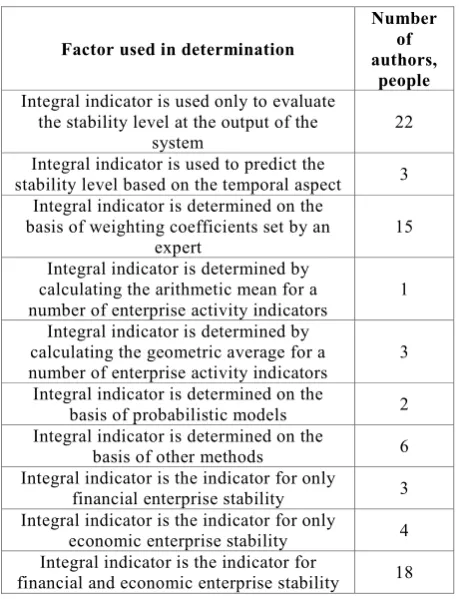
Based on the analysis of determining the integral evaluation indicators, and financial and economic enterprise stability forecasting indicators, we can draw conclusions on the current approaches to this indicator determination (see Table 1).
[image:2.595.56.286.448.748.2]The study of the current approaches to determining the integral enterprise stability indicator revealed the following regularities. First, most of the authors follow the concept of stability evaluation in determining the indicator and eliminate the issues of stability level forecasting in a given period. Though some authors refer to the existing indicators dynamics, which should be considered in the space-time continuum, however, the proposed calculation models, based on simulation and mathematical methods, do not allow predicting the indicator level in the future. This approach is observed in almost 88% of the studied works. The authors of such works are: V. Bor, L. Irkhina, E. Kazyuka, E. Slabinskiy, A. Babich, P. Nefedov, D. Yunusova, B. Shchurov, M. Dmitriev, T. Saakyan, and others. Only 12% of the scientific approaches to determining the integral stability coefficient include tools for forcasting financial and economic situation at the enterprise in the context of stability for future periods. Such authors are: Yu. Suleymanova, I. Pavlova, A. Shmidt.
Table 1. The main approaches to determining the integral
assessing indicators, and financial and economic enterprise stability forecasting indicators, identified on the basis of
research analysis.
Factor used in determination
Number of authors,
people
Integral indicator is used only to evaluate the stability level at the output of the
system
22
Integral indicator is used to predict the
stability level based on the temporal aspect 3 Integral indicator is determined on the
basis of weighting coefficients set by an expert
15
Integral indicator is determined by calculating the arithmetic mean for a number of enterprise activity indicators
1
Integral indicator is determined by calculating the geometric average for a number of enterprise activity indicators
3
Integral indicator is determined on the
basis of probabilistic models 2 Integral indicator is determined on the
basis of other methods 6 Integral indicator is the indicator for only
financial enterprise stability 3 Integral indicator is the indicator for only
economic enterprise stability 4 Integral indicator is the indicator for
financial and economic enterprise stability 18
However, in our view point, in a period of significant fluctuations of the external enterprise
environment, due to the crisis, as well as sanctions against the Russian Federation, it is crucial for the managers of different levels and stakeholders to have the tools, which primarily would allow forecasting enterprise development in the dynamic environment conditions as only this instrument type will allow mitigating the negative impact of enterprise environment disturbing factors, based on proactive management. When the purpose of an entity is not just functioning, but developing – achieving new levels, a need of developing forecasting indicators increases significantly.
Scientific literature analysis in the context of the methods, proposed by the authors for calculating integral enterprise stability level indicator, revealed the following main principles of its determination: the calculation is based on weighting factors, determined primarily by experts. The approaches, based on the method of weighting coefficients, presented in the majority of works, the authors are: E. Nekrasova, A. Kanunnikov, M. Makova, G. Khusnullina, V. Strokov, V. Kozlov, L. Danchenok, A. Il'icheva, A. Aroshidze, O.Zaytsev, V. Bor, L. Irkhina, E. Kazyuka, Yu. Suleymanova, D. Yunusova, Yu. Perskiy, V. Lepikhin, E. Semenova, I. Pavlova. The share of this group is approximately 56%.
based on calculating the geometric average for a number of enterprise activity indicators. This approach was used in the works by M. Makovoya, A.Il'icheva, N. N. Khomyachenkova. It accounts for about 11%.
based on calculating arithmetic mean for a number of enterprise activity indicators. This approach is applied in the research by A. Babich. It accounts for 3.7%;
other approaches for determining the integral indicator. This group includes works outside the group with the general trend – individual scientific approaches. However, in most of these authors’ works the integrated enterprise stability indicator was formally expressed: E. Slabinskiy, A. Duraeva, E. Nekrasova.
only two works are based on the necessity of applying probabilistic approaches in predicting the enterprise stability level (the authors are: Kozlov V.A., Danchenok L.A., Shmidt A.V.) – about 7%.
The analysis was also performed in the context of stability type, allowing evaluating and/or forcasting the integral stability indicator. We can note that in modern research, the authors tend to divide principles of financial and economic stability. However, still there are works in which enterprise stability means only financial stability, and works in which, despite the fact that in calculation methods both financial and economic indicators are used, authors consider stability in terms of one aspect: either financial stability or economic stability.
stability (the works of V. Strokov, Yu. Suleymanova, B. Shchurov, M. Dmitriev, A. Shmid), the remaining 72% of works consider the enterprise stability in the financial and economic aspect (E. Nekrasova, A. Kanunnikov, M. Makovoy, G. Khusnullina, M. Makovoy, N. Katkova, E. Matushevskya, V. Kozlov, L. Danchenok, A. Il'icheva, A. Aroshidze, O. Zaytsev, Khomyachenkova A., V. Bor, L. Irkhina, E. Kazyuki, E. Slabinskiy, A. Babich, P. Nefedov, Yu. Perskiy, V. Lepikhin, E.Semenova, D. Yunusova).
B. The basic requirements for the simulation model of forecasting of financial and economic stability of the enterprise
Thus, as an analysis result of modern scientific approaches to determining the integral enterprise stability indicator, the following indicator patterns can be observed:
first, it allows only assessing, not forecasting the entity stability level (with the exception of only 3 works);
second, the calculation is carried out mainly on the basis of calculating geometric average for growth rates of financial and/or economic indicators;
third, almost all proposed methods are based on principles of determinism, when input enterprise parameters are set by a certain number. In models, stochasticity is not provided, while in a dynamic environment of entity functioning, determinism is not possible (with the exception of only 2 works).
fourth, in most cases, it can be used to evaluate the financial and economic stability level. However, in the economic stability analysis, only different sets of technical and economic indicators are taken into account. The approach to determining the stability level in the context of goal-setting is used only in one work (the author is A. Schmidt).
As an analysis result, we formulated the basic principles of constructing integral financial and economic enterprise stability indicator:
The indicator should be able to be used for assessing and forecasting stability, which is especially important in the period of crisis phenomena in the economy.
Assessing and forecasting entity stability must be comprehensive, and consider not only financial and economic enterprise activity, but the degree of its strategic and tactical goals achievability, i.e., the integral stability indicator should reflect the financial and economic stability. And economic stability should be considered in the context of goal-setting.
The integral indicator should be based on probabilistic and statistical approaches, which will improve the calculations accuracy, compared to the majority of authors’ methods, based on the expert assessing.
The integral indicator should allow assessing and forecasting financial and economic enterprise stability, regardless of the input factors in a simulation model, for example, the size of enterprise
profits, but not its cash flow, is used as an input parameter for the economic stability analysis, etc. The integral financial and economic enterprise stability indicator should consist of both – financial stability and economic stability indicators, to conduct a separate analysis in this context, which will allow correlating generalized evaluation with assessing individual entity stability aspects.
The indicators, included in the assessment methodology of financial and economic stability, must be quantifiable.
The use of integral financial and economic stability indicator should give possibility for implementing generalized comparative assessing various mini-economic systems activities and have relativity aspects. The integral stability indicator of various groups should have the same calculation method. Methods of assessing and forecasting economic and financial stability should be based on the dynamics of the model input parameters, and the resulting value of financial and economic stability level should be continuous in the whole domain of the determination. For interpreting the financial and economic stability level, there must be a rating scale with the characteristics of the established ranges.
Thus, the developed integral indicator for the financial and economic enterprise stability level, as well as financial stability indicator and economic stability indicator taken separately, should be considered as random variables, distributed according to the particular distribution law and other law with corresponding parameters.
C. Mathematical economic model
Analyzing the financial and economic stability level of an enterprise, defined as the product of two independent events, i.e. system’s economic and financial stability, limitations, imposed on the stability condition, should be taken into account. Evaluating the economic stability should be based on the interpretation of the term, which implies that the economic entity operates smoothly if its resulting indicator reaches the goal area [20]. We assume the probability of cash flow reaching a certain area as a company’s goal, which is consistent with its stability in a certain extent [21]. However, the proposed technique may use other types of indicators as a resulting economic stability indicator, such as product sales profit, gross profit, etc.
Thus, the probability of the desired economic and financial stability level growth (Pfs) may be generally used as the integral indicator for the enterprise’s economic financial stability level, i.e. the criteria for evaluating stability controlling results. This integral indicator can be presented as follows:
** *
fes fes fes
Ɋ Ɋ Ɋ
'
enterprise’s controlling system; P**fes – the probability of achieving a desired economic and financial stability level without using enterprise’s controlling system; P*fes – the probability of achieving the economic and financial stability.
We propose determining the economic financial and stability achievement as a probabilities achievement product either for economic or financial stability, which is possible due to our interpreting the categories of "economic stability" and "financial stability”, as in this case these events are independent.
Ɋfes Ɋ 3 es fs
where Pes – the probability of achieving only the economic stability; Pfs – the probability of achieving only the financial stability.
The probability of achieving the company’s financial stability, which can be expressed, for example, using the financial stability coefficient, should take into account the limitations imposed on the coefficient. It reflects the company’s dependence on the external suppliers and is calculated as a part of the equity base in the balance sheet total. We propose calculating the probability of achieving the economic stability as the probability of the resulting indicator (the company’s cash flow) reaching the goal area that is determined by the top managers or stakeholders at the stage of goal setting when taking the strategic and tactical aims.
Thus, the probability of achieving the economic and financial stability can be calculated using the formula:
fes es min max
fs fs min fs fs max Ɋ Ɋ &) &) &)
3 N N N
d d
d d
where &)min – the lower boundary of the goal area; &)max – the upper boundary of the goal area; &) – the random variable of the company’s cash flows; kfs – the random coefficient variable of the company’s financial stability.
Using the rules for estimating the probability of a random variable determined by the normal law in a given interval [23], the probability of the financial and economic stability can be calculated using the Laplace function.
max fs max
min fs min
k
&)
efs fs fs
&) N
Ɋ ³ I&)G&) ³ IN GN
In Russia, the financial stability safety margin is ranged from 0.5 to 0.7. When the value is less than 0.5, a company is considered to have the financial instability, and when the value is more than 0.7, it is considered to use its financial resources inefficiently. Thus, the lower limit of the second integral in the formula (4) may be changed to 0.5, and the upper – to 0.7 respectively. Although in practice, these
boundaries may vary depending upon the analysis objectives.
0 5 0 70 7 0 5
fs fs
efs es min max
fs fs
max min
&) &)
fs fs
k k
Ɋ Ɋ &) &) &)
P . k .
&) &) &) &)
) )
. k . k
) )
d d
d d
§ § · § ··
¨ ¨¨ ¸¸ ¨¨ ¸¸¸u
¨ © V ¹ © V ¹¸
© ¹
§ § · § ··
¨ ¨ ¸ ¨ ¸¸
u
¨ ¸ ¨ ¸
¨ © V ¹ © V ¹¸
© ¹
(5)
where ) – the Laplace function; &) – the mathematical expectation of the random cash flows variable; ı&) – the mean squire deviation of the random cash flows variable;
fs
k – the mathematical expectation of the random coefficient variable for financial stability; ıkfs– the mean squire deviation of the random coefficient variable for financial stability.
4 Conclusions
The study helps to solve a number of essential problems. First, using modern approaches to developing the enterprise’s stability integral indicator, the author's approach is formulated, based on the stochasticity principles.
Second, the integral indicator is proposed, which allows to assess both the financial stability level as the total solvency and the economic stability level defined in our approach as the possibility to reach the goal level of the resulting figure (e.g. a cash flow).
Third, the authors propose the model based on probabilistic and statistical approaches. In this model, both input and output parameters are subjected to stochasticity principles.
Thus, the tools produced by the study provide the effective assessment, forecasting and controlling financial and economic stability of the enterprise, which has a great significance during the world global crisis.
This publication was prepared within the framework of a -32-01051 supported by the Russian Humanitarian Scientific Fund.The work was supported by Act 02.A03.21.0011
References
1. A. Aroshidze, Economic Sciences, 6, 115, 30-34 (2014)
2. A. Babich, Bulletin of the Samara State University of Economics, 7(45), 10-15 (2008)
3. V. Bor, ,PSURYLQJ VWDELOLW\ DQG HIIHFWLYHQHVV PDQDJHPHQWLQVPDOOVHUYLFHEXVLQHVVHV (2009) 4. A. Duraeva, 6WXGHQWV¶ VFLHQWLILF IRUXP.
5. N. Homyachenkova, Bulletin of the Tver State University. Series: Applied Mathematics, 4(37), 81-96 (2010)
6. A. Ilicheva, 'HYHORSLQJ WKH PHFKDQLVP IRU HYDOXDWLQJ VXVWDLQDEOH GHYHORSPHQW RI UHJLRQDO LQGXVWULDOFRPSOH[ (Moscow, 2014)
7. L. Irkhina, 0HWKRGLFDO DVSHFWV IRU DVVHVVLQJ WKH HFRQRPLF VWDELOLW\ RI LQGXVWULDO HQWHUSULVHV SHUIRUPDQFH (2007)
8. E. Kazyuka, Bulletin of ISEA, 4(60), 89-92 (2008) 9. A. Kanunnikov, Bulletin of OrelGIET, 1(19),
121-126 (2012)
10. N. Katkova, E. Matushevskaya, BIZNES NFORM,
1, 252-257 (2015)
11. V. Kozlov, L. Danchenok, Problems in managing WKHVWDELOLW\GHYHORSPHQWDQGEXVLQHVVSHUIRUPDQFH Monography (MESI, Moscow, 2012)
12. M. Makova, Bulletin of VEGU, 4(60), 53-60 (2012) 13. M. Makova, G. Husnullina, ,PSURYLQJ HFRQRPLF
VXVWDLQDELOLW\ EDVHG RQ WKH UHVRXUFH SURYLVLRQ optimization (BashGAU Publishing House, Ufa, 2007)
14. E. Nekrasova, 'HYHORSLQJWKHHIIHFWLYHGHYHORSPHQW system of the enterprise (Publishing House of the Institute of Economics and Management of the Udmurt State University, Izhevsk, 2004)
15. P. Nefedov, )RUPDWLRQ RI WKH HQWHUSULVH IRU VXVWDLQDEOHGHYHORSPHQWPHFKDQLVP (2010)
16. J. Persky, V. Lepihin, E. Semenova, Bulletin of Perm University. Series: Economics, 1(24), 103-110 (2015)
17. E. Slabinsky, National Academy of Sciences of Ukraine.http://dspace.nbuv.gov.ua/bitstream/handle/ 123456789/4403/st_26_23.pdf?sequence=1.
18. V. Strokov, Engineering magazine: Science nd Innovations, 11, 11, 199-211 (2012)
19. Y. Suleymanova, Management Issues, 2(19), 224-229 (2012)
20. T.A. Khudyakova, 3URF RI WKH ,QWernational &RQJUHVV RQ ,QWHUGLVFLSOLQDU\ %HKDYLRU DQG 6RFLDO 6FLHQFH, 292-294 (2015)
21. T.A. Khudyakova, 3URFHHGLQJVRIWKH,QWHUQDWLRQDO &RQJUHVV RQ ,QWHUGLVFLSOLQDU\ %HKDYLRU DQG 6RFLDO 6FLHQFH, 295-297 (2015)
22. B. Schurov, M. Dmitriev, Humanitarian, socio-economic and social sciences, (2015).
http://www.online-science.ru/m/products/economi_sciense/gid2918/pg 0/
23. E. Wetzel, Probability Theory (Nauka, Moscow, 1969)
24. D. Yunusova, 2UJDQL]DWLRQDO DQG HFRQRPLF PHFKDQLVPWRLQFUHDVHWKHHFRQRPLFVWDELOLW\RIDQ LQGXVWULDO HQWHUSULVH EDVHG RQ WKH 5HSXEOLF 'DJHVWDQH[DPSOH (Makhachkala, 2009)
25. T.A. Khudyakova, Actual problems of economics,
12, 444-450 (2015)