Abstract: Image dehazing is a system which can reduce poor consequence of haze on pictures which increase competence of the picture/tape meting out method in the indistinct climate. The present study, presents a simple image dehazing technique. System deletes the initial transmittal, exactly depends on hidden area division which in turn reduces the initial transmittal. First, we build raw transmittal in Gaussian pyramid using selective transmittal extraction prior. Second, a patch based on Laplacian pyramid which gives the value of nonlinear re-trace function point by point. Third, is universal Laplacian map which states the segmentation-based re-traced image. All the three segmentation guide the performer for transmittal refinement. Finally, the dehazing output gets back from the refined transmittal and atmospheric scattered technique.
Keywords : dehazing, Image Processing, MATLAB.
I. INTRODUCTION
Haze is a usual phenomenon which a photographer face while capturing the picture. During the haze the picture captured by the photographer won’t be clear due to climatic absorption and scattered. The base unadulterated pictures brought about by dimness generally corrupt the exhibition of multi-picture preparing and video break down, for example, face distinguishing proof, object finding and keen checking. The dehazing configuration can be evacuated constantly impact of fog on pictures can be improve the presentation of picture/video preparing structure in the foggy atmosphere. In any case, picture dehazing is a center issue (i.e) transmittal estimation. The performance won’t have the exact image on the time of capturing. The performer make use of the analyst who used mid transmittal to remove haze and presented images. Narasimhan [1] utilizes 2 pictures to recognized the different atmosphere execution to bring the inexact item thickness as the transmittal. In [3], their structure needs the client to illuminate district that are most extreme influenced by atmosphere and ones that are not, or to give some center thickness subtleties. In [4], Schechner talk about expulsion of murkiness which is displayed in two or numerous pictures by utilizing different level of polarization. He says that camera position assume a fundamental job in limiting the dimness sway.
Revised Manuscript Received on August 05, 2019.
Dr.S .Saradha, Department of computer science, VISTAS, Chennai, India,
. Priyanandhini, Department Of Computer Science, VISTAS, City, Country.
S.Mangayarkarasi, Assistant Professor, Department of Computer Science, VISTAS, Chennai, India.
T. Sreekala , Department of Computer Science, VISTAS, Chennai, India.
II. LITERATURE SURVEY
TITLE AUTHO
R METHOD/ ALGORITHM DESCRIP TION A Novel Approach For Image Dehazing Combining Visible-NIR Images,201 7 Ashish V. Images Demonstrate /existing image dehazing Image pair has seen growing interest in last decade for improving visibility in landscape Contrast Restoration of Weather Degraded Images,201 6 Narasim han and Shree Physics- based/Fast algorithm weather removal The appearanc es of scenes in uniform poor weather conditions High-Speed Min-Max Bilateral Filter-Based Image Dehazing by Using GPGPU High-Speed Min-Max,2 016 Shota Furukaw a Shota Estimation method Estimation
Cost of the filters are very high
Cost of the filters are Single Image Haze Removal Using Light and Dark Channel Prior,2015 Yueshu Xu Effective/novel dehazing The transmissi on map using soft mapping is high & the atmospher ic light is over-expo sure when a
bright area
Single Image Dehazing using Transmission
Estimation
III. PROPOSED SYSTEM
A tale DCP-based perceivability reclamation strategy that endeavors the benefits of the proposed dimness thickness estimation (HTE) module and the proposed picture perceivability rebuilding (IVR) module and consolidates them so as to adequately beat shading cast issues and deficient estimation of cloudiness thickness. Interestingly with customary DCP based methods, the proposed system is based on a Laplacian technique. In light of this system, the proposed strategy can more viably deliver a dimness free picture than can the conventional DCP-based procedures. Coming up next are the key highlights of our proposed technique.
First, the proposed HTE module is utilized to stay away from lacking estimation of cloudiness thickness in true dust storm conditions. This module depends on the Laplacian-based gamma redress procedure and can viably assess the thickness of dimness arrangement, which along these lines refines the transmission map.
After murkiness thickness is viably determined in the proposed HTE module, the proposed IVR module is connected by means of Laplacian-based white fix Retinex procedure to successfully recuperate genuine scene hues. Thus, a dimness free picture can be viably produced by the proposed technique.
A. PHASE 1 : Lower-upper-middle filter
The lower-upper-middle (LUM) filter may be a nonlinear filter that is explained by (Hardie and Boncelet, 1993) as effective noise attenuation during a non-stationary signal process. during this the author explained that non-stationary signal process has 2 parameters, one for smoothing and also the alternative for sharpening. LUM filters otherwise called LUM smoothers and LUM sharpeners in special cases. By dynamic the parameters (for smoothing) and (for sharpening), the lower-upper-middle (LUM) N may be a pricethat we tend to get from smoothing and sharpening parameters. which may be thought-about as a characteristics price. one will apply this formula to get rid of the haze. which can facilitate for artificial and field knowledge. within the artificial [Figure 3] a special smoothing and sharpening parameters, which is , is taken to balance the flexibilitybetween noise attenuation and fault protection
Fig 1. [FORM 1]
[image:2.595.305.546.70.688.2]. In victimisation the LUM filter on the artificial crying image, the ultimate image is shown in Figure three. examination with Figure three, within the LUM filter that shows similarity that is capable Gaussian filter. The animator like the LUM filter
that minimize the work of them compare thereto of Gaussian filters.
Fig 2. [FORM 2]
Fig 3. [FORM 3]
Fig 4. FORM 4]
[image:2.595.48.260.564.742.2]B. PHASE 2: Image decomposition
In Laplacian map a picture has been developed in that element structure of the picture is framed. As referenced over, the standard method for packing the element structure is connected in the parallel advance, in this way diminish the group of murkiness picture into basic double structure. In the event that essential advances isn't connected in the first place which will prompt end of significant data in the picture.
The other technique is compacting the element data which resuscitates the a picture which had been erased from the pixels. Contrast with the primary strategy the subsequent technique favored by the vast majority of the professional. By utilizing the general laplacian map the specialist can disregard or bring back the picture on the off chance that they requirement for the future use. Without commotion, the element map and the smooth guide which involve the entire picture. At the point when commotion is available, the third segment of any picture signal, one is reliant of the other two. This methodology was created by Aw [1,2] in his investigation he utilized widespread laplacian guide to build up a picture pressure procedure that works in all respects viably on pictures with fine highlights. where the standard calculations like JPEG neglect to keep up picture constancy. In dividing cloudiness from picture into its part structures, one should initially comprehend the idea of non-straight nature of the neighborhood vitality highlight model. At the point when two picture signals, both present and nonattendance of commotion are consolidate to frame new picture signal which contain the picture structure of both the sign. For another situation if two picture signals, are without highlights, are joined and brings about a picture without highlights. These requirements force a specific kind of strong component on the procedure of picture observation.
Notwithstanding, in the event that we essentially include pictures together, some element structure may offset or be made, with the goal that the basic highlights would be lost. To see this, consider including two sine waves together, where the sine waves have various frequencies, state and . Presently both sine waves exclusively have no component structure, since the Hilbert change of is and . In any case, the waveform has highlights, absolutely at the point where beating happens between the two waves. Under the nearby vitality model, this is actually what is anticipated, since the vitality of the additional waveforms is
furthermore, this vitality capacity has crests at the pinnacles of the cosine term In this non-linearity equation an issue emerges in psychophysical tests, that people exhibit an observation known as recurrence multiplying which is delineated with two sine waves, one totally out of stage with the other. The adjustments in the pictures variation which not known to the viewers(Non-expert), the spectator wont know the uniform level picture, as they believe that the two picture is a mix of two picture signal. The specialist must watch the adjustments in the recurrence which changes as often as possible. Such
changes can't be clarified by accepting a hidden straight framework for visual observation. Be that as it may, the nearby vitality model predicts precisely this observation.
To perceive how this functions in psychophysical tests, we need to characterize how pictures are joined inside the nearby vitality model. Rather than basic expansion, nearby vitality proposes a picture mix administrator that reproduces complex duplication. Two picture sign, f and g, are at first envisioned as the genuine pieces of two complex pictures
signals, and . These two complex sign can
be duplicated together in the typical manner, and the resulting
signal would have real part whilst the imaginary
part would be . We characterize our new picture
mix as the genuine piece of the intricate pictures joined utilizing complex duplication:
Along these lines, and again by similarity with complex division, the reverse administrator is characterized by
With these definitions, we would now be able to demonstrate the accompanying hypothesis
THEOREM
The stage congruency guide of a picture interestingly characterizes the picture luminance work, aside from an element free profile.
Verification: We first show how vitality circulates over the administrator
and so as is an element free picture since its vitality capacity has no neighborhood maxima.
Coming back to the marvel of recurrence multiplying, we presently observe that the picture blend of the two sine waves
is in certainty a cosine wave of double the recurrence. For
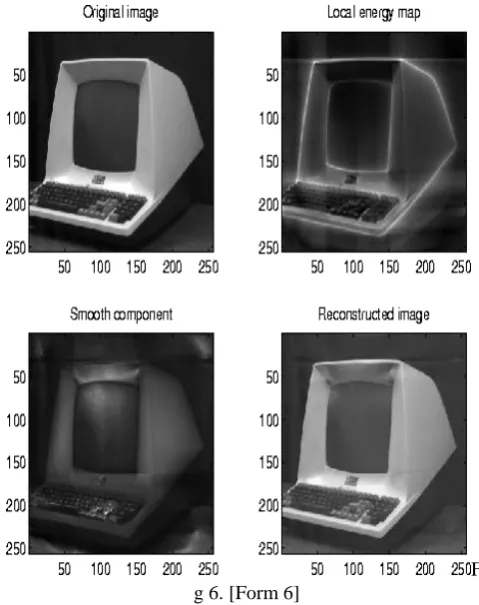
We can likewise find from this hypothesis that given any picture signal f, when we have determined its stage congruency map PC we can likewise compute its smooth guide S by essentially ascertaining
The part S(x) contains all the non-highlight data of the picture, and PC contains all the element data. Together, they re-join to frame the first picture, that
[Form 5]
Fig 5: a) An actual image. b) Its phase congruency map. c) Its smooth component. d) Thereconstruction of the image.
Fi g 6. [Form 6]
IV. RESULTS AND DISCUSSION
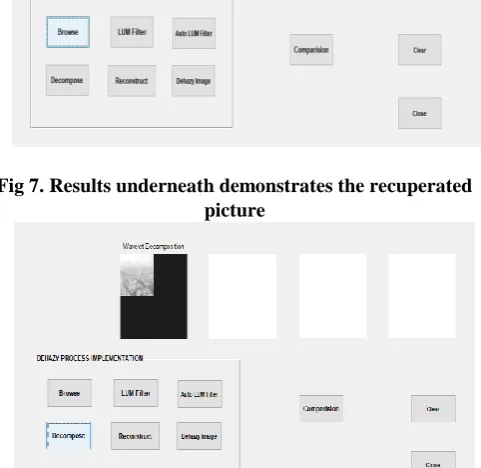
[image:4.595.303.543.48.351.2]Fig 7. Results underneath demonstrates the recuperated picture
[image:5.595.313.545.57.518.2]Fig 8. crude profundity map and refined profundity map
Fig 9. Results red pixels in the firsts segment
[image:5.595.51.292.135.369.2]Fig 10. Results red pixels in the next segment
[image:5.595.315.547.266.653.2]Fig 11. The methodology proposed can recuperate the subtleties
Fig 12. The methodology climate is homogeneous
Fig 13. the recovered images becomes darker , less hazier and also the color appears oversaturated
V. CONCLUSION
Haze free & detail restoration technique for transmittal refinement is the finding of the research paper. There are four method are involved in removing the haze. The first methodology involves in
[image:5.595.56.283.407.558.2] [image:5.595.56.282.592.735.2]method and smoothing method with the help of LUM and filters which is better then the Gaussian pyramid. The animators find it easy to see the pixel difference in the images. The second methodology is noise attenuation and fault protection which re-bring the images. The third method is laplacian map. In the laplacian map the animators find easy to combaine both the signals. Amoung the above mentioned method universal laplacian method is the effective one. There is no need for the artificial flashes. With the light available background is safficiant for the images. The following techniques can be used by the animator for removing haze which is easier than the method which they used in the past.
REFERENCES
1. ‘Dynamic range independent image quality assessment’, ttp://resources. mpiinf.mpg.de/hdr/-vis_metric/, accessed 27 July 2015
2. Yan, Q., Xu, L., Jia, J.: ‘Dense scattering layer removal’ (ACM Asia
Technical Briefs, 2013), p. 14
3. Meng, G., Wang, Y., Duan, J., et al.: ‘Efficient image dehazing with
boundary constraint and contextual regularization’. Proc. Int. Conf. on Computer Vision, 2013, pp. 617–624
4. Kim, J., Jang, W., Sim, J., et al.: ‘Optimized contrast enhancement for
realtime image and video dehazing’, J. Vis. Commun. Image Represent., 2013, 24, (3), pp. 410–426
5. Gibson, K.B., Vo, D.T., Nguyen, T.Q.: ‘An investigation of dehazing effects on image and video coding’, IEEE Trans. Image Process. (TIP), 2012, 21, (2), pp. 662–673
6. Tang, K., Yang, J., Wang, J.: ‘Investigating haze-relevant features in a
learning framework for image dehazing’. Proc. Int. Conf. Computer Vision and Pattern Recognition, 2014, pp. 2995–3002
7. Xu, L., Lu, C., Xu, Y., et al.: ‘Image smoothing via L0 gradient minimization’, ACM Trans. Graph. (TOG), 2011, 30, (6), p. 174 [7] He, K., Sun, S., Tang, X.: ‘Guided image filtering’. Proc Int. Conf. European Conf. on Computer Vision,2010, pp. 1–14.
8. Ancuti, C.O., Ancuti, C., Hermans, C., et al.: ‘A fast semi-inverse approach to detect and remove the haze from a single image’. Proc. Int. Conf. Asian Conf. on Computer Vision, 2010, pp. 501–514
9. Tarel, J., Hautire, N.: ‘Fast visibility restoration from a single color or
gray level image’. Proc. Int. Conf. Computer Vision, 2009, pp. 2201–2208
10. He, K., Sun, S., Tang, X.: ‘Single image haze removal using dark channel prior’. Proc. Int. Conf. Computer Vision and Pattern Recognition, 2009 (Oral)
11. Kopf, J., Neubert, B., Chen, B., et al.: ‘Deep photo: model-based photograph enhancement and viewing’, ACM Trans. Graph. (TOG), 2008, 27, (5), p. 116
12. Tan, R.: ‘Visibility in bad weather from a single image’. Proc. Int. Conf.Computer Vision and Pattern Recognition, 2008, pp. 1–8
13. Fattal, R.: ‘Single image dehazing’,ACM Transactions on
Graphics(TOG),2008, 27, (3), p. 72
14. Aydin, T.O., Mantiuk, R., Myszkowski, K., et al.: ‘Dynamic range
independent image quality assessment’, ACM Trans. Graph. (TOG), 2008, 27, (3), p. 69
15. Dr.K.Dharmarajan, Farhanah Abuthaheer and Dr.K.Abirami.
![Fig 2. [FORM 2]](https://thumb-us.123doks.com/thumbv2/123dok_us/8185828.256298/2.595.305.546.70.688/fig-form.webp)