THESES SIS/LIBRARY TELEPHONE: +61 2 6125 4631 R.G. MENZIES LIBRARY BUILDING NO:2 FACSIMILE: +61 2 6125 4063
THE AUSTRALIAN NATIONAL UNIVERSITY EMAIL: [email protected] CANBERRA ACT 0200 AUSTRALIA
USE OF THESES
This copy is supplied for purposes
of private study and research only.
Passages from the thesis may not be
copied or closely paraphrased without the
Kenneth Vine
A thesis sul:rni tted for the Degree of Doctor of Philosophy The Australian National University, Canberra.
This thesis describes original research
carried out by the author during the tenure of a Commonwealth Postgraduate
Research Award in the Department of
Psychology of the Australian National
University from October, 1978 to
January, 1982.
ACKNcmLEDGEMENrS.
I am most grateful to my supervisor Dr. Michael Cook for his many helpful
suggestions and advice. I am particularly indebted to him for his assistance with the writing and editing of this thesis.
I am also grateful to Professor Gavin Seagrim for his advice and guidance.
I am indebted to Dr .Stellan Ohlsson of the Department of Psychology,
University of Stockholm. Dr. Ohlsson graciously permitted me to use his PSS computer modelling system, and encouraged me to adopt an
information-processing approach to theory formulation.
I thank Mr.Martin Schaefer for the many forms of assistance he gave me.
I also thank the Technical Staff for providing the materials used in the
study •
. I am indebted to my family for their patience, tolerance and support.
I acknowledge with gratitude and pleasure the many contributions made by
Catherine May, especially during the data collection phase when her
knowledge of children was most valuable. She also typed the drafts and
and final copy of this thesis. Moreover, she provided constant emotional
support.
Finally, I thank the children and teachers at the AME School, and at
St.Thornas More's, St.Joseph's, and St.Brigid's Convent Schools, for their
Part I.
Chapter l.
Chapter 2.
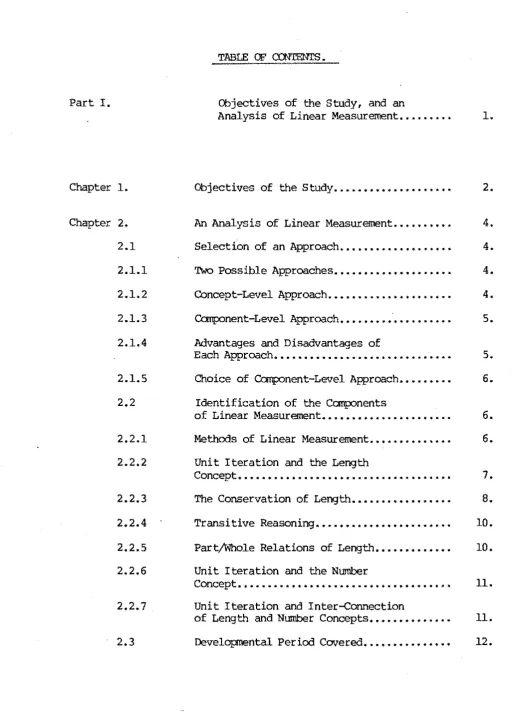
2.1 2.1.1 2.1.2 2.1.3 2.1.4 2.1.5 2.2 2.2.1 2.2.2 2.2.3 2.2.4 2.2.5 2.2.6 2.2.7 2.3
TABLE OF aJNTENTS.
Objectives of the Study, and an
Analysis of Linear Measurement •••••••••
Objectives of the Study •.•.••••••••••••••••
An Analysis of Linear Measurement ••••••••••
Selection of an Approach •••••••••••••••••••
Two Possible Approaches ••••••••••••••••••••
Concept-Level Approach .•••••..•.•••••••.•••
Cc::trq:::onent-Level Approach • ... ; ... .
Ad'il'antages and Disadvantages of
l. 2. 4. 4. 4. 4. 5.
Each Approa.ch. • . • • . . • • . . • • .. • .. . . . .. • . .. • • • .. .. 5 ..
Choice of Cc::trq:::onent-Level Approach ••••••••• Identification of the Components
of Linear Measurement ... .
Methods of Linear Measurement .•.•••••••••••
Unit Iteration and the Length
6.
6.
6.
Concept... . . . .. . .. .. • • • • • .. .. .. .. .. .. • . .. .. • • .. . .. .. • 7.
The Conservation of Length ••••••••••••.••••
B.
Transitive Reasoning .. ... . 10.
Part/Whole Relations of Length ••••••••••••• 10. Unit Iteration and the Number
Concept. . .. .. . .. .. .. • .. .. .. • .. .. . . . .. . .. .. . . .. .. . • . . .. . . .. 11.
Unit Iteration and Inter-connection
of Length and Number Concepts •••••••••••••• 11.
[image:5.595.73.592.42.769.2]2.4 List of Components of Linear
Measurement ... ,... 13 ..
2.5 Non-Independence of Components
of Linear Measurement • ... ·.. . .. . . • .. .. • • .. .. 19 ..
2.6 Nature of the Empirical Questions
Asked by the Present Study ••••••••••••••••• 20.
2.6.1 Which Components are Necessary
for Linear Measurement •••••••••••••••••••.• 20.
2.6.2 Is there an order in which the
Part II
Chapter 3.
3.1 3.1.1 3.1.2 3.1.3 3.2 3.2.1 3.2.2 3.2.3 3.2.4 3.2.5 3.3 3.3.1 3.3.2 3.3.3 3.3.4 3.4 3.4.1 3.4.2 3.4.3 3.4.4 3.4.5
Literature ~iew •..••..•.•.•...•.... ~ ..
Piagetian View on Components of Linear Measurement and their
22.
Order of Development... 23.
Predicted Order of Development •••••••••••• 23.
Parallel Development •••••••.• ~ •••••••••••• 24.
Three Sub-Stage Model •••••••••••••••••••• 24.
Horizontal Decalage •••••••••••••••••••••• 25.
Overview of Piaget~s Theory of
Cognitive Development •••.•••••••••••••••• 26.
Nature of the Theory ... . 26. Cognitive Structures ••••••••••••••••••••• 27.
Concept of Scheme ... . 28.
Cognitive Functions ... . 28.
Structural Change ... . 30. Stages of Development •••••••••••••••••••• 31.
Sens~tor Stage ••••••.••.•...•.•...•. 32.
Pr~rational Stage ..•.•••••..•...•..•• 32.
Concrete Operational Stage •••••••••.••••• 34.
Formal Operational Stage ••••••••••••••••• 34.
Concrete Operations ••••••••••.••••••••••• 35.
Logical and Infralogical
Operations...
35. Grouping and Group Structures •••••••••••• 36.Types of Grouping Structure •••••.•••••••• 37.
Types of Group Structure ••••••••••••••••• 39.
3.5 3.6 3.6.1 3.6.2 3.6.3 3.6.4 3.7 3.8
Chapter 4.
4.1 4.2 4.3 4.4 4.4.1 4.4.2 4.4.3' 4.4.4 4.5
Parallel Development Hypothesis ••••••••.•
Three Sub-Stage Model .... .; ... ~ ... ~
Classes . ... ..
~latioos .... ... ..
Number Conservation •.••.••••••••••.••••••
Conservation, Measurement and
42.
43.
44.
45.
47.
Arithmetical Operations... 48.
Horizontal Decalage .. ... .
S1.1Il1l'Tlary • ... ~ ••
Methodological Considerations ••••••••••••
Piaget's Modified Clinical
52.
53.
55.
Awroach... .... .. . . .. .. .. .. .. .
ss.
Performance/Competence Issue •••••••••••••
Performance/Competence Criticism of Piagetian Concrete Operational
55.
Tasks...
56.
Criticism of the Piagetia~
Transitive Reasoning Task... 57.
Studies Controlling Visual Illusion, Merrory Capacity and
Verbal Skill Factors •••••••.••..•••••.•••
The Role of Linguistic Coding
in Transitive Inferenoe ... ..
The Role of Mental Imagery in
Transitive Inferenceo••••••••••••••••••••
Form of Internal Representation ••••••••••
Summary of Criticism Regarding
58.
59.
60.
60.
Chapter 5. 5.1 5.2 5.3 5.3.1 5.3.2 5.4 5.4.1 5.4.2 5.4.3 5.5
Chapter 6.
6.1 6.2 6.2.1 6.2.2 6.2.3 6.2.4
Parallel Developnent: Empirical Evidence Concerning Order of Emergence of Conservation and
Transitive Reasoning,. .. .. .. . .. .. . .. .. .. . .. .. .. . .. • . .. .. 63 ..
Predictions ••••••••••••••.••••••••.•.••••
Assessment Criteria .•...•. *•••···~··
EVidence~ that Acquisition of Conservation Precedes Acquisition
63.
64.
of Transitive Inference •....•• ~... 65.
Length. and Weight ... .
EVidence that Acquisition of Transitive Inference Precedes
65.
68.
Acquisition of Conservation... 70.
Weight ... _.~ ... ..
!£rtg"th and Weigl1t . ... .
Lengtll . ... .
Sl.lJtl[t'l.a.ry ... ... ..
Sequential Development: Empirical Evidence Concerning Order of Emergence of Conservation, Arithmetical Proficiency and
Measurenent .... ... .
Preciictions .. ... .
The Conservation of Number and
70. 70. 71. 72. 74. 74.
Arithmetical Proficiency ••••.•••••••• ~.. 76.
The Number Concept and
Arithmetical ~rations... 76.
Defining and Understanding of
Ari tmnetic. • ... .. .. .. • .. .. • • • • • • . .. .. • • .. • .. .. .. .. .. • . . • 76.
Equivocal Findings of Studies Linking Conservation of Number
and Arithmetic ..••••••.••••••••••••••.•••
Studies Linking the Laws of Arithmetic and the Laws of
77.
6.2.5 6.3 6. 3.1 6.3.2 6.3.3 6.3.4 6.4 6.5
Chapter 7.
7.1 7.2 7.2.1 7.3 7.3.1 7.4
. 7
.s
7.5.1
7.6
Sunnnary of Discussion: The Conservation of Number and
Understanding of Arithmetic ••••••••••••..
The Conservation of Length/ Distance, and Measurement of
Let1gth/Distar1ce ... ..
Empirical Studies of Length/ Distance, Conservation and
87.
82.
Measure:nent.. .. • .. .. .. • .. • • • • .. • .. .. .. • • . • • .. • .. .. .. .. .. .. 82 ..
Identity, Inversion and
Compensation Arguments •... ~ ••••.•••.••• ~. 83.
Role of Measurement in
Acquisition of Conservation ••.••••••••••• 84.
Summary of Discussion and
Conclusion...
85.
Seriation, Ordination, and
Transitive Inference ... -... ..
Sll.Itlina.ry .. • " • • .. • ... " ... • " • " • " • • • • ... " "
Horizontal Deca1age:
Evidence Concerning Order of Emergence of Corresponding
Canponents of the Number, Length,
and Distance Concepts ... .
Predictions ... ... ..
Evidence that Acquisi lion of the Conservation of Number Precedes Acquisition of the Conservation of
86.
87.
88.
88.
Ler1gth.. .. .. .. • • .. .. .. .. • • .. .. .. • • .. • .. . .. .. • .. • • • .. .. • • • .. • 89 ..
Concl us ion .. • • .. • .. • .. .. . . .. • .. • . .. .. . .. . . • .. . • .. .. .. .. ..
Evidence that Length and Distance
Conservation Emerge Synchronously ••••••••
Conclusion ... .
Evidence that Length and Distance Measurement Emerge
Syn.chrooousl y .. ... ..
Evidence that Acquisition of Seriation Precedes Acquisition of
91.
91.
93.
93.
Nl..ll'neration .... ... ,. .. •... .. • • .. • .. • .. .. . • 93.
Conclusion . ... . 94.
Part III The Enpirical Study:
Discussion of Met:h:xblogy and
Presentation of Results ••..•.•..•••..• ,. 95.
Chapter
e.
The Strategy of the Study and Statement of Hypotheses ••••••••••••••••• 96. 8.1 The Strategy of the Study ... . %. 8.1.1 Questions Asked in the Study •••••••••••• 96. 8.1.2 T:Y:f?e' of Design . • .. .. . • .. . . . .. . . .. . .. . . , . • 97.8.1.3 Training Study •••••••••••••••••••••••••• 97. 8.1.4 CaTq:::Jarati v-e
s
tud.y • ... 98.8.1.5 Developmental Study ••••••••••••••••••••• 98. 8.1.6 Preferred Approach •••••••.••.•.•••••••.. 98.
8.1.7 Cross-Sectional Method •••••••••••••••••• 99. 8.1.8 Longitudinal Method ••••••••••••••••••••• 99. 8.1.9 Sc!alc:x:Jr an f.tetllc:rl. • ... 99.
8.1.10 Corlclusioo . ... . 100.
8.2 Statement of Hypotheses ••••••••.••••••.. 101.
8.2.1 Co:np:lnents of Linear Measurement •••••••• 101. 8.2.2 Order of Development of Canponents of Linear Measurement •••••••• 103. 8.2.3 Expected Pattern of Development ••••••••• 104. 8.3 Age, Sex, and Length of Sch:x>ling Factors ••.• ... 110.
Chapter 9. Subjects, Tasks and Procedure ... . 111.
9.1 Subjects ... ., ... ... .. 111.
9.1.1 Age ... • ... • • • • • • ... • • • • .... •. • .. • .. • • ••• 111.
9.1.3 Scllcx:)l CurriClll1.llll ... . 112.
9.1.4 Santf)lillg' Factors .••.•.••••••.••. ., ... . 113.
9.1.5 51..IITI['(L3I'y • ... 113.
9.2 Tasks • ... 115.
9.2.1 Nt.Jnl:>er Tasks •• ... 116.
9.2.2 I.e11gth Tasks ••• ... 119.
9.2.3 Dis tan~ Tasks ... ... .. 122.
9.3 Prooed.ure ... . 123.
9.3.1 Order of Administration •••••••••••••.••• 123. 9.3.2 Testillg SessiC>IlS • ... 125.
Chapter 10. Results of the Study . ... . 126.
10.1 Summary Data ••••••••••••••••••••••.••••• 126. 10.2 Canponents of Linear Measurement •••••••• 126. 10.3 Order in the GrOW'th of the Nl.JIIl1:::er Coo~pt ••••• ... 130.
10.4 Order in the GrOW'th of the Lelll3'th Cooc:e-pt • ... 135.
10.5 Expected Pattern of Development of the Number Concept ••••••••••••.•.•••• 140. 10.6 Expected Pattern of Development of the Lenc:Jth Concept • ... 142.
10.7 Expected Pattern of Development
of the Distance Concept ••••••••••••••••• 144.
10.8 Linkages Between Concepts •.••••••••••••• 145.
10.9 The Effects of 1\ge, Lergth of
Schooling and Sex .•••••••••. ~... 148.
10.9.1 Differences Between Group Means ••••••••. 148. 10.9.2 Multiple Regression 1\.~alysis •••••••••... 149. 10.9.3 St..IIIliTla.ry ... " •• " ... II . . . ~ . . . 151.
10.10 The Effect of Scoring Criteria on
the Findi.rlg's ... , ... 152. 10.11 St.rnnary of Findings ... 153A.
10.11.1 Components of Linear Measurement •••••••• 153A. 10.11.2 Order of D?velopment of Linear
ltie:asurernent • ... 153A.
Part !11 Interpretation of Results,
Discussion and Conclusions... 154a
Chapter 11. Discussion of Results ••.••.•• ~···~···· 155.
11.1 The Canp::ments of Linear
11.1.1
11.1.2
11.1.3
11.1.4
11.1.5
11.1.6
11.2
Measurement •••.•.••.•••••••.••..• ~... 155.
Arithmetical Proficiency and
Linear Measurement... 156.
Transitive Reasoning and
Linear Measurement... 158.
Conservation and Linear
Measurenent...
159.
Use of a Unit in Linear
Measurenent ... .,... 160.
Estimation and Linear Measurement... 161.
Length and
Distance...
162.
Inter-connection of the Camponents
of Linear Measurement •••••.• ~... 162.
11.3 The Irrplications of the Order of Emergence of Ccmponents of the
NIJI1ber and Length Concepts... 165.
11.4 The Order of Emergence of
Ccmponents of the N IJI1ber Conoept. • • • • • • • 167.
11.5 The Order of Emergence of Camponents
of the Length Concept ••••.••••.•
«...
173.11.6 Ordering Across NIJI1ber and
Length Tasks... 178.
Chapter 12. 12.1 12.2 12.2.1 12.2.2 12.2.3 12.2.4
12. 2. 5
12.3 12.4 12.4.1 12.4.2 12.5 12.5.1 12.5.2 12.5.3 12.6 12.6.1 12.6.2 12.6.3 12.7 12.7.1
An Information-Processing Analysis of Cert;o.in Number and Length Tasks,
Using Pascual-Leone's M-Space Model... 182.
Intrcxluction. . . .. .. . . . 182.
Pascual-Leone's M-Space Model... 183.
Nature of the Model... 183.
Figurative Schemes... 183.
Operative Schemes... 184.
Execu.ti ve Schemes. . . .. . . . • . • . .. . 184.
M-Space Construct... 185.
Developmental Progressions... 187.
Individual Differences... 188.
I..ear ning .. . • . . . . • • . • • • • • • • • • • • • • • . • . . • • • • 18 9 • Field-Independence/Dependence... 190.
Empirical Evidence for the M-5pace Model... 190.
Early Studies... 190.
Methodological Criticisms... 191.
Later studies.. . . 191.
MrlSpace Analysis of Certain Nllnll:>er Tasks... 193.
Selection of Number Tasks... 193.
Specification of the Co-Activated Schemes for the Selected Number Tasks... 194.
Number of Co-activated Schemes Required for the Selected Number Tasks... 198.
M-Space Analysis of Certain length Tasks... 199.
12.7.2
12.7.3
12.8
Chapter 13.
Specification of the Co-activated Schemes for the Selected Length
Tasks...
200.
Number of Co-activated Schemes Required for the Selected Length Tasks... 203.
Stmtrna.ry. • • • • • • • .. • • • • • • • • • • • • • • • • • • • • • • • • 203.
An Example of a Production-System Analysis of Certain Canponents of Linear Measurement... 205.
13.1 The need for a Detailed Process 13.2 13.3 13.4 13.4.1 13.4.2 13.4.3 13.5 13.5.1 13.5.2 13.6 13.7 Chapter 14. 14.1 Analysis of Linear Measurement... 205.
Overview of a Production-System L arlgllage. • • • • • • • • • • • • • • • • • • • • • • • • • • • • • • • 20 9 • Tasks Selected for Modelling... 211.
Outline of the Models... 213.
.Addition Models... . . . 213.
Subtraction MOdels... 215.
Addition and Subtraction Models. • • • • • • • • 215. Annotated Listings of the Counting-Based Addition and Subtraction Models... 216.
The Counting-Based Model of N-ADI)-N\T. • .. • • • • • • • • • • • • • • • • • • • • • • • • • • • • • 217.
The Counting-Based Model of N ...oS
tlB""'*" • • • • • • • • • • • • • • • • • • • • • • • • • • • • • • • •
22 5 • Performance Statistics... 225.Conclusioo.s. .. . . • . . . • • . . • . • . . • • . . • • • . . • . • 227.
Summary of Conclusions... 229.
14. 2 Order of Development of
Linear Measurement... 230.
14.3 Order of Development of
Canp:ments in the Number, Length,
and Distance Danains... 231.
14.4 Discontinuities in Number and
Length Concept Development... 232. 14.5 Production-System Models of
L inear Measurement. • • • • • • • • • • • • • • • • • • • . • · 23 3.
14.6 The Effects of Age and Length of
Sc11c:x:>lil'lg. • • • • • • • • • • • • • • • • • • • • • • • • • • • • • • 233.
APPENDICES.
Af:pend ix 1.
Af:pend ix 2 •
Appendix 3.
Af:pend ix 4 •
Af:pend ix 5 •
Af:pend ix 6 •
Task Descriptions •• ~... 235.
Ra, w r>a. ta. Sl.lil'ITla. ry... • .. .. .. .. .. • .. .. • • • . .. .. .. • • .. • .. .. .. . . • .. .. 2 7 B •
M:::Nemar Oli -Squared Matrix: All Tasks. .. .. • • • 28 2.
I:escriptions of
Production-System M:xlels. .. • • .. • .. • .. • .. .. .. • .. .. • • • • • • • • • • • • • • .. .. 28 5.
Cbnparative Analysis of Results Using Assessm;;nt Criteria Varying in tegree
of Strictness .. ~···4·
Speculative CUtline of Further 'iibrk on Production System M:ldelling of
the I:evelopnent of Linear M::!asure~rent •••.••••
293.
317.
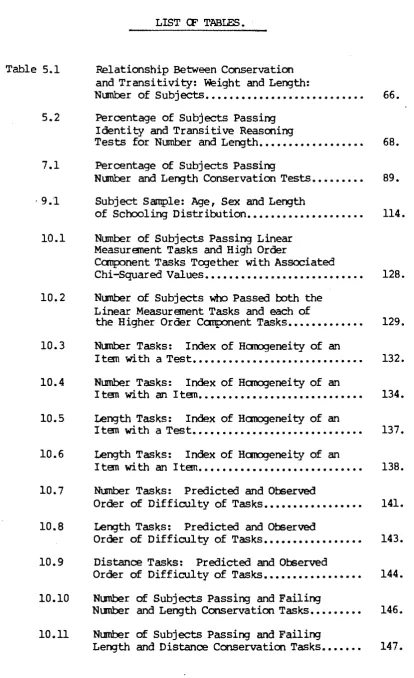
Table 5.1
5.2
7.1
'9.1
LIST CF TABLES.
Relationship Between Conservation and Transitivity: Weight and Length:
Number of Subjects •••••••••••••••••••••••••.•
Percentage of Subjects Passing Identity and Transitive Reasoning
Tests for Number and Length ••••••••••••••••••
Percentage of Subjects Passing
Nunber and Length Conservation Tests ••••••.••
Subject Sample: Age, Sex and Length
of Schooling Distribution ••••••.•••••••••.•.•
10.1 Number of Subjects Passing Linear
Measurenent Tasks and High Order
Component Tasks Together with Associated
66.
68.
89.
114.
Chi -Squared Values.. .. . . . .. . . 128.
10.2 Number of Subjects who Passed t:oth the
Linear Measurenent Tasks and each of
the Higher Order Component Tasks... 129.
10.3 Number Tasks: Index of Harogeneity of an
I tan with a Test. . . .. . . . .. . . . 132.
10.4 Number Tasks: Index of Hanogeneity of an
I ten with an. I ten. . . • . . . 134 ..
10.5 Length Tasks: Index of Hanogeneity of an
I ten with a Test... 137.
10.6 Length Tasks: Index of Hanogeneity of an
I
ten
with ar1 Itan...
138.10.7 N!Jnber Tasks: Predicted and Observed
Order of Difficulty of Tasks... 141.
10.8 Length Tasks: Predicted and Observed
Order of Difficulty of Tasks... 143.
10.9 Distance Tasks: Predicted and Observed
Order of Difficulty of Tasks... 144.
10.10 Number of Subjects Passing and Failing
Number and Length Conservation Tasks... 146.
10.11 N!Jnber of Subjects Passing and Failing
[image:19.595.154.569.79.758.2]10.12 Group Characteristics - Number of
Subjects by Group .•.•• ~··· 148.
10.13 Total Scores oo all Tasks - Group Means
and Standard Deviations... 149.
10.14 All Tasks - SLliillllary of Multiple
Regression Analysis... 150.·
10.15 Number Tasks - SLliillllary of Multiple
Regression
Analysis...
150.10.16 Length Tasks - SLliillllary of Multiple
Regression Analysis... 151.
'11.1 Number Tasks: Chi-squared Values
for Adjacently Ranked Item Pairs... 167.
11.2 Levels oo the Performance Gradient
for the Number Tasks... 168.
11.3 Length Tasks: Chi-5quared Values
for Adjacently Ranked Item Pairs... 174. 11.4 Levels oo the Performance Gradient
for the Length Tasks... 175.
12.1 Number Tasks Selected for M-Space
Ana.lysis...
193 ..12.2 Length Tasks Selected for M-space
Anillysis...
199.
13.1 Performance Statistics for Each Model... 226.
A2.1 Raw Data Matrix - Subjects
b:Y'
Tasks...
278.
AS.l All Tasks: Order of Task Difficulty Obtained Under the Strict, M::lderate
and Weak Scoring Criteria... 301. AS.2 Nunber Tasks: Order of Task Difficulty
Obtained Under the Strict, M::lderate
and Weak Scoring Criteria... 303. AS.3 length Tasks: Order of Task Difficulty
Obtained Under the Strict, M::lderate
and Weak Scoring Criteria... 304. A5.4 Distance Tasks: Order of Task Difficulty
Obtained Under the Strict, M::lderate
and Weak Scoring Criteria... 305.
AS.S Corrparison of Rank Orderings O:>tained Under the Strict, M::lderate and Weak
Scoring Ciiteria... 305.
A5.6 Scaling Indices O:>tained from Data Derived from Strict, M::lderate and Weak
A5.7
AS.8
A5.9
A5.10
AS.ll
Scaring Criteria... 307.
Nurrber of Subjects Passing Conservation and Transitivity Tasks J\ceording to
Scoring Criterion Used... 309.
Number Tasks -Moderate Criterion: Chi-Squared Values for Adjacently
Ranked Item Pairs... 312.
Nurrber Tasks -Weak Criterion: Chi-Squared Values for Adjacently
Ranked Item Pairs. . .. .. . .. .. .. . .. . . .. .. . . .. .. .. . . . .. .. .. 313.
length Tasks - M::lderate Criterion: Chi-Squared Values for Adjacently
Ranked Item Pairs ...
$...
314.Length Tasks -Weak criterion: Chi-Squared Values for Adjacently
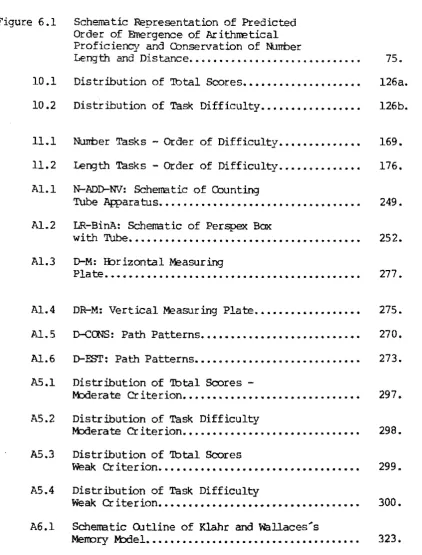
Figure 6.1
LIST OF FIGURE:S.
Scherratic Representation of Predicted Order of Emergence of Arithnetical Proficiency and Cbnservation of Nurrber
~rqtll and Distance ...
,.s...
75.10.1 Distribution of Tbtal Scores •••••••••••.••.••••• 126a. 10.2 Distribution of Task Difficulty •••••••••••••.••• 126b. 11.1 Number Tasks- Order of Difficulty •••••••••••••• 169. 11.2 Length Tasks- Order of Difficulty .••••••••••••• 176. ALl N-ADD-NV: Scherratic of Cbunting fube Ai?f>ara tus. • . .. . .. .. .. . • • .. .. .. .. .. .. . . • • .. .. . . • • • .. .. . . .. . 249.
AL2 LR-BinA: Scherratic of Perspex Box witl1
'1\lbe...
252.Al.3 D-M: Ibrizontal Measuring
Plate...
277.
Al.4 DR-M: Vertical Measuring Plate... 275.
Al. 5 D-COOS: Path Patterns. .. • .. .. .. .. . . . .. . . . . .. . . .. . .. . .. .. . 270.
Al.6 ~EST: Path Patterns... 273.
AS.l Distribution of Tbtal Scores
-Moderate criterion...
297.A5.2 Distribution of Task Difficulty r.t:xierate
c:r
iter ion... 298.A5.3 Distribution of Tbtal Scores weak
criterion...
299 ..A5.4 Distribution of Task Difficulty weak
criterion...
300. [image:22.595.118.541.152.708.2]ABS'l'Rl'CT.
The study had two d::>jectives. The first was to identify the 'higher-level' kmwledge necessary for a child to un:lerstand linear m?asurement.
The secorrl was to chart the growth of linear measurerrent in terms of the developm?nt of its corrponents. In this context, 'higher-level~
krowledge refers to skills such as counting an array of object..s, as distinct from 'lower-level' skills such as attending to an d::>ject in an array.
An analysis of m=asurem=nt operations yielded a list of corrponents which it was argued would underlie linear measurenent. Piagetian theory and related errpirical literature were consulted as sources of infornation on the em?rgence of these carponents in the child's thinking. This led
to the fornulation of a ru.mber of predictions concerning the carponents of linear rreasurem?nt, and their order of errergence.
A battery of 34 nunber, length, and distance tasks was developed to assess the presence of these carponents. It was administered to 100 children aged between 63 and 78 m:mths, and drawn from kindergarten and
grade one. The results were analyzed using s::::alogra:m techniques. The nain contribution of the thesis is in this errpirical work.
following:-Knowing how to make transitive inferences of equivalence,
with respect to discrete quantity, and length.
KnCMing that the numerosity of an array of objects is
invariant under certain transformations (the conservation
of numter}.
KnCMing that length is invariant under certain transferror
ations (the conservation of length}.
KnCMing how to carry out numerical addition operations.
Knowing how to obtain a linear measurement by counting
iterations of a unit of length.
Knowing how to make transitive inferences of
non-equiv-alence, with respect to discrete quantity.
There appeared to te a substantial developmental delay between acqusition
of these components and emergence of a mature grasp of linear
measure-ment.
It was also found that the collections of components for the number and
length domains formed scaled sets. However, within each domain the
pattern of development was marked by discontinuities (abrupt changes
in the slopes of the task performance· gradients}.
It was suggested that the discontinuities might be due to differences
in short-term-memory (STM} demands made by tasks which differed
signif-icantly in difficulty. An information-processing analysis, using
A production-system analysis of certain of the number tasks also failed
to reveal differences in demands made on STM by tasks differing in
diff-iculty.
The discontinuities in development were interpreted as being associated
with the need to re-organise number and length concepts.
Length of schooling, but not age, was found to be a predictor of