Rochester Institute of Technology
RIT Scholar Works
Theses
10-2018
Meta Learning for Graph Neural Networks
Rohan N. Dhamdhere
Follow this and additional works at:https://scholarworks.rit.edu/theses
This Thesis is brought to you for free and open access by RIT Scholar Works. It has been accepted for inclusion in Theses by an authorized administrator of RIT Scholar Works. For more information, please [email protected].
Recommended Citation
1 | P a g e
Meta Learning for Graph Neural Networks
By
Rohan N. Dhamdhere
October 2018
A Thesis Submitted in Partial Fulfillment
of the Requirements for the Degree of Master of Science
in
Computer Engineering
Committee Approval:
Dr. Raymond Ptucha, Advisor Date
Assistant Professor
Dr. Andres Kwasinski, Committee Member Date
Professor
Dr. Ifeoma Nwogu, Committee Member Date
Assistant Professor
2 | P a g e
Acknowledgments
This thesis work is the culmination of an important period of my life. I would like to
take this opportunity to thank my advisor Dr. Raymond Ptucha for his continual support and guidance during my master’s degree. I am thankful for Dr. Kwasinski
and Dr. Nwogu for being in my thesis committee. I would like to give a personal
thank you to Miguel Dominguez for getting me involved in the fun research work
that is Graph CNNs. I would also like to thank my family and my close friends,
without their support this journey would not have been as easy as it was. My time
here at RIT was one that I shall remember a long time and would like to thank
3 | P a g e
I dedicate this work to my father, my mother and my sister. For they always supported me
in my quest for excellence.
“Somewhere, something incredible is waiting to be known
.
”
4 | P a g e
Abstract
Deep learning has enabled incredible advances in pattern recognition such as the
fields of computer vision and natural language processing. One of the most
successful areas of deep learning is Convolutional Neural Networks (CNNs).
CNNs have helped improve performance on many difficult video and image
understanding tasks but are restricted to dense gridded structures. Further,
designing their architectures can be challenging, even for image classification
problems. The recently introduced graph CNNs can work on both dense gridded
structures as well as generic graphs. Graph CNNs have been performing at par
with traditional CNNs on tasks such as point cloud classification and segmentation,
protein classification and image classification, while reducing the complexity of the
network.
Graph CNNs provide an extra challenge in designing architectures due to
more complex weight and filter visualization of generic graphs. Designing neural
network architectures, yielding optimal performance, is a laborious and rigorous
process. Hyperparameter tuning is essential for achieving state of the art results
using specific architectures. Using a rich suite of predefined mutations,
evolutionary algorithms have had success in delivering a high-quality population
from a low-quality starter population. This thesis research formulates the graph
CNN architecture design as an evolutionary search problem to generate a
high-quality population of graph CNN model architectures for classification tasks on
5 | P a g e
Contents
Meta Learning for Graph Neural Networks ... 1
Contents ... 5
List of Figures ... 7
List of Tables ... 9
Acronyms ... 10
Chapter 1: Introduction ... 11
1.1Introduction ... 11
1.2 Motivation ... 12
1.3 Contributions ... 13
Chapter 2: Background ... 14
2.1 Deep Learning ... 14
2.2 Convolutional Neural Networks ... 14
2.3 Graph-Convolutional Neural Networks ... 15
A. Spectral Approaches ... 16
B. Spatial Approaches ... 17
2.4 Meta Learning for Architecture search ... 20
Chapter 3: Methodology ... 23
3.1 Graph Convolutional Neural Networks ... 23
A. Graph Convolution ... 24
B. Graph Pooling ... 27
3.2 Architecture Search using Evolutionary Algorithm ... 30
A. Mutations for Evolutionary Algorithm ... 31
B. Fitness Score ... 36
C. Evolutionary Algorithm for Architecture Search ... 36
D. Features of Evolutionary Algorithm ... 38
Chapter 4: Implementation
... 40
4.1 Datasets ... 40
A. Enzymes ... 40
B. MUTAG ... 40
4.2 Implementation ... 41
6 | P a g e
B. Parallel Implementation ... 42
C. Saving and Loading Best model ... 42
Chapter 5: Results and Analysis ... 45
5.1 Results ... 45
A. Comparisons with Other methods ... 45
B. Comparisons with Manual method ... 48
C. Model Architectures ... 48
5.2 Analysis ... 50
A. Mutation Probability Analysis ... 50
B. Weight Loading Analysis ... 51
C. Mutation analysis ... 53
D. Hyperparameter reduction ... 55
Chapter 6: Conclusions and Discussions ... 57
6.1 Conclusions... 57
6.2 Discussions ... 57
6.3 Future works ... 58
Bibliography ... 59
7 | P a g e
List of Figures
Figure 2.2.1: A 2D convolution operation [33]. ... 15
Figure 2.3.1: The PATCHY-SAN algorithm used to find fixed size vector representations of the graph. [18] ... 18
Figure.2.3.2: Graph CNN proposed by FeaStNet [29], where each node in the input patch is associated in a soft manner to each of the M weight matrices based on its features using the weight 𝑞𝑚𝑥𝑖, 𝑥𝑗. [29] ... 19
Figure 2.4.1: The XOR problem and solutions based on genetic search methods. [10] ... 20
Figure 2.4.2: Evolutionary algorithm proposed by Suganuma et al. [1] ... 22
Figure 3.1.1: An example graph and the corresponding vertex matrix and adjacency matrix... 24
Figure 3.1.2: (a) Learnable parameters in 1-hop graph filters. (b) Classical 3×3 convolution filters. (c) Illustration of eight different edge connections combined to form a 3 × 3 filter. [22] ... 26
Figure 3.1.3: (a) and (c) show the original 3D mesh graph of chair. (b) shows the 3Dmesh graph after Lloyd pooling. (d) shows the 3D mesh graph after Graph embed pooling. It can be inferred that graph embed pooling is a dense pooling method. [14] ... 30
Figure 3.2.1: Graph convolution layer mutation. ... 31
Figure 3.2.2: Fully-connected layer mutation. ... 31
Figure 3.2.3: One-by-one graph convolution layer mutation. ... 32
Figure 3.2.4: Graph attention layer mutation. ... 33
Figure 3.2.5: Skip connection mutation. ... 33
Figure 3.2.6: Lloyd pooling mutation. ... 33
Figure 3.2.7: Graph embed pooling mutation. ... 34
Figure 3.2.8: Reduced max pooling mutation. ... 34
8 | P a g e
Figure 3.2.10: The flow diagram of Test-and-Mutate-with-Probability algorithm. .... 38
Figure 4.2.1: Loss explosion within training of a fold of an architecture. ... 43
Figure 5.1.1: Model evolution over cycles for (a) Mutag dataset and (b) Enzymes
dataset. ... 47
Figure 5.1.2: (a) Best architecture designed manually. (b) Best architecture
generated by evolution. ... 49
Figure 5.1.3: (a)Best architecture designed manually. (b) Top architectures
generated by evolution. ... 50
Figure 5.2.1: Top row (Fig. (a), (b)) are experiments with no probability associated
with mutations (baseline algorithm). Bottom row (Fig. (c), (d)) are experiments with
probabilities associated with mutations. ... 51
Figure 5.2.2: This figure emphasizes the importance of weight loading. Fig. (a) is
based on experiment which involved no weight loading, Fig (b) is based on
experiment with weight loading. ... 53
Figure 5.2.3: Evolution of different mutations’ probability over cycles. (a) shows the
‘add’ mutations and their probability change over cycles. (b) shows the ‘remove’
mutations and their probability change over cycles. (c) shows the pooling and
parameter mutations and their change over cycles. All these figures show the
9 | P a g e
List of Tables
Table 4.1: Summary of protein datasets to be used in this thesis. ... 41
Table 5.1.1: 10-fold cross validation accuracy score comparisons between different
methods. ... 46
Table 5.1.2: Comparison of running times and best accuracy scores between
10 | P a g e
Acronyms
CNNs
Convolutional Neural networks
Graph-CNNs
Graph Convolutional Neural Networks
MLP
11 | P a g e
Chapter 1
Introduction
1.1 Introduction
Neural networks can successfully execute challenging tasks when provided with
abundant data along with sizable computational resources. Convolutional Neural
Networks (CNNs) have broken traditional computer vision barriers and achieved high
quality results on image classification and segmentation tasks [7, 8, 19]. CNNs are
helping deep learning get embedded into newer fields every day. CNNs have the
ability to simultaneously automate the process of feature extraction and classification.
This ability of CNNs is helping them beat other machine learning algorithms at several
tasks.
CNNs are highly successful in tasks involving data represented in discrete
gridded structures such as image, videos etc. Unstructured data (e.g.: 3D Point clouds
or 3D meshes [26, 27]) or data that cannot be represented in such gridded structures
(e.g.: Protein graphs [21, 24, 25]) cannot be filtered by conventional convolution
operations, and therefore CNNs have enjoyed very little success in tasks involving
such data. Most unstructured data can easily be processed into graphs. This has led
to the development of different convolutional operators for graph data and has led to
the research field of Graph CNNs [12, 14, 18, 22].
Graph CNNs have shown comparable to state-of-the-art performances on
classification tasks of protein graphs, 3D point clouds and images [12, 14]. They have
also performed well on image and 3D segmentation tasks [29] as well as classification
of functional MRIs of brain [28]. With graph CNNs, Convolutional Neural Networks can
12 | P a g e Although CNNs can automatically extract and perform classification of
features, they need precise hyperparameters and optimal architectures to achieve
high accuracy and precision. Solving for hyperparameters and designing architectures
are typically done by a human expert. This is a laborious process and requires high
amount of focus and experience. Designing CNN architectures is a tough task even
for image data where visualization of weights and filters aid the process of design.
Graph CNNs work on unstructured data which are converted to graphs. Visualizations
of weights and filters of graph CNNs inform abstract knowledge about the data. Due
to the difficulty of weight visualization, the process of designing graph CNNs is extra
challenging compared to conventional CNNs.
Research to automate the process of neural network design has been going
on for few decades with early work being related to automating Multi-Layer Perceptron
(MLP) based neural network design [2, 3, 10, 13]. In recent years, many approaches
like reinforcement learning [30, 31], genetic algorithms [6] and evolutionary algorithms
[1,17] have been used to automate the process CNN architecture design and
hyperparameter search. This process has had some success on standard image
datasets like CIFAR [32]. This work attempts automate the process of graph CNN
architecture design and hyperparameter search using evolutionary algorithms for the
classification of protein graph structures.
1.2 Motivation
Designing of any neural network is laborious process. After designing, tuning of
hyperparameters is another time-consuming task. This work is an extension of
previous work which was done for classification of protein graphs by designing custom
graph CNNs manually. The difficulty of the previous research motivated the
automation of various parameters required for graph CNN design. Also, this work is a
feasibility check on whether evolutionary algorithms are able to generalize over
different datasets and find top performing architectures tailored for specific datasets.
Many other works on automation of CNN architecture design use abundant
computing resources. This work attempts to find out if evolutionary search for
13 | P a g e and what are the modifications required to make the algorithm more computationally
efficient. Discovering tangible answers to the above mentioned problems related
architecture design is the main motivation for this work.
1.3 Contributions
The main contributions of this thesis work can be summarized as:
• An evolutionary algorithm for graph CNNs based on probabilistic mutation
strategy.
• Achieve better than human performance on benchmark protein datasets using
same graph CNN method.
• Parallel implementation of cross validation evaluation for evolution of models.
• Selective loading of weights based on layers present in previous architectures.
• Saving and loading of best trained models using training loss for boosting
14 | P a g e
Chapter 2
Background
2.1 Deep Learning
Deep Learning has provided breakthrough research results in many fields. Deep
learning network’s ability to extract its own features for classification has provided it
an edge over other machine learning techniques. It has especially helped computer
vision research by providing better feature descriptors than traditional computer vision features like HoG, SIFT etc. [46, 47]. Also, it has reduced the feature designer’s bias
introduced in the extracted features. All these merits have resulted in deep neural
networks being the method of choice for feature extraction along with MLP classifiers.
2.2 Convolutional Neural Networks
Much of the success achieved by deep learning can be attributed to CNNs. CNN
architectures have performed exceptionally well on tasks related to image or video
data classification and understanding [7, 8, 19]. CNNs extend the capabilities of MLPs
while keeping a similar number of parameters. CNNs make use of localized
information by using a common filter over the full input. Parameter sharing over
different regions of the input results in sharing of localized features. A CNN layer can
be defined as in (2.2.1), where
𝑉
(𝑖,𝑗,𝑐)𝑙 contains pixel information for the layer l of thenetwork, for pixel i, j at the cth channel, where channel is the third dimension of the
image volume. Here, at any layer, image volume V is convolved with a convolutional
filter volume W to get convolved image volume V.
15 | P a g e
Figure 2.2.1: A 2D convolution operation [33].
Much power of CNNs is derived from the common set of parameters shared
over different inputs. Their limitation is that the input needs to be gridded with fixed
neighbors. Graph Convolutional Neural Networks (Graph CNNs) remove this limitation
using Graph-based Convolution operation.
2.3 Graph-Convolutional Neural Networks
Research to broaden the extent of neural networks to graph structured data has had
substantial success in recent times. A graph G is represented using a tuple (V, A) -
vertices V and adjacency matrix A. The adjacency matrix entries can be defined as in
(2.3.1).
𝑎
𝑖𝑗= {
𝑤
𝑖𝑗, 𝑖𝑓 𝑡ℎ𝑒𝑟𝑒 𝑖𝑠 𝑎𝑛 𝑒𝑑𝑔𝑒 𝑏𝑒𝑡𝑤𝑒𝑒𝑛 𝑖 𝑎𝑛𝑑 𝑗
0, 𝑜𝑡ℎ𝑒𝑟𝑤𝑖𝑠𝑒
(2.3.1)
The scalar 𝑤𝑖𝑗 is a weight that represents some measure of strength of the
edge between vertex i and vertex j. The research of graph convolutional networks
follows two broad general approaches to generalizing CNNs to graph data: spectral
16 | P a g e
A.
Spectral Approaches
Spectral approaches use spectral graph theory. Spectral graph theory works in the
spectral domain by constructing a filter based on the eigenvector decomposition of the
Graph Laplacian L shown in (2.3.2).
𝐿 = 𝐷 − 𝐴
(2.3.2)
𝐿 = 𝐼 − 𝐷
−1 2⁄𝐴𝐷
−1 2⁄(2.3.3)
L can be normalized as shown in (2.3.3), where A is the adjacency matrix of
the graph, D is the diagonal degree matrix and I is the identity matrix. L can be used
to compute an eigenbasis U. This eigenbasis U is similar to the Discrete Fourier
Transform (DFT). A graph signal x can be transformed into spectral domain and
multiplying each frequency by a filter h, to get its filtered output in spectral domain.
This is illustrated in (2.3.4), where ⊙ is the elementwise product and ‘.’ represents the
matrix multiplication.
𝑥 ∗ ℎ = 𝑈
𝑇. (𝑈𝑥 ⊙ ℎ)
(2.3.4)
Thus, the filtering operation in the spectral domain is performed multiplying filter
coefficients with spectrally transformed graph signals. Many works propose graph
CNN models based on this method of filtering [34, 35, 37]. One of the major practical
limitations of spectral domain-based learning of filters is the necessity of input graph
samples to be homogenous for converting graphs to Laplacian matrix. This is
necessary as the eigenbasis of the Graph Laplacian needs to be solved separately for
every unique graph structure. Most spectral works tend to focus on experiments
where there is a single graph structure common across all samples, like a single large
social network graph. Spatial approaches are advantaged over spectral methods in
17 | P a g e
B.
Spatial Approaches
To achieve better generalization across graphs, various works follow a local
neighborhood graph filtering strategy. They generally require advanced data
preprocessing techniques for learning to process neighborhoods that are different
sizes and structures for each vertex. These methods differ in how they find a
correspondence between filter weights and nodes in local graph neighborhoods.
Bruna et al. [38] assumed fixed graph structure and does not share weights
among neighborhoods. Duvenaud et al. [39] sums the signal over neighboring vertices
followed by a weight matrix multiplication, effectively sharing the same weights among
all edges. Diffusion Convolutional Neural Networks (DCNNs) [40] arrange vertex
features based on sequence of hops from different starting vertices to encode a graph
into matrix layers.
Similar to Petroski Such et al. [5], DCNNs use polynomials of the adjacency
matrix to define convolutional filters. They also use global vertex mean pooling to
obtain a vector representation of the graph. The diffusion process of DCNNs is shown
in (2.3.5), where Zt is the output feature vector for the vertices on the graph Gt , f is
the activation function, Wc is a learnable weight-matrix, 𝑃𝑡∗ is a degree-normalized
polynomial of the adjacency matrix At , and Xt is the input feature vector for the vertices
on the graph Gt. (⊙ is the elementwise product)
𝑍
𝑡= 𝑓(𝑊
𝑐⊙ 𝑃
𝑡∗𝑋
𝑡)
(2.3.5)
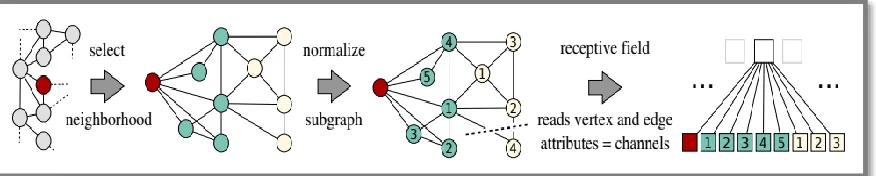
Niepert et al. [18] rely on a heuristic ordering of the nodes, and then apply 1D
CNNs. They linearize the graphs using a method called PATCHY-SAN. Using graph
search algorithms, PATCHY-SAN attempts to obtain fixed size feature vector
18 | P a g e
Figure 2.3.1: The PATCHY-SAN algorithm used to find fixed size vector representations of the
graph. [18]
Simonovsky et al. [12] generate conditioned filter weights for edge labels.
These weights are generated dynamically for every input to the graph. This edge
conditioned convolution operation is given in (2.3.6), where 𝑋𝑙(𝑖) is the current layer
signal to be computed, N(i) is the neighborhood of vertex i, 𝜃𝑗𝑖𝑙 is the edge-weight
matrix, 𝑋𝑙−1(𝑗) is the previous layer signal and 𝑏𝑙 is the learnable bias. The
edge-weights 𝜃𝑗𝑖𝑙 are given as per (2.3.7), where L(j, i) is the given class label. 𝐹𝑙 is
parameterized with learnable network weights 𝑤𝑙. The model parameters 𝑤𝑙 and𝑏𝑙
update during training and dynamically generate 𝜃𝑗𝑖𝑙 for an edge label in input graph.
𝑋
𝑙(𝑖) =
1|𝑁(𝑖)|
∑
𝜃
𝑗𝑖𝑙
𝑋
𝑙−1(𝑗)
𝑗∈𝑁(𝑖)
+ 𝑏
𝑙(2.3.6)
𝜃
𝑗𝑖𝑙= 𝐹
𝑙(𝐿(𝑗, 𝑖); 𝑤
𝑙)
(2.3.7)
The main challenge in the case of irregular data graphs is to define the
correspondence between neighbors and weight matrices. FeaStNet [29] proposes to
establish this correspondence in a data-driven manner, using a function over features
computed in the preceding layer of the network, and learning the parameters of this
function as a part of the network. They propose a similar approach to [12]. Instead of
assigning each neighbor j of a node i to a single weight matrix, we use a
soft-assignment 𝑞𝑚(𝑥𝑖, 𝑥𝑗) of the j-th neighbor across all the 𝑀 weight matrices. The
activation 𝑦𝑖 ∈ ℝ𝐸 of pixel i in the output feature map using the soft assignments is
defined as in (2.3.8), where b ∈ ℝ𝐸 is the vector of bias terms, 𝑞
19 | P a g e assignment of 𝑥𝑖 to the m-th weight matrix, and 𝒩𝑖 is the set of neighbors of i (including
i), and |𝒩𝑖| its cardinal.
𝑦
𝑖= 𝑏 + ∑
1|𝒩𝑖|
∑
𝑗∈ 𝒩𝑖𝑞
𝑚(𝑥
𝑖, 𝑥
𝑗)𝑊
𝑚𝑥
𝑗𝑀
𝑚=1
(2.3.8)
They use Mahalanolbis distance based soft assignment in feature space to determine
local filters dynamically based on previous layers of the network. Their approach is
[image:20.612.108.547.266.432.2]illustrated in Figure 2.3.2.
Figure.2.3.2: Graph CNN proposed by FeaStNet [29], where each node in the input patch is
associated in a soft manner to each of the M weight matrices based on its features using the weight 𝑞𝑚(𝑥𝑖, 𝑥𝑗). [29]
Similar to earlier mentioned spatial methods, Such et. al. [22] use local edge features
for graph convolution, done by convolving on adjacency matrix of the graph. They
introduce vertex graph filters helping to learn on both graph vertex and edges
simultaneously. Pooling in traditional CNNs helps to increase the receptive field of the
filter and thereby helps to learn higher order features. They introduce pooling for
graphs which is further explored by Dominguez et. al [14] to provide deep graph
networks for 3D point cloud classification.
In this thesis work, graph convolution and pooling operations introduced in
Such et. al. [22] and Dominguez et. al. [14] are used as the base operations for building
20 | P a g e
2.4 Meta Learning for Architecture search
CNNs architectures have been able to achieve state-of-the-art performance on a
variety of tasks. There are many popular architectures, each of which can be used on
a broad variety of data. For example, AlexNet, VggNet, ResNet, DenseNet [7, 9, 41,
42] are popular CNN architectures available for users to develop a neural network
based prediction model for the user defined task. Each of these architectures were
manually designed by expert humans. These designers leverage their in-depth
knowledge about CNN training and optimization to define these architectures.
These popular architectures are flexible and generalize well to a variety of data
but often need optimized hyperparameter tuning or custom architecture modifications
for good performance. This process of designing neural network architectures is
arduous and requires focused human attention. Also, hyperparameter tuning is time
consuming and tedious.
Research to automate the design of neural networks has a long but sporadic
history. Miller et al. [10] used genetic-search based methods to evolve MLP based
neural networks to automate the task of network design. Initially, the evolution was
only restricted to only evolving weights of static architectures. They were successful
to solve the XOR problem, a big test at the time and Figure 2.3.1 shows some of the
[image:21.612.114.548.538.670.2]evolved architectures for the same.
21 | P a g e “Evolving Neural Networks through Augmenting Topologies” [13] did
simultaneous adaption of weights and architectures. They defined basic mutations for evolution:
i. Modify a weight.
ii. Add a connection between existing nodes.
iii. Insert node while splitting existing connection.
These evolutionary algorithms are not sufficient for deep neural networks.
Current research directions focus on reinforcement learning and evolutionary
strategies for the solving the neural architecture search problem. Both these directions
have focused on allowing building of CNN architectures resembling those designed
manually by humans.
Reinforcement learning based approaches have been able to achieve more
success on real-world image data related classification tasks. Most reinforcement
learning based approaches use indirect encoding schemes for network
representation. Zoph et al. [31] used reinforcement learning on a deeper fixed-length
architecture, adding one layer at a time. Their mutations included addition/removal of
skip connections as well as tunable hyperparameters. Baker et al. [30] used
Q-learning to discover networks. They made architectures more flexible by allowing the
algorithms to decide the number of layers in the network. This allows the network to
adapt to the dataset at hand and construct shallow or deep solutions as necessary.
Progressing from earlier works, evolutionary approaches later combined with
back-propagation [1, 17, 43] to evolve architectures and tune hyperparameters
simultaneously. These approaches introduce architectural mutations and weight
back-propagation. More recent approaches [43] added weight inheritance for architectures.
Suganuma et al. [1] use a direct encoding type approach using Cartesian Genetic
Programming (CGP) [44] for their evolutionary process as shown in Figure 2.3.2. They
define functional blocks such as ConvBlock, ResBlock etc. as functional blocks or
22 | P a g e
Figure 2.4.2: Evolutionary algorithm proposed by Suganuma et al. [1]
This work is uses evolutionary approaches similar to Real et al. [17] and Graph
CNN defined by Dominguez et. al. [14] as the base model and built an evolutionary
23 | P a g e
Chapter 3
Methodology
3.1 Graph Convolutional Neural Networks
A Graph can be decomposed into two main elements, the graph vertices vij and
graph edges aij. A graph signal can be represented as a tuple described in (3.1.1)
𝑮 = ( 𝑽, 𝑨)
(3.1.1)
where 𝑽 𝜖 ℝ𝑁 × 𝑓 is the vertex signal matrix describing 𝑁 vertices with 𝑓 features
each. 𝑨 𝜖 ℝ𝑁 × 𝑁 represents the adjacency matrix which encodes the edge
information with its elements as defined Chapter 2. Each entry in 𝑨 is defined as per
(3.1.2) previously defined in (2.3.1),
𝑎
𝑖𝑗= {
𝑤
𝑖𝑗, 𝑖𝑓 𝑡ℎ𝑒𝑟𝑒 𝑖𝑠 𝑎𝑛 𝑒𝑑𝑔𝑒 𝑏𝑒𝑡𝑤𝑒𝑒𝑛 𝑖 𝑎𝑛𝑑 𝑗
0, 𝑜𝑡ℎ𝑒𝑟𝑤𝑖𝑠𝑒
(3.1.2)
An Illustration of the graph and its corresponding vertex matrix V and adjacency matrix
24 | P a g e
Figure 3.1.1: An example graph and the corresponding vertex matrix and adjacency matrix.
A.
Graph Convolution
Graph data can succinctly represent information in both vertices and edges. To
process and learn the information, the convolution filtering technique for graphs must
account for filtering both vertex information and edge information. This work uses the
Graph convolution model proposed by Such et al. [22]. This is a spatial approach
related graph convolution method following the local neighborhood graph filtering
strategy. The graph convolution operation is based on the polynomials of the graph
adjacency matrix and is similar to the convolution defined by Sandryhaila et al. [36] as
25 | P a g e
𝐻 = ℎ
0𝐼 + ℎ
1𝐴
1+ ℎ
2𝐴
2+ ℎ
3𝐴
3+ ⋯ + ℎ
𝑘𝐴
𝑘(3.1.3)
The filter is defined as the kth-degree polynomial of the graph’s adjacency
matrix. The exponent of polynomial encodes the number of hops from a given vertex
that are being multiplied by the given filter tap. The scalar coefficients ℎ𝑖 control the
contribution of the neighbors of a vertex during the convolution operation. The filter
matrix thus obtained is 𝐻 ∈ ℝ𝑁 × 𝑁. To convolve the vertices 𝑉 with the filter 𝐻 is a
matrix multiplication shown in (3.1.4), where 𝑉𝑜𝑢𝑡, 𝑉𝑖𝑛 ∈ ℝ𝑁.
𝑉
𝑜𝑢𝑡= 𝐻𝑉
𝑖𝑛(3.1.4)
Such et al. [22] adjust this model in three ways. First, they avoid the
exponentiated A and simplify the polynomial of adjacency in (3.1.3) to be linear as
shown in (3.1.5). This is done because a cascade of filters can effectively approximate
the receptive field of a single large filter as shown by VGGNet [41].
𝐻 ≈ ℎ
0𝐼 + ℎ
1𝐴
(3.1.5)
Second, they construct an adjacency tensor 𝓐. This tensor contains multiple
adjacency matrices 𝓐𝓵 as the slices of adjacency tensor. Each slice encodes a
particular edge feature and thus the linear filter matrix from (3.1.5) is defined as a
convex combination of each adjacency matrix as in (3.1.6) and concisely as in (3.1.7).
𝐻 = ℎ
0𝐼 + ℎ
1𝐴
1+ ℎ
2𝐴
2+ ⋯ + ℎ
𝐿𝐴
𝐿−1(3.1.6)
𝐻 ≈ ∑
𝐿ℓ=0ℎ
ℓ𝐴
ℓ(3.1.7)
Multiple adjacency matrices encode multiple edge features, each encoding a
single feature. Also, partitioning the edges into multiple matrices conveys a sense of
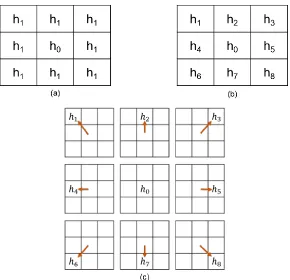
26 | P a g e default Graph CNN linear filter in an image application. A given filter tap is applied to
all vertices of a given distance, isotropically (no sense of ‘direction’). In this case, ℎ0
is applied to the 0-hop vertex and ℎ1 is applied to all adjacent vertices. If another
border of pixels surrounded this figure, each pixel in that border would be multiplied
by a filter tap ℎ2.
The Figure 3.1.2(c) shows that the adjacency matrix can be partitioned into
nine adjacency matrices to form an adjacency tensor. Each partitioned adjacency
matrix represents a different relative connection (edge feature) to a given vertex. Now
a unique filter is applied to every adjacency matrix and aggregated to perform
convolution. This induces a sense of direction into the Graph CNN filter making it
anisotropic. This is equivalent to a 3 x 3 FIR filter in conventional CNN applications
[image:27.612.180.470.349.629.2](Figure 3.1.2(b)).
Figure 3.1.2: (a) Learnable parameters in 1-hop graph filters. (b) Classical 3×3 convolution filters.
27 | P a g e All these filters are described for a single vertex feature. To extend to multiple
vertex features, each ℎℓ needs to be in ℝ𝐶 making H of dimension ℝ𝑁×𝑁×𝐶. Thus,
every vertex feature has a N * N filter matrix H. So (3.1.7) can be modified as in (3.1.8)
where 𝐻(𝑐) is an N * N slice of H and 𝒉(𝒄) ` is a scalar corresponding to a given input
feature and a given slice of 𝐴ℓ.
𝐻
(𝑐)≈ ∑
𝐿ℓ=0ℎ
ℓ(𝑐)𝐴
ℓ(3.1.8)
The vertex signal is filtered using the 𝐻(𝑐) as described in (3.1.9) where
𝑉𝑖𝑛(𝑐) is the column of 𝑉𝑖𝑛 that only contains vertex feature c. We also add a bias b ∈ ℝ.
This results in 𝑉𝑖𝑛 ∈ ℝ𝑁.
𝑉
𝑜𝑢𝑡= ∑
𝐶𝑐=1𝐻
(𝑐)𝑉
𝑖𝑛(𝑐)+ 𝑏
(3.1.9)
This is how graph convolution is defined on a graph with multiple vertex features and
edge features by Such et al. [22]. This approach is used for this thesis work.
B.
Graph Pooling
The pooling operation can be dissected in two parts: the coarsening of structure and
the reduction of signal on that structure. In grid structures such as images, the
coarsening of structure is implicitly understood. But for graphs, such as protein
structures, every sample can have a unique structure. Dominguez et al. [14] defined
various pooling frameworks for graphs. These will be described here in succession.
The first method they proposed is Lloyd Algebraic graph pooling on graphs that can
28 | P a g e a. Lloyd Algebraic graph pooling:
In this, a coarsening operator P is defined to reduce the Graph G = (V,A) with
N1 vertices to Greduced = (Vreduced,Areduced) with N2 vertices. P is a N1 × N2 matrix
with its elements defined as in (3.1.10).
𝑷
𝒊𝒋= {
𝐶, 𝑖𝑓 𝑖
𝑡ℎ𝑣𝑒𝑟𝑡𝑒𝑥 𝑜𝑓 𝑮 𝑖𝑠 𝑢𝑠𝑒𝑑 𝑡𝑜
𝑑𝑒𝑓𝑖𝑛𝑒 𝑡ℎ𝑒 𝑗
𝑡ℎ𝑜𝑓 𝑮
𝒓𝒆𝒅𝒖𝒄𝒆𝒅.
0, 𝑜𝑡ℎ𝑒𝑟𝑤𝑖𝑠𝑒
(3.1.10)
C is determined by mapping the graph clustering method used in mapping
“fine” vertices to the “coarsen” vertices. Distances are calculated by finding the
shortest path on a graph using the Bellman Ford algorithm. Using the
coarsening operator P, Areducedis defined using (3.1.11) and Vreduced is defined
using (3.1.12) through (3.1.14). Sum, average, and max pooling are defined
using (3.1.12), (3.1.13), and (3.1.14) respectively.
𝐴
𝑟𝑒𝑑𝑢𝑐𝑒𝑑= 𝑃
𝑇𝐴𝑃
(3.1.11)
𝑉
𝑠𝑢𝑚𝑟𝑒𝑑𝑢𝑐𝑒𝑑= 𝑃
𝑇(𝑉)
(3.1.12)
𝑉
𝑎𝑣𝑔𝑟𝑒𝑑𝑢𝑐𝑒𝑑= 𝑃ˆ
𝑇(𝑉)
(3.1.13)
𝑉
𝑚𝑎𝑥𝑟𝑒𝑑𝑢𝑐𝑒𝑑= 𝜙
𝑃(𝑉)
(3.1.14)
Element 𝑨𝒊,𝒋𝒓𝒆𝒅𝒖𝒄𝒆𝒅 can be thought of as the aggregation of all the weights of
edges while coarsening the graph G to Greduced. 𝑷ˆ𝑻 is the column-sum normalized
version of P. Also, 𝜙𝑃 is a non-linear max pooling function. Here in this work we
used only max pooling. Thus, the graph structure is reduced by (3.1.11) and the
29 | P a g e b. Graph Embed Pooling:
Such et al. [5, 22] introduced graph embed pooling for graphs. It is a dense
pooling method but fits the structure of Algebraic pooling. Graph embed pooling
learns a fully connected layer whose output is treated as an embedding matrix that
produces a fixed size output. To produce a pooled graph reduced to a fixed N’
vertices, the learned filter taps from this pooling layer produce an embedding
matrix 𝑉𝑒𝑚𝑏 ∈ ℝ𝑁×𝑁′. Like in (3.1.9), a filter tensor 𝐻𝑒𝑚𝑏 ∈ ℝ𝑁×𝑁×𝐶×𝑁′ is learned
and multiplied by the vertices to produce a filtered output as shown in (3.1.15).
𝑉
𝑒𝑚𝑏(𝑛′)= ∑
𝐶𝑐=1𝐻
𝑒𝑚𝑏(𝑐,𝑛′)𝑉
𝑖𝑛(𝑐)+ 𝑏
(3.1.15)
𝑉𝑒𝑚𝑏(𝑛′) is column wise stacked up to form the matrix 𝑉𝑒𝑚𝑏. Softmax function is used
for normalization of values of 𝑉𝑒𝑚𝑏 as in (3.1.16). Equations (3.1.17) and (3.1.18)
show how 𝑉𝑒𝑚𝑏 pools the graph data.
𝑉
𝑒𝑚𝑏∗= 𝜎(𝑉
𝑒𝑚𝑏)
(3.1.16)
𝑉
𝑜𝑢𝑡= 𝑉
𝑒𝑚𝑏∗𝑇𝑉
𝑖𝑛(3.1.17)
𝐴
𝑜𝑢𝑡= 𝑉
𝑒𝑚𝑏∗𝑇𝐴
𝑖𝑛𝑉
𝑒𝑚𝑏∗(3.1.18)
The above equations represent the graph embed pooling defined by Such et al.
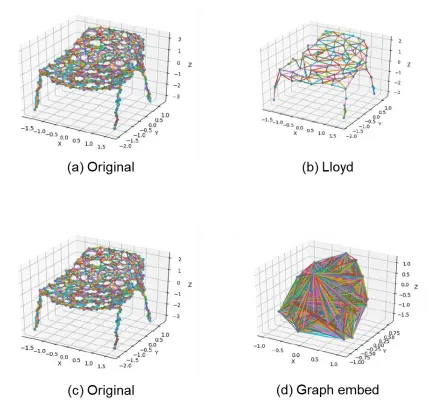
[22] and Dominguez et al. [14]. Figure 3.1.3 illustrates both the graph pooling
30 | P a g e
Figure 3.1.3: (a) and (c) show the original 3D mesh graph of chair. (b) shows the 3Dmesh graph
after Lloyd pooling. (d) shows the 3D mesh graph after Graph embed pooling. It can be inferred that graph embed pooling is a dense pooling method. [14]
3.2 Architecture Search using Evolutionary Algorithm
This work uses evolutionary algorithms for searching architectures in graph
convolution neural networks. A set of mutations are defined which the architectures
can choose to improve their fitness scores and maximize the fitness function. Added
features of the evolutionary algorithm help in speeding up the architecture search
while achieving good fitness scores. This section explains in detail the evolutionary
31 | P a g e
A.
Mutations for Evolutionary Algorithm
For architecture search using evolutionary methods, it is important to define mutations
that can find improved architectures or hyperparameters that would raise the fitness
score of the architecture. There are 3 types of mutations:
a. Architectural change mutations:
These mutations change the architecture of the network by adding or removing
layers from the previous architecture. These mutations are as follows:
i. Adding / Removing a graph convolution layer:
In this mutation a graph convolution layer is added to or removed from a
randomly chosen position in the current network architecture. While adding, the
number of output filters of the new convolution layer are randomly chosen from
[128, 256, 512]. An example mutation is shown in Figure 3.2.1.
Figure 3.2.1: Graph convolution layer mutation.
ii. Adding / Removing a fully-connected layer:
In this mutation a fully-connected layer is added to or removed from a randomly
chosen position in the current network architecture. While adding, the number of
units of the new fully-connected layer is a randomly chosen value x, where x ∈
[image:32.612.158.531.602.642.2](output_classes,500]. This mutation is shown in Figure 3.2.2.
32 | P a g e
iii. Adding / Removing a one-by-one graph convolution layer:
One-by-one convolution were proposed by Lin et al. [48]. These are used to
alter the size of the channel dimension c of the convolution filters. They also
require less parameters to change the channel size when compared to the 33 filter. One-by-one graph convolution is same as the one-by-one normal
convolution. In this mutation a one-by-one graph convolution layer is added to
or removed from a randomly chosen position in the current network
architecture. One-by-one convolution helps in reducing dimensionality in filter
dimension. While adding, the number of output filters of the new one-by-one
layer are randomly chosen from [128, 256, 512]. This mutation is shown in
Figure 3.2.3.
Figure 3.2.3: One-by-one graph convolution layer mutation.
iv. Adding / Removing a graph attention layer:
In this mutation, a graph attention layer is added to or removed from a randomly
chosen position in the current network architecture. This attention layer is a soft
attention. It learns attention over the vertices by weighing the vertex features. The
attention is given by (3.2.1) and applied on the vertices as given in (3.2.2), where
𝑉is the vertex graph signal, 𝑤 is the vertex feature, 𝛼 is the attention vector and
𝑉 ∈ ℝ𝐵×𝑁×𝐹, 𝑤 ∈ ℝ𝐹, 𝛼 ∈ ℝ𝑁
𝛼 = softmax(𝑉𝑤)
(3.2.1)
𝑉
𝑜𝑢𝑡(𝑛)= 𝛼
𝑛𝑉
(𝑛)(3.2.2)
While adding, the number of output filters of the new attention layer are
33 | P a g e
Figure 3.2.4: Graph attention layer mutation.
v. Adding / Removing a skip connection:
In this mutation, a skip connection path is added or removed between randomly
chosen graph convolution layers in the current network architecture. This mutation
is shown in Figure 3.2.5.
Figure 3.2.5: Skip connection mutation.
b. Graph structure change mutation:
These mutations are responsible for changing the graph structure to increase the
receptive field of the filters applied on them. These help in understanding high
level features in the graphs. These mutations are as follows:
i. Pooling mutation:
In this mutation, the graph structure is changed using max pooling defined in
(3.1.11) and (3.1.12). The pooling ratio is a randomly chosen value x where x ∈
(0,1]. The pooling layer is added at a randomly chosen position in the current
[image:34.612.147.544.611.649.2]network. This mutation is shown in Figure 3.2.6.
34 | P a g e
ii. Graph embed pooling mutation:
In this mutation, the graph structure is changed using graph embed pooling
defined in (3.1.15) and (3.1.16). The pooled number of vertices is randomly chosen
from [16,32,64]. The pooling layer is added at a randomly chosen position in the
current network. This mutation is shown in Figure 3.2.7.
Figure 3.2.7: Graph embed pooling mutation.
iii. Reduced max layer:
Reduce max operation for a matrix/tensor reduces the matrix/tensor to a single
dimension vector, where each element of the vector is maximum value along
other dimensions of the matrix/tensor. The reduce max mutation changes the
graph structure to a linear feature vector. The reduce max layer is added at the
position before the first fully-connected layer in the current network. There can
[image:35.612.116.548.77.627.2]be at max. one reduced-max layer in the network. This mutation is shown in
Figure 3.2.8.
Figure 3.2.8: Reduced max pooling mutation.
c. Hyperparameter mutations:
These mutations change some of the different hyperparameters needed to tune
the architecture. These mutations are as follows:
i. Learning rate mutations:
These mutations change the learning rate parameter in different ways. There
are three types of learning rate mutations. When the learning rate mutation is
chosen, a random number of these mutations are chosen and applied to the
35 | P a g e
• Changing starter learning rate:
Starter learning rate is the parameter which decides the learning rate of the
model at the beginning of a model training cycle. In this mutation, the starter
learning rate is changed from an old value to a value randomly chosen from
[0.5×old value, 2×old value]
• Changing learning rate step:
Learning rate step is the parameter which decides the iteration steps of the
model training cycle at which learning rate value is decreased. A model
starts its training cycles with the starter learning rate and after every
learning rate step cycles, the learning rate value is decreased. In this
mutation, the learning rate step is changed from the old value old value to
a value randomly chosen from [0.5×old value, 2×old value]
• Changing learning rate exponential:
Learning rate exponential decides the factor by which the learning rate
value is decreased at the learning rate step in a model training cycle. In this
mutation, the learning rate exponential is changed from the old value to a
value randomly chosen from [0.5×old value, 2×old value]
ii. Regularization mutations:
These mutations change the learning rate parameter in different ways. There
are two types of regularization mutations. When the regularization mutation is
chosen, a random number of these mutations are chosen and applied to the
current architecture. They are:
• L1 regularization: In this mutation, the L1 regularization is changed from the old value old value to a value randomly chosen from [0.5×old value, 2×old
value]
• L2 regularization: In this mutation, the L2 regularization is changed from the old value old value to a value randomly chosen from [0.5×old value, 2×old
36 | P a g e
B.
Fitness Score
For evaluating the success of a mutation, it is important to define a good metric as the
fitness score. In the case of architecture search of graph CNNs for classification tasks,
the accuracy of the network is a good measure to evaluate the performance of the
architecture. But this accuracy score must be on unforeseen data. Hence, in this case,
this work uses validation accuracy score as fitness score metric for architecture
search.
C.
Evolutionary Algorithm for Architecture Search
Architecture design is a laborious and resource intensive process. Evolutionary
algorithms used for its automatic discovery must increase its efficiency of resource
usage and improve the time taken for reaching optimal performance compared to
manual architecture design. For this task, this research defines a baseline evolutionary
algorithm model and then introduces an improved evolutionary algorithm model which
reduces the training time and converges to better solutions faster.
a. Test-and-Mutate Algorithm (Baseline):
In this algorithm, all the N models in the pool are trained for the first cycle and for every
next cycle two random models are chosen and compared based on their validation
accuracy scores. The best model from the chosen two are mutated. Mutation is
selected randomly from all the available mutations. Mutated model is trained, and its
validation accuracy is compared with the two chosen models. If it is better than either
of the two chosen models, the worst model is replaced with the mutated model in the
37 | P a g e
Figure 3.2.9: The flow diagram of Test-and-Mutate algorithm.
b. Test-and-Mutate-with-Probability Algorithm:
This algorithm is an improvement over the baseline Test-and-Mutate baseline
algorithm described above. The model training and selection process remains same
as in the baseline algorithm. The mutation process is improved. In the First cycle, all
mutations are assigned equal selection probabilities. Based on the helpfulness of the
mutation a constant reward is added or subtracted from the mutation’s selection
probability. The changed mutation selection probabilities are applied to the mutation
selection process after every p cycles. The flow of this algorithm is shown in the Figure
38 | P a g e
Figure 3.2.10: The flow diagram of Test-and-Mutate-with-Probability algorithm.
D.
Features of Evolutionary Algorithm
The improved evolutionary algorithm Test-and-Mutate-with-Probability has some
salient features that helps the algorithm converge to better graph CNNs architectures.
These salient features are as follows:
a. Mutation probability:
In this algorithm, every mutation is assigned a selection probability. All the
mutations are assigned equal selection probabilities at the training cycle. This
selection probability changes every cycle a model is replaced with a better model
architecture.
b. Mutation probability reward:
Every mutation selection probability is changed by a factor of the mutation
probability reward. The Mutation probability reward is set value between (0,1). If
39 | P a g e is multiplied by a factor of (1.0 + reward). If the mutation is unsuccessful in replacing an architecture, the mutation probability is multiplied by a factor of (1.0 –
reward).
c. Mutation probability cycle:
The mutation selection probability value is changed and stored after every cycle
based on the replacement of the model architecture. The mutation probability cycle
decides the update cycle, when the most current mutation selection probabilities
are used for the process of model selection. The mutation probability cycle is a set
number to update probabilities in recurring manner. This gives an account for
history of mutations which have helped in replacing model architecture.
d. Weights loading:
Loading weights of a model from a similar model trained previously often aids in
model convergence. It is particularly important in this evolutionary algorithm. In this
algorithm, the difference between the previous model and mutated model
architecture is no more than one layer different. Thus, loading the weights of all
the unchanged layers would help the model in learning faster. The weights are
loaded according to the type of mutation:
i. Architectural change mutations:
These mutations add or remove a layer in the architecture keeping the
graph structure unchanged. In these types of mutations, all the layer weights
except the added or mutated layer are loaded from the previous model
architecture. In the case of layer removal, all the layer weights except the layer
before and after removed layer are loaded.
ii. Graph structure change mutations:
These mutations are pooling type mutations. In these types of
mutations, all the layer weights before the added pooling layer are loaded from
the previous model architecture.
40 | P a g e These mutations just change the hyperparameters without changing
either the architecture or the graph structure. Hence all the weights from the
previous model architecture are loaded.
Chapter 4
Implementation
4.1 Datasets
The Weisfeiler-Lehman Graph Kernel proteins datasets [25] are standard datasets for
graph classification. These are small protein classification datasets that are useful
testbeds for analysis and comparison of graph-based machine learning algorithms.
A.
Enzymes:
ENZYMES is a data set of protein tertiary structures obtained from Borgwardt et
al. [21] consisting of 600 enzymes from the BRENDA enzyme database [15]. In this
case the task is to correctly assign each enzyme to one of the six op-level classes.
B.
MUTAG:
MUTAG [24] is a data set of 188 mutagenic aromatic and heteroaromatic nitro
compounds labeled according to whether they have a mutagenic effect on the
41 | P a g e Properties of these protein graph datasets are summarized in Table 1 below.
Table 4.1: Summary of protein datasets to be used in this thesis.
ENZYMES MUTAG
# Graphs 600 188
Mean |V| 32.63 17.93
Mean |E| 62.14 19.79
# Classes 6 2
# Vertex labels 3 7
# Edge labels - 11
4.2 Implementation
Implementing an evolutionary search algorithm requires plentiful CPU and GPU
resource time. Even for small classification tasks, training graph CNNs is a
GPU-intensive and time GPU-intensive task. Also, given the small size of these protein datasets,
the reporting method followed is a standard 10-fold cross validation based aggregated
accuracy score. The implementation details of the evolutionary algorithm are
explained in this section.
A.
Basic Implementation:
The basic implementation of evolutionary algorithm is simple. The experiment is
started with set number of model architectures N and set number of total cycles C. N
is kept constant for both MUTAG and Enzymes dataset to 10 models. C is 40 for
MUTAG and is 250 for Enzymes. Other hyperparameters are also initialized to set
values. For the first cycle, N new models of weak classifiers (weak architectures) are
created similar to Real et al. [17]. In this case the weak classifiers are made up of two
layers: random fully-connected layer and output classes based fully-connected layer.
42 | P a g e Model training is done using 10-fold cross-validation. The data is divided into a
train: validation split of 90:10. Each model is trained for a set number of iterations and
validation accuracy score is calculated after the iterations are finished. This is the
validation accuracy for that fold. This is repeated for 10 independent folds and the
mean validation accuracy is calculated. This mean validation accuracy is the assigned
fitness score for the model.
B.
Parallel Implementation:
The basic implementation is time consuming and GPU-intensive. To implement the
evolutionary search algorithm in GPU-constrained environment, it was necessary to
perform parallelization of the algorithm. All the experiments were performed using only
2 Nvidia Tesla P100 GPUs with 12 GB capacity each. Initial architectures are very
simple and do not require full capacity of the GPU. Also, given the small size of the
datasets, complex architectures would also make optimal use of the GPU space while
running a single fold at a time.
To avoid wastage of GPU space and to speed up the training process, this
work implements a parallel version of 10-fold cross validation with specified number
of folds running parallelly. This is possible as each fold is independent from any other
fold and fold data indices can be precomputed easily. The python ‘multiprocessing’
library [45] helps in parallelization of the code. With this parallel implementation, the
training time speed up achieved is directly proportional to the number of parallel folds
running simultaneously.
C.
Saving and Loading Best model:
With increase in complexity of the architectures, the models start fitting the data and
that is reflected in lower loss values. All these models are trained for certain preset
value of iterations and validated on validation set. With complex models, it is observed
the loss value attains a low point at some iteration of the fold and then explodes to a
very high value. This is called loss explosion. This happens because the learning rate
43 | P a g e But in our case of 10-fold cross validation, loss explosion iteration is different
for every fold. For some folds, it may not occur at all. In others, it may occur twice.
This problem is illustrated in Figure 4.2.1 which is a tensorboard snippet of 10 folds of
[image:44.612.113.552.195.478.2]a single model architecture.
Figure 4.2.1: Loss explosion within training of a fold of an architecture.
In such a case, calculating validation score after a preset number of iterations
seem counterintuitive as the models, even after fitting the data, may have their training
loss explode and result into a poor validation accuracy score for that particular fold.
Hence, instead of calculating the score based on the model of a preset iteration, this
work incorporates a method of saving the best model based on its training loss value.
After the completion of the preset iterations, this best model is loaded, and validation accuracy score is calculated for that particular fold’s model. This method may not
always give the best validation score as the model is saved on basis of lower training
44 | P a g e performance on validation set. But this method reduces hyperparameters by removing
45 | P a g e
Chapter 5
Results and Analysis
5.1 Results
A.
Comparisons with Other methods:
In this work, experiments were done on the protein graph structure datasets of
Enzymes and Mutag. The scores obtained after evolution were able to beat the
state-of-the-art accuracy score on Mutag dataset and got comparable to state of the art
accuracy score on Enzymes dataset. Table 5.1.1 shows the accuracy scores of
different methods on these two datasets. It must be noted that this work is based on
Dominguez et. al. [14] and Such et. al. [5, 22]. And this work beats the accuracy scores
46 | P a g e
Table 5.1.1: 10-fold cross validation accuracy score comparisons between different methods.
MUTAG ENZYMES
PATCHY-SAN [18] 92.63% -
Deep WL [4] 87.44% 53.43%
Donini et al. [20] 93.00% -
structure2vec [23] 88.28% 61.10%
WL [25] 83.78% 59.05%
WL-OA [20] 84.5% 59.90%
Morris et al. [16] 87.2% 61.80%
ECC [12] 89.44% 53.50%
Manual method 98.42% 53.00%
Test-and-Mutate (baseline) 100.00%1 48.33%
Test-and-Mutate-with-Probability 100.00%1 55.50%
Figure 5.1.1 shows the evolution of models over cycles for both, Enzymes and
Mutag dataset. The experiments shown in Figure 5.1.1 achieve best results using
evolutionary approach for the respective datasets.
47 | P a g e (a)
[image:48.612.149.497.70.704.2](b)
48 | P a g e
B.
Comparisons with Manual method:
The experiments based on evolutionary algorithm clearly top the results to that of the
manual experiments. Also, these experiments have significantly less running time than
that taken by manual designers to design specific architectures and tune
hyperparameters to achieve optimal performance. Both these results are summarized
[image:49.612.107.542.287.375.2]in Table 5.1.2.
Table 5.1.2: Comparison of running times and best accuracy scores between manual and evolutionary approaches.
Method MUTAG Enzymes
Accuracy Time Accuracy Time
Manual 98.42% 5 days 53.00% 18 days
Evolutionary 100.00% 20 mins 55.50% 9 days
C.
Model Architectures:
Evolutionary algorithms, unlike manual design methods, provide a pool of model
architectures which have undergone various mutations and hyperparameter tunings
to achieve close to optimal performance. This section provides certain model
architectures found in the pool of models, after the experiment was finished for a
dataset.
a. Mutag dataset:
For this dataset, the most surprising result was that none of the top models
contained any type graph convolution layers. Most models had fully-connected
layers and reduce-max pooling layers. Model architectures yielding top accuracy
score are shown in Figure 5.1.2. The contrast between manual and evolutionary
49 | P a g e
Figure 5.1.2: (a) Best architecture designed manually. (b) Best architecture generated by
evolution.
b. Enzymes dataset:
For this dataset, the pool of models had less diversity. Top model architectures
were tuned for hyperparameters to get comparable accuracy score. This being a
more complex dataset with more output classes and more input samples, most
architecture elements are found in these architectures. Graph embed pooling, the
dense pooling method, is helpful for this dataset and is thus present in one of the
top architectures. Model architectures yielding top accuracy score are shown in
50 | P a g e
Figure 5.1.3: (a)Best architecture designed manually. (b) Top architectures generated by
evolution.
5.2 Analysis
A.
Mutation Probability Analysis:
Mutation probability was an important parameter boosting the performance of the
evolutionary algorithm. It helped the algorithm converge faster to better model
architectures with higher validation scores. The variance between validation scores in
the pool of models reduces with probability. Also, the variance between different
experiments decreases after introduction of mutation probability.
This can be observed in the Figure 5.2.1. It can be seen that high variance
between scores is present between the experiments with no mutation probabilities (top
row in Figure 5.2.1). Also, experiments with mutation probabilities (bottom row in
Figure 5.2.1) achieve higher max and mean scores over time, but they are also running
51 | P a g e convergence rate. If we observe the max. and mean accuracy value at 100 cycles, it
can be easily seen that experiments with mutation probabilities converge to higher
[image:52.612.79.537.172.524.2]mean and max. accuracy values.
Figure 5.2.1: Top row (Fig. (a), (b)) are experiments with no probability associated with mutations
(baseline algorithm). Bottom row (Fig. (c), (d)) are experiments with probabilities associated with mutations.
B.
Weight Loading Analysis:
Mutation probability was an important parameter for the evolutionary algorithm. To
further reduce the converging time, weights of selected layers were loaded from the
previous architecture, based on the mutation. This helps the current architecture by
52 | P a g e The radical time reduction in achieving top score is easily spotted on comparing
the two results. Also, weight loading reduces the variance in accuracy scores among
the pool of models. Thus, weight loading along with mutation probability, is able to
generate quickly a pool of high performing model architectures with very close
accuracy scores.
53 | P a g e (b)
Figure 5.2.2: This figure emphasizes the importance of weight loading. Fig. (a) is based
on experiment which involved no weight loading, Fig (b) is based on experiment with weight loading.
C.
Mutation analysis:
Different mutations play an important role in converging to pool of better model
architectures. The importance of a mutation changes over time. Adding a fully
connected layer may be helpful at the start, but over time adding a fully-connected
layer may prove counter-productive to the manual designer. The same can be said
with other feature extraction mutations. Figure 5.2.3 shows the change in mutation
probability over cycles for every mutation in the Enzymes experiment with top results. It can be observed that ‘add’ mutations are prominent at the start and ‘remove’
mutations are prominent at the end.
Pooling gains importance only when the model is complex and has been
saturated after learning low level features. Pooling helps in reducing the graph
structure and increases the receptive field helping the model learn higher order
54 | P a g e training cycles. This shows that this evolutionary process is attaining to a better model
in a way similar to that of a manual designer.
(a)
55 | P a g e (c)
Figure 5.2.3: Evolution of different mutations’ probability over cycles. (a) shows the ‘add’ mutations and their probability change over cycles. (b) shows the ‘remove’ mutations and their probability change over cycles. (c) shows the pooling and parameter mutations and their change over cycles. All these figures
show the importance of a mutation within the
![Figure 2.2.1: A 2D convolution operation [33].](https://thumb-us.123doks.com/thumbv2/123dok_us/64461.6098/16.612.144.503.94.268/figure-a-d-convolution-operation.webp)
![Figure.2.3.2: Graph CNN proposed by FeaStNet [29], where each node in the input patch is associated in a soft manner to each of the M weight matrices based on its features using the weight](https://thumb-us.123doks.com/thumbv2/123dok_us/64461.6098/20.612.108.547.266.432/proposed-feastnet-associated-matrices-features.webp)
![Figure 2.4.1: The XOR problem and solutions based on genetic search methods. [10]](https://thumb-us.123doks.com/thumbv2/123dok_us/64461.6098/21.612.114.548.538.670/figure-xor-problem-solutions-based-genetic-search-methods.webp)
![Figure 2.4.2: Evolutionary algorithm proposed by Suganuma et al. [1]](https://thumb-us.123doks.com/thumbv2/123dok_us/64461.6098/23.612.123.524.72.299/figure-evolutionary-algorithm-proposed-suganuma-et-al.webp)