I
THE DEVELOPMENT OF AN AUTOMATIC ACCIDENT ALERT RESPOND SYSTEM THROUGH IOT (AARS SYSTEM)
CHAN SHEAT LEE
This Report Is Submitted In Partial Fulfillment Of Requirements For The Bachelor Degree of Electronic Engineering (Industrial Electronics)
Fakulti Kejuruteraan Elektronik dan Kejuruteraan Komputer University Teknikal Malaysia Melaka
II
UNIVERSTI TEKNIKAL MALAYSIA MELAKA FAKULTI KEJURUTERAAN ELEKTRONIK DAN KEJURUTERAAN KOMPUTER
BORANG PENGESAHAN STATUS LAPORAN
PROJEK SARJANA MUDA II
Tajuk Projek THE DEVELOPMENT OF AN AUTOMATIC ACCIDENT ALERT : RESPOND SYSTEM THROUGH IOT (AARS SYSTEM)
Sesi Pengajian
: 1 6 / 1 7
Saya CHAN SHEAT LEE
mengaku membenarkan Laporan Projek Sarjana Muda ini disimpan di Perpustakaan dengan syarat-syarat kegunaan seperti berikut:
1. Laporan adalah hakmilik Universiti Teknikal Malaysia Melaka.
2. Perpustakaan dibenarkan membuat salinan untuk tujuan pengajian sahaja.
3. Perpustakaan dibenarkan membuat salinan laporan ini sebagai bahan pertukaran antara institusi pengajian tinggi.
4. Sila tandakan ( √ ) :
SULIT* *(Mengandungi maklumat yang berdarjah keselamatan atau kepentingan Malaysia seperti yang termaktub di dalam AKTA
RAHSIA RASMI 1972)
TERHAD** **(Mengandungi maklumat terhad yang telah ditentukan oleh organisasi/badan di mana penyelidikan dijalankan)
TIDAK TERHAD
Disahkan oleh:
__________________ _________________________
(TANDATANGAN PENULIS) (COP DAN TANDATANGAN PENYELIA)
Tarikh:
III
DEDICATION
“I hereby declare that the work in this project is my own except for summaries and quotations which have been duly acknowledge.”
Signature : ... Author : CHAN SHEAT LEE
IV
“I acknowledge that I have read this report and in my opinion this report is sufficient in term of scope and quality for the award of Bachelor of Electronic Engineering (Industrial Electronics) with Honours.”
Signature : ...
V
A very special dedication for my beloved family especially to my parent, Leow Ah Mooi.
VI
ACKNOWLEDGEMENT
First of all, I would like to express my gratitude towards my supervisor of FYP project, Dr. Norihan Binti Abdul Hamid. During the research on components, she has gave me a guidance on what components is better to use in the design. Besides, when I was confusing on how to start the part of literature review, she will teach me. Furthermore, she is also will help me to check the thesis and give me some comment.
Secondly, I would like to appreciate Dr. Sani Irwan Bin for his guidance and assistance for completing the FYP project. When I had some circuit problem, Dr.Sani will help me and give me some idea or suggestion for solving the circuit problem.
Thirdly, I would like to thank my course mate because they have gave me some help on my coding part and hardware part of the design.
VII
ABSTRACT
VIII
ABSTRAK
IX
TABLE OF CONTENT
CHAPTER TITLE PAGES
PROJECT TITLE...I DECLARATION...II DEDICATION...III ACKNOWLEDGEMENT...VI ABSTRACT...VII ABSTRAK...VIII TABLE OF CONTENT...IX LIST OF FIGURES...XIII LIST OF TABLES... XV LIST OF ABBREVIATIONS...XVI
CHAPTER 1 INTRODUCTION...1
1.1 Overview...1
1.2 Research Motivation...1
1.3 Objectives...4
1.4 Problem Statement...4
1.5 Scope of work...4
X
1.7 Summary...6
CHAPTER 2 LITERATURE REVIEW...7
2.1 Overview...7
2.2 Background...7
2.3 Automatic accident alert respond system…...7
2.3.1 Operating of automatic accident alert respond system through IoT...8
2.3.2 Previous or related project...9
2.4 Introduction to Arduino and PIC microcontroller...11
2.4.1 Comparison between PIC18f4550 microcontroller, Arduino Uno and Arduino Mega 2560...12
2.5 GSM SIM900 module...15
2.5.1 Comparison between GSM SIM900 and GSM SIM300...16
2.5.2 Previous project that used GSM module to operate...18
2.6 GPS module...19
2.7 ESP8266 Wi-Fi module...20
2.8 Sensor...21
XI
CHAPTER 3 Methodology...24
3.1 Introduction...24
3.2 Project Implementation...24
3.3 Simulation of circuit design...26
3.4 PCB Fabrication...27
3.5 Method implementation Flow Chart of project for Seminar 1 and Seminar 2...28
3.6 Summary...31
CHAPTER 4 RESULT AND DISCUSSION...32
4.1 Overview...32
4.2 Interfacing between Arduino Mega 2560 and GSM SIM900 module...33
4.3 Interfacing between Arduino Mega 2560 and GPS module...36
4.4 Interfacing between Arduino Mega 2560 and ESP8266 Wi-Fi modul...36
4.5 Interfacing between Arduino Mega 2560 and vibration sensor……….………...40
XII
4.7 Summary………...43
CHAPTER 5 DISCUSSION AND CONCLUSION………...…...44
5.1 Conclusion………...44
5.2 Recommendation……….…....45
REFERENCES……….…...46
APPENDICES………..…...48
APPENDIX A………...49
APPENDIX B………..………....50
APPENDIX C………..51
APPENDIX D………...52
APPENDIX E………...53
APPENDIX F………..54
XIII
LIST OF FIGURES
Figure 1.1: The number of road traffic deaths in Malaysia in 2013 [2]. ... 2
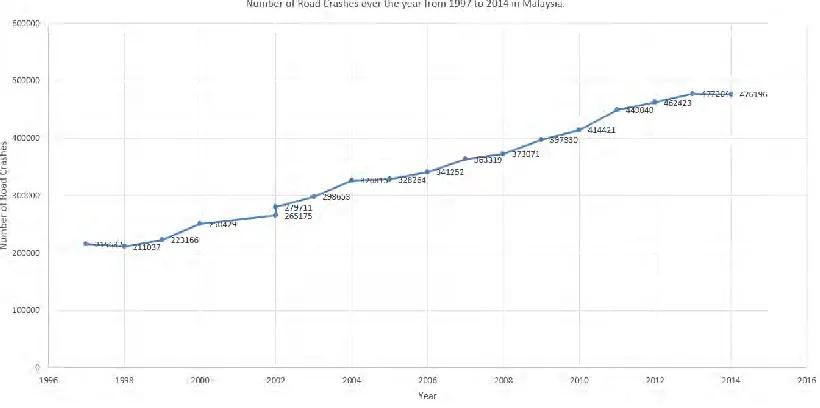
Figure 1.2: Number of road crashed from 1997 to 2014 in Malaysia. ... 3
Figure 1.3: The number of road deaths from 1997 to 2014 in Malaysia. ... 3
Figure 2.1: The concept of the working principle of accident alert respond system. ... 8
Figure 2.2: The GSM SIM900 which is used for the design of accident alert response system. ... 15
Figure 2.3 The block diagram shows the process of GSM modem interact with GSM module [6]. ... 16
Figure 2.4: The GPS module is used for the design of accident alert response system. .. 19
Figure 2.5: The ESP8266 Wi-Fi module is used for the design of accident alert response system. ... 20
Figure 3.1: The block diagram of whole project system. ... 24
Figure 3.2: The simulation circuit done in Proteus 8 which is only used to show the working principle of the whole design system. ... 26
Figure 3.3: The connection of an overall components in PCB layout. ... 27
Figure 3.4: The flow chart of the methodology for seminar 1. ... 29
Figure 3.5: The flow chart for the methodology for seminar 2. ... 31
Figure 4.1: The connection between Arduino Mega 2560 and GSM SIM900 module on a breadboard. ... 34
XIV
Figure 4.3: The SMS is send to the specified number successfully. ... 36
Figure 4.4: The connection between GPS module and Arduino Mega 2560 on breadboard. ... 37
Figure 4.5: The outcome shown in message when the GPS module is unable to track location. ... 39
Figure 4.6: The complete circuit connection... 41
Figure 4.7: The ESP8266 Wi-Fi module is ready to connect Internet. ... 42
Figure 4.8: The accident position is uploaded to the server. ... 43
XV
LIST OF TABLES
XVI
LIST OF ABBREVIATIONS
CPU - Central Processing Unit
GSM - Global System for Mobile Communication GPS - Global Positioning System
Miros - Malaysia Institute of Road Safety Research IoT - Internet of Things
PIC - Peripheral Interface Controller USB - Universal Serial Bus
SRAM - Static Random Access Memory
EEPROM - Electrically Erasable Programmable Read-Only Memory PWM - Pulse-Width Modulation
I/O - Input / Output
GPRS - General Packet Radio Service
AT - ATtention
SMS - Short Message Service
ARM7 - Advanced RISC Machines
RISC - Reduced Instruction Set Computer DoD - Department of Defence
XVII
UART - Universal Asynchronous Receiver/ Transmitter
CPU-AHB - Central Processing Unit–Advanced High-performance Bus ESP 8266 - Espressif System
RF - Radio Frequency
MEMS - Micro-Electro-Mechanical Systems G-Force - Force exerted by gravity
MMS - Multimedia Messaging Service ITS - Intelligent Transportation System PCB - Printed Circuit Board
Rx - Receiver
Tx - Transmitter
Vcc - IC power supply pin
Gnd - IC Ground pin
Sats - Satellites
CH-PD - Power - down mode
ISIS - Intelligent Schematic Input System ARES - Advanced Routing and Editing Software TCP - Transmission Controller Protocol
AARS - Accident Alert Respond System
1
CHAPTER 1
INTRODCUTION
1 HEADING 3 – CHANGE COLOR TO WHITE BEFORE PRINTING
1.1 Overview
The rapid growth population in the world and large demand to have an own vehicle has caused the increasing of vehicles on the road. This phenomenon is getting worst when most of the family is starting to buy multiple cars. Based on Miros survey, road accident almost occurs every day. The occurrence of the road accident has increased alarmingly day by day. When an accident occurs, the nearby people will give a help for the victim. However, the problems still occur if the accident happened in an isolation place without any vehicle passed by. The victim cannot request any help. Besides, sometimes it is hard to track accident location. Therefore this project proposes a designing of an automatic accident alert respond system which is used to give notification after the vehicle crash in order to reduce the response time of emergency response. The information of the accident is also uploading to the cloud for future needs.
1.2 Research Motivation
2
Malaysia is a developing country. The rapid growth in population and technologies is proportional to the increasing of number of vehicles on the road in Malaysia. Nevertheless, the number of the road accident also is increasing. According to the fact in 1999, the road accidents in Malaysia exceed to 223000 cases. Almost 16 people died per day in 1999[3]. The rate of the road accident is becoming a global issues today. Based on the general road crashes data Miros, the rate of road crashes increases significantly year by year. Although the government has solved the problem by giving a road talk to the road user, penalty and punishment the road user who ignores the road rules, the number of road accident still increases.
[image:19.612.117.532.409.661.2]The data of a number of traffic deaths by country in 2013 was shown by World Health Organization (WHO). Figure 1.1 shows that the number of road deaths in Malaysia is 7129 people in 2013. Malaysia is in ranked 58 over the world.
3
[image:20.612.120.530.211.415.2]Figure 1.2 show the general road accident data in Malaysia from the year 1997 to the year 2004 by Miros. From the figure, observation found that the figure show the rate of road crash is increasing dramatically from 215632 cases to 476196 cases. Among the road crash, there was also increased in the number of road death in Malaysia. Figure 1.3 shows that in 1997, the number of road deaths were 6302 people and increasing to 6674 people in 2014[4].
[image:20.612.114.528.473.682.2]Figure 1.2: Number of road crashed from 1997 to 2014 in Malaysia.
4
The road accident is a major cause of death in Malaysia. People who are killed by road accident is higher than the people who are killed by war and diseases. Road accident usually occurs in a developing country due to the busy life style. Therefore, the road accident has become a serious public health issue in Malaysia.
1.3 Objectives
The main objectives of this project are:
• To design an automatic accident alert respond system that can connected through IoT (Internet of Things).
• To develop an automatic accident alert respond system which can send the emergency notification more quickly to prevent the death in lack of rescue time. • To analyze the performance of device of automation accident alert respond system.
1.4 Problem statement
When an accident occurred, the nearby people would give a help for the victim. However, the problem still occurs when an incident happens in isolation area. In this situation, the victim cannot request any help and delay the rescue golden hour. In fact, most of the death was due to the delayed of rescue operation time. Therefore, this system will be an important device for the victim because its can convey a message and send the rescue signal to the authority while in an isolation place.
1.5 Scope of work
5
important knowledge should know in this project is the technique on how to interface the Arduino Mega 2560, switch, vibration sensor, GSM SIM900 module, GPS, and ESP8266 Wi-Fi Module. Besides, the data such as incident location date and time will be uploaded to the cloud for future reference. This project is including 4 different stages. The first stage is concern about the concept of the whole design. The design is simulate using Proteus 8 Software. The second stage, the system is built and the connection between each components is tested. The third stage is to fabricate the components, measure the performance, functionality and capability. Finally, the prototype is coming out.
1.6 Thesis outline
This thesis consists of five chapters. It explains and discusses each detail description for each chapter.
I. Chapter 1- Introduction
The introduction briefly describes road crashes in Malaysia and over the world. The introduction is also including the objectives of the project, problem statement of the project and the scope of the project.
II. Chapter 2-Literature Review
In order to increase the knowledge for this research, reading on past year thesis, related journals and articles are a must in this part. Some of the useful knowledge can be taken from the related references for the improvement for automatic accident alert respond system through IoT. The comparison is completed for the different type of microcontroller, the different sensor used for these design and their function.
6
The methodology has explained the method used to complete the design system. The flow chart also considered as a method. Proteus 8 software will help to simulate the function and make people understand clearly the whole concept. Arduino IDE software is used to compile the source code and convert it to a hex file.
IV. Chapter 4-Result and Analysis
Several experiments were done for analyzing the function of the design system is reached the goal of expected outcome. The data will be collected and proved that the project is success.
V. Chapter 5-Conclusion and Recommendation
Few suggestion and future improvement will be discussed in this section. The result and analysis for the whole project were be concluded in conclusion.
1.7 Summary
7
CHAPTER 2
LITERATURE REVIEW
2 HEADING 3
2.1 Overview
This chapter will present the total road accident cost and total number of people death in 2016 in Malaysia. The previous or similar project that had been done will also discuss in this chapter. Other than that, the comparison between microcontroller, Arduino Uno and Arduino Mega will be discussed. Besides, both GSM SIM300 module and GSM SIM900 is compared. The information of each component like, GPS, vibration sensor and ESP8266 Wi-Fi module is described in this chapter.
2.2 Background
![Figure 1.1: The number of road traffic deaths in Malaysia in 2013 [2].](https://thumb-us.123doks.com/thumbv2/123dok_us/67016.6327/19.612.117.532.409.661/figure-number-road-traffic-deaths-malaysia.webp)