“
EFFECT
OF SHOE RAISE ALONG WITH MOTOR
RELEARNING PROGRAM FOR IMPROVING BALANCE AND
GAIT FOR PATIENTS WITH CHRONIC STROKE
”
REGISTER NO : 271720301
ELECTIVE : PHYSIOTHERAPY IN NEUROLOGY
A DISSERTATION SUBMITTED TO THE TAMILNADU
Dr. M.G.R MEDICALUNIVERSITY, CHENNAI
AS PARTIAL FULFILLMENT OF THE
MASTER OF PHYSIOTHERAPY DEGREE
CERTIFICATE
Certified that this is the bonafide work of Ms. ANJU JACOB of K.G. College of Physiotherapy, Coimbatore submitted in partial fulfilment of the
requirements for the Master of Physiotherapy Degree course from the Tamil Nadu Dr.M.G.R. Medical University under the Registration No:271720301for the May 2019 Examination.
A Dissertation on
“
EFFECT
OF SHOE RAISE ALONG WITH MOTOR
RELEARNING PROGRAM FOR IMPROVING BALANCE AND
GAIT FOR PATIENTS WITH CHRONIC STROKE
”
Has been submitted in partial fulfillment for the requirement of the Master of
Physiotherapy degree,
MAY 2019
_________________ ______________
“
EFFECT
OF SHOE RAISE ALONG WITH MOTOR
RELEARNING PROGRAM FOR IMPROVING BALANCE AND
GAIT FOR PATIENTS WITH CHRONIC STROKE
”
Principal: ………...
Dr. B. ARUN, MPT, PhD
Principal,
K.G. College of Physiotherapy,
K.G .Hospital,
Coimbatore - 641035.
Under the guidance of ………
Dr. K.Mohanraj, M.P.T, PhD
Vice Principal,
K.G. College of Physiotherapy.
K.G. Hospital,
Coimbatore-641035.
A DISSERTATION SUBMITTED TO THE TAMILNADU Dr. M.G.R
MEDICAL UNIVERSITY, CHENNAI, AS PARTIAL FULFILLMENT OF
THE MASTER OF PHYSIOTHERAPY DEGREE,
ACKNOWLEDGEMENT
With a humble and grateful heart, I thank ALMIGHTY GOD who has granted me this good opportunity to experience his abundant blessing and gracious
mercy to be a fruitful throughout this venture.
With due respect, I would like to express my sincere thanks to Padmashree
Dr. G. Bakthavathsalam, Chairman, K.G. Hospital for permitting to conduct the
study by providing a wonderful environment and necessary infrastructure.
With sincere and a honest heart full of gratitude I would like to thank madam, Mrs. Vaijayanthi Mohandas, CEO of Education, K.G. College of Health Sciences for her enthusiasm and concern for all the well being of students.
I humbly submit my thanks to my principal Dr. B. Arun, MPT, PhD.,
Principal for her valuable teaching and guidance. He has always given me his support and timely help in all possible manners in successfully carrying out and
completing this project.
It gives me immense pleasure to express my gratitude to my Vice-Principal and also my project guide Dr. K. Mohanraj, MPT, PhD., for rendering valuable
suggestions, constant guidance and support for the progress of my work and fruitful outcome of this study.
I sincerely thank my coordinator Prof. C.H. Anand Chellappa, MPT,
I express my sincere gratitude to Prof. V. Mohan Gandhi, MPT., CEO-Rehabilitation, K.G. Hospital, Coimbatore for his valuable support and guidance.
I am extremely pleased to thank all Staffs K.G. College of Physiotherapy, and All Staffs Department of Physiotherapy, K.G. Hospital, Coimbatore, for their
valuable suggestions which greatly enhanced the contents.
I would like to thanks to Librarian Mr. Kadhirvadivelu, MLISC for allowing me to utilize the library materials.
I also express my sincere thanks to ALL SUBJECTS for having consented to participate in this study and their co-operation in making this study a successful one.
CONTENTS
S.NO CHAPTER PAGE NO
I. INTRODUCTION 01
1.1 Need for the study 06
1.2 Purpose of the study 06
1.3 Key Words 06
1.4Objectives of the study 07
1.5 Hypothesis 07
II. REVIEW OF LITERATURE 08
III. METHODOLOGY 21
3.1 Study design 21
3.2 Study setting 21
3.3 Study duration 21
3.4 Sampling method 21
3.5 Selection Criteria 22
3.6 Variables 23
3.7 Outcome Measure 23
3.8 Orientation of the subjects 23
3.9 Procedure 23
3.10 Statistical tools 26
IV. DATA ANALYSIS AND INTERPRETATION 28
V. RESULT 40
VI. DISCUSSION 42
VII. SUMMARY AND CONCLUSION 46
VIII. LIMITATIONS AND RECOMMENDATIONS 47
IX. BIBLIOGRAPHY 48
LIST OF TABLES
Table No.
Title Page No.
1.
PAIRED ’t’ TEST- PRE-TEST AND POST-TEST VALUES OF GROUP - A- BERG BALANCE SCALE
28
2.
PAIRED ‘t’ TEST-PRE-TEST AND POST-TEST VALUES OF GROUP - B- BERG BALANCE SCALE
30
3.
UNAPIRED ‘t’ TEST- POST-TEST VALUES OF GROUP - A AND GROUP - B- BERG BALANCE
SCALE
32
4.
PAIRED’ t’ TEST- PRE-TEST AND POST-TEST VALUES OF GROUP - A- DYNAMIC GAIT INDEX
34
5.
PAIRED ‘t’ TEST- PRE-TEST AND POST-TEST VALUES OF GROUP - B- DYNAMIC GAIT INDEX
36
6.
UNPAIRED ‘t’ TEST- POST-TEST VALUES OF GROUP - A AND GROUP - B- DYNAMIC GAIT INDEX
LIST OF GRAPHS
Graph No.
Title Page No.
1.
MEAN PRE-TEST AND POST-TEST VALUES OF GROUP - A- BERG BALANCE SCALE
29
2.
MEAN PRE-TEST AND POST-TEST VALUES OF GROUP - B- BERG BALANCE SCALE
31
3.
MEAN POST-TEST VALUES OF GROUP - A AND GROUP - B- BERG BALANCE SCALE
33
4.
MEAN PRE-TEST AND POST-TEST VALUES OF GROUP - A- DYNAMIC GAIT INDEX
35
5.
MEAN PRE-TEST AND POST-TEST VALUES OF GROUP - B- DYNAMIC GAIT INDEX
37
6.
POST-TEST VALUES OF GROUP - A AND GROUP - B- DYNAMIC GAIT INDEX
I INTRODUCTION
Stroke is defined as rapidly developing clinical signs of focal or global disturbances of cerebral blood function with symptom lasting for 24 hours or longer or leading to death. Stroke is a non-communicable disease of increasing
socio economic importance in ageing populations.
According to WHO, stroke was the second commonest cause of worldwide mortality in 1990 and, the third commonest cause of mortality in more developed
countries; it was responsible for about 4.4 million deaths worldwide (WHO 1990). Stroke causes 5.7 million deaths in 2005 and 87% of these deaths were in low income and middle income countries. Without any intervention, the no. of deaths
are projected to rise in 6.5 million in 2015 and to 7.8 million in 2030 (Colin Mathers 2007).
Stroke is a common neuromuscular disorder due to abnormal blood circulation in the brain. It is a major cause of impairment of being paralyzed on the
unilateral side including the trunk, reduction in muscle control and body movements, balance, inability to perform functional task, inability to stand and walk. In 2005 it was recorded that about 5-7 millions were affected with stroke and
To maintain balance in activities of daily living postural control is essential, while motor, sensory and higher brain cognitive facilities all contribute to postural control. Following stroke, patients lose functions of the motor, sensory and higher
brain cognitive faculties of various degrees which leads to diminished balance (Shumway-cook A, 1988).
Gait or human locomotion may be described as a translator progression of the body as a whole produced by coordinated, rotator movements of body
segments (Cynthia .C. Norkin 2012).
Human gait is defined as a manner of walking or moving foot. Gait is composed of two primary phases - stance phase, swing phase. It is clinically
divided into 8 separate sub-phases which are: Initial contact, Loading response, Midstance, Terminal stance, Pre swing, Initial swing, Mid swing, Terminal -swing.
Normal gait requires adequate strength and range of motion of all participating joints, proprioception and balance. The common features of gait after stroke include decreased gait velocity and asymmetrical gait pattern. In the acute phase more than half of the people with stroke are unable to walk and walking
Motor Relearning Program (MRP) focuses on improvement of functional recovery, walking, motor function, balance, and quality of life in acute and sub-acute stroke patients (B Langhammer J K Stanghella et al 2016).
Motor relearning programs can be defined as a set of internal processes
associated with practice experience leading to relatively permanent changes in the capability of skilled behavior. Motor relearning program is associated with task-oriented training strategies. Motor relearning programs theory describes motor
patterns can be acquired and modified through learning (Millikin CH et al., 2016).
Shoe raise also known as shoe insert focuses on loading of the bodyweight towards the affected lower extremity during treatment and daily activities which
helps in overcoming learned disuse of affected lower limb (Jeba C et al., 2015) .
Compelled body weight shift therapy is defined as the prolonged lift of unaffected lower extremity through the use of shoe insert which forces loading of
bodyweight towards the affected lower extremity during treatment and daily activities thus helping in overcoming learned disuse of affected lower limb(Gajanan Bhalerao et al., 2015).
Postural control is an essential component which helps in improving
cognitive functions to various degrees which may lead to balance problems following stroke. The various balance problems include increased postural sway, asymmetric weight distribution, impaired weight shifting ability and decreased
stability capacity (Horak FB et al., 2002).
Berg Balance Scale and Dynamic Gait Index scale are the central components of physical therapy evaluation to identify the balance and gait in patients suffering from stroke. These two scales are used to measure the change in
functional mobility of walking (Romero S 2011).
Berg Balance Scale is a 14-item scale that quantitatively assesses balance and risk for falls in older community-dwelling adults through direct observation of
their performance. The scale requires 10 to 20 minutes to complete and measure the patient's ability to maintain balance either statically or while performing various functional movements for a specified duration of time. The items are
scored from 0 to 4, with a score of 0 representing an inability to complete the task and a score of 4 representing independent item completion. A global score is calculated out of 56 possible points. Scores of 0 to 20 represent balance
stopwatch, ruler, step) and space and requires no specialized training. (Lisa Blum Nicol Korner-Bitensky et al 2008)
The Dynamic Gait Index (DGI) was developed by Shumway-Cook and Woollacot to evaluate functional stability during gait activities in older people and
to evaluate their risk of falling. The Dynamic Gait Index includes items such as walking while changing speed and turning the head, gait with pivot turn, walking over and around obstacles, and stair climbing. People with stroke tend to have
problems with sensory and neuromotor organization and with controlling momentum during movement.
A scale such as the Dynamic Gait Index might be useful in capturing
problems that cannot be detected with more static balance measures. Further, the use of the Dynamic Gait Index for the stroke population may allow a simple evaluation of falls risk in that population. The Dynamic Gait Index has been found
1.1 NEED FOR STUDY
The poor walking ability, affects the quality of life of the patient. The main problems faced by these patients are lifelong dependency over their caretakers. Therefore being able to walk independently is their ultimate goal.
There are lots of studies done for stroke rehabilitation, but for a complete rehabilitation process motor relearning program could be combined with foot wear modification. There are no previous study combining the effects of motor
relearning program along with shoe raise for improving balance and gait. Therefore the need of the study is to analyze the effect of shoe raise along with motor relearning program for improving balance and gait for patients with chronic
stroke.
1.2 AIM OF THE STUDY
The aim of the study is to analyze the effect of shoe raise along with motor relearning program for improving balance and gait for patients with chronic stroke.
1.3 KEY WORDS:
Stroke
Motor relearning program
Shoe raise
Dynamic gait index
Berg balance scale
1.4
OBJECTIVE OF THE STUDY
To find out the effectiveness of shoe raise on improving balance and gait in
patients with chronic stroke.
To find out the effectiveness of motor relearning program on improving
balance and gait in patients with chronic stroke.
To find out the effectiveness of shoe raise along with motor relearning
program on improving balance and gait in patients with chronic stroke.
1.5 HYPOTHESIS
1.5.1
NULL HYPOTHESIS
There will be no significant difference on the effect of shoe raise and motor relearning program in patients with chronic stroke.
1.5.2 ALTERNATE HYPOTHESIS
II REVIEW OF LITERATURE
REVIEWS FOR STROKE REHABILITATION
Dally J et al., (2000):
Stroke is one of the most common neurological disorder that represent a
major cause of disability. It is an enormous and serious public health and the third leading cause of death, after ischemic heart disease and cancer. Most of death from stroke occurred in the less developed countries. There are various rehabilitation
techniques evolving to improve walking endurance, gait speed , functional balance and mobility .
Ferrarello F et al., (2011):
Stroke is one of the main causes of disability and mortality in the adult population in the developed world. The loss of motor control, abnormal movement pattern, tone disorder, coordination difficulties, and sensory dysfunction of the lower extremities which arise post- stroke period reduces motor function. In spite
Catherine E et al., (2002):
Stroke is an acute, neurological event that is caused by an alteration in blood flow to the brain. The traditional definition of stroke, devised by WHO in 1970s is a neurological deficit of cerebrovascular cause that persist beyond 24 hours or is
interrupted by death within 24hours. Many patients experience chronic motor impairment and limitation in activities of daily living even after extensive neurological rehabilitation. They often result in long-term dependence at a
considerable cost to the careers and health services. Loss of independence of upper limb function contributes enormously to functional disability, affecting quality of life and independence in basic and instrumental activities of daily living.
Jeyaraj D et al., (2013):
The estimated prevalence rate of stroke range from 84-262/ 100000 in rural and 334-424/100000 in urban areas. The incidence rate is 119- 145/100000 based
on the recent population based studies. There is also a wide variation in case fatality rate with the highest being 42% in Kolkata.
James McLntosh et al., (2017):
most effective way to prevent stroke is through maintaining a healthy life style and treating the risk factors.
REVIEWS FOR SHOE RAISE
Enas Elsayed et al., (2016):
A study on the effect of shoe insert on weight bearing symmetry in 20 stroke patients and concluded that use of shoe insert in the non-affected lower
extremity in addition to the conventional physical therapy program, is effective in improving weight bearing symmetry and motor function in patients with stroke.
Aruin AS et al., (2002):
The effect of shoe wedges and lifts on symmetry of stance and weight
bearing in hemiparetic individuals. Shoe wedges and shoe lifts under the
unaffected limb induced compelled weight shift toward the paretic limb, resulting
in improved symmetry of stance of individuals with mild hemiparesis. that
improved symmetry of bipedal standing obtained with a shoe wedge or a shoe lift
applied to the unaffected limb can help overcome the learned disuse of the affected
limb.
Chaudhari S et al., (2014):
shortened. The effort of walking needed during swing phase is consequently reduced. This make the foot clearance on the affected leg easy improving the step and stride length. There is equal weight bearing on bilateral lower extremities
which corrects the asymmetry and improves balance.
Gajanan Bhalerao et al., (2016):
An additional shoe-raise of 1 cm on the unaffected side while ambulating during therapy as well as at home along with motor relearning program on
ambulation in chronic stroke subjects faces less sedentary lifestyle due to various impairments, such as muscle weakness, pain, spasticity, and poor balance. Thus, loss of independent ambulation especially outdoors is generally observed in them.
There were significant improvement seen in almost all the spatio-temporal gait parameters and RVGA score in within group analysis. Whereas on between group
the results from between group comparison suggests that subjects in MRP with shoe-raise group showed better results in spatio-temporal parameters of gait than subjects receiving MRP alone.
Alexander S. Aruin
et al., (2012):A shoe lift on the unaffected side during rehabilitation improves the
both the sides. Balance exercises included weight shifts on the affected side and pre-gait activities such as stepping forward, sideways, and stepping on a stool. Gait activities involved walking using the patient’s own assistive device. Both, the
patients and their caregivers were trained on how to perform these exercises at home and were required to perform them daily for 60 minutes. Copies of all of the prescribed exercises were given to the patients and their caregivers, and they were required to provide a time log of their daily exercise activity at home. Each subject
had a bathroom scale and a mirror at home and used them daily. The shoe lift maintained the improvement in symmetrical weight bearing and gait.
REVIEWS FOR MOTOR RELEARNING PROGRAMME
Carr JH et al., (2007):
The motor relearning program can significantly improve the functions of patient with brain ischemia, and can produce neuroprotective effect. The motor
relearning program promote neural regeneration and angiogenesis, and to examine the relationship between motor relearning program with brain functional reconstruction, neural regeneration and angiogenesis.
Del-Zoppo GJ et al., (2010):
neural regeneration, angiogenesis and cerebral blood flow in the regions surrounding the ischemic lesion. From the preserved motor function with proper motor relearning program , gait and balance can be improved to the maximum.
Motor relearning program will be applied according to the adaptation of the regeneration of brain.
Dora YL et al., (2013):
The efficacy of the motor relearning approach in promoting physical function and task performance for patients after a stroke. The motor relearning programme was found to be effective for enhancing functional recovery of patients who had a stroke. Both ‘sequential’ and ‘function-based’ concepts are important in applying the motor relearning approach to the rehabilitation of stroke patients.
Bhojan Kannabrian et al., (2016):
A motor relearning program and bobath technique with motor relearning
program in improving functional activities among hemiplegic patients. 30 subjects were selected according to the selection criteria. Statistical analysis was done by using student t test and independent t test showed that there was significant improvement in subjects who received bobath technique with motor relearning
B Langhammer JK et al., (2000):
Motor relearning program (MRP) studies show considerable improvement in functional recovery, walking, motor function, balance and quality of life in acute and sub acute stroke patients. It can significantly improve various functional
disturbance induced by ischemic cerebrovascular disease. In injured brain tissue, glia fibrillary acidic protein and neurofilament protein changes can reflect the conditions of injured neurons and astrocytes , while vascular endothelial growth
factors and basics fibroblast growth factor changes can indicate angiogenesis.
Krisciunas A et al., 2003
In motor relearning program physical therapist guides patient's body on
key-points at work stimulating normal postural reactions, and training normal movement pattern based on movement science, biomechanics and training of functional movement. Program is based on idea that movement pattern shouldn't be
trained; it must be relearned
REVIEWS FOR BALANCE AND GAIT
Tae- Ho Kim et al., (2017):
patient can walk, regardless of whether they walk in a correct way or walk well, repeated gait training makes the patients to regain balance and stability while walking.
Chang Gung et al., (2002):
The effects of balance training program on hemiplegic stroke patients by visual feedback balance training , Significant improvements in dynamic balance. The
ability of self-care and sphincter control also improved for patients . Dynamic balance function of patients in the visual feedback training had significant improvements . Activities of daily living (ADL) function in self-care also had significant improvements.
Bohanon RW et al., (2002):
Gait is an essential part of daily activity and allows participants as a member of a community. Even though many patients have experienced some restoration of independent gait when they leave rehabilitation centers, many gait problems
Seung Ho Shin et al., (2014):
Gait training with additional weight improves balance ability and gait ability in stroke patients this gait training method is effective and suitable for stroke patients to increase the abilities of functional performance.
Reported that muscle activation increased as load increased, and that muscle
activation around the hip and knee was increased by forward and downward manual approximation on the pelvic area. Additional weight might improve
balance ability based on the results of a previous study that muscle activation and balance ability increased with additional weight.
Gait velocity is related to many motor function factors in stroke patients,
especially weakness in the affected lower limb, which is a manifestation of a decreased number of motor units and activation. The activations of hip extensors, knee extensors, and ankle plantar flexors on the affected side are significantly related to maintaining or increasing movement velocity, and thus, an increase in
gait velocity reflects an improvement in overall gait abilities.
Gunes Yavozer et al., (2006):
were measured to determine the average change of spatial gait variables before and after 6 weeks of gait training. Gait in stroke patients is characterized by a decrease in stride length, duration of stance phase of the affected side, single support
percentages, and by an increase in duration of the swing phase of the affected side
REVIEWS FOR BERG BALANCE SCALE
Major MJ et al., 2013
The berg balance scale (BBS) appear to be a valid and reliable clinical instrument for assessing balance in individuals with lower- limb amputation, but it may not be able to discriminate between individuals with greater or lesser fall risk.
Berg K et al., 2008
Berg balance scale that addresses various static and dynamic functional capabilities in sitting and standing. Although originally developed with older adults, this tool may be beneficial for other population with balance deficits.
Sahin F et al., 2008
The berg balance scale is a well-established clinical outcome measure originally designed to assess the balance of elderly individuals. The berg balance scale is confirmed with good validity and reliability for the use of older adults and
Samira Tatiyama et al., 2004
The study was conducted to translate and adapt the Berg balance scale which is an instrument for functional balance assessment. Forty patients older than 65 years and forty therapists were included in the adaptation phase. Reliability of the
measure was assessed twice by one physical therapist and once by one independent physical therapist. The study concluded that the berg balance scale is a reliable instrument to be used in balance assessment of elderly patients.
Nicol korner- Bitensky et al., (2008)
The study was conducted to find out the usefulness of the Berg Balance scale in stroke rehabilitation which was conducted as a systemic review.
Twenty-one studies examining the psychometric properties of the BBS with a stroke population were retrieved. The study concluded that the BBS is a psychometrically sound measure of balance impairment for use in post stroke assessment.
Korner-Bitensky N et al., (2008)
The study concluded that 655 physiotherapist working with stroke population , identified that Berg Balance scale is most commonly used assessment
Twenty one studies examined the psychometric properties of Berg Balance scale and 16 studies examined on validity of Berg Balance scale with a stroke population were retrieved. Berg Balance scale is psychometrically sound measure of balance
impairment using post stroke assessment.
REVIEWS FOR DYNAMIC GAIT INDEX
Johanna Jonsdottir et al., (2007)
Dynamic Gait Index in persons with chronic stroke test-retest and interrater
reliability as well as concurrent construct validity of the Dynamic Gait Index (DGI) as a measure for dynamic balance in people with chronic stroke was also done through. Dynamic Gait Index showed high reliability and showed evidence
of concurrent validity with other balance and mobility scales. Dynamic Gait Index is a useful clinical tool for evaluating dynamic balance in ambulatory people with chronic stroke.
Deanna C et al., (2013)
The validity of the Dynamic Gait Index in a balance clinic disorders to determine whether the patient features such as dizziness or fall history influence
Alghwiri AA et al., (2014)
The study was conducted to assess the reliability and validity of the Dynamic Gait Index in people post stroke. Patients with stroke aged 64 were enrolled the A-DGI score reflected high agreement for both interrater reliability
and correlated moderately but significantly with the Glascow Coma Scale, Beck depression inventory, and stroke impact scale-16 version. The A-DGI reflected high reliability and validity in the stroke population. The availability of a reliable
and valid A-DGI facilitates its use among therapists from which will enrich the rehabilitation process in the clinical practice.
III METHODOLOGY
3.1 STUDY DESIGN:
Pre - test and post - test experimental study design.
3.2 STUDY SETTING:
The study was conducted in Physiotherapy outpatient department, K.G. Hospital, Coimbatore.
3.3 STUDY DURATION:
6 months duration, individual treatment duration of 6 weeks.
Frequency – 6 days/ week
Duration – 60 minutes/ day
3.4 STUDY SAMPLING:
The sample size was determined based on a pilot study 10 participants were divided randomly into two equal parts, and the main part of the study was
A total of about 30 post stroke patients were selected according to the selection criteria and they were allotted into 2 groups by simple random sampling method with 15 subjects in each group.
3.5 CRITERIA FOR SELECTION
3.5.1 INCLUSION CRITERIA:
Both sexes are included in the study.
Age group between 45- 65 years.
Chronic stroke patients (>6months) with Functional Ambulatory Category
score ≥2 and ability to walk a distance of at least 10 meters.
Subjects with ability to understand therapist direction and communication.
Subjects with no disease affecting balance.
3.5.2 EXCLUSION CRITERIA:
Subjects with loss of sensation.
Subjects with hypersensitivity.
Brain tumor.
History of diseases with vertigo or vestibular dysfunctions.
Subjects with cognitive impairments.
Uncontrolled diabetes mellitus, hypertension and postural hypotension.
Subjects with musculoskeletal problems.
Visual impairments and hearing deficits.
Subjects with psychiatric illness.
3.6
VARIABLES
3.6.1 INDEPENDENT VARIABLES:
Motor Relearning Program
Shoe Raise
3.6.2 DEPENDENT VARIABLES:
Balance
Gait
3.7OUTCOME MEASURES:
Berg Balance Scale
Dynamic Gait Index
3.8 ORIENTATION OF THE SUBJECTS
the course of the treatment. All the subjects who were interested to participate in the study were asked to sign the consent form before the treatment.
3.9 PROCEDURE
Based on the selection criteria 30 chronic stroke subjects were selected.
They were assigned into 2 groups by Simple Random Sampling method, with 15 subjects in each group. All 30 subjects were involved in pre-test assessment for balance ability and gait. 6 weeks treatment program was given for 60minutes, 6
times a week for 6 weeks for each individual.
GROUP A:
Warm up exercise for 5minutes.
Motor Relearning Program for 60minutes, 6times a week for 6 weeks.
Shoe Raise used for gait training.
Cool down exercise for 5minutes.
GROUP B:
Warm up exercise for 5minutes.
Motor Relearning Program for 60minutes, 6times a week for 6 weeks.
TRANSFERING FROM WHEEL CHAIR:
3.10 STATISTICAL TOOLS:
Statistical analysis was done by using student‘t’ test. Paired‘t’ test was used to find out the improvement within the group. Unpaired‘t’ test was used to find out the difference between two groups.
Formula of paired ‘t’ test:
The paired t-test was used to compare the Pre and Post - test values of pain from Group - A and Group - B.
S=
√
∑ 𝑑2 − ∑ 2𝑑 𝑛 𝑛−1
t= 𝑑̅√𝑛 𝑠
where,
d = difference between the pre-test versus post test
𝑑̅ = mean difference
n = total number of subjects
s = standard deviation
Formula of unpaired ‘t’ test:
The unpaired ‘t’ test was used to explore the gait competency between Group - A and Group - B.
S =
√
∑(𝑥1−𝑥2̅̅̅̅)2+ (𝑥2−𝑥̅2)2
𝑛1+𝑛2−2
T = 𝑥̅̅̅̅−𝑥1 ̅̅̅̅2
𝑆
√
𝑛1𝑛2
𝑛1+𝑛2
Where,
𝑛1 = total number of subjects in Group - A
𝑛2 = total number of subjects in Group - B
𝑥1 =difference between pre-test versus post-test of Group - A
𝑥1
̅̅̅ =mean of Group - A
𝑥 2=difference between pre-test versus post-test of Group - B
𝑥2
̅̅̅ = mean of Group - B
S = Standard deviation
IV DATA ANALYSIS AND INTERPRETATION
TABLE I
PRE - TEST AND POST - TEST- BERG BALANCE SCALE
GROUP - A
S.NO GROUP - A MEAN STANDARD
DEVIATION
MEAN
DIFFERENCE
‘t’
VALUE
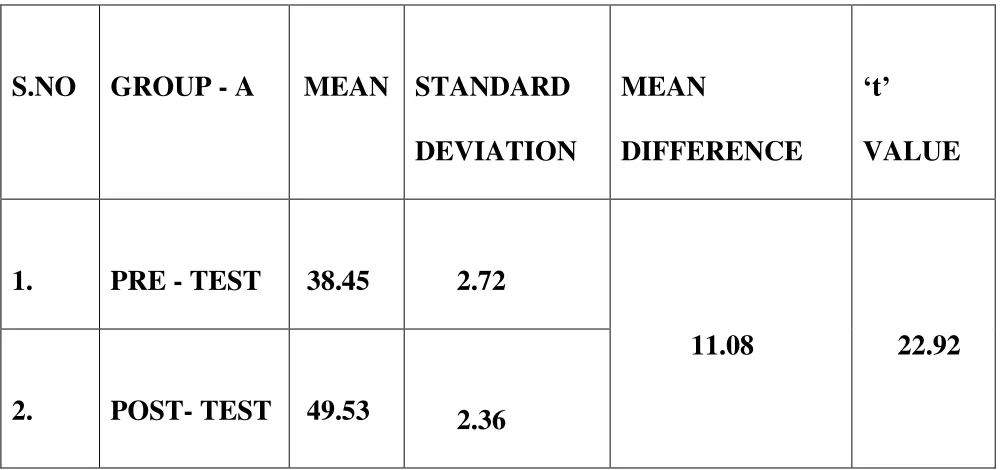
1. PRE - TEST 38.45 2.72
11.08 22.92
2. POST- TEST 49.53 2.36
The comparison of pre-test and post-test values of berg balance scale for Group - A showed that the calculated ‘t’ value 22.92 is significantly greater than the tabulated ‘t’ value 2.145 at 5% level of significance. This shows that there is a
GRAPH- I
PRE - TEST AND POST - TEST- BERG BALANCE SCALE
GROUP - A
38.47
49.53
0 10 20 30 40 50 60
TABLE-II
BERG BALANCE SCALE
PRE - TEST AND POST - TEST VALUES OF GROUP - B
S.NO GROUP - B MEAN STANDARD
DEVIATION
MEAN
DIFFERENCE
‘t’
VALUE
1. PRE - TEST 38 2.59
8.47 13.31
2. POST - TEST 46.47 1.68
The comparison of pre-test and post-test values of berg balance scale for Group - B showed that the calculated ‘t’ value 13.31 is significantly greater than
GRAPH-II
PRE - TEST AND POST - TEST VALUES OF GROUP - B
38
46.47
0 5 10 15 20 25 30 35 40 45 50
TABLE-III
BERG BALANCE SCALE
POST-TEST VALUES OF GROUP - A AND GROUP - B
S.NO GROUPS MEAN STANDARD
DEVIATION
MEAN
DIFFERENCE
‘t’
VALUE
1. GROUP - A 49.54 2.36
3.07 4.20
2. GROUP - B 46.47 1.55
The comparison of post-test values of Berg balance between Group - A and
Group - B showed that the calculated‘t’ value 4.20 is significantly greater than the tabulated ‘t’ value 2.048 at 5% level of significance. This shows that there is a significant improvement on balance in Group - A than Group - B
GRAPH-III
BERG BALANCE SCALE
POST - TEST VALUES OF GROUP - A AND GROUP - B
49.53
46.47
44.5 45 45.5 46 46.5 47 47.5 48 48.5 49 49.5 50
TABLE- IV
DYNAMIC GAIT INDEX
PRE - TEST AND POST - TEST VALUES OF GROUP - A
S.NO GROUP - A
MEAN STANDARD
DEVIATION
MEAN
DIFFERENCE
‘t’
VALUE
1. PRE - TEST 17.93 0.8
3.47 26
2. POST - TEST 21.4 1.12
The comparison of pre-test and post-test values of Dynamic Gait Index scale for Group - A showed that the calculated ‘t’ value 26 is significantly greater than the tabulated ‘t’ value 2.145 at 5% level of significance. This shows that there is a
significant improvement in gait following motor relearning program and shoe raise.
GRAPH-IV
DYNAMIC GAIT INDEX
PRE - TEST AND POST - TEST VALUES OF GROUP - A
17.93
21.4
16 17 18 19 20 21 22
TABLE-V
DYNAMIC GAIT INDEX
PRE - TEST AND POST - TEST VALUES OF GROUP - B
S.NO GROUP - B MEAN STANDARD
DEVIATION
MEAN
DIFFERENCE
‘t’
VALUE
1. PRE - TEST 17.93 0.80
1.8 16.8
2. POST - TEST 19.73 0.70
The comparison of pre-test and post-test values of Dynamic Gait Index for Group - B showed that the calculated ‘t’ value 16.8 is significantly greater than the
GRAPH-V
DYNAMIC GAIT INDEX
PRE - TEST AND POST - TEST VALUES OF GROUP - B
17.93
19.73
17 17.5 18 18.5 19 19.5 20
TABLE-VI
DYNAMIC GAIT INDEX
POST - TEST VALUES OF GROUP - B
S.NO GROUPS MEAN STANDARD
DEVIATION
MEAN
DIFFERENCE
‘t’
VALUE
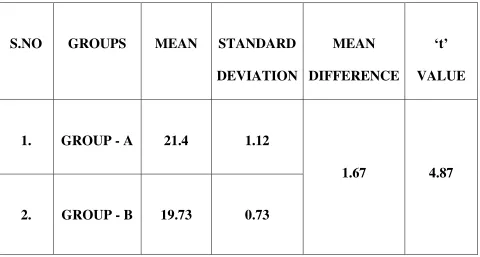
1. GROUP - A 21.4 1.12
1.67 4.87
2. GROUP - B 19.73 0.73
The comparison of post-test values of Dynamic Gait Index between Group- A and Group - B showed that the calculated ‘t’ value 4.87 is significantly greater
than the tabulated ‘t’ value 2.048 at 5% level of significance. This shows that there is a significant improvement on gait in Group - A than Group - B.
GRAPH-VI
DYNAMIC GAIT INDEX
POST - TEST VALUES OF GROUP - A AND GROUP - B
21.4
19.73
18.5 19 19.5 20 20.5 21 21.5 22
V RESULT
The paired ‘t’ test analysis for the pre-test and post-test variables of Berg Balance Scale for the Group - A and Group - B patients with chronic stroke which was shown in tables I and II. Both the groups show significant difference in the
pre-test and post-test values. The ‘t’ value for the Group - A is 22.92 and the ‘t’ value for the Group - B is 13.31.
The unpaired ‘t’ test analysis for the post test variables of both the groups for
Berg balance scale for measuring balance in patients is shown in table III. There is significant difference shown between the group. Subjects in Group - A show more improvement than subjects in Group - B. The unpaired ‘t’ value for the post test
variables for both the groups in 4.20.
The paired ‘t’ test analysis for the pre-test and post-test variables for Dynamic gait index for measuring gait in patients with chronic stroke is shown in table IV and V. Both the groups show significant difference in the pre-test and
post-test values. The ‘t’ value for the Group - A is 23, the ‘t’ value for Group - B is 16.8.
The unpaired ‘t’ test analysis for the post test variables for the both the
showed more improvement than subjects in Group - B. The ‘t’ value for the post test variables for both the Groups is 4.87.
Statistical analysis revealed that there was statistically significant improvement in both the groups in Berg Balance Scale and Dynamic Gait Index,
VI DISCUSSION
Successful rehabilitation of chronic stroke patients is the major goal for successful rehabilitation. This is achieved when the patients perform routine activities which is strongly associated with walking which in turn depends on
balance.
30 patients with chronic stroke who fulfilled the pre-determined inclusive and exclusive criteria were selected and divided in two equal groups, 15 patients in
each group. Group - A underwent motor relearning program along with shoe raise and Group - B underwent motor relearning program alone.
Outcome for both the groups were measured by using operational tools before and after the treatment duration 6 weeks. The Berg Balance Scale was used
to measure balance and Dynamic Gait index was used to calculate the gait.
Student ‘t’ test was used to find out the difference between the pre-test outcome as well as the difference between the two groups. Based on this statistical
analysis both Group - A and Group - B showed significant difference in walking ability and pain-free walking distance.
This study concluded the effectiveness of motor relearning program and
pre-test for both the groups, Group - A and Group - B revealed that there is no significant difference between the two groups indicating that they are unmatched groups of subjects undergoing different treatment protocol but were selected from
the same population.
Stroke subjects life usually end up to sedentary lifestyle due to various impairments like muscle weakness, pain, tone abnormalities and poor balance. (Michael K M et al 2005 and Janice J Eng et al 2007). Thus, loss of ambulation is
usually seen in them. So this study is to find out the effect of motor relearning program with shoe raise on improving balance and gait in patients with chronic stroke.
Reduced ability to do hip knee flexion in swing phase leads to inability to shorten the leg, giving rise to a circumduction gait, excessive shifting of weight on unaffected side, hip hiking, short stepping, wide base, excessive out toeing and toe
drag of affected side. If chronic stroke patients can’t shorten the leg in swing phase, then this can be done by increasing the length of opposite leg using shoe raise. Hence by increasing the length of unaffected leg with shoe-raise of 1 cm the
The motor relearning program can significantly improve the functions of patient with brain ischemia, and can produce neuroprotective effect. The motor relearning program promote neural regeneration and angiogenesis, and to examine
the relationship between motor relearning program with brain functional reconstruction, neural regeneration and angiogenesis. [Carr JH, Shepherd R, Beijing et al (2007)].
Use of shoe raise on unaffected side causes forced shifting of weight on
affected leg. This helps in improving equal weight bearing on both legs, reduce the non-use phenomenon of affected lower leg during walking. The improvement of the step length and stride step length of the affected side can be attributed to the
correction of weight bearing asymmetry, due to lack of weight bearing on affected side the distance covered by unaffected leg while walking is less.[ Chitra J and Mishra S 2014].
Motor relearning program (MRP) studies show considerable improvement in functional recovery, walking, motor function, balance and quality of life in acute and sub acute stroke patients [B langhammer jk stanghella et al (2000)].
This study thus proposes the use of 1 cm shoe raise on the unaffected side
gait. Increasing the height of the unaffected side can help to relatively shorten the affected lower extremity, shifting weight on affected side in stance helping symmetrical weight bearing, foot clearance in swing and reduce the effort of
walking [Aruin A S, Rodriguer G M, 2002].
Therefore motor relearning along with shoe raise improve balance and gait in patients with chronic stroke than motor relearning alone.
VII SUMMARY AND CONCLUSION
Aim of the study was to compare the effect of motor relearning program along with shoe raise and motor relearning alone on balance and gait in patients with chronic stroke.
This study was to find out the effectiveness of motor relearning program and shoe raise to improve balance and gait in chronic stroke patients and concluded from the statistical analysis that motor relearning along with shoe raise will
VIII LIMITATIONS AND RECOMMENDATIONS
LIMITATIONS:
The period allotted for the study was found to be insufficient for the
inclusion of greater number of subjects.
Influence of drug, nutritional, psychological state and climate cannot be
controlled.
The difference in individual interest shown to the treatment sessions and
further practices.
Small sample size
30 subjects were only included in the study.
RECOMMENDATION:
Study with more patients is recommended.
Further analysis in balance and gait training could be done by using EMG
Biofeed back.
Study can be done in subjects with different age groups.
The study can be extended to al other types of stroke.
IX BIBLIOGRAPHY
BOOKS
1. Susan. B. O. Sullivan and Thomas J Schmitz, Physical Rehabilitation;
and treatment, IV Edition, Jaypee Brothers. 2001.
2. Richard Snell, Clinical neuroanatomy for medical students, III Edition 1992.
3. Glady Samuel Raj, Physiotherapy in Neuro conditions, I Editions 2006.
4. Kenneth W Linsay, Ian Bone, Neurological and Neuro –surgery Illustrated IV, Edition 2005.
5. P. S .S Sundar Rao and J Richard, Introduction to biostatistics III
Edition 2001.
6. Raymond D Adams and Maurice Victor, Principles of Neurology VII Editions 2005.
7. Cynthia C Norkin, Pamela K Levangie, Joint Structure and Function, second edition, 2012.
JOURNALS
1. Foulkes M, Wolf P, Price T, Mohr J, Hier D. The Stroke Data Bank:
2. Brandstater M. Stroke rehabilitation. In: DeLisa JA, Gans BM, editors. Rehabilitation medicine, principles and practice. 3rd ed. Philadelphia: Lippincott-Raven; 1998. p 1184-8.
3. Seliktar R, Susak Z, Najenson T, Solzi P. Dynamic features of standing and their correlation with neurological disorders. Scand J Rehabil Med 1978;10:59-64.
4. Dickstein R, Nissan M, Pillar T, Scheer D. Foot-ground pressure pattern
of standing hemiplegic patients: major characteristics and patterns of improvement. Phys Ther 1984;64:19-23.
5. Bohannon RW, Tinti-Wald D. Accuracy of weight-bearing estimation by
stroke versus healthy subjects. Percept Mot Skills 1991;72:935-41.
6. Wall J, Turnbull G. Gait asymmetries in residual hemiplegia. Arch Phys Med Rehabil 1986;67:550-3.
7. Wing A, Allison S, Jenner J. Retaining and retraining balance after stroke. Baillieres Clin Neurol 1993;2:87-120.
8. Turnbull G, Charteris J, Wall J. Deficiencies in standing weight shifts by ambulant hemiplegic subjects. Arch Phys Med Rehabil 1996;77:356-62.
10. Arcan M, Brull MA, Najenson T, Solzi P. FGP assessment of postural disorders during process of rehabilitation. Scand J Rehabil Med 1977;9:165- 11. Hamrin E, Eklund G, Hillgren AK, Borges O, Hall J, Hellstrom O.
Muscle strength and balance in post stroke patients. Ups J Med Sci 1982;87:11-26.
12. Keenan M, Perry J, Jordan C. Factors affecting balance and ambulation following stroke. Clin Orthop 1984;182:165-71.
13. Aruin A, Hanke T, Chaudhuri G, Harvey R, Rao N. Compelled weight bearing in patients with hemiparesis following stroke: the effect of a lift insert and goal-directed balance exercise. J Rehabil Res Dev 2000;37:66-72.
14. Taub E, Goldberg JA, Taub P. Deafferentation in monkeys: pointing at a target without visual feedback. Exp Neurol 1975;46:178- 86.
15. Taub E, Ellman SJ, Berman AJ. Deafferentation in monkeys: effect on
conditioned grasp response. Science 1966;151:593-4.
16. Taub E, Wolf S. Constrain induced movement techniques to facilitate upper extremity use in stroke patients. Top Stroke Rehabil 1997;3:38-61. 17. Ostendorf C, Wolf S. Effect of forced use of the upper extremity of a
18. Visintin M, Barbeau H, Korner-Bitensky N, Mayo NE. A new approach to retrain gait in stroke patients through body weight support and treadmill stimulation. Stroke 1998;29:1122-8.
19. Hesse S, Bertelt C, Jahnke MT, et al. Treadmill training with partial body weight support compared with physiotherapy in nonambulatory hemiparetic patients. Stroke 1995;26:976-81.
20.Bohannon R W: Comfortable and maximum walking speed of adults
aged 20–79 years: reference values and determinants. Age and Ageing 1997, 26(1):15-9.
21.Enright P L, Sherrill D: Reference equations for the six-minutewalk in
healthy adults. Am J RespirCrit Care Med. 1998, 158(5 Pt1):1384-1387. 22.Geiger R A, Allen J B,O’ Keefe J, Hicks R R. Balance and mobility following stroke : effects of physical therapy interventions with and without biofeedback/force plate training. Phys Ther. 2001;81(4):995-1005.
23. Solomon N A, Glick H A, Russo C J, Lee J, Schulman K A. Patient preferences for stroke outcomes. Stroke. 1994, 25(9):1721-1725.
24. B Langhammer J K Stanghella, Bobath or Motor Relearning
25.B Langhammer J K Stanghella, Bobath or Motor Relearning Programme? A follow-up one and four years post stroke Clinical Rehabilitation. Clin Rehabil. 2003 Nov;17(7):731-4.
26.Bhalerao G, Kulkarni V ,Doshi C, Rairikar S, Shyam A, Sancheti P. Comparison of MRP vs Bobath Approach at every 2 weeks interval for improving Activities of daily living and Ambulation in Stroke Rehabil-itation, Int J of Basic and Applied Medical Sciences. 2013;3(3):70-77.
27. Aruin A S , Hanke T ,Chaudhari G, Harvey R, Rao N. Compelled weight bearing in persons with hemiparesis following stroke :The effect of a lift insert and goal directed balance exercises. J of Rehabilitation Research and
Development.2000; 37(1):65-72.
28. Rodriguer G M, Alexander A S. The effect of shoe wedges and lifts on symmetry of stance and weight bearing in hemiparetic individuals. Arch
Phys Med Rehabil. 2002 Apr;83(4):478-82.
29.Carr JH, Shepherd RB. A Motor Relearning Programme for stroke. 2nd edition; 1987.
30. Mohapatra S, Evioto A C, Ringquist K L ,Muthukrishnan S R, Aruin A
31. Chaudhari S, Aruin A S. The effect of shoe lifts on static and dynamic postural control in individuals with hemiparesis. Arch Phys Med Rehabil. 2000 Nov;81(11):1498-503.
32.Chitra J, Mishra S. Effect of Compelled Body Weight Shift Technique on weight bearing symmetry and balance in post stroke patients: An experimental Pre- Post study. Int J Physiother Res. 2014;2:6.
33.Shumway-Cook A, Anson D, Haller S. Postural sway biofeedback: its
effect on reestablishing stance stability in hemiplegic patients. Arch Phys Med Rehabil 1988;69: 395-400.
34. Nashner LM. Fixed patterns of rapid postural responses among leg
muscles during stance. Exp Brain Res 1977; 30:13-24.
35. Nashner LM. Adaptation of human movement to altered environments. Trends Neurosci 1982;5:358-61.
36. Shumway-Cook A, Horak FB. Assessing influence of sensory interaction on balance: Suggestion from field. Phys Ther 1986;66:1548-50.
37. Rode G, Tiliket C, Boisson D. Predominance of postural imbalance in left hemiparetic patients. Scand J Rehab Med 1997;29:11-6.
39. Dettmann MA, Linder MT, Sepic SB. Relationships among walking performance, posture stability, and functional assessments of the hemiplegic patient. Am J Phys Med 1987;66:77-90.
40. Badke MB, Duncan PW. Patterns of rapid motor responses during postural adjustments when standing in healthy subjects and hemiplegic patients. Phys Ther 1983;63:13- 20.
41. Horak FB, Esselman P, Anderson ME, Lynch MK. The effects of
movement velocity, mass displaced, and task certainty on associated postural adjustments made by normal and hemiplegic individuals. J Neurol Neurosurg Psychiatry 1984;47:1020-8.
42.Wood-Dauphinee S, Berg K, Bravo G, Williams JI: The Balance Scale: Responding to clinicallymeaningful changes. Canadian Journal of Rehabilitation, 10: 35-50,1997.
43.Berg K, Wood-Dauphinee S, Williams JI: The Balance Scale: Reliability assessment for elderlyresidents and patients with an acute stroke. Scand J Rehab Med, 27:27-36, 1995.
45. Shumway-Cook A, Woollacott M. Motor Control Theory and
Applications, Williams and Wilkins Baltimore, 1995: 323-324
46.Berg K, Maki B, Williams JI, Holliday P, Wood-Dauphinee S: A
comparison of clinical andlaboratory measures of postural balance in an elderly population. Arch Phys Med Rehabil, 73:1073-1083, 1992.
47. Lisa Blum Nicol Korner-Bitensky Usefulness of the Berg Balance Scale in Stroke Rehabilitation: A Systematic Review Physical Therapy, Volume
88,Issue5, 1 May 2008, Pages 559–566,https://doi.org/10.2522/ptj.20070205
48. Davide Cattaneo et al., Reliability and Validity of the Dynamic Gait Index in Persons With Chronic StrokeLaRiCE: Clinical Laboratory on
X APPENDIX
APPENDIX - I
PATIENT PROFILE
SUBJECTIVE ASSESSMENT
Name: Age: Sex:
Occupation:
Date of assessment: Date of admission: Chief complaints:
History
Past medical history:
Present medical history:
Surgical history:
Family history:
Family history:
Drug history:
Associated problem:
Vital signs:
OBJECTIVE ASSESSMENT
ON OBSERVATION
:
Built:
Posture:
Deformity:
Attitude of limbs:
Pattern of movements:
Tropical changes:
External applications:
ON PALPATION:
Muscle tone:
edema:
Tenderness:
Warmth:
Temperature:
On examination
Level of consciousness:
Orientation:
Attention:
Memory:
Speech:
Intellectual function:
Vision:
Emotional changes:
Higher cortical function:
Cognition:
Perception:
Cranial nerve examination:
Sensory examination
Superficial sensation:
Deep sensation:
Combined cortical sensation:
SPINO MOTOR ASSESSMENT:
Muscle tone:
Muscle power:
Muscle girth
REFLEXES:
Superficial cutaneous reflex:
Deep tendon reflex:
Primitive and tonic reflex:
Voluntary control of movement:
Co-ordination:
Involuntary movements:
Balance:
Static balance
Dynamic balance
Balance reactions
Gait:
Hand function:
CARDIO PULMONARY ASSESSMENT
Air entry: breathe sound:
Cardiac sound:
Type of breathing:
Pattern of breathing:
Depth of breathing:
Integumentry system
Bladder function
Bowel function
Functional assessment
INVESTIGATION:
DIAGNOSIS:
AIMS:
APPENDIX-II
BERG BALANCE TESTS AND RATING SCALE
PatientName
__________________________________________________________________ _
Date
__________________________________________________________________ ___
Location
__________________________________________________________________ Rater
__________________________________________________________________
__
ITEM DESCRIPTION SCORE (0-4) Sitting to standing _____ Standing
unsupported _____ Sitting
unsupported _____ Standing to sitting _____ Transfers _____ Standing with eyes
closed _____
from floor _____ Turning to look behind _____ Turning 360 degrees _____ Placing alternate foot
on stool _____ Standing with one foot in front _____ Standing on one foot _____
TOTAL _____
GENERAL INSTRUCTIONS
Please demonstrate each task and/or give instructions as written. When scoring, please record the
lowest response category that applies for each item.
In most items, the subject is asked to maintain a given position for a specific time. Progressively
more points are deducted if the time or distance requirements are not met, if the subject's
performance warrants supervision, or if the subject touches an external support or
receives
assistance from the examiner. Subjects should understand that they must maintain their balance
while attempting the tasks. The choices of which leg to stand on or how far to
reach are left to the
Equipment required for testing are a stopwatch or watch with a second hand, and a ruler or other
indicator of 2, 5 and 10 inches (5, 12 and 25 cm). Chairs used during testing should
be of
reasonable height. Either a step or a stool (of average step height) may be used for item #12.
1. SITTING TO STANDING
INSTRUCTIONS: Please stand up. Try not to use your hands for support. ( ) 4 able to stand without using hands and stabilize independently
( ) 3 able to stand independently using hands
( ) 2 able to stand using hands after several tries ( ) 1 needs minimal aid to stand or to stabilize ( ) 0 needs moderate or maximal assist to stand
2. STANDING UNSUPPORTED
INSTRUCTIONS: Please stand for two minutes without holding. ( ) 4 able to stand safely 2 minutes
( ) 3 able to stand 2 minutes with supervision
( ) 2 able to stand 30 seconds unsupported
If a subject is able to stand 2 minutes unsupported, score full points for sitting unsupported.
Proceed to item #4.
3. SITTING WITH BACK UNSUPPORTED BUT FEET SUPPORTED ON
FLOOR OR ON A
STOOL
INSTRUCTIONS: Please sit with arms folded for 2 minutes. ( ) 4 able to sit safely and securely 2 minutes
( ) 3 able to sit 2 minutes under supervision
( ) 2 able to sit 30 seconds ( ) 1 able to sit 10 seconds
( ) 0 unable to sit without support 10 seconds
4. STANDING TO SITTING
INSTRUCTIONS: Please sit down.
( ) 4 sits safely with minimal use of hands ( ) 3 controls descent by using hands
5. TRANSFERS
INSTRUCTIONS: Arrange chairs(s) for a pivot transfer. Ask subject to transfer one way toward a
seat with armrests and one way toward a seat without armrests. You may use two chairs (one with
and one without armrests) or a bed and a chair. ( ) 4 able to transfer safely with minor use of hands
( ) 3 able to transfer safely definite need of hands
( ) 2 able to transfer with verbal cueing and/or supervision ( ) 1 needs one person to assist
( ) 0 needs two people to assist or supervise to be safe
6. STANDING UNSUPPORTED WITH EYES CLOSED
INSTRUCTIONS: Please close your eyes and stand still for 10 seconds.
( ) 4 able to stand 10 seconds safely
( ) 3 able to stand 10 seconds with supervision ( ) 2 able to stand 3 seconds
( ) 1 unable to keep eyes closed 3 seconds but stays steady
7. STANDING UNSUPPORTED WITH FEET TOGETHER
INSTRUCTIONS: Place your feet together and stand without holding. ( ) 4 able to place feet together independently and stand 1 minute safely
( ) 3 able to place feet together independently and stand for 1 minute with supervision
( ) 2 able to place feet together independently but unable to hold for 30 seconds ( ) 1 needs help to attain position but able to stand 15 seconds with feet together
( ) 0 needs help to attain position and unable to hold for 15 seconds
8. REACHING FORWARD WITH OUTSTRETCHED ARM WHILE
STANDING
INSTRUCTIONS: Lift arm to 90 degrees. Stretch out your fingers and reach forward as far as you
can. (Examiner places a ruler at end of fingertips when arm is at 90 degrees.
Fingers should not
touch the ruler while reaching forward. The recorded measure is the distance forward that the
finger reaches while the subject is in the most forward lean position. When
possible, ask subject to
( ) 3 can reach forward >12 cm safely (5 inches) ( ) 2 can reach forward >5 cm safely (2 inches) ( ) 1 reaches forward but needs supervision
( ) 0 loses balance while trying/requires external support
9. PICK UP OBJECT FROM THE FLOOR FROM A STANDING
POSITION
INSTRUCTIONS: Pick up the shoe/slipper which is placed in front of your feet.
( ) 4 able to pick up slipper safely and easily ( ) 3 able to pick up slipper but needs supervision
( ) 2 unable to pick up but reaches 2-5cm (1-2 inches) from slipper and keeps
balance
independently
( ) 1 unable to pick up and needs supervision while trying
( ) 0 unable to try/needs assist to keep from losing balance or falling
10. TURNING TO LOOK BEHIND OVER LEFT AND RIGHT
SHOULDERS WHILE STANDING
INSTRUCTIONS: Turn to look directly behind you over toward left shoulder.
Repeat to the right.
( ) 4 looks behind from both sides and weight shifts well
( ) 3 looks behind one side only other side shows less weight shift ( ) 2 turns sideways only but maintains balance
( ) 1 needs supervision when turning
( ) 0 needs assist to keep from losing balance or falling
11. TURN 360 DEGREES
INSTRUCTIONS: Turn completely around in a full circle. Pause. Then turn a full
circle in the other direction.
( ) 4 able to turn 360 degrees safely in 4 seconds or less
( ) 3 able to turn 360 degrees safely one side only in 4 seconds or less ( ) 2 able to turn 360 degrees safely but slowly
( ) 1 needs close supervision or verbal cueing
( ) 0 needs assistance while turning
12. PLACING ALTERNATE FOOT ON STEP OR STOOL WHILE
STANDING UNSUPPORTED
INSTRUCTIONS: Place each foot alternately on the step/stool. Continue until
each foot has
touched the step/stool four times.
( ) 3 able to stand independently and complete 8 steps in >20 seconds ( ) 2 able to complete 4 steps without aid with supervision
( ) 1 able to complete >2 steps needs minimal assist
( ) 0 needs assistance to keep from falling/unable to try.
13. STANDING UNSUPPORTED ONE FOOT IN FRONT
INSTRUCTIONS: (DEMONSTRATE TO SUBJECT) Place one foot directly in front of the other. If
you feel that you cannot place your foot directly in front, try to step far enough ahead that the heel
of your forward foot is ahead of the toes of the other foot. (To score 3 points, the
length of the step
should exceed the length of the other foot and the width of the stance should approximate the
subject's normal stride width)
( ) 4 able to place foot tandem independently and hold 30 seconds
( ) 3 able to place foot ahead of other independently and hold 30 seconds ( ) 2 able to take small step independently and hold 30 seconds
14. STANDING ON ONE LEG
INSTRUCTIONS: Stand on one leg as long as you can without holding. ( ) 4 able to lift leg independently and hold >10 seconds
( ) 3 able to lift leg independently and hold 5-10 seconds ( ) 2 able to lift leg independently and hold = or >3 seconds
( ) 1 tries to lift leg unable to hold 3 seconds but remains standing independently ( ) 0 unable to try or needs assist to prevent fall
TOTAL SCORE (Maximum = 56: _______
APPENDIX-III
DYNAMIC GAIT INDEX
Description:
Developed to assess the likelihood of falling in older adults. Designed to test eight
facets of gait.
Equipment needed: Box (Shoebox), Cones (2), Stairs, 20’ walkway, 15” wide
Completion:
Time: 15 minutes
Scoring: A four-point ordinal scale, ranging from 0-3. “0” indicates the lowest
level of
function and “3” the highest level of function.
Total Score = 24
Interpretation: < 19/24 = predictive of falls in the elderly
> 22/24 = safe ambulators
1. Gait level surface _____
Instructions: Walk at your normal speed from here to the next mark (20’)
Grading: Mark the lowest category that applies.
(2) Mild Impairment: Walks 20’, uses assistive devices, slower speed, mild gait deviations.
(1) Moderate Impairment: Walks 20’, slow speed, abnormal gait pattern, evidence
for imbalance.
(0) Severe Impairment: Cannot walk 20’ without assistance, severe gait deviations or imbalance.
2. Change in gait speed _____
Instructions: Begin walking at your normal pace (for 5’), when I tell you “go,”
walk as fast as you can (for
5’). When I tell you “slow,” walk as slowly as you can (for 5’).
Grading: Mark the lowest category that applies.
(3) Normal: Able to smoothly change walking speed without loss of balance or gait deviation. Shows a
significant difference in walking speeds between normal, fast and slow speeds. (2) Mild Impairment: Is able to change speed but demonstrates mild gait deviations, or not gait
deviations but unable to achieve a significant change in velocity, or uses an
assistive device.
in speed with significant gait deviations, or changes speed but has significant gait deviations, or
changes speed but loses balance but is able to recover and continue walking.
(0) Severe Impairment: Cannot change speeds, or loses balance and has to reach for wall or be caught.
3. Gait with h