Int. J. Electrochem. Sci., 7 (2012) 9748 - 9764
International Journal of
ELECTROCHEMICAL
SCIENCE
www.electrochemsci.org
Cyclic Ammonium-Based Ionic Liquids as Potential Electrolytes
for Dye-Sensitized Solar Cells
I-Wen Sun1, H. Paul Wang2, Hsisheng Teng3, Shyh-Gang Su1, Yuan-Chung Lin4, Chung-Wen Kuo5, Pin-Rong Chen6, Tzi-Yi Wu6,*
1
Department of Chemistry, National Cheng Kung University, Tainan 70101, Taiwan
2
Department of Environmental Engineering, National Cheng Kung University, Tainan, Taiwan
3
Department of Chemical Engineering, National Cheng Kung University, No. 1, University Rd., Tainan, Taiwan 70101, Taiwan
4
Institute of Environmental Engineering, National Sun Yat-Sen University, Kaohsiung 804, Taiwan
5
Department of Chemical and Materials Engineering, National Kaohsiung University of Applied Sciences, Kaohsiung 80778, Taiwan
6
Department of Chemical and Materials Engineering, National Yunlin University of Science and Technology, Yunlin 64002, Taiwan
*
E-mail: [email protected]
Received: 24 August 2012 / Accepted: 19 September 2012 / Published: 1 October 2012
Cyclic ammonium-based ionic liquids containing pyrrolidinium, piperidinium, morpholinium-based cations are synthesized, and their thermal properties, viscosities, ion diffusion coefficients, charge transfer resistances, and photovoltaic properties are characterized. A DSSC electrolyte employing Pyr14 (1-butyl-1-methylpyrrolidinium iodide) gives an open circuit voltage of 0.685 V, a short-circuit current of 14.53 mA/cm2, and conversion efficiency of 6.52 % under light intensity of 100 mW/cm2 due to Pyr14 possesses the lowest viscosity and highest diffusion coefficient. The DSSC based on Pip14 exhibited 5.55 % conversion efficiency, which is smaller than that of Mor14 (η = 6.19 %) due to an oxygen atom substitutes for a carbon atom.
Keywords: Ionic liquid, cyclic ammonium, electrochemical impedance spectroscopy, Dye-sensitized solar cells.
1. INTRODUCTION
the interface between a redox electrolyte containing iodide and tri-iodide (I-/I3-) ions and a
dye-adsorbed mesoscopic TiO2 electrode [42]. The electrolyte, as one of the key ingredients, provides
internal electric conductivity by diffusing within the mesoporous TiO2 layer [43] and is an important
factor in determining the cell performance.
The advancement of dye-sensitized solar cells (DSSCs) with liquid electrolytes from the laboratory level to the industrial level has been impeded by the problems related to the hermetic sealing and evaporation of liquids at high temperatures. Replacing the liquid electrolyte in the DSSC with a quasi-solid electrolyte is expected to solve these technological problems, however, the solar-energy-to-electricity conversion efficiency decreases. In earlier works, the composition of the electrolyte was based on solvents capable to dissolve both iodide salts and iodine, which are the source of the I3-/I- redox couple. Such solvents are, for example, acetonitrile, propylene carbonate,
methoxyacetonitrile [44], etc. However, no solvent can be equally good for iodine and iodide salts (for example alkali salts) [45]. In addition, solvent volatility problems and the necessity of costly cell sealing urged for the search of alternative materials. Room temperature ionic liquids (molten salts) have several qualities as compared with other choices since they have negligible volatility and satisfactory ionic conductivity [46]. Ionic liquids are viscous materials, therefore ion diffusion is limited and it is expected to give lower conductivities than common solvents. However, it has been shown that a Grotthus-like mechanism owing to electron exchange between I- and I3- in the redox
couple endows ionic liquids with satisfactory conductivity despite the high viscosity value [47].
Accordingly, the objective of this paper is to analyze the influence of the cation component in cyclic ammonium-based ILs on the properties of electrolytes and performance of DSSCs, we studied seven ILs with different cations as DSSCs electrolytes. The thermal properties of these ILs were measured, and electrolytes prepared based on these ILs were characterized by density, viscosity, and electrochemical impedance spectroscopy. Cell performances of the DSSCs assembled based on the prepared ILs-based electrolytes were also characterized. The authors hope that this work will stimulate further discussions and eventually be useful in choosing suitable IL electrolytes to improve the efficiency of DSSCs in the future.
2. EXPERIMENTAL
2.1. Materials and measurement
temperature bath for 10 min to allow the temperature to equilibrate. The main interval between the two marks in the capillary tube was 0.01 cm3, and the minor interval between two marks was 0.001 cm3. From the correction coefficient of glycerin in capillary tube at various temperatures, we can calculate the density of electrolyte system by the expanded volume of liquid in the capillary tube at various temperatures. Each sample was measured at least three times to determine an average value, and the values of the density were ±0.0001 g mL-1. The viscosities (η) of the electrolytes were measured using a calibrated modified Ostwald viscometer (Cannon-Fenske glass capillary viscometers, CFRU, 9721-A50). The viscometer capillary diameter is 1.2 mm. The measurement of viscometer capillary diameter is implemented by a caliper, model No. PD-153, the accuracy is ± 0.02 mm. The viscometer was placed in a thermostatic water bath (TV-4000, TAMSON), in which the temperature was regulated to within ± 0.01 K. The flow time was measured with a stop watch capable of recording to 0.01 s. For each electrolyte, the experimental viscosity was obtained by averaging three to five flow time measurements. The melting point of each IL was analyzed by using a differential scanning calorimeter (DSC, Perkin–Elmer Pyris 1) in the temperature range -140 oC to a predetermined temperature. The sample was sealed in an aluminum pan, and then heated and cooled at scan rate of 10 oC min-1 under a flow of nitrogen. The thermal data were collected during heating in the second heating–cooling scan. The thermal stabilities were measured with TGA (Perkin–Elmer, 7 series thermal analysis system). The sample was placed in the platinum pan, and heated at 20 oC min-1 from room temperature to 800
o
C under nitrogen. The water content of the dried ILs was detected by a moisture titrator (Metrohm 73KF coulometer) basing on Karl–Fischer method, and the values were less than 250 ppm. NMR spectra of synthetic ionic liquids were recorded on a BRUKER AV500 spectrometer in D2O and
calibrated with tetramethylsilane (TMS) as the internal reference. Electrochemical impedance spectra of DSSCs were measured in the dark at −0.65V forward bias to determine diffusion coefficients (Del)
of triiodide (I3−) and charge transfer resistances (RCT) using a Zahner IM6 Impedance Analyzer. The
spectra were scanned at room temperature in a frequency range of 0.01 Hz to 100 kHz with the alternated voltage amplitude set at 10 mV.
2.2. Synthetic procedure of cyclic ammonium-based ILs 2.2.1. 1-Butyl-1-methylpyrrolidinium iodide (Pyr14)
To a stirred solution of N-methylpyrrolidine (8.51 g, 0.10 mol) in acetonitrile (70 mL) was added requisite aliphatic halide (butyl iodide, 20.24 g, 0.11 mol) dropwise under Ar at 0 oC. The reaction mixture was stirred for 24 ~ 48 h at 30 oC. Removal of the solvent under reduced pressure, the crude compound was dissolved in 200 mL of water and extracted with dichloromethane at least three times. After removing water on a rotary evaporator, the resulting solid was dried at 100 oC under a vacuum for 6 h. In order to eliminate traces of water either coming from the starting materials or from atmosphere, the resulting mixtures were heated at 85 oC for 48 h under vacuum of 1 torr. The ionic liquid samples were kept sealed in vials using thick layers of paraffin before uses.
Yield: 91 %. 1H NMR (400 MHz, D2O, ppm): 3.45 (m, 4H, N-CH2-), 3.28 (t, 2H, N-CH2-),
CH2-CH3), 0.90 (t, 3H, N-CH2-CH2-CH2-CH3). Elem. Anal. Calcd. for C9H20IN: C, 40.16 %; H, 7.49
[image:4.596.179.418.163.627.2]%; N, 5.20 %. Found: C, 40.02 %; H, 7.53 %; N, 5.18 %.
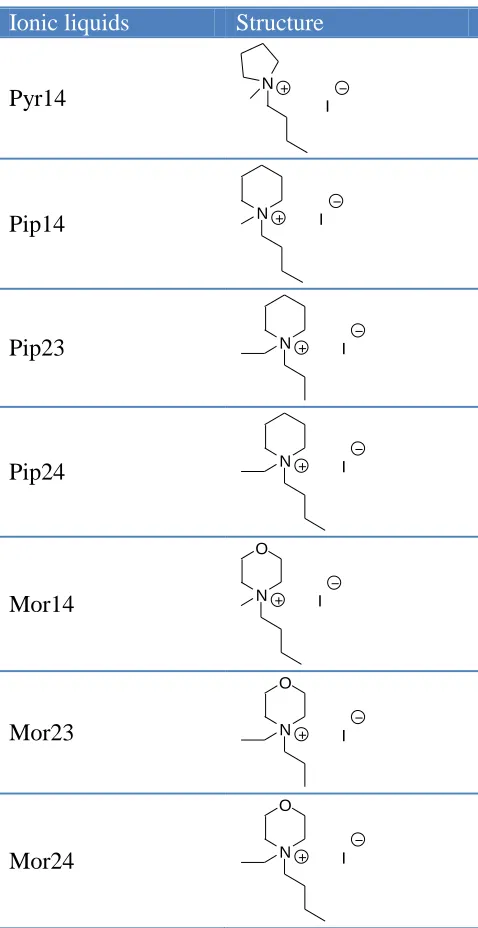
Table 1. The denominations and chemical structures of cyclic ammonium-based ILs.
Ionic liquids Structure
Pyr14 N I
Pip14 N I
Pip23 N I
Pip24 N I
Mor14 N
O
I
Mor23 N
O
I
Mor24 N
O
I
2.2.2. 1-Butyl-1-methylpiperidinium iodide (Pip14)
Yield: 88 %. 1H NMR (400 MHz, D2O, ppm): 3.39 (m, 4H, N-CH2-), 3.25-3.19 (t, 2H, N-CH2
-), 2.93 (s, 3H, N-CH3), 2.10 (m, 4H, N-CH2-CH2), 1.86-1.62 (m, 4H, N-CH2-CH2 and N-CH2-CH2
-CH2), 1.32-1.24 (m, 2H, N-CH2-CH2-CH2-CH3), 0.86-0.82 (t, 3H, N-CH2-CH2-CH2-CH3). Elem. Anal.
2.2.3. 1-Ethyl-1-propylpiperidinium iodide (Pip23)
Yield: 90 %. 1H NMR (400 MHz, D2O, ppm): 3.35-3.25 (m, 8H, N-CH2-), 1.89 (m, 4H,
N-CH2-CH2), 1.72 (m, 4H, N-CH2-CH2 and N-CH2-CH2-CH2), 1.31 (m, 3H, N-CH2-CH3), 1.01 (t, 3H,
N-CH2-CH2-CH3). Elem. Anal. Calcd. for C10H22IN: C, 42.41 %; H, 7.83 %; N, 4.95 %. Found: C, 42.22
%; H, 7.79 %; N, 4.85 %.
2.2.4. 1-Butyl-1-ethylpiperidinium iodide (Pip24)
Yield: 94 %. 1H NMR (400 MHz, D2O, ppm): 3.38-3.22 (m, 8H, N-CH2-), 1.85 (m, 4H,
N-CH2-CH2), 1.66 (m, 4H, N-CH2-CH2 and N-CH2-CH2-CH2), 1.39-1.34 (m, 2H, N-CH2-CH2-CH2
-CH3), 1.26 (t, 3H, N-CH2-CH3), 0.97-0.93 (t, 3H, N-CH2-CH2-CH2-CH3). Elem. Anal. Calcd. for
C11H24IN: C, 44.45 %; H, 8.14 %; N, 4.71 %. Found: C, 44.36 %; H, 8.07 %; N, 4.75 %.
2.2.5. 4-Butyl-4-methylmorpholin-4-ium iodide (Mor14)
Yield: 85 %. 1H NMR (400 MHz, D2O, ppm): 4.01 (m, 4H, O-CH2-), 3.53-3.40 (m, 6H,
N-CH2-), 3.14 (s, 3H, N-CH3), 1.74 (m, 2H, N-CH2-CH2), 1.36 (m, 2H, N-CH2-CH2-CH2-CH3), 0.92 (t,
3H, N-CH2-CH2-CH2-CH3). Elem. Anal. Calcd. for C9H20INO: C, 37.91 %; H, 7.07 %; N, 4.91 %.
Found: C, 37.79 %; H, 7.07 %; N, 4.85 %.
2.2.6. 4-Ethyl-4-propylmorpholin-4-ium iodide (Mor23)
Yield: 87 %. 1H NMR (400 MHz, D2O, ppm): 4.05 (m, 4H, O-CH2-), 3.51-3.41 (m, 8H,
N-CH2-), 1.77 (m, 2H, N-CH2-CH2), 1.34 (t, 3H, N-CH2-CH3), 1.01 (t, 3H, N-CH2-CH2-CH3). Elem.
Anal. Calcd. for C9H20INO: C, 37.91 %; H, 7.07 %; N, 4.91 %. Found: C, 37.81 %; H, 7.01 %; N, 4.82
%.
2.2.7. 4-Butyl-4-ethylmorpholin-4-ium iodide (Mor24)
Yield: 90 %. 1H NMR (400 MHz, D2O, ppm): 4.03 (m, 4H, O-CH2-), 3.54-3.38 (m, 8H,
N-CH2-), 1.69 (m, 2H, N-CH2-CH2), 1.41-1.30 (m, 5H, N-CH2-CH2-CH2-CH3 and N-CH2-CH3),
0.97-0.94 (t, 3H, N-CH2-CH2-CH2-CH3). Elem. Anal. Calcd. for C10H22INO: C, 40.14 %; H, 7.41 %; N,
4.68 %. Found: C, 40.03 %; H, 7.36 %; N, 4.65 %.
2.3. Preparation of dye-sensitized TiO2 electrode (photoanode) and counter electrode
and ethanol. Two kinds of TiO2 paste, containing nanocrystalline (~25 nm) TiO2 (Degussa P25, paste
A) and submicroparticle TiO2 (500 nm, paste B), respectively, were prepared using a previously
reported procedure [44]. To prepare paste A, commercial titania powder (3 g, Degussa P25) was ground in a mortar with a small amount of water (1 mL) containing acetylacetone (0.1 mL). After the TiO2 particles were dispersed, the paste was diluted with 3 mL water under continued grinding and a
surfactant, Triton X-100 (0.05 mL), was added to facilitate the spreading of the colloid on the substrate. Paste A was sonicated for about 24 h at 28 oC. TiO2 film (12 m) was prepared by spin
coating. After paste A was dried at 125 oC, ~4 m thick paste B was spin-coated on top of it. The electrodes coated with TiO2 pastes were gradually heated (5 oC min-1) under airflow up to 450 oC for
30 min followed by treating with 40 mM TiCl4, rinsed with water and ethanol, and sintered again at
450 oC for 30 min. The electrodes with an active area of 0.5 cm × 0.5 cm were immersed in a 1:1 acetonitrile and isoporpanol solution containing 3 × 10⁻⁴ M of dye. The dye-adsorbed TiO2 films were
then rinsed with dry ethanol, and dried in air. A counter electrode was prepared by sputtering a thin platinum layer (50 nm) on an FTO substrate. The thicknesses of the TiO2 films were determined by
profilometry. Platinum sputtering was carried out using a Hitachi E 1045 instrument. The platinum layer thickness on the glass substrates was estimated using the amount of sputtered platinum recorded on a quartz thickness monitor.
2.4. DSSC assembly
The dye adsorbed TiO2 electrode and Pt-counter electrode were assembled into a sandwich
sealed type cell by heating them with hot-melt ionomer film (60 m thickness, Solaronix) as a spacer. A drop of electrolyte solution (0.1 M LiI, 0.05 M I2, 0.6 M DMPII and 0.5 M tert-butyl pyridine (TBP)
in acetonitile (ACN)) was injected through a hole in the counter electrode, which was then sealed with hot-melt ionomer film and glass. The electrolyte was introduced into the cell and sealed with AB epoxy for 30 min. The working area of the electrode was 0.25 cm2.
2.5. Photovoltaic measurements of the solar cells
3. RESULTS AND DISCUSSION
3.1. Thermal Property
The structures of the cyclic ammonium-based ionic liquids prepared and studied in the present work are shown in Table 1. Thermal stability of the synthesized cyclic ammonium-based ionic liquids is studied using TGA and the decomposition temperatures of 10% weight loss are summarized inTable 2. Each ionic liquid used for thermal property measurements was dried under vacuum at 393 K for 24 h before use. Figure 1 shows the thermogravimetric traces of these ILs. The thermal decomposition temperatures (Td) of these ILs has some relationship with the structure of cations, the thermal stability
of these cations follows the order: piperidinium (Pip14: 261 oC) > pyrrolidinium (Pyr14: 256 oC) > morpholinium (Mor14: 241 oC). For piperidinium and morpholinium based ionic liquids, Pip23 exhibits higher Td (292 oC) than that of Pip14 and Pip24 (261 and 260 oC, respectively), Mor23
exhibits higher Td (272 oC) than that of Mor14 and Mor24 (241 and 238 oC, respectively), implying
symmetrical alkyl substitute in the cations increases the thermal stability significantly. The good thermal stability of the synthesized cyclic ammonium-based ionic liquids (Td > 238 oC) enables their
potential use for electrolytes in Dye-sensitized solar cell.
Table 2. Thermal properties of cyclic ammonium-based ionic liquids Ionic liquid Mw / g mol
-1
Tg / ◦C Ts-s / ◦C Tm / ◦C Td / ◦C
Pyr14 269.17 -91 -24, 8 153 256
Pip14 283.19 -25 53 184 261
Pip23 283.19 -42 --- 67 292
Pip24 297.22 --- 77 128 260
Mor14 285.17 -16 --- 125 241
Mor23 285.17 --- --- 87 272
Mor24 299.19 -40 --- 103 238
a
Decomposition temperature (Td) of 10 % weight loss.
The phase transitions temperature is an important issue to evaluate the liquid or gel state of ionic liquid electrolyte. Thermal properties of the ionic liquid electrolytes were investigated by differential scanning calorimetry. The phase transitions were observed on a second heating, the melting point (Tm) and glass transition point (Tg) were summarized in Table 2. By inspecting the transition
temperatures as a function of the cation, it can be noted that the glass transition temperature (Tg) of the
pyrrolidinium-based IL (Pyr14: Tg = -91 oC) is lower than piperidinium-based IL (Pip14: Tg = -25 oC)
and morpholinium-based IL (Mor14: Tg = -16 oC).
The typical DSC thermograms are reported in Figure 2. One type of behavior characterized by ILs exhibits a melting transition, such as morpholinium based ILs (Mor23). A second form of behavior arises from samples such as Pip24 with a solid-solid transition (Ts-s = 77) before Tm were observed.
The third type of behavior was from sample Pyr14 with multiple solid-solid transitions (Ts-s = -24, 8 o
C) before Tm and with substantial supercooling as the freezing points (Tc = -51 oC) of the samples are
[image:8.596.162.438.78.280.2]
Figure 1. Thermogravimetric trace for these cyclic ammonium-based ionic liquids under nitrogen atmospheres.
Figure 2. Selected DSC thermogram of ILs obtained from DSC heating experiment.
3.2. The temperature dependence of the density and viscosity of IL-based electrolytes
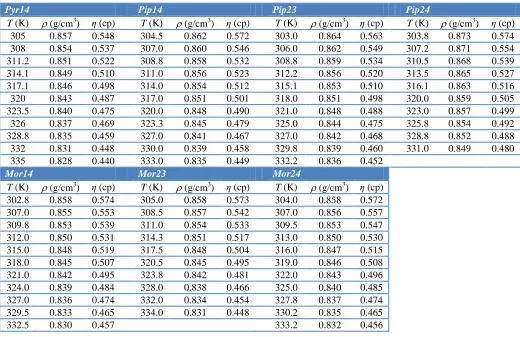
Viscosity measurement is an important issue to estimate the ionic conductivity of electrolyte due to ionic transport. In general, viscosities at room temperature are enough for solar cell application. For outdoor use, viscosities at higher temperatures become important parameters. The temperature-dependent densities () were characterized to evaluate the kinematic viscosity and were fitted to a linear equation as shown in Eqn. 1 by using linear regression techniques
= A + BT (1) Temperature / K
0 100 200 300 400 500 600
W
e
ig
h
t /
%
0 20 40 60 80 100
Pyr14 Pip14 Pip23 Pip24 Mor14 Mor23 Mor24
Temperature / oC
-150 -100 -50 0 50 100 150 200 250
<
--- E
ndo
-10 0 10 20 30 40
[image:8.596.160.433.351.560.2][image:9.596.38.558.188.525.2]
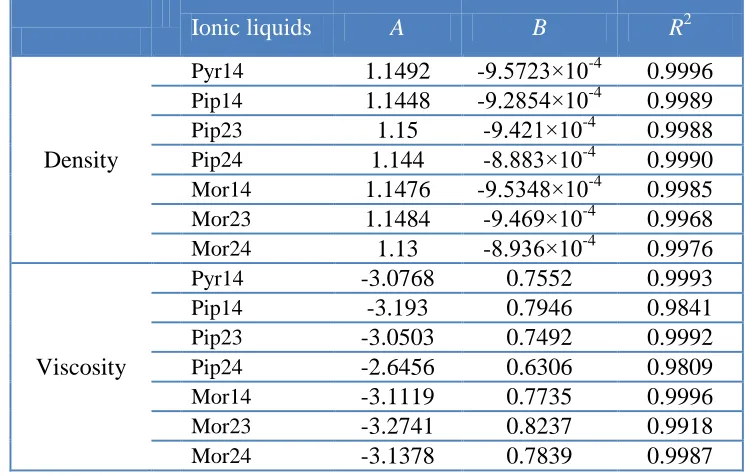
where A and B are constants and T is the absolute temperature. The adjustable parameters of Eqn. 1 for density of these ILs-based electrolytes are summarized in Table 4.
Table 3. Temperature dependence of density and dynamic viscosity (η) data for DSSC electrolyte (0.1
M LiI, 0.05 M I2, 0.6 M cyclic ammonium-based ionic liquids (Pyr14, Pip14, Pip23, Pip24,
Mor14, Mor23, Mor24), 0.5 M tert-butyl pyridine (TBP) in acetonitile (ACN)).
Pyr14 Pip14 Pip23 Pip24
T (K) (g/cm3) η (cp) T (K) (g/cm3) η (cp) T (K) (g/cm3) η (cp) T (K) (g/cm3) η (cp)
305 0.857 0.548 304.5 0.862 0.572 303.0 0.864 0.563 303.8 0.873 0.574
308 0.854 0.537 307.0 0.860 0.546 306.0 0.862 0.549 307.2 0.871 0.554
311.2 0.851 0.522 308.8 0.858 0.532 308.8 0.859 0.534 310.5 0.868 0.539
314.1 0.849 0.510 311.0 0.856 0.523 312.2 0.856 0.520 313.5 0.865 0.527
317.1 0.846 0.498 314.0 0.854 0.512 315.1 0.853 0.510 316.1 0.863 0.516
320 0.843 0.487 317.0 0.851 0.501 318.0 0.851 0.498 320.0 0.859 0.505
323.5 0.840 0.475 320.0 0.848 0.490 321.0 0.848 0.488 323.0 0.857 0.499
326 0.837 0.469 323.3 0.845 0.479 325.0 0.844 0.475 325.8 0.854 0.492
328.8 0.835 0.459 327.0 0.841 0.467 327.0 0.842 0.468 328.8 0.852 0.488
332 0.831 0.448 330.0 0.839 0.458 329.8 0.839 0.460 331.0 0.849 0.480
335 0.828 0.440 333.0 0.835 0.449 332.2 0.836 0.452
Mor14 Mor23 Mor24
T (K) (g/cm3) η (cp) T (K) (g/cm3) η (cp) T (K) (g/cm3) η (cp)
302.8 0.858 0.574 305.0 0.858 0.573 304.0 0.858 0.572
307.0 0.855 0.553 308.5 0.857 0.542 307.0 0.856 0.557
309.8 0.853 0.539 311.0 0.854 0.533 309.5 0.853 0.547
312.0 0.850 0.531 314.3 0.851 0.517 313.0 0.850 0.530
315.0 0.848 0.519 317.5 0.848 0.504 316.0 0.847 0.515
318.0 0.845 0.507 320.5 0.845 0.495 319.0 0.846 0.508
321.0 0.842 0.495 323.8 0.842 0.481 322.0 0.843 0.496
324.0 0.839 0.484 328.0 0.838 0.466 325.0 0.840 0.485
327.0 0.836 0.474 332.0 0.834 0.454 327.8 0.837 0.474
329.5 0.833 0.465 334.0 0.831 0.448 330.2 0.835 0.465
332.5 0.830 0.457 333.2 0.832 0.456
The kinematic viscosity data obtained with the modified Oswald viscometer were converted to dynamic or absolute viscosities, , by using the following equation
Kinematic viscosity =
An Arrhenius plot of ln vs 1/T was constructed from the experimental data and a linear relationship was found. A linear equation of the form was fitted to the experimental data.
ln = A + B(103 1T) (3)
exp[ ]
( )
o
o
B T T
(4)
where T is the absolute temperature, and , B, and To are adjustable parameters. The best-fit ηo
(cP), B (K), and To (K) parameters are given in Table 5. The electrolyte (0.1 M LiI, 0.05 M I2, 0.6 M
[image:10.596.115.484.297.535.2]cyclic ammonium-based ionic liquids, 0.5 M tert-butyl pyridine (TBP) in acetonitile (ACN), total 12 ml) exhibits a low absolute viscosity (ca 0.54 ~ 0.58 cp at 30 oC). Based on the concern of higher mass transport, it is expected that these IL-based electrolytes should be an appropriate media for the electrolyte of dye-sensitized solar cell.
Table 4. Fitted parameters of DSSC electrolyte for ρ = A + BT, ρ, density (g/cm3), and for ln = A + B(103 1/T), , absolute viscosity (cp).
Ionic liquids A B R2
Density
Pyr14 1.1492 -9.5723×10⁻⁴ 0.9996
Pip14 1.1448 -9.2854×10⁻⁴ 0.9989
Pip23 1.15 -9.421×10⁻⁴ 0.9988
Pip24 1.144 -8.883×10⁻⁴ 0.9990
Mor14 1.1476 -9.5348×10⁻⁴ 0.9985
Mor23 1.1484 -9.469×10⁻⁴ 0.9968
Mor24 1.13 -8.936×10⁻⁴ 0.9976
Viscosity
Pyr14 -3.0768 0.7552 0.9993
Pip14 -3.193 0.7946 0.9841
Pip23 -3.0503 0.7492 0.9992
Pip24 -2.6456 0.6306 0.9809
Mor14 -3.1119 0.7735 0.9996
Mor23 -3.2741 0.8237 0.9918
Mor24 -3.1378 0.7839 0.9987
Table 5. VTF equation parameters of viscosity for some DSSC electrolytes. (η = ηo exp[-B/(T - To)]).
Ionic liquids ηo (cp) To (K) B (K)a R2b
Pip14 0.3246 262.7 23.3 0.993
Pip24 0.3824 268.0 14.5 0.999
Mor23 0.261 238.6 51.8 0.996
a
Activation energy (kJ mol-1). b
Correlation coefficient.
3.3. Electrochemical properties
[image:10.596.110.483.299.537.2]
the dye-sensitized TiO2 solar cell prepared with liquid electrolyte ((0.1 M LiI, 0.05 M I2, 0.6 M
cyclic ammonium-based ionic liquids (Pyr14, Pip14, Pip23, Pip24, Mor14, Mor23, Mor24), 0.5 M tert-butyl pyridine (TBP) in acetonitile (ACN)), and an equivalent circuit corresponding to the DSSCs is shown in Figure 3(b). The measurements are carried out at the open-circuit voltage and under 100 mW cm−2 illumination. The parameters listed in Table 6 are obtained by fitting the spectra with the equivalent circuit, different impedance elements are contributing to the impedance spectrum of a thin layer cell. Most of the spectra exhibit three semicircles, which were assigned, from left to right, to the electrochemical reaction at the Pt counter electrode (Z1), the reaction at the
TiO2/dye/electrolyte interface (Z2) and the diffusion of I3– at the Pt/electrolyte interface (Z3) [59]. The
values of RCT1, R CT2 and R3 are described as the real parts of Z1, Z2, and Z3, respectively, and were
always used to evaluate the internal resistances involved in the corresponding reactions. For high frequencies, the serial resistance (RS) is dominating the impedance of the cell. In the frequency range
between 100 Hz and 10 kHz, the impedance is dominated by the RC network of the Pt/electrolyte interface, consisting of the charge-transfer resistance (RCT) and the capacitance (C) of the electrical
double layer. In the range of 1~10 Hz, the Nernst diffusion impedance (ZN) is visible.
(a)
[image:11.596.54.478.355.701.2](b)
Figure 3. (a) Nyquist diagrams of the impedance spectra obtained for a dye-sensitized TiO2 solar cell
prepared with liquid electrolyte ((0.1 M LiI, 0.05 M I2, 0.6 M cyclic ammonium-based ionic
liquids (Pyr14, Pip14, Pip23, Pip24, Mor14, Mor23, Mor24), 0.5 M tert-butyl pyridine (TBP) in acetonitile (ACN)). (b) Equivalent circuit of DSSC for fitting model.
0.000 2.000 4.000 6.000 8.000 10.000 12.000
0.000 10.000 20.000 30.000 40.000 50.000
Z
''
/
O
h
m
Z' / Ohm
Pyr14
Pip14
Pip23
Pip24
Mor14
Mor23
Mor24
N Rs
CPE1
RCT1 RCT2
CPE2 Z1
Z2
Z3
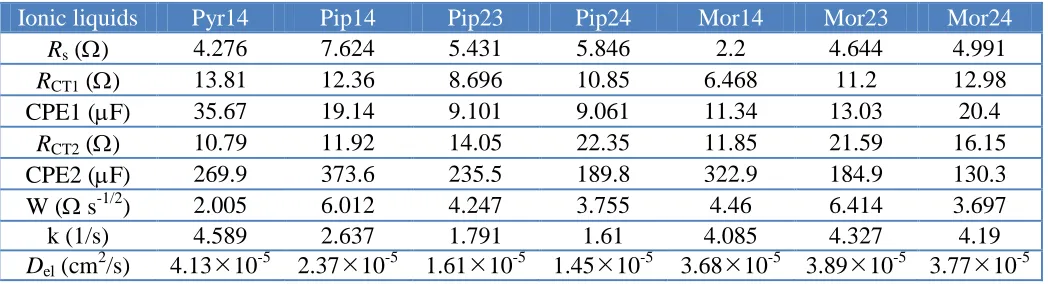
Table 6. Characteristic fitting parameters of equivalent circuit; series resistances (Rs/W) and charge
transfer resistances (RCT/W), constant phase element (CPE/F), Warburg parameter (W/ s−1/2)
and triiodide diffusion coefficients (Del/cm2 s-1) of IL electrolytes.
Ionic liquids Pyr14 Pip14 Pip23 Pip24 Mor14 Mor23 Mor24
Rs () 4.276 7.624 5.431 5.846 2.2 4.644 4.991
RCT1 () 13.81 12.36 8.696 10.85 6.468 11.2 12.98
CPE1 (F) 35.67 19.14 9.101 9.061 11.34 13.03 20.4
RCT2 () 10.79 11.92 14.05 22.35 11.85 21.59 16.15
CPE2 (F) 269.9 373.6 235.5 189.8 322.9 184.9 130.3
W ( s-1/2) 2.005 6.012 4.247 3.755 4.46 6.414 3.697
k (1/s) 4.589 2.637 1.791 1.61 4.085 4.327 4.19
Del (cm2/s) 4.1310-5 2.3710-5 1.6110-5 1.4510-5 3.6810-5 3.8910-5 3.7710-5
The diffusion coefficient of triiodide is one of the most important variables for the optimisation of electrolytes applied in Grätzel-type sensitised solar cells (DSSCs) [60]. For application in dye-sensitised solar cells a preferably high triiodide diffusion coefficient in the electrolyte is required. When the diffusing species is present in an electrolyte, Del is just the diffusion coefficient of this
species. Therefore in mixtures containing the I−/I3− redox couple with an excess amount of iodide, Del
is given by the diffusion coefficient of triiodide, DI3–. The diffusion of the tri-iodide in the electrolyte is
described by a Nernst impedance ZN [61],
N
N
tanh
W i
Z
K i
(5)
where W is the Warburg parameter, and KN is the time constant. W and KN are described by
following Eqns.
3
2 2
0 I el
kT W
m e c A D
(6)
el
N 2
D K
(7)
where Del is the diffusion constant of I3−,
3
I
c is the concentration of I3−, A is the electrode area,
m is number of electrons transferred in each reaction (m = 2 for the present discussion, k is Boltzman constant, T is temperature, e0 is elementary charge; is the thickness of the Nernst diffusion layer ( =
0.5del; del, distance between the electrodes: 60 m).
The diffusion constant Del of the DSSCs was determined by fitting the impedance values and
[image:12.596.38.562.130.272.2]
(Del)Pyr14 > (Del)Mor14 > (Del) Pip14; (2) (Del)Pip14 > (Del)Pip23 > (Del) Pip24. The higher Del value gives the
larger photocurrent due to the quick charge transport in the electrolyte.
3.4. Photovoltaic performances
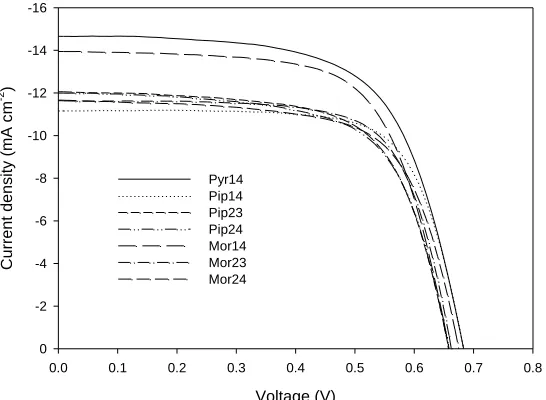
DSSCs were prepared and compared to investigate the relationships between the electrolyte behavior of pyrrolidinium, piperidinium, and morpholinium-based ILs and their structures. Typical photocurrent–photovoltage (I–V) curves for DSSC cells based on these electrolytes (0.1 M LiI, 0.05 M I2, 0.6 M cyclic ammonium-based ionic liquids (Pyr14, Pip14, Pip23, Pip24, Mor14, Mor23, Mor24),
0.5 M tert-butyl pyridine (TBP) in acetonitile (ACN)) are shown in Fig. 4. The detailed photovoltaic parameters are summarized in Table 7.
Figure 4. Current density-voltage characteristics for dye-sensitized solar cell assembled with cyclic ammonium-based ionic liquids electrolyte under illumination of simulated solar light (AM 1.5, 100 mW/cm2).
Table 7. Photovoltaic performances of the DSSCs under 100 mW cm−2 light intensity and AM1.5 global radiation.
Ionic liquids Pyr14 Pip14 Pip23 Pip24 Mor14 Mor23 Mor24
Voc/mV 685 685 661 661 661 663 679
Jsc/mA cm-2 14.53 11.16 12.14 11.95 13.97 11.63 11.69
Fill factor (ff) 0.66 0.73 0.66 0.66 0.67 0.72 0.67
(%) 6.52 5.55 5.33 5.24 6.19 5.52 5.34
Vmpp/V 0.517 0.56 0.517 0.522 0.506 0.533 0.533
Impp/mA cm-2 10.16 10.29 9.714 10.03 12.22 7.948 10.02
MPP/mW 5.252 5.763 5.024 5.242 6.188 4.239 5.34
Voltage (V)
0.0 0.1 0.2 0.3 0.4 0.5 0.6 0.7 0.8
C
u
rr
e
n
t de
n
s
ity
(mA
c
m
-2 )
-16
-14
-12
-10
-8
-6
-4
-2
0
[image:13.596.160.433.289.489.2] [image:13.596.37.560.620.744.2]
The photoelectronic performance [i.e. fill factor (FF) and overall conversion efficiency (η)] were calculated by the following equations [62]:
max max
FF
oc sc
V J V J
(8)
max Imax FF
(%) oc sc
in in
V V J
P P
(9)
where Jsc is the short-circuit current density (mA cm−2), Voc is the open-circuit voltage (V), Pin
is the incident light power (mW cm−2), and Jmax (mA cm−2) and Vmax (V) are the current density and
voltage in the I–V curves, respectively, at the point of maximum power output.
Under the standard global AM 1.5 solar condition, the DSSCs with the electrolyte composed of 0.1 M LiI, 0.05 M I2, 0.6 M cyclic ammonium-based ionic liquids Pyr14, 0.5 M tert-butyl pyridine
(TBP) in acetonitile (ACN), gave short circuit photocurrent density of 14.53 mA cm-2, open circuit voltage of 0.685 V, and fill factor of 0.66, corresponding to the photoelectric conversion efficiency of 6.52 % at the illumination (100 mW cm-2). Under similar conditions, the photoelectric conversion efficiency of cells with the piperidinium-based electrolyte Pip14, Pip23, and Pip24 are 5.55, 5.33, and 5.24 %, respectively, and those of the morpholinium-based electrolyte Mor14, Mor23, and Mor24 are 6.19, 5.52, and 5.34 %, respectively. As seen from Table 3, The Pyr14-based electrolyte has the lowest viscosity value, this suggests that the DSSC for Pyr14 should have the highest short circuit current and highest efficiency. In fact, it is seen that the Pyr14-based electrolyte gives the highest Isc and η values
among the investigated DSSCs. For piperidinium- and morpholinium-based electrolyte,increasing the side chain length of cation from methyl (Mor14) to ethyl (Mor24), respectively, slightly decreases efficiency from 6.19 % to 5.34%; and from propyl (Mor23) to butyl (Mor24), respectively, slightly decreases efficiency from 5.52% to 5.34% because of larger cation size has lower diffusion coefficient [63].
As seen in Table 6 and Table 7, the DSSC cell for Pyr14 has the highest current of 14.53 mA cm-2, demonstrating that the larger diffusion coefficient for the DSSCs, in general cause the great short circuit current. Moreover, charge transfer resistance is related with charge recombination reactions in the TiO2/dye/electrolyte interface (RCT2). Among theses DSSCs, the DSSC cell for Pyr14 has the
lowest RCT2 value, implying Pyr14 shows the lowest charge losses in the TiO2/electrolyte interface.
4. CONCLUSIONS
ammonium-based ionic liquids Pyr14, and 0.5 M tert-butyl pyridine (TBP) in acetonitile (ACN), gave short circuit photocurrent density of 14.53 mA cm-2, open circuit voltage of 0.685 V, and fill factor of 0.66, corresponding to the photoelectric conversion efficiency of 6.52% at the illumination (Air Mass 1.5, 100 mW cm-2).
ACKNOWLEDGEMENTS
The authors would like to thank the National Science Council of the Republic of China for financially supporting this project. We are very grateful to Ms. Ru-Rong Wu for her help in performing the NMR experiments.
References
1. R.D. Rogers, Nature, 447 (2007) 917.
2. M.R. Ganjali, H. Ganjali, M. Hosseini, P. Norouzi, Int. J. Electrochem. Sci., 5 (2010)967. 3. V.S.R. Channu, R. Holze, E.H. Walker, S.A. Wicker, R.R. Kalluru, Q.L. Williams, W. Walters,
Int. J. Electrochem. Sci., 5 (2010)1355.
4. T.Y. Wu, S.G. Su, K.F. Lin, Y.C. Lin, H.P. Wang, M.W. Lin, S.T. Gung, I.W. Sun, Electrochim. Acta, 56 (2011) 7278.
5. M.R. Ganjali, S. Aghabalazadeh, M. Rezapour, M. Hosseini, P. Norouzi, Int. J. Electrochem. Sci., 5 (2010)1743.
6. M.T. Montañés, R. Sánchez-Tovar, J. García-Antón, V. Pérez-Herranz, Int. J. Electrochem. Sci., 5 (2010)1934.
7. T.Y. Wu, B.K. Chen, L. Hao, C.W. Kuo, I.W. Sun, J. Taiwan Inst. Chem. Eng., 43 (2012) 313. 8. M. Pandurangachar, B.E.K. Swamy, B.N. Chandrashekar, O. Gilbert, S. Reddy, B.S. Sherigara, Int.
J. Electrochem. Sci., 5 (2010)1187.
9. M.R. Ganjali, M. Rezapour, S.K. Torkestani, H. Rashedi, P. Norouzi, Int. J. Electrochem. Sci., 6 (2011)2323.
10.T.Y. Wu, B.K. Chen, L. Hao, Y.C. Peng, I.W. Sun, Int. J. Mol. Sci., 12 (2011) 2598.
11.P. Norouzi, Z. Rafiei-Sarmazdeh, F. Faridbod, M. Adibi, M.R. Ganjali, Int. J. Electrochem. Sci., 5 (2010) 367.
12.M.R. Ganjali, M. Hosseini, M. Pirali-Hamedani, H.A. Zamani, Int. J. Electrochem. Sci., 6 (2011) 2808.
13.T.Y. Wu, I.W. Sun, S.T. Gung, B.K. Chen, H.P. Wang, S.G. Su, J. Taiwan Inst. Chem. Eng., 42 (2011) 874.
14.F. Faridbod, M.R. Ganjali, M. Pirali-Hamedani, P. Norouzi, Int. J. Electrochem. Sci., 5 (2010) 1103.
15.M.R. Ganjali,T. Poursaberi, M. Khoobi, A. Shafiee, M. Adibi, M. Pirali-Hamedani, P. Norouzi, Int. J. Electrochem. Sci., 6 (2011)717.
16.T.Y. Wu, S.G. Su, H.P. Wang, Y.C. Lin, S.T. Gung, M.W. Lin, I.W. Sun, Electrochim. Acta, 56 (2011) 3209.
17.P. Norouzi, M. Hosseini, M.R. Ganjali, M. Rezapour, M. Adibi, Int. J. Electrochem. Sci., 6 (2011) 2012.
18.M.R. Ganjali, M.H. Eshraghi, S. Ghadimi, S.M. Moosavi, M. Hosseini, H. Haji-Hashemi, P. Norouzi, Int. J. Electrochem. Sci., 6 (2011)739.
20.M.R. Ganjali, M.R. Moghaddam, M. Hosseini,P. Norouzi,Int. J. Electrochem. Sci., 6 (2011) 1981.
21.H.A. Barham, S.A. Brahim, Y. Rozita, K.A. Mohamed, Int. J. Electrochem. Sci., 6 (2011) 181. 22.P.N. Tshibangu, S.N. Ndwandwe, E.D. Dikio, Int. J. Electrochem. Sci., 6 (2011) 2201.
23.T.H. Tsai, K.C. Lin, S.M. Chen, Int. J. Electrochem. Sci., 6 (2011) 2672.
24.Y.X. An, P.J. Zuo, X.Q. Cheng, L.X. Liao, G.P. Yin, Int. J. Electrochem. Sci., 6 (2011) 2398. 25.P. Norouzi, M. Pirali-Hamedani, S.O. Ranaei-Siadat, M.R. Ganjali, Int. J. Electrochem. Sci., 6
(2011) 3704.
26.F. Faridbod, H.A. Zamani, M. Hosseini, M. Pirali-Hamedani, M.R. Ganjali, P. Norouzi, Int. J. Electrochem. Sci., 6 (2011) 3694.
27.M.R. Ganjali, S.O. Ranaei-Siadat, H. Rashedi, M. Rezapour, P. Norouzi, Int. J. Electrochem. Sci., 6 (2011) 3684.
28.S.K. Shukla, L.C. Murulana, E.E. Ebenso, Int. J. Electrochem. Sci., 6 (2011) 4286.
29.H. Wang, L.X. Wu, Y.C. Lan, J.Q. Zhao, J.X. Lu, Int. J. Electrochem. Sci., 6 (2011) 4218.
30.N.V. Likhanova, O. Olivares-Xometl, D. Guzman-Lucero, M.A. Dominguez-Aguilar, N. Nava, M. Corrales-Luna, M.C. Mendoza, Int. J. Electrochem. Sci., 6 (2011) 4514.
31.S. Ibrahim, M.R. Johan, Int. J. Electrochem. Sci., 6 (2011) 5565.
32.M.R. Ganjali, T. Alizadeh, F. Azimi, B. Larjani, F. Faridbod, P. Norouzi, Int. J. Electrochem. Sci., 6 (2011) 5200.
33.L.C. Xuan, Y.X. An, W. Fang, L.X. Liao, Y.L. Ma, Z.Y. Ren, G.P. Yin, Int. J. Electrochem. Sci., 6 (2011) 6590.
34.B. Baek, S. Lee, C. Jung, Int. J. Electrochem. Sci., 6 (2011) 6220.
35.J. Gao, J.G. Liu, W.M. Liu, B. Li, Y.C. Xin, Y. Yin, Z.G. Zou, Int. J. Electrochem. Sci., 6 (2011) 6115.
36.H. Ganjali, M.R. Ganjali, T. Alizadeh, F. Faridbod, P. Norouzi, Int. J. Electrochem. Sci., 6 (2011) 6085.
37.T.Y. Wu, M.H. Tsao, F.L. Chen, S.G. Su, C.W. Chang, H.P. Wang, Y.C. Lin, W.C. Ou-Yang, I.W. Sun, Int. J. Mol. Sci., 11 (2010) 329.
38.S.Y. Ku, S.Y. Lu, Int. J. Electrochem. Sci., 6 (2011) 5219.
39.T.Y. Wu, M.H. Tsao, F.L. Chen, S.G. Su, C.W. Chang, H.P. Wang, Y.C. Lin, I.W. Sun, J. Iran Chem. Soc., 7 (2010) 707.
40.M.H. Tsao, T.Y. Wu, H.P. Wang, I.W. Sun, S.G. Su, Y.C. Lin, C.W. Chang, Mater. Lett., 65 (2011) 583.
41.T.Y. Wu, M.H. Tsao, S.G. Su, H.P. Wang, Y.C. Lin, F.L. Chen, C.W. Chang, I.W. Sun, J. Braz. Chem. Soc., 22 (2011) 780.
42.M. Grätzel, Nature, 414 (2001) 338.
43.Q. Wang, J.-E. Moser, M. Grätzel, J. Phys. Chem. B, 109 (2005) 14945.
44.P. Wang, S.M. Zakeeruddin, P. Comte, R. Charvet, R. Humphry-Baker, M. Grätzel, J. Phys. Chem. B, 107 (2003) 14336.
45.E. Stathatos, P. Lianos, A. Surca Vuk, B. Orel, Adv. Funct. Mater., 14 (2004) 45.
46.T.Y. Wu, B.K. Chen, C.W. Kuo, L. Hao, Y.C. Peng, I.W. Sun, J. Taiwan Inst. Chem. Eng., (2012) http://dx.doi.org/10.1016/j.jtice.2012.06.001.
47.R. Kawano, H. Matsui, C. Matsuyama, A. Sato, M.A.B.H. Susan, N. Tanabe, M. Watanabe, J. Photochem. Photobiol. A Chem., 164 (2004) 87.
48.T.Y. Wu, B.K. Chen, L. Hao, Y.C. Lin, H.P. Wang, C.W. Kuo, I.W. Sun, Int. J. Mol. Sci., 12 (2011) 8750.
49.T.Y. Wu, S.G. Su, S.T. Gung, M.W. Lin, Y.C. Lin, W.C. Ou-Yang, I.W. Sun, C.A. Lai, J. Iran. Chem. Soc., 8 (2011) 149.
Eng., 42 (2011) 513.
52.T.Y. Wu, H.C. Wang, S.G. Su, S.T. Gung, M.W. Lin, C.B. Lin, J. Taiwan Inst. Chem. Eng., 41 (2010) 315.
53.T.Y. Wu, H.C. Wang, S.G. Su, S.T. Gung, M.W. Lin, C.B. Lin, J. Chin. Chem. Soc., 57 (2010) 44. 54.T.Y. Wu, S.G. Su, Y.C. Lin, H.P. Wang, M.W. Lin, S.T. Gung, I.W. Sun, Electrochim. Acta, 56
(2010) 853.
55.I.W. Sun, Y.C. Lin, B.K. Chen, C.W. Kuo, C.C. Chen, S.G. Su, P.R. Chen, T.Y. Wu, Int. J. Electrochem. Sci., 7 (2012) 7206.
56.T.Y. Wu, S.G. Su, H.P. Wang, I.W. Sun, Electrochem. Commun., 13 (2011) 237.
57.T.Y. Wu, L. Hao, C.W. Kuo, Y.C. Lin, S.G. Su, P.L. Kuo, I.W. Sun, Int. J. Electrochem. Sci., 7 (2012) 2047.
58.S.R. Starkey, R. Frech, Electrochim. Acta, 42 (1997) 471.
59.T. Asano, T. Kubo, Y. Nishikitani, J. Photochem. Photobiol. A, 164 (2004) 111. 60.M. Grätzel, J. Photochem. Photobiol. A, 164 (2004) 3.
61.M. Zistler, P. Wachter, P. Wasercheid, D. Gerhard, A. Hinsch, R. Sastrawan, H.J. Gores, Electrochim. Acta, 52 (2006) 161.
62.G. Boschloo, A. Hagfeldt, J. Phys. Chem. B, 109 (2005) 12093.
63.R. Komiya, L. Han, R. Yamanaka, A. Islam, T. Mitate, J. Photochem. Photobiol. A, 164 (2004) 123.