Int. J. Electrochem. Sci., 7 (2012) 10685 - 10697
International Journal of
ELECTROCHEMICAL
SCIENCE
www.electrochemsci.org
A Naphthalene-Based Multi-Electrochromic Material and Its
Neutral Green Electrochromic Device
Hui Zhao1,2, Caixia Xu2, Bin Wang2, Jinsheng Zhao2,*, Chuansheng Cui2, Xianxi Zhang2,*
1
College of Chemical Engineering, China University of Petroleum (East China), QingDao, 266580, P. R. China
2
Shandong Key laboratory of Chemical Energy Storage and Novel Cell Technology, Liaocheng University, Liaocheng, 252059, P. R. China
*
E-mail: [email protected]; [email protected]
Received: 1 October 2012 / Accepted: 19 October 2012 / Published: 1 November 2012
2,6-Bis(2-thienyl)naphthalene monomer was successfully synthesized via Suzuki coupling reaction and electrochemically polymerized to obtain a multi-electrochromic polymer poly(2,6-bis(2-thienyl)naphthalene) (P(2,6-BTN)). The electroactive yellow color film converted respectively to yellowish green, green, gray and blue upon applied stepwise oxidations from 0 to 1.1 V. Characterizations of the polymer was performed by cyclic voltammetry (CV), UV–vis spectroscopy and scanning electron microscopy (SEM). Moreover, the spectroelectrochemical and electrochromic properties of the polymer films were investigated. The P(2,6-BTN) film showed maximum optical contrast (ΔT%) of 41.78% with response time of 2.6 s at 594 nm. The coloration efficiency (CE) of P(2,6-BTN) film was calculated to be 160 cm2 C−1 at 594 nm. What's more, a neutral green electrochromic device (ECD) based on P(2,6-BTN) and poly(3,4-ethylenedioxythiophene) (PEDOT) was also constructed and characterized. The dual type ECD showed a maximum optical contrast (ΔT%) of 21.11% with response time of 0.7 s at 615 nm. The CE of the device was calculated to be 200 cm2 C−1 at 615 nm. This ECD has good optical memories and redox stability. These properties make the polymer a suitable material for electrochromic applications.
Keywords: Conjugated polymer; Spectroelectrochemistry; Electrochemical polymerization; Electrochromic device; 2,6-Bis(2-thienyl)naphthalene.
1. INTRODUCTION
organic small molecules such as viologens, metallophthalocyanines [3], and finally conducting polymers [4]. As a kind of important electrochromic material, conducting polymers have several advantages, such as structurally controllable HOMO–LUMO band gap, easy tuning of colors, fast switching times, high contrast ability and processibility [5]. They have been widely used in electrochromic displays [6], smart windows [7], electroluminescent organic light emitting diodes (OLEDs) [8], camouflage materials [9] and electrochromic devices [10–12]. For conjugated polymers, the electrochromism is related to the doping-dedoping process, the doping process modifies the polymer electronic structure, producing new electronic states in the band gap, causing color changes [13]. Thus, the electrochromic properties of conducting polymers can be varied over a wide range via proper choice of heteroaromatic ring and substituents [14].
As a class of electro-active polymers, poly(heterocycle-arylene-heterocycle)s derived from substituted heterocycles have been extensively studied. They are attractive, mainly because of the ease in their electrochemical syntheses from the designed monomers whose oxidation potentials can be tailored to be lower than those of the parent heterocycles [15]. This allows electropolymerization to be carried out at relatively low applied potentials leading to efficient polymerization processes with a minimum of side reactions [16]. Now, many of the monomers having the structure like thiophene-arylene-thiophene have been synthesized and the corresponding polymers were also studied, the resulting polymers usually present satisfactory electrochromic properties, which render it possible to build the electrochromic devices [17]. However, most of the literature on poly(bisheterocycle-arylenes) has focused on benzene ring or substituted benzenes as the arylene components [17-19]. In recent years, the monomers containing naphthalene as the arylene part have been investigated, the electrochromic properties and the electrochromic device of poly(1,4-bis(2-thienyl)naphthalene) has been studied by our group [20,21]. The synthesis and electrochemical polymerization of 2,6-bis(2-thienyl)naphthalene have been reported by L.S. Tan [15]. However, to the best of our knowledge, there are still no reports on the electrochromic properties of the poly(2,6-bis(2-thienyl) naphthalene) (P(2,6-BTN)) and nor its application in electrochromic devices fabrication.
In the present study, 2,6-BTN monomer was synthesized and electrochemically polymerized to form the polymer BTN). The spectroelectrochemical and electrochromic properties of the P(2,6-BTN) film were studied in detail. It is interesting to find that the P(2,6-P(2,6-BTN) film displays multichromic properties. What deserves to be mentioned the most is that P(2,6-BTN) displays neutral yellow color, which can be used to fabricate neutral green dual type ECDs with PEDOT. The dual type ECD constructed utilizing P(2,6-BTN) and PEDOT has fast response time, reasonable optical contrast and coloration efficiency. These properties make the polymer a suitable material for electrochromic applications.
2. EXPERIMENTAL 2.1. Materials
1,6-Dibromonaphthalene, 2-bromothiophene, trimethylborate (B(OMe)3),
were purchased from Aldrich Chemical and used as received. Commercial high-performance liquid chromatography grade acetonitrile (ACN, Tedia Company, INC., USA), dichloromethane (DCM, Sinopharm Chemical Reagent Co., Ltd, China), poly(methyl methacrylate) (PMMA, Shanghai Chemical Reagent Company), propylene carbonate (PC, Shanghai Chemical Reagent Company) were used directly without further purification. Sodium perchlorate and lithium perchlorate (Shanghai Chemical Reagent Company) were dried in vacuum at 60 ºC for 24 h before use. Other reagents were all used as received without further treatment. Indium-tin-oxide-coated (ITO) glass (sheet resistance : < 10 Ω □–1, purchased from Shenzhen CSG Display Technologies, China) was washed with ethanol, acetone and deionized water successively under ultrasonic, and then dried by N2 flow.
2.2. Synthesis of 2,6-bis(2-thienyl)naphthalene
2,6-Bis(2-thienyl)naphthalene monomer was synthesized via Suzuki coupling reaction. As shown in Scheme 1 (A), 2-bromothiophene in a dry ethylether (Et2O) was added dropwise to a stirred
suspension of magnesium powder in anhydrous Et2O at room temperature. The obtained Grignard
reagent was reacted with trimethylborate (B(OMe)3) in dry tetrahydrofuran (THF) to afford
(2-thienyl)boronic acid, which was then cross-coupled to 2,6-dibromonaphthalene in the presence of catalytic tetrakis(triphenylphosphine)palladium(0) (Pd(PPh3)4). The purified 2,6-BTN was a glistening
yellow solid. 1H NMR verified the structure and purity of the 2,6-BTN monomer. 1H NMR (CDCl3,
400 MHz, ppm): δ= 8.05 (s, 2H), 7.87 (d, 2H), 7.78 (d, 2H), 7.47 (d, 2H), 7.34 (dd, 2H), 7.15 (dd, 2H).
S
S
S Br S MgBr S B(OH)2
S S n S S (i) (ii) electrochemical polymerization (A) 2,6-BTN (iii) P(2,6-BTN) (B)
Scheme 1. Synthetic routes of 2,6-BTN monomer and P(2,6-BTN) polymer. Reagents: (i) Mg, Et2O;
(ii) B(OMe)3, THF; (iii) 2,6-dibromonaphthalene, Pd(PPh3)4, THF, K2CO3.
2.3. Instrumentation
1
polymer films and electrochromic devices were taken by a Canon Power Shot A3000 IS digital camera.
2.4. Electrochemical syntheses
Electrochemical syntheses and experiments were carried out in a one-compartment cell with a CHI 760 C Electrochemical Analyzer under computer control, employing a platinum wire with a diameter of 0.5 mm as working electrode, a platinum ring as counter electrode, and a silver wire as pseudo reference electrode. The working and counter electrodes for cyclic voltammetric experiments were placed 0.5 cm apart during the experiments. The electrolytes used were ACN/DCM (1:1, by volume) containing 0.2 M NaClO4. The pseudo reference electrode was calibrated externally using a 5
mM solution of ferrocene (Fc/Fc+) in the electrolyte (E1/2(Fc/Fc+) = 0.25 V vs. Ag wire in 0.2 M
NaClO4/ACN/DCM (1:1, by volume) solution). The half-wave potential (E1/2) of Fc/Fc+ measured in
ACN/DCM (1:1, by volume) solution containing 0.2 M NaClO4 was 0.28 V vs. SCE. Thus, the
potential of Ag wire was assumed to be 0.03 V vs. SCE [22]. All of the electrochemical experiments were carried out at room temperature under nitrogen atmosphere.
2.5. Preparation for measurements
All electrochemical polymerization and CV tests were taken in ACN/DCM (1:1, by volume) containing 0.2 M NaClO4 as a supporting electrolyte. The concentration of 2,6-BTN used for
polymerization was 5 mM. The thickness of the polymer films grown potentiostatically on ITO is controlled by the total charge passed through the cell. To obtain sufficient amount of polymers for spectral analysis and SEM measurements, ITO glass (the active area was 0.9 cm×2.0 cm) was employed as a working electrode. After polymerization, electrochemical dedoping was carried out at 0 V for 30 mins, and then washed with ACN/DCM (1:1, by volume) for 3 times to remove the supporting electrolyte and oligomers/monomers.
2.6. Preparation of the gel electrolyte
A gel electrolyte based on PMMA and LiClO4 was plasticized with PC to form a highly
transparent and conductive gel. ACN was also included as a high vapor pressure solvent to allow an easy mixing of the gel components. The composition of the casting solution by weight ratio of ACN:PC:PMMA:LiClO4 was 70:20:7:3 [23].
2.7. Construction of ECDs
same polymerization charge (2.5×10⁻² C) at 1.1 and 1.4 V, respectively. ECD was built by arranging the two polymer films (one oxidized, the other reduced) facing each other separated by a gel electrolyte.
3. RESULTS AND DISCUSSION
3.1. Electrochemical polymerization and characterization of polymers 3.1.1. Electrochemical polymerization
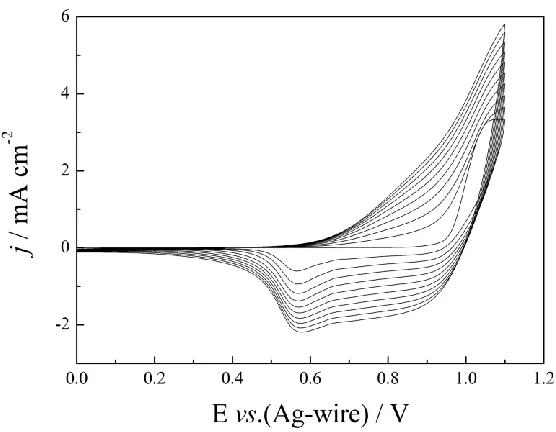
Electrochemical polymerization of the 2,6-BTN monomer was carried out in a mixture of DCM and ACN solution (1:1 by volume) containing 0.2 M NaClO4. Fig. 1 shows the cyclic voltammograms
(CV) of 2,6-BTN which has a onset oxidation potential (Epa onset) at 0.95 V and a distinct reduction
waves located at 0.58 V, while the corresponding oxidation waves are overlapped with the oxidation waves of the 2,6-BTN monomer and cannot be observed clearly. As the CV scan continued, the polymer films were formed on the working electrode surface. The increases in the redox wave current densities imply that the amount of conducting polymers deposited on the electrode were increasing [24]. The polymerization potential of the monomer is 1.1 V which was determined via cyclic voltammetry. Compared with 1,4-bis(2-thienyl)naphthalene (polymerization potential is 1.3 V vs. Ag wire) [20], 2,6-BTN has lower polymerization potential, indicating the oxidation potential of the latter one can be tuned by increasing its effective conjugate length. The low polymerization potential indicates that the electropolymerization process perhaps occured at the unsubstituted (α) positions of the thiophene ring (as shown in Scheme 1 (B)).
Figure 1. Cyclic voltammogram curves of 5 mM 2,6-BTN in 0.2 M NaClO4/ACN/DCM (1:1, by
[image:5.596.160.438.510.726.2]
3.1.2. Electrochemistry of the polymer films
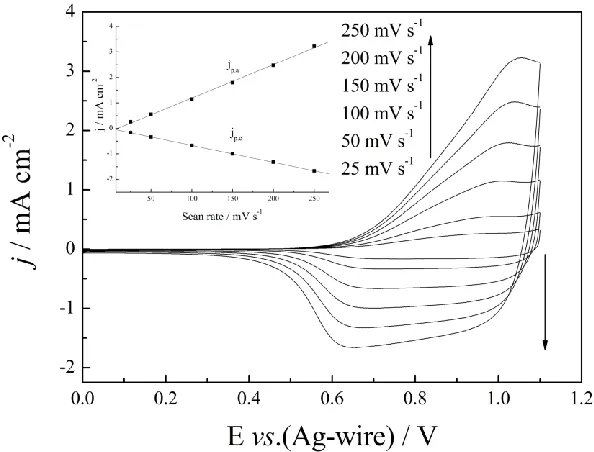
Fig. 2 shows the electrochemical behaviors of the P(2,6-BTN) films at different scan rates between 25 and 250 mV s−1 in 0.2 M NaClO4/ACN/DCM (1:1, by volume) solution. The P(2,6-BTN)
shows an oxidation wave at 1.05 V and a reduction peak around 0.66 V. Furthermore, according to the insets of Fig. 2, the peak current density (j) response increases with the increasing of the scan rate, indicating that the polymer films are electroactive and adhere well to the electrode [25]. The scan rate dependence experiments for both polymer films showed a linear relationship between peak current densities and the scan rates, which demonstrates that the electrochemical processes of the polymer are reversible and not diffusion limited [26].
Figure 2. The CV curves recorded in a monomer-free 0.2 M NaClO4/ACN/DCM (1:1, by volume)
solution of P(2,6-BTN) at different potential scan rates. Insets: peak current densities vs. potential scanning rates. jp.a and jp.c denote the anodic and cathodic peak current densities,
respectively.
3.1.3. Morphology
The surface morphology of polymer film was investigated by scanning electron microscopy (SEM). The P(2,6-BTN) film was prepared by constant potential electrolysis from the solution of 0.2 M NaClO4/ACN/DCM containing 5 mM monomer on ITO electrode and dedoped before
[image:6.596.150.447.271.497.2]
Figure 3. SEM image of P(2,6-BTN) deposited potentiostatically on ITO electrode.
3.2. Electrochromic properties of P(2,6-BTN) films
3.2.1. Spectroelectrochemical properties of P(2,6-BTN) films
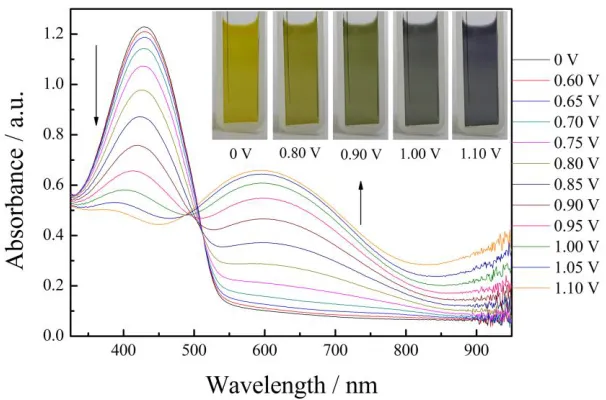
Spectroelectrochemistry is a useful method for studying the changes in the absorption spectra and the information about the electronic structures of conjugated polymers as a function of the applied potential difference [27]. The P(2,6-BTN) film were electrodeposited onto ITO (the active area was 0.9 cm × 2.0 cm) with the polymerization charge of 3.3×10⁻² C at 1.1 V. The P(2,6-BTN) film was switched between 0 and 1.1 V. At the neutral state, the polymer P(2,6-BTN) film exhibits an absorption band at 429 nm due to the π-π* transition.
[image:7.596.159.462.503.703.2]
As shown in Fig. 4, the intensity of the P(2,6-BTN) π–π* electron transition absorption decreased while two charge carrier absorption bands located at around 594 nm and longer than 900 nm increased dramatically upon oxidation. The appearance of charge carrier bands could be attributed to the evolution of polaron and bipolaron bands. The neutral form of P(2,6-BTN) is yellow in color. Stepwise oxidation of the polymer shows that the color changes from yellow to blue, while yellowish green, green and grey colors exist at intermediate potentials.
3.2.2. Electrochromic switching of P(2,6-BTN) films in solution
It is important that polymers can switch rapidly and exhibit a noteworthy color change for electrochromic applications [28]. For this purpose, double potential step chronoamperometry technique was used to investigate the switching ability of P(2,6-BTN) film (polymerization charge is 3.3×10⁻² C, coated area is 0.9 cm × 2.0 cm) between its neutral and full doped state (Fig. 5) [29]. The dynamic electrochromic experiment for P(2,6-BTN) was carried out by switching potentials between 0 V and 1.1 V at 594 nm. One important characteristic of electrochromic materials is the optical contrast (ΔT%), which can be defined as the transmittance difference between the redox states. As shown in Fig. 5, the optical contrasts of the P(2,6-BTN) were found to be 41.78% at 594 nm. Response time, one of the most important characteristics of electrochromic materials, is the necessary time for 95% of the full optical switch (after which the naked eye could not sense the color change) [30]. The optical response times of P(2,6-BTN) were found to be 2.6 s at 594 nm from the reduced to the oxidized state.
Figure 5. Electrochromic switching response for P(2,6-BTN) film monitored at 594 nm between 0 V and 1.1 V with a residence time of 4 s.
[image:8.596.167.432.446.645.2]
b
c
ΔOD = lg
T
T
andΔOD
=
ΔQ
η
where Tb and Tc are the transmittances before and after coloration, respectively. ΔOD is the change of the optical density, which is proportional to the amount of created color centers. η denotes the coloration efficiency (CE). ΔQ is the amount of injected charge per unit sample area. CE of P(2,6-BTN) film was measured as 160 cm2 C−1 for 594 nm at full doped state. The polymer film shows higher optical contrast (ΔT%) and coloration efficiency when compared with that of the poly(1,4-bis(2-thienyl)-naphthalene) (PBTN) [20]. The high degree of optical contrast and reasonable switching property make P(2,6-BTN) a promising electrochromic material for smart windows.
3.3. Spectroelectrochemistry of electrochromic devices (ECDs) 3.3.1. Spectroelectrochemical properties of ECD
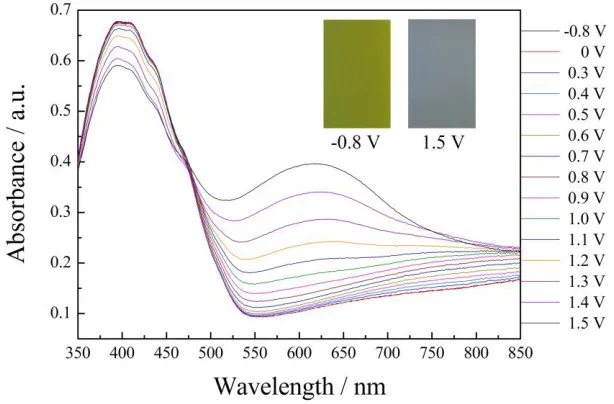
[image:9.596.155.462.517.719.2]The dual type ECD consisting of polymer P(2,6-BTN) film and PEDOT film constructed and its spectroelectrochemical behaviors were studied. The spectroelectrochemical spectra of the P(2,6-BTN)/PEDOT device as a function of applied potential (between –0.8 V and 1.5 V) is given in Fig. 6. At its neutral state, there was an absorption at 394 nm which is due to π–π* transition of the P(2,6-BTN). As the applied potential increased, the polymer layer started to get oxidized and the intensity of the peak due to the π–π* transition decreased, which leaded to a new absorption at around 615 nm due to the reduction of PEDOT, and the dominated color of the device was blue at 1.5 V. The device color from green shifted to blue with a clear and homogeneous change of color.
3.3.2. Switching of ECD
Double potential step chronoamperometry was performed to evaluate the response time of the device. The potential was stepped between –0.8 and 1.5 V with a residence time of 2 s. The experiments were carried out at 615 nm for P(2,6-BTN)/EDOT device. The maximum transmittance difference between the oxidized and reduced states was measured as 21.11% for P(2,6-BTN)/EDOT device. The time required to attain 95% of the total transmittance difference, was found as 0.7 s for P(2,6-BTN)/EDOT device (Fig. 7). CE of P(2,6-BTN)/EDOT device was measured as 200 cm2 C−1 at 615 nm.
Figure 7. Electrochromic switching, optical transmittance change for P(2,6-BTN)/PEDOT device at 615 nm between –0.8 and 1.5 V.
3.3.3. Open circuit memory of ECDs
[image:10.596.160.436.256.469.2]
Figure 8. Open circuit stability of the P(2,6-BTN)/PEDOT device monitored at 615 nm.
3.3.4. Stability of ECD
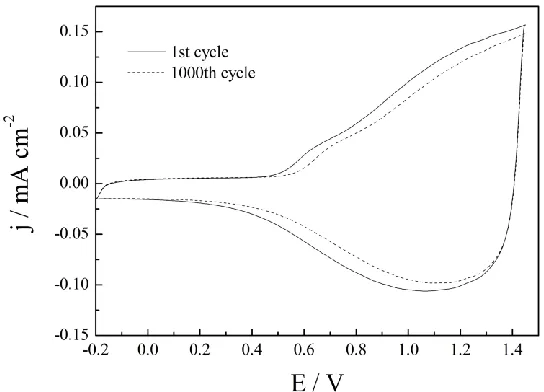
The stability of the device toward multiple redoxes switching usually limits the utility of electrochromic materials in ECD applications. Therefore, redox stability is another important parameter for ECD. In this study, cyclic voltammetry was exploited as a method to evaluate the stability of the devices. For this purpose, we accomplished non-stop cycling of the applied potential between −0.2 and 1.45 V for P(2,6-BTN)/PEDOT device, with 500 mV s–1 scan rate (Fig.9). As seen in Fig.9, after 1000 cycles, P(2,6-BTN)/PEDOT device retain 87.7% of their original electroactivity. This result indicated that this device have satisfactory redox stability.
[image:11.596.164.436.520.716.2]
4. CONCLUSIONS
2,6-Bis(2-thienyl)naphthalene monomer was successfully synthesized via Suzuki coupling reaction and electrochemically polymerized. The obtained polymer poly(2,6-bis(2-thienyl)naphthalene) (P(2,6-BTN)) was studied by cyclic voltammetry, UV–visible spectrum and scanning electron microscopy. Electrochromic properties of the multi-electrochromic P(2,6-BTN) film were investigated in details. Spectroelectrochemistry reveals that P(2,6-BTN) film has good electrochromic properties, high optical contrast and fast response time. The dual type ECD constructed utilizing P(2,6-BTN) and PEDOT has fast response time, satisfactory optical contrast and coloration efficiency. Particularly, the device displays saturated green at neutral state and good open circuit stability and cyclic voltammetry stability. These properties make the P(2,6-BTN) a good candidate for commercial applications.
ACKNOWLEDGEMENTS
The work was financially support by the National Natural Science Foundation of China (20906043,21171084), the National Basic Research Program of China (2011CBA00701), the Promotive research fund for young and middle-aged scientists of Shandong Province (2009BSB01453), the Natural Science Foundation of Shandong province (ZR2010BQ009) and the Taishan Scholarship of Shandong Province.
References
1. L.T. Huang, H. J. Yen, G. S. Liou, Macromolecules 44 (2011) 9595–9610. 2. C.G. Granqvist, Electrochim. Acta 44 (1999) 3005–3015.
3. P.R. Somani, S. Radhakrishnan, Mater. Chem. Phys. 77 (2003) 117–133.
4. T.A. Skohheim, J.R. Reynolds, Handbook of Conducting Polymers, 3rd ed.; CRC Press: Boca Raton, FL, 2007.
5. A. Cihaner, F. Algı, Adv. Funct. Mater. 18 (2008) 3583–3589. 6. R.J. Mortimer, A.L. Dyer, J.R. Reynolds, Displays 27 (2006) 2–18.
7. D.T. Gillaspie, R.C. Tenent, A.C. Dillon, J. Mater. Chem. 20 (2010) 9585–9592. 8. Pierre M. Beaujuge, John R. Reynolds, Chem. Rev. 110 (2010) 268–320.
9. E.N. Esmera, S. Tarkucb, Y.A. Uduma, L. Toppare, Mater. Chem. Phys. 131 (2011) 519–524. 10.P.M. Beaujuge, J.R. Reynolds, Chem. Rev. 110 (2010) 268–320.
11.W. Yang, J.S. Zhao, Y. Kong, T.Y. Kong, C.S. Cui, Int. J. Electrochem. Sci., 7 (2012) 2764–2780. 12.B. Wang, J.S. Zhao, J. Xiao, C.S. Cui, R.M. Liu, Int. J. Electrochem. Sci., 7 (2012) 2781–2795. 13.M. Ak, M.S. Ak, G. Kurtay, M. Güllü, L. Toppare, Solid State Sci. 12 (2010) 1199–1204.
14.P. Camurlu, E. Şahmetlioğlu, E. Şahin, İ.M. Akhmedov, C. Tanyeli, L. Toppare, Thin Solid Films 516 (2008) 4139–4144.
15.B. Sankaran, M.D. Alexander Jr., L.S. Tan, Synth. Met. 123 (2001) 425–433.
16.F. Larmat, J. Soloducho, A.R. Katritzky, J.R. Reynolds, J. Electrochem. Soc. 143 (1996) 161–163. 17.L.Y. Xu, J.S. Zhao, C.S. Cui, R.M. Liu, J.F. Liu, H.S.Wang, Electrochim. Acta 56 (2011) 2815–
2822.
18.B. Wang, T.Y. Kong, J.S. Zhao, C.S. Cui, R.M. Liu, Q.P. He, Int. J. Electrochem. Sci. 7 (2012) 615–630.
20.C. Li, M. Wang, C.S. Cui, L.Y. Xu, Z. Wang, T.Y. Kong, Int. J. Electrochem. Sci., 7 (2012) 1214– 1229.
21.B. Wang, J.S. Zhao, C.S. Cui, R.M. Liu, J.F. Liu, H.S. Wang, H.T. Liu, Electrochim. Acta 56 (2011) 4819–4827.
22.S. Chen, Q.X. Gao, J.S. Zhao, C.S. Cui, W. Yang, X.X. Zhang, Int. J. Electrochem. Sci. 7 (2012) 5256–5272.
23.G. Sonmez, H. Meng, F. Wudl, Chem. Mater. 16 (2004) 574–580.
24.R.R. Yue, J.K. Xu, B.Y. Lu, C.C. Liu, Y.Z. Li, Z.J. Zhu, S. Chen, J. Mater. Sci. 44 (2009) 5909– 5918.
25.G.W. Lu, G.Q. Shi, J. Electroanal. Chem. 586 (2006) 154–160.
26.B. Yigitsoy, S. Varis, C. Tanyeli, I.M. Akhmedov, L. Toppare, Electrochim. Acta 52 (2007) 6561– 6568.
27.J. Hwang, J.I. Son, Y.B. Shim, Sol. Energy Mater. Sol. Cell. 94 (2010)1286–1292.
28.E. Yildiz, P. Camurlu, C. Tanyeli, I. Akhmedov, L. Toppare, J. Electroanal. Chem. 612 (2008) 247–256.
29.E. Sefer, F.B. Koyuncu, E. Oguzhan, S. Koyuncu, J. Polym. Sci. Polym. Chem. 48 (2010) 4419– 4427.
30.A. Cihaner, F. Algı, Electrochim. Acta 54 (2008) 786–792.
31.S.J. Yoo, J.H. Cho, J.W. Lim, S.H. Park, J. Jang, Y.E. Sung, Electrochem. Commun. 12 (2010) 164–167.
32.M. Ak, M.S. Ak, G. Kurtay, M. Güllü, L. Toppare, Solid State Sci. 12 (2010) 1199–1204.