PHYSICS
and
SCIENTIFIC REALISM
by
JOHN PATRICK LONERGAN
A th e s i s s u b m itte d fo r th e d e g r e e o f D octor of P h ilo s o p h y of T h e A u s tr a lia n N a tio n a l U n iv e r s ity
ALL OF THE WORK REPORTED HEREIN IS MY OWN.
AS RECORDED IN §2.7.1, PART 1, I DISCUSSED TECHNICAL FEATURES OF THE TRANSISTOR AMPLIFIER WITH G. J. JOHNSON, FORMERLY ASSOCIATE
ACKNOWLEDGEMENTS
T here are m any to w hom I am in d eb ted . I owe a lot to Dr. Richard Campbell and to Dr. G enevieve LLoyd for th eir en co u rag em en t w h e n I re tu rn e d to philosophy in 1983 after a long break. To Paul Thom I am p articu la rly g ratefu l for his en th u siastic en d o rsem en t of the suggestion th a t I do my resea rch in th e philosophy of physics, and for his agreeing to act as a supervisor. To the staff and stu d e n ts of the D epartm ent of
Philosophy of the A. N. U., and especially to Drew Khlentzos w ith w hom I sh ared a room for a couple of years, I record my g ratitu d e for m aking the e n v iro n m en t such a delightful one in w hich to w ork.
My special th a n k s go to Dr. P eter Roeper and Professor Jack S m art who, as su p erv iso r and advisor respectively, encouraged me th ro u g h o u t the project and w e n t to a lot of tro u b le to criticize the e arlie r d rafts of th e p re se n t w ork. M istakes or deficiencies th a t m ay p erh ap s rem a in are solely my ow n doing.
IV
ABSTRACT
In this thesis I argue for a realist interpretation of physics. I respond to claims to the contrary by submitting rebuttals of some of the more serious objections, and by formulating and defending counter-claims.
It would be too ambitious to try to argue here for realism throughout physics, so I restrict my constructive efforts to the classical domain.
Attempted rebuttals of the anti-realist case, however, involve intrusions into the quantum arena.
I take issue in Part 1 with Nancy Cartwright. She argues in How the Law s o f P hysics L ie th a t: (i) the fundamental laws of physics are false; (ii) causal explanation can ensure truth, in which case the theoretical entities invoked are real; and (iii) current theories of
explanation are misconceived. To support (i) she analyses cases drawn from both classical and modern physics, and my response is to show in detail how, in these examples, I believe she is mistaken. Whilst I agree with (ii), I argue that there is incoherence in simultaneously holding (ii) with (i). As for (iii), I defend the D-N model of explanation and point to the inadequacies of Cartwright s simulacrum model.
In R epresenting an d In terven in g Ian Hacking argues for the reality of (theoretical) entities that can be manipulated in interactions with other things. However, he is agnostic on realism about theories, because he believes that incompatible theories can equally well cover a given range of phenomena. The case to which he points to instantiate the view is Hertz s treatment of mechanics in which Hacking claims to find
three equally good theories, with the overt threat of inconsistency among them. In Part 2 I argue that there is but one theory of mechanics and that Hertz s project was to investigate three different ways of
axiomatising it. Only one of the three ways (as conceived by Hertz) survives.
To support their position, anti-realists commonly seize on the doctrine, supposedly due to Pierre Duhem, that a given range of
it transpires, was not Duhem, but Henri Poincare. I explain how the
subsequent course of physics invalidated the grounds which misled these two philosophers into adopting it.
Part 4 examines Bas van Fraassen's claim to reduce to absurdity the demand for explanation that he thinks is exemplified in J.J.C. Smart's classic cosmic coincidence' argument for realism. I show that Smart s argument comprehends two different sorts of cosmic coincidence, and that van Fraassen addresses only the less formidable of these. In so
VI
CONTENTS
Certification ii
Acknowledgements iii
Abstract iv
Foreword xi
PART 1
ON CARTWRIGHT'S ANTI-REALISM
SI. INTRODUCTION 1
§2. THESIS 1 : THAT THE FUNDAMENTAL LAWS OF PHYSICS
DO NOT TELL THE TRUTH 7
1 The Argument from Principle, and the Multiplicity of
Theoretical Treatments 7
2 Interactions among the Theses 11
3 A Structure for the Whole Argument 12
4 Critique of the Argument from Principle 14
3 Laws that apply Ceteris Paribus - e.g. Snell's Law 18
1 Abstract and Phenomenological Laws - a Problem
of Demarcation with Some Consequences 22
6 The Intersection of the Gravitational and Electric
Domains, and the Composition of Causes 23
1 The Case for the Falsity of the Laws 23
2 The Case against 26
3 The Ground State of the Carbon Atom 36
7 Approximations that improve on Laws 39
1 Explanatory Practice and the Transistor Amplifier 39
2 Exponential Decay 49
8 Conclusion 51
53. THESIS 2 : CONCERNING CAUSAL EXPLANATIONS AND
THEORETICAL ENTITIES 52
1 Cartwright's Account in Summary 52
2 A Basic Objection 54
3 The Radiometer - Other Objections 61
4 Perrin and the Reality of Molecules - More Objections 70
5 What Cartwright s Examples, and Others, show 76
54. THESIS 3 : CONCERNING MODELS OF EXPLANATION 83
1 Explanation - the Story so far 83
2 The Significance of the Lamb Shift for the
Generic-Specific Account of Explanation 84
3 Cartwright's New Account 87
1 The D-N Model of Explanation and the Problem
about Bridge Principles 87
vu
4 Illustrations invoked to support the Simulacrum
Account, and the Contrast with the D-N Model 91
1 Quantum Theory - Explanation and Truth 91
2 False Description 93
3 Louisell's Treatm ent of the Laser 93
4 Extrapolation to Other Cases 93
5 Against the Thesis 97
1 Quantum Theory, Paucity of Bridge Principles,
and the Nexus between Theory and Phenomena 97
2 The Conventional Treatm ent of Hydrogen in
Quantum Theory 102
3 Louisell's Treatm ent of the Laser, and False Descriptions - Phenomenological Terms and
Realistic Modelling 107
4 The Problem of Theory Exit 113
5 The Transistor Amplifier 114
6 Woolworth's Radiometers 117
§5. CONCLUSION 124
PART 2
ON HACKING'S THEORY-AGNOSTICISM
§1. INTRODUCTION 125
1 Hacking s Basic Position 125
2 Hacking's Perception of Incompatible Theories in
Hertz's Treatm ent of Mechanics 128
S2. HERTZ'S PRINCIPLES OF MECHANICS AND THE CLAIM OF
MULTIPLICITY AND INCOMPATIBILITY OF EMPIRICALLY
EQUIVALENT THEORIES 131
1 Classical Mechanics 131
2 Hertz on Mechanics 137
1 Criteria for judging Concepts and Theories 137
2 Criticism of the Newtonian Formulation of
Mechanics 138
3 Criticism of the Energy Formulation 141
4 The Hertzian Formulation 146
5 Deficiencies of the Formulation 151
6 Two Objections to the Concept of Fixed
Connections 152
3 The Nature of Hertz's Project 156
1 Hertz's Motivation 156
2 The Essence of Hertz's Project 161
4 One Source of Possible Misconception 164
5 A Second Source of Possible Misconception
Vül 1 T he T h e sis of a C ru cial T e s t 167 2 T he Im p lic a tio n s of a S u c c e ssfu l T e s t 169 3 A n I n t e r p r e t a t i o n of H e rtz s T h e sis 172 4 F in al A s s e s s m e n t o f th e T h e sis 183 6 A Final W o rd o n H ack in g s I n t e r p r e t a t i o n of H e rtz s
E i p o sitio n 186
PART 3
DUHEM AND POINCARE : THE MISCONCEIVED GROUNDS FOR ANTI-REALISM
S I. OVERVIEW 189
§2. CONJUNCTION OF A MISCONCEIVED AN TI-REA LISM ABOUT
ENTITIES W ITH QUASI-REALISM ABOUT THEORIES 192
1 D u h em 192
2 P o in c a re 198
§3- GENESIS OF THE DOCTRINE OF M ULTIPLICITY AND
INCOMPATIBILITY OF THEORIES 2 0 6
1 D u h em 2 0 7
2 P o in c a re 2 1 0
1 T h e C ritiq u e of M a r v e l l 's T h e o ry , a D ilem m a,
a n d th e I n c o m p a tib ility T h e sis 211 2 T h e F a c to rs t h a t in f lu e n c e d P o in c a re 2 1 3 3 T h e Q u a lific a tio n s in th e D o ctrin e 2 1 6
§4. AN EVALUATION OF THE DOCTRINE 2 1 8
1 T h e D o ctrin e in R e tr o s p e c t 2 1 8 2 T h e M is ta k e n P e r c e p tio n of I n c o h e r e n c e in
M ax w e ll's T h e o ry 221
3 H ow D u h em m ig h t h a v e b e c o m e a R e a list 2 2 4
PART 4
ON VAN FRAASSEN'S RESPONSE TO ARGUMENTS FOR REALISM
S I. INTRODUCTION 2 2 7
§2. THE PRINCIPLE OF THE COMMON CAUSE 2 2 9
1 F o rm a l p r e lim in a r ie s 2 2 9
2 R e ic h e n b a c h ’s C o n ju n c tiv e C au sal F o rk s' 2 3 2 §3. VAN FRAASSEN’S CRITICISM OF THE STANDARD
ARGUMENTS FOR REALISM 2 3 6
1 S m a r t's p a ra d ig m a r g u m e n t 2 3 6 2 A n in tr o d u c tio n to v a n F r a a s s e n 's c ritiq u e , w ith
ii
1 Strategy of presentation 244
2 Demand for explanation, cosmic coincidences.and the principle of the common cause - connections
and clarifications 245
3 The argument that the alternative to Smart's demand for explanation is not a commitment to
coincidences on a cosmic scale 251
4 The claim that T is in principle no better than T1 253
§4. THE SUPPOSED REDUCTION OF THE REALIST'S DEMAND FOR
EXPLANATION TO ABSURDITY 258
1 Aims 258
2 A precis of the argument and of its rebuttal 258
3 The supposed refutation of Reichenbach s principle of
the common cause 259
4 A preliminary assessment and an impasse 260
5 van Fraassen's example lies outside the domain of
application of Reichenbach s principle 263
6 Reichenbach s reasons for the specific exclusion of
the sort of example invoked by van Fraassen 264
7 Three cases which fit van Fraassen's schema and are
irrelevant to Reichenbach's principle 266
8 Reichenbach's principle stands; so does Smart's argument; and the anti-realist remains committed
to lucky accidents 268
9 Reflections on Reichenbach's principle 270
§5. VAN FRAASSEN'S SCHEMA AND QUANTUM MECHANICS 273
1 The non-classical correlations 273
2 The schema and the EPR non-classical correlations 276
§6. CONCLUSION : CONCERNING THE SUPPOSED DEMAND FOR
HIDDEN VARIABLES 279
Appendix 1
INSTANTIATIONS OF VAN FRAASSEN'S SCHEMA
1. Case 2 - a structural connection between effects' 282
2. Case 3 - different descriptions of the same event 284
Appendix 2
THE NON-CLASSICAL CORRELATIONS
1. The Einstein-Podolsky-Rosen Argument
1 Some basic concepts in quantum mechanics 289
X
2. Bell’s Theorem and the Bell Inequalities 296
3. Experiments to test the Theorem 299
4. van Fraassen on epistemic realism 301
xi
FOREWORD
This project was begun with a different intention from that reflected by its current presentation. For, initially, my plan had been to see what I could offer in the way of a realist interpretation of modern physics, especially quantum mechanics. But the work had barely started when Nancy Cartwrights book, How the Laws of Physics Lie, came to my attention. And she raised serious questions about scientific realism, including in the domain of classical physics which I had always believed reasonably secure to a realist interpretation. It were best, I thought, to see how I might respond to Cartwright before I launched into what I
mainly aimed to do.
But then Cartwright s book led inevitably to Ian Hacking's
Representing and intervening, and to Bas van Fraassen's The Scientific Image. And all three forced me to go back to Pierre Duhem to look at his grounds for espousing the doctrine that incompatible theories could be empirically equivalent. Duhem's book, The Aim and Structure of Pbysicai
Theory, caused me in turn to go back to the writings of Henri Poincar6.
Now all of this took quite some time and resulted in a sizable
manuscript which, in the event, turned out to be the first draft of what follows. The project on realism in quantum mechanics remains for the future. That question is barely touched upon in the present work,
although it does arise in some of my responses to Cartwright - only because of the cases she introduces to support her claims. It also arises, but coincidentally, in my response to van Fraassen's alleged rebuttal of J. J. C. Smart s cosmic coincidence’ argument for realism. In fact, the
present thesis ends, quite abruptly, with my summary attitude in
Appendix 2 to van Fraassen's rebuttal of epistemic realism'. I justify this peremptory treatment by noting that epistemic realism' is a doctrine that few versed in physics would support, and that there is no mileage to be gained from its refutation.
which I do not respond substantively here, because the point marks the entry to what I hope will be the successor to the present work. I cannot refrain, however, from recording one comment. The non-ciassical
correlations are all to do with those rather peculiar properties, spin and polarisation. But the correlations would not be registered at all if
som ething were not interacting with each of the detectors. That
so m eth in g, in circumstances which we can arrange, exhibits properties other than the very strange ones that are the subjects of the
EPR/Bohm/Bell experiments. There is plenty of comfort here for the realist.
So much for the genesis of the present work. What underlies its orientation? Substantially, the thesis speaks for itself and reveals my strong commitment to scientific realism. But what does that entail? Put quite simply, it entails (i) the belief that (some) theoretical entities exist with the properties that physics reveals that they have, and (ii) the belief that (some) physical theories state truths which derive their integrity from the way the world is. These views could be expanded at length, and qualified at length. The simplest and most practicable thing to do here, however, is to point to the philosophers with whose writings I am most in sympathy.
Smart, in his several works, and W.H. Newton-Smith, in his The R ationality o f Science, head the list. Apart from them, when it comes to realism about entities there are few who present the implications and the case in support better than do Ian Hacking and Nancy Cartwright in the books which are the subjects of my criticisms here; and when it comes to realism about theories, there are, incredible as it may at first appear, few who put the case so forcefully and yet so concisely as does Pierre Duhem. In Part 3 of the thesis will be found the justification for this attribution to Duhem.
Since Newton-Smith receives only passing reference in what follows (see my p.127) let me put on record my admiration for the book
IUI
various parts of the text are, in essence, very closely akin to his cosmic coincidence argument. I hope that, to a modest extent, I have managed both to draw out some additional nuances of this argument and also to add to the grounds that support it.
Finally I am all too aware that, lurking below the surface of what 1 have written here, there are many unanswered questions. There are also
many places in the text where, with profit, I might have made diversions into other territory. The subtleties in The Scientific Image deserved
much more consideration than I could give at the time. For example, the last word has not been said, I believe, on the van Fraassen/Grover
[Parti,SI]
Part 1
ON CARTWRIGHT’S ANTI-REALISM
l
SI. INTRODUCTION
Do the laws of physics lie? Nancy Cartwright asks the question and answers yes' in a set of nine essays and an introductory synthesis1. Her arguments are deeply embedded in physics, and involve some thirty examples ranging from the abstractions of quantum theory to mundane concrete cases, such as toy radiometers costing $2.29 each.
Below, I present the essential thrust of her views and the reasons why I believe she is mistaken. Two prefatory comments are called for. Firstly, I do not follow the order of her presentation, the three
components of my account constituting interpretations distilled from throughout the book. Secondly, my task requires exegeses of a number of physical theories, some of which will unavoidably be somewhat lengthy.
Cartwright distinguishes within physics tw o k in d s o f explanation and, correspondingly, tw o k in d s o f law s:
1. A phenomenon is explained by subsum ption w ithin som e theoretical fra m ew o rk accommodating similarly
other phenomena. A scientific realist might say that a set of fundamental equations, expressing fu n d a m e n ta l la w s, governs the phenomena - e.g. Newton s Law of Gravitation and his laws of motion, applied to planetary movements; 2. A phenomenon is explained via an account o f h o w i t is
caused. The causal story invokes phenom enological law s which, unlike fundamental laws, are highly specific to concrete situations and describe what happens - e.g. Boyle s Law.2
[Parti,SI] 2
Starting with these distinctions and with the assumption of an abundance of highly confirmed phenomenological laws, Cartwright
argues fo r three theses'.
1. The fu n d a m e n ta l law s o f p h y sic s are fa l s e; their explanatory p o w er entails th eir fa ls ity, because that power derives from ceteris p a rib u s riders attached to the laws, or because our explanations involve com positions o f
causes or approxim ations that im prove on the Jaws\ 2. Causal explanations, by contrast, can guarantee truth, and
then the phenom enological law s invoked are true; 3. Current theories of explanation, in particular the covering
law or Deductive-Nom ological fD-NJ m odel are misconceived. The Sim ulacrum m odel provides an account that fits practice.
Cartwright dissociates herself from the view that phenomenological laws are about appearances and theoretical ones about the underlying reality. For her, phenomenological laws describe truly what happens in specific situations, and they may or may not explain. Theoretical laws organise knowledge by subsumption, exhibiting explanatory power at the expense of truth or descriptive accuracy; the processes of abstraction, simplification and organisation peel off the nitty-gritty detail without which there is no truth.
Her philosophical standpoint, Cartwright says, is a kind of anti realism'3: one acknowledging the phenomenological and rejecting the theoretical; but one not based on any theory/observation distinction. She
accepts theoretical e n title s fe a tu rin g in causal explanation. So, for example,
' We can believe in the unexpected entities of quantum electrodynamics if v e can give them causal roles"* *.
Not surprisingly, controlled experiments are advocated as the vehicles for progress in causal explanation. She is, then, an ti-rea list about
theories, b u t rea list about (som e) theoretical entities.
[Porti , SI ] 3
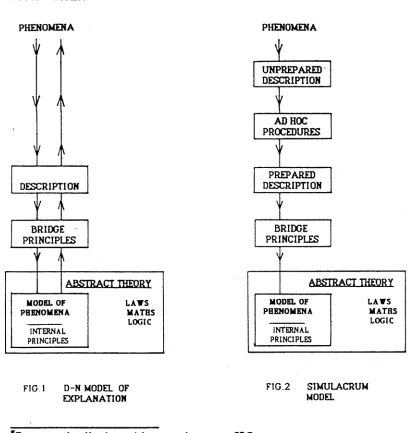
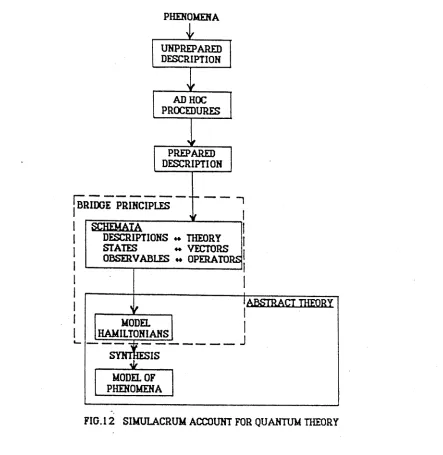
Refer now to Figs. 1 and 2, representing my interpretations
respectively of the D-N model of explanation and Cartwright's simulacrum model. Those figures properly belong to Thesis3, but they may be
usefully anticipated here to provide a good context for understanding what is going on in Thesis 1.
Typically the D-N model works like this : via a bridge principle we couple some description of a phenomenon to our theory, deduce
something from the conjunction, and then, via a bridge principle pointing in the reverse direction, formulate another description that can confront other phenomena; e.g., from observations that glass is an optically
isotropic refractive material, we might invoke Maxwell’s equations to deduce that Snell's law is true of that material, and using that law make predictions about glass (e.g. in lenses) that are tested by further
observations.5
PHENOMENA PHENOMENA
PREPARED DESCRIPTION
AD HOC PROCEDURES UNPREPARED DESCRIPTION
BRIDGE PRINCIPLES DESCRIPTION
BRIDGE PRINCIPLES
MODEL OF PHENOMENA
INTERNAL PRINCIPLE S
MODEL OF PHENOMENA
INTERNAL PRINCIPLES
ABSTRACT THEORY
L A V S MATHS
LOGIC
ABSTRACT THEORY
L A V S MATHS LOGIC
FIG 1 D-N MODEL OF EXPLANATION
F I G . 2 SIMULACRUM MODEL
[image:16.567.70.486.328.761.2][Porti , SI ] 4
If the claim that the fundamental laws of physics lie were sustained by showing that particular laws are false, then there would h a ve to be something wrong in the forward path of the D-N model. In that case a new account would be called for, and Cartwright has it available in the simulacrum model. Conversely, if it could be shown that the forward path is not as claimed in the D-N model, but rather that it is interrupted by some process or other that itself falsifies descriptions, as the simulacrum account has it, then the relevant laws would h a ve to be false.
Cartwright uses both approaches :
‘ som e illu stra tio n s p u rp o rt to fa ls ify particuiar Jaws (and so to discredit th e D-N m o d e l) ;
* others p u rp o rt to show th a t our e ip la n a to ry m ethods conform to th e sim ulacrum m odel an d so en ta il the fa ls ity o f the fu n d a m e n ta i Jaws.
. Notice that, in the simulacrum model, laws are true of prepared descriptions:
'....fundamental laws do not govern objects in reality; they govern only objects in models.'6
Deductions from the laws, then, must also be true of objects in models, not of objects in reality. But on this view Cartwright has a problem which she does not tackle - how is it that theoretical predictions, not about objects in models, but about objects in reality, turn out to be true? She gives no convincing account of how the simulacrum model gets us back from theory output to descriptions confronting reality. But more of that later!
[ Port i , SI] 5
She alms, then, n o t to reject fu n d a m e n ta l la v s b u t ra th er to r e sta te th eir roles'.
1. by showing that the fa c ti c ity view of laws is false - the view that laws of nature describe facts about reality, and that the laws are true when the descriptions are sufficiently well matched to the facts. This aim relates to Thesis 1;
2. by clarifying their explanatory function; this aim too relates to Thesis 1, and also to Thesis 3;
3. by showing how the breaking of the nexus between fundamental laws and reality is accommodated by the simulacrum account which has it that the so-called laws of nature govern objects in models, not objects in reality. This aim relates to Thesis 3.
P oints to be k e p t co n sta n tly in m in d in what follows are these: E m ianation of a phenomenon is provided either by
demonstrating its subsumption within a broad theoretical framework, or by pointing to its cause; the Jaws in the former case are fu n d a m e n ta l or theoretical, and those in the latter are phenom enological;
Theoretical la v s describe no particular circumstances, while phenom enological law s describe concrete situations;
Truth resides in descriptive accuracy; it is precisely because of the claim that the fundamental laws do not yield factual accuracy of description that Cartwright labels them false; on the face of it,
no Jaw properly characterized as fundamental is exempt from the claim that it is false;
A n ti-rea lism in Cartwright s philosophy focusses sharply on the fundamental explanatory laws. She accepts theoretical entities and causes, and allows that
all sorts of statements represent facts of nature'7.
[Porti, SI] 6
Throughout the book the three theses are run together in various ways. To facilitate understanding we will, in our consideration of Thesis 1, disentangle them to the extent practicable.
How then, with an eye on clarity of exposition, can we best go about the task of unravelling the several threads whilst not losing essential interconnections? My solution is :
‘to begin in §2.1 with exposition of Cartwright's web of argument that I have called the argument from principle’; ‘in S2.2 to note (i) how the three theses, taken together, conflict
with the Grünbaum (generic-specific) account of explanation, (ii) that something would be amiss if that account were valid, and (iii) Cartwright s arguments against the account;
‘with this background, to set out in §2.3 a structure for the full argument in support of Thesis 1 by locating the argument from principle in a unified context;
[Parti ,S2] 7
§2. THESIS 1 : THAT THE FUNDAMENTAL LAWS OF PHYSICS DO NOT TELL THE TRUTH
C artw right offers sev eral argum ents. One of th ese I call th e a r g u m e n t fr o m p rin c ip le . I t p u r p o r ts to s h o w th a t th e e ip ia n a to r y p o w e r
o f th e la w s o f p h y s ic s d o es n o t e n ta ii th e ir tru th , b u t r a th e r i s th e re a so n f o r th e ir f a l s i t y This a rg u m e n t is not simple, and m atters are fu rth e r com plicated by the fact th a t it o v erlap s w ith o th ers w hich are of a pragm atic c h aracter and stem from w h a t C artw right tak es to be our
m ethods of explanation.
2.1 The A rgum ent from Principle, and th e M ultiplicity of Theoretical T reatm en ts
The argum ent, w e are told, d eriv es v ia Bas v a n Fraassen from P ierre Duhem. It begins w ith a challenge :
"Show exactly w hat about the explanatory relationship tends to guarantee that, if x explains y and y is true, then x should be true as well".1
C artw right th in k s th a t this challenge has an answ er if and only if the explanation is causal. Let us defer co n sid eratio n of one of these
im plications till w e come to Thesis 2 and, for th e m oment, co n cen trate on th e o th er : if the ex p lan atio n is not causal, th e n the challenge cannot be answ ered.
Recall th at, if th e ex p lan atio n of a phenom enon is not causal, th e n it co n stitu tes su b su m p tio n of th e phenom enon w ith in a th eo ry at a higher level of generality. The claim is th a t such subsum ption, am ounting m erely to organisation or classification w ith in theory, has nothing to do w ith tr u th which, it is asserted , is a c h aracteristic ex te rn al to explanation and to theory.
C artw right adm its th a t th e a r g u m e n t fr o m c o in cid e n ce stan d s against her v iew about th e tr u th of e x p la n ato ry laws. This argum ent, she says, is often coupled to th e notion, in tro d u ced b y Gilbert Harman, of
in fe r e n c e to th e b e s t e i p i a n a t i o n:
[Porti ,S2] 8
‘It vouid be an absurd coincidence if a vide variety of different kinds of phenomena v e re ail explained by a particular lav. and yet v ere not in reality consequent upon the lav'.2
But, she goes on, we must impose on the argument from coincidence a constraint of n o n -red u n d a n cy \
'We can infer the truth of an explanation only if there are no alternatives that account in an equally satisfactory v a y for the phenomena'3 4
As we shall see when we consider Thesis 2, she argues that this
requirement is satisfied by an acceptable causal account of any particular phenomenon. By contrast, she claims, theoretical explanations often
proliferate, and she invokes Duhem's views in the following terms :
for any given set of phenomena, in principle there v ill alvays be more than one equally satisfactory explanation, and som e o f th e se
ex p la n a tio n s w ill be in c o m p a tib le . Since not ail of these can be true it is clear that tru th is in d e p e n d e n t o f sa tisfa c to r in e s s fo r
explan ation “*(my emphasis)
So the point reached is that, for the abstract laws, the constraint of non-redundancy, coupled with Duhem's views about multiplicity of theoretical treatment, has dealt with the argument from coincidence, and the van Fraassen challenge remains unanswered. Cartwright now moves to consider some actual cases of multiple theories in physics for the one phenomenom, in order to illustrate their occurrence and to show that these different theories serve differing explanatory purposes. The in feren ce which she chooses to draw is that wide explanatory p o w er goes h a n d in h a n d with the fa ls ity o f the abstract la w s invoked, confirming that abstract theory cannot meet the van Fraassen challenge.
She says:
' ...consider actual physical theories v h ic h v e are v illin g to account as acceptable, ...and ask "vhich ...explanatory claims are v e to deem true?". My ansver is that causal claims are to be deemed true, but to count th e basic e x p la n a to ry la ws as tru e i s to f a i l to take s e r io u s ly ho w p h y s ic s su cceed s in g iv in g ex p la n a tio n s:..I v i l l use tvo examples to sh o v this.’5 (my emphasis)
[Parti ,S2] 9
She then outlines the theory of quantum damping and its associated line broadening which exhibits
' a single causal story but a fruitful multiplication of successful theoretical accounts
The causal factor responsible for the widths of the lines observed in a spectroscope when atoms radiate light is identified as the reaction of the radiation field on the atom. For the theoretical treatment, she refers us to Agarwal's summary6 7 where, she says, there are six different approaches, each providing precise and accurate calculations for the shapes and
widths of the lines, and each starting from the basic Schrödinger equation but casting it into a form different from that of the others.
Cartwright dismisses the idea that the differences merely signify the use by physicists of techniques they know well. She interprets the six approaches as com peting with one another, offering d iffe re n t Jaws fo r e ia c tiy the sam e phenom ena. She acknowledges that Agarwal would disagree, and, in an ingenious twist, uses the substance of his purported disagreement to support the other component of her claim:
For Agarwal, the six approaches are complementary, serving different purposes;
For Cartwright, not only do they signify the invocation of different laws, but their supposed complementarity for different purposes shows just how their falsity endows them with wide explanatory power.
Her second example of multiplicity of theoretical treatments comes from a summary article8 on the theory of the laser, in which H. Haken provides a 'family tree' of the connections between different theories in a situation of theory overkill'9. This account of the different explanatory purposes of the different theories seems, p rim a facie, to offer good support to the theses for which Cartwright is arguing.
6ibid.
7Agarvai G. S; Quantum Statistical Theories o f Spontaneous Emission and th eir Relation to Other A pproaches; Springer-Verlag; 1974
8Haken H; The Semiclassical and Quantum Theory o f the Laser , in. Kay S.M. and Maitland A. (eds); Quantum Optics; Academic Press; 1970.
[Porti ,S2] 10
She asks us to consider, by contrast, the as yet unproven explanation of how Crookes' radiometer works (Fig.3). There it is a question, she believes, of determining which of two causal accounts is correct: do the vanes rotate as a consequence of stresses in the gas tangential to their
surfaces, or in response to forces perpendicular to the surfaces stemming from momentum interchange with the bombarding molecules of gas? When experiment settles the issue, she says, only one causal account will survive. We will look more closely at this example when we examine Thesis 2. Meanwhile we will concentrate on Cartwright's views about fundamental laws and theories.
EV AC U AI FLASK
^ V A N E S MOUNTED ON I STRUTS PIVOTED AT / CENTRE
EACH VANE HAS ONE SIDE BLACKENED. THE OTHER SILVERED
TO VACUUM ^ PUMP
VANES ROTATE VHEN ILLUMINATED BY LIGHT OR HEAT
( A ) ’WINDMILL' VERSION
TO VACUUM PUMP
= 7\
TORSION SUSPENSION RESTRAINS ROTATION
MIRROR CAUSES LIGHT TO BE REFLECTED TO A SCALE SHOVING DEFLECTION
( B ) DEFLECTION VERSION
[Parti ,S2] 11
2.2 Interactions among the Theses
Since Cartwright believes that phenomenological laws are true but fundamental laws are not, and that the van Fraassen challenge can be
met in the case of the former but not the latter, she moves, as she must do, to put paid to the realist view that the fundamental laws are basic and that the phenomenological laws hold because of them. The D-N
m o d el o f explanation may be interpreted along such lines: from statements of the abstract fundamental laws we formally derive statements of the phenomenological laws, such deductions mirroring causal relations in the material world. Cartwright rejects the doctrine, claiming that we cannot justify the metaphysical supposition. On such a basis, therefore, we have no warrant to invoke the D-N model of
explanation as ground for the truth of the fundamental laws.
Grünbaum 's view of the relationship between fundamental and phenomenological laws, which Cartwright calls the generic-specific
account, avoids metaphysics : phenomenological laws are special cases of more comprehensive truths expressed by fundamental laws. This account fits comfortably within a D-N model: a fundamental law, supplemented by specification of physical circumstances, entails the relevant
phenomenological law; the fundamental law make the same claims as the phenomenological law when account is taken of the specific facts at hand.
Cartwright reje c ts th is account on th e grounds that actual explanations in oh vsics do n o t proceed in th is w ay:
*'Itis n e v e r s tr ic t deduction that takes you from the fundamental equations at the beginning to the phenomenological laws at the end. Instead we r e q u ir e a. v a r ie ty o f d if f e r e n t approxim ation s In any field of physics there are at most a handful of rigorous solutions, and those usually for h igh ly artificial situations.'10 (my em phases); *'p r a c tic a l a p p ro x im a tio n s u su a lly im p r o v e on th e a c cu ra cy
o f o u r fu n d a m en ta l la w d11 (my em p h a sis),
producing som ething closer to th e tru th than w ould b e obtained via a rigorous d ed u ctive r o u te. Moreover, she says, seldom are the fa c ts su ffic ie n t to j u s tify th e d e riv a tio n; this being so, how can it be sustained that the two types of laws make the same claims?
[Porti ,S2] 12
Additional premises have to be supplied and sometimes choices among these, not dictated by the facts, have to be made; and
*' different choices give rise to different in co m p a tib le results. The generic- specific account fails because the content of the
phenomenological laws we derive is not contained in the fundamental laws which explain them' 12 (my emphasis)
Such is Cartwright s case against the Grünbaum account. Her strategy, then, is to isolate causal laws (Thesis 2) from deductive connection with fundamental theory, and so make room for Theses 1 and 3.
2.3 A Structure for the Whole Argument
The story is not simple, and it grows in complexity as it further unfolds. As background for a critique I now provide a formal precis of the whole argument b y anticipation o f what lie s ahead and conjunction of that with what we have already heard:
(a) A challenge : show that explanation entails truth;
(b) First p ro p o sitio n: the challenge cannot be met for explanation via abstract laws;
(c) First objection t o{ h): the argum ent fro m coincidence constitutes a strong reason for belief in inference to the best explanation and so to the truth of fundamental laws;
(d) Counter to i t ); the argument from coincidence is subject to the constraint of non-redundancy; Duhem has taught us that, for any given phenomenon, there will always be more than one
satisfactory explanation; since som e o f these eip lanations w ill be incom patible, tru th m u st b e in d ep en d en t o f satisfactoriness fo r e ip ia n a tio n;
(e) A rg u m en t in support o f (b) - Second p ro p o sitio n :
....to count the basic explanatory laws as true is to fail to take seriously how physics succeeds in giving explanations ...if th e th e o r y is to h a v e
con sid era b le e x p la n a to ry p o w er, m ost o f i t s fu n d a m en ta l claim s w ill n o t s ta te tr u th s ...a n d ..th is w ill in g e n e r a l in clu d e th e b u lk o f o u r m ost h ig h ly p r iz e d la w s a n d equationS 13 (my
emphasis);
[Parti ,S2] 13
(f) in support of (e) c o n sid e r actuaJ c a s e s :
i. where the same phenomenon is subject to different laws, e.g. quantum damping- instances being
* s p e c tr a l lin e b r o a d e n in g, and x la s e r th e o r y ,
ii. where laws carry c e te r is p a r ib u s q u a lif ie r s , e. g. * S n e ll's Jaw ,
iii. where laws intersect, or w here there is composition of causes, e g.
* th e g r a v ita tio n a i fo r c e J a w, and th e eJectric fo r c e J a w,
* e n e r g y JeveJs in th e g r o u n d s ta te o f th e carbon a t o m;
(g) S e c o n d o b je c tio n t o { b ): deductive relations between statem ents of fundam ental laws and statem ents of
phenomenological laws m ir r o r causaJ re J a tio n s in the material world (one interpretation of the D-N model of explanation)14;
(h) C ounter to { g ) : no justification can be given for the metaphysical supposition;
(i) T h ir d o b je c tio n t o (b) - (a realist interpretation of the D-N model of explanation, namely the g e n e r ic -s p e c ific account of G rünbaum ): phenomenological laws are special cases of more comprehensive truths expressed by fundam ental laws; statements of the former are deducible when statem ents of the latter are supplemented by statem ents expressing the relevant physical circumstances;
(j) C ounter to (i ) :
i. phenomenological laws are n e v e r derived strictly from the fundam ental equations; approximations are required,
ii. a p p r o iim a te d e r iv a tio n s usuaJJy im p r o v e on the accuracy of the fundam ental laws,
iii. where approximations are required, choices not dictated by the facts have to be made, and
‘ different choices give rise to different incompatible results’^;
[Parti ,S2] 14 (k) in support o f ( j ) :
i. no attempt is made to prove (j) i,
ii. as we shall see, the examples offered of (j) ii are
‘the equivalent circuit of a single stage transistor amplifier, and
‘the th eo ry o f e ip o n e n tia i decay, iii. examples given of (j) iii are
‘the Lamb s h ift in the excited state of a single two-level atom, and
‘the Lamb shift in the ground state of the atom.
Further exposition and criticism will be presented in the context of the structure thus identified.
2.4 Critique of the Argument from Principle
Cartwright writes sometimes as though what matters in supporting (b) is mere multiplicity of alternative treatments rather than multiplicity together with incompatibility. Thus, for example, she says:
' We can infer the truth of an explanation only if there are no alternatives that account in an equally satisfactory v a y for the phenomena'16
At other times she seems to take it for granted that multiplicity of explanation entails incompatibility - for example :
Marvell's explanation involving tangential stresses in the radiometer is incompatible v ith the earlier ligh t pressure account, and it is incompatible with the more standard hypothesis involving normal pressures'17
We must insist that multiplicity does not entail incompatibility, f t wouid be the in co m p a tib iiity ciause in {d), n o t m ere m uitipiicity, that
w ouid estabiish (b). Duhem's argument would not work for alternative theories that are compatible.
/ g iv e f u i i consideration to the g en esis o f Duhem 's view in P art3 o f th e p re se n t work and show in detail how he was misled by the state of physics in his day. It is my claim that there is no instance in contemporary physics where the sam e phenomena are explained by
credibie different theories, of which at least one is incompatible with
[Parti, S2] 15
another. To back up this claim /
show in detail in Part 2 how
Hacking is mistaken when he points to Hertz s Principies of
Mechanics
as instancing the contrary.The dogma at 2.3(d) is well known in the latter day guise of Quine's thesis18 of the under-determination of theory. The strong version of this thesis has it that two theories could be empirically equivalent and so of equal explanatory value, and yet logically incompatible; a weak version omits the rider of incompatibility. Quine attempted to establish the strong thesis19 but, in some good company, I believe that he failed to do so. In Davidson s words :
' ( Quine) goes to lengths to convince us that there may be tvo theories such that they imply all and only true observation sentences, are equally simple, and yet logically incompatible. Thus truth is apparently relative to a theory. But Quine settles, at the end, for a frank dualism’ in v h ic h distinctive signs are used to state the theories. The theories turn out to be irreducible one to the other, but unconflicting. No relativism remains.’20
We can only muster the weak version of the thesis of under- determination of theories and, in consequence, 2.3(d) loses its force against (c), and (c) retains its force against (b). So we conclude that
the argument summarised at
(a)through
(d)does
not stand as a refutation of any ciaim to the effect
that ezpianation entaiis tru th
, and moreoverthe argument from coincidence remains on the
books as potentiai compiement to the thesis of
inference to best ezpianation.
Despite this theoretical failure to establish the strong thesis of under- determination of theories, nevertheless,
if, contrary to my ciaim
above, it were the case that we couid actuaiiy point to different
accepted theories which both ezpiained a given phenomenon
and were Jogicaiiy incompatible,
then (b) would be established since(d) could be rephrased to serve as a counter to (c). Propositions (e) and
18Q uine¥. V; Word a n d Object , M.I.T. Technology Press; Cambridge (Mass.); 1960; p.22 and p.78
19Quine W .V; On E m p iric a lly E q u iva len t S ystem s o f th e World-, in E r k e n n tis9; 1975; pp 313*328
[Parti ,S2] 16
(f) can be interpreted as being aimed in part at moving the argument forward along these lines.
Cartwright s immediate example, (f) i, is the six different theoretical treatments of quantum damping that explain spectral line broadening :
' All six provide precise and accurate calculations for the shape and width of the broadened line,... (but) offer different laws for e x a c tly th e sam e p h e n o m e n a21 (my emphasis)
But note that the question of incompatibility of these laws, which is of vital importance to the argument, does not arise explicitly and,
presumably, is taken for granted.
The example illustrates how Cartwright sees explanation working throughout physics:
Tn physics it is usual to give alternative theoretical treatments of the same phenom enon. We construct different models for different purposes, with different equations to describe them. Which is the right model, w hich the "true" set of equations? The question is a mistake. One model brings out some aspects of the phenomenon; a different model brings out others. Some
equations give a rougher estimate for a quantity of interest, but are easier to solve. No single model serves all purposes best.' 22 (my underlining)
This passage throws additional light on (e), but, here too, the question concerning incompatibility is left hanging.
The last quotation might give rise to some unease. Although at first sight it seems to be something to which we could readily assent,
nevertheless, it embodies a covert a m b ig u ity associated with the
phrase, the sam e phenomenon. Take the case of a transistor amplifier and consider three different models used to represent i t : the low
frequency, the mid frequency, and the high frequency e q u iv a le n ts.2^ Are
they models of the same phenomenon? Well, they are models of a
working transistor, so we might be tempted to answer yes’. But working transistors deal in signals, and signals come in convenient, albeit
different, categories, and what is being modelled is the transistor working in the domain appropriate to the signal category chosen. I say that, in this case, the same phenomena are not being treated in the three models,
21 Cartwright; op. cit; pp 79/81 22op. cit; p .ll
[Parti ,S2] 17
except in the two special cases where low and mid frequencies merge, and where mid and high frequencies merge.
In the examples where line broadening only is being considered, the six different treatments clearly do deal with the same phenomenon. But that is not the case with Cartwright's second example which draws on Haken s family tree' of laser theories. There at least some of the theories deal specifically with matters that others do not. Only when m odels
overlap In what th e y trea t can we sa y th a t th e y are com peting In explanation; a n d then, o n ly I f we could show that th e y were Incom patible, could we claim one or m ore false.
With the qualification just made about ambiguity in the phrase the sam e phenom enon, Haken s discussion of the laser fits well to the views expressed by Cartwright about models. And Haken is at pains to
show how and where the different models apply, and how they are related. But no hint of incompatibility among them is to be detected in the text; it is just that some handle certain questions and not others; for example, determination of line width or intensity fluctuations requires full quantum mechanical treatment; for the threshold condition at which lasing action starts, we can get by with the much simpler treatment
afforded by semi-classical equations. But note that, in all cases, each model originates from the same theoretical foundation -interaction between the field equations for the behaviour of quanta and the
(appropriate) equations for matter, mirroring as it were the sort of actual causal type mechanism that Cartwright s own anti-realism approves. There would have to be incompatibility at that level of the theory if incompatibility were to be found at lower levels reached by normal
deductive routes. But the common starting point for the theories seems to militate against the possibility of incompatibility arising there except via incompatible descriptions of the physical circumstances to which they are being applied. Let me re-emphasise the point that m e re ly d iffe re n t
descriptions do n o t su ffic e fo r Incom patibility.
[Parti ,S2] 18
different theoretical treatments of the laser. But unless the laws are incompatible, the Duhem argument does not go through.
I conclude th erefo re that, p ro tew , n e ith e r 2.3(b) nor is), insofar as (e) depends on (f) i, has been established, and that the
argum ent from coincidence and the th esis o f inferen ce to b est eip la n a tio n (c) h a ve n o t been refuted.
We may now turn to detailed examples of th e rem aining three ty p e s o f ein la n a to rv p ra c tic e, namely (f) ii, (f) iii and (j) ii, each of which, it is claimed, supports the thesis that the fundamental laws of physics lie.
But before we do so there is an item which can be got out of the way. I do not intend to challenge Cartwright here in her counter 2.3(h) to the interpretation (g) of the D-N model. Rather, I d e fe n d the Grünbaum
version, an d I claim in §2.5 that Cartwright s own eiam ple, Snell's law ; is an endorsem ent o f it. F urther support fo r the Grünbaum m odel w ill be forthcom ing in §4.
2.5 Laws that apply Ceteris Paribus-, e.g. Snell's law
The second pragmatic argument, (f) ii, begins with the claim that our usual explanatory practice is to take a fundamental law as true, only subject to a ceteris p a rib u s modifier; that is, the law
‘...holds only in special circumstances'24
This qualification, the argument continues, shows that the law is false, because the modifier s effect is to isolate it, in one way or another, from application to factual situations. But, Cartwright says, the retention of these false laws on the books has value for explanatory purposes because it is in this way that the factors to be admitted in explanation are
registered and types of explanation are authorised.
In this section I focus my objection on the example she gives to illustrate the argument, namely Snell s law. If that example is representative, then I claim that this line of argument fails.
[Porti ,S2] 19
Snell's law (Fig.4) in its usual formulation relates the angles of incidence and refraction when light crosses the boundary between two isotropic materials : nj Sin 8j = n2 Sin82 . According to Cartwright the law is false, and the reason she gives is that there are anisotropic media (certain crystals) which exhibit double refraction. For her Snell s law applies only in circumstances ceteris p a rib u s (which she prefers to see interpreted as other things being right’).
I *<--- nor m il to b o u n d a ry
in c id e n t ray re fle c te d ray
m edium 1
m edium 2
re fra c te d ra y
SHELL'S La w: Hj * in 9 | a n 2 i i n 0 2
w h e re n Itn 2 a re r e f r a c tiv e in d ices (c o n sta n ts) d e te rm in e d b y th e v e lo c ity of lig h t in
m edium 1 and m edium 2 re s p e c tiv e ly .
FIG.4 ILLUSTRATING SNELL S LAW
But surely no-one would claim that Snell’s law in its usual
formulation is a completely unrestricted generalisation. No covering law theorist would do so, because its derivation from other principles would not go through if the materials concerned were other than isotropic. The fact that the law can be so derived and that its derivation requires the factual premise of isotropy runs counter to Cartwright’s denial that phenomenological laws are entailed by fundamental laws in the manner of the generic-specific account of explanation. For the law is deducible from Maxwell’s equations2^ and there is no good reason not to regard it
[Porti ,S2] 2 0
also as a well-confirmed phenomenological law. In the same process we can also derive some related laws:
* that the incident, reflected and refracted rays are co-planar; ‘ that the angle of reflection is equal to the angle of incidence; * that the energies in the reflected and refracted beams are of
specified amounts (the Fresnel equations);
*that, for a certain angle of incidence, the reflected ray will be plane-polarised (Brewster's law), this being the basis o f a sta n d a rd m e th o d fo r producing p i an e-p oiarise d Jigh t. So far when I have spoken about Snell's law I have added the
qualification, in its usuai form ulation .This I have done with an eye on a way in which a law of similar form arises for refraction in both isotropic and anisotropic cases.26 For reasons that will shortly become apparent the law in its more general formulation is not given a new name but is still called Snell's law':
"ve should remember that Snell's l a v ....is a lw a y s true for the k-vector directions"27 (emphasis in the original)
A detailed exposition would take us too far afield so I give only a brief summary. Electromagnetic energy propagation through anisotropic
media can be represented by two refractive index surfaces called u- surfaces, each associated with a particular vector called a k-vector.* 2* In the special case of an isotropic medium there is only one p-surface and that surface is spherical. The k-vector is then nothing different from the ray path of geometrical optics, and Snell s law could be said to apply to the k-vector or to the ray path, interchangeably.
The theory of u-surface construction for anisotropic materials is outlined by Lipson and Lipson2^ and we may take it that particular 4- surfaces are characteristic of particular crystals. Now, from Maxwell’s equations and continuity conditions at the common boundary of any two
26Iipson S.G. and Lipson H.; O p tica l P h ysics, Second Edition; Cambridge University Press; 1981. See especially Chapter 3.
27op. cit; p.115 2Sop. cit; pp94-%
[Parti ,S2] 21
media, it follows that Snell's law holds for the two k-vectors. The respective ray paths are then determined uniquely by the points of intersection of the ke-vector (corresponding to the extraordinary ray' of conventional optics) and the k0-vector (corresponding to the ordinary ray ) with their respective u-surfaces.
We may therefore generalise Snell's law, in terms of k-vectors, over both isotropic and anisotropic media, the general formulation reducing to the usual one about ray paths as soon as we apply the specific
phenomenological condition of isotropy. In the anisotropic case the law in its general formulation, along with the specific conditions of anisotropy in particular crystals, together with information about the incident light summarised in the relevant k-vector, tells us how that light will be refracted in the anisotropic medium.
In the circumstances I have described I am unable to agree with Cartwright that Snell's law is in any sense false or that it holds only
ceteris paribus
I conclude that the example afforded by Snell's law serves Cartwright b a d ly.
1. the Ja w is tr u e;
2. taken as a phenom enological law, i t can be d erive d from abstract th e o ry and so confirm s the Grünbaum generic-specific account o f explanation . It is thus at odds with the simulacrum account and is a counter-exam ple to
Cartwright s claim that i t is n e v e r strict deduction that ta kes yo u fro m fu n d a m e n ta l equations to
phenom enological la w s. §2.3(0, pace Cartwright, seems tobe holding up well, and her claim at (j) i appears to have been refuted (see my p. 13);
3. taken as a fu n d a m e n ta l law, it features in that sort of explanation where detailed data about phenomena, in this case refracted light, are derived from the law plus specifics30 of the case at hand. In this, the exam ple again supports the g en eric-sp ecific account o f exp la n a tio n;
[Porti ,S2] 22
4. the case also introduces another problem which I outline in a moment and which threatens Cartwright's whole enterprise. There may be other instances of ceteris p a rib u s laws that would do better. But the prospects would not look promising if interpretation of the law of universal gravitation ceteris paribus, in the manner
conceived by Cartwright, were to fare just as badly, as I claim below.
2.5.1 Abstract and Phenomenological Laws - A Problem of Demarcation, with Some Consequences
Snell's law reveals a demarcation problem for Cartwright. Whilst there are seemingly obvious cases where one law should be called 'abstract' or
fundamental' and another 'phenomenological', there seem to be other laws that could be put into either category, at the whim of the classifier. Ohm s law, Boyle's law, Ampere's law, ...are further examples.
The problem arises when some seemingly very particular concrete phenomenological law acquires a degree of wider applicability that lifts it into a plane of abstraction removed from any one of its particular
manifestations. Concurrently, the law may start to assume the status of a fundamental law. Indeed it may turn out to be one that can be deduced within an encompassing abstract theory - Kepler's laws for instance.
Now the process just described presents Cartwright with a problem. The law which started out as a well confirmed phenomenological law and which, by her lights, is therefore true, turns into a fundamental law which, by her lights, ought to be false. Notice that what we have here is just the generic-specific model going in reverse.
Cartwright's response might be to insist that she is referring to the law (e.g. Snell's law) in its usual formulation and that the move to generalise that law beyond any particular occurrence results in falsity because there are non-isotropic materials for which it would be false. If that were all there were to it, then our dispute would be only about
[Parti , S 2] 23 One thing that the example brings out is that Cartwright m ust eJab or ate the criterion b y which the distinction is made unam biguousiy b etw een Jaws that are phenomenoJogicaJ and Jaws th a t are abstract. SneJJ's Jaw, I thinJc, show s that th e
distinction is in danger o f coJJapse.
2.6 The Intersection of the Gravitational and Electric Domains, and the Composition of Causes
2.6.1 The Case for the Falsity of the Laws
As an introductory comment I note that Cartwright’s views here are similar to some of Bertrand Russell's31, but I shall not try to draw
comparisons. Interestingly enough, Russell’s remarks also bear directly on issues we discuss in Part 2 concerning Hertz's mechanics.
What Cartwright aims to show is that the fundamental laws of physics, here exemplified by Coulomb’s law and the law of Universal Gravitation, taken as descriptions of facts, are false and that, when
amended to be true by the addition of ceteris parib u s modifiers, they lose their explanatory force.
She thinks that, when causes combine in the intersection of different domains, the laws we invoke to calculate what each cause contributes cannot do their jobs if they are taken to be literally true:
' the la v s v e use are designed only to tell truly v h a t happens in each domain separately 32
She rejects any appeal to ’super' laws, attributable to the unity of nature - firstly because she thinks that such laws, when available (and that, she says, is rarely), may not be sufficiently explanatory; secondly because, when they are not available, she declines to accept promissory notes for their eventual appearance; and thirdly because she has a metaphysical view (which she does not urge) that nature is too untidy for there to be hope of finding laws matching the uniformity believed in by the realist.
31Russell B; The P rin cip J es o f M athem atics, Allen and Unvin; second edition; 1937; see esp. pp474 and 485
[Parti ,S2] 24
She tells us that neither the law of Universal Gravitation
(F=Gmim2/ r 2) nor Coulomb's law for the force between two charged bodies (F=q jq2/ r 2) is true by itself. For b o d ie s th a t are b o th m a s s iv e
a n d c h a r g e d th e tw o ia w s in te r a c t a n d n e i th e r ia w b y i t s e i f t r u l y s ta te s h o w th e b o d ie s b e h a v e:
' No charged objects v i l l behave just as the la v of universal gravitation says; and an y m assive objects v i l l constitute a counterexample to Coulomb s la v . These tv o la v s are not true; v o rse they are not even approximately true. In the interaction b etv een the electrons and the protons of an atom, for example, the Coulomb effect svam ps the gravitational one, and the force that naturally occurs is v ery d ifferen t from that described by the la v of gravity" 33
She allows that the law of gravity, prefixed by a c e te r is p a r ib u s modifier- ( If there are no forces other than gravitational forces at work, th e n ... ')- is true, but, she claims, it is not a very useful law :
‘ This la v can explain in on ly v e r y simple, or ideal, circum stances...it is of no h elp for cases in v h ic h both gravity and electricity matter. Once the
c e te r is p a r ib u s m odifier has been attached, the la v of gravity is irrelev a n t to the more complex and in terestin g situations' 34
Cartwright, casting her thoughts ahead to her intended simulacrum account, attributes the supposed failure of facticity to the nature of the explanations we give rather than to the nature of our physics : w hen we explain via composition of causes, the laws we invoke do not satisfy the requirem ent of facticity; each law by itself states that something will happen which, in the event, does not accord with what occurs when they act in combination. To be true the law would have to describe w hat actually occurs (which it does not), but to be explanatory it has to
describe something else (which it does) which is not what happens. H er ciaim h e r e in s ta n c e s again h e r c o n v ic tio n a b o u t th e in e v ita b ie tr a d e - o f f b e tw e e n tr u t h a n d e x p ia n a to r y p o w e r
She dismisses vector addition as metaphor; it is we who add forces vectorially, not nature. We will see later that this view is mandatory if the simulacrum account of explanation is to hold. As Cartwright has it, the law of Universal Gravitation and Coulomb's law
33op. cit; p.57
[P o rti, S2] 25
do not satisfy the facticity requirement. They appear, on the face of it. to describe what bodies do : in the one case, the two bodies produce a force of size. G m jfl^/r2; in the other, they produce a force of size, q ^ / r 2 But this cannot literally be so. For th e fo rc e o f size, Gm jm 2/1^, e n d th e
fo rc e o f size, q / q2/r * ', a re n o t redi, o c cu rre n t forces. In
in tern c tio n s s in g le fo rc e occu rs - th e fo rc e we c a ll th e r e s u l t a n tand this force is neither the force due to gravity nor the electric force. On th e v ec to r addition story, th e g r a v ita tio n a l a n d
th e e le c tr ic fo rc e a re both produced, y e t n e ith e r ex ists' 35 (my emphases)
I argue b elo w that, in th ese views, Cartwright is radically m istaken.
A few paragraphs on she softens her views just a little :
‘It is im p la u sib le to take the force due to gravity and the force due to electricity literally as parts of the actually occurring force ‘ 36 (my emphasis)
This milder conclusion emerges from her criticism of Mill s assertion that a body subject simultaneously to a force to the north and one to the east would be caused to move in a given time exactly as far in both directions as the two forces would separately have carried it. For Cartwright:
.... no pure north motion can be a part of a motion that always heads north east*^
/ argue b eio w th a t Cartwright is aiso m istaken on th is point.
To make her supposed rebuttal of Mill the more striking Cartwright charges him with the view that a body pulled equally in opposite
directions would be caused to move simultaneously in both - an
attribution for which his words seem to me to give no licence, but a view which can be sustained in appropriate circumstances38.
Vector addition would make sense, Cartwright believes, and the law of gravitation and Coulomb s law would be true, if we were to give up the facticity view of laws and make them descriptive of the ca u sa ip o w ers that bodies have. Thus, two bodies would have the power to produce a force, Gmim2/ r 2, which they would not always succeed in exercising. The