2003 Namibia Joint Annual Report of
the National Authorising Officer and
2003 Namibia Joint Annual Report of the National Authorising Officer and
Head of Delegation
1. EXECUTIVE
SUMMARY ... 1
2. NAMIBIA
POLICY AGENDA... 2
3. POLITICAL,
ECONOMIC
AND POVERTY SITUATION ... 3
3.1. Political situation ...3
3.2. Economic situation...3
3.3. Poverty situation...5
3.3.1. Poverty indicator – the Human Development Index...5
3.3.2. Progress in Education MDG...5
3.3.3. Progress in Health MDG ...6
3.3.4. Progress in Water MDG ...8
3.3.5. General Assessment of Poverty Situation...9
3.4. Cross cutting issues ...10
3.4.1. Gender ...10
3.4.2. Environment ...11
3.4.3. Fisheries policy...11
3.4.4. Migration and LRRD...11
3.4.5. Food Security situation and Drought Relief...12
4.
OVERVIEW OF PAST AND ONGOING CO-OPERATION ... 13
4.1. Focal Sectors ...13
4.1.1. 9ACP NAM02, Education Sector Programme ...13
4.1.2. Rural Poverty Reduction Support Programme...20
4.2. Cooperation with NSAs...24
4.3. Other Instruments...25
4.3.1. EC Budget Line Projects ...25
4.3.2. EIB activities in Namibia in 2004...25
5. PROGRAMMING
PERSPECTIVES
FOR THE FOLLOWING YEARS ... 26
5.1. Integration of new EC/EU policy initiatives and commitments ...26
5.2. Proposal on a review and adaptation of the CSP...27
6. CONCLUSIONS OF THE JOINT ANNUAL REPORT... 28
6.1. EXECUTIVE SUMMARY...28
6.2. NAMIBIA’S POLICY AGENDA...29
6.3. MAIN POLITICAL, ECONOMIC AND SOCIAL DEVELOPMENTS IN THE COUNTRY ...29
6. 4. STATE OF PLAY IN IMPLEMENTATION OF THE EC COOPERATION...33
6.4.1. Results achieved ...33
6.4.2. Progress in implementation of current operations ...34
6.4.3. Cross-cutting issues ...34
6.4.4 The main measures outside the focal sectors of the 9th EDF CSP/NIP are the following: ...35
6.4.5. Sysmin, budget lines, regional co-operation, EIB ...35
6.5. PROGRAMMING PERSPECTIVES FOR THE FUTURE ...35
ANNEX I: NAMIBIA TRADE PROFILE ... 40
ANNEX II: NAMIBIA SUMMARY ENVIRONMENTAL PROFILE... 44
ANNEX III: EDUCATION INTERVENTION FRAMEWORK ... 48
ANNEX IV: PROGRESS IN OTHER PROGRAMMES ... 49
EDF 9 Projects and Programmes outside focal sectors ...49
SYSMIN...53
Article 255 Lomé IV Bis Convention...54
Regional Cooperation ...55
EDF7 and EDF8 Programmes...58
ANNEX V: EC BUDGET LINES PROGRAMMES... 68
ANNEX VI: DONOR MATRIX... 72
ANNEX VII: EDF FINANCIAL MANAGEMENT AND PLANNING ... 73
ANNEX VIII: MIGRATION PROFILE NAMIBIA ... 78
1. EXECUTIVE
SUMMARY
The Joint Annual Report, prepared by the National Authorising Officer (NAO) and Head of Delegation, reports on EU – Namibia co-operation in 2003 and fine-tunes certain aspects of the EC – Namibia Country Strategy Paper (CSP) 2002-2007.
In 2003, GRN has developed the strategic framework of Vision 2030 and has launched the mid-term evaluation of the five year National Development Plan 2 (NDP2), which serves as the framework for EDF support to Namibia. A significant development since the preparation of the NDP2 and the Country Strategy has been the evolution of the Medium Term Expenditure Framework (MTEF), the Performance and Efficiency Management Programme (PEMP) and in 2003, the Medium Term Plans (MTPs). The relevance and effectiveness of National Development Plans will largely depend on how NDPs take into account these critical public finance reform measures.
Namibia continues to be committed to democracy, good governance and human rights. The President, Sam Nujoma has pledged he would retire at the end of the current five-year term. Land reform remains a politically sensitive issue. The economy has grown slower than expected and the fiscal stance, coupled with a revision downwards of revenue has worsened in 2003. Namibia is one of seven SADC countries that have decided to launch early in 2004 an EPA with the EU. Namibia is one of the countries in the world which allocates the most to the social sectors and has shown significant improvement in reaching the MDGs in the Education and water sectors. However, HIV/AIDS represents the single most important threat to public health with consequences for the country’s capacity to reduce poverty and achieve the MDGs.
Namibia has recorded progress in the key cross cutting issues of HIV/AIDS policy, gender and environment. These issues together with food security and fisheries are recognised as critical to achieve the objectives in the CSP and EC interventions take them duly into account.
For the 9th EDF, poverty reduction remains the primary objective of assistance to Namibia and the EC will take a more central role in supporting policy and institutional reform. All EDF 9 Financing proposals (CBDP, ESP, NTRIP, TCF, HRCDP) with the exception of the Rural Poverty Reduction Support Programme (RPRSP) were submitted to EC Head Quarters in 2002/3. There has been good progress in the implementation of the Education Sector Programme with the setting up of the framework for institutional planning and policy driven reforms and the release of the first tranche of budget support. For the RPRSP, the development of the policy framework revolving around the Poverty Reduction Action Programme and the finalisation of the feasibility study should enable the submission of a financing proposal to EC Head Quarters in the first quarter 2004. There has also been progress in the development of a policy framework to manage NSA activities with the development of a Civic Organisations Partnership policy and all EDF 9 programmes are supportive to public-private partnerships, capacity building for NSAs and NSA specific activities.
The 7th and 8th EDF have been fully committed and most of the 8th EDF programmes were phasing out end of 2003. Feedback from mid-term reviews and final evaluations to date has indicated that EC assistance has been effective and of high quality whilst recognizing that the challenge remains to fully internalise lessons learnt and ensure sustainability of inputs. Namibia has also benefited considerably from the SYSMIN instrument, refugee aid, EC budget lines, the European Investment Bank and the Southern Africa Development Community (SADC) programme where the finalisation of the Walvis Bay financing proposal is well advanced and a key priority for 2004.
The in-country dialogue with the NAO, Non State Actors and the EU Member States has progressed effectively in line with the policy-oriented approach of EC assistance and the formulated intention of Government to increase sector policy dialogue. The EU is currently the Development Partner providing the largest amount of assistance to Namibia.
2.
NAMIBIA POLICY AGENDA
Since the Donor Round table conference in February 2003, the country policy agenda which revolves around the 5-year NDP2 has focused on the development of Vision 2030. GRN has engaged in a broad partnership of stakeholders including NSA to formulate the strategic framework of Vision 2030 and facilitate the “shift from sector development to integrated approaches and strategic partnerships”. Vision 2030 embodies the country’s long-term aspiration of improving its people’s quality of life “to the level of their counterparts in the developed world”. For this vision to be meaningful, GRN is taking steps so that it takes the form of a people’s vision – formulated with their active participation. Designing a practical implementation strategy is the next and last step in the formulation process of Vision 2030. The Vision 2030 will provide the broad framework in which future National Development Plans will operate.
The Namibia-EC Mid-term review anticipates the mid-term evaluation of the NDP2 which should be finalised by mid-2004. GRN is currently undertaking the mid-term evaluation of NDP2 which will appraise progress in achieving the objectives set out in NDP2 and assess whether there is a need to reconsider and to modify any of the policies and strategies based on the two and half years experience in the implementation of the plan. This exercise will be closely linked to the parallel review of the National Poverty Reduction Action Programme (NPRAP) which provides the poverty framework within NDP2. One of the constraints in this review exercise will be the limited amount of baselines that were available when NDP2 was prepared.
The mid-term evaluations underpin the Government’s intentions to improve and strengthen monitoring of poverty in the second half of NDP2 and beyond. GRN and more particularly the National Planning Commission Secretariat with the support of the EC, UNDP and Sida, is also developing the institutional framework to initiate and monitor pro-poor strategies. The recently established Poverty Reduction and Equity unit within NPCS should strengthen NDP2 and NPRAP strategies through the development, inter alia, of a Poverty Monitoring System, including poverty indicators and participatory poverty assessments.
A significant development since the preparation of the Second National Development Plan and the EC-Namibia Country Strategy has been the evolution of the Medium Term Expenditure Framework (MTEF), the Performance and Efficiency Management Programme (PEMP) and in 2003, the Medium Term Plans (MTPs). In 2001, Namibia introduced the MTEF which presents budget ceilings for three years, linking these to Ministry objectives and performance indicators. It has been recognised that the MTEF has considerably improved the transparency in the budget process, encouraged fiscal discipline and allowed a better understanding of Government priorities. In 2002/03, the MTEF included for the first time a set of Government indicators developed as part of the PEMP which contains outcomes (and outputs) the Ministries are expected to meet with allocated resources.
3.
POLITICAL, ECONOMIC AND POVERTY SITUATION
3.1. Political situationIn line with pledges undertaken in the framework of NEPAD and the New Partnership for Africa, Namibia continues to be committed to democracy, good governance and respect for human rights. Indeed, since independence, the Constitution of Namibia has provided for a presidential-parliamentary democracy, safeguarded by a comprehensive Bill of Rights incorporating international human rights standards and an independent judiciary. The American NGO Freedom House classifies Namibia as “free” as regards its civil liberties and political rights, a fact that bears well for regional and local elections scheduled for the first half of 2004 and presidential and parliamentary elections scheduled for late 2004.
The President, Sam Nujoma has pledged he would retire at the end of the current five-year term (March 2005). The SWAPO candidate for the Presidential election will be chosen at an extraordinary party congress to be held in May 2004. This change in party leadership and presidential candidate could provide an impetus for higher voter turnout which has continued to drop sharply since independence, affecting the quality of democracy.
Developments from a regional perspective have been that some countries, including Namibia, voiced reservations to the African Union (AU) peer review mechanism.
In 2003, the human rights situation has remained broadly favourable with some improvements noted. On 17 November 2003, the Combating of Domestic Violence Act and the Maintenance Act entered into force, opening up the possibility of advancing women’s and child rights in the country. The Caprivi secessionist trial began in October 2003 after a delay of more than four years due to among others a dispute over the State’s responsibility to grant legal assistance to the 120 defendants facing 275 charges of treason and related offences. The first months of the trial have shown that the legal process will be long and difficult, with 13 of the defendants having raised a challenge over the jurisdiction of the court. At the time of writing, the re-arrest of the 13 abovementioned defendants despite a High Court ruling that the Court lacked jurisdiction to examine the charges brought before them is being challenged. On an international level, it can be noted that Namibia ratified the statute of the International Criminal Court in 2002.
Against this generally positive background, some human rights issues have seen less progress in the year 2003. The economic and social integration of minorities such as the San into development efforts continues to pose a challenge for the country. Government should take stronger action to address incidence of discrimination against sexual minorities.
Namibia’s governance challenge lies in maintaining the achievements of a corruption free, transparent and accountable administration. Year 2003 saw the plummeting of Namibia’s corruption index as measured by Transparency International from 5.7 in 2002 to 4.7 in 2003, and reports on the business practices of the Social Security Commission, the Roads Authority and Road Fund Administration have raised concern about the state of corruption. It is against this background, the passing in April 2003 of an Anti-Corruption Act, establishing a Corruption should be noted as a positive development. The transparency and accountability of actions of the National Assembly and of Government were further enhanced with the establishment of an assets register for MPs and Ministers.
The important issue of land reform has been on the agenda in 2003 with the establishment of a Permanent Technical Team supported by Germany for the design of a National Land Reform Action Plan. Despite an increase in the funding provided for land reform in the past year – from N$20 million to N$50 million – the scheme for resettling disadvantaged Namibians on commercial farms continues to face difficulties and there are doubts on the viability of the new farming units. In a move to revitalise the “willing buyer, willing seller” scheme, Government recently announced that they will commence the expropriation of farms in accordance with the Constitution and related laws providing for adequate compensation.
3.2. Economic situation
The employment picture in the country remains unclear due to the non-availability of data. The most recent data available on the employment in the country is the 1997 Namibia Labour Force Survey, complimented by the 2000 Labour Force Survey estimates. According to the Labour Force survey, the rate of unemployment is estimated to be 33.8% and is slightly lower than the 34.8% recorded in 1997. In 2003 there was an improvement of the monetary condition that can be seen in the downward trend of inflation and interest rates for 2003. Inflation came down from 12.8% in January 2003 to 5.0% in September 2003. The Namibian dollar strengthened by about 30% against the US Dollar in 2003 (following a 40% appreciation in 2002)
With the economy growing slower than expected, the 2003/04 revised budget resulted in a downward revision of total revenue (first time in years) and a rise in the estimated budget deficit from 3.1% to 4% of GDP away from the stated target of 3.0%. Not only has the fiscal deficit widened but the public debt, while still low, has continued to rise. The national debt stock is expected to reach 30.3% of GDP at the end of 2003/04 and 32.0% at the end of 2004/05 which is above the stated target in the MTEF/NDP2 of 25% (in 2002/03 total Government debt was 25.2%). For the 2004/05-2006/07 MTEF period the budget deficit is expected to average 1.3% which is substantial reduction from the 4.1% deficit estimated in 2003/04 and should lead to a levelling off of public debt from 2004/05
The worsened fiscal stance of the central Government in 2003/04 emanated from a decline in revenue from diamond and other mining companies’ taxes as a result of the strengthening of the Namibia Dollar against all major currencies, the US Dollar in particular. This clearly indicates the degree of dependency of a small commodity based economy on diamond revenues (15% of Government Revenues in 2002/03).
On the fiscal reforms, GRN as mentioned in section 2 above, introduced the Medium Term Plans for each spending agency. Tax reforms are also currently being implemented on the basis of a review assessment e.g. amendment of tax brackets. Public Financial Management has been an area where GRN has been increasingly engaged in reforms in the budget process, the introduction of an integrated public financial management system and the decentralisation of service delivery. Further expenditure restraint will be crucial against the backdrop of declining revenue from SACU. There is a need confirmed by the IMF article 4 consultations to tackle the sensitive issues of public service and public enterprises reform. It should be noted that the 2003/04 Revised Budget did not present any new subsidies for Air Namibia or other parastatals. The Minister of Finance also announced the establishment of the Development Bank of Namibia (DBN) but challenges yet remain to ensure its capitalisation.
With revenue down and with the persistence of widespread poverty and high unemployment, the central policy challenge remains to achieve higher growth rates and more equitable resource distribution to reduce poverty and unemployment.
Namibia has advanced in 2003 its trade and regional integration agenda. It has been active in the regional integration processes, particularly under SACU and SADC frameworks. SACU Member States agreed that the SACU Secretariat should be established in Windhoek and the Chief Executive Officer has been appointed. Namibia together with the other SACU Member States has been involved in Free trade negotiations with the United States, EFTA, MERCOSUR, India, China and Kenya. Namibia has opted in 2003 to notify COMESA of its decision to withdraw its membership.
Further to the SADC Trade Ministerial meeting on 21 November, Namibia is one of the seven SADC countries (BLNS, Tanzania, Mozambique and Angola) that are speeding up preparations and would like to launch EPA negotiations early in 2004.
In November 2003 a mission from the Food and Veterinary Office (FVO) of the European Commission visited Namibia in order to evaluate animal health controls related particularly to Foot and Mouth Disease (FMD), BSE and BSE related issues, public health control systems and certification procedures.
During this visit and after detection of certain shortcomings, the Namibian veterinary authorities decided to suspend for some weeks the issuing of certificates for the export of beef and mutton to the EU. Following the submission of the FVO mission report, the Namibian authorities have been requested to establish a programme of action in order to correct the identified deficiencies.
3.3. Poverty situation
This chapter begins with the indicators proposed by EC and its Member States to systematically monitor progress towards poverty reduction in the framework of the CSPs.
3.3.1. Poverty indicator – the Human Development Index
A Poverty Line for Namibia is currently under preparation and should be finalised in the coming months. The NAO and the EC Delegation have hence opted to utilise the Human Development Index to measure poverty as it gives a broad indication of the multidimensional nature of poverty (based on health, education and income data).
The HDI (Source UNDP) analysis below indicates that despite the considerable investment in Education and Health, there has been a decline since 1998 of the HDI. This is also clear from Namibia’s ranking: Namibia ranked 93 in the World HDI in 1998 and ranked 122 in 2002. The main cause for this decline has been the tremendous impact of HIV/AIDS (22% prevalence in pregnant women in 2002) on life expectancy coupled with the insufficient GDP growth rate as analysed in section 3.2 and the high unemployment. The fact that 67% of the population live in rural areas and that 46% of the rural households depend on farming activities as main sources of income, illustrates the strong rural dimension of poverty and the EC is focusing on addressing this under the Rural Development Focal Sector.
Year 1996 1997 1998 1999 2000 2001 2002
HDI Index 0.573 0.570 0.644 0.638 0.632 0.627 0.610
HDI - Namibia
0.560 0.580 0.600 0.620 0.640 0.660
1996 1997 1998 1999 2000 2001 2002
Year
3.3.2. Progress in Education MDG
Education has been a prime development priority since independence, consuming around 25% of total Government expenditure, or 9% of GDP, making Namibia the highest investor in Education in Sub-Saharan Africa and third highest in the world. Namibia is on track to meet the Millennium Development Goals of achieving universal primary Education in 2015.
Goal 2: Achieve universal primary education
Target 3: Ensure that, by 2015, children everywhere, boys and girls alike, will be able to complete a full course of primary schooling
Indicators Act.
1999
Act. 2000
Act. 2001
Act. 2002
Actual/ Target 2003
Target 2004
Target 2005
Target 2006
Net Enrolment Ratio (NER) (Primary)
92.9% 91% 92% 94% 94% 94% 94% 94% Survival rate to Grade 5
total female male
92% 93% 92%
94% 95% 93% Survival rate to Grade 7
total female
82% 84%
82% 86%
85% 88%
male 80% 79% 81%
Until 2000 the NER was calculated using population projections based on the last National Census data from 1991, and the NER for 1999 and 2000 are estimates based on these projections. From 2001 the NER has been calculated using more accurate data from the 2001 Population and Housing Census. The NER for Namibia has been steadily increasing over the past decade; from 81.5% in 1991 it had reached over 90% by the end of the decade. New census data shows that the primary NER currently stands at around 92%. In these terms Namibia is progressing well towards the target set out in the NDP2 of 94% by 2006 and is well ahead of most countries in the region in ensuring access to primary education. However, there are regional variations not shown by this national level statistic. As highlighted in Namibia’s EFA Assessment in 2000, the remaining 8% of primary-aged children not in school are “those most difficult to reach, largely because of their isolation on large commercial farms or in remote rural areas”. A key challenge will therefore be to explore strategies for providing access to high quality schooling to educationally marginalised children, including children with disabilities and minority language speakers.
The internal efficiency of the primary school system has shown improvements, as illustrated by the encouraging survival rates (Survival rates rather than completion rates are used in Namibia) of children to Grade 5 and Grade 7. This has been helped considerably by reduced repetition rates, brought about by the introduction of a policy for semi-automatic promotion. This progress is significant when compared to the Grade 5 survival rate of only 63% in 1992. These advances have been made with a comparatively high spending on education, which has shown Government commitment to the sector, but highlights the poor external efficiency of the system. There are a number of critical concerns over both the effectiveness and sustainability of spending on education, with specific implications on both the quality of education outcomes and the inequities that still exist in terms of educational opportunities and distribution of resources. These issues are explored in more detail in Section 4 of this report.
Goal 3: Promote gender equality and empower women
Target 4: Eliminate gender disparity in primary and secondary education preferably by 2005 and in all levels of education no later than 2015
Indicator Actual 1999
Actual 2000
Actual 2001
Actual 2002
Actual/ Target 2003
Target 2004
Target 2005
Target 2006
Ratio girls/boys Primary Secondary Tertiary
100 112
100 112 88?
100 113 99?
100 113
102
Namibia is clearly performing well in terms of schooling opportunities for girls at all levels of the system, with a generally good national balance in male and female enrolments. Indeed, while the intake of females into Grade 1 is equal to or sometimes lower than for males in many regions, the lower promotion rates and higher drop out rates for males in primary and junior secondary levels leads to higher female than male enrolments. More research is required to better understand this imbalance and the generally poorer performance of males at secondary levels. At the tertiary level there is a fairly similar gender balance, again with more females than males enrolled. There is variation by subject and at different institutions; for example in 2003 at both the University and at Community Skills Development Centres females accounted for around 57% of students, while at Vocational Training Centres they accounted for only 33%. As tertiary education is further developed in Namibia, the key issue is to improve links to the job market and ensure that the courses provided at this level are more relevant to the needs of students. As part of this, a better understanding of the gender balance in different subject areas may be an important consideration.
3.3.3. Progress in Health MDG
reduced), these improvements fall short of the targets set by the MDGs largely due to HIV/AIDS which has eroded the investments in the Health Sector.
Goal 1: Eradicate extreme poverty and hunger
Target 2: Halve between 1990 and 2015, the proportion of people who suffer from hunger.
Indicator 1990 1991 1992
actual
2000
actual 2003
2006 forecast Prevalence of under-weight in
children under five years of age1
N/A N/A 26 NDHS 24
NDHS
N/A N/A
Recognizing a difference in surveying techniques in the 1992 and 2000 NDHS reports, the comparable data for 1992 is 26% and in 2000 24%. This indicates a small decline in the prevalence of under-weight children under-five and limited progress in achieving the MDG target, placing Namibia in the league of average performers in Sub-Saharan Africa as per UNICEF estimates for year 2000. Goal 4: Reduce child mortality
Target 5: Reduce by two-thirds, between 1990 and 2015, the under-five mortality rate
Indicator 1990 actual 1991 actual 1992 actual 2000 act./for e 2001 actual 2002 fore. 2003 fore. 2004 fore. 2005 fore. 2006 fore. Under-five child mortality2 Source N/A 87 Census 83 NDHS 62 NDHS 71 Census
& PEMP
69 PEMP 68 PEMP 66 PEMP 65 PEMP 63 PEMP
Proportion of one-year-old children immunized against measles3
Source
N/A N/A 63.5
NDHS 72 NDHS 71 PEMP 75 PEMP 76 PEMP 78 PEMP 79 PEMP 80 PEMP
Under-five child mortality
In the 1991 Census, under-five child mortality was pegged at 87, contrasting sharply with data from the 2001 Census which indicated a decline to 71 per 1,000 live births. Data from the 1992 and 2000 NDHS surveys confirm the trend of a declining under-five child mortality rate. This decline has been seen by the Ministry of Health and Social Services as attributable to the Ministry’s increased focus on Primary Health Care. Assuming that the current trend of a decreasing under-five mortality rate prevails, Namibia is seeing good progress towards achieving the MDG target. This is also reflected in the PEMP indicators which are using the 2001 Census as the baseline for its forecasts. In regional comparison and drawing upon UNICEF estimates, Namibia belongs to the top ten countries with the lowest under-five child mortality rate.
Proportion of one-year-old children immunized against measles
Using data from the NDHS reports and the PEMP forecasts, it can be noted that the immunization coverage against measles increased from year 1992 to 2000, while a slight decline could be noted for 2000-2001 before a positive trend is forecasted to pick up again in 2002 (the PEMP uses HIS data as its baseline for forecasts). The Ministry of Health and Social Services acknowledges that a number of factors are affecting the coverage of immunization programmes, including the lack of transport and shortage of qualified staff to reach out to remote areas for vaccination campaigns, and the limited amounts of vaccines available.
Vaccination coverage for measles needs to be above 90% to stop transmission of the virus – a fact which has been reflected in the NDP2 target for this indicator. It can be noted that Namibia is not
1
Definition: The percentage of children under five years of age whose weight for age is less than minus two standard deviations from the median for the international reference population.
2
Definition: The probability – expressed as a rate per 1,000 live births – of a child born in a specified year dying before reaching the age of five.
3
currently meeting the target of 90% coverage and is an average performer in Sub-Saharan African terms as per UNICEF estimates.
Goal 5: Improve maternal health
Target 6: Reduce by three-quarters, between 1990 and 2015, the maternal mortality rate
Indicator 1992 act. 2000 act. 2001 act. 2002 fore. 2003 fore. 2004 fore. 2005 fore. 2006 fore. Maternal mortality4
Source 225 NDHS 271 NDHS 271 PEMP 265 PEMP 260 PEMP 254 PEMP 248 PEMP 242 PEMP Maternal mortality
Due to the lack of data for the indicator “Proportion of births attended by skilled health personnel”, another (more comprehensive) indicator for measuring progress towards Goal 5 has been chosen. The maternal mortality monitors deaths related to pregnancy and is therefore a good indicator for maternal health. However, it is of concern to note that the maternal mortality has increased to 271 in 2000 from 225 per 100,000 liver births in 1992, indicating that the situation has deteriorated in the eight years presumably because of HIV/AIDS. In view of the continuing HIV crisis, the PEMP projections which use the NDHS as its baseline seem optimistic. However, even with these projections in place, the MDG target looks unlikely to be met.
Goal 6: Combat HIV/AIDS, Malaria and other diseases
Target 7: Have halted by 2015 and begun to reverse the spread of HIV/AIDS
Indicator 2000
actual 2001
2002 actual
2006 forecast HIV prevalence among a.
15-19 and b. 20-24 year-old pregnant women5
Source
a. 12% b. 20%
Sentinel Survey 2000
N/A a. 11%
b. 22%
Sentinel Survey 2002
Target for 2007: a. 9% b. 15%
Global Fund Application
As indicated in the 2002 National HIV Sentinel Survey, the HIV prevalence has increased from year 2000 to 2002 in all age groups of pregnant women except in the age group 15-19 years that has seen a 1% decrease. Statistical modelling using the national HIV prevalence suggests that Namibia is in the second phase (HIV prevalence rises sharply) of the epidemic and that prevalence rates will level off at 24% by the year 2005, justifying the targets set for year 2007 in Namibia’s application to the Global Fund to fight AIDS, Tuberculosis and Malaria. This could imply that by 2015, HIV prevalence might be on the decline.
Namibia is ranked among the top 5 most AIDS-affected countries in the world with around 60% of all reported deaths directly or indirectly linked to HIV/AIDS, while Tuberculosis and Malaria take the second and third place respectively for reported cause of death. As indicated in the table above, average HIV prevalence in pregnant women in 2002 was 22% (range per site 43% to 9%), and continues to increase in most areas and age groups, affecting among others the maternal mortality rates. An estimated 230,000 adults and children were living with HIV/AIDS at the end of 2001 and Namibia will have a predicted 118,000 orphans by 2006.
3.3.4. Progress in Water MDG Goal 7: Ensure environmental sustainability
Target 10: Halve, by 2015, the proportion of people without sustainable access to safe drinking water Almost all inhabited parts of the country are of semi-arid nature. During periods of drought there is rapid depletion of water resources, effecting the provision of drinking water for both people and
4
Definition: The number of women who die from any cause related to or aggravated by pregnancy or its management (excluding accidental or incidental causes) during pregnancy and childbirth or within 42 days of termination of pregnancy, irrespective of the duration and site of the pregnancy, per 100,000 live births.
5
animals, and thereby impacting on the health and household economy. According to the national Needs Assessment Report (2003), water is generally available and accessible except in few communal areas, but salinity affects the consumption availability of this resource.
Indicator 1991 2000 2001 2006 forecast
Rural access to safe water (%) 43 67 79 82
Source: Census 2001, NDP2 and PEMP
According to the data above, Namibia access to safe water improved from 43% (1991) to 79% (2001) of the total population. The current situation according to the national Census 2001 is that “87% of all households in Namibia have access to safe water”. With regards to the rural population, 79.9% are currently served with safe water, and the GRN forecast is that by 2006, 82% of the rural households in Namibia will have access to safe water, meaning a distance of 2,5Km or less to the nearest water point. This is fully in line with the MDG to provide access to safe water to most of the rural population by 2006.
3.3.5. General Assessment of Poverty Situation
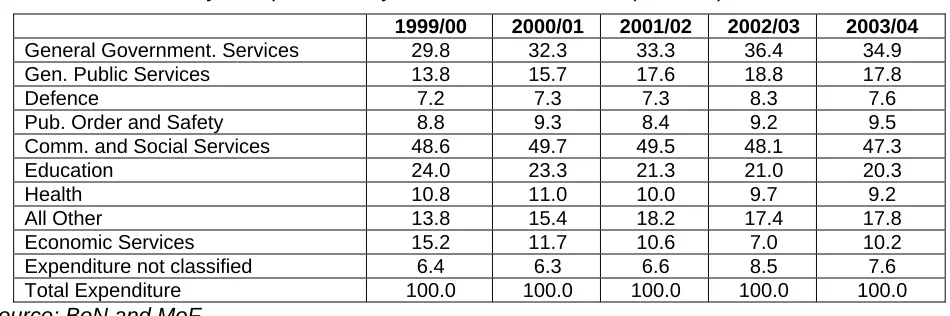
GRN has made tremendous efforts compared to most ACP countries in supporting pro-poor policies. As illustrated in table 1, the largest portion of the total expenditure (47.3%) was allocated to community and social services, although this is down from 48.1% during 2002/03. The education sector took up 20.3%, while other social services have 17.8% and health 9.2%. 14 years after independence Namibia continues to be among the countries in the world that allocates the most to the social sectors. In its current stage of development, allocations to these sectors are being marginally reduced in line with the MTEF ceilings since efficiency reforms should be implemented to achieve improved Social Sector outcomes. A particular reform that will have to be tackled is control of the wage bill.
[image:12.595.65.540.443.601.2]There is an increase in the allocation of economic services in 2003/04, which in view of the low levels of economic growth and the current stage in economic development is critical to stimulate growth and meet Namibia’s Vision 2030 ambitions.
Table 1 Summary of expenditure by economic classification (% share)
1999/00 2000/01 2001/02 2002/03 2003/04 General Government. Services 29.8 32.3 33.3 36.4 34.9
Gen. Public Services 13.8 15.7 17.6 18.8 17.8
Defence 7.2 7.3 7.3 8.3 7.6
Pub. Order and Safety 8.8 9.3 8.4 9.2 9.5
Comm. and Social Services 48.6 49.7 49.5 48.1 47.3
Education 24.0 23.3 21.3 21.0 20.3
Health 10.8 11.0 10.0 9.7 9.2
All Other 13.8 15.4 18.2 17.4 17.8
Economic Services 15.2 11.7 10.6 7.0 10.2
Expenditure not classified 6.4 6.3 6.6 8.5 7.6
Total Expenditure 100.0 100.0 100.0 100.0 100.0
Source: BoN and MoF
However, tremendous challenges remain since Namibia has the highest level of the Gini coefficient recorded in the world (0.67) and HIV/AIDS is affecting the overall development perspectives of the country.
The HIV/AIDS epidemic represents the single most important threat to the public health with consequences to the country’s capacity to reduce poverty and achieve the MDGs.
In 2003, a major development has been the start of a roll-out of ARV treatment to major hospitals and clinics in the country. It can be hoped that the provision of treatment will have a positive impact on the declining levels of productivity due to HIV/AIDS.
Vulnerable). The Ministry of Health and Social Services has recently been mandated by the Head of State to manage the overall HIV/AIDS response and the new Directorate for Special Programmes has been established for this purpose.
The overall conclusion is that Namibia has shown marked improvement in reaching the MDGs in the education and water sectors. However, to revert the negative trend in the HDI indicator (and the Health indicators), there is a recognised need to stabilise the HIV/AIDS pandemic by consolidating the momentum generated by the Global Fund initiative. The Namibia-EC CSP is strongly supportive to this approach with HIV/AIDS mainstreamed in both focal sectors and a specific institutional and capacity development programme acting as a catalyst to the substantial resources coming from the Global Fund and the ‘Bush Initiative’.
Furthermore, whereas the efforts of GRN to reduce poverty have been substantial, there is a need to strengthen performance and measurement systems and to encourage the shift from activity based monitoring to outcome based monitoring. The PEMP linked to the overall MTEF and the establishment in NPCS of the poverty reduction unit are important steps in this direction.
3.4. Cross cutting issues
3.4.1. Gender
The situation of Namibian women remains precarious despite recorded progress in establishing a legal and institutional framework to promote gender equality. The Namibian Constitution prohibits discrimination based on sex and this commitment has been taken up in the Affirmative Action Act that promotes the access of women to the job market. However, the 2001 Household survey has concluded that Namibian women in urban areas face the highest rates of unemployment although urban females have by far the highest literacy rate (92%). Unequal access to economic resources means also that Namibian women tend to be poorer than men. The HIV/AIDS epidemic is taking a high toll on women with 22% of pregnant women being infected with the virus and home based care of patients continuing to be a burden on women’s time and resources. Migratory patterns and HIV/AIDS contribute to 45% of the households being headed by women. On the political scene, women make up 40% of the local councillors and 25% of the members of the Parliament in the National Assembly, contrasting sharply with the limited participation in regional councils (4%) and the National Council (2 out of 26 places). The gender-related development index for Namibia is 0.62, ranking Namibia in 100th place among 144 countries surveyed for the Human Development Report 2003.
The policy framework for gender and development is articulated in the National Gender Policy of 1997 and the National Gender Plan of Action of 1998-2003. The latter will be reviewed in 2004 with a view to drafting a new Plan of Action along the policy lines of NDP2. To implement the gender policy framework, a Ministry of Women’s Affairs and Child Welfare was established in the year 2000.
Recent positive developments in the legal field include the adoption and entry into force of the Combating of Domestic Violence Act and the Maintenance Act. The importance of the former legislation should be analyzed in light of the conclusions of the WHO Multi-Country Study on Women’s Health and Domestic Violence 2001-2002 that found that 36% of ever-partnered women in Windhoek reported having suffered physical and/or sexual violence at the hands of an intimate partner. The latter Act establishes a principle of joint responsibility of both parents for the maintenance of their children. Discrimination continues, however, on inheritance and marriage under civil and customary law.
In terms of international commitments to the rights of women, Namibia acceded to the Convention on the Elimination of All Forms of Discrimination Against Women in 1992 and was the first country to ratify the Optional Protocol to the Convention. For the Beijing plus 5 review process, Namibia also contributed with a national report on progress achieved.
some of the education specific indicators for annual monitoring are gender specific (divided into male/female). For rural development, the programme of support is currently in the planning phase and the feasibility study highlights the need to take into account the gender implications of proposed interventions and promote qualified women to key positions in the programme.
3.4.2. Environment
Environment is recognised as a major cross-cutting issue by Government to promote economic growth while ensuring equitable and sustainable utilisation of renewable and non-renewable natural resources (NDP2). An Integrated State of the Environment Report is under preparation and a set of Core Environmental Indicators (CEI) is being agreed upon with ample consultations with relevant stakeholders. The most relevant identified trends as well as the institutional and policy framework to address environmental issues are analysed in the Summary Environmental Profile in Annex II. Extensive efforts are being made to provide for the adequate policy and legislative framework for environmental issues. The key challenges for Namibia include:
The need for economic diversification within the natural resources sectors (mainly agriculture, fisheries, tourism and mining)
The need to implement development plans that take into account the Total Economic Value of all resource sectors (that is, including direct use values, indirect use values and non use values). This links with the need for reliable indicators for monitoring and analysis.
The need to develop and maintain economically sound systems of tenure and management of all natural resources.
These issues should be addressed inter alia, by the EDF 9 supported Rural Poverty Support Programme.
3.4.3. Fisheries policy
Fisheries continue to be one of the main drivers of Namibia’s economic growth, only second to mining in terms of export value in 2002. There is currently no fisheries agreement with the EU but Namibia’s fishing industry benefits substantially from the duty free access under Cotonou. The industry’s development has been hampered by the scarcity of key fish resources, and the authorities are trying to rebuild stocks through sustainable management. Restrictive catch quotas are aimed at rebuilding stocks and achieving sustainability. For example, owing to the fragility of fish stocks, in March 2003 it was announced that no new applications for long-term fishing rights would be accepted in 2003, but extensions to already existing ones were granted. Total annual marine catch increased from 511,400 tonnes in 1997 to 623,000 tonnes in 2002, reaching an export value of N$3.311 billion and contributing 6.6% to GDP. Fisheries employ about 14,000 workers; about 60% of the workers are employed in some 16 processing plants.
Revised fisheries legislation has strengthened management and "Namibianiziation" policies. Government priority is to encourage fishing joint ventures between established foreign firms and Namibian entrants. Allocation of fishing rights and quota fees favour Namibian involvement and domestic processing by foreign-owned operators. These policies may reduce the industry’s efficiency (e.g. through allocation of uneconomic small catch quotas to Namibians and encouraging inefficient processing). The industry’s domestication may also be overstated if foreign firms simply adopt "Namibianization images" so as to receive special treatment, such as reduced quota fees. However, some results have been attained, as the number of vessels with more than 31% Namibian crew increased form 13% in 2000 to 43% in 2002.
3.4.4. Migration and LRRD
issuing of work permits and this is assumed to lead to some undocumented labour migration from Angola, Zambia and Zimbabwe. Emigration data point to a similar trend of limited numbers of Namibians working abroad. A survey in 1998 concluded that Namibians have a low propensity to migrate to South Africa which remains the most accessible and likely destination for work, implying that the total number of emigrants is insignificant. This is also reflected in the sum of incoming remittances from emigrants that in 1998 amounted to US$11 million. The main destinations for emigrants include South Africa, Zambia, Zimbabwe and Botswana.
This situation of low-intensity international migration can be contrasted with the state of internal migration. The 2001 Census noted that 2 out of 5 persons usually residing in urban areas were not born there, accounting for a growth in the population of urban areas.
A substantial proportion of the foreign nationals residing in Namibia are refugees or asylum-seekers of African origin. In 2003, Osire refugee camp housed approximately 26,000 refugees or asylum-seekers, 4423 of which were repatriated in 2003. Despite the commencement of the repatriation of Angolan refugees, Osire refugee camp has seen some unrest due to the shortage of food and other items.
2243 new asylum-seekers entered the country in 2003. As a result of internal stability, internally displaced people are not an issue in Namibia and in year 1999, the UN Mine Action Service asserted that landmines constitute neither a humanitarian emergency nor a major obstacle for development in Namibia. Nevertheless, in November 2002 the Government of Namibia requested international mine action assistance to clear remaining mine areas. The reintegration of ex-combatants is also well underway with approximately 1190 ex-combatants out of a total of 18,361 registered being unemployed.
For more details on migration, please refer to Annex VIII Migration Profile Namibia.
3.4.5. Food Security situation and Drought Relief
The GRN has a National Disaster Plan and Drought Aid Scheme for the distribution of food assistance in line with the Food and Nutrition Policy and the National Food security and Nutrition Action Plan (1995).
The year 2003 presented the second successive drought situation further to the 2002 drought. The crop assessment indicated that the yields for maize were the lowest since 1998/99 and the production of sorghum was exceptionally low. The reasons for the poor cereal production were attributed not only to the poor rainfall, but also to shortage of seeds, non retention of seeds from previous seasons by most farmers and late distribution of the drought relief seeds. At the same time, the grazing condition in most communal areas did not recover from the poor rainfall of the 2001/2002 season, leading to deterioration of the livestock condition.
On 20th November 2003, the Office of the Prime Minister (OPM), launched an international official appeal for drought relief, given the situation regarding poor rainfall expectations, for an amount of N$127.5 million and covering the following areas: food provision, cash and food for work, water provision, crop production, livestock, transport costs, fire-fighting equipment, health and sanitation and orphans and other vulnerable children.
The UN undertook a review of the food security situation (still not available) and this should facilitate a common response from the donors to the Government appeal.
At the same time in some regions notably in Caprivi, floods were recorded due to rains in the catchment area of the Zambezi. The floods recorded in April 2003, caused the displacement of around 15,000 people. The main consequence was the reduction in crop production and the food availability in the affected regions. The Commission provided €100,000 for victims of the floods in Caprivi channelled by the Humanitarian Aid Office (ECHO) through the International Federation of the Red Cross, providing essential medicines, water/sanitation and emergency relief items to 12,000 people in 20 villages affected. ECHO also funded an intervention from Oxfam International supported by Intermon Oxfam for an amount of €200,032 ensuring the distribution of seeds to 10,171 households.
opportunity to improve the state of the livestock. At the same time and for the same reason, the risk of repeating flood situations in certain regions is estimated as high, and another crisis situation is feared, due to high precipitations upstream of the Okavango and Zambezi rivers in Angola and Zambia.
4. OVERVIEW OF PAST AND ONGOING CO-OPERATION
This chapter covers an assessment of the results achieved at sectoral level as well as specific activities of programmes financed by the EC and the EIB. The programmes analysed in this section are those of the EDF 9 focal sectors. For sake of completeness, EDF 9 non-focal sectors, EDF 8 and EDF 7 programmes, article 255 and the Sysmin programme are also reviewed in the Annual Report and the appraisal is included in Annex IV.
4.1. Focal Sectors
4.1.1. 9ACP NAM02, Education Sector Programme Start-up date (Disbursement of 1st tranche): January 2004 Total budget: EUR 21 million from EDF 9
a) ESP Policy Framework
Pro-poor policy objectives set out in the NDP2 and the NPRAP, as well as the strong legislative framework provided by the Education Act of 2001, guide the planning process for the emerging education SWAp. Strategic planning has been based on extensive consultative and analytical work, including that set out in Toward Education for All (1993), the Report of the Presidential Commission on Education and Training (1999), the Education Sector Appraisal Report (2002) prepared in preparation for the first Education Sector Joint Annual Review, and more recently the World Bank study on Human Capital and Knowledge Development for Economic Growth with Equity (2003/04). Other policy work has analysed specific issues, such as in National Policy Options for Educationally Marginalised Children and a Study on the Impact of HIV/AIDS on Education in Namibia. Throughout these documents the emphasis remains on the broad goals of access, equity, quality, democracy and efficiency, and on the long term commitment to the six EFA goals within the Dakar Framework for Action.
In this context, the 2003 Joint Annual Review set out a framework within which policy planning and key reforms in the sector should take place. Firstly, it is a GRN policy priority to focus on improving education quality and learner outcomes throughout the system. While the increases in access to schooling since independence have been very encouraging, given Namibia’s relatively high expenditure on the sector, educational outcomes are disappointing. Secondly, the focus on learning outcomes reveals inefficiencies and inequities in the allocation and use of resources. As the sector faces increasing resource constraints in coming years, substantial improvements in the efficiency of resource use will be required if the quality of public education is to be sustained and improved. Thirdly, the ESP is closely linked to the broader Government decentralisation policy; focusing on strengthening regional/local level management capacity and enabling the developing role of School Boards in overseeing school budgets and ensuring greater accountability for educational outcomes. Finally, with the increased decentralisation of operational management moving forward, the roles of central education ministries will focus more on policy management, programme development, standard setting, monitoring, inspection and evaluation.
Support to the ESP is premised on an understanding that continuing levels of inefficiency, inequity and poor quality in the delivery of education services in Namibia require a more comprehensive policy driven and results oriented approach to sector planning, financing and monitoring. The policy framework is embedded in GRN medium-term planning and budgeting mechanisms (MTEF, PEMP and MTP), and Government has agreed with development partners on a collaborative framework to guide education sector development, most notably through the Joint Annual Review, the Education Sector Planning and Advisory Group (ESPAG) and the ESP Task Force. These mechanisms for sector management and coordination are beginning to institutionalise a rolling programme of performance review and strategic adjustment to policy priorities and strategic targets.
cooperation to coordinate support to the ESP through the SRF and the Institutional Strengthening and Capacity Building Facility. More regular meetings of Education sector development partners has also promoted increasing cooperation and information exchange, focusing on how various programmes and projects are supporting the common sector programme within the framework of the sector MTPs. This is enabling improved coordination with on-going and planned support from other key development partners such as Germany, USAID, Luxembourg, UNICEF and UNESCO. It has recently emerged that the Netherlands will start to investigate active support to the sector through the SRF
.
b) Results
b.1) Sectoral Commitments
The sector policy commitments set out in the CSP have either been achieved or are well underway, although this needs to be seen within the context of on-going development of the sector under the ESP. The MBESC strategic plan has been costed and a strategic plan for MHETEC has been developed. A key recent initiative, mentioned in section 2 of the JAR has been the development of the Medium Term Plans (rolling line Ministry MTEFs) which support the move from activity to programme budgeting. The costing of the strategic plans whilst important has been a stand alone exercise that has to be revisited in line of this critical development which captures all resources, from both GRN and donors, and links these to priority programmes and outcome indicators based on the PEMP.
The second sector policy commitment set out in the CSP is the establishment of the Namibian Training Authority (NTA); independent of Government, more inclusive of and responsive to private sector stakeholders, and more able to guide and upgrade skills development appropriate to Namibia’s requirements and resources. Again, progress here has been encouraging and as the ESP moves forward strategic support both to the NTA and the Vocational Education and Training (VET) sub-sector more broadly is becoming more coherent at a policy level. The establishment of the NTA was approved by Cabinet in January 2004, including the setting up of a Training Levy which will eventually fund it. It is anticipated that the establishment of the NTA will be complete within this calendar year. Before this can be done legal advice is being sought on either amending the 1994 Vocational Training Act or the drafting of a new act. Long term technical assistance and other appropriate advisory support to the establishment of the NTA are being provided under the Facility.
From this it is clear that Namibia’s performance against sectoral commitments can be assessed as good. It is anticipated that significant further progress will be made over the medium term, under the framework of the ESP. Sector performance is assessed further below against key indicators.
b.2) Performance Measurement
Ministries are focusing more on the results and performance of the system, rather than only on the management of activities. It is anticipated that through the sector programme a more prioritised policy framework will be established in which these sector performance targets will be embedded. Given that the monitoring framework is still in development, some indicators of policy results/impact are lacking, for example in showing the quality and relevance of education and school performance, especially in relation to the labour market. Also the impact of education services on poverty and rural populations needs further monitoring. Another gap seems to be on the outcomes of programmes for HIV/AIDS in education. With the strategic development of the EMIS and the further strengthening of the National Inspectorate indicators for sector performance will become more complete and nuanced.
The following assessment refers to the indicators in Annex III: • Input indicators
Indicator 1 illustrates Government’s financial commitment to the sector. As highlighted in Section 3.3.2 above, a high proportion of Government expenditure is taken up by education, illustrating the high commitment to the sector. In this context, while the share of Government expenditure allocated to education has been decreasing, it is still possible to assess performance on this indicator as good. However, as can be seen in indicator 2, the non-wage share of education recurrent spending is relatively low. In primary education, salaries make up around 94% of the recurrent budget, significantly higher than other countries in the region. This imposes a serious constraint on the budget available for other quality related expenditures such as text books and teaching materials. An indicator showing the pupil-textbook ratio may be useful to show the need in schools for spending on materials.
Indicator 3 shows that at a national level the learner-teacher ratio (LTR) is relatively stable at around 31 in primary schools and 25 in secondary schools. This is in line with the staffing norms set in 2001 (see Section b.3 below). Clearly in Namibia where control of the wage bill will increasingly become a central policy issue, any reduction in the LTR will have significant implications on the cost and efficiency of the system. As highlighted in the Education Sector Efficiency Report (2003), a 1% reduction in the wage bill would free up substantial further resources for other inputs. What is not shown in this indicator except when disaggregated is the significant disparity between regions. Various policy scenarios with cost implications need to be considered by decision makers to address this critical issue and implement programme level reforms.
The Education Ministries have only recently established the HIV and AIDS Management Unit (HAMU), staffed by the two ministries. Data is currently lacking and programmes in the sector are fragmented. HAMU will provide a focus for coordination and monitoring. Indicator 4 shows that there are increasing numbers of schools with HIV/AIDS support groups. Clearly this is only a first step in the response of the ministries in fighting the spread of HIV/AIDS. This indicator can be assessed as good, in that such groups are being set up relatively quickly. However, this is not sufficient in giving any detail on the quality of the work done and the outcomes it is having. The development of more relevant indicators and targeted research will be required to provide regular monitoring information.
• Output indicators
The low proportion of qualified primary teachers is seen as a key causal factor behind the generally accepted poor quality of education in schools. While most children now have access to school, the quality of teaching is often poor, and the distribution of qualified teachers belies significant inequities. However, as can be seen under indicator 5, the proportion of qualified primary teachers has been steadily increasing. In this respect progress can be assessed as sufficient, though in coming years both the proportion of teachers qualified and the spread of teachers across regions needs absolutely to be further improved.
important regional and subject variations. Further desegregation shows that results are especially poor in mathematics and biology, with well over 20% of IGCSE candidates un-graded.
While enrolments at VTCs appear to be rising gradually, the available data shows a poor pass rate on the trade tests at Level 2 and Level 4, at around 50%. There are clearly problems with the quality of this as an indicator of the quality and efficiency of the sub-sector. At present, however, there is little other data available, and it is a current priority of the support to the NTA to establish more reliable monitoring information systems. Certainly such low pass rates are not encouraging and confirm widely accepted analysis that the provision of VET is of poor quality and supply driven, and does not respond to the needs of employers and the labour market. More information is required on the outcomes and impact of training, for example the number of graduates entering and remaining in full time employment. It should be stated however that the Government has shown an increasing commitment to this sub-sector, revealed in on-going reforms (see below) and the increasing allocation of resources.
• Outcome indicators
As outlined in Section 3.3.2 above, Namibia is well on track to meet the NDP2 target for 2006 and the MDG of achieving Universal Primary Education by 2015. This is clear from the encouraging NER figures, and confirmed by GER figures which show a trend towards children entering school at the correct age. There is need for caution, as reaching educationally marginalised children remains a significant challenge, and on-going monitoring is needed of the impact that HIV/AIDS is having on creating new barriers to children entering or remaining in school.
Survival rates indicate that the Government is on track to reach its target to ensure that all children complete primary education. Again some caution is required, as there remain questions over the capacity of the primary system to enrol and keep all children in school. Furthermore, if NER and survival rates continue to increase, the need for more classrooms may become pressing.
The most reliable data currently available on literacy rates comes from the 2001 Census. There needs to be a degree of caution in interpreting data on reported literacy. The Census asked the question – Can you write and read in any language with understanding? – Which is likely to overestimate the number of literate people. To date no reliable literacy tests have been administered that could be used to confirm these figures. The youth literacy rate captured in the census is encouraging and shows an increase over the past decade. As in 1991, urban females have the highest literacy rate, although the variation in urban-rural literacy rates are significantly less for this age group than for the general adult population. Despite the progress in the recorded youth literacy rate, there is a need for further research into the outcomes of education, and in particular functional literacy which forms a basis for further levels of education and sustainable employment. The limited research in this area has raised questions over the quality of education outcomes in key areas of the curriculum. This is further seen in the low number of learners reaching the qualifying level for promotion from Grade 10 to Grade 11, and in the generally low achievement level reflected in IGCSE results.
b.3) Status of Education Sector reforms
A number of sector reforms are set out in the NPRAP and NDP2, as well as in the strategic plans of the two ministries of education. These are largely guided by the 2001 Education Act, and analysis set out in Towards Education For All and the Report of the Presidential Commission on Education and Training, and subsequent policy documents. In broad terms, these reforms aim to ensure equitable access to high quality schooling, and improve the efficiency of the system. A number of these proposed reforms also promote greater levels of decentralisation and improved school management. While some progress has been made, and initial reforms brought in, especially after the Education Act, there is a need for further progress. With the move to a sector wide approach and the introduction of medium term expenditure planning there is now an opportunity for the proposed reforms to be brought together under a broad view encompassing sectoral objectives, priorities and strategies.
On-going and proposed sector reforms include:
• Pro-poor funding formula for schools: A proposed reform to further reduce inter-regional disparities in the provision of education services is to introduce a pro-poor, capitation based funding formula for schools. This might be linked to the delegation of budget management to schools. These policy reforms have not been taken forward, but will need to be located in the context of public financial management reforms, in order to ensure the necessary systems are in place to make implementation effective. However, a policy for the provision of school maintenance budgets has been approved, though not yet implemented.
• Establishment of School Boards: Following a mandate under the Education Act, School Boards have been established at each school, forming the basis for further decentralisation of educational responsibilities to the school level and a higher degree of local accountability for learner outcomes. Schools are also required to prepare development plans and increase parental/community awareness and involvement in school management and decision making.
• Staffing and efficiency reforms: In 2001 a staffing norm of 35 for primary schools and 30 for secondary schools was introduced. As outlined in the Namibian Education Sector Efficiency Review in 2003, while this ratio was set in order to reduce the number of teaching staff, in fact 600 more teachers were needed. It seems the staffing norm may be unaffordable within the context of increasing salary costs and an increasingly constrained overall budget. Linked to this issue, the Presidential Commission recommended setting minimum and maximum qualifications for teachers, in order to contain the costs associated with the link between qualifications and salaries. This issue was raised at the 2003 Sector Review and will be closely scrutinised at the 2004 Review.
• Curriculum reform/development and teacher development: Since independence great progress has been made in curriculum development, focused on skills and competencies and inclusive of critical cross-cutting issues (e.g. HIV/AIDS, life skills, entrepreneurship). However, there seem to be major gaps between the curricula and the quality of teaching and school management. The continuing lack of qualified teachers in many regions is a key factor in this. Furthermore, curriculum development needs to be closely linked to the costing and provision of teaching materials, and the capacity of the system to deliver core curricula within available teaching hours.
• Semi-automatic promotion: In 1996 a policy of semi-automatic promotion was introduced allowing learners to repeat only once in each primary school phase and once during junior secondary.
• Primary school assessment: Effective external examination systems have been established for Grades 10 and 12. A proposed reform has been to introduce a standardised assessment and certificate for primary level, to encourage learners to stay in school and so increase overall learning outcomes. In 2000, a semi-external examination was introduced, chiefly to enable schools to monitor quality. Currently this does not effectively provide a national level perspective.
• Establishment of National Inspectorate: Following the 2001 Education Act, a National Inspectorate has been established, staffed at regional and central levels. Work has begun on building up the capacity of the Inspectorate to set and use performance indicators for school inspection and support. It is expected that this will provide more information on school performance, ensure failing schools are identified and assisted, and provide a national level picture of system performance.
• Establishment of National Qualifications Authority (NQA): The NQA was established in 1999 to develop a National Qualifications Framework, set national standards and provide recognition and certification for service providers.
• More relevant and responsive systems for Vocational Education and Training: The 2002 Appraisal Report for the first Joint Annual Review and the 2003 World Bank study have outlined the problem of fragmentation and inadequate strategic planning in the higher education and VET sub-sectors. Strategic plans for MHETEC set out plans to both strengthen capacity in the provision of VET, with closer links to industry, and reform the institutional arrangements under which the sub-sector operates. The establishment of the NTA has been a first step towards this, and under the current support to the NTA a planned review of the National Vocational Training Act is shortly to take place.
inter-ministerial ESP Task Force assigns responsibility for specific actions and reporting to the ESPAG on progress against this Action Plan.
The developments engendered under the sector wide approach go hand in hand with on-going and selective decentralisation. There is a need to focus on the new roles and responsibilities that come with this, as central ministry staff focus more on strategic planning and monitoring of education services and reforms. EC support is consistent with this shift, recognising the need for institutional and organisational development at central, regional and local levels to manage change.
b.4) Milestones in Establishing the ESP
It is important to locate the current baselines for sector performance in the context of the emerging education SWAp. This will form the basis of future policy review and adjustment processes. In terms of the process in establishing the ESP, significant progress has been made. Key milestones in the implementation of the ESP include:
• EC/DFID Readiness/Scoping study on a move towards Sector Wide Approach in Namibia (November 2001)
• Establishment of Namibia’s MTEF in 2001/2002 Fiscal year (2001)
• Costing of strategic plan MBESC and finalisation of strategic plan MHETEC, (May 2002)
• First Joint Annual Review held with production of Education Sector Appraisal Report and Signing of Statement of Intent between GRN and 14 DPs, establishing an agreed consultative process for the ESP, including annual reviews, reporting, (June 2002)
• Government further develop MTEF, with sub-sector envelopes, linked to the PEMP for sector performance monitoring (March 2003)
• ESPAG meetings three times each year, for improved sector management and coordination, co-chaired by Permanent Secretaries MBESC and MHETEC (March, June, November)
• ESP Task Force meetings, chaired by Deputy Permanent Secretary MBESC (On-going as required) • Signing of MOU between GRN and contributing partners to the ESP setting out the agreed
procedures/actions for timely release of funds (July 2003)
• Second Joint Annual Review, with production of Aide Memoire and ESP Action Plan and with draft set of core education sector indicators to be agreed March 2004 (September 2003)
• First Education MTPs are prepared for the fiscal year 2004/05, with programme allocations in line with MTEF and targeted to priorities as set out in the NDP2 (October 2003)
• Establishment of Institutional Strengthening and Capacity Building Facility, with Principles of Implementation signed by GRN and contributing DPs, a Facility Implementation Manual and Start-up Work Plan, and set Start-up of Technical and Administrative SStart-upport unit (October 2003)
• First tranche of budget support from EC and Sida (January 2004)
• More regular DP coordination meetings, especially in preparation for ESPAG meetings (On-going) From this it is clear that significant progress in the move towards a Sector Wide Approach in Education has been made, as the GRN starts to take a stronger lead in the coordination of sector planning, financing, management and monitoring under the ESP.
c) Activities