This is a repository copy of
The structural dependence of the effective mass and Luttinger
parameters in semiconductor quantum wells
.
White Rose Research Online URL for this paper:
http://eprints.whiterose.ac.uk/1677/
Article:
Long, F., Hagston, W.E., Harrison, P. et al. (1 more author) (1997) The structural
dependence of the effective mass and Luttinger parameters in semiconductor quantum
wells. Journal of Applied Physics, 82 (7). pp. 3414-3421. ISSN 1089-7550
https://doi.org/10.1063/1.365657
[email protected] https://eprints.whiterose.ac.uk/
Reuse
See Attached
Takedown
If you consider content in White Rose Research Online to be in breach of UK law, please notify us by
The structural dependence of the effective mass and Luttinger parameters
in semiconductor quantum wells
Fei Longa) and W. E. Hagston
Department of Applied Physics, University of Hull, HU6 7RX, United Kingdom
P. Harrison
Department of Electronic and Electrical Engineering, University of Leeds, LS2 9JT, United Kingdom
T. Stirner
Department of Applied Physics, University of Hull, HU6 7RX, United Kingdom
~Received 6 May 1997; accepted for publication 24 June 1997!
A detailed comparison of the empirical pseudopotential method with single and multiple band calculations based on the envelope function and effective mass approximations are presented. It is shown that, in order to give agreement with the more rigorous microscopic approach of the pseudopotential method, structural dependent effective masses and Luttinger parameters must be
invoked. The CdTe/Cd12xMnxTe system has been employed as an example, and the first
pseudopotential calculations of quantum wells and superlattices in this material are presented. It is shown that the electron, light- and heavy-hole effective masses tend towards twice their bulk values in the limit of narrow quantum wells. © 1997 American Institute of Physics.
@S0021-8979~97!00319-8#
I. INTRODUCTION
The envelope function and effective mass approxima-tions have been employed extensively in the determination of electronic states in semiconductor heterostructures such as quantum wells and superlattices following the early work by Nedorezov1and Bastard.2,3In this approach, the periodic in-teratomic potential is eliminated from the description and is replaced by a smoothly varying macroscopic potential deter-mined by the band offset of the materials. The wavefunction of the system is assumed to be a linear combination of the product of a slowly varying envelope function together with a Bloch function appropriate to a bulk carrier. The latter changes rapidly on an interatomic scale, with a period of unit cell length, and can be eliminated from the description.4 In-deed the approach offers a simple but successful way to in-terpret experimental data from ‘‘large systems’’ such as wide
quantum wells or long period superlattices.5–8 It is to be
noted, however, that these successes rely, to some extent, on the judicious choice of important parameters such as the ef-fective masses of the carriers.
In contrast with the large system, the envelope function approach was shown to be less effective in describing the electronic properties of ‘‘small systems’’ such as narrow quantum wells, or short period superlattices, if one employed
the same input parameters as with the large system.9–11
In-deed, when the characteristic dimensions of the systems de-crease to values comparable with the interatomic length scale, e.g., less than 20 Å, say, there exists dramatic differ-ences between the results based on the envelope function approximation and the experimental data.12 It is evident that some of the basic approximations used in the envelope func-tion approach are not valid for these small systems. For ex-ample, the envelope function and the macroscopic potential
change on a scale comparable with those of the Bloch func-tion and the periodic interatomic potential, hence they can no longer be regarded as slowly varying in this case.
Further-more, the effective masses parameters ~or equivalently, the
Luttinger parameters!, which incorporate the effect of micro-scopic potential change in the parametrization scheme, are normally treated as constants which are derived from band structure properties associated with the corresponding bulk materials. One can expect such a treatment to become in-creasingly inappropriate as the characteristic dimension of the system decreases. Although some progress has been made with regard to the general formalism of the envelope function and effective mass theory for heterostructures,13–16 the central problems mentioned above relating to the values of the effective masses to be employed in a given calculation remain largely unresolved.
Although computationally costly, solving the Schro¨-dinger equation with microscopic atomic potentials is widely employed in band structure calculations such as the semi-empirical pseudopotential or the tight-binding method. The developments that have made use of these methods extend from band structure calculations of bulk materials to those of microstructures.17,18,20 In particular, Jaros et al.18,19 and
Zunger et al.20–24have developed two different schemes for
pseudopotential calculations of semiconductor heterostruc-tures, which can handle efficiently both small and large sys-tems. These pseudopotential calculations are, of course, free from the approximations and restraints to which the envelope function approach suffers. Consequently, a comparison of the predictions of both methods permits a direct evaluation of the limitation of the envelope function approach and the modifications to it that are needed in order to give agreement with the exact results of the pseudopotential theory.
In the present article, which is an extension of our recent work on the band structure and effective masses of the bulk Cd12xMnxTe alloy,
25
we perform the first empirical
potential calculations of ~001!CdTe/Cd12xMnxTe superlat-tices and quantum wells. These results are then compared with those from a simple single band model and with a
multiband k•p model, both of which encompass the
enve-lope function and effective mass approximations. In particu-lar, the effective masses of the electron, light- and heavy-holes in the quantum wells have been determined by treating them as parameters within the envelope function calculation and adjusting them until the resultant energy level structure agrees with that of the empirical pseudopotential method. In this manner, we can deduce, for the first time, the dependen-cies of the effective masses of the electron, light- and heavy-holes in~001!Cd12xMnxTe/CdTe superlattices and quantum
wells, on the width of the wells, a feature which has received scant attention to date.
II. PSEUDOPOTENTIAL CALCULATION OF THE SUPERLATTICES AND QUANTUM WELLS
In this section, we describe the empirical pseudopoten-tial calculation for the diluted magnetic semiconductor
~DMS! Cd12xMnxTe/CdTe superlattices grown along the
(001) direction. There are extensive experimental10,26,27and
theoretical8,28–30 studies of these DMS quantum well
sys-tems. These have led to a great understanding of their novel
properties due to the large sp3-d exchange interaction
be-tween the carriers and the magnetic Mn21 ions. However,
the majority of these studies have been based on the enve-lope function and effective mass approximations.
The calculational scheme used here was first developed by Jaros et al.18,19,31,32 who applied it to evaluate the elec-tronic structure of types I and II superlattices of III–V and II–VI compound semiconductors. In the calculation, a super-lattice unit cell is chosen so that the length of the supersuper-lattice period lies along the growth direction. The Schro¨dinger equation for the superlattice is written as
~H01V!C5EC, ~1!
whereH0 is the Hamiltonian of the bulk zinc-blende CdTe
crystal while V is the perturbation introduced to account for the difference in the microscopic atomic potential between CdTe and Cd12xMnxTe. This occurs, within the unit cell,
when the latter substitute the former thus creating the super-lattice. The superlattice wavefunction is constructed as a lin-ear combination of the eigenfunctions of H0, i.e.,
C~r!5
(
n,k,S
an,k,sFn,k,s~r!, ~2!
where n and s are, respectively, the band and spin index of the bulk CdTe system. The wave vector k lies in the bulk Brillouin zone and is determined by the period of the pertur-bation V. This is because the bulk statesFn,k(z) which
con-tribute significantly to the superlattice state Cks(z) having
the superlattice wave vector ks, are those having a k vector
which can couple to k by some linear combination of the superlattice reciprocal lattice vectors. It is only those bulk states which satisfy this condition that need to be included in the expansion of the superlattice state in Eq. ~2!. In the present work, only the¯ point in the superlattice BrillouinG
zone is considered since the quantum wells and superlattices discussed in this work are type I. Consequently, the only
wave-vector ks which needed to be included in Eq.~2!are
the set
2p
a0
S
0,0,m
N
D
, ~3!where a0 is the lattice constant of bulk CdTe, i.e., 6.481 Å.
The entity N is the number of lattice constants in a superlat-tice unit cell and the m are the integers satisfying m<N. Fn,k,sis generated by the standard local pseudopotential cal-culation including spin-orbit coupling,11,25,33i.e., by directly diagonalizing the matrix equation
U
F
1 2k2
2Enks
G
dG,G8ds,s81VL(uG2G8
u)ds,s81Vs,s
8
s2o
~K,K
8
!U
50, ~4!where G is a bulk reciprocal lattice vector, and K5k1G.
Enks is the eigenvalue corresponding toFnks. Vs,s 8
s2o
is the spin-orbit coupling matrix element which is evaluated using
the method introduced by Bloom and Bergstresser.34 VL is
the screened local atomic pseudopotential. Knowledge of the appropriate value of VL for CdTe, MnTe, and Cd12xMnxTe
is essential to this work. VL for CdTe and MnTe are
deter-mined by adjusting the form factors V~G!, i.e., the Fourier
transformed components of VL, in order that the resulting
band structures and effective masses of the bulk materials agree with those from experimental data.
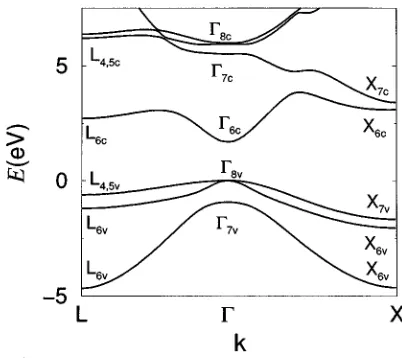
Figure 1 is a typical band structure for the Cd12xMnxTe
alloy with x 5 0.1. This alloy will be used as the barrier
[image:3.612.333.534.33.212.2]material in later calculations. It is worth pointing out that although the 3d electron energy bands do not appear explic-itly in Fig. 1, their effects on the electrons in the conduction and valence bands have been included implicitly in the cal-culations, further details of which can be found in our recent work.25
FIG. 1. The band structure of the bulk Cd0.9Mn0.1Te obtained from the
pseudopotential calculation.
3415
The relative alignment between CdTe and Cd12xMnxTe
is determined by the symmetric part VLS(G) of V~G!
associ-ated with MnTe at G50. In effect, VLS(G) causes a rigid
shift of the whole band structure, and its value was adjusted so that 35% of the difference in the band gap between CdTe
and MnTe at theG point was taken up by the valence-band
offset. Although the exact values of the valence-band offset between CdTe and Cd12xMnxTe are still controversial,
26,35
recent experimental work36 suggests that the values are
within the range of 30%–40%.
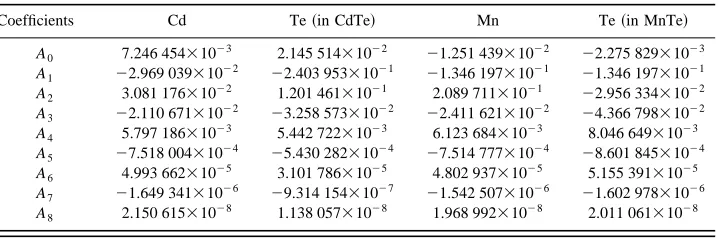
It is known that the form factors V(q) for small q, in addition to those for the bulk zinc blende reciprocal lattice vectors, are needed in an empirical pseudopotential calcula-tion of superlattices. Several attempts19,37,38 at determining these small q form factors, based essentially on the quasicon-tinuous dependencies of V(q) on q, have been made. These have involved fitting a parameterized algebraic form of po-tential V(q), to the form factors at the zinc-blende reciprocal lattice vectors. The parameters are then optimized in order that a variety of bulk properties, such as the band structure, effective masses, band offsets, and deformation potentials agree with the measured values. In the present work, the quasicontinuous forms of V(q) for CdTe and MnTe are as-sumed to be a polynomial of degree 8, i.e.,
V~q!5
(
i50 8
Aiqi. ~5!
The polynomial is first fitted to V(G) at the zinc-blende vec-tors, which means that the measured band structure and ef-fective masses of bulk materials have been reproduced. Then, for CdTe, the gradients of the polynomial at the dif-ferent zinc-blende reciprocal vectors G are optimized so that
a variety of measured deformation potentials39 are
repro-duced by the pseudopotential calculation. For MnTe and Cd12xMnxTe, because of the scant knowledge available
con-cerning the deformation potentials, we first made a ‘‘best
guess’’ at the gradients of the polynomial. This polynomial form of V(q) is then used in a calculation of a large period superlattice. For the latter, it has been shown in the literature, e.g., Ref. 9, that calculations based on microscopic potential models, such as the pseudopotential or tight-binding ap-proaches, give good agreement with those from the simple envelope function approach within the effective mass ap-proximation. Consequently we adjusted the gradients of the polynomial at the zinc- blende vectors so that the calculated
energy levels of a given large period superlattice, ~e.g.,
207.4 Å Cd12xMnxTe/90.7 Å CdTe! agree with those of
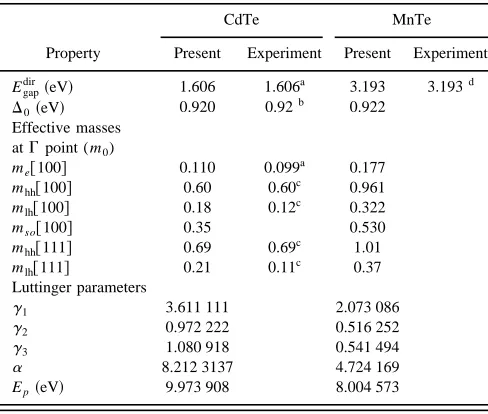
the simple envelope function approach. The critical point energies of bulk CdTe and MnTe calculated by the pseudo-potential approach employed in the present work are shown in Table I. Similarly Table II shows the other band properties of bulk CdTe and MnTe calculated which are also used as the input parameters for the single- and multiple-band effec-tive mass model calculation performed in the present work. Table III lists the coefficients of the polynomial functions of
V~q!for CdTe and MnTe.
Using the quasicontinuous form of V(q) for CdTe and
Cd12xMnxTe, the energy levels of the superlattices and
quantum wells are obtained by substituting Eq. ~2! into Eq.
~1!and directly diagonalizing the resulting matrix equation.
III. ENVELOPE-FUNCTION TECHNIQUE
[image:4.612.50.297.82.266.2]In this section, we describe the calculations based on the envelope function approximation and compare them with the results obtained from the empirical pseudopotential ap-proach. Two classes of model were employed within the en-velope function approach
TABLE I. Comparison of the critical point energies of bulk CdTe as ob-tained in the present pseudopotential calculation with those obob-tained in the nonlocal pseudopotential by Chelikowsky and Cohena~CC!. The
eigenval-ues for bulk MnTe are also listed and the way to compare them to ab initio calculation is detailed in our recent work.b
Energy level~eV!
CdTe
MnTe
Present CC
G7v 20.920 20.89 20.922
G8v 0.000 0.00 0.000
G6c 1.606 1.59 3.193
G7c 5.384 5.36 6.837
X6v 24.799 25.05 24.306
X7v 22.011 21.98 22.025
X6v 21.700 21.60 21.568
X6c 3.097 3.48 3.814
L6v 24.686 24.73 2.812
L6v 21.212 21.18 21.357
L4,5 20.646 20.65 20.873
L6c 2.831 2.82 4.795
L6c 6.127 6.18 5.797
a
See Ref. 45.
b
[image:4.612.316.560.85.292.2]See Ref. 25.
TABLE II. Comparison of the other band properties of bulk CdTe and MnTe calculated by the pseudopotential approach employed in the present work with the experiments. These properties are also used as the input parameters for the single- and multiple-band effective mass model calcula-tions in the present work.
Property
CdTe MnTe
Present Experiment Present Experiment
Egap
dir ~eV! 1.606 1.606a 3.193 3.193d
D0~eV! 0.920 0.92
b 0.922
Effective masses atGpoint (m0)
me@100# 0.110 0.099
a
0.177
mhh@100# 0.60 0.60
c
0.961
mlh@100# 0.18 0.12
c
0.322
mso@100# 0.35 0.530
mhh@111# 0.69 0.69
c
1.01
mlh@111# 0.21 0.11
c
0.37 Luttinger parameters
g1 3.611 111 2.073 086
g2 0.972 222 0.516 252
g3 1.080 918 0.541 494
a 8.212 3137 4.724 169
Ep~eV! 9.973 908 8.004 573
aRef. 46. bRef. 47. c
Ref. 44.
~1! the single-band effective mass model—although the cou-plings between electrons in different bands are not in-cluded explicitly in this kind of model, it still gives a good description of band-edge states of a large quantum well system provided an appropriate choice of the effec-tive masses is made.
~2! the multiband k•p model—a perturbation theory in
which a small set of coupled zone-center states of the different bands are used to give a description of the band structures and other related electronic properties of bulk materials and corresponding heterostructures.
In the class ~i! model, the Schro¨dinger equation of a
quantum well is reduced to a one-dimensional problem which, for definiteness, was taken to have the form
S
21
2
] ]z
1
m*~z!
]
]z1Vext~z!
D
Fi~z!5eiFi~z!, ~6!where Vext(z) is the quantum potential which represents the band-edge changes of the bulk carriers between the two ma-terials of the quantum well structure. Under zero bias condi-tions, Vext(z) is constant in each material and its change at the interface is defined in terms of the band offset. Fi(z) is
the envelope function of the ith state of a carrier in the quan-tum well, and m*(z) is the effective mass~taken as a con-stant within each material comprising the quantum well!. It is worth noting that utilization of Eq. ~6! automatically im-plies a boundary condition of the form
S
1m*
dFi~z!
dz
D
U
interface2CdTe
5
S
1
m*
dFi~z!
dz
D
U
interface2CdMnTe
~7!
i.e., F(z) and 1/m* dFi(z)/dz are continuous at the
inter-face between CdTe and Cd12xMnxTe.
Equation~6!, under the restraint of the boundary condi-tion~7!, is solved by a numerical shooting technique. It is to be noted that, in the majority of calculations reported in the literature, the values of the effective masses of the electron,
and the light- and heavy- holes used in Eq. ~6! are those
appropriate to the bulk materials as defined via the bulk band structure. But, in the present work, the value of the effective
mass m* in the ~CdTe! well was treated as a parameter
which was adjusted for wells of varying width, until the en-ergy levels of the electron, heavy and light holes agreed with those obtain from the pseudopotential calculation. On other hand, the value of m* for the Cd12xMnxTe was kept at its
bulk value since the widths of the barrier layers are much thicker than those of the well layers and could be considered to be ‘‘bulk-like.’’ The effective masses appropriate to bulk Cd12xMnxTe were obtained from our recent pseudopotential
calculation of the band structure of Cd12xMnxTe 25
as a func-tion of the alloy concentrafunc-tion x.
In the class~2!model, the states of the quantum well are expanded in terms of a linear combinations of the periodic parts of the zone center Bloch function appropriate to bulk materials, i.e.,
F~r!5eik'•r
(
l51 NulG~r!fl~z!, ~8!
where k'is the in-plane wave vector, ulG(r) is the part of the zone center Bloch function with the period of the bulk unit cell, and fl(z) is the envelope function. At this stage, two
assumptions are made: ~1! ulG(r) takes the same form in
both well ~CdTe! and barrier material ~Cd12xMnxTe!. ~2!
fl~z!is slowly varying on the scale of the unit cell
appropri-ate to bulk mappropri-aterial.
Substituting Eq.~8!into the Schro¨dinger equation of the quantum well, and utilizing the property of ulG~r!, we can establish a set of N coupled partial differential equations. In the present work, we use the k•p model for the quantum well
system developed by Ekenberg et al.40and emphasis is paid
to the hole energy levels. In particular, the Luttinger param-eters are directly related to the band2edge effective masses through the relations41
m0
mhh*@100#5g122g2, ~9a! m0
mlh*@100#5g112g2, ~9b! m0
[image:5.612.128.487.55.174.2]mhh*@111#5g122g3, ~9c!
TABLE III. Coefficients of the polynomial function of atomic pseudopotential form factors V(q). The unit of V(q) is eV and that of q is 2p/a0.
Coefficients Cd Te~in CdTe! Mn Te~in MnTe!
A0 7.246 45431023 2.145 51431022 21.251 43931022 22.275 82931023
A1 22.969 03931022 22.403 95331021 21.346 19731021 21.346 19731021
A2 3.081 17631022 1.201 46131021 2.089 71131021 22.956 33431022
A3 22.110 67131022 23.258 57331022 22.411 62131022 24.366 79831022
A4 5.797 18631023 5.442 72231023 6.123 68431023 8.046 64931023
A5 27.518 00431024 25.430 28231024 27.514 77731024 28.601 84531024
A6 4.993 66231025 3.101 78631025 4.802 93731025 5.155 39131025
A7 21.649 34131026 29.314 15431027 21.542 50731026 21.602 97831026
A8 2.150 61531028 1.138 05731028 1.968 99231028 2.011 06131028
3417
m0
mlh*@111#5g112g3, ~9d! m0
mel*5a1
Ep~Eg123D !
Eg~Eg1D !
, and ~9e!
m0
ms*2o
5g12
EpD
3Eg~Eg1D !
, ~9f!
where g1, g2,g3,a, and Ep are the Luttinger parameters4
which are shown in Table I. Eg and D are band gap and
spin-orbit gap, respectively. The m*are the effective masses along the different directions. It is well known that the Lut-tinger parameters reflect the effects of microscopic potential in the form of the V(k), and that, in general, they are energy dependent. Consequently, even if the Luttinger formalism could be applied to quantum well structures~a feature which we have shown recently is questionable!,42the energy depen-dence of the parametrization scheme would need to be incor-porated into the formalism, particularly for narrow wells. This is achieved in the present work by deducing the Lut-tinger parameters via Eq. ~9!, utilizing effective masses ob-tained by fitting the results of Eq. ~6!, for a given quantum well structure, to the pseudopotential calculation for this same structure.
IV. NUMERICAL RESULTS AND DISCUSSION
A. Comparisons of the single band envelope function model and the pseudopotential calculation
Figures 2~a! and 2~b! plots, respectively, the confine-ment energies of electron, light-, and heavy-hole ground states as a function of the width of the CdTe quantum well
when surrounded by Cd0.9Mn0.1Te. Two curves are
dis-played:~i!PP-full pseudopotential calculation of the electron and hole energy levels in the quantum wells.~ii!EFA-single band envelope function model as summarized by Eq~6!. It is clear that the curve given by the EFA model does agree well with that given by the microscopic PP model within quite a large range of the wide wells, i.e., the discrepancy between two sets of the curves is less than 3 meV for the well widths greater than 50 Å. However in all three cases, the discrep-ancy between the two models increases as the well width decreases. This is attributed to a steady decrease of the ap-plicability of bulk band structure considerations~in the form
of the bulk effective mass parameters! to narrow quantum
well structures. This is predicated on the reasonable assump-tion that the pseudopotential, being a microscopic model, gives a more accurate description of narrow wells.
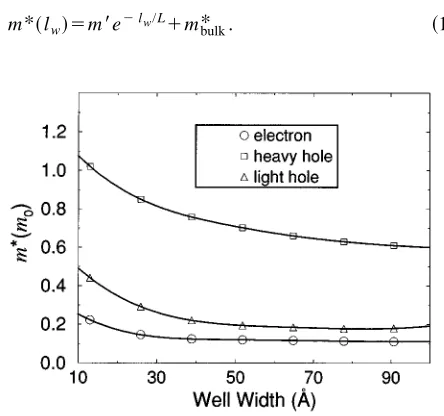
The effective masses which appear in Fig. 3 are deduced by adjusting their values in Eq.~6! until exact agreement is obtained with the PP calculation of the corresponding one electron energy. It is apparent that the expected limit of bulk mass values for the wide wells is obeyed. For CdTe wells of width greater than 50 Å, the effective masses of the electron, light-, and heavy- holes increase by less than 10%, 8%, and 17% of their bulk values, respectively. However, increas-ingly larger effective masses must be employed in narrower
wells in order to eliminate the discrepancy in energies shown in Figs. 2~a! and 2~b!. In particular, these effective masses reach values which are double that of the bulk at around 13 Å ~4 monolayers!. Figure 3 also suggests an empirical
rela-tionship between m*and the well width lw of the form
m*~lw!5m
8
e2lw/L [image:6.612.68.189.73.140.2]1mbulk* . ~10!
FIG. 2. The dependence of the confinement energies of~a!electron and~b!
light- and heavy-holes on the quantum well widths. PP and EFA correspond to the pseudopotential and single-band envelope function models, respectively.
[image:6.612.328.550.506.714.2]This relationship was fitted to the data in Fig. 3 and gave the
values of the constants m
8
and L as shown in Table III.It is interesting to note that well width dependent
effec-tive masses have been proposed before by Ekenberg,43 who
applied the nonparabolicity correction of bulk band structure to the confinement energy of a subband of a quantum well. In particular, as the quantum well becomes narrower, the
wave vector kz along the growth-axis, which appears in the
one-dimensional envelope function cos(kzz), becomes larger.
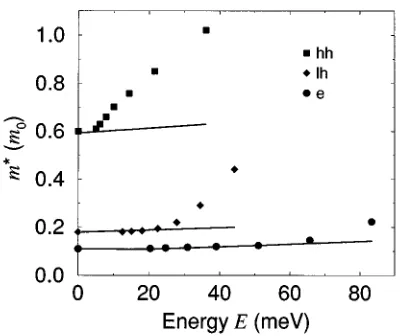
The effective mass of the corresponding bulk states can be-come altered due to the deviation of the bulk band structure from the parabolic E } k2relationship, and hence the effec-tive mass becomes a function of well width. In Fig. 4, the effective mass of Fig. 3 are plotted against the corresponding confinement energies, as illustrated by the solid symbols. In comparison with this, the solid lines are the results of
imple-menting the approach of Ekenberg.43 Basically this involves
deducing the effective mass from the bulk @100#
bandstructure25 at the band energies corresponding to the
quantum well confinement energies. It is apparent that while the nonparabolicity of the bulk band structure is contributing to the variation in the effective mass, it is not sufficient to explain the dependency.
B. Comparisons of the multiple-band k–p model and the pseudopotential calculation
Figure 5 displays the band structure of bulk CdTe along
~001! calculated with three different methods. The first
method employs the pseudopotential approach~PP!, the
sec-ond method the k•p model with Luttinger parameters
de-duced from experimental data of cyclotron resonance44~KP
model 1!, while the third employs the k•p model with
Lut-tinger parameters deduced @via Eq. ~9! from the
pseudopo-tential data shown in Table I~KP model 2#. It is clear from
this figure that both k•p models have a dispersion curve
which agrees well with that from the pseudopotential
ap-proach in a small region near theG point. This demonstrates
clearly that the k•p model is a successful model in the
vi-cinity of a special point of the bulk Brillioun zone. However,
beyond that small region, the discrepancy between the k•p
model and the pseudopotential calculation can be very large
~up to several eVs!. This has significant implications for the k•p model description of a quantum well, particularly a
nar-row quantum well, where it has been shown42that more bulk
Bloch functions~i.e., more band states!need to be included
in the k•p basis set for a quantum well system than are
required for the description of a bulk state. Given that the energy levels of these bulk Bloch functions are themselves described poorly by the k•p model, it is clear how errors can
enter into the k•p calculation for a quantum well system.
One means of overcoming this would be to increase the
number of Luttinger parameters employed.42 Another
ap-proach would be to adopt the energy dependent ~i.e., well
width dependent!Luttinger parameters.
Figure 6 shows the well width dependence of the Lut-tinger parametersg1 andg2 as defined by Eqs.~9a!and Eq.
[image:7.612.75.275.32.200.2]~9b!, where the corresponding mhh*@100# and mlh*@100#come
[image:7.612.328.542.33.203.2]FIG. 4. The effective masses of the electron, light-, and heavy-holes as a function of the confinement energies. The solid points are from the pseudo-potential calculations and the solid lines from nonparabolicity approach~see Ref. 42.
FIG. 5. The band structure of bulk CdTe along~001!calculated with the pseudopotential approach ~PP!, the k•p model with Luttinger parameters deduced from Ref. 42 ~KP model 1!, and the k•p model with Luttinger parameters deduced@via Eq. ~9!from the pseudopotential data shown in Table I~KP model 2#.
FIG. 6. The dependence of the Luttinger parameters g1 and g2 on the
quantum well widths.
3419
[image:7.612.337.538.541.706.2]from Fig. 3 or Eq. ~10!. When these Luttinger parameters, together with g3 appropriate to the bulk value, are put into
the calculation, they produce the same confinement energy of the ground heavy- and light- hole states obtained from the pseudopotential calculation shown in Fig. 2~b!. The errors are within 0.2 meV. This shows the self-consistency of the calculation even when the masses are taken from a different model. It can be seen from Fig. 6 that the Luttinger param-eters corresponding to the narrow wells deviate significantly from their bulk values. This again serves to illustrate the
relative crudity of the approximation of using g1 and g2
values deduced from observation of bulk properties. For completeness, the four curves in Fig. 7 display all the approaches to the heavy-hole energy calculation adopted in the present article. Curve~i!is from PP, a full empirical pseudopotential calculation. Curve~ii!is from the k•p model
3, which employs the well width dependent Luttinger param-eters given in Fig. 6. Curve ~iii! is from the k•p model 2,
which uses constant Luttinger parameters appropriate to bulk effective masses deduced from the bulk pseudopotential cal-culations shown in Table I.25 Curve ~iv! is from the k•p
model 1, which uses constant Luttinger parameters derived from the experimental observations of bulk materials.44
Figure 8 displays the equivalent data of Fig. 7 but for the light hole. These curves substantiate the point that the utili-zation of constant ~bulk!Luttinger parameters are totally in-appropriate for the calculation of the energy level structure of narrow quantum wells.
V. CONCLUSION
It has been demonstrated that calculations of the electron and hole energy levels in narrow quantum wells, based on the envelope function approach employing effective masses, or equivalently Luttinger parameters, deduced from bulk band structure properties, can have large discrepancies com-pared with the rigorous microscopic approach of the empiri-cal pseudopotential method. Indeed both the effective mass and Luttinger parameters have been shown to have
appre-ciable structural ~i.e., well width! dependencies.
These dependencies have been illustrated in detail, for the
CdTe/Cd12xMnxTe system. As described in more detail in
the text, these discrepancies can be regarded as a manifesta-tion of the inappropriateness of the envelope funcmanifesta-tion meth-ods employing structurally independent effective masses within the standard form of the Hamiltonian, which will overestimate considerably the quantum confinement energies in such systems.
1S. S. Nedorezov, Sov. Phys. Solid State 12, 1814~1971!. 2G. Barstard, Phys. Rev. B 24, 5693~1981!.
3
G. Barstard, Phys. Rev. B 25, 7584~1982!.
4
G. Barstard, Wave Mechanics Applied to Semiconductor Heterostructures
~Les Edition de Physique, Les Ulis, France, 1988!.
5D. L. Smith and C. Mailhiot, Rev. Mod. Phys. 62, 173~1990!. 6D. L. Smith and C. Mailhiot, Phys. Rev. B 33, 8345~1986!. 7
S. Schmitt-Rink, D. S. Chemla, and D. A. B. Miller, Adv. Phys. 38, 89
~1989!.
8T. Stirner, P. Harrison, W. E. Hagston, and J. P. Goodwin, Phys. Rev. B
50, 5713~1994!.
9
G. Barstard, J. A. Brum, and R. Ferreira, in Solid State Physics, Advances in Research and Applications, edited by H. Ehrenreich and D. Turnbull
~Academic, New York, 1991!, Vol. 44, p. 229.
10S. R. Jackson, J. E. Nicholls, W. E. Hagston, P. Harrison, T. Stirner, J. H.
C. Hogg, B. Lunn, and D. E. Ashenford, Phys. Rev. B 50, 5392~1994!.
11
P. Harrison, F. Long, and W. E. Hagston, Superlattices Microstruct. 19, 123~1996!.
12M. V. Rama Krishna and R. A. Friensner, Phys. Rev. Lett. 67, 629~1991!. 13M. G. Burt, Semicond. Sci. Technol. 3, 739~1988!.
14
M. G. Burt, J. Phys.: Condens. Matter 4, 6651~1992!.
15
M. G. Burt, Phys. Rev. B 50, 7518~1994!.
16B. A. Foreman, Phys. Rev. B 52, 12 241~1995!.
17P. Vogl, H. P. Hjalmarson, and J. Dow, J. Phys. Chem. Solids 44, 365
~1983!.
18
M. Jaros, K. B. Wong, and M. A. Gell, Phys. Rev. B 31, 1205~1985!.
19M. A. Gell, D. Ninno, M. Jaros, and D. C. Herbert, Phys. Rev. B 34, 2416
~1986!.
20L.-W. Wang and A. Zunger, J. Chem. Phys. 100, 2394~1994!. 21K. Ma¨der, L.-W. Wang, and Z. Zunger, Phys. Rev. Lett. 74, 2555~1995!. 22
K. Ma¨der, L.-W. Wang, and Z. Zunger, J. Appl. Phys. 78, 6639~1995!.
23L.-W. Wang, A. Zunger, and K. Ma¨der, Phys. Rev. B 53, 2010~1996!. 24D. M. Wood and A. Zunger, Phys. Rev. B 53, 7948~1996!.
25F. Long, P. Harrison, and W. E. Hagston, J. Appl. Phys. 79, 6939~1996!. 26
B. Kuhn-Heinrich, W. Ossau, T. Litz, A. Wang, and G. Landwehr, J. Appl. Phys. 75, 8046~1994!.
27G. Peter, E. Deleporte, J. M. Berroir, C. Delalande, J. M. Hong, and L. L.
Chang, Phys. Rev. B 44, 11 302~1991!.
28T. Piorek, W. E. Hagston, and P. Harrison, Phys. Rev. B 52, 14 111
[image:8.612.63.290.39.206.2]~1995!. FIG. 8. The light- hole confinement energy in the quantum wells calculated
[image:8.612.64.285.542.709.2]with the same approaches as in Fig. 7.
29
D. R. Yakovlev, Festko¨rperprobleme/Advances in Solid State Physics, ed-ited by U. Ro¨ssler~Vieweg, Braunschweig, 1992!, Vol. 32.
30S. Jackson, W. E. Hagston, P. Harrison, J. H. C. Hogg, J. E. Nicholls, B.
Lunn, P. Devine, and S. Ali, Phys. Rev. B 49, 13 512~1994!.
31M. Jaros, A. Zoryk, and D. Ninno, Phys. Rev. B 35, 8277~1987!. 32
F. Long, S. H. Liu, F. Mei, J. Miao, and J. Liang, Chin. Phys. Lett. 11, 109
~1994!.
33M. L. Cohen and T. K. Bergstresser, Phys. Rev. 141, 789~1966!. 34S. Bloom and T. K. Bergstresser, Solid State Commun. 6, 465~1968!. 35P. Harrison, T. Stirner, S. J. Weston, S. R. Bardorf, S. Jackson, W. E.
Hagston, J. H. C. Hogg, J. E. Nicholls, and M. O’Neill, Phys. Rev. B 51, 5477~1995!.
36P. Chen, J. E. Nicholls, J. H. C. Hogg, T. Stirner, and W. E. Hagston,
Phys. Rev. B 52, 4732~1995!.
37
J.-B. Xia, Phys. Rev. B 38, 8358~1988!.
38
K. Ma¨der and A. Zunger, Phys. Rev. B 50, 17 393~1994!.
39
A. Blacha, H. Presting, and M. Cardona, Phys. Status Solidi B 126, 11
~1984!.
40U. EkenBerg and M. Altarelli, Phys. Rev. B 35, 7585~1987!.
41D. Gershoni, C. H. Henry, and D. A. Baraff, IEEE J. Quantum Electron.
29, 2433~1993!.
42
W. E. Hagston and F. Long~unpublished!.
43U. EkenBerg, Phys. Rev. B 40, 7714~1989!.
44Le Si Dang, G. Neu, and R. Romestain, Solid State Commun. 6, 1187
~1982!.
45J. R. Chelikowsky and M. L. Cohen, Phys. Rev. B 14, 556~1988!. 46 Ch. Neumann, A. No¨the, and N. O. Lipari, Phys. Rev. B 37, 922~1976!. 47 J. Van Vechten, in Handbook of Semiconductors, edited by S. P. Keller
~North-Holland, Amsterdam, 1980!, Vol. 3, p. 44 .
48
A. Twadoski, M. Nawrochi, and J. Ginter, Phys. Status Solidi B 96, 497
~1979!.
3421