White Rose Research Online URL for this paper:
http://eprints.whiterose.ac.uk/79699/
Version: Submitted Version
Article:
Gawthrop, P.J., Neild, S.A., Wallace, M.I. et al. (1 more author) (2007) Robust real-time
substructuring techniques for under-damped systems. Structural Control and Health
Monitoring, 14. 591 - 608. ISSN 1545-2255
https://doi.org/10.1002/stc.174
Reuse
Unless indicated otherwise, fulltext items are protected by copyright with all rights reserved. The copyright exception in section 29 of the Copyright, Designs and Patents Act 1988 allows the making of a single copy solely for the purpose of non-commercial research or private study within the limits of fair dealing. The publisher or other rights-holder may allow further reproduction and re-use of this version - refer to the White Rose Research Online record for this item. Where records identify the publisher as the copyright holder, users can verify any specific terms of use on the publisher’s website.
Takedown
If you consider content in White Rose Research Online to be in breach of UK law, please notify us by
for under-damped systems
P. J. Gawthrop
1,∗, M. I. Wallace
2, S. A. Neild
2, and D. J. Wagg
21Centre for Systems and Control and Department of Mechanical Engineering, University of Glasgow, GLASGOW. G12 8QQ
UK
2
Department of Mechanical Engineering, Queens Building, University of Bristol, Bristol BS8 1TR, UK.
SUMMARY
This paper considers the hybrid simulation of under-damped dynamical systems using numerical-experimental real-time substructuring. Substructuring joins together a physical plant with a numerical model using real time control techniques, such that the combined model emulates the behaviour of the entire system. Due to the low damping, the control of substructured systems can be highly sensitive to delay and uncertainty. We present a technique for calculating the critical delay of the substructured system using a phase margin approach. In addition, it is shown that robustness techniques, drawn from feedback control theory, can be used to reduce the destabilizing effect of uncertainty. To demonstrate this a comparison of three different robustness compensators is presented, using a well known linear system. The level of uncertainty is deliberately increased to compare their performances and a discussion is made on when each may be most useful. Copyright c°2005 John Wiley & Sons, Ltd.
KEY WORDS: Hybrid testing, substructuring, stability, robust control
∗Correspondence to: P. .J .Gawthrop, Centre for Systems and Control and Department of Mechanical Engineering, University of
1. Introduction
In this paper we consider the recently developed structural testing method of real-time dynamic
substructuring. This is a form of hybrid numerical-experimental testing suited to testing large structures
or complex systems containing acritical componentof interest [13]. The technique allows the critical
component to be tested experimentally at full scale while the remainder of the system is modelled
numerically. The coupling between the physical and numerical parts is achieved using real-time control
of actuators connected to the physical substructure [1, 2, 6, 9].
As pointed out previously [4, 10], substructuring can be viewed as a control problem. However,
unlike conventional control system design which aims for a well-damped closed-loop system, the
corresponding substructuring design often has lightly-damped behaviour near the boundary of stability.
For this reason,robustnessis an essential consideration for this type of testing. However, because the
testing technique has been developed primarily from a civil engineering perspective, robustness has
not been studied using a control theoretic approach. In this paper we apply tools from control theory
to study the robust stability of a generic linear substructuring system. In particular we focus on the
effect of unmodelled delays and other uncertainties which occur during substructuring. We present
a technique for calculating the critical delay,τc, beyond which the substructured system will become
unstable, characterized by the onset of oscillations with positive exponential growth. Another approach
for identifying this critical delay is presented by Wallace et al. [11] which uses Delay Differential
Equation (DDE) models to analyse the substructured system; the relation between the two approaches
is discussed in this paper.
12]. These strategies consist of compensating for the combined dynamics of the actuator(s) and
corresponding proprietary (i.e. built in) controller(s) — together these are referred to as thetransfer
system(s). An additional compensator (or outer-loop controller) is introduced around the transfer
system to eliminate the effect of its own dynamics from the force fed back from the substructure.
The outer-loop controllers suggested to date broadly fall into two categories, those that provide (time)
delay (e−sT) compensation and those that provide lag (e.g.1+1sT) compensation; section 2 presents more
detail on these outer-loop strategies.
In this paper, the problem of robustness is considered for a generic substructuring model. In
particular, robustness is a particular concern when the structure being tested is lightly damped or
there is a high level of uncertainty in the transfer system control. Here we examine the stability and
robustness of a substructuring algorithm and describe a strategy for increasing the control robustness
for lightly-damped systems through the use of a robust transfer system design methodology. Three
types of robustness compensators are proposed to address uncertainties in the transfer system model.
The trade off is that control performance (in terms of accuracy of the hybrid simulation) is reduced
for increased control robustness. The effects of the robustness compensators are illustrated using a
single degree-of-freedom example, with both hybrid numerical-experimental results compared to pure
numerical simulations, by intentionally increasing the uncertainty in the system.
2. The substructuring algorithm
To carry out a substructuring test, the numerical model and the physical substructure are run in parallel
and interact in real-time to emulate the dynamic behaviour of the complete structure. This interaction
is achieved through the exchange of information at the interface between the numerical model and
using a numerical model and imposed via actuation devices (the transfer systems) on the physical
substructure. Secondly, the forces due to imposing these displacements on the physical substructures
are measured and fed back to the numerical model where they are included at the interface for the
next time step. A controller is used to minimize the effects of the dynamics introduced by the transfer
system. Most dynamic test methods use a proprietary controller, which typically performs PID control,
to reduce the uncertainty of the transfer system dynamics to an acceptable level. However, to achieve
a stable substructuring algorithm a more sophisticated compensation scheme is also required to reduce
the delay introduced by the transfer system to a level below the critical limit.
The first time delay compensators were obtained by assuming that the dynamics of the transfer
system may be approximated to a pure delay. For example, Horiuchi et al. [6] and Blakeborough et al.
[1] proposed outer-loop forward prediction methods which use polynomial extrapolation to predict
forward the numerical model displacement by a fixed number of time-steps. Darby et al. [2] relaxed the
assumption of a pure delay by developing a forward prediction method that varied the amount of delay
compensation, based on the error between the actuator displacement and the desired numerical model
displacement. This method was extended by Wallace et al. [12] who developed an adaptive forward
prediction algorithm that used variable polynomial coefficients such that non-integer multiples of the
previous time step could be predicted and also incorporates an amplitude correction algorithm. The use
of a Smith predictor has also been proposed as a suitable delay compensator [9].
Lag compensation via an experimental transfer function estimation of the combined inner-loop
controller and actuator dynamics has been proposed by Gawthrop et al. [4] and Reinhorn et al. [9].
The proposed outer-loop controllers compensate for unwanted dynamics by applying the inverse of
the transfer function estimation. Model reference adaptive control has also been suggested as an
compensation can be achieved via this approach.
Noting that bothe−sT and1+1sT have the same first-order Taylor expansion (1−sT) – which indeed
they share with more complicated transfer functions such as 1
(1+sT 2)2
and (1−s T 2) 1+sT
2
– there is not much
practical difference between the approaches when the damping is small as low order approximations
apply in this case. This point is examined further in Section 3.1.
[Figure 1 about here.]
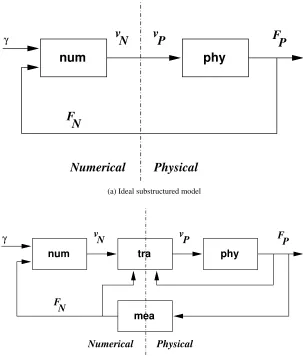
Figure 1 shows two block diagram representations of substructuring†. Figure 1(a) shows the ideal case
where a numerical substructure,num, is coupled directly to a physical substructure,phy, and there
are no transfer system dynamics and hence no need for a controller. The detail of the two substructure
blocks is: forphythe outputFpand inputdPare a collocated force and displacement pair connecting
phyto the numerical part of the substructured system. Similarly fornumthe outputFN and inputdN
are the collocated force and displacement pair connectingnumto the physical part of the substructured
system. The signalrrepresents the net effect of external forces in the numerical part of the model.
In this ideal situation,FN=FPanddP=dNand the dynamic behaviour of the substructured system
exactly replicated that of the emulated system‡. However, for structural or mechanical systems, the
physical system input dP has to be generated by a transfer system which has the control objective
of settingdP≈dN. The physical force FP is measured by asensor system which also has it’s own
dynamics. In practice the ideal sensor system has the relationship thatFP→FN asdp→dN.
Figure 1(b) gives a block diagram representation of the practical case. In addition to the two blocks
of Figure 1(a);trarepresents the controlled transfer system including both inner- and outer-loop control
†An alternative bond graph representation is given by Gawthrop et al. [4].
‡
This is the case in Hardware-in-the-loop testing, where because of the structure of the system being tested, the transfer systems
systems, andmearepresents the measurement sensor system, which includes the force transducer and
associated power supplies (this is assumed not to interact withphy). We note that physical part oftra
usually consists of the actuator and inner-loop controller and is affected byFP(an actuator only has a
finite performance capacity envelope in which it will operate in a linear fashion), while the numerical
(augmented) part oftrais the outer-loop controller and robustness compensator with its accuracy being
affected by the measured version ofFP(FN). At this point, the following assumption is made
Assumption 1. The four systems in Figure 1(b) arelinear,time-invariantandstable.
Using Assumption 1, the ideal substructuring case, Figure 1(a), may be represented by:
FP=P(s)dP (phy), (1)
dN =N1(s)r−N2(s)FN (2)
=N(s)(Nr(s)r−FN) (num), (3)
where,P(s)is the transfer function corresponding tophy,N1(s)andN2(s)in Equation (2) are separate
parts of the numerical model, which we re-express in Equation (3) in a more convenient form for
later analysis;N(s)is the transfer function corresponding to num andNr(s)is a transfer function
representing the interface betweennumand the external forcing. In the ideal case there are no transfer
system or measurement dynamics, such that FN =FPanddP=dN. Then Equations (1) and (3) for
the physical substructure and the numerical model dynamics may be simplified such that the overall
system dynamics are identical to that of the emulated system. This leads to the relation
FP=
L0(s)
1+L0(s)Nr(s)r, (4)
whereL0(s) =P(s)N(s)and is defined as thenominalloop gain.
the measurement system must be included. We define these dynamics as
dP=T(s)dN−TP(s)FP (tra), (5)
FN=M(s)FP (mea), (6)
where the termTP(s)FPof Equation (5) includes theneteffect ofFPandFNontra. From Assumption 1,
each transfer function explicitly appearing in Equations (1)–(6) isstable. The issue is then to investigate
whether the dynamics of the substructured system shown in Figure 1(b) is also stable.
Rearranging equations (1), (3), (5) and (6) the representation of Figure 1(b) may be written as
[1+P(s)Tp(s)]Fp=L0(s)[T(s)Nr(s)r−T(s)M(s)Fp]. (7)
Defining theneglectedgain asΛ(s)and theneglectedforward gain asΛr(s)we obtain
Λ(s) = [1+P(s)TP(s)]−1T(s)M(s), (8)
Λr(s) = [1+P(s)TP(s)]− 1
T(s)). (9)
Defining anequivalentforce,Fe=Λr(s)Nr(s)r, the system dynamics may be expressed as
FP=L0(s)[Fe−Λ(s)FP]. (10) Figure 1(b) can thus be represented by the classical feedback system of Figure 2.
[Figure 2 about here.]
Finally, definingD(s)as the transfer function relatingFeandFPfor the practical substructured system,
using (10) we can write:
D(s) = L0(s)
1+Λ(s)L0(s), (11)
such that
Using Equation (4) and recognising that for the ideal caseΛ(s) =Λr(s) =1, the corresponding nominal transfer function relating to the ideal substructured system, and the emulated system, may be defined
as
D0(s) = L0(s)
1+L0(s). (13)
In Section 4 we discuss the use of different robustness compensation schemes. We note that D0(s)
will explicitly include these algorithms and therefore change. Thus for comparison, we defineDemas
the emulated system transfer function such that Dem=D0(s)when L0(s) does not incorporate any
compensation schemes.
3. Relative and robust stability
Figure 2 and the corresponding closed-loop system (12) are in the classical feedback control system
form where L0(s) would be interpreted as the “system” and Λ(s) as the “controller”. This means
that a range of standard control system design techniques (Goodwin et al. [5] gives a comprehensive
exposition) can be brought to bear on the problem.
For example,relative stability [5, sec. 5.8] can be characterized as follows. Define the critical
frequencyωcas the solution of
|L(jωc)|=1, (14)
where theactualloop gain,L(s), is defined as
L(s) =Λ(s)L0(s). (15)
The correspondingphase marginφmmay be written as
The phase margin provides a measure of how near to instability the ideal system (whereΛ(s) =1) is in
terms of how much phase lag (due toΛ(s)6=1) is permissible. For example, if the neglected dynamics
comprise a pure delay (Λ(s) =e−sτ) then thecritical delay,τ
c, is the time delay which would give a
phase lag ofφmand is given by
τc=
φm
ωc
. (17)
This gives an alternative method for computing the critical delay, in addition to that developed by
Wallace et al. [11] which uses Delay Differential Equation (DDE) models. For the class of system for
which the DDE methods cannot be applied or when it is impractical to use the technique, Equation
(17) could still be used in many cases (even if only as a linear approximation) to give an estimate ofτc. The link between the two techniques is discussed further in Section 3.1.
For substructuring systems in the form developed in Section 2 we would like to apply more general,
robust stabilitymethods. Using the approach outlined in [5, sec. 5.9], together with the assumption that
bothL0(s)andΛ(s)are stable implies that the closed-loop system of Figure 2 is stable if
|D0(jω)||∆(jω)| ≤1 ∀ω, (18)
where
∆(s) =Λ(s)−1. (19)
This is a conservative result but has the advantage of bounding the error transfer function∆in terms of
the desired systemD0(jω). In particular is shows that∆(jω)must be small at those frequencies where
D0(jω)is large — typically at the resonant frequencies of the desired system.
Although these methods are standard in the control system context, they are novel in the
substructuring context. In particular, both relative and robust stability can be reinterpreted for
3.1. Substructuring Example
[Figure 3 about here.]
[Figure 4 about here.]
[Figure 5 about here.]
An example of a substructured system is shown schematically in Figure 3. The system has
a numerical substructure consisting of a mass of mkg, a spring with stiffness kN/m and damper
with constant cNs/m and a physical substructure consisting of a spring with stiffness ksN/m. This
corresponds to the hybrid numerical-experimental system which will be presented in Section 5. In this
case
L0(s) = ks
ms2+cs+k, (20)
Nr(s) =cs+k. (21)
Defining the natural frequency of the numerical subsystem asωn=
q
k
m, the corresponding damping
ratioζ= c
2mωn andp= ks
k we can write
L0(s) = pω 2 n
s2+2ζω ns+ω2n
, (22)
Nr(s) =m(2ζωns+ω2n). (23) Defining ˆs=ωsn, this can be rewritten in normalised form as
L0(s) = p ˆ
s2+2ζsˆ+1, (24)
Nr(s) =k(2ζsˆ+1). (25) Defining ˆω=ωω
n and using (14), the critical frequency corresponding to (24) is the solution of
Equation (26) is quadratic in ˆω2
. It has real solutions if
(4ζ2−2)2>(1−p2). (27)
There are two cases: ifp≥1 then Equation (27) is independent ofζ, otherwise the condition depends
on the value ofζ. In the case of real solutions, the positive square root of a positive solution gives a
(positive) value of ˆωsatisfying Equation (14).
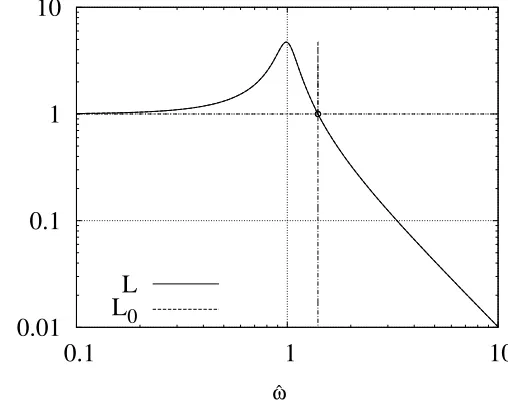
Figure 4(a) shows log|L0(jωˆ)|plotted against jωˆ forp=1 andζ=0.107. In this case, ˆωc=1.398, the frequency at which|L0(jωˆ)|=1. Figure 4(b) gives the corresponding phase (in degrees) indicating a phase margin of 17.34◦=0.3027rad. This gives a critical delay of ˆτc=0.2165, which is precisely the value obtained from the DDE numerical analysis of Wallace et al. [11] confirming the fact that both
methods are exact. However, the method of this paper gives a different insight into the problem and
has a number of advantages: it can be used for more complicated examples than can the DDE approach
and is applicable to uncertainties modelled byanytransfer function.
The corresponding diagrams forL=e−jωˆL
oare plotted in Figures 4(a) and 4(b). As predicted,
L(jωˆc) =−1 corresponding to|L(jωˆc)|=1 and∠L(jωˆc) =−180◦.
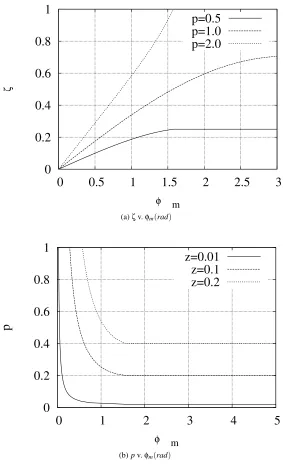
Figure 5(a) shows how the phase margin varies withζand 5(b) how it varies withp. For small values
ofζ, the phase marginφmis approximately proportional toζ. Larger values ofpgive a reduced phase
margin. Figure 4(a) also provides alternative insight into the solution of Equation (26). From Equation
(24), the sole effect of pis to move the curve of Figure 4(a) vertically. It is therefore clear that when
p>1, log|L0(jωˆ)|=0 at only one frequency implying a single positive real solution of Equation (26) for ˆω2
. On the other hand, ifp<1 there is no solution if the peak of the curve is below zero. From
Equation (24), the peak value occurs at an approximate frequency of ˆω=1 where|L0(jωˆ)|=2pζ. Thus, as also indicated in Figure 5(b), the phase margin is infinite whenp<2ζ.
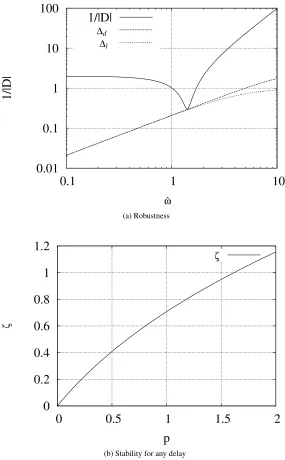
The robustness criterion Equation (18) can be examined by plotting both |D(1jωˆ)| and|∆(jω)| on
the same diagram. For example, Figure 6(a) shows |D(1jωˆ)| when p=1 andζ=0.107. On the same
diagram,|∆(jω)|is plotted for two cases:
Λ(sˆ) =
e−τˆsˆ, (shown as∆din Figure 6(a)) 1
1+ˆτsˆ, (shown as∆lin Figure 6(a))
(28)
where ˆτ=0.21. In this case, stability is predicted in each case as Equation (18) is satisfied. However,
this would not be the case ifτwere increased slightly. Note that both forms ofΛ(sˆ)of Equation (28)
give similar results in this case indicating thatphaseerror is more important thatamplitudeerror in
this case. Note that ˆτ=0.21 predicted by this (conservative) robust stability method is less than that predicted by the the exact relative stability (phase margin) approach. However, the robustness approach
is more general in that the uncertainty does not need to be parameterized by a transfer function.
The minimum value of|D(1jωˆ)|occurs at ˆω2
≈(1+p)with a value of approximately 2ζ√p1+p. Noting
that the maximum value of∆=1−e−ˆτsˆis 2, it follows that the substructured system will be stable for
anydelayτif
ζ>√ p
1+p. (29)
Figure 6(b) shows the boundary implied by Equation (29).
4. A Robust Transfer System Design Methodology
This paper provides a stability and robustness analysisof the substructuring problem by applying
techniques from linear control theory. This leads on to a methodology for thedesignof the transfer
system to achieve robust stability. The use of linear theory — and particularly the assumptions that the
at first sight appear to be a serious limitation of this analysis. However, these results can be applied to
— and in some cases can significantly improve results from — substructuring tests with nonlinear
elements. This is because a robust linear system can cope with a significant amount of nonlinear
‘disturbance’. Using this approach we are able to get a good comparison of results between three
different types of robustness compensator — shown in section 5.
Using linear analysis, we propose a 4 stage controller design strategy for each transfer system (which
in this work we assume to be an actuator):
1. Design an (or use the proprietary) inner-loop controller around the actuator to reduce
uncertainty and non-linearity in the resultant closed-loop transfer system.
2. Use system identification to estimate a (closed-loop) transfer function of the actuator and
inner-loop controller (which we define as thenominalmodel). Use the same system identification
results to estimate anuncertaintymodel for the transfer system.
3. Use the nominal model from step 2 to design an outer-loop transfer system cancellation
controller.
4. Use theuncertaintymodel from step 2 to design a robustness compensator.
Broadly, the literature outlined in Section 2 addresses steps 1–3; the selection of the inner-loop
controller gains, a system identification of the resulting transfer system and the design of an
outer-loop controller to compensate for the transfer system dynamics. The adaptive nature of the outer-outer-loop
controllers proposed in [2, 8, 12] allow for the compensation of the transfer system dynamics despite
uncertainty in the transfer function model derived in step 2. Although they incorporate some level of
robustness due to this adaptation, they do not explicitly include the robustness compensator proposed
in step 4. This is the key reason why the linear results can be applied so readily to systems where the
adaptive forward prediction of Wallace et al. [12]) plus the robustness compensation allows the system
to cope with a significant degree of nonlinear ‘disturbance’. We note also that the analysis applies
primarily to the design of the transfer system. In fact we wish to design a stable robust control strategy
to eliminate (or at least mitigate) the effect of uncertainty and non-linearity from the transfer system —
we want to make the transfer system dynamics linear. The only time we actually require a definition of
the transfer function of the physical substructure (which is usually a nonlinear element [13]) is in order
to apply the robustness compensation technique based on physical model emulation, as described in
Section 4.3.
From Section 3, it is clear that instability can still occur even in the presence of apparently quite
small neglected dynamics; in other words, the nominal design is not necessarily robust. However, the
trade off for achieving a robust system is a reduced level ofnominalperformance.
There are three approaches suggested here
1. Damping-ratio compensation:ζ-robustness
2. Phase-advance compensation:α-robustness
3. Physical model emulation:γ-robustness
All three approaches have a single parameter which provides a trade-off between performance and
robustness and are considered in the following sections. Section 4.4 gives a specific example. Methods
1 and 3 are believed to be new and have been developed specifically with substructuring in mind
[4, 12]; method 2 is a standard control system technique [5, section 6.6] applied here for the first time
to substructuring. Method 3 is related to the Youla parametrisation of all stabilising controllers [5,
4.1. Damping-ratio compensation:ζ-robustness
From Figure 6(a), it is clear that it is the magnitude of the resonant peak of the closed-loop transfer
function|D0(jωc)| that restricts the maximum allowed value of uncertainty|Λ(jωc)|. As|D0(jωc)| decreases with increasing damping, a simple way of trading robustness for stability is to increase the
damping coefficients of the numerical model above their correct values.
This method has the advantage of requiring no knowledge about the system properties but has the
disadvantage of distorting the nominal closed loop system.
4.2. Phase-advance compensation:α-robustness
The example of Section 3.1 implies that lack of robustness is due to the neglected phase lag associated
withΛ(jω)atw=ωc. One way to improve robustness is to deliberately introduce phase advance, at
the critical frequency, toΛ(jω)by interposing a phase advance transfer function between numand
tra. Perhaps the simplest such transfer function is [5, sec. 6.6]:
C(s) =α1s+ωc
αs+ωc
(30)
where the parameterα≥1. Clearlyα=1 corresponds to a unit transfer function which has no effect;
the maximum phase advance occurs at aboutω=ωc. The maximum phase advance rises to about
π
4rad=45owhich whenα≈10 [5, sec. 6.6]. Typically, for this application, 1<α<2.
This method has the advantage of requiring only knowledge of ωc, but has the disadvantage of
distorting the nominal closed loop system.
4.3. Physical model emulation:γ-robustness
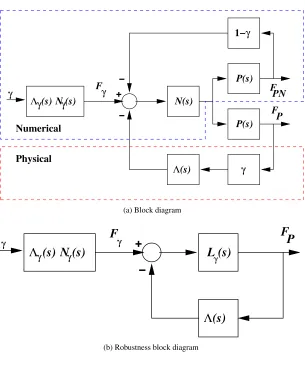
[Figure 7 about here.]
subsystem. As indicated in block diagram form in Figure 7(a), the output ofnumis fed into both the
simulation ofphyand the physical subsystemphy. In comparison to Figure 2, there aretwofeedback
loops:γtimes the output of the physical system and(1−γ)is fed back to the input of the numerical
subsystem. At the two extremes,γ=0 gives a purely numerical simulation (andΛ(s)is not part of the
feedback), whereasγ=1 gives the hybrid numerical/physical simulation discussed in the preceding
sections. When 0≤γ≤1, there is a smooth transition between the two extremes. However, for each
value ofγ, thenominalclosed loop system dynamics are the same.
The block diagram of Figure 7(a) can be rewritten in the simplified form of Figure 7(b) where
Lγ(s) = γ
L0(s)
1+ (1−γ)L0(s). (31)
The robustness results of Section 2 can then be applied to Figure 7(b) in a similar way as to that
discussed for Figure 2.
This method has the disadvantage of requiring an accurate model of the physical system transfer
functionP(s)but has the advantage ofnotdistorting the nominal closed loop system.
4.4. Example (continued)
[Figure 8 about here.]
Figure 8(a) is the same as Figure 6(a) except that the results of each of the three compensators are
shown as well. In each case, the stability margin is significantly increased at the resonant frequency; in
each case, ˆτ≈0.35, about0.35
0.21=1.67 larger than the uncompensated case.
Figure 8(b) shows the closed loop system when the actual system (comprising the nominal system
and the time delay) is compensated by the three robustness compensators. Although, as expected, these
three closed-loop responses differ from the nominal (D0) they are better than the uncompensated case
The other observation from Figure 8(a) is that there are significant differences between 1/|D|for the
three different compensation methods. This will be discussed in more detail in relation to the hybrid
numerical-experimental results shown in the next section.
5. Hybrid testing
[Figure 9 about here.]
The proposed robustness methods were evaluated using a small-scale substructuring experiment
of the system described in Section 3.1. For the experiments, the numerical model and outer-loop
compensator were written in the Matlab Simulink environment and run in real-time on a DSP using a
dSpace DS1104 Controller Board. The transfer system is a linear electro-mechanical actuator attached
to a centralising plate which is free to run via linear bearings on three guide rails, as shown in Figure
9. The physical substructure is a spring of stiffnessks=2250Nm−1, which is held rigid at one end and
attached to the actuator centralising plate via a load cell at the other.
5.1. Robust Transfer System Design
The experimental equipment has been extensively analysed and it is known that a good model for the
neglected dynamics of the system under an inner-loop proportional (P) control withkp=1 is a pure
delayΛ(sˆ)≈e−sˆˆτwhere ˆτ≈0.29. Using the parameters for this example and Equation (17) the critical
value of the delay is found to be ˆτc≈0.2. Therefore this system isunstablewithout some form of
delay compensation because ˆτ>τˆc. In this present study we are interested in robustness, therefore we will use the delay compensation method of Wallace et al. [12] as step 3 of the robust transfer system
within the stable range of 0≤ˆτ<ˆτc by varying the parameters of the delay compensation scheme. This is a simple way of varying the degree of uncertainty in the system, and gives an indication of the
performance of each robustness compensator as uncertainty increases.
[Table 1 about here.]
Table I summaries the values of ˆτused to generate the hybrid numerical-experimental results shown
in Figures 10–12. For each ˆτvalue, Table I shows the ratio ˆτ/τˆcto give an indication of how close the system is to the stability boundary at ˆτ/τˆc=1.
5.2. Numerical-experimental results
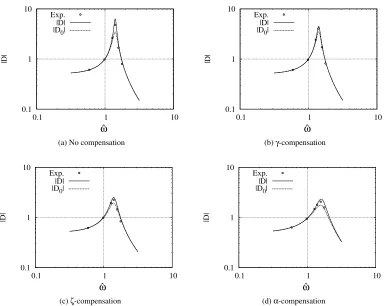
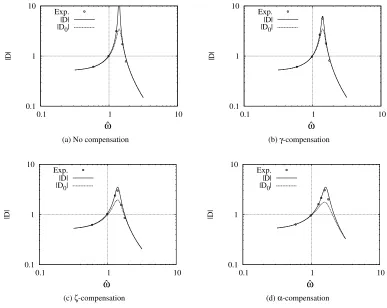
Each of Figures 10–12 shows hybrid numerical-experimental results for four cases: no compensation,
γ-compensation, ζ-compensation and α-compensation. Each plot shows three sets of data. Circles
correspond to hybrid numerical-experimental measurements of|D(jωˆ)|(11) at six frequencies: 3.0Hz,
5.0Hz, 6.5Hz, 7.1Hz, 8.0Hz and 9.0Hz. The solid and dashed lines are the theoretical values of|D(jωˆ)|
(withΛ(sˆ)≈e−sˆτ) (11) and|D0(jωˆ)|(whereΛ(sˆ) =1) (13) respectively.
[Figure 10 about here.]
Figure 10 shows the case where ˆτ=0 (i.e. the delay compensation method is removing the full 9.4ms
of delay in the system). In this case|D(jωˆ)|and|D0(jωˆ)|are indistinguishable and the uncertainty is
very low such thatΛ≈1 and|D| ≈ |D0|. With no compensation (Figure 10 (a)) there is good agreement
between the hybrid numerical-experimental results and|D0(jωˆ)|, indicating (as expected) that for this hybrid test setup the delay compensation method of Wallace et al. [12] provides a significant degree
of robustness without an additional compensator. Figure 10 (b) shows theγ-compensation case where
show theζ-compensation andα-compensation respectively. In each case the robustness is improved —
indicated by an increased phase margin — but|D0(jωˆ)|is distorted. Agreement with the hybrid test
results is good although theα-compensation looses some correlation near resonance.
[Figure 11 about here.]
Figure 11 shows the case where ˆτ=0.1. This case corresponds to the situation when the delay
compensation method (step 3 in Section 4) is not fully compensating for the delay error. This can be
seen in Figures 11 (a)-(d) as the discrepancy between|D|and|D0|close to resonance. Now without
any robustness compensation, the resonance peak|D(jωˆ)|becomes significantly exaggerated near the
resonant frequency compared to the nominal case|D0(jωˆ)|. In Figures 11 (b)-(d) the three robustness
compensators results are shown. Theγ-compensation results give a significant improvement in reducing
|D(jωˆ)|to|D0(jωˆ)|. Theζ-compensation andα-compensation also achieve the same effect, but with significant distortions in the|D0(jωˆ)| transfer function. In all three compensation cases the hybrid results match well with|D(jωˆ)|.
[Figure 12 about here.]
Figure 12 shows the case where ˆτ=0.19. This case corresponds to the situation when the delay
compensation method is stabilising the system, but leaving a significant delay error – corresponding to
a higher degree of uncertainty in the system. This can be seen clearly in Figure 12 (a) where now
the discrepancy between |D(jωˆ)| and |D0(jωˆ)| is even more pronounced close to resonance. The compensation methods shown in Figures 12 (b)–(d) all help to reduce this significantly. As with the
previous example the hybrid results correlate well with|D(jωˆ)|across the frequency range considered. The robustness compensation schemes can therefore be summarized by the following strengths and
γ-compensation has the advantage of not modifying the overall system response but is based on having an accurate model of the physical system – this was available for the experimental
considered here but would not generally be available. In less well known experimental
equipment, details ofΛ(sˆ)would be unknown and thus initial experiments would useγ=1.
γcould then be decreased as more experimental results allowed reduction of the uncertainty
encapsulated inΛ(sˆ).
ζ-compensation does not require a model of the physical system but does change the overall system characteristics; however, it has a clear physical meaning as a numerical model with an increased
damping ratio.
α-compensation again does not require a model but does distort the the overall system characteristics significantly.
6. Conclusion
Hybrid testing of under-damped dynamical systems using numerical-experimental real-time
substructuring is sensitive to both transfer system delay and uncertainty. The four stage robust transfer
system design methodology presented in the paper is designed to reduce both of these destabilizing
effects.
A phase margin approach to calculating the relative and robust critical delay is presented in Section
3, such that a cancellation controller (step 3) can be designed to ensure the stability of the substructuring
algorithm when there is zero uncertainty in the nominal model of the transfer system. However, due
to the characteristic nature of experimental testing, uncertainty is never negligible, especially the first
from feedback control theory can reduce this destabilizing effect. Three methods for reducing the effect
of uncertainty are discussed using theoretical and experimental results in Section 5, which show that
each is effective in increasing robustness to uncertainty.
A pragmatic view of robustness is that the amount of compensation would be large for initial
experiments, but would reduce as uncertainty was reduced. For example, using an advanced system
identification technique as suggested by Gawthrop et al. [4] or when using an adaptive cancellation
controller for step 3 of the robust transfer system design methodology. It should be noted that the lower
the damping in the system the greater the destabilizing the effect both the transfer system delay and
uncertainty have on the substructuring algorithm.
Noting that the linear robustness criterion (18) is closely related to the small-gain theorem and
circle criterion [3] for nonlinear systems, we believe that the approach can be rigorously extended to
the non-linear case.
ACKNOWLEDGEMENT
Peter Gawthrop is a Visiting Fellow at Department of Mechanical Engineering, University of Bristol.
references
[1] A. Blakeborough, M. Williams, A. Darby, and D. Williams. The development of real-time substructure testing.Philosophical Transactions of the Royal Society pt. A, 359(1869-1891), 2001.
[2] A. Darby, M. Williams, and A. Blakeborough. Stability and delay compensation for real-time substructure testing.ASCE Journal of Engineering Mechanics, 128:1276–1284, 2002.
[4] P. Gawthrop, M. Wallace, and D. Wagg. Bond-graph based substructuring of dynamical systems.Earthquake Engng Struc. Dyn., 34(6):687–703, May 2005. URLhttp://dx.doi.org/10.1002/eqe.450.
[5] G. Goodwin, S. Graebe, and M. Salgado.Control System Design. Prentice Hall, 2001.
[6] T. Horiuchi, M. Inoue, T. Konno, and Y. Namita. Real-time hybrid experimental system with actuator delay compensation and its application to a piping system with energy absorber. Earthquake Engng Struc. Dyn., 28:1121–1141, 1999.
[7] C. Lim, S. Neild, D. Stoten, C. Taylor, and D. Drury. Using adaptive control for dynamic substructuring tests. InThirteenth World Conference on Earthquake Engineering, Vancouver, August 2004. Paper No 2529.
[8] S. Neild, D. Drury, and D. Stoten. An improved substructuring control strategy based on the MCS adaptive control algorithm. Proceedings of the Institution of Mechanical Engineers Pt. I: Journal of Systems and Control Engineering, 2005. (Accepted).
[9] A. Reinhorn, M. Sivaselvan, Z. Liang, and X. Shao. Real-time dynamic hybrid testing of structural systems. InThirteenth World Conference on Earthquake Engineering, Vancouver, August 2004. Paper No 1644.
[10] D. Wagg and D. Stoten. Substructuring of dynamical systems via the adaptive minimal control approach. Earthquake Engng Struc. Dyn., 30(6):865–877, June 2001.
[11] M. Wallace, J. Sieber, S. Neild, D. Wagg, and B. Krauskopf. A delay differential equation approach to real-time dynamic substructuring.Earthquake Engng Struc. Dyn., 2005. (Accepted).
[12] M. Wallace, D. Wagg, and S. Neild. An adaptive polynomial based forward prediction algorithm for multi-actuator real-time dynamic substructuring.Transactions of the Royal Society, May 2005. (Accepted).
List of Figures
1 Substructuring: block diagram approach . . . 23
2 Sensitivity feedback system . . . 24
3 A substructured system. . . 25
4 Sensitivity: Phase margin. (a) shows the log magnitude of the nominal log|L0| and
actual log|L|plotted against log normalised frequency log ˆω; because there is only a phase error (pure delay), the curves are the same; the critical frequency ˆωcis marked by a vertical line and a unit gain by a horizontal line. (b) shows the corresponding phases together with a vertical line at the critical frequency ˆωcand a horizontal line at−180◦.
The phase margin is the vertical distance between−180◦and the corresponding phase
curve∠L0(jωˆ)at ˆω=ωˆc. In this case, the actual system is such that the neglected time
delay is on the boundary of stability. . . 26
5 Sensitivity: dependence on parameters. (a) shows how the phase marginφm depends
onζfor three values ofp; in this case, the phase marginφmincreaseswithζ. (b) shows
how how the phase marginφmdepends onpfor three values ofζ; in this case, the phase
marginφmdecreaseswithp. . . 27
6 Robustness. (a) Shows the inverse magnitude ofD(jωˆ)against jωˆ on a logarithmic
scale. For comparison two possible uncertainty transfer functionse−jωˆτˆand1+1jωˆˆτare
plotted for ˆτ=0.21. (b) Shows the boundary of stability foranydelay. . . 28
7 γ-robustness . . . 29
8 Robustness Compensation. (a) The inverse magnitude ofD(jωˆ)is plotted against jωˆ
on a logarithmic scale for the three robustness compensators withα=1.5, ζr=2ζ
andγ=0.5. For comparison two possible uncertainty transfer functionse−jωˆˆτ and 1
1+jωˆτˆ are plotted for ˆτ=0.35. (b) The lines markedα,ζandγgive the corresponding closed-loop systems for each compensator, in the presence ofe−jωˆˆτ. The case of no
compensator, with (none) and without (D0) delay, is given for comparison . . . 30
9 Experimental Equipment: the linear electro-mechanical actuator is on the left of the
picture and the physical substructure (spring) is on the right. Two of the three guide
rails are visible crossing the picture horizontally. . . 31
10 Experimental Results: ˆτ=0.00. In this case the uncertainty is very low so Λ≈1
and|D| ≈ |D0| in all four cases. γ-compensation does not distort |D| butζ andα
-compensation do. The experimental fit is good in each case. . . 32
11 Experimental Results: ˆτ=0.10. There is a small amount of uncertainty due to the
neglected delay soΛ6=1 and|D| 6=|D0|in each case. No compensation leads to an
exaggerated resonant peak which is reduced by each of the three compensators.The
experimental fit is good in each case. . . 33
12 Experimental Results: ˆτ=0.19. There is a large amount of uncertainty due to the
neglected delay soΛ6=1 and|D| 6=|D0|in each case. No compensation leads to an
almost unstable system with almost no damping and an excessive resonant peak which far from the nominal. Each of the three compensators stabilises the system giving a
num
v
N
F
N
phy
F
P
v
P
Physical
Numerical
γ
(a) Ideal substructured model
phy
num tra
F P v
P v
N
mea
F N
Physical Numerical
γ
(b) Practical substructured model
[image:25.612.113.416.151.510.2]L (s)
0F
P
Λ
(s)
N (s)
Λ
(s)
F
+
−
γ γ
γ
γ
m
k
c
k
s
γ0.01
0.1
1
10
0.1
1
10
|L|,|L
0
|
L
L
0ˆ
ω
(a) log|L0(jωˆ)|& log|L(jωˆ)|v. log ˆω
-350
-300
-250
-200
-150
-100
-50
0
0.1
1
10
L,L
0
L
L
0ˆ
ω
∠
[image:28.612.118.407.75.530.2](b)∠L0(jωˆ)&∠L(jωˆ)v. log ˆω
Figure 4. Sensitivity: Phase margin. (a) shows the log magnitude of the nominal log|L0|and actual log|L|plotted against log normalised frequency log ˆω; because there is only a phase error (pure delay), the curves are the same; the critical frequency ˆωcis marked by a vertical line and a unit gain by a horizontal line. (b) shows the
corresponding phases together with a vertical line at the critical frequency ˆωcand a horizontal line at−180◦. The
phase margin is the vertical distance between−180◦and the corresponding phase curve∠L0(jωˆ)at ˆω=ωˆ
c. In
[image:28.612.149.403.89.290.2]0
0.2
0.4
0.6
0.8
1
0
0.5
1
1.5
2
2.5
3
m
p=0.5
p=1.0
p=2.0
ζ
φ
(a)ζv.φm(rad)
0
0.2
0.4
0.6
0.8
1
0
1
2
3
4
5
p
m
z=0.01
z=0.1
z=0.2
φ
(b)pv.φm(rad)
Figure 5. Sensitivity: dependence on parameters. (a) shows how the phase marginφmdepends onζfor three values
ofp; in this case, the phase marginφmincreaseswithζ. (b) shows how how the phase marginφmdepends onp
[image:29.612.121.404.81.545.2]0.01
0.1
1
10
100
0.1
1
10
1/|D|
1/|D|
ˆ
ω ∆d
∆l
(a) Robustness
0
0.2
0.4
0.6
0.8
1
1.2
0
0.5
1
1.5
2
p
ζ
ζ
(b) Stability for any delay
Figure 6. Robustness. (a) Shows the inverse magnitude ofD(jωˆ)againstjωˆ on a logarithmic scale. For comparison two possible uncertainty transfer functionse−jωˆˆτ
[image:30.612.121.406.82.542.2]N(s) N (s)
Λ (s)
F
P(s) F
P F PN P(s)
γ
1−γ
Λ(s)
+ − −
Numerical
Physical
γ γ
γ
γ
(a) Block diagram
L (s)
γF
P
N (s)
Λ
(s)
F
Λ
(s)
+
−
γ γ
γ
γ
(b) Robustness block diagram
[image:31.612.115.420.155.525.2]0.01
0.1
1
10
100
1000
0.1
1
10
1/|D
0|
none
ˆ ω α ζ ∆d ∆l γ(a) Robustness analysis
.
0.001
0.01
0.1
1
10
100
1000
0.1
1
10
|D
0|, |D|
D
0none
ˆ ω α ζ γ(b) Closed-loop response
.
Figure 8. Robustness Compensation. (a) The inverse magnitude ofD(jωˆ)is plotted against jωˆ on a logarithmic scale for the three robustness compensators withα=1.5,ζr=2ζandγ=0.5. For comparison two possible uncertainty transfer functionse−jωˆˆτ
and 1+1jωˆˆτare plotted for ˆτ=0.35. (b) The lines markedα,ζandγgive the corresponding closed-loop systems for each compensator, in the presence ofe−jωˆτˆ
[image:32.612.120.434.85.548.2]Figure 9. Experimental Equipment: the linear electro-mechanical actuator is on the left of the picture and the physical substructure (spring) is on the right. Two of the three guide rails are visible crossing the picture
0.1 1 10
0.1 1 10
|D|
Exp. |D| |D0|
ˆ
ω
(a) No compensation
0.1 1 10
0.1 1 10
|D|
Exp. |D| |D0|
ˆ
ω
(b)γ-compensation
0.1 1 10
0.1 1 10
|D|
Exp. |D| |D0|
ˆ
ω
(c)ζ-compensation
0.1 1 10
0.1 1 10
|D|
Exp. |D| |D0|
ˆ
ω
(d)α-compensation
Figure 10. Experimental Results: ˆτ=0.00. In this case the uncertainty is very low soΛ≈1 and|D| ≈ |D0|in all four cases.γ-compensation does not distort|D|butζandα-compensation do. The experimental fit is good in each
[image:34.612.73.457.173.481.2]0.1 1 10
0.1 1 10
|D|
Exp. |D| |D0|
ˆ
ω
(a) No compensation
0.1 1 10
0.1 1 10
|D|
Exp. |D| |D0|
ˆ
ω
(b)γ-compensation
0.1 1 10
0.1 1 10
|D|
Exp. |D| |D0|
ˆ
ω
(c)ζ-compensation
0.1 1 10
0.1 1 10
|D|
Exp. |D| |D0|
ˆ
ω
(d)α-compensation
Figure 11. Experimental Results: ˆτ=0.10. There is a small amount of uncertainty due to the neglected delay so
[image:35.612.74.458.173.479.2]0.1 1 10
0.1 1 10
|D|
Exp. |D| |D0|
ˆ
ω
(a) No compensation
0.1 1 10
0.1 1 10
|D|
Exp. |D| |D0|
ˆ
ω
(b)γ-compensation
0.1 1 10
0.1 1 10
|D|
Exp. |D| |D0|
ˆ
ω
(c)ζ-compensation
0.1 1 10
0.1 1 10
|D|
Exp. |D| |D0|
ˆ
ω
(d)α-compensation
Figure 12. Experimental Results: ˆτ=0.19. There is a large amount of uncertainty due to the neglected delay so
Λ6=1 and|D| 6=|D0|in each case. No compensation leads to an almost unstable system with almost no damping and an excessive resonant peak which far from the nominal. Each of the three compensators stabilises the system
[image:36.612.70.457.171.479.2]List of Tables
Fig. τˆ ˆτ
ˆ
τc
10 0 0
11 0.1 0.5
12 0.19 0.9