arXiv:cond-mat/0207660v1 [cond-mat.str-el] 27 Jul 2002
The Hydride Anion in an Extended Transition Metal Oxide Array: LaSrCoO
3H
0.7
M.A. Hayward1, E.J. Cussen1, J.B. Claridge1, M. Bieringer1, M.J. Rosseinsky1*, C.J. Kiely1,2, S.J. Blundell3, I.M. Marshall3and F.L. Pratt4
We present the synthesis and structural characterisation of a transition metal oxide hydride, LaSrCoO3H0.7, which adopts an unprecedented structure in which oxide chains are bridged by hydride anions to form a two-dimensional extended network. The metal centers are strongly coupled by their bonding with both oxide and hydride ligands to produce magnetic ordering up to at least 350 K. The synthetic route is sufficiently general to allow the prediction of a new class of transition metal-containing electronic and magnetic materials.
The covalent interaction between the O2− anion and the d-orbitals of the
transition metal cation is at the heart of the remarkable electronic properties of the transition metal oxides(1, 2): even in mixed-anion oxyhalides(3), it is the metal-oxide interactions which dominate the physical properties. De-veloping synthetic routes to materi-als in which other anions partially re-place oxide could open up the possibil-ity of preparing entirely novel families of electronically active transition metal compounds. The hydride anion, H−,
with a 1s2 electronic configuration,
is known to engage in strong cova-lent bonding with transition metal cen-tres in discrete molecular species(4) and would be an excellent candidate for the transmission of exchange inter-actions or electron delocalization be-tween transition metal cations in an oxide hydride, if the formidable syn-thetic difficulties barring the path to such a phase could be overcome. The problem is that H−, unlike O2− or
halide anions such as F− and Cl−, is a
powerful reducing agent and would be expected to transform the transition metal component of a typical high-temperature ternary transition metal oxide synthesis into the metal, de-feating most possible synthetic strate-gies. Here we demonstrate a low-temperature topotactic route to insert H− anions directly into an extended
transition metal oxide array, and show that H− transmits exchange
inter-actions between the transition metal cations at least as effectively as O2−,
opening up a new mechanism for de-signing co-operative effects in solids.
We have recently shown that NaH is an effective low-temperature reducing
agent for ternary transition metal ox-ides. At temperatures below 190◦C
NaH affords the Ni(I)(5) and Co(I)(6) oxidation states, but at higher temper-atures completely reduces the metal because of the presence of hydrogen gas in thermal equilibrium with the hy-dride salt. In order to study the solid-state reactivity of H− with ternary
transition metal oxides at higher tem-peratures, we used the more ther-mally stable CaH2 (with a
decom-position temperature of 885◦C
com-pared with 210◦C for NaH). CaH2
was reacted with the Co(III) oxide LaSrCoO4, which adopts the layered
K2NiF4 structure with square planar
CoO2 sheets alternating with (La/Sr)
O rock-salt layers and octahedral co-ordination around Co(III). Reaction for two periods of 4 days at 450◦C in a
sealed Pyrex tube with intermediate grinding afforded a mixture of CaO and an orthorhombic phase 1 (7). The orthorhombic phase is structurally related to the starting material and its lattice parameters suggest a one-dimensional Sr2CuO3 structure that
consists of chains of corner sharing MO4 squares (7). The transformation
to such a structure suggests that 1 is the Co(I) phase LaSrCoO3, formed by
the reductive topotactic extraction of O2− to afford CaO. CaO was removed
from1by washing with 0.1M NH4Cl in
degassed methanol under nitrogen and then filtering and drying under vac-uum. The structure and composition of1were investigated by powder syn-chrotron X-ray diffraction (XRD) and neutron diffraction, and selected-area electron diffraction (SAED).
The 290 K synchrotron XRD pat-tern was readily indexed with the
or-thorhombic Sr2CuO3-type unit cell in
theImmmspace group, an assignment confirmed by SAED (7). Structural re-finement showed that the cations oc-cupy the metal positions expected for the Sr2CuO3 structure. The ambient
temperature neutron powder diffrac-tion data, however, could not be in-dexed on this basis; a doubling of the basal ab plane area was required to account for additional diffraction re-flections observed at larged-spacings. The absence of these reflections in the XRD and SAED data, which would be sensitive to superstructure formation due to chemical or crystallographic or-dering, suggests they are of magnetic origin.(5)
Magnetic long-range order in a strongly one-dimensional (1D) struc-ture such as that adopted by Sr2CuO3
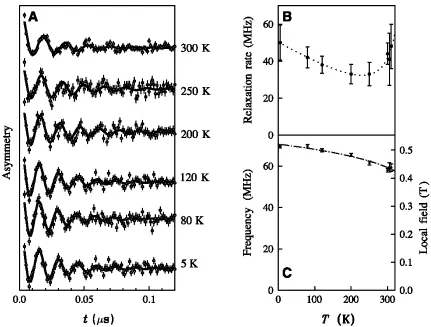
is totally unexpected at 300 K. We therefore recorded muon spin rota-tion (µSR) data(8) to investigate the behavior of the magnetic moments carried by the cobalt cations(Fig. 1A). Clear oscillations are apparent over the entire temperature range which signify a quasi-static magnetic field at the muon site. This result demonstrates unambiguously that 1 is uniformly magnetically ordered throughout its bulk at temperatures up to at least 310 K. The amplitude of the oscilla-tions corresponds to a signal from the whole sample so these results exclude the possibility that only a small region of the sample is ordered. The fre-quency of the oscillations approaches 71 MHz as T→0 (corresponding to an
internal field of 0.53 T) and decreases as the sample is warmed to 310 K (Fig. 1C). At the highest temperatures the relaxation rate of the oscillations
be-1Department of Chemistry, University of Liverpool, Liverpool, L69 7ZD, U.K.
2Materials Science Division, Department of Engineering, University of Liverpool, L69 3BX, U.K. 3Clarendon Laboratory, Department of Physics, University of Oxford, Oxford, OX1 3PU, U.K.
gan to increase and probably reflects the approach of the phase transition. (Fig. 1B). These results do not al-low us to determine precisely the N´eel temperature, but show that it is likely to be above 350 K. The muon site is likely to be similar to that found in Sr2CuO3 and Ca2CuO3, in which the
muon is believed to form an O–µ+
bond with a bond length of∼1 ˚A.(9,
10) However the measured muon pre-cession frequency for these materials is much lower, corresponding to 2.32 and 3.5 mT for Sr2CuO3and Ca2CuO3
respectively (10). Such low internal fields are associated with magnetic moments less than 0.1µB. The
pre-cession frequency in the present case is >200times greater than in Sr2CuO3,
which is consistent with the moment refined from powder neutron diffrac-tion on 1. The N´eel temperatures of Sr2CuO3and Ca2CuO3 are∼5K and ∼11K respectively. The much larger
value ofTNobserved for1points to a
large interchain coupling, which is sur-prising because the lattice constants in the interchain direction are larger than in Sr2CuO3 and Ca2CuO3.
After the verification of long-range magnetic order at room temperature by µSR, a simple antiferromagnetic (AF) ordering model, with antiparal-lel spin alignment of all neighboring Co spins, was incorporated in refine-ment of the neutron data. Although this addition gave a satisfactory fit to the magnetic reflections, the fit to the nuclear reflections was unsatisfactory (χ2 = 5.15, weighted profile residual
(Rwp) = 5.55%) (7). A difference
Fourier map was computed and re-vealed a strong peak of negative scat-tering density at (0, 1/2, 0) midway between the Co atoms along the b-axis at the vacant oxide anion posi-tion in the CoO2−x sheets (7). Hy-drogen is one of the few elements to have a negative neutron scatter-ing length,(11) and therefore hydro-gen was inserted into the model at this position. The refinement immediately converged atχ2= 1.96,R
wp= 3.43%
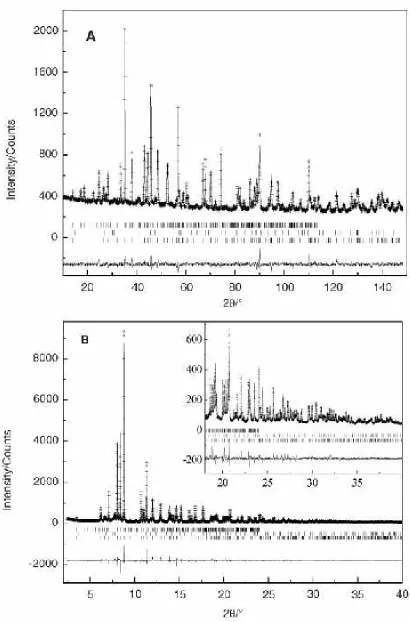
as shown in Fig. 2, demonstrating that 1is the first extended transition metal oxide hydride.
The structural analysis was com-pleted by a three histogram
refine-ment of 2.4 ˚A and 1.59 ˚A neu-tron histograms together with the synchrotron data (Fig. 2). The quality of the fits demonstrates the correctness of the structural model, which gives a refined composition of LaSrCoO3H0.70(2). The presence of a small amount of La2O3 is not
in-consistent with this composition (7). The ordered magnetic moment car-ried by the cobalt cations increases from 1.77(5)µBat 290 K to 1.95(4)µB
at 2 K. The +1.7 oxidation state of Co deduced from the refined compo-sition with a charge distribution as-signing the −1 oxidation state to H
is consistent with the position of the Co K-edge in LaSrCoO3H0.70(2),(7) and the presence of hydride was con-firmed chemically by quantitative mass spectrometric monitoring of the H2O
evolved simultaneously with oxidation of 1 under flowing O2 at 272(5)◦C,
which indicates 0.4 H− per formula
unit; while necessarily less accurate than the structure refinement, this chemically confirms the presence of hydrogen. Chemical analysis (5) re-veals 0.27% H by mass compared with 0.21% expected for LaSrCoO3H0.70(2).
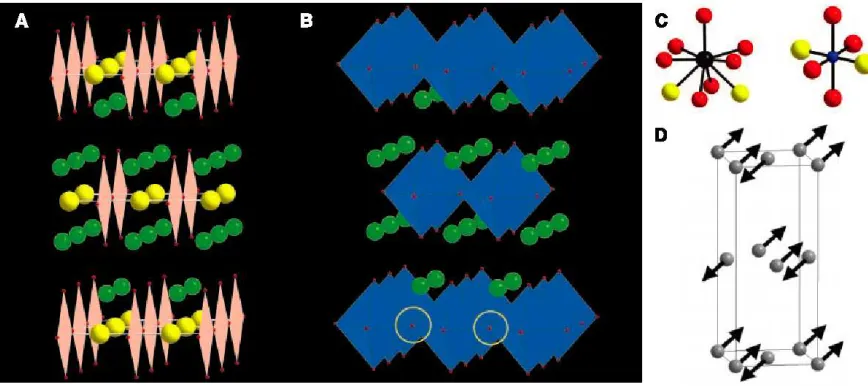
The structure (Fig. 3) consists of chains of CoO4 squares sharing
cor-ners along a to form chains which are linked into a 2D array in theab plane by H− bridges along b. The CoO
2
sheets in the ab plane of the start-ing material have been replaced with CoOH0.7 sheets in the oxide hydride product, consistent with a reduction-insertion mechanism in which oxide va-cancies are created in the xy plane fol-lowed by their filling by the H−
an-ions. The Co(II) cations have a mean coordination number of 5.40(4), with the H−anions occupying the axial
po-sitions between the square plane of oxide anions. The Co–H distance of 1.80174(2) ˚A is shorter than either of the Co–O distances and this, coupled with the strong covalency expected for the interaction between Co2+ and
H−, produces strong AF coupling
be-tween the Co(II) cations within the 2D sheets. The effect of the hydride an-ions on bridging the Sr2CuO3-like 1D
chains is qualitatively demonstrated by comparing TN of above 300 K here
with 11 K in Sr2CuO3 itself. A
qual-itative comparison between H− and
O2−oxide bridges can be made by
not-ing that LaSrCoO3.5 (6) has a N´eel temperature of 110 K, with a similar concentration of bridging anions in the abplane.
The high AF ordering temperature of LaSrCoO3H0.70 demonstrates that the H− anion can strongly couple
transition metal cations electronically. To confirm this supposition, we have performed spin wave calculations to crudely model the effect of coupling the CoO3 oxide chains by H− anions.
We find that increasing the effective exchange between chains in one di-rection to close to the intrachain ex-change J is sufficient to raise the N´eel temperature to the order ofJ/kB
(whereJ is the intrachain exchange), even if the coupling in the orthogo-nal interchain direction is quite weak; the size of the moment will then be near the full value (this scenario is ap-propriate for LaSrCoO3H0.70, in which we observe a large moment andTN∼ 350K which is of the order ofJ/kB).
If, however the interchain exchange is weak in both directions, the N´eel tem-perature is largely controlled by that weak interchain exchange and the size of the moment is greatly reduced be-cause of quantum fluctuations (this scenario is appropriate for Sr2CuO3,
in which the moment is reduced to 0.06µB and TN = 11 K (8)). This
stark difference in magnetic properties highlights the crucial role played by the bridging H− ions, and confirms that
they are capable of coupling transition metal centres equally as effectively as O2− anions.
The H−anions are exclusively located
in the transition metal containing lay-ers in the structure, in contrast to oxyhalides such as Sr2CoO3Cl(3) in
which the halide anions occupy the apical positions within the electroni-cally inactive rock salt layers. The demonstration that transition metal oxide hydrides can be isolated now suggests such species should be con-sidered when discussing chemical and catalytic processes involving transition metal oxides, such as the spillover pro-cess(12) where only H+and OH−have
ox-ide sheets may reflect the enhanced bridging interaction with the transi-tion metal catransi-tions in this site, or be due to a topotactic transforma-tion mechanism in which anion vacan-cies present in an LaSrCoO3.5 inter-mediate are filled with hydride anions. The combination of cation reduction with anion insertion is unusual for a topotactic solid-state transformation, but may prove to be a general route to transition metal oxide hydrides, open-ing up previously uncharted areas in electronic and magnetic materials syn-thesis. Quantitative estimates of the strength of the exchange interaction demonstrate that the H− bridge
cou-ples metal centres as effectively as O2−, although the different frontier
or-bital symmetry (σonly in H−, σ+π
in O2−) promises interesting property
differences to be revealed in future de-tailed studies of this new class of ex-tended solid.(14)
References and notes
1. J. B. Goodenough, J. S. Zhou, Chem. Mater. 10, 2980 (1998). 2. Y. D. Chuang, A. D. Gromko, D. S. Dessau, T. Kimura, Y. Tokura, Sci-ence292, 1509 (2001).
3. S. M. Loureiro, C. Felser, Q. Huang, R. J. Cava,Chem. Mater. 12, 3181 (2000).
4. Z. Y. Lin, M. B. Hall, Coord. Chem. Rev. 135, 845 (1994). 5. M. A. Hayward, M. A. Green, M. J. Rosseinsky, J. Sloan,J. Am. Chem. Soc. 121, 8843 (1999).
6. M. A. Hayward, M. J. Rosseinsky, Chem. Mater. 12, 2182 (2000). 7. Full synthetic and structural char-acterization details are provided as supplemental data at Science online. 8. S. J. Blundell, Contemporary Physics40, 175 (1999).
9. A. Keren, et al.,Physical Review B 48, 12926 (1993).
10. K. M. Kojima, et al.,Physical
Re-view Letters78, 1787 (1997). 11. G. E. Bacon, Neutron Diffraction (Clarendon Press, Oxford, ed. 3rd, 1975).
12. W. C. Conner, J. L. Falconer, Chem. Rev. 95, 759 (1995).
13. S. J. Teichner,Appl. Catal. 62, 1 (1990).
Figure 2: Structural characterisation of1, LaSrCoO3H0.70by simultaneous Rietveld refinement of (A) neutron diffraction and (B) synchrotron XRD data collected as described in (5), where full refinement details are also available. 1adopts space group Immm, a = 3.87093(4)˚A, b = 3.60341(3) ˚A, c = 13.01507(10) ˚A, V = 181.541(3) ˚A3, La (50 %
Figure 3: (A) The crystal structure of1, LaSrCoO3H0.70 and its topotactic relation with (B) the LaSrCoO4 starting material. 1 can be generated from LaSrCoO4 by substitution of half of the equatorial O2− anions (circled in yellow)
by H−. Hydride ions and Sr/La cations are represented as yellow spheres and green spheres respectively and the oxide
ion arrangements around the Co cations are illustrated by squares and octahedra in (A) and (B) respectively. Co–O(1) 2.1779(22) ˚A ×2, Co–O(2) 1.93549(2) ˚A ×2, Co–H 1.80174(2) ˚A ×2, Sr/La–O(1) 2.469(2) ˚A, 2.6633(3) ˚A ×4,
Sr/La-O(2) 2.5902(3) ˚A×2, Sr/La–H 2.6849(3) ˚A×2 The bond angles within the CoO4H1.4unit are all constrained to 90◦ or 180◦ by the symmetry of 1. (C) The coordination environments of the La/Sr (black sphere) and Co (blue
[image:6.612.97.531.260.453.2]