Accelerating Engineering Innovation
.com
JULY 2015 $15.00DESIGN
NEWS
•
JUL
Y
2015
CHIP
MAKERS
TARGET
IOT
COMPLEXITY
•
WHA
T’S
NEW
IN
HMIS
•
CARBON
FIBERS
SPEARHEAD
AUTO
LIGHTWEIGHTING
EFFORT
VOL.
70
NO.7
•
DESIGNNEWS.COM
Gadget Freak
Rock, Paper, Scissors Gets High Tech 48 Captain Hybrid
We Still Need a Better Battery 19
ES632841_DN1507_C1.pgs 06.23.2015 23:09 UBM
black yellow
magenta
ES632059_DN1507_C2_FP.pgs 06.23.2015 02:08 UBM black
ES632067_DN1507_001_FP.pgs 06.23.2015 02:09 UBM
the #1 value in automation Order Today, Ships Today!
* See our Web site for details and restrictions. © Copyright 2014 AutomationDirect, Cumming, GA USA. All rights reserved. 1-800-633-0405 With AutomationDirect’s new special-purpose,
push-to-connect pneumatic f ttings, it’s easy to add the components you need to any circuit, at any location. These small, highly-ef cient f ttings are mounted inline without any tools required, making installation a breeze!
Research, price, buy at:
www.automationdirect.com/pneumatic-parts
NITRA QUICK EXHAUST VALVES • NITRA quick exhaust valves have
a technopolymer body and nickel-plated brass valve insert
• Pressure range of 7 to 150 psi • Normal fl ow is from inlet to
outlet ports, reversing fl ow from outlet is directed to exhaust port • Ideal for use with pneumatic
actuators that require a very
fast stroke speed NITRA FLOW CONTROL VALVES • Elbow meter-in, meter-out and inline pneumatic fl ow valve confi gurations • NPT and BSPT (R) threads
available
• Tough thermoplastic bodies, stainless steel tube gripping claws, nickel-plated threads with pre-applied Tefl on sealant (O-ring on #10-32 and M5 threads) • Release rings are color coded to
diff erentiate between meter-in and meter-out
• Working pressure: -29.5” Hg to 150 psi • Working temperature 32 to 140°F (0 to 60°C) NITRA HAND SHUTOFF VALVES • 2 and 3-way, locking and
non-locking manual shutoff valves with technopolymer body and nickel-plated brass internal parts • Union straight manual hand
valves with thermoplastic (PBT) body and stainless steel tub gripping claws
• Technopolymer body
• NITRA miniature pressure regulators allow adjustments to downstream air pressure in a range of 15 to 120 psi • NITRA pressure gauges have
metal gauge housings and off er a range of 0 to 170 psi
• NITRA pressure indicators have a range of 29 to 145 psi with your choice of green or orange indicators
Starting at: $8.75
Starting at: $8.25 Starting at:
$11.25 (HVU14-12)
Starting at: $11.75 (PMU14A) NITRA PRESSURE REGULATORS /
GAUGES / INDICATORS
Pneumatics made easy
with Push-to-Connect inline f ttings
ES632057_DN1507_002_FP.pgs 06.23.2015 02:08 UBM
black
A bad choice could cost you thousands!
Look Familiar?
When hot weather causes the electronics inside a control cabinet to fail, there is a panic to get the machinery up and running again. T e operator might choose to simply open the panel door and aim a fan at the circuit boards. In reality, the fan ends up blowing a lot of hot, humid, dirty air at the electronics and the cooling ef ect is minimal. If the machinery starts functioning again, the likelihood of repeated failure is great since the environment is still hot (and threatens permanent damage to the circuit boards). Worse yet, that open panel door is an OSHA violation that presents a shock hazard to personnel.
The Real Solution!
Stop electronic downtime with an EXAIR Cabinet Cooler® System! T e complete line of low cost Cabinet Cooler Systems are in stock and can ship now. T ey mount in minutes through an ordinary electrical knockout and have no moving parts to wear out. T ermostat control to minimize compressed air use is available for all models. All Cabinet Coolers are UL Listed to US and Canadian safety standards.The Secret To Keeping Electronics Cool!
If you would like to discuss an application, contact:
11510 Goldcoast Drive Cincinnati, Ohio 45249-1621 (800) 903-9247/fax: (513) 671-3363 www.exair.com/14/440a.htm
Jef Hauck, Lasercraft Inc. Cincinnati OH
“It took us three days to get a replacement computer cabinet and we didn’t want to risk another heat failure. Fans weren’t an option since they would just blow around a lot of hot air. Freon-type air conditioners like those on some of our other machines were a constant maintenance project of their own. We purchased EXAIR’s Model 4330 NEMA 12 Cabinet Cooler
System since it was easy to install and requires no maintenance.” @exair
The only compressed air powered
cooler that is CE compliant!
The only compressed air powered
cooler that is CE compliant!
www.exair.com/14/44014a.htm
Watch The Video!
NEMA 4 and 4XCabinet Coolers NEMA 4 and 4X Cabinet Coolers for large heat loads up to 5,600 Btu/hr. T ey are ideal for PLCs and modular controls.
• Enclosure remains dust-tight, oil-tight and splash resistant
• Suitable for wet locations where coolant spray or hose down can occur
Type 316 Stainless Steel Cabinet Coolers Type 316 Stainless Steel Cabinet Coolers for NEMA 4X applications are available for heat loads up to 5,600 Btu/hr. • Resists harsh environments
not suitable for Type 303/304
• Ideal for food and chemical processing, pharmaceutical, foundries, heat treating and other corrosive environments
Mini NEMA 12, 4, and 4X Cabinet Coolers T e mini NEMA 12, 4 and 4X Cabinet Coolers for small heat loads up to 550 Btu/hr. are ideal for control panels, relay boxes, laser housings, electronic scales. • Measures 5" (127mm) high
• Mounts top, side or bottom
• Enclosure remains dust-tight and oil-dust-tight
High Temperature Cabinet Coolers High Temperature Cabinet Coolers for NEMA 12, 4 and 4X applications are available for heat loads in many capacities up to 5,600 Btu/hr.
• Suitable for ambients up to 200°F (93°C)
• Ideal for mounting near ovens, furnaces, and other hot locations
Non-Hazardous Purge Cabinet Coolers NHP Cabinet Coolers keep a slight positive pressure on the enclosure to keep dirt from entering through small holes or conduits. For use in non-hazardous locations. • Uses only 1 SCFM in
purge mode
• For heat loads up to 5,600 Btu/hr.
• NEMA 12, 4 and 4X NEMA 12
Cabinet Coolers T e NEMA 12 Cabinet Coolers for large heat loads up to 5,600 Btu/ hr. are ideal for PLCs, line control cabinets, CCTV cameras, modular control centers, etc.
• Measures 8" (203mm) high
• Mounts top, side or bottom
• Enclosure remains dust-tight and oil-tight
ES632071_DN1507_003_FP.pgs 06.23.2015 02:09 UBM
black
877-245-6247
www.clippard.com
Cincinnati, OH 45239
Air Cylinders • Solenoid Valves • FRLs • Control Valves • Fittings • Tubing
A leader in miniature pneumatics, Clippard provides
quality products and complete design solutions for
the unique needs of the packaging industry!
Miniature
Solutions
for
Today’s
Packaging
Challenges
Air Cylinders • Solenoid Valv • FRLs • Control Valves
ES632109_DN1507_004_FP.pgs 06.23.2015 02:18 UBM
black yellow
Design News | JULY 2015 | www.designnews.com –5–
Accelerating Engineering Innovation
Contents
www.designnews.com
July 2015
Vol 70 No. 7
30
36
42
continued
Cover Story
30
Big Data Lumbers into
Product Design
Whether it’s simulation, visualization, or data bouncing back from the field, Big Data has entered the design process.By RoB SPiegeL
Features
34
Chip Makers Target internet
of Things Complexity
As issues of time and complexity increasingly dog embedded product developers, semiconductor makers are stepping in to help.By ChaRLeS J. MuRRay
36
What’s New in hMis
Mobile technology is putting its imprint on industrial operator interfaces, offering touch capabilities, new design approaches, and more sophisticated functionality.By aL PReSheR
42
Carbon Fibers
Spearhead automotive
Lightweighting effort
To meet looming fuel efficiency standards, automakers are using carbon fiber composites in hundreds of automotive components.By ChaRLeS J. MuRRay
Columns
M y O p i n i O n O n …
12
Can’t We all get along?
The consensus is that design and manufacturing companies that don’t change from legacy organizational structures will struggle, while those that take holistic, systems-integration approaches will do well.By WiLLiaM Ng
M a d e B y M O n k e y s
18
unsafe Stove has
owner Seeing Red
Dave Maples’ oven started sparking and arcing, so he turned it off, but part of the oven element continued to glow cherry red.
On the Cover:Design by Richard Antony
Images courtesy of loops7, MF3d/ iSTOCKPHOTO.COM.
ES633245_DN1507_005.pgs 06.24.2015 01:04 UBM black
Dymax advanced dispensing and curing systems are part of the most dynamic and effective total solutions program in the industry – the Dymax EDGE. That means with every Dymax system, you get the insight, expertise, and collaborative effort of people who know how to seamlessly integrate equipment, materials, and your production process. As well as the assurance of a single-source provider who answers your call with problem solving, not finger pointing. Visit dymax.com/solutions for more information.
D Y M A X . C O M 8 7 7 - 3 9 6 - 2 9 8 8
ES632110_DN1507_006_FP.pgs 06.23.2015 02:18 UBM black
yellow
magenta
Design News | JULY 2015 | www.designnews.com –7–
Contents
continued
designnews.com/explore
Wherever You Are
We’ve Got
You Covered
Industry News at
Your Fingertips
Explore. Learn. Subscribe.
Serving the 21st Century Design Engineer18
Karaoke Machine
owner Sings the Blues
Heavy flux residue and the beginnings of corrosion killed the music for James Sebastian.C a p ta i n H y B r i d
19
yes, We Still Need a
Better Battery
If we want to wave goodbye to oil, then we’ll need a $100/kWh battery with 300 miles of range.
By ChaRLeS J. MuRRay
s H e r l O C k O H M s
20
What Caused the
hummer’s Rough Ride?
Scott Moore’s 2006 Hummer H3 started to idle roughly and the check engine light lit up the dash. He found that cylinder five was misfiring. Why?G a d G e t F r e a k
48
The handy Rival
This arcade game lets you play rock, paper, scissors against a robotic hand.
Departments
14
design decisions22
Green scene24
news44
design engineering productsSupplements
automation & Motion
Control/packaging
These stories, and more, also appear online at www.designnews.com.
DESIGN NEWS® (ISSN 0011-9407) is published monthly by UBM Canon,
2901 28th St., Ste. 100, Santa Monica, CA 90405, 310-445-4200. Periodicals postage paid at Santa Monica and at additional mailing offces. SuBSCRiPTioNS—Free to qualifed subscribers as defned on the subscription card. Rates for non-qualifed subscriptions, including all issues: U.S.A, $150.00 one year, $250.00 two years, $300.00 three years; Canada, $184.90 one year, $314.90 two years (includes 7% GST, GST# 123397457); Mexico, $172.90 one year, $295.90 two years; Foreign, $323.90 one year, $579.90 two years. Except for special issues where price changes are indicated, single copies are available for $10 U.S.A and $15 foreign. For telephone inquiries regarding subscriptions 763-746-2792. email: [email protected].
ChaNge oF aDDReSS—Notices should be sent promptly to DESIGN NEWS® P.O. Box 47461, Plymouth, MN 55447—Please provide old
mailing labels as well as new address. Allow two months for change.
NoTiCe—Every precaution is taken to ensure accuracy of content; however, the publisher cannot accept responsibility for the correctness of the information supplied or advertised or for any opinion expressed herein. PoSTMaSTeR—Send address changes to, DESIGN NEWS® P.O. Box 47461, Plymouth, MN 55447. Printed in U.S.A. Copyright 2015 by UBM Canon. All rights reserved. Reproduction in whole or part without written permission is prohibited.
48
ES634800_DN1507_007.pgs 06.26.2015 02:32 UBM
black
yellow
magenta
Major Credit Cards Accepted | © 2015 Proto Labs, Inc. Request your free
Digital Manufacturing For Dummies at
go.protolabs.com/DN5GJ ISO 9001:2008 Certified | ITAR Registered
Proto Labs uses proprietary software and a massive compute cluster to accelerate manufacturing of prototypes and production parts for every industry.
Got a project? Get 1 to 10,000+ plastic, metal or
liquid silicone rubber parts in as fast as 1 day.
Rapid Manufacturing with a
Polite Disregard for Tradition
Tech-driven injection molding, CNC machining and
3D printing for those who need parts
tomorrow
ES632087_DN1507_008_FP.pgs 06.23.2015 02:09 UBM black
yellow
magenta
Design News | JULY 2015 | www.designnews.com
–9–
NOW ON
NOW ON
.
com
CONNECT WITH US
Design News’ System & Product Design Engineering group:
http://linkd.in/Zh671Z
Design News’ general Twitter feed:
http://twitter.com/designnews
Automation & Motion Control
The fully connected smart plant is often vulnerable to cyber threats simply because of its extensive connectivity. So, as the plant gets more connected, control engineers need to make sure the plant’s security matches the complexity and sophistication of the plant’s intelligence.
http://ubm.io/1LibisL
Design Hardware & Software
Four key advancements are driving wearables out of the lab and into the mainstream, making it easier for startups and makers to create hardware and for consumers to adopt the technology.
http://ubm.io/1GvclRL
Electronics & Test
Advances in simulation tables are allowing faster and more ef ective testing on new products, parts, and subsystems. What should a design engineer know when choosing the right simulation table for the job?
http://ubm.io/1LlUa23
Materials & Assembly
Graphene 3D Lab has added graphene to 3DP PLA f lament to strengthen the material and add conductivity to prints made with it. The material can be used to 3D print conductive traces embedded in 3D-printed parts for elec-tronics, as well as capacitive touch sensors.
http://ubm.io/1J6xy8c
The Best of Sensors Expo 2015: 14 Award-Winning Technologies
Meet the 14 award-winning sensor innovations and applications from Sensors Expo 2015.
http://ubm.io/1MQ21W1
Experts: EVs Are the Way to Meet California’s 2030 Petroleum Reduction Goal
Switching to alternative, cleaner fuels and electric-powered vehicles is the way forward if California wants to meet the goals of an initiative to reduce the use of petroleum in the state 50% by 2030.
http://ubm.io/1St5Y6M
4 Factors That Determine if a Robot Can Do Your Job
There are four key traits that determine if a robot could replace you at work. How does your position score?
http://ubm.io/1K1bNp1
The Fallout from the UCLA Sterilization Failure Will be Better Medical Device Design
Concerns about the rising number of infec-tions acquired in US hospitals from reusable in-struments is driving changes in medical device design and materials, mostly for the better.
http://ubm.io/1eDxtMK
WHITE PAPER
Engineering Thin Medical Parts Through Photo Etching
Photo etching — also called chemical milling, photochemical machining, and chemical machining — of ers many advantages for manufacturing thin metal or polymer f lm medical parts, including improved accuracy, low-cost tooling, inexpensive prototyping, burr-free parts, and speed of production.
http://ubm.io/1L3KxHl
WHITE PAPER
RF WCDMA Benchmark Comparisons
Understand the speed improve-ments that software-def ned PXI RF instruments deliver over traditional instruments in a benchmark comparison. As the WCDMA measurement results illustrate, inherently parallel Lab-VIEW measurement algorithms achieve signif cantly faster execu-tion times than tradiexecu-tional instru-ments on multicore processors.
http://ubm.io/1RdHVGz
WHITE PAPER
Basics of Linear Drives: How to Compare Rack and Pinion Drives to Linear Motors and Ball Screws
Here’s a look at how rack-and-pinion drives compare to linear motors and ball screws.
http://ubm.io/1HZ7xpT
http://on.fb.me/fanpagedn
Get Design News’ RSS feeds at
http://www.designnews.com/rss/ and sign up for e-mail newsletters at
http://www.designnews.com/register.asp
RESOURCE
CENTER
Design News Direct
Design News Direct is the go-to resource for engineers in the sourcing stage of a design. This comprehensive online directo-ry provides the latest product information, educational white papers, instructional vid-eos, and opportunities to collaborate with leading design and manufacturing compa-nies. A simple search bar lets designers f nd products and services, from the most basic to the most complex.
http://directory.designnews.com/
Join the fastest growing
design engineering
community
on the Web!
ES632317_DN1507_009.pgs 06.23.2015 04:43 UBM
black
yellow magenta
Design News | July 2015 | www.designnews.com
–10–
EDITOR-IN-CHIEF
William Ng 718-501-2449 [email protected]
SAlES DIRECTOR
Al Schmidt 972-980-8810 [email protected]
EXECuTIVE EDITOR
Jennifer Campbell 781-778-7787 [email protected]
MANAGING EDITOR
Chris Wiltz 310-445-4282 [email protected]
Charles J. Murray, Senior Technical Editor Ann R. Thryft, Senior Technical Editor Rob Spiegel, Senior Editor
Technical SpecialTieS
CAE Software & Hardware: Rob Spiegel / [email protected] Electronics: Charles J. Murray / [email protected] Fluid Power/Automation/Control: Rob Spiegel / [email protected] Materials & Assembly: Ann R. Thryft / [email protected]
producTion
Saravanan Selvaraj, Project Manager Mercy Glory Beulah M, Production Coordinator Marco Aquilera, Creative Director
Quinn Williams, Art Director
Manikandan Veerakumar, e-Newsletter Specialist
BuSineSS oFFice
Steven Carlisle, Marketing Manager [email protected] / 310-445-8523
Stephaney McGinnis, Senior Program & Project Manager [email protected] / 503-643-4262 Tanya Von Grumbkow, Webinar Program Manager [email protected] / 310-445-4215 Marissa Decoteau, Sales Operations Specialist [email protected] / 310-445-3794 Amanda Silva, Sales Assistant
[email protected] / 781-778-7790
deSign newS adviSory Board
Susan Avery, Executive Director, International Assn. of Plastics Distribution Raj Batra, President, Siemens Industry Inc.
Mike Campbell, General Manager, PTC
Dave Heacock, SVP and Manager, TI Silicon Valley Analog Scott Hibbard, VP of Technology, Bosch Rexroth
Ken Karnofsky, Senior Strategist, Signal Processing Applications, The MathWorks Chris Loberg Sr., Technical Marketing Manger, Tektronix
Ron Martino, VP of F&D, Automotive and Industrial/Multi-Market Group, Freescale Mark Minnichelli, Director Tech & Development for Engineering Plastics, BASF
u.S. SaleS repreSenTaTiveS
IL/IN/KY/MI/OH/ON/WI Jami Brownlee 815-893-6052 / [email protected] DC/FL/GA/IA/KY/MD/MN/NC/PA/SC/SD/VA
Doug Robertson 781-778-7783 / [email protected] CT/DE/MA/ME/NH/NJ/NY/RI/VT
Julie Simoneau 781-778-7784 / [email protected] AR/AL/AZ/CA/CO/ID/MO/NV/OK/OR/TX/WA
Len Pettek 805-493-8297 / [email protected]
regional/SaleS managerS
CUSTOM PUBLISHING Mike Paul 781-778-7781 / [email protected]
inTernaTional repreSenTaTiveS
JAPAN Toshiyuki Uematsu 011 81 3 5775 6056
UK, GERMANY, AUSTRIA, SWITZERLAND Adela Ploner (0)8192-933-78-22
uBm canon execuTive Team CHIEF EXECuTIVE OFFICER Tim Cobbold
CHIEF FINANCIAl OFFICER Aharon Shamash
CHIEF OpERATING OFFICER/uBM CONNECT Brian Field
CHIEF EXECuTIVE OFFICER/uBM CONNECT Sally Shankland
EXECuTIVE Vp/MANAGING DIRECTOR Josh Dome
SENIOR Vp, MEDICAl pORTFOlIO DIRECTOR Stephen Corrick
SENIOR Vp, CONTENT & STRATEGy Pam Moore
SENIOR Vp, INTEGRATED MEDIA Amy Sklar
SENIOR Vp, pEOplE & CulTuRE Stacey Lisowski
Vp DESIGN & MFG pORTFOlIO DIRECTOR Roger Burg
Design News® is a member of UBM Canon 6 Alfred Circle, Bedford, MA 01730 www.designnews.com
Subscription Inquiries: 847-559-7597 Reprints: Wrights Media
2407 Timberloch Place, Suite B The Woodlands, TX 77380 281-419-5725
POWER TRANSMISSION-PART CONVEYING
PYRATHANE
®
BELTS
With Lifetime Warranty Against Manufacturing Defects
AN ISO 9001 CERTIFIED COMPANY
Very Clean in Operation Eliminates Tensioning Devices Exceptional Abrasion Resistance
COLORS AVAILABLE
www.pyramidbelts.com
(P) 641.792.2405 • E-mail: [email protected]
522 North Ninth Avenue East, Newton, IA 50208
CUSTOM MADE IN INCH, METRIC &
O-RING SIZES
Round, Flat and Connectable Polyurethane Belts Samples available at little
or no cost.
Allows for accurate, non destructive measurements on
o-ring and belt inside diameter (ID) or inside circumference (IC).
Available in Standard and Metric Sizes.
DIAMETAPE BELT MEASURING TOOL
ES632318_DN1507_010.pgs 06.23.2015 04:43 UBM black
The chemistry for
what’s next starts now.
Welcome to Chemours.
We are a new company, dedicated to the power of chemistry.
A new company starting with a 200-year heritage.
A company that’s taking an age-old discipline and evolving it to shape markets,
define industries, and change lives.
A company committed to working hand-in-hand with customers to develop
new applications and industry-defining solutions.
A company dedicated to making a big impact while leaving a smaller footprint.
A company that makes ordinary things extraordinary.
Welcome to Chemours. We are Living Chemistry.
chemours.com
©2015 The Chemours Company. Chemours™ and the Chemours Logo are trademarks or registered trademarks of The Chemours Company.
ES632070_DN1507_011_FP.pgs 06.23.2015 02:09 UBM
black
yellow
magenta
Design News | JULY 2015 | www.designnews.com –12–
Follow us on:
My Opinion On ....
William Ng, Editor-in-Chief [email protected]
Can’t We All Get Along?
LateLy I’ve been hearing and reading “tossing it over the wall” a lot from industry professionals. Engineers are intimately familiar with this phrase, which has begun to be conjoined to calls of “we need better collaboration” and a “multidisciplinary approach” to design and engineering. For that, all of us can thank, first, Apple, and now the Internet of Things.
Connected-everything is bringing us novel de-vices that manage our lives. Just about every new product has complex electronics, computer-based control, and telecommunications abilities, from wrist-worn fitness trackers to million-dollar indus-trial machines. As Chris Rahn, a Penn State profes-sor, quipped to Design News recently , “Who would have guessed that a company making thermostats would be worth $3.2 billion?”
I am seeing two things happening as we dive into IoT and condensed product development cycles: greater integration between engineering and industrial design and demand for mechatron-ics expertise. Engineers may scoff, but think about how the original Apple iPod, with its interface and click-wheel control, revolutionized how people toted their portable music — the result of brilliant, holistic design and engineering, as Tom Kramer, president of Kablooe Design, put it in a recent De-sign News column (http://ubm.io/1PXF5Vq). Competing MP3 players at the time were techni-cally and functionally just as sound as the iPod, but no one remembers iRiver, do we?
Now we are seeing an explosion of mobile and digital health devices with inventive form factors and user interfaces. These empowering tools mean greater servicing and managing ourselves, which means a big need for foolproof user experiences (UX). At the recent Atlantic Design & Manufac-turing show, a Design News industry event, Sean Hughes of Philips spoke about interaction design’s role has in preventing improper device usage and inaccurate data from being sent in telemedicine. With our health on the line, good industrial design is more than making things look pretty.
Mitch Maiman, president of IPS, a
full-ser-vice product engineering and industrial design firm, in a Design News column (http://ubm.
io/1HY7Hhp), described the uneasy alliance me-chanical engineers and industrial designers have struck and how it is now commercial and industrial software engineering’s turn with UX designers. Resist, as many engineers might, but look around the manufacturing plant. Machine HMIs are be-ginning to resemble the touchscreens and visual-based f lows on our personal devices; eventually the E-stop might be the only button on a machine operator interface. This buttonless, icon-driven in-teroperability is not a dumbing-down movement but rather what has come to be expected from con-sumer technology that has proved to work.
Are you being asked to have Aunt Mary come on the plant f loor and expertly operate a metal-cutting machine or an injection molding and assembly cell like she does with Facebook? Of course not, but in this day and age, an engineer with a good sense of ergonomics — or who can work with input by an industrial designer — is going to be more valuable than an engineer who simply wants to crunch the systems and then pass the project onward.
The consensus is that design and manufacturing companies that don’t change from legacy organi-zational structures — those that silo and delineate product development functions — will struggle, while those that take holistic, systems-integration approaches will do well. And those that hire ex-clusively engineers with laser-focused disciplines could falter to those that seek the growing pool of mechatronics professionals with interdisciplinary knowledge and skills. Already, we are seeing suc-cesses by smaller, nimble firms with cross-trained engineers or which can synthesize their multidisci-plinary teams.
Will you be throwing it over the wall and away?
DN
ES632343_DN1507_012.pgs 06.23.2015 04:44 UBM black
yellow
magenta
From 50 MHz to 4 GHz:
Powerful oscilloscopes
from the T&M expert.
Fast operation, easy to use, precise measurements – That‘s Rohde & Schwarz oscilloscopes.
R&S®RTO: Analyze faster. See more. (Bandwidths: 600 MHz to 4 GHz)
R&S®RTE: Easy. Powerful. (Bandwidths: 200 MHz to 2 GHz)
R&S®RTM: Turn on. Measure. (Bandwidths: 200 MHz to 1 GHz)
¸HMO3000: Your everyday scope. (Bandwidths: 300 MHz to 500 MHz)
¸HMO Compact: Great Value. (Bandwidths: 70 MHz to 200 MHz)
¸HMO 1002: Great Value. (Bandwidths: 50 MHz to 100 MHz)
All Rohde & Schwarz oscilloscopes incorporate time domain, logic, protocol and frequency analysis in a single device.
Take the dive at www.scope-of-the-art.com/ad/all
Global Oscilloscopes Competitive Strategy Innovation and Leadership Award Global Oscilloscopes Competitive Strategy Innovation and Leadership Award
ES632069_DN1507_013_FP.pgs 06.23.2015 02:09 UBM
black
yellow
magenta
Design News | JULY 2015 | www.designnews.com –14–
Design
Decisions
Choosing the Right Simulation
Table for the Design Job
Advances in simulation tables are allowing faster and more effective testing on new
products, parts, and subsystems. What should a design engineer know when choosing
the right simulation table for the job?
By Fons Hoeberichts, Moog
Simulation tableS have support-ed the job of fatigue testing car compo-nents for years, but other industries are enlisting these industrial workhorses to replicate everything from the sensation of driving a tank to the vibration a pack-age “feels” as it snakes its way along the global supply chain. Even the things you don’t typically think moves, like a high-rise building, are getting a ride on simu-lation tables to assess the efectiveness of engineers’ designs.
Advances in simulation tables (both electric and hydraulic) and the products underpinning them, such as fatigue-rated actuators, servovalves, and test controllers, are allowing faster and more efective testing on new products, parts, and subsystems.
What should a design engineer know to choose the right simulation table for the job?
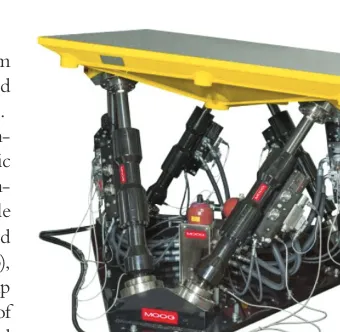
There are hydraulic and electric simu-lation tables. Both are also known as multi-axis shaker tables, or MAST, and are six-degree-of-freedom (DoF) tems. Both hydraulic and electric sys-tems use integrated control hardware and application software to control po-sition, velocity, and acceleration on the top platform.
A hydraulic simulation table is com-prised of a very stif, aluminum-weld-ed top platform and a steel baseplate.
Mounted in between the top platform and baseplate are six, weight-optimized hydrostatic-bearing hydraulic actuators.
Hydraulic systems can typically han-dle higher payloads than their electric counterparts. In fact, a modern, high-performance hydraulic simulation table in hexapod confguration can be rated for payloads as high as 680 kg (1,500 lb), while providing frequency response up to 100 Hz and high acceleration levels of 10 G. Hydraulic systems are mainly used for fatigue testing.
In comparison, an electric simulation table uses electromechanical actuators and an electric cabinet containing the necessary electric drives. Engineers use these tables for functional testing at fre-quencies up to 30 Hz and accelerations to around 1 G. Electric tables are cleaner (i.e., no risk of hydraulic fuid leaking) and quieter than hydraulic systems. Electric systems are designed to perform, for example, functional tests and driver training by adding the vehicle motion.
As for power requirements, an elec-tromechanical system typically uses only a quarter of the energy used by a hydrau-lic system, which requires a hydrauhydrau-lic pump unit. The latter produces a lot of heat and requires additional technology to cool the oil. No real diference exists in terms of space requirements, as elec-tric simulation tables have approximately
the same size footprint as hydraulic sim-ulation tables.
Hydraulic simulation tables require a bit more maintenance than electrome-chanical tables because owners of the former must periodically change seals and hoses and clean the valves.
Companies choose high-performance simulation tables for a variety of reasons, including reducing time to market and testing the viability of a design. In the world of automobiles, designs have be-come highly complex. Now there are control units for the suspensions, exhaust line, and steering system, to name a few. Software linked to the simulation table systems replicates and plays out time history drive fles that were recorded
[image:16.612.367.537.293.459.2]Moog hydraulic simulation table ordered by Thule.
S ou rce : M oo g
ES632320_DN1507_014.pgs 06.23.2015 04:43 UBM
At ebm-papst, we develop blowers for air conditioners that let hotel guests enjoy a quieter night’s sleep. As well as running particularly quietly, they’re also very energy-efficient. Which is great news for hotel managers – and for the environment, of course. You can’t see it. But you can feel it!
For our complete product line, visit ebmpapst.us
David Kehler, project engineer at ebm-papst
Discover ebm-papst.
Energy-saving air conditioning for hotels at
discover.ebmpapst.com/air_conditioning
ES632992_DN1507_015_FP.pgs 06.24.2015 00:00 UBM
black
yellow
magenta
Design Decisions
at the test track, or performs resonant-frequency research.
Twenty years ago it might have taken three to four years to develop a new car model. With realistic simula-tion, that timeframe is now between 18 and 24 months. This is not only because of better engineered simulation tables but also computer-aided engineering tools, which are far more accurate.
There remain possibilities to further improve simulation tables. In the past, design engineers created single-axis sys-tems replicating, for example, heave. To bring more realism to testing, engineers can now opt for six-DoF systems, instead of simulating each axis (i.e., X, Y, and Z) separately.
The hexapod designs ofer vector-based motion and can perform transla-tion and rotatransla-tion functransla-tions in conjunc-tion with an expanded frequency range up to 100 Hz (for the hydraulic types).
When automakers perform testing analysis, a lot of damage occurs within the range from 50 to 80 Hz. With older MAST, results are often fltered down to 40 Hz, so any damaging events beyond that point are not captured.
Initially, the auto industry relied on simulation tables for fatigue testing, but now carmakers also use simulation tables for functional testing. With an eight-DoF system, carmakers can achieve total pitch and roll angles of more than 50 de-grees to simulate a continual acceleration of up to 12 m/s for the testing of fuel tanks.
A simulation table’s usefulness isn’t limited to the automobile industry any-more. Simulation tables can mimic ev-erything from the motion of driving a tank and piloting a ship to testing a sta-bilization system and sloshing fuid in containers.
There are even larger simulation tables
[image:18.612.7.543.370.740.2](with top platforms measuring 3m by 4m) that designers can use as the founda-tion for testing the efects of earthquakes on an ofce space. A company in Japan recently commissioned a simulation table to carry a full-scale ofce and sub-ject it to a prolonged vibration of up to 20 Hz to evaluate diferent construction designs as they were struck with simu-lated tremors.
Even packaged goods frms are now showing interest in placing their pallet-ized packaging on simulation tables to generate the movement and turning of a delivery truck. All of this is done to bet-ter understand whether manufacturing and shipping companies are adequately protecting their products during deliv-ery. Anything of value that can be put in motion is a candidate for simulation testing. DN
Fons Hoeberichts is a business development manager for test systems at Moog.
Major Credit Cards Accepted | © 2015 Proto Labs, Inc. Download your free
LSR white paper at
go.protolabs.com/DN5PG
ISO 9001:2008 Certified | ITAR Registered
Proto Labs uses advanced liquid silicone
rubber molding technology to produce
durable, elastic parts within days. We
manufacture LSR parts in various
colors and durometers as well as
optical and medical grades.
Injection Molding That’s
Uncommonly Flexible
Got a project? Get up to 5,000+
metal parts in less than 15 days.
ES632330_DN1507_016.pgs 06.23.2015 04:43 UBM
black yellow magenta
CUT THE WEIGHT
ES633013_DN1507_017_FP.pgs 06.24.2015 00:02 UBM
black yellow
magenta
Design News | JULY 2015 | www.designnews.com –18–
M
http://bit.ly/MadeByMonkeys
ONKEYS
MADE
BY
Made by Monkeys highlights products that somehow slipped by the QC cops.
Email your stories to Chris Wiltz at [email protected].
©2015 United Alloy Inc. UAI Strat HP-DN 15-V2 Why do Fortune 500 industry leaders look to United Alloy, Inc. (UAI) for metal fuel and hydraulic tanks, skids, frames, trailers, chassis and other products crafted to world-class standards?
We design, manufacture, powder coat, assemble, test and deliver the highest quality products, on-time, every time.
Call us at 608-758-4717 to experience the service, quality and savings firsthand.
Learn more at www.unitedalloy.com
4100 Kennedy Road,•Janesville, WI 53545
TANKS, TRAILERS, SKIDS, FRAMES
Stove Has Owner Seeing Red
I was on the way home from work recently, when my wife called. She said the oven had started sparking and arcing, so she turned it off, but part of the oven element continued to glow cherry red. I guided her through the process of locating the cir-cuit breaker for the range and turning it off.
When I got home, I continued to wonder, “How can the oven element have power on it when the oven is turned off ?” I started looking around the Web for replacement parts and for any explanation as to why the element would continue to have power applied after it was turned off. I finally came across a post from someone with the same stove, and exactly the same issue.
Apparently, the stove manufacturer put the controls for this oven in one side of the element, and left the other side of the element connected permanently to line power. Normally, the element is grounded by its outside covering, but what if that joint fails? Worse yet, what if the ground for the stove fails or is never prop-erly connected, and the element heating wires short to the element covering?
— DAVE MAPLES
Karaoke Machine Owner Sings the Blues
We purchased an inexpensive but fairly full-featured karaoke machine for the kids. One selling point for this particular model was that it accepted two separate inputs. But just one week later, one of the kids asked, “Can you look at the karaoke ma-chine? One of the microphone inputs isn’t working.”
We swapped the microphones around and determined the problem was inter-nal to the unit, so I decided to open it up and see what I could find. The back of the unit came off easily, as it was attached with standard Phillips screws, only one of which was hidden by a label. After detaching the power input panel from the back cover, I had clear access to the internals.
My first impressions were good, with most connectors secured with an ad-hesive to help prevent them from vibrating loose. I started tracking the micro-phone signals through the plugs and cabling, eventually back to a board with potentiometers for sound adjustment. A check of the volume adjustment pots for the microphones seemed OK. The next step was to track the signals from the inputs, which led me to a dual op-amp. First, the op-amp is a JRC4558, which turned out to be obsolete. Second, a brief examination of the board revealed what appeared to be heavy f lux residue and the beginnings of corrosion. Clean-ing this area and some others led to the system workClean-ing again.
— JAMES SEBASTIAN
ES634502_DN1507_018.pgs 06.25.2015 22:03 UBM black
yellow magenta
Captain Hybrid
designnews.com/blog/captain_hybrid
Design News | JULY 2015 | www.designnews.com –19–
Yes, We Still Need a
Better Battery
Why aren’t electriccar sales better? The answer, it seems, can’t be repeated often enough: It’s the bat-tery; it’s the batbat-tery; it’s the battery.
Automotive engineers know this, of course. So do materials scientists. But consumers look in awe at the accom-plishments of Tesla Motors and won-der why its electric success can’t trickle down to mid- and entry-level cars.
General Motors recently blamed lack of demand. Plug In America cited lack of awareness and vehicle avail-ability. “Some dealers are less enthu-siastic about making the additional in-vestment required to support PEVs,” the organization wrote in a recent report (http://bit.ly/1zVPcsd).
Both are right. Demand on the low end of the market is weak. Vehicle availability and awareness are poor.
The question is, why? The answer: It’s still the battery.
A recent study done by TrueCar. com stated the obvious: People with higher incomes purchase battery elec-tric cars. The study showed that buyers of the Ford Focus EV had an average household income of $199,000 a year, whereas the buyers of the gas-burning Focus averaged $77,000 a year. Simi-larly, buyers of the Fiat 500e electric car earned $145,000, while gas-burning Fiat 500 owners came in at $73,000.
In an interview with USA Today, TrueCar president John Krafcik sug-gested that the afuent buyers were more bargain conscious, and therefore wanted a car with lower operating costs. Left out of the explanation was
the fact that the more afuent owners can aford to buy a relatively expen-sive second or third car that ofers less utility. Less afuent owners can’t do that. If they can aford a second ve-hicle, it’s a beater.
In the next few years, economies of scale will push electric vehicle tech-nology forward. Batteries will get cheaper; car prices will drop, volumes will grow. Overall penetration of bat-tery electrics will rise — maybe to 5%, maybe even 10%.
But if you’re looking for an explo-sion of sales — one that makes us wave goodbye to oil — then good luck. Economies of scale won’t do that. For that, we need the so-called “God bat-tery” — 300 miles of range, $100/ kWh.
That’s a tall order, of course. We know this because we’ve heard about countless new battery chemistries over the past 25 years, from sodium-sulfur to nickel-iron to nickel-metal hydride to advanced lead-acid to lithium-ion to lithium-air to lithium-sulfur to aluminum-air and on and on. We’re still waiting. Apparently, it’s harder than it looks. DN
If we want to wave goodbye to oil, then we’ll need a
$100/kWh battery with 300 miles of range.
By Charles J. Murray, Senior Technical Editor
If you’re looking
for an explosion of
sales — one that
makes us wave
goodbye to oil —
then good luck.
ES632309_DN1507_019.pgs 06.23.2015 04:12 UBM black
yellow
magenta
S
Famous investigations into engineering’s
herlock
Ω
hms
most diabolical real-world cases
Design News | JULY 2015 | w w w. d e s i g n n e w s . c o m Ð20Ð
http://bit.ly/SherlockOhms
Balancing Efficiency and Comfort in a Ford Building a prototype of a car is a tough way to find the optimal balance between efficiency and comfort. The Sherlocks at Ford are finding the bal-ance using simulation. http://ubm.io/1KsQNbr
Have you applied your deductive reasoning and technical prowess to troubleshoot and solve an engineering mystery that even the fictional Sherlock would find most perplexing? Tell us about it!
Email Managing Editor Chris Wiltz:
Design
News.com
What Caused the
Hummer’s Rough Ride?
By Scott Moore, Guest WriterA while bAck my 2006 (out of war-ranty) Hummer H3 started to idle roughly and I was presented with an amber “check engine” light on the dash. I went to the local auto parts store and borrowed their code reader, and plugged it into the con-nector beneath the dash. The system was reporting that cylinder five had been mis-firing.
I had rough idle issues previously and I was able to correct the issue by clean-ing the throttle body, but this time there was no improvement. I also ran a couple tanks of fuel with fuel injector cleaner through it with no improvement.
Having received a recall regarding a bad aesthetic trim clip, I brought the vehicle into the dealership. Since I was there anyway, I had them check into the rough idle issue.
I was told that the inline 5cyl motors occasionally had issue with the last cyl-inder (number f ive) in that it doesn’t cool as well as the others and as a result the valves have a tendency to hang up and cause rough idling. I was also told that I should replace the throttle body, and the cylinder head which would cost approxi-mately $4,500 plus labor. Just as shock was starting to set in, the service man-ager told me the work would probably resolve the issue. I told him that I was not about to spend that much money for a “probably.”
When I got home I thought about it a bit and went back to basic trouble-shooting. In order for an engine to run, it needs air, fuel, and an ignition source. Since I had cleaned the throttle body, and checked the air f ilter, I f igured it was a safe bet that it was getting air, and hav-ing run a couple tanks of fuel with a fuel injector treatment, I was most likely get-ting fuel, so the only thing left was spark. Interestingly enough, the engine has f ive identical ignition coils, one for each cylinder. So I swapped the ignition coils of cylinder f ive, where the problem was reported by the code reader, and cylinder one where I had never had any issues. A couple days later, the rough idle returned and was accompanied by the check en-gine light. Again, I went to the auto parts store, borrowed their code reader and … the system was now reporting misf ires on cylinder one! Therefore, the problem had to be the ignition coil since the prob-lem followed it to cylinder one.
I brought the code reader back into the store, purchased a new ignition coil for $60, and installed it right there in the parking lot in a couple minutes.
The engine ran wonderfully smooth and I have not had any problems since. I was very pleased that just some basic troubleshooting saved me from a $4,500-plus repair bill, which incidentally would not have solved the problem! DN
Scott Moore is the chief engineer for Alliant Techsystems’ Sporting Group. He has been with the company for 11 years in the manufacturing engineering department where he has served as engineer, engineering manager, and now chief engineer.
ES632257_DN1507_020.pgs 06.23.2015 04:05 UBM
Save the Date!
For more information on attending or exhibiting, call 310/445-4200 or visit us online at ubmcanon.com
There’s Nothing Better than a LIVE Event. Meet
real
people, have
real
conversations, and even better... you get to touch the cool stuff.
October 13–14, 2015
NRG Center | Houston, TX
30543_AS_TX15
ES633000_DN1507_021_FP.pgs 06.24.2015 00:01 UBM black
Environmental news engineers can use
Green
Scene
Share your sustainable engineering news with Executive Editor Jennifer Campbell at
Design News | JULY 2015 | w w w. d e s i g n n e w s . c o m Ð22Ð
GREEN
UPDATES
Spanish Firm Designs Bladeless
Wind Turbine
One of the chief ecological com-plaints about wind turbines is how birds can f y into their blades and be killed. To solve this problem -- as well as reduce the amount of materi-als it takes to build a turbine and make it more cost-ef ective -- a Spanish company has designed a new bladeless wind turbine, aptly named the Blade-less Vortex.
The concept of a device that makes wind without blades is not a new one; Dyson already sells a bladeless fan, although the Vortex design is on a larger scale and has a dif erent look than Dyson’s product. The Vortex in complete form looks like the base of a typical turbine that gradually gets slightly thicker at the top.
Instead of capturing energy via the rotational motion of a turbine’s blades, the Vortex takes advantage of what’s known as vorticity, according to the company. Vorticity is an aerodynamic ef ect that occurs when wind breaks against a solid structure. When this structure starts to oscillate, it captures the energy that is produced.
By generating energy in this way, the Vortex not only doesn’t kill birds, it also has a number of other benef ts, the company said on its IndieGogo campaign page, on which it’s aim-ing to raise $50,000. At the time this article was written, the company al-ready had exceeded its goal by nearly $10,000.
According to the company, funds
from the campaign will be used to f nance a pilot study in India.
The Bladeless Vortex has f ve main parts: foundation, rod, generation sys-tem, tuning syssys-tem, and mast. Engi-neers have streamlined the design of the turbine so none of the parts are in contact, which means it has no gears or linkages and thus requires a smaller amount of raw materials for manufac-turing, the company said. This also cuts production costs and the time it will take to produce the turbines.
Unlike turbines with blades, the Vortex doesn’t make any noise, an-other benef t to the design, according to the company. The turbine’s de-signers also estimate that the Bladeless Vortex will produce energy at a 40% lower cost than a comparable wind
installation due not only to its low-ered production costs but also lower maintenance costs. This is because the turbine has less parts that will suf er wear and tear -- and none that come into contact and thus cause friction that can break down materials -- than conventional turbines.
The company aims to design Bladeless Turbines for both small-scale and large-small-scale deployments. Within a year 100W and 4 Kw turbines will be available for small-scale and residential use, according to the company.
Visit DesignNews.com to see the Bladeless Vortex in action: http://ubm.
io/1L0eckP
ÑElizabeth Montalbano, Contributing Writer Bladeless Vortex says its turbine is more environmentally friendly and more cost-eff cient than typical wind turbines.
ES632254_DN1507_022.pgs 06.23.2015 04:05 UBM black
yellow
magenta
Attend for More Opportunities
Than Ever Before
For more information on attending or exhibiting,
call 310/445-4200 or visit us online at ubmcanon.comNEW!
NEW!
NEW!
The Minneapolis event expands to SEVEN shows, offering the Midwest’s most comprehensive experience for advanced design and manufacturing companies!
November 4–5, 2015
Minneapolis Convention Center | Minneapolis, MN
SAVE
THE
DATE!
30526_AS_MN15
ES632991_DN1507_023_FP.pgs 06.24.2015 00:00 UBM black
yellow
magenta
News
Trends \\\ Breakthroughs \\\ Developments
Design News | May 2013 | www.designnews.com
–24–
Source: Freescale Semiconductor
News
Trends \\\ Breakthroughs \\\ Developments
Design News | JULy 2015 | www.designnews.com
–24–
Source: Norma Auto Concept
Leading pLastics companies are getting more in-volved with OEMs, from cars to medical devices, to help design lighter and stronger components and assemblies while also tweaking their own material formulations. Belgium-based Solvay is already known for its extensive work helping Solar Impulse 2 designers get their second 100% solar-pow-ered plane of the ground earlier this year. Now, the plastics innovator is taking what it calls a leadership role in developing an all-plastic car engine, the Polimotor 2.
Version 2 of the Polimotor plastic engine is a four-cylinder, double-overhead CAM engine that will weigh between 138
lb and 148 lb (63 kg to 67 kg), or about 90 lb (41 kg) less than the standard, all- or mostly metal production engine in today’s cars.
Working with the engine’s original designer, US engineer Matti Holtzberg, Solvay will replace up to 10 engine compo-nents usually made of metal with parts made from seven of its high-performing thermoplastic materials. The components include the oil pump, water pump, water inlet/outlet, throttle body, fuel rail, and cam sprockets, among others. Solvay says it contributed a major role toward the success of the frst Polimo-tor engine, also conceived by Holtzberg, in the early 1980s.
All-Plastic Engine Revs Up
Solvay is taking a leadership role in developing an all-plastic car engine, the Polimotor 2.
ES634248_DN1507_024.pgs 06.25.2015 02:03 UBM
Design News | JULy 2015 | w w w. d e s i g n n e w s . c o m
–25–
Source: DARP
A
Solvay plastics on the initial bill of materials for the new engine include the company’s Torlon polyamide-imide (PAI), Amodel polyphthalamide (PPA), KetaSpire polyetheretherketone (PEEK), AvaSpire polyaryletherketone (PAEK), Radel polyphenylsulfone (PPSU), Ry-ton polyphenylene sulfde (PPS), and Tecnofon VPL fuoroelastomers.
The all-plastic Polimotor 2 engine will be installed in an M-20 C Coupe concept car from French race car design-er and builddesign-er Norma Auto Concept, and raced competitively next year at the Lime Rock Park auto racetrack in Lime Rock, Conn.
In an article in Engine Labs, Holtzberg is quoted as saying he had already begun to work on a next-generation version of the Polimotor engine when Solvay approached him to restart the project. He says there that the new engine’s architecture will be the same as the origi-nal’s. What will be diferent are its new materials.
— Ann R. Thryft, Senior Technical Editor
Automation & Control
A Champion Is
Crowned in the
2015 DARPA
Robotics Challenge
A South Korean team took
the top prize in DARPA’s
robotics challenge.
How Long before robots can be sent in to rescue victims in crisis situa-tions? While there’s no fast answer, par-ticipants in the DARPA Robotics Chal-lenge (DRC) collectively brought us one big step toward that stage.
After two days of challenges (and plenty of falls and accidents) held last month at the Fairplex in Pomona, Ca-lif., Team Kaist from Daejeon, Repub-lic of Korea emerged in frst place with
its robot DRC-Hubo (That’s DARPA Robotics Challenge HUmanoid Ro-BOt). In development since 2002 the Hubo robot is a bipedal humanoid ro-bot that also uses wheels on its knees to move faster and more easily traverse certain obstacles.
Twenty-three teams from the US, Japan, Germany, Italy, Republic of Ko-rea, and Hong Kong participated in the outdoor challenge. Robots were tasked with completing a series of increasing-ly difcult challenges — all related to needs for disaster response — includ-ing drivinclud-ing a vehicle, walkinclud-ing while avoiding obstacles, tripping circuit breakers, turning valves, and climbing stairs. Robots were untethered and per-formed their tasks using a combination of remote control and automation algo-rithms. Teams had an hour to complete the obstacle course and were scored by time and number of tasks completed. South Korea’s Team Kaist came out on top with a fnishing time of just over 44 minutes for all eight tasks.
Team Kaist from Daejeon, Republic of Korea won frst place with its robot DRC-Hubo.
ES634345_DN1507_025.pgs 06.25.2015 04:48 UBM black
yellow
magenta
Design News | JULy 2015 | www.designnews.com
–26–
News
The DRC was spearheaded following the 2011 Fukaushima nuclear disaster with the hopes of advancing technology to create robotic aids for rescue work-ers that need to venture into harsh or dangerous environments. With its win, Team Kaist takes home a $2 million prize. Second place fnisher, the Run-ning Man robot from Team IHMC Ro-botics from Pensacola, Fla., took home a $1 million prize, and third-place fn-isher, the CHIMP robot from Tartan Rescue of Pittsburgh earned a $500,000 prize.
In a press statement, DARPA Direc-tor Arati Prabhakar said, “This is the end of the DARPA Robotics Challenge but only the beginning of a future in which robots can work alongside people to reduce the toll of disasters.”
—Chris Wiltz, Managing Editor
Automation & Control
Industry Group
Pushes for Free
Open-Source
Ethernet Standard
for Machine
Communications
The Ethernet Powerlink
Standardization Group
believes in an open-source,
software-based Ethernet
communication standard.
as we are on tHe cusp of the In-dustrial Internet of Things and its exten-sive connectivity potential, one organi-zation believes that industrial machinery and components can communicate data rapidly and reliably among themselves, system controllers, and ultimately to their human overseers via an open-source,
software-based Ethernet communication standard.
This organization, Ethernet Powerlink Standardization Group (EPSG), supports Ethernet Powerlink, which was devel-oped in 2001 by B&R Industrial Automa-tion and links PLCs, I/O devices, sensors, motion controls and actuators, and HMI (human-machine interface) systems.
B&R formed EPSG in 2003, and Pow-erlink has been available since 2008 as downloadable, patent-free software.
EPSG has hundreds of members, counting mostly machinery and compo-nent OEMs and processing companies. Members test and certify Powerlink for their equipment (Powerlink meets IEEE 802.3 standards for Ethernet networks). Access to the software, though, is not re-stricted — any company can download it from sourceforge.net for free.
What this means, according to Sari Germanos, technology marketing man-ager at EPSG, is machinery and device manufacturers and plant operators can readily build broadly interconnected, real-time automation networks using Powerlink.
Companies have promoted open com-munication standards for automation for some time. Examples include Sercos III from Rexroth, Beckhof’s EK9500 Eth-ernet/IP bus coupler, Simatic Net from Siemens, and Rockwell Automation’s Ethernet/IP Network.
Germanos, who is also business devel-opment manager at B&R, believes Pow-erlink has broader potential. B&R, alone, manufactures 1.2 million PLCs equipped with the communications technology, and the company is the fourth-largest PLC maker in the world.
Powerlink got a major boost in 2011, when China’s national standard GB/T 27960-2011 recommended it for the country’s huge machinery industry.
Germanos said OEMs that use the soft-ware can instantly communicate with Powerlink-enabled devices. “Everything works right out of the box,” he said. “There is no need to license code, pay royalties, do paperwork, or involve law-yers.”
Catheter
ablation
cooling
pumps
Watson-Marlow is unveiling the new 400RXMD pumps designed to meet the demands of medical device manufacturers
t/FXNFDIBOJTNXIJDIBTTVSFT accurate, repetitive pump performance
t%FMJWFSFEXJUIQSFTFUQSFTTVSF performance up to 90 psi for effective catheter ablation t5SPVCMFGSFFUVCFMPBEJOH
eliminates the risk of human error
wmftg.com
800 282 8823
ES632391_DN1507_026.pgs 06.23.2015 05:58 UBM
black
yellow
magenta
I need a plastic molder that will
work with me, no matter how
simple or complex my application.
I need experts I can count on.
For more than 65 years, Caplugs has been the leading technical expert in product protection and masking. If one of our 12,000 standard parts doesn’t fit your requirements, our team of design engineers will create a unique solution, working closely with you throughout the process — from design and prototyping to production.
You’ll enjoy peace of mind knowing that Caplugs can produce the parts you need – on time and on budget.
www.caplugs.c
om •
1.888.CAPLUGS
Powerlink connects up to 240 nodesper network. Each network, in turn, can be connected and synchronized in an in-fnitely expanding capability.
Powerlink bus frequencies meet strin-gent real-time requirements, Germanos said. Typical motion applications run at 400-microsecond cycle times, and some Powerlink applications run as fast as 100 microseconds.
Among the benefts of Powerlink for are more efective remote diagnostics for machinery OEMs, detection and correc-tion of problems for plant operators before they cause unscheduled downtime, and more productively (and proftable) process lines.
Germanos said the protocol is efective for all types of manufacturing and can be used on almost all types of equipment. As long as PLCs need to connect to remote I/O devices, Powerlink is good to go, he noted.
—Pat Toensmeier, Contributing Writer
Design Hardware & Software
3D Systems Going
Mainstream in
Heathcare
3D printing is becoming
a go-to for customized
healthcare solutions.
3d printing’s move to the medi-cal industry is accelerating rapidly, due largely to its ability to ofer solu-tions to patients who seek a more cus-tomized form of healthcare, an expert told engineers at the Medical Design & Manufacturing East show in June. Katie Weimer, vice president of medi-cal devices for 3D Systems Corp., said 3D printing’s strength lies in its ability to provide custom parts for modern pa-tients who typically want medical devices that ft and look better. “We’re moving
Design News | JULy 2015 | www.designnews.com
–27–
ES633006_DN1507_027.pgs 06.24.2015 00:01 UBM
black
yellow
magenta
News
toward patient-specifc, patient-centric healthcare,” Weimer told Design News. “And, for that, 3D printing will always be a wonderful tool because of its ef-fciency in building complex parts.” In a speech titled, “3D Printing:
Chang-ing the Game in Healthcare,” Weimer cited examples of customized hearing aids, neck braces, fracture casts, ortho-dontics, prosthetics, orthotics, and den-tures that have been custom-designed for 3D printing. She added that tens of
thou-sands of hearing aids have already been manufactured using 3D printers. “You can print hundreds of them, and they will print in hours, not days.”
Signs of mainstream acceptance of the technology are everywhere, she noted.
Parade Magazine recently published a sto-ry about a girl whose prosthetic hand was 3D printed, and GQ told the story of a man whose face transplant was planned by virtual surgical techniques and 3D printing. Other media outlets have told stories of 3D printed jaws, arms, legs, and spinal disks. To show how mainstream the technology has become, Weimer cited an episode of Grey’s Anatomy, in which characters 3D-printed a reference model of a heart with a complicated tu-mor in it.
One of the big advantages of 3D printing is its ability to bring beauty to healthcare products, Weimer said. Eyewear can be custom-printed in various colors and shapes, and fracture casts can be decorated with the names of patients. She also cited the use of 3D printing in the creation of braces for scoliosis patients. Because many scoliosis patients are teenaged girls, ugly braces are unpopular and often go unworn. “Wouldn’t a young woman feel better about wearing a brace that’s a piece of art?” she asked. “If she feels beautiful in the brace, her compliance increases, and she gets better faster.”
Weimer traced the popularity of 3D printing to two events. The frst was the invention of the stereolithography print-ing process by 3D Systems cofounder Chuck Hull in 1983. The second was the coincidental invention of CT scanning and medical imaging, which has made the design of custom medical parts pos-sible.
“It’s very difcult to make a patient-specifc implant or a patient-patient-specifc de-sign if you don’t have any data on the pa-tient,” Weimer said. “But when you take that data and fast-forward 30 years to to-day’s market, you can see why 3D print-ing is suddenly goprint-ing mainstream.”
—Charles J. Murray, Senior Technical Editor
HOW DO I KNOW
IF I’M TALKING TO
AN ENGINEER OR
A SALESMAN?
Ask Smalley. It’s simple to tell when you work with Smalley. That’s because you’ll always collaborate directly with our world-class team of engineers—experts whose only focus is helping you get the most performance from your precision wave springs or retaining rings.
Smalley wave springs reduce spring operating height by 50%, saving space DQGZHLJKWƓWWLQJWLJKWUDGLDODQGD[LDO spaces. We offer more than 4,000 stock sizes in carbon and stainless steel.
Visit smalley.com for your no-charge test samples.
THE ENGINEER’S CHOICE™
ES632398_DN1507_028.pgs 06.23.2015 05:59 UBM black
yellow magenta
Design News | JULy 2015 | w w w. d e s i g n n e w s . c o m
–29–
POLYMER SOLUTIONS Your Single-Source Supplier 800-683-0676 | www.lauren.com
ENGINEERED SEALING SOLUTIONS
CREATED
FOR
YOUR LATEST
INNOVATION
Materials & Assembly
Solar Impulse 2
Forced to Abort
Transpacifc Flight
Adverse weather conditions
forced the Solar Impulse 2
to delay its record-breaking,
round-the-world journey.
soLar impuLse 2, the solar-powered aircraft attempting a round-the-world fight, had its record-breaking attempt derailed last month when weather condi-tions forced the aircraft to abort a leg of its fight from Nanjing China to Hawaii. Adverse weather conditions over the Pa-cifc ocean forced the crew to make an unscheduled landing in Nagoya airfeld.
The fight from China to Hawaii, one of the longest legs of the Solar Impulse 2’s fight since leaving Abu Dhabi in March was estimated to take about fve to six days. Before being forced to land, the air-craft was about 44 hours into its fight, reaching a maximum altitude of 28,000 feet and covering about 1,772 miles.
The 2.3-metric-ton Solar Impulse 2 is powered by 17,248 solar cells on its wings (which span 236 ft). The craft con-tains about 1,395 lbs of lithium batteries, which are recharged by solar energy and allow the plane to fy by night. Making sure these batteries are fully charged dur-ing the day is key to the Solar Impulse 2 completing its mission as the plane is only
traveling at about 60 mph on average. The lack of clear skies over the Pacifc contrib-uted to the decision to make the landing in Japan. Even at this stage the Solar Im-pulse 2 has already traveled 1,860 miles since leaving China — the longest fight
ever by a solar-powered aircraft in both distance and duration.
As of printing the plane is still awaiting an open weather window to resume its fight. Its next stop will be in Hawaii. DN
—Chris Wiltz, Managing Editor
Weather conditions forced the Solar Impulse 2 to make an unscheduled landing in Nagoya, Japan.
Source: Solar Impulse
ES632393_DN1507_029.pgs 06.23.2015 05:59 UBM
black yellow
magenta
Design News | JULY 2015 | w w w. d e s i g n n e w s . c o m
–30–
Cover Story
Big Data
Whether it’s simulation, visualization, or data bouncing back from the feld,
Big Data has entered the design process.
By Rob Spiegel, Senior Editor
Lumbers into Product Design
T
hanks to Big Data, design teams can now receive feedback about product problems — whether they occur on the factory production f loor or during customer use. Much of this data has been around for years, though in the past it was less voluminous and harder to find. But now, data management has become part of the design engineer’s job function.The top companies of the world, naturally, are leading the way in Big Data analytics for design and manufacturing. At Dell, data coming in from the field revealed memory problems with one of its business server problems that had not come to light in the design or production process. Dell was able to identify the source of the problem quickly through the use of Siemens’ Omneo data management system.
The system was used to diagnose the memory configuration prob-lem, and it enabled Dell to get a replacement server out less than an hour after the customer reported a problem. “It would ordinarily take two weeks to identify the source of the problem and determine the fix, but they were able to get it done in two days,” said Bill Boswell, senior director of marketing and business strategy for Cloud Services at Siemens PLM. “The old manual way of approaching this would have required three days just to gather the data.”
ES632877_DN1507_030.pgs 06.23.2015 23:28 UBM black
yellow
magenta