I N S I D E - O U T S I D E R E E S T I M A T I O N F R O M P A R T I A L L Y
B R A C K E T E D C O R P O R A
Fernando Pereira
2D-447, AT~zT Bell Laboratories PO Box 636, 600 Mountain Ave
Murray Hill, NJ 07974-0636 pereira@research, art. com
Yves Schabes
Dept. of Computer and Information Science University of Pennsylvania
Philadelphia, PA 19104-6389 schabes@una~i, c i s . upenn, edu
A B S T R A C T
The inside-outside algorithm for inferring the pa- rameters of a stochastic context-free grammar is extended to take advantage of constituent in- formation (constituent bracketing) in a partially parsed corpus. Experiments on formal and natu- ral language parsed corpora show that the new al- gorithm can achieve faster convergence and better modeling of hierarchical structure than the origi- nal one. In particular, over 90% test set bracket- ing accuracy was achieved for grammars inferred by our algorithm from a training set of hand- parsed part-of-speech strings for sentences in the Air Travel Information System spoken language corpus. Finally, the new algorithm has better time complexity than the original one when sufficient bracketing is provided.
1. M O T I V A T I O N
The most successful stochastic language models have been based on finite-state descriptions such as n-grams or hidden Markov models (HMMs) (Jelinek et al., 1992). However, finite-state mod- els cannot represent the hierarchical structure of natural language and are thus ill-suited to tasks in which that structure is essential, such as lan- guage understanding or translation. It is then natural to consider stochastic versions of more powerful grammar formalisms and their gram- matical inference problems. For instance, Baker (1979) generalized the parameter estimation meth- ods for HMMs to stochastic context-free gram- mars (SCFGs) (Booth, 1969) as the inside-outside algorithm. Unfortunately, the application of SCFGs and the original inside-outside algorithm to natural-language modeling has been so far in- conclusive (Lari and Young, 1990; Jelinek et al., 1990; Lari and Young, 1991).
Several reasons can be adduced for the difficul- ties. First, each iteration of the inside-outside al- gorithm on a grammar with n nonterminals may require
O(n3[wl 3)
time per training sentence w,while each iteration of its finite-state counterpart training an HMM with s states requires at worst
O(s2lwl)
time per training sentence. That com- plexity makes the training of suffÉciently large grammars computationally impractical.Second, the convergence properties of the algo- rithm sharply deteriorate as the number of non- terminal symbols increases. This fact can be intu- itively understood by observing that the algorithm searches for the maximum of a function whose number of local maxima grows with the number of nonterminals. Finally, while SCFGs do provide a hierarchical model of the language, that structure is undetermined by raw text and only by chance will the inferred grammar agree with qualitative linguistic judgments of sentence structure. For ex- ample, since in English texts pronouns are very likely to immediately precede a verb, a grammar inferred from raw text will tend to make a con- stituent of a subject pronoun and the following verb.
We describe here an extension of the inside-outside algorithm that infers the parameters of a stochas- tic context-free grammar from a partially parsed corpus, thus providing a tighter connection be- tween the hierarchical structure of the inferred SCFG and that of the training corpus. The al- gorithm takes advantage of whatever constituent information is provided by the training corpus bracketing, ranging from a complete constituent analysis of the training sentences to the unparsed corpus used for the original inside-outside algo- rithm. In the latter case, the new algorithm re- duces to the original one.
new algorithm has b e t t e r time complexity when sufficient bracketing information is provided.
2 . P A R T I A L L Y B R A C K E T E D T E X T
Informally, a partially bracketed corpus is a set of sentences a n n o t a t e d with parentheses m a r k i n g constituent boundaries t h a t any analysis of the corpus should respect. More precisely, we s t a r t f r o m a corpus C consisting of
bracketed strings,
which are pairs e = ( w , B ) where w is a string and B is abracketing
of w. For convenience, we will define the length of the bracketed string c by Icl = Iwl.Given a string w = wl ..-WlM, a
span
of w is a pair of integers ( i , j ) with 0 < i < j g [w[, which delimits a substringiwj = wi+y . . . w j
of w. T h e abbreviationiw
will stand for iWl~ I.A bracketing B of a string w is a finite set of spans on w ( t h a t is, a finite set of pairs or integers (i, j ) with 0 g i < j < [w[) satisfying a consistency condition t h a t ensures t h a t each span (i, j) can be seen as delimiting a string
iwj
consisting of a se- quence of one of more. T h e consistency condition is simply t h a t no two spans in a bracketing m a yoverlap,
where two spans (i, j ) and (k, l) overlap if either i < k < j < l or k < i < l < j.T w o bracketings of the same string are said to be
compatible
if their union is consistent. A span s isvalid
for a bracketing B if {s} is compatible withB.
Note t h a t there is no requirement t h a t a bracket- ing of w describe fully a constituent s t r u c t u r e of w. In fact, some or all sentences in a corpus m a y have e m p t y bracketings, in which case the new al- g o r i t h m behaves like the original one.
To present the notion of compatibility between a derivation and a bracketed string, we need first to define the
span
of a symbol occurrence in a context-free derivation. Let(w,B)
be a brack- eted string, and c~0 ==~ a l :=¢, . . . =~ c~m = w be a derivation of w for ( S ) C F G G. T h e span of a symbol occurrence in (~1 is defined inductively as follows:• I f j -- m, c U = w E E*, and the span of wi in ~j is ( i - 1, i).
• I f j < m, then a j :
flAT, aj+l =
/3XI"'Xk')',
where A -* X I " . X k is a ruleof G. T h e n the s p a n of A in a j is ( i l , j k ) , where for each 1 < l < k,
(iz,jt)
is the s p a n of Xl in a j + l - T h e spans in (~j of the s y m b o l occurrences in/3 and 7 are the s a m e as those of the corresponding s y m b o l s in ~ j + l .A derivation of w is then c o m p a t i b l e with a brack- eting B of w if the span of every s y m b o l occurrence in the derivation is valid in B.
3 . G R A M M A R R E E S T I M A T I O N T h e inside-outside a l g o r i t h m (Baker, 1979) is a reestimation procedure for the rule probabilities of a C h o m s k y n o r m a l - f o r m ( C N F ) S C F G . It takes as inputs an initial C N F S C F G and a training cor- pus of sentences and it iteratively r e e s t i m a t e s rule probabilities to maximize the p r o b a b i l i t y t h a t the g r a m m a r used as a stochastic generator would pro- duce the corpus.
A reestimation algorithm can be used b o t h to re- fine the p a r a m e t e r e s t i m a t e s for a C N F S C F G de- rived by other m e a n s (Fujisaki et hi., 1989) or to infer a g r a m m a r f r o m scratch. In the latter case, the initial g r a m m a r for the inside-outside algo- r i t h m consists of all possible C N F rules over given sets N of nonterrninals and E of terminals, with suitably assigned nonzero probabilities. In w h a t follows, we will take N , ~ as fixed, n - IN[, t =
[El, and assume e n u m e r a t i o n s N - { A 1 , . . . ,An} and E = { h i , . . . ,bt}, with A1 the g r a m m a r s t a r t symbol. A C N F S C F G over N , E can then be specified by the
n~+ nt
probabilitiesBp,q,r
of each possible binary ruleAp --* Aq Ar
andUp,m
of each possible u n a r y ruleAp --* bin.
Since for each p the p a r a m e t e r sBp,q,r
andUp,rn
are supposed to be the probabilities of different ways of e x p a n d i n g Ap, we must have for all 1 _< p _< nE Bp,q,r + E Up,m
= 1 (7)q , r m
For g r a m m a r inference, we give r a n d o m initial val- ues to the p a r a m e t e r s
Bp,q,r
andUp,m
s u b j e c t to the constraints (7).T h e intended meaning of rule probabilities in a S C F G is directly tied to the intuition of context- freeness: a derivation is assigned a p r o b a b i l i t y which is the p r o d u c t of the probabilities of the rules used in each step of the derivation. C o n t e x t - freeness together with the c o m m u t a t i v i t y of mul- tiplication thus allow us to identify all derivations associated to the s a m e parse tree, and we will
I ~ ( i -
1,i) =I~(i, k) =
O~(O, lel)
=O~(i,k)
=^
~ , q j r "--
p c - -
P ; =
Up,m
where c = (w, B) and b m = wie(i, k) ~ ~ B,.,.,g(i,i)1,~(.~, k)
q , r i < j < k
1 i f p = l 0 o t h e ~ i s e .
• ~-1 I d
~(~,k) ~ ( ~ O;(j,k)~(~,OB,.,~, + ~
OI(i,jlB,~.d~(k,~))
,~,r \ j = o ~=k+1
I
-f; ~
B,.,.,g(~,j)~:(j,k)O~(~,k)
,ec o_</<,f<k<i=,t
Z:g/e"
c E C
1 c •
E
U,,mO;(,-
¢~c l<i<ld,.=(,.,B),,~,=b..
EP;/P"
¢ECIf(0, Id)
I;(i,j)O~(i,j)
o_<i<./__.ld
(1)
(2)
(s)
( 4 1
(5)
(6)
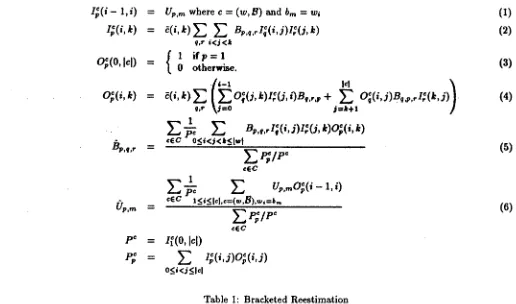
Table I: Bracketed Reestimation
speak indifferently below of derivation and anal- ysis (parse tree) probabilities. Finally, the proba- bility of a sentence or sentential form is the sum of the probabilities of all its analyses (equivalently, the s u m of the probabilities of all of its leftmost derivations from the s t a r t symbol).
3.1.
T h e I n s i d e - O u t s i d e A l g o r i t h m
The basic idea of the inside-outside algorithm is to use the current rule probabilities and the train- ing set W to estimate the expected frequencies of certain types of derivation step, and then compute new rule probability estimates as appropriate ra- tios of those expected frequency estimates. Since these are most conveniently expressed as relative frequencies, they are a bit loosely referred to as
inside
andoutside
probabilities. More precisely, for each w E W, the inside probability I~ (i, j ) es- timates the likelihood t h a t Ap derivesiwj,
while the outside probabilityO~(i, j)
estimates the like- lihood of deriving sentential formowi Ap j w
from the start symbol A1.3.2.
T h e
Extended Algorithm
In adapting the inside-outside algorithm to par- tially bracketed training text, we must take into account the constraints t h a t the bracketing im- poses on possible derivations, and thus on possi- ble phrases. Clearly, nonzero values for
I~(i,j)
orO~(i,j)
should only be allowed ifiwj
is com- patible with the bracketing of w, or, equivalently, if ( i , j ) is valid for the bracketing of w. There- fore, we will in the following assume a corpus C of bracketed strings c = (w, B), and will modify the standard formulas for the inside and outside prob- abilities and rule probability reestimation (Baker, 1979; Lari and Young, 1990; Jelinek et al., 1990) to involve only constituents whose spans are com- patible with string bracketings. For this purpose, for each bracketed string c = (w, B) we define the auxiliary function1 if ( i , j ) is valid for b E B ~(i,j) = 0 otherwise
[image:3.612.38.554.89.393.2]those for shorter spans with the recurrence given by equations (1) and (2). Equation (2) calculates the expected relative frequency of derivations of iwk from Ap compatible with the bracketing B of c = (w, B). The multiplier 5(i, k) is i just in case (i, k) is valid for B, that is, when Ap can derive iwk compatibly with B.
Similarly, the outside probabilities for shorter spans of c can be computed from the inside prob- abilities and the outside probabilities for longer spans with the recurrence given by equations (3) and (4). Once the inside and outside probabili- ties computed for each sentence in the corpus, the ^
reestimated probability of binary rules,
Bp,q,r,
and the reestimated probability of unary rules,(Jp,ra,
are computed by the reestimation formulas (5) and (6), which are just like the original ones (Baker, 1979; Jelinek et al., 1990; Lari and Young, 1990) except for the use of bracketed strings instead of unbracketed ones.The denominator of ratios (5) and (6) estimates the probability that a compatible derivation of a bracketed string in C will involve at least one ex- pansion of nonterminal
Ap.
The numerator of (5) estimates the probability that a compatible deriva- tion of a bracketed string in C will involve ruleAp --* Aq At,
while the numerator of (6) estimates • the probability that a compatible derivation of a string in C will rewrite Ap tob,n.
Thus (5) es- timates the probability that a rewrite of Ap in a compatible derivation of a bracketed string in C will use ruleAp --~ Aq At,
and (6) estimates the probability that an occurrence of Ap in a compat- ible derivation of a string in in C will be rewritten tobin.
These are the best current estimates for the binary and unary rule probabilities.The process is then repeated with the reestimated probabilities until the increase in the estimated probability of the training text given the model becomes negligible, or, what amounts to the same, the decrease in the cross entropy estimate (nega- tive log probability)
E log pc
H ( C , G ) =
(8)
Icl
c6C
becomes negligible. Note that for comparisons with the original algorithm, we should use the cross-entropy estimate /~(W, G) of the
unbrack-
eted
text W with respect to the grammar G, not(8).
131
3 . 3 . C o m p l e x i t y
Each of the three steps of an iteration of the origi- nal inside-outside algorithm - - computation of in- side probabilities, computation of outside proba- bilities and rule probability reestimation - takes time O(Iwl 3) for each training sentence w. Thus, the whole algorithm is O(Iw[ 3) on each training sentence.
However, the extended algorithm performs better when bracketing information is provided, because it does not need to consider all possible spans for constituents, but only those compatible with the training set bracketing. In the limit, when the bracketing of each training sentence comes from a complete binary-branching analysis of the sen- tence (a
full
binary bracketing), the time of each step reduces to O([w D. This can be seen from the following three facts about any full binary brack- eting B of a string w:1. B has o(Iwl) spans;
2. For each (i, k) in B there is exactly one
split
point j
such that both (i, j ) and (j, k) are in3. Each valid span with respect to B must al- ready be a member of B.
Thus, in equation (2) for instance, the number of spans (i, k) for which 5(i, k) • 0 is O([eD, and there is a single j between i and k for which 6(i, j ) ~ 0 and 5(j,k) ~ 0. Therefore, the total time to compute all the
I~(i, k) is
O(Icl). A simi- lar argument applies to equations (4) and (5).Note that to achieve the above bound as well as to take advantage of whatever bracketing is available to improve performance, the implementation must preprocess the training set appropriately so that the valid spans and their split points are efficiently enumerated.
4. E X P E R I M E N T A L E V A L U A T I O N
The following experiments, although preliminary, give some support to our earlier suggested advan- tages of the inside-outside algorithm for partially bracketed corpora.
case, training on a bracketed corpus can lead to a good solution while no reasonable solution is found training on raw text only.
The second experiment uses a naturally occurring corpus and its partially bracketed version provided by the Penn Treebank (Brill et al., 1990). We compare the bracketings assigned by grammars in- ferred from raw and from bracketed training mate- rial with the Penn Treebank bracketings of a sep- arate test set.
To evaluate objectively the accuracy of the analy- ses yielded by a grammar G, we use a Viterbi-style parser to find the most likely analysis of each test sentence according to G, and define the bracket-
ing accuracy of the grammar as the proportion
of phrases in those analyses that are compatible in the sense defined in Section 2 with the tree bank bracketings of the test set. This criterion is closely related to the "crossing parentheses" score of Black et al. (1991). 1
In describing the experiments, we use the nota- tion GR for the grammar estimated by the original inside-outside algorithm, and GB for the grammar estimated by the bracketed algorithm.
4.1.
Inferring the Palindrome Lan-
guage
We consider first an artificial language discussed by Lari and Young (1990). Our training corpus consists of 100 sentences in the palindrome lan- guage L over two symbols a and b
L -
( w w R I
E {a,b}'}.
randomly
generated
S
with the SCFG
° ~ A C
S ° ~ B D
S °-~ A A
S BB
C * - ~ S A
D ! + S B
A *-~ a
B & b
1 Since the g r a m m a r inference procedure is restricted to Chomsky normal form grannnars, it cannot avoid difficult decisions by leaving out brackets (thus making flatter parse trees), as h u n m n a n n o t a t o r s often do. Therefore, the recall
c o m p o n e n t in Black et aL's figure of merit for parser is not
needed.
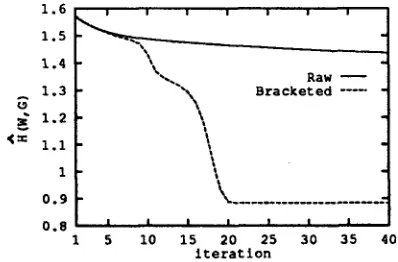
The initial grammar consists of all possible CNF rules over five nonterminals and the terminals a and b (135 rules), with random rule probabilities. As shown in Figure 1, with an unbracketed train- ing set W the cross-entropy estimate H(W, GR) re- mains almost unchanged after 40 iterations (from 1.57 to 1.44) and no useful solution is found. In contrast, with a fully bracketed version C of the same training set, the cross-entropy estimate /~(W, GB) decreases rapidly (1.57 initially, 0.88 af- ter 21 iterations). Similarly, the cross-entropy esti- mate H ( C , GB) of the bracketed text with respect to the grammar improves rapidly (2.85 initially, 0.89 after 21 iterations).
1.6
1.5
1.4
1.3
G 1.2
< " I . i I 0.9 0.8
~-...
\
\
!
\
Raw - - B r a c k e t e d . . .
%
i ! i ! , , !
1 5 10 15 20 25 30 35 40 iteration
Figure 1: Convergence for the Palindrome Corpus The inferred grammar models correctly the palin- drome language. Its high probability rules (p > 0.1, p i p ' > 30 for any excluded rule p') are
S - - * A D
S - * C B
B - - * S C D - - * S A
A --* b
B -* a
C --* a
D ---* b
which is a close to optimal CNF CFG for the palin- drome language.
[image:5.612.341.540.280.411.2]a separate test set for the result of bracketed training is above 90% (100% in several cases), in contrast to bracketing accuracies ranging between 15% and 69% for unbracketed training.
4 . 2 . E x p e r i m e n t s o n t h e A T I S C o r - p u s
For our main experiment, we used part-of-speech sequences of spoken-language transcriptions in the Texas Instruments subset of the Air Travel Infor- mation System (ATIS) corpus (Hemphill et el., 1990), and a bracketing of those sequences derived from the parse trees for that subset in the Penn Treebank.
Out of the 770 bracketed sentences (7812 words) in the corpus, we used 700 as a training set C and 70 (901 words) as a test set T. The following is an example training string
( ( ( VB ( DT ~NS ( IB ( ( NN ) ( NN CD ) ) ) ) ) ) . )
corresponding to the parsed sentence
( ( ( L i s t (the f a r e s (for ( ( f l i g h t )
(number 8 9 1 ) ) ) ) ) ) .)
The initial grammar consists of all 4095 possible CNF rules over 15 nonterminals (the same number as in the tree bank) and 48 terminal symbols for part-of-speech tags.
A random initial grammar was trained separately on the unbracketed and bracketed versions of the training corpus, yielding grammars GR and GB.
4 . 6 4 . 4 4 . 2 4 3 . a
3 . 6 3 . 4 3 . 2 3 2 . 8 1
i ! | I i ! !
~, Raw - -
~ B r a c k e t e d ...
\
\ .
I I I I I | I
I 0 2 0 3 0 4 0 5 0 6 0 7 0 7 5 i t e r a t i o n
Figure 2: Convergence for the ATIS Corpus
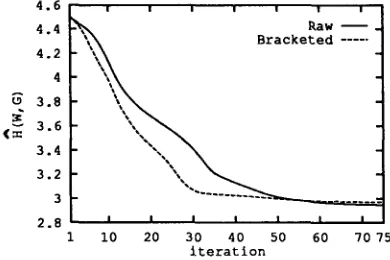
Figure 2 shows that H(W, GB) initially decreases faster than the/:/(W, GR), although eventually the
133
two stabilize at very close values: after 75 itera- tions, /I(W, GB) ~ 2.97 and /:/(W, GR) ~ 2.95. However, the analyses assigned by the resulting grammars to the test set are drastically different.
I00
8 0
u 6 0 o
o 40
rd
20
' R a w ' ' ' ' ' B r a c k e t e d ... ., ... ~ " ° ....
/
l
I I I i ' ' i I 0 2 0 3 0 4 0 5 0 6 0 7 0 7 5
i t e r a t i o n
Figure 3: Bracketing Accuracy for the ATIS Cor- pus
With the training and test data described above, the bracketing accuracy of GR after 75 iterations was only 37.35%, in contrast to 90.36% bracket- ing accuracy for GB. Plotting bracketing accu- racy against iterations (Figure 3), we see that un- bracketed training does not on the whole improve accuracy. On the other hand, bracketed training steadily improves accuracy, although not mono- tonically.
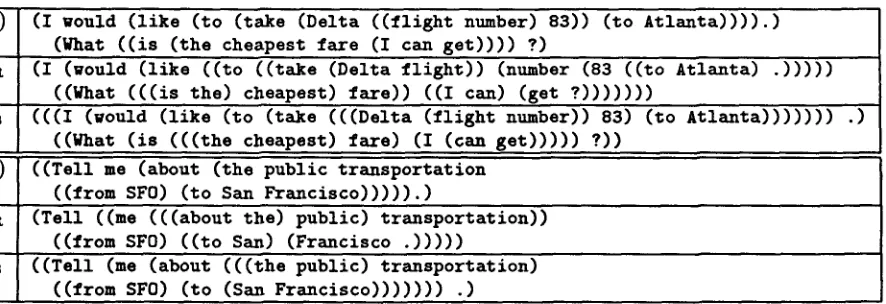
It is also interesting to look at some the differences between GR and GB, as seen from the most likely analyses they assign to certain sentences. Table 2 shows two bracketed test sentences followed by their most likely GR and GB analyses, given for readability in terms of the original words rather than part-of-speech tags.
For test sentence (A), the only GB constituent not compatible with the tree bank bracketing is ( D e l t a f l i g h t number), although the con- stituent ( t h e c h e a p e s t ) is linguistically wrong. The appearance of this constituent can be ex- plained by lack of information in the tree bank about the internal structure of noun phrases, as exemplified by tree bank bracketing of the same sentence. In contrast, the GR analysis of the same string contains 16 constituents incompatible with the tree bank.
[image:6.612.328.540.157.297.2] [image:6.612.87.282.530.660.2](A)
Ga
(I would (like (to (take (Delta ((flight number) 83)) (to Atlanta)))).)
(What ((is (the cheapest fare (I can get)))) ?)
(I (would (like ((to ((take (Delta flight)) (number (83 ((to Atlanta) .)))))
((What ( ( ( i s the) cheapest) fare)) ((I can) (get
? ) ) ) ) ) ) )(((I (would (like (to (take (((Delta (flight number)) 83) (to Atlanta))))))) .)
((What ( i s ( ( ( t h e c h e a p e s t ) f a r e ) (I (can g e t ) ) ) ) ) ? ) )
G B
(B)
((Tell
me (about(the public transportation
((from SF0) (to San Francisco))))).)
G R
(Tell ((me (((about the) public) transportation))
((from SF0) ((to San) (Francisco .)))))
G B
((Tell (me (about (((the public) transportation)
((from SFO) ( t o (San F r a n c i s c o ) ) ) ) ) ) ) .)
Table 2: Comparing Bracketings
example places F r a n c i s c o and the final punctua- tion in a lowest-level constituent. Since final punc- tuation is quite often preceded by a noun, a gram- mar inferred from raw text will tend to bracket the noun with the punctuation mark.
This experiment illustrates the fact that although SCFGs provide a hierarchical model of the lan- guage, that structure is undetermined by raw text and only by chance will the inferred grammar agree with qualitative linguistic judgments of sen- tence structure. This problem has also been previ- ously observed with linguistic structure inference methods based on mutual information. Mater- man and Marcus (1990) addressed the problem by specifying a predetermined list of pairs of parts of speech (such as verb-preposition, pronoun-verb) that can never be embraced by a low-level con- stituent. However, these constraints are stipulated in advance rather than being automatically de- rived from the training material, in contrast with what we have shown to be possible with the inside- outside algorithm for partially bracketed corpora.
5. C O N C L U S I O N S A N D F U R T H E R W O R K
We have introduced a modification of the well- known inside-outside algorithm for inferring the parameters of a stochastic context-free grammar that can take advantage of constituent informa- tion (constituent bracketing) in a partially brack- eted corpus.
The method has been successfully applied to SCFG inference for formal languages and for part-of-speech sequences derived from the ATIS
spoken-language corpus.
The use of partially bracketed corpus can reduce the number of iterations required for convergence of parameter reestimation. In some cases, a good solution is found from a bracketed corpus but not from raw text. Most importantly, the use of par- tially bracketed natural corpus enables the algo- rithm to infer grammars specifying linguistically reasonable constituent boundaries that cannot be inferred by the inside-outside algorithm on raw text. While none of this is very surprising, it sup- plies some support for the view that purely unsu- pervised, self-organizing grammar inference meth- ods may have difficulty in distinguishing between underlying grammatical structure and contingent distributional regularities, or, to put it in another way, it gives some evidence for the importance of nondistributional regularities in language, which in the case of bracketed training have been sup- plied indirectly by the linguists carrying out the bracketing.
Also of practical importance, the new algorithm can have better time complexity for bracketed text. In the best situation, that of a training set with full binary-branching bracketing, the time for each iteration is in fact linear on the total length of the set.
[image:7.612.97.540.84.236.2]and misplacement are lacking.
Second, we would like to extend our experiments to larger terminal vocabularies. As is well known, this raises both computational and data sparse- ness problems, so clustering of terminal symbols will be essential.
Finally, this work does not address a central weak- ness of SCFGs, their inability to represent lex- ical influences on distribution except by a sta- tistically and computationally impractical pro- liferation of nonterminal symbols. One might instead look into versions of the current algo- rithm for more lexically-oriented formalisms such as stochastic lexicalized tree-adjoining grammars (Schabes, 1992).
A C K N O W L E G M E N T S
We thank Aravind Joshi and Stuart Shieber for useful discussions, and Mitch Marcus, Beatrice Santorini and Mary Ann Marcinkiewicz for mak- ing available the ATIS corpus in the Penn Tree- bank. The second author is partially supported by DARPA Grant N0014-90-31863, ARO Grant DAAL03-89-C-0031 and NSF Grant IRI90-16592.
R E F E R E N C E S
J.K. Baker. 1979. Trainable grammars for speech recognition. In Jared J. Wolf and Dennis H. Klatt, editors, Speech communication papers presented at the 97 ~h Meeting of the Acoustical Society of
America, MIT, Cambridge, MA, June.
E. Black, S. Abney, D. Flickenger, R. Grishman, P. Harrison, D. Hindle, R. Ingria, F. Jelinek, J. Klavans, M. Liberman, M. Marcus, S. Roukos, B. Santorini, and T. Strzalkowski. 1991. A pro- cedure for quantitatively comparing the syntactic coverage of english grammars. In DARPA Speech
and Natural Language Workshop, pages 306-311,
Pacific Grove, California. Morgan Kaufmann.
T. Fujisaki, F. Jelinek, J. Cocke, E. Black, and T. Nishino. 1989. A probabilistic parsing method for sentence disambiguation. In Proceedings of the International Workshop on Parsing Technologies,
Pittsburgh, August.
Charles T. Hemphill, John J. Godfrey, and George R. Doddington. 1990. The ATIS spoken language systems pilot corpus. In DARPA Speech
and Natural Language Workshop, Hidden Valley,
Pennsylvania, June.
F. Jelinek, J. D. Lafferty, and R. L. Mercer. 1990. Basic methods of probabilistic context free gram- mars. Technical Report RC 16374 (72684), IBM, Yorktown Heights, New York 10598.
Frederick Jelinek, Robert L. Mercer, and Salim Roukos. 1992. Principles of lexical language mod- eling for speech recognition. In Sadaoki Furui and M. Mohan Sondhi, editors, Advances in Speech
Signal Processing, pages 651-699. Marcel Dekker,
Inc., New York, New York.
K. Lari and S. J. Young. 1990. The estimation of stochastic context-free grammars using the Inside- Outside algorithm. Computer Speech and Lan-
guage, 4:35-56.
K. Lari and S. J. Young. 1991. Applications of stochastic context-free grammars using the Inside- Outside algorithm. Computer Speech and Lan-
guage, 5:237-257.
David Magerman and Mitchell Marcus. 1990.
Parsing a natural language using mutual informa- tion statistics. In AAAI-90, Boston, MA.
Yves Schabes. 1992. Stochastic lexicalized tree- adjoining grammars. In COLING 92. Forthcom- ing.
T. Booth. 1969. Probabilistic representation of formal languages. In Tenth Annual IEEE Sympo-
sium on Switching and Automata Theory, Octo-
ber.
Eric Brill, David Magerman, Mitchell Marcus, and Beatrice Santorini. 1990. Deducing linguistic structure from the statistics of large corpora. In
DARPA Speech and Natural Language Workshop.
Morgan Kaufmann, Hidden Valley, Pennsylvania,
JuDe.