University of Southern Queensland
Faculty of Health, Engineering and Sciences
DOMINATION PROBLEMS IN SOCIAL NETWORKS
A Dissertation submitted by
Guangyuan Wang, MSc
For the award of
Doctor of Philosophy
Abstract
The thesis focuses on domination problems in social networks. Domination prob-lems are one of the classical types of probprob-lems in computer science. Domination problems are fundamental and widely studied problems in algorithms and com-plexity theory. They have been extensively studied and adopted in many real-life applications. In general, a set D of vertices of a simple (no loops or multiple edges), undirected graphG= (V, E) is calleddominating if each vertex in V −D is adjacent to some vertex in D. The computational problem of computing a dominating set of minimum size is known as “the dominating set problem”. The dominating set problem is NP-hard in general graphs.
A social network - the graph of relationships and interactions within a group of individuals - plays a fundamental role as a medium for the spread of informa-tion, ideas, and influence among its members. In a social network, people, who have problems such as drinking, smoking and drug use related issues, can have both positive and negative impact on each other and a person can take and move among different roles since they are affected by their peers. As an example, posi-tive impacts of intervention and education programs on a properly selected set of initial individuals can diffuse widely into society via various social contacts: face to face, phone calls, email, social networks and so on. Exploiting the relation-ships and influences among individuals in social networks might offer considerable benefit to both the economy and society.
In order to deal with social problems, the positive influence dominating set (PIDS) is a typical one to help people to alleviate these social problems. However, existing PIDS algorithms are usually greedy and finding approximation solutions that are inefficient for the growing social networks. By now these proposed algorithms can deal with social problems only in undirected social networks with uniform weight value. To overcome the shortcomings of the existing PIDS model, a novel domination model namely weight positive influence dominating set (WPIDS) is presented. A main contribution of the thesis is that the proposed WPIDS model can be applied in weighted directed social networks. It considers the direction and degree of users’ influence in social networks in which the PIDS model does not. The experimental results have revealed that the WPIDS model is more effective than the PIDS model.
proposed, such as the self-stabilizing algorithms for minimal single dominating sets and minimal k-dominating sets (MKDS). However, for the MKDS problem, so far there is no self-stabilizing algorithm that works in arbitrary graphs. The proposed algorithms for the MKDS either work for tree graphs or find a minimal 2-dominating set. So, in the thesis, for the MKDS problem, two self-stabilizing algorithms are presented that can operate on general graphs. For the weighted dominating set (WDS) problem, most of the proposed algorithms find approx-imation solutions to a WDS. For the non-uniform WDS problem, there is no self-stabilizing algorithm for the WDS. In the thesis, self-stabilizing algorithms for the minimal weighted dominating set (MWDS) and minimal positive influence dominating set (MPIDS) are presented when operating in any general network. The worst case convergence time of the two algorithms from any arbitrary initial state are also proved. Finally, in order to reduce cost in an education/intervention programme arising from the PIDS problem, two cooperative cost games about PIDS problem are constructed.
Certification of Dissertation
I certify that the ideas, experimental work, results, analysis and conclusions re-ported in this dissertation are entirely my own effort, except where otherwise acknowledged. I also certify that the work is original and has not been previously submitted for any other award.
Guangyuan Wang, Candidate Date
ENDORSEMENT
Prof. Hua Wang, Principal supervisor Date
Dr Ji Zhang, Co-supervisor Date
I would like to thank my supervising Professor Hua Wang for constantly moti-vating and encouraging me, and also for his invaluable advice during the course of my doctoral studies. I am extremely fortunate to have had the opportunity to work with him over the past few years. In addition, I would like to thank Dr. Xiaohui Tao and Dr. Ji Zhang for their support, feedback, and encouragement.
I would also like to extend my appreciation to the Centre for Systems Biology (CSBi), Department of Mathematics and Computing, Faculty of Science and Research and Higher Degree office of University of Southern Queensland for pro-viding the excellent study environment and financial support. It is my great pleasure to study at the Department of Mathematics and Computing.
List of Publications
The following publications were produced during the period of candidature:
1. G. Wang, H. Wang, X. Tao and J. Zhang: Finding Weighted Positive In-fluence Dominating Set to Make Impact to Negatives - A Study on Social Networks in New Millennium. To appear in ICTs and the Millennium De-velopment Goals - A United Nations Perspective (Ed. by Haur and Tao), 2014, Springer.
2. G. Wang, H. Wang, X. Tao, J. Zhang and X. Yi: Positive influence domi-nating set games. To appear in the 18th IEEE International Conference on Computer Supported Cooperative Work in Design (CSCWD 2014), 2014.
3. G. Wang, H. Wang, X. Tao, J. Zhang and J. Zhang: Minimisingk-dominating set in arbitrary network graphs. In proceedings of the 9th International Conference on Advanced Data Mining and Applications (ADMA 2013), pp: 120-132, 2013.
4. G. Wang, H. Wang, X. Tao, J. Zhang and G. Zhu: Finding a weighted positive influence dominating set in e-learning social networks. Internal Journal Computing & Technology, 10(10), pp: 2136-2145, 2013.
5. G. Wang, H. Wang, X. Tao and J. Zhang: A self-stabilizing protocol for minimal weighted dominating sets in arbitrary networks. In proceedings of the 17th IEEE International Conference on Computer Supported Cooper-ative Work in Design (CSCWD 2013), pp: 496-501, 2013.
6. G. Wang, H. Wang, X. Tao and J. Zhang: A self-stabilizing algorithm for finding a minimal positive influence dominating set in social networks. In proceedings of 24th Australasian Database Conference (ADC 2013), pp: 93-99, 2013.
7. G. Wang, H. Wang, X. Tao and J. Zhang: A self-stabilizing algorithm for finding a minimal k-dominating set in general networks. In proceed-ings of 2012 International Conference on Data and Knowledge Engineering (ICDKE2012), pp: 74-85, 2012.
Abstract i
Certification of Dissertation iii
Acknowledgments iv
List of Publications v
List of Figures ix
List of Tables x
Chapter 1 Introduction 1
1.1 Introduction . . . 1
1.2 Research Problem Statement . . . 5
1.3 Contributions . . . 5
1.4 Structure of the Thesis . . . 6
Chapter 2 Weighted Positive Influence Dominating Set 8 2.1 Introduction . . . 8
2.2 Motivations and Contributions . . . 9
2.3 Problem Definition . . . 11
2.4 Weighted Positive Influence Dominating Set Algorithms . . . 12
2.5 Experimental Evaluations . . . 16
2.5.1 Simulation Program Design . . . 17
2.5.2 Evaluation Metrics . . . 17
2.5.3 Experimental Results . . . 18
2.6 Case Study . . . 20
2.6.1 Discussions . . . 21
2.7 Summary . . . 21
CONTENTS vii
3.2 Self-Stabilization . . . 24
3.3 K-Dominating Set Problem . . . 26
3.4 Motivations and Contributions . . . 27
3.5 Minimal K-Dominating Set Algorithm . . . 28
3.5.1 An Illustration of a Minimal 3-Dominating Set . . . 29
3.6 Convergence of the K-Dominating Set Algorithm 3.1 . . . 32
3.7 Related Work and Algorithm Comparison . . . 34
3.8 Summary . . . 36
Chapter 4 A Self-Stabilizing Algorithm for K-Domination 37 4.1 Introduction . . . 37
4.1.1 K-Dominating Set Problem . . . 37
4.1.2 Self-Stabilizing Algorithm . . . 38
4.2 Related Work . . . 38
4.3 Motivations and contributions . . . 40
4.4 K-Dominating Set Algorithm . . . 40
4.4.1 Formal Definition of the MKDS Problem . . . 41
4.4.2 Proposed Algorithm . . . 41
4.5 The Stabilization Time of Algorithm 4.1 . . . 42
4.6 Algorithm Comparison . . . 45
4.7 Summary . . . 46
Chapter 5 A Self-Stabilizing Algorithm for Weighted Domination 47 5.1 Introduction . . . 47
5.2 Dijkstra’s Central Daemon Model . . . 48
5.3 Motivations and Contributions . . . 49
5.4 Weighted Dominating Set . . . 49
5.5 Weighted Dominating Set Algorithm . . . 51
5.5.1 An Illustration . . . 52
5.6 The Stabilization Time of Algorithm 5.1 . . . 52
5.7 Related Work and Comparisons . . . 55
5.8 Summary . . . 56
Chapter 6 A New Algorithm for the Positive Influence Dominating Set 57 6.1 Introduction . . . 57
6.1.1 Positive Influence Dominating Set . . . 57
6.2 Self-Stabilization . . . 59
6.3 Motivations and Contributions . . . 59
6.4 Positive Influence Dominating Set . . . 60
6.5 Positive Dominating Set Algorithm . . . 61
6.5.2 An Illustration . . . 62
6.5.3 The Stabilization Time of Algorithm 6.1 . . . 64
6.6 Related Work and Comparison . . . 65
6.7 Summary . . . 67
Chapter 7 Positive Influence Dominating Set Games 68 7.1 Introduction . . . 68
7.1.1 Cooperative Game . . . 68
7.1.2 Positive Influence Dominating Set Problem . . . 70
7.2 Related Work . . . 70
7.3 Motivations and Contributions . . . 72
7.4 Definition of Positive Influence Dominating Set Games . . . 72
7.4.1 Cooperative Game . . . 73
7.5 Positive Influence Dominating Set Games . . . 73
7.6 The Balancedness of the PIDS Game . . . 75
7.6.1 Balancedness of the relaxed PIDS game . . . 75
7.6.2 Computational Complexity on Cores . . . 76
7.7 Summary . . . 77
Chapter 8 Conclusions 78 8.1 Overview of Previous Chapters . . . 78
8.2 Key Outcomes . . . 80
8.3 Future Research . . . 80
References 82
Appendices 91
Appendix A Procedure Code 92
List of Figures
1.1 An example of a dominating set . . . 2
2.1 An example of a PIDS graph model . . . 10
2.2 An example of a WPIDS graph model with an authority . . . 13
2.3 An example of a WPIDS selection algorithm graph model . . . 16
2.4 A case study of a WPIDS selection algorithm group model . . . . 20
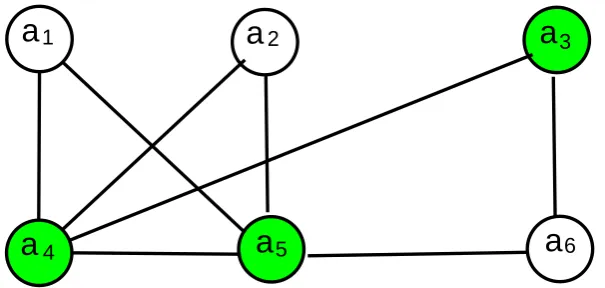
3.1 A M2DS example . . . 26
3.2 A M3DS example to illustrate the execution of Algorithm 3.1. . . 30
3.3 A M3DS example to illustrate the execution of Algorithm 3.1. . . 31
3.4 The M3DS result of Figs. 3.2 and 3.3 by running Algorithm 3.1. . 31
4.1 A M2DS example to illustrate the execution of Algorithm 4.1. . . 43
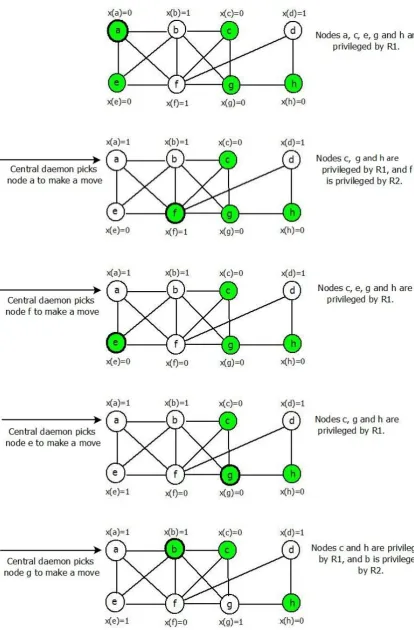
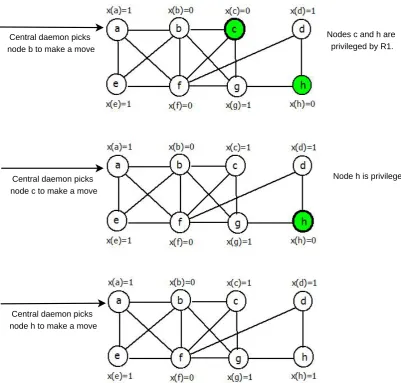
5.1 An example to illustrate the execution of Algorithm 5.1. . . 53
2.1 Result of the simulation program by WPIDS selection algorithm 2.1 18 2.2 Result of the simulation program by WPIDS selection algorithm 2.2 19
2.3 Comparison between WPIDS and PIDS selection algorithms . . . 19
3.1 Self-stabilizing algorithms for the dominating set . . . 35
4.1 Algorithms for the dominating set . . . 45
5.1 Self-stabilizing algorithms for the dominating set . . . 56
Chapter 1
Introduction
1.1
Introduction
Graph Domination problems are one of the classical types of problems in computer science. Domination problems are fundamental and widely studied problems in algorithms and complexity theory. They are an important class of combinatorial problems with many practical and theoretical applications. For example, in con-structing a cellular phone network, one needs to choose locations for the towers to cover a large region as cheaply as possible. This is a domination problem: the vertices of the graph are the locations that need coverage, the neighborhood of a vertex is the area that a tower at that vertex would cover, and a dominating set is any set of locations at which one could place towers to cover the whole region.
Mathematical study of domination in graphs began around 1960, beginning with Claude Berge [1] in 1962. He introduced the coefficient of external stability, which is now known as the domination number of a graph. Oystein Ore [2] introduced the terms dominating set and domination number in his book on graph theory which was published in 1962. A decade later, Cockayne and Hedetniemi [3] published a survey paper, in which the notation γ(G) was first used for the domination number of a graph G. In 1998, a book [4] on domination has been published which lists 1222 papers in this area. Since this book was published, domination in graphs has been studied extensively and several additional research papers have been published on this topic. Recently, domination problems have been extensively studied and adopted in many real-life applications in fields such as optimisation, communication networks and network design, social network theory, computational complexity, and algorithm design. Many facility location, resource allocation, and scheduling problems, are variants of graph domination problems [5–10].
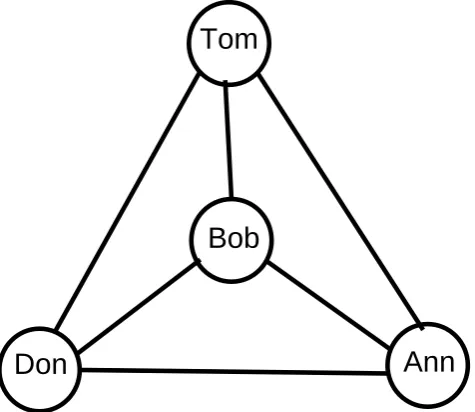
Bob
Don
Ann
[image:14.595.200.438.71.277.2]Tom
Figure 1.1: An example of a dominating set
Dominating Set Problem1
Input: A graph G = (V, E) with vertex set V and edge set E and an integer k∈N (N is the set of natural numbers).
Question: Does there exist a dominating set D⊆V inG of size at most k?
We use an illustration to further understand the dominating set (DS). For exam-ple, there are four persons in Fig. 1.1 and their relationships constitute a complete graph. We can say anyone of the four persons is a DS of the four persons group. Due to the practical applications of dominating sets, there are many variations of dominating sets such as Total Dominating Set (TDS) [11–14], Weighted Dominat-ing Set (WDS) [15–18], Connected DominatDominat-ing Set (CDS) [19–24],K-Dominating Set (KDS) [25, 26], Positive Influence Dominating Set (PIDS) [27, 28] and so on.
Recently, online social network has developed significantly in the new millennium. For example, online social network sites like Facebook, MySpace and Twitter are among the most popular sites on the Internet. Some research has been done to understand the properties of online social networks [29–34] and how to effectively utilize social networks to spread ideas and information within a group [27, 28, 35, 36]. Among these research, Wang et. al explored the problem of how to utilize online social networks to help alleviate social problems in the physical world [27, 28]. The social problems include drinking, smoking, drug use and so on. Within the context of the drinking problem, for example, a person can be an abstainer, or an alcoholic. An abstainer has positive impact on his direct friends (called neighbourhoods), but he might turn into an alcoholic and have negative impact on his neighbourhoods if many of his friends are alcoholics and vice versa. Ideally, in an alcohol intervention programme the purpose is to educate all alcoholics, since this will reduce the possibility of the converted alcoholics being influenced by his alcoholic friends who are not selected in the intervention programme. On the other hand, due to the financial limitations in budget, it is too
1.1 Introduction 3
expensive to select all the alcoholics in an intervention programme. Therefore, it becomes an important research problem as to how to select a subset of individuals to be part of the programme so that the effect of the intervention programme can spread through the whole group under consideration.
To deal with the above social problems, Wang et. al [27] introduced the notion of the positive influence dominating set (PIDS) and proposed a greedy approxima-tion PIDS selecapproxima-tion algorithm in 2009. Recall that D⊆V is a positive influence dominating set (PIDS) [27, 28] if any node v ∈V is dominated by at least ⌈d(2v)⌉ nodes (that is, v has at least⌈d(2v)⌉ neighbours) in D where d(v) is the degree of nodev. Note that there are two requirements for PIDS:
(i) Every node not in Dhas at least half of its neighbours in D;
(ii) Every node inD also has at least half of its neighbours in D.
Wang et al. [27] revealed that approximately 60% of the whole group under consideration needs to be selected into the PIDS in order to achieve the goal that every individual in the community has more positive neighbours than negative neighbours. However, the proposed algorithm can deal with social problems only in undirected social networks with uniform weight value. If we consider some key factors, such as the attribute, direction and degree of each person’s influence, the size of the solution for selecting a proper subset of the whole group might be smaller and the algorithm might be more effective and economical. Exploiting the relationships and influences among individuals in social networks might offer considerable benefit to both the economy and society.
Following the key factors as we analyzed above, Figure 1.1 is a proper example which illustrates the scenario as discussed above. In Figure 1.1, Bob, Tom, Don and Ann are four equal e-learners in a small group. Any three of them is a PIDS satisfying its definition (requirements (i) and (ii)). But if Bob is a tutor and has strong positive influence on others, only Bob can positively affect (dominate) others.
In this thesis we would like to explore how to select a subset of individuals to be part of the programme so that the effect of the intervention programme can spread through the whole group under consideration. We consider the degree and direction of each user’s influence, propose a novel DS named weighted positive influence dominating set (WPIDS) and develop two WPIDS selection algorithms in e-learning environments.
The computational problem of computing a DS of minimum size is known as dom-ination problems. Domdom-ination problems are all NP-hard in general graphs [11,37]. Nowadays, it is commonly believed that NP-hard problems cannot be solved in polynomial times. For these problems one remaining hope is to design exact al-gorithms with good exponential running times [38, 38–44]. The fastest currently known exact algorithms for the DS are around O(1.5n) where n is the number
Research on local algorithms has been thriving again [45–48], probably thanks to emerging applications in ad hoc and sensor networks. To get a virtual backbone (connected DS), Guha, Khuller, and Du et al. [20–23, 49–51] presented some two-stage greedy approximation algorithms and interesting results by utilizing the property of wireless networks.
Owing to the rapid development of social network services, domination problems in social networks have become important issues [27,28,36,52]. Eubank et al. [36] proposed a greedy approximation algorithm and proved that the algorithm gives an 1 +O(1) approximation with a small constant in O(1) to the DS problem in a power-law graph. Kleinberg et al. [53] studied online social networks, in which relationships can be either positive or negative. Wang et al. introduced a new DS, called PIDS which can help alleviate social problems in the physical world [27, 28].
Although domination problems are all NP-hard in general graphs [11, 37], which means to find a minimum DS is NP-hard in general graphs, some proposed self-stabilizing algorithms for minimal dominating sets are in polynomial time (steps or rounds) complexity [26, 54] or linear time (steps or rounds) complexity [54,55].
Self-stabilization is an optimistic fault tolerance approach for distributed sys-tems. It was introduced by Dijkstra [56, 57]. Self-stabilization can be used to solve a variety of graph theoretic problems such as dominating sets [58, 59], in-dependent sets [54, 59, 60], colorings [61–63], and matchings [64–66] problems in graphs. According to Dijkstra’s work, a self-stabilizing system is guaranteed to reach a correct state, in a finite time, regardless of its initial state [67]. Thus, a self-stabilizing system can recover from any transient fault without any external intervention. Self-stabilization is also a non-masking approach, since after the oc-currence of a transient fault, the system exhibits temporarily disrupted behaviour for a certain period of time.
A fundamental idea of self-stabilizing algorithms is that the distributed system may be started from an arbitrary global state. After finite time the system reaches a correct global state, called a legitimate or stable state. An algorithm is self-stabilizing if the following two properties hold: convergence andclosure. That is, when the system executes the algorithm,
(1) for any initial illegitimate state it reaches a legitimate state after a finite number of node moves (convergence), and
(2) for any legitimate state and for any move allowed by that state, the next state is a legitimate state (closure).
1.2 Research Problem Statement 5
seldom self-stabilizing algorithms for the weighted dominating set (WDS) prob-lem.
In this thesis, we have the motivations to extend the PIDS model which can deal with social problems only in undirected social networks with uniform weight and the minimal 2-dominating set (M2DS) to the general k: the minimal k -dominating set (MKDS). We have proposed a novel DS, namely weight positive influence dominating set (WPIDS) considering the direction and degree of users’ influence in weighted directed social networks in which the PIDS model does not. To extend Huang et al.’s work, two self-stabilizing algorithms have been proposed for the MKDS when operating in any general networks. Moreover, two self-stabilizing algorithms for finding a minimal weighted dominating set (MWDS) and an MPIDS under a central daemon in a general graph are presented. Finally, we consider cooperative cost games arising from the PIDS problem which can deal with social problems. We introduce two games, the rigid PIDS game and relaxed PIDS game and focus on the cores of both games.
1.2
Research Problem Statement
Based on the background knowledge and the research gap we discuss above, we list five research problems.
• Problem A: How to find a smaller DS in an education/intervention pro-gramme to positively dominate the whole group?
• Problem B: How to find an MKDS2 in any general network. • Problem C: How to find an MWDS3 in any general networks. • Problem D: How to find an MPIDS4 in any general social network. • Problem E: How to distribute the total cost among the individual players
in a “fair” way to ensure that no coalition would have an incentive to split from the grand coalitionV, and do better on its own when there is a PIDS.
1.3
Contributions
In this section, we list our models and algorithms which we have solved these five problems we listed above.
First, the research is as to how to effectively select positive e-learners to affect an individual in the e-learning network becomes “positive” if half of its neighbours are “positive” about adopting a product or behaviour. We give both theoretical justification and empirical verification for the two proposed selection algorithms [69, 70]. Second, we are interested in an MKDS in any general networks [71, 72].
Third, we extend Huang et al.’s work and consider the extension problem of M2DS mentioned in [55, 68]. We will solve that extension problem for general k (i.e., for k being an arbitrary positive integer) in general networks. We firstly develop two new self-stabilization algorithms for finding an MKDS in a general network. The first algorithm works under a central daemon [71] and the second one works under a distributed daemon [72]. We discuss the PIDS problem further. We propose a self-stabilizing algorithm for an MPIDS [73] and discuss the core of the PIDS games [74]. The contributions of this thesis are as follows:
1. A new DS named WPIDS and its model are defined. Two WPIDS selection algorithms to solve Problem A are proposed. The model reasonably utilizes its online social network structure to help e-learners to improve their study achievements [69,70]. It overcomes the drawbacks that the PIDS model can deal with social problems only in undirected social networks with uniform weight. The effectiveness of our two WPIDS selection algorithms has been evaluated by simulation experiments. The experimental results show the size of the WPIDS is much smaller than that of the PIDS model.
2. A self-stabilizing algorithm for finding an MKDS under a central daemon in an arbitrary simple connected undirected network graph to solve Problem B is presented. The correctness of the proposed algorithm is verified. The computational complexity of the algorithm is proved that the worst case convergence time of the algorithm from any arbitrary initial state isO(n2) steps wheren is the number of nodes in the network [71].
3. A self-stabilizing algorithm for finding an MKDS under a distributed dae-mon in an arbitrary connected simple undirected graph to research Problem B further is presented. The correctness of the proposed algorithm is veri-fied; the worst case convergence time of the algorithm from any arbitrary initial state is proved to be O(n2) steps where n is the number of nodes in the network graph [72].
4. A self-stabilizing protocol for finding an MWDS in an arbitrary network graph under a central daemon to solve Problem C is proposed. The worst case convergence time of the protocol from any arbitrary initial state is proved to beO(n2) steps wherenis the number of nodes in the network [75].
5. A self-stabilizing algorithm for finding an MPIDS in an arbitrary network graph under a central daemon to solve Problem D. The worst case conver-gence time of the protocol from any arbitrary initial state is proved to be O(n2) steps wheren is the number of nodes in the network [73].
6. Two new game models, the rigid PIDS game and relaxed PIDS game are presented. A relationship between the cores of both games is obtained. The core of the relaxed PIDS game is discussed to solve Problem E [74].
1.4
Structure of the Thesis
1.4 Structure of the Thesis 7
Chapter 1- In the first chapter, we have discussed the background of domination problems and listed the research problems or what we can improve for domination problems. We have also listed our contributions or what we have done to solve these research problems.
Chapter 2 - We analyze the problem of how to utilize online social network as a medium to improve users’ study achievements in e-learning environments. We have proposed a new DS named WPIDS and two WPIDS selection algorithms to evaluate the effect of educating a subset of the entire target group susceptible to a social problem. The simulation experimental results have revealed that the WPIDS model and selection algorithms are more effective than the PIDS one [27].
Chapter 3 - We extend Huang et al.’s work and consider the extension prob-lem of M2DS mentioned in [55, 68]. We have solved the extension probprob-lem for generalk (i.e., fork being an arbitrary positive integer) in general networks. We have first developed a new self-stabilization algorithm for finding an MKDS in a general network that works under a central daemon. We have also analyzed the correctness and time complexity of the proposed algorithm, in which the time complexity of their algorithm is not been discussed in [68].
Chapter 4- We have proposed another new self-stabilization algorithm for find-ing an MKDS in a general network that works under a distributed daemon. We have also analyzed the correctness and time complexity of the proposed algorithm in this chapter.
Chapter 5 - We have presented a self-stabilizing protocol for finding an MWDS in an arbitrary network graph under a central daemon. We have also analyzed the correctness and time complexity of the proposed algorithm in this chapter.
Chapter 6 - We have first presented a self-stabilizing algorithm for the MPIDS problem, which can find an MPIDS in large social networks without any isolated node. We have also proved that the worst case convergence time of the algorithm from any arbitrary initial state is O(n2) steps where n is the number of nodes in the network.
Chapter 7- We investigate cooperative cost games arising from the PIDS prob-lem on social network graphs. We have proposed two new game models, the rigid PIDS game and relaxed PIDS game, and focused on their cores. First, a relationship between their cores of both games is obtained. Next, we have proved that the core of the relaxed PIDS game is non-empty if and only if there is no integrality gap for the relaxation linear programming of the PIDS problem on the graph G.
Weighted Positive Influence
Dominating Set
In order to help alleviate a certain social problem, a variation of dominating set, called positive influence dominating set (PIDS) was introduced by Wang et al. [27]. The PIDS can deal with social problems only in undirected social networks for uniform weight cases [69, 70]. In this chapter, we have motivations to extend the PIDS to overcome its drawbacks. For example, the PIDS in existing research does not take into consideration the attributes, directions and degrees of persons’ influence [27, 28]. We will propose a novel dominating set called weighted positive influence dominating set (WPIDS) and two WPIDS selection algorithms in e-learning environments. The WPIDS can deal with social problems in weighted directed social networks. Experimental results demonstrate that the proposed WPIDS and algorithms are more reasonable and effective than those of the PIDS without considering the factors of attribute, direction and weight of users’ influence in e-learning environments.
The information in this chapter is based on two published papers [69, 70].
2.1
Introduction
As the Internet becomes widespread, e-learning communities have become more and more popular [76–78]. E-learning is an attractive and efficient way for modern education since e-learning environments are more convenient and source saving to build compared with the traditional learning environments. In such learning environments, almost all the resources are provided through the computers and networks and students can learn at anytime or anywhere. Meanwhile, the inter-action and collaboration of tutors and students also play important roles in the e-learning programme. Social interaction within an online framework can help students share experiences and collaborate on relevant topics.
2.2 Motivations and Contributions 9
users (e-learners) composes an online social network. In e-learning programmes the tutors and students compose the set of e-learners. There are some different studying groups according to their interests and purposes. The fact is that each e-learner has a different learning ability. For instance, an excellent student, an average student, or a poor student in terms of their academic records. An ex-cellent student has positive influence on his direct friends (outgoing neighbours), but he might turn into a poor student and has negative influence on his outgoing neighbours if he is affected by many of his friends who are poor students, and vice versa. Besides, an e-learner can be an authority such as a tutor who has strong positive influence on others. It is very important to divide groups such that there are plenty of tutors or excellent students in each group to have positive influence to help other students.
On the other hand, due to the financial limitations in budget, it is too expensive to set many tutors in the study programme. Therefore, how to choose a subset of individuals to be part of the programme so that the effect of the intervention program can spread through the whole group under consideration becomes an important research problem. These issues are very intricate and complex prob-lems. In an effort to address this issue, the specific problem we study in this chapter is the following: Given an online e-learning social network and the set of e-learners, we identify a subset of the individuals within the e-learning online social network to participate in an education/intervention programme such that the education/intervention can result in a globally positive impact on the other e-learners.
2.2
Motivations and Contributions
In [27], Wang et al. introduced the notion of the PIDS and proposed a greedy approximation PIDS selection algorithm in 2009. Recall thatD⊆V is apositive influence dominating set (PIDS) [27, 28] if any node i in V is dominated by at least ⌈d(2i)⌉nodes (that is, ihas at least⌈d(2i)⌉neighbours) in D whered(i) is the degree of node i. Note that there are two requirements for PIDS:
(i) Every node not in Dhas at least half of its neighbours in D;
(ii) Every node inD has at least half of its neighbours in D.
Wang et al. [27] revealed that approximately 60% of the whole group under con-sideration needs to be selected into the PIDS to achieve the goal that every individual in the community has more positive neighbours than negative neigh-bours.
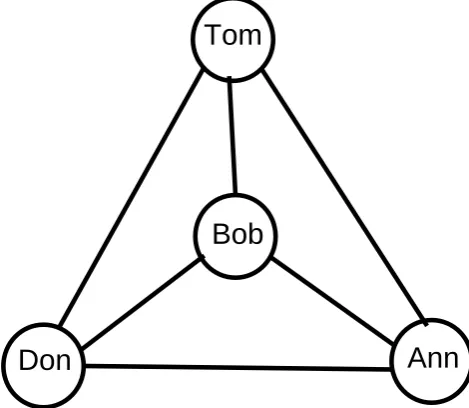
Bob
Don
Ann
[image:22.595.198.433.73.277.2]Tom
Figure 2.1: An example of a PIDS graph model
As we discussed above, if we consider some key factors in e-learning environments, such as the important persons and degree of each e-learner’s influence, the size of the solution for selecting a proper subset of the whole group might be smaller and the algorithm might be more effective and economical. In this chapter we consider the degree and direction of each e-learner’s influence in e-learning social networks. We propose a novel dominating set named WPIDS and develop two WPIDS selection algorithms. The effectiveness of our proposed WPIDS model and algorithms are evaluated by experiments.
The main idea of our research is as to how to effectively select positive e-learners to affect an individual in the e-learning social network. An individual becomes a “positive” e-learner if its neighbours’ “positive” influence are more than its neigh-bours’ “negative” influence. We give both theoretical justification and empirical verification for the two proposed selection algorithms. Specifically, we prove the feasibility of the two selection algorithms by a theorem. The contributions of our work are as follows:
1. A new dominating set named WPIDS and two WPIDS selection algorithms have been presented. The WPIDS model reasonably utilizes its online social network structure to help e-learningers to improve their study achievements.
2. The effectiveness of the two WPIDS selection algorithms has been evaluated by simulation experiments.
2.3 Problem Definition 11
2.3
Problem Definition
In this section, we formulate the WPIDS problem arising from the e-learning so-cial networks. We will use the following graph model to illustrate the e-learning social network in the context of the improving study achievement issue: A di-graphG= (V, A, C, W) is used to represent the e-learning online social network. V is the set of nodes in which each node is an e-learner in the e-learning social network; A is the set of arcs in which each direct arc represents the existence of a social connection/influence between the two endpoints; C is the compartment vector that saves the compartment of each node. The compartment of a node decides whether it has positive or negative influence on its outgoing neighbours. For example, for the improving e-learningers’ study achievements problem, the compartment of each node is one of the followings: authority (tutor), excellent student, average student, or poor student. A node in the authority or excellent student compartment has positive influence and all nodes in any of the other two compartments have negative influence. W is a set of weight values corresponding to arcs belong to A. Each arc’s value is decided by the frequency of the two persons’ interactions.
We assume that:
(i) If the total arcs weight of an individual’s incoming neighbours has positive impact on him, then the probability that this individual positively impacts others in the social network is high;
(ii) Education/intervention programmes can convert a negative influential indi-vidual to a positive influential person;
(iii) There are some authority e-learners (tutors) with no incoming arcs which means that they are positive e-learners without others’ influence.
The first assumption comes from an extensive body of evidence suggesting that one of the most powerful predictors of habitual behaviour in individuals is whether an individual has friends who also engage in that behaviour [81–83]. Due to out-side competition in terms of personality traits attained from peer influence, the more neighbours/friends exerting positive influence an individual has, the more likely he is to impact others in a positive way. The second assumption comes from the work in [81, 84, 85], where nearly every individual in the feedback interven-tion programme showed an improving grade in studying. The third assumpinterven-tion comes from the fact that the tutors are authorities in the study programme who cannot be affected by other students’ negative influence. With the above three assumptions, the problem is equivalent to selecting a subset of all the e-learners in an e-learning programme such that other e-learners in the social network receive more positive influence than negative influence.
The formal definitions of the WPIDS problem are as follows.
a weighted digraph G = (V, A, C, W). V is the set of nodes in which each node is an e-learner in the network; A is the set of arcs between the vertices:
A ={(u, v)|u, v ∈V, u 7→ v}, where u 7→ v indicates that the e-learner u affects the e-learnerv; C is the compartment vector; the compartment of a node decides whether it has positive or negative influence on its outgoing neighbours. W is a set of weight values corresponding to arcs belonging to A. The weight valueW of an arc (u, v) is defined as:
{
w(u, v)∈[−1,0) if the e-learner u is a negative e-learner;
w(u, v)∈[0,1] if the e-learner u is a positive e-learner.
Definition 2.2. (Weighted Positive Influence Dominating Set (WPIDS)). With Definition 2.1, the WPIDS of an e-learner online social network G is defined as a subsetP ⊆V such that any nodeu∈V −P is positively dominated byP. That is,
∀u∈V −P, w(u−) = ∑
v∈N−(u)
w(u, v)≥0,
where N−(u) ={v|(v, u)∈A} is the set of incoming neighbours of node u.
The WPIDS problem is to find a so-called minimum WPIDS of G, which min-imizes the total number of its vertices. In this chapter, we will propose two selection algorithms for the WPIDS problem and find approximate solutions to the WPIDS problem in large online social networks.
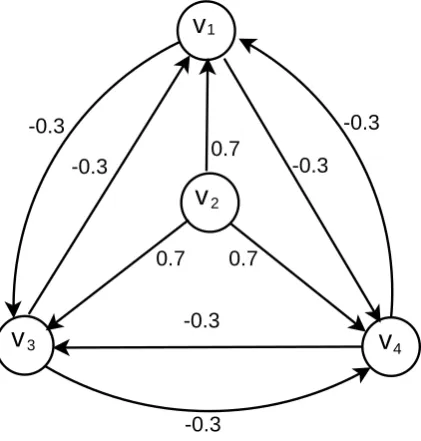
Example 2.1. An example of the WPIDS is shown in Fig. 2.2. Let node v2
represent an authority (tutor) and nodes v1, v3, v4 represent negative students,
and let w(v2, v1) =w(v2, v3) =w(v2, v4) = 0.7, other arcs weight values are -0.3.
According to the definition of WPIDS, the total incoming arcs weight values of nodes v1, v3, v4 are 0.1. So the subset P ={v2} is a WPIDS, which shows the key
person’s influence.
2.4
Weighted Positive Influence Dominating Set
Algorithms
2.4 Weighted Positive Influence Dominating Set Algorithms 13
v
12
3 4
v
v
v
-0.3
-0.3
-0.3 -0.3
-0.3
-0.3 0.7
[image:25.595.213.424.71.292.2]0.7 0.7
Figure 2.2: An example of a WPIDS graph model with an authority
Definition 2.3. Consider a weighted digraph G= (V, A, C, W) as an instance of WPIDS. For any vertex subset P ⊆V, we define
f(P) = ∑v∈V−Pmin{0, w(n−P(v))}, where w(n−P(v)) = ∑u∈n−
P(v)w(u, v), n
−
P(v) = {u|(u, v) ∈P} denotes the
incom-ing neighbours of v ∈P.
The following theorem states important properties of the function f.
Theorem 2.1.
(1) f(∅) = 0.
(2) ∀v ∈V −P, f(P) = 0, if and only if P is a WPIDS of G.
(3) Iff(P)<0, then there exists a vertex u∈V−P such thatf(P∪{u})> f(P).
Proof. Note that n−∅(v) =∅ for all v ∈V. Therefore (1) holds.
For (2), we note thatf(P) = 0 if and only if 0 ≤w(n−P(v)) for every v ∈V −P if and only if P is a WPIDS.
To see (3), note that f(P) < 0 implies the existence of v ∈ V −P such that 0> w(n−P(v)). Let ube an incoming neighbour of v which is not in P and select u intoP, then f(P ∪ {u}) =∑v∈V min{0, w(n−P(v)) +w(u, v)}> f(P).
Theorem 2.1 is the theoretical analysis to conduct two greedy algorithms for the WPIDS problem formalized in the earlier section. This is very important for running the algorithms in practice.
weight value of v′s outgoing arc weight value w(u, v). The same holds for the negative degree. The compartment C of a node decides whether the node is a positive or a negative node. For example, in the e-learning social network, a node in the tutor compartment is a positive node and a node in any other compartment is a negative node. Nodes chosen into the WPIDS are marked positive. Thus an e-learner u is a positive e-learner if u is initially a positive node or u is selected into the WPIDS. A PIDS P of a graph G is a subset of nodes in G that any nodeuinGis dominated by at least⌈d(2u)⌉positive nodes (that is,u has positive neighbours in at least half of its neighbourhood) in P whered(u) is the degree of nodeu. A WPIDS P of a graphG is a subset of nodes in G such that any node u inV −P is positively dominated by the positive nodes in P (that is, the total influence value ofu′s incoming neighbours is no less than zero).
We explain the heuristic methods to the two WPIDS selection algorithms as follows:
Algorithm 2.1:Weighted Positive Influence Dominating Set (WPIDS) Selection Algorithm
Input: A digraph G= (V, A, C, W) whereV is the set of nodes, A is the set of arcs that capture the social interaction of the nodes, C is the set of nodes that are initially in a positive compartment.
Output: A subset P ∪C of V such that any node u in V −P ∪C has been positively dominated by P ∪C, i.e., each node u∈V,w(u−) is non-negative.
1 letV′ =V −C and set the status of nodes inC to POSITIVE;
2 initialize the status of all nodes inV′ to NEGATIVE and P to empty; 3 each node u∈V′, calculate w(u−) ;
4 T is the set of nodes in V′ that have been positively dominated; 5 letV′ =V′−T;
6 while not every node in V′ has been positively dominated
7 choose the node uwith the minimum negative weight value of its total outgoing arcs in V′ into set P, set the status of nodes in P to positive; resetting the node u has absolute weight value of outgoing arc weights; 8 update P =u∪P, V′ =V′−T;
9 update the positive values of each node in V′; 10 end of while
11 the nodes in set V −P ∪C are positively dominated in G, and the positive influence of each node (w(u−)) in V −P ∪C is also calculated. 12 OUTPUT: The nodes in setP ∪C positively dominate set ofV −P ∪C, and
the positive value of each node (w(u−)) in V −P ∪C is also calculated.
be-2.4 Weighted Positive Influence Dominating Set Algorithms 15
cause they have more positive influence on others. Repeat this procedure until all nodes not in the WPIDS are positively dominated by their incoming neighbours. The procedure of this algorithm is presented in Algorithm 2.1.
Considering the fact that the negative e-learners (nodes) who have the highest accumulative negative weights from other neighbours’ influence are more easily educated into positive e-learners, we propose a new algorithm. The main idea of WPIDS Selection Algorithm 2.2 is to select the e-learners (nodes) from the negative e-learners group with the highest accumulative weights of incoming arcs into the WPIDS according to the fact that these selected e-learners are more easily educated into positive e-learners. The procedure of this algorithm is presented in Algorithm 2.2.
Algorithm 2.2:Weighted Positive Influence Dominating Set (WPIDS) Selection Algorithm
Input: A digraph G= (V, A, C, W) whereV is the set of nodes, A is the set of arcs that capture the social interaction of the nodes, C is the set of nodes that are initially in a positive compartment.
Output: A subset P ∪C of V such that any node u in V −P ∪C has been positively dominated by P ∪C, i.e., each node u∈V,w(u−) is non-negative.
1 letV′ =V −C and set the status of nodes inC to POSITIVE;
2 initialize the status of all nodes inV′ to NEGATIVE and P to empty; 3 each node u∈V′, calculate w(u−) ;
4 T is the set of nodes in V′ that have been positively dominated; 5 letV′ =V′−T;
6 while not every node in V′ has been positively dominated
7 choose the node uwith the maximum negative weight value of its total incoming arcs in V′ into set P, set the status of nodes in P to positive; resetting the node u has absolute weight value of outgoing arc weights; 8 update P =u∪P, V′ =V′−T;
9 update the positive values of each node in V′; 10 end of while
11 the nodes in set V −P ∪C are positively dominated in G, and the positive influence of each node (w(u−)) in V −P ∪C is also calculated. 12 OUTPUT: The nodes in setP ∪C positively dominate set ofV −P ∪C, and
the positive value of each node (w(u−)) in V −P ∪C is also calculated.
v
12
3 4
v
v
v
-0.3
-0.3
-0.3 -0.3
-0.3
-0.3 0.7
0.7 0.7
5
v
[image:28.595.175.460.69.295.2]-0.2 -0.2
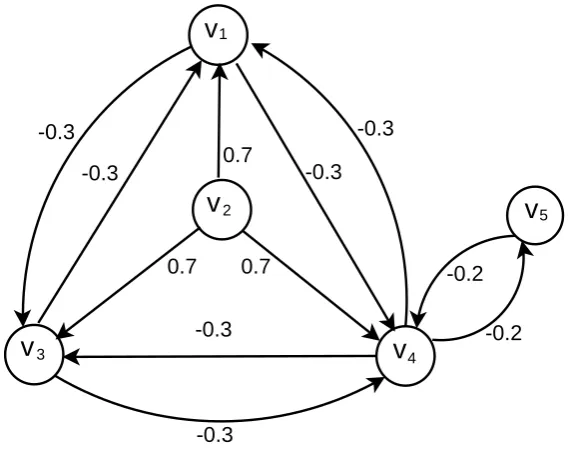
Figure 2.3: An example of a WPIDS selection algorithm graph model
Example 2.2. Figure. 2.3 shows how to operate our two WPIDS selection algo-rithms. Figure. 2.3 is almost the same as Fig. 2.2 except one more negative node
v5 and let w(v4, v5) =w(v5, v4) = −0.2. According to Algorithm 2.1, the nodes v1
andv3 have already been positively dominated by the nodev2. So we just consider
the nodes v4 and v5. The node v4 has the smallest total outgoing arcs weight
value (-0.8) and the node v5 has total outgoing arcs weight values as -0.2, so the
nodev4 is selected as a positive node. The arc weightw(v4, v5) becomes 0.2 which
can positively dominate the node v5. Consequently, the set {v2, v4} is a WPIDS,
which can positively dominate the whole set of nodes. According to Algorithm 2.2, the node v4 has the biggest total ingoing arcs weight value (-0.1) and the node v5
has total ingoing arcs weight values as -0.2, so the nodev4 is selected as a positive
node. The arc weight w(v4, v5) becomes 0.2, which can positively dominate the
node v5. The set {v2, v4} is a WPIDS of Fig. 2.3.
2.5
Experimental Evaluations
In order to clearly reveal the effectiveness of our proposed WPIDS methods, we designed a programme to simulate e-learning environment. In this way, we can clearly predefine the ground truth of each e-learner’s attribute to test the efficiency of our greedy WPIDS selection algorithms. In this section, we will discuss the experiments of WPIDS selection algorithms on data generated from the programme.
The evaluation is designed to answer the following questions:
a) What is the difference between the size of WPIDS and PIDS and what is the difference between the influences of these two sets?
2.5 Experimental Evaluations 17
the more effective the algorithm.
b) How many nodes need to be selected into the WPIDS and how influential these nodes can be?
To answer the second question, we calculate the average total incoming arcs’ weight of each node (called positive influence value) [86] to measure influence. The higher the average positive influence value is, the more the influential of the WPIDS can be; and the possibility of the whole community turning into a posi-tive community is higher.
c) what is the difference of the performance of our two greedy WPIDS selection algorithms in the WPIDS problem?
In order to test the third question, we compare the evaluation of these two WPIDS selection algorithms by parameter selection respectively.
2.5.1
Simulation Program Design
The experiment coded was implemented by standard Java and conducted on a Windows XP server with a 2.4GHz Intel Dual Core processor, 4GB of RAM, and 2TB SATA HD RAID (Level 5).
We conducted experimental evaluations of the proposed method on the data set generated from simulations. Two types of e-learners are defined in the simulation including: P Type (positive e-learners or tutors), N Type (neutral e-learners or students). P Type of e-learners have three characteristics as follows.
1) All P Type e-learners have outgoing arcs. They are positive e-learners or tutors without others’ influence during the process.
2) All P Type e-learners have more outgoings arcs than N Types e-learners. They are the very active e-learners or instructor presenting distance learning courses.
3) A P Type e-learner has higher total influence degree than an N Type e-learner. N Type e-learners are neutral e-learners or students whose neighbours and influ-ence degree are smaller than P Type e-learners. They are assigned randomly.
In the designed simulation programme, we simulated 300 e-learners and ran the programme 100 cycles. Among these 300 e-learners, in the light of the e-learning course of USQ standard, we used a parameter θ to determine the percentage of positive e-learners. For example, θ = 5%, 10%, or 15%, would make 15 P Type e-learners, 30 P Type e-learners or 45 P Type e-learners respectively,
2.5.2
Evaluation Metrics
of selected e-learners in the whole e-learners group, i.e.,
Size= |W P IDS|
|V| , (2.1)
The smaller the size of dominating sets, the more effective the algorithm.
We used the Average Positive Influence Value of e-learners (APIV) [86] as the other evaluation parameter, which implies the possibility of the whole community turning into a positive community. The APIV of e-learners is calculated as:
AP IV =
∑
v∈V−Pw(n−(v))
|V −P| , (2.2)
where n−(v) ={u|(u, v)∈V}denotes the incoming neighbour nodes of v inV. The high APIV of e-learners reflects the high possibility of the whole community turning into a positive community.
[image:30.595.147.490.437.495.2]2.5.3
Experimental Results
Table 2.1: Result of the simulation program by WPIDS selection algorithm 2.1
P Type (percentage) Size of WPIDS (percentage) APIV
15(5%) 52(17.3%) 0.218
30(10%) 67(22.3%) 0.212
45(15%) 79(26.3%) 0.211
Table 2.1 illustrates the result of the simulation experiments for WPIDS Selection Algorithm 2.1. The size of the e-learning group is 300 e-learners, we performed the simulation experiments with three different settings of the parameter θ = 5% (15 P Type e-learners), 10% (30 P Type e-learners), and 15% (45 P Type e-learners). The result in Table 2.1 is the average over 100 runs. Applying WPIDS Selection Algorithm 2.1, the experiment results show that when θ= 5% the model has the best performance: 17.3% (52 P Type e-learners are selected) of the e-learners (nodes) are selected into the WPIDS (the smallest) and the resulting APIV is 0.218 (the biggest), which means it is more effective to positively dominate the whole group. For the PIDS Selection Algorithm [27], 58.2% of the nodes are selected into the dominating set, which is more than three times as big as our WPIDS Selection Algorithm 2.1. Another observation is that the WPIDS Selection Algorithm 2.1 displays a tendency that the smaller the parameterθ, the better WPIDS can be obtained (for both the two evaluation parameters). Based on experiences, this tendency is not monotonic, there should be a turning point.
2.5 Experimental Evaluations 19
Table 2.2: Result of the simulation program by WPIDS selection algorithm 2.2
P Type (percentage) Size of WPIDS (percentage) APIV
15(5%) 76(25.3%) 0.306
30(10%) 74(24.7%) 0.324
45(15%) 68(22.7%) 0.324
Table 2.2 thatθ= 15% gives the best performance: 22.7% (68 P Type e-learners, the smallest) of the nodes are selected into the dominating set which is also much smaller than 58.2% (PIDS Selection Algorithm [27]), and the resulting APIV is 0.324 (the biggest). From Table 2.2 we can also see a tendency that the bigger the parameter θ, the better result can be achieved (for both the two evaluation parameters).
[image:31.595.124.512.502.559.2]In summary, from Tables 2.1 and 2.2, we can see that the size of WPIDS by Algorithm 2.1 is smaller than that of Algorithm 2.2 when the parameterθis small (θ = 5% and θ = 10%). This result meets our conjecture. Because Algorithm 2.1 is firstly to select the persons who have the more influence among the users as positive dominators and it is more “greedy” than Algorithm 2.2. So it may find a WPIDS much smaller and faster than Algorithm 2.2. Another experiment result is that the APIV of Algorithm 2.1 is smaller than that of Algorithm 2.2 respectively. This phenomenon contradicts our conjecture. Heuristically, to select persons with the biggest negative influence into positive ones in Algorithm 2.1 can provide a bigger positive influence than to select persons with the smallest negative influence in Algorithm 2.2. An explanation is that it is more effective to change persons who are easily changed than to change persons who are hard changed in an education/intervention programme. This interesting result needs further investigation.
Table 2.3: Comparison between WPIDS and PIDS selection algorithms
Algorithm (percentage) Size of DS (percentage) Average
WPIDS Selection Algorithm 2.1 26.3% 0.211 (APIV)
WPIDS Selection Algorithm 2.2 22.7% 0.324 (APIV)
PIDS Selection Algorithm 58.2% 22.5 (degree)
Bob Don
Kris Tom
Ann
0.7 0.7
0.7 -0.3
-0.3
-0.3
-0.3 -0.3
-0.3
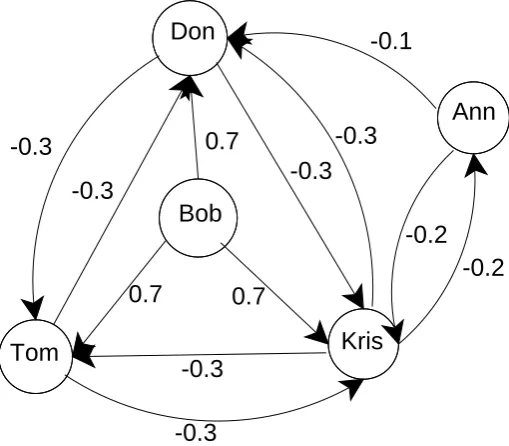
[image:32.595.189.444.71.294.2]-0.2 -0.2 -0.1
Figure 2.4: A case study of a WPIDS selection algorithm group model
through an intervention programme where participants selection is determined by the WPIDS Selection Algorithm is significantly higher by moderately considering the key persons’ positive effect and increasing the participation related cost.
2.6
Case Study
In this section we use a study group Fig. 2.4 to discuss the differences between WPIDS and PIDS selection algorithms. The study case is depicted in Fig. 2.4. The scenario undergraduates are picked from a computer science class1, where Bob is a tutor and other persons are non-positive students in a small e-learning group. Ann is a quiet and introverted girl who has limited influence on others. In Fig. 2.4, the arcs weight values are the same as in Fig. 2.3 and Ann has -0.1 influence value on Don. According to our WPIDS definition, Bob and Kris are a WPIDS. If we get rid of the arc’s weights and directions, Don and Kris are a PIDS according to its definition [27]. The difference between these two solutions is that the solution to WPIDS select Bob as one of the dominators and considers the fact Bob is a tutor which should be as a key person who plays an important role in the programme. But the solution to PIDS does not. Another difference is our graph model is directed. The influence of relationship between e-learners is different, whereas the influence between e-learners in PIDS model is uniform [27].
1From Faculty of Science, University of Southern Queensland, Australia. For privacy reasons,
2.7 Summary 21
2.6.1
Discussions
So from the Case Study of Fig. 2.4, we can see that the WPIDS in our model has some different real meanings from the PIDS [27]. One of our improvements is that we consider the reasonable partition of persons who attended the programme. Either in e-learning programme or drinking (smoking or drug use) intervention strategies and programmes we should consider the authorities’ effect such as tu-tors or correctional officers who have strong positive influence on other persons and without interference from others. In other words, they are the key persons who play important roles in the programme. For example, in the above Case Study Bob is a tutor who should be a key person and as one of the dominators in the programme. But the PIDS model has a different conclusion of the Case Study. Tom’s role is the same as Bob’s. Tom can be a replacement dominator of Bob in any solution. This does not meet the fact that Bob is a tutor whereas Tom is a student.
Due to Ann’s special situation, Kris should be selected into WPIDS to positively influence Ann instead of other persons. This solution shows the importance of effective directions. For example, the influence of relationship between tutors and students can be considered one-way. The fact is that the degree of influence between two persons is different and should be considered. Besides, our defini-tion of the dominating problem is more reasonable than that of PIDS since one person’s neighbours’ level of influence is the decisive factor instead of the number of one’s positive neighbours. So, in order to positively dominate the whole group we can strengthen influence on the key persons instead of increasing the number of positive persons. Through these discussions we can draw the conclusion our WPIDS model is more reasonable and effective than PIDS model [27].
2.7
Summary
In this chapter, we have introduced and studied the problem of how to utilize online social network as a medium to improve learners’ study performances in e-learning environments. We have proposed an innovative dominating set (WPIDS) and two WPIDS Selection Algorithms (Algorithms 2.1 and 2.2) to evaluate the effect of educating a subset of the entire target group susceptible to an e-learning issue. Our idea is one person’s neighbours’ level of influence is the decisive factor instead of the number of its positive neighbours. The experimental results have demonstrated that the WPIDS model and selection algorithms are more effective than the PIDS one [27, 28], especially to deal with the large social network cases. The main reason is that the WPIDS model considers the key persons who play important roles in the community. So the size of WPIDS is smaller than that of the PIDS one in an online social network. Moreover, the Case Study has further revealed that the WPIDS model and algorithms are more effective than those of the PIDS ones [27].
Chapter 3
Self-Stabilization and
K
-Dominating Set
In this chapter, the extension problem, “To find a self-stabilizing algorithm for the minimal 2-dominating set (M2DS) problem in general networks under the central daemon model” which was studied by Huang et al. [55, 68] is presented. In the past, the existing proposed self-stabilizing algorithms for the minimal k -dominating set (MKDS) either work for tree graphs (Kamei and Kakugawa [26]) or find an M2DS (Huang et al. [55, 68]). We have the motivation to extend the M2DS from 2 to general k (MKDS). We propose a self-stabilizing algorithm for the MKDS under a central daemon model when operating in any general network. We further prove that the worst case convergence time of the algorithm from any arbitrary initial state is O(n2) steps where n is the number of nodes in the network.
The information in this chapter is based on one published paper [71].
3.1
Introduction
In this chapter, we first discuss a classical approach for distributed systems: Self-stabilization, which was introduced by Dijkstra in [56, 57]. Self-stabilization is a paradigm for distributed systems that allows the system to achieve a desired global state, even in the presence of faults [56, 57]. It is an optimistic fault tolerance approach for distributed systems. Before introducing Self-Stabilization we first present the conception of distributed systems.
dis-tributed system, a global criterion for the global configuration is defined. Those global configurations satisfying the criterion are called legitimate configurations, whereas other global configurations are calledillegitimate configurations. A goal of a distributed system is that the system should function correctly in spite of intermittent faults. When the system is in a legitimate configuration, the purpose of the system is fulfilled. Ideally the global state of the system should remain in a legitimate state. Often, however, malfunctions or perturbations bring the system to some illegitimate state, and it is desirable that the system be automatically brought back to a legitimate state without the interference of an external agent.
A distributed system can be modeled as a simple undirected graph. The topology of a distributed system can be represented as an undirected graph G = (V, E) (called the system’s communication graph) with nodes set V and edges set E, where the nodes represent the processes and the edges represent the intercon-nections between the processes. Throughout this chapter, we denote by n the number of nodes ( |V| = n), and by m the number of edges (|E| = m) in the graph G. Let i ∈ V be a node; then N(i), its open neighbourhood, denotes the set of nodes to which i is adjacent. Every node j ∈ N(i) is called a neighbour of node i. We denote by d(i) the number of neighbours of node i, or its degree (d(i) =|N(i)|). Throughout this chapter we assumeG is connected and n >1.
3.2
Self-Stabilization
Self-stabilization can be used to solve the Dominating Set problem, which is introduced by Dijkstra [56, 57], is the most inclusive approach to fault toler-ance in distributed systems. According to Dijkstra’s work, a distributed system is self-stabilizing if it can start at any possible global configuration and regain consistency in a finite number of steps by itself without any external interven-tion and remains in a consistent state [56, 57]. After having been neglected for nearly a decade, Dijkstra’s work was drawn to public attention by Lamport in his invited address at PODC [87]. Since then, the research on self-stabilizing systems has flourished, and a great number of papers regarding self-stabilizing algorithms have been published. Recently, some self-stabilizing algorithms for Dominating Set, Independent Set, Colorings, and Matchings in graphs have been developed [54, 61, 64, 88].
In a self-stabilizing algorithm, each process maintains its local variables, and can make decisions based on the knowledge of its neighbours’ states. A process changes its local state by making amove (a change of local state). The algorithm is a set of rules of the form “if condition part (or guard)” then “action part”. The condition part (or guard) is a Boolean function over the states of the process and its neighbours; the action part is an assignment of values to some of the process’s shared registers. A process i becomes privileged if it’s condition is true. When a process becomes privileged, it may execute the corresponding move.
3.2 Self-Stabilization 25
self-stabilizing if, when the system executes the algorithm,
(i) for any initial illegitimate state it reaches a legitimate state after a finite number of node moves (convergence), and
(ii) for any legitimate state and for any move allowed by that state, the next state is a legitimate state (closure).
The convergence property ensures that, starting from any incorrect state, the distributed system reaches a correct state. The closure property ensures that, after convergence, the system remains in the set of correct states.
Various execution models have been suggested for developing self-stabilizing al-gorithms. These models are encapsulated within the notion of a daemon (or scheduler). Daemons are one of the most central yet less understood concepts in self-stabilization. Most of these papers adopt Dijkstra’s computational model, which is generally referred to as the central daemon model [56, 89, 90]. Under a
central daemon, only one process can execute an atomic step at one time. In a
central daemon, we assume a serial model in which no two processes move simul-taneously. If two or more processes are privileged, one cannot predict which one will move next. Multiple protocols exist [58, 91, 92] that provide such a scheduler.
Another popular scheduler is the distributed daemon, which selects a subset of the system processes to execute an atomic step at the same time. Thedistributed daemon activates the processors by repeatedly selecting a set of processors and activating them simultaneously to execute a computation step. Each processor executes the next computation step as defined by its state just prior to this activation. Once every processor in the set has finished reading, all the processors write a new state (change state). Only then does the scheduler choose a new set of processors to be activated. Note that no non-activated processor changes its state. Thus if a system is self-stabilizing under the distributed daemon model, then it is self-stabilizing under the central daemon model. The converse, however, is not true (the total Dominating Set algorithm in [58] and the 2-Dominating Set algorithm in [55] are self-stabilizing under the central daemon models, but not under the distributed daemon models).
If a synchronous daemon is supposed, then all the system processes will execute an atomic step at the same time. The synchronous daemon plays a very important part in the self-stabilization literature. First introduced by Herman [93] to enable analytical tractability of probabilistic self-stabilizing protocols, it was later used in domination problems [94, 95].
Thestabilization time is the maximum amount of time it takes for the system to reach a correct state. When estimating the time complexity of a self-stabilizing algorithm, we consider the stabilization time, since a self-stabilizing algorithm is usually a do forever loop and it does not terminate. The time complexity is estimated in terms ofprocess atomic steps (or simplysteps), or in terms ofrounds. Around is usually defined to be the minimum time period in which every process is scheduled to execute an action at least once.
a
a
a
a
a
a
1 2 3
[image:38.595.167.470.69.213.2]4 5 6
Figure 3.1: A M2DS example
then the algorithm issemi-uniform. Some algorithms are designed foranonymous
systems, where the processes do not have any identification [71,96], whereas other algorithms assume that processes have globally unique identifiers [55,58,68,70,73].
3.3
K
-Dominating Set Problem
The k-dominating set (KDS) was introduced by Fink and Jacobson in 1985 [97]. Jacobson and Peters showed that the k-domination problem is NP-complete for general graphs [98].
The KDS has many practical applications. For example, to build some fire sta-tions in an urban area with a limited budget we need to ensure that its six areas can receive help from at leastk times services from its neighbour areas. Assume there is also a fixed cost for building a fire station in each area. The problem can be interpreted as to determine the number of the fire stations such that the total building cost is minimum among the participating areas under the k times ser-vices condition. This problem is equivalent to the problem of finding a minimum weighted KDS among these areas. The following is the formal definition of KDS problem.
Let G = (V, E) be a simple