HIV-1 Core
Yang Yang, Thomas Fricke, Felipe Diaz-Griffero
Department of Microbiology and Immunology, Albert Einstein College of Medicine, Bronx, New York, USA
Previous studies showed that HIV-1 reverse transcription occurs during or before uncoating, linking mechanistically reverse
transcription with uncoating. Here we show that inhibition of reverse transcriptase (RT) during HIV-1 infection by
pharmaco-logic or genetic means increased the stability of the HIV-1 core during infection. Interestingly, HIV-1 particles with increased
core stability were resistant to the core-destabilizing effects of rhesus TRIM5
␣
(TRIM5
␣
rh). Collectively, this work implies that
the surface of the HIV-1 core is dynamic and changes upon the ongoing processes within the core.
U
ncoating is the shedding of monomeric capsids from the
ret-roviral core. Since only
⬃
40% of the total capsid in the virion
comprises retroviral core (
1
,
2
), a simplified view of uncoating is
that the monomeric capsid is in dynamic equilibrium with the
assembled capsid (viral core). This implies that the core may exist
in a metastable state only in the presence of a high concentration
of soluble capsid, keeping the equilibrium shifted toward core
formation by mass action; however, the fact that complexes
con-taining capsid have been detected in the cytoplasm implies that
cellular factors may be involved in stabilization of the core (
3
–
5
).
In agreement, elegant experiments have shown that isolated cores
undergo reverse transcription more efficiently in the presence of
cellular extracts, suggesting the requirement for cellular factors for
reverse transcription and uncoating (
5
–
7
).
Cumulative evidence suggests that reverse transcription occurs
before or during uncoating: (i) TRIM5
␣
blocks HIV-1 reverse
transcription by destabilizing the core (
8
–
10
); (ii) HIV-1 cores
without Vif, Vpr, or Nef exhibit low stability and a defect in
re-verse transcription (
11
); (iii) TRIM5
␣
mutations that block
HIV-1 infection but have lost the ability to block reverse
transcrip-tion are unable to accelerate uncoating (
12
); (iv) use of
protea-some inhibitors during HIV-1 infection increases the stability of
the core and augments reverse transcription (
8
,
13
); and (v)
dif-ferent assays measuring infection of HIV-1 as a surrogate for
un-coating suggest that HIV-1 unun-coating happens before the
comple-tion of reverse transcripcomple-tion (
14
–
16
). Overall, this evidence
suggests that reverse transcription is mechanistically linked to the
uncoating process of HIV-1.
Effect of RT inhibitors on HIV-1 core stability.
To test the
effect of viral reverse transcriptase (RT) activity on the stability of
the HIV-1 core during infection, we used the fate of the capsid
(FOC) assay (
8
–
10
,
17
–
19
). The FOC assay discriminates
pellet-able from soluble capsids during infection and allows for the
quantification of pelletable capsids or HIV-1 cores, which is a
direct measure of core stability. Cf2Th cells containing the empty
vector LPCX were first challenged with increasing amounts of
HIV-1 green fluorescent protein-expressing (GFP-reporter) virus
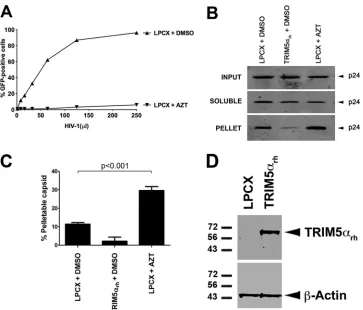
in the presence of azidothymidine (AZT), and the degree of
infec-tion was assessed by measuring the percentage of GFP-positive
cells by flow cytometry. As previously shown (
20
), AZT potently
blocked HIV-1 infectivity compared to controls treated with
di-methyl sulfoxide (DMSO) (
Fig. 1A
). We then examined the effect
of AZT on stability of the HIV-1 core. For this purpose, we
in-fected LPCX-transduced cells with HIV-1 in the presence of AZT
for 16 h and performed a FOC assay on the infected cells (
Fig. 1B
).
Interestingly, the amount of pelletable HIV-1 capsid increased
3-fold by the use of an RT inhibitor compared to DMSO-treated
cells (
Fig. 1B
and
C
). As a positive control, we challenged Cf2Th
cells stably expressing rhesus TRIM5
␣
(TRIM5
␣
rh) (
Fig. 1D
) with
HIV-1 GFP-reporter for the same length of time. TRIM5
␣
rhde-stabilizes the HIV-1 core by reducing the amount of pelletable
capsids during infection (
8
,
10
). As expected, TRIM5
␣
rhseverely
decreased the amount of HIV-1 pelletable capsids during
infec-tion (
Fig. 1B
and
C
). Overall these results suggested that inhibition
of RT by AZT increases the amount of pelletable HIV-1 capsids
during infection.
Effects of RT mutants on HIV-1 core stability.
Because AZT
increases core stability during infection, we hypothesized that HIV-1
viruses bearing mutations in the active site of RT exhibit more stable
cores. To test this hypothesis, we used the FOC assay to examine the
stability of the HIV-1 core with a D185N mutation in the RT active
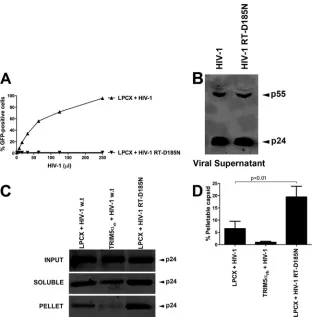
site. As expected, this mutation allows production of particles that
are not infectious (
Fig. 2A
) (
21
); however, HIV-1 D185N particles
were mature, as determined by Gag processing (
Fig. 2B
) (
22
).
Subse-quently, the effect of RT mutations on the stability of the HIV-1 core
was analyzed by the FOC assay (
Fig. 2C
and
D
). For this purpose,
Cf2Th cells containing the empty vector LPCX were challenged for 16
h with similar amounts of wild-type and mutant viruses normalized
by p24 enzyme-linked immunosorbent assay (ELISA). Analysis of
soluble and pelletable capsids by the FOC assay revealed that HIV-1
D185N was more stable than wild-type HIV-1 (
Fig. 2C
and
D
). As a
control, TRIM5
␣
rhdestabilized the HIV-1 core during infection (
Fig.
2C
and
D
). These results demonstrated that inhibition of reverse
transcription resulted in an increase of pelletable HIV-1 capsid
dur-ing infection.
Ability of TRIM5
␣
to destabilize an HIV-1 core bearing a
mutated RT.
The ability of TRIM5
␣
rhto restrict infection correlates
Received16 May 2012Accepted7 October 2012
Published ahead of print17 October 2012
Address correspondence to Felipe Diaz-Griffero, Felipe.Diaz-Griffero @einstein.yu.edu.
Copyright © 2013, American Society for Microbiology. All Rights Reserved.
doi:10.1128/JVI.01228-12
on November 7, 2019 by guest
http://jvi.asm.org/
with destabilization of the HIV-1 core (
8
,
10
). To test whether the
stability gained by the core in our HIV-1 RT D185N mutant could
overcome the destabilization induced by TRIM5
␣
rh, we challenged
cells expressing TRIM5
␣
rhwith wild-type and mutant HIV-1
vi-ruses normalized by p24 ELISA. At 16 h postinfection, we
sepa-rated soluble from pelletable capsids by the FOC assay (
Fig. 3A
and
B
). Consistent with our hypothesis, the HIV-1 RT D185N
mutant showed an increase of pelletable capsids in the presence of
TRIM5
␣
rhcompared to wild-type HIV-1 (
Fig. 3A
and
B
).
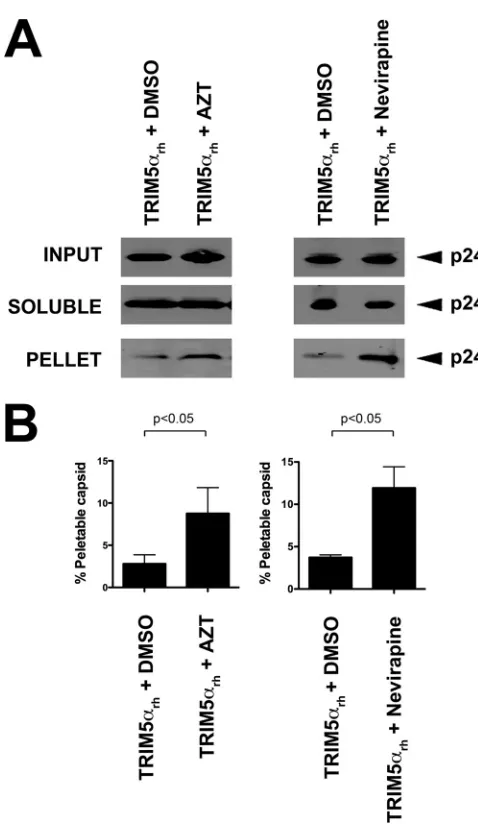
Simi-larly, we found that AZT and nevirapine inhibit the ability of
TRIM5
␣
rhto decrease the amount of pelletable capsids during
infection (
Fig. 4A
and
B
). Altogether, these experiments suggested
that RT activity within the HIV-1 core is required for the ability of
TRIM5
␣
rhto accelerate uncoating.
These results showed that mutations or drugs that disrupted
RT activity increased the amount of particulate HIV-1 capsid by
2-to 3-fold, which is in agreement with previous findings (
12
,
14
–
16
). An attractive hypothesis that arises from these findings is that
the enzymatic activity of RT, which involves conformational
changes during synthesis of viral DNA (
6
), induces the
reorgani-zation of core components in some way that facilitates shedding of
monomeric capsids. This effect could be achieved by triggering
dissociation of putative stabilizing factors from the surface of the
core. In addition, the DNA is a less flexible molecule than RNA, so
it is likely that DNA will require more space inside the core. The
synthesis of DNA inside the core will probably require more space
and will end up rearranging the entire core structure.
In the first hours of infection, while the reverse transcription
complex is forming, the viral core undergoes enlargement (
4
,
23
,
24
), which is likely to be due to acquisition of host cell proteins.
One possibility is that RT activity facilitates recruitment of factors
that can trigger uncoating of the virus (
6
,
25
). This notion is in
agreement with recent findings of second-site suppressor
muta-tions that rescue virus infection without restoring capsid stability
(
3
,
26
); these mutants might be gaining the ability to better recruit
host factors that are required for reverse transcription. In contrast,
the absence of RT activity might be preventing the normal
initia-tion of uncoating.
The result that the HIV-1 RT D185N mutant was resistant to
the core-destabilizing effects of TRIM5
␣
rhimplies that the RT
FIG 1Effects of reverse transcriptase inhibitors on HIV-1 core stability.(A) Cf2Th cells transduced with the empty vector LPCX were challenged with increasing amounts of HIV-1 GFP-reporter virus (800 pg/ml of p24) in the presence of AZT. As a control, LPCX-transduced cells were challenged in the presence of DMSO, the solvent used to resuspend the RT inhibitors. GFP-positive cells were quantified by flow cytometry. (B) LPCX-transduced Cf2Th cells in the presence of AZT or DMSO were challenged with similar amounts of HIV-1 GFP-reporter, and the amount of soluble versus particulate capsid was determined by the FOC assay. As control, we used the same amount of HIV-1 GFP-reporter to perform the FOC assay in Cf2Th cells stably expressing TRIM5␣rh, which is expressed from the
LPCX vector. Briefly, cells were incubated with HIV-1 GFP-reporter at 4°C for 30 min, washed, and returned to 37°C. Infection was allowed to proceed for 16 h. Cell extracts were fractionated on a sucrose cushion. Input, soluble, and pellet fractions were analyzed by Western blotting using antibodies against the HIV-1 p24 capsid protein. (C) The percentage of pelletable HIV-1 capsid was determined with respect to the amount of total input capsid. Similar results were obtained in three independent experiments, and standard deviations are shown. Statistical differences are given asP⬍0.001 (two-way analysis of variance [ANOVA] followed by the Bonferroni posttest). (D) Cf2Th cells stably transduced with TRIM5␣rhand selected in puromycin were analyzed for TRIM5␣rh-hemagglutinin
(HA) expression by Western blotting using anti-HA antibodies. The loading control was performed using anti--actin antibodies.
on November 7, 2019 by guest
http://jvi.asm.org/
[image:2.585.112.475.63.373.2]FIG 2Effects of RT mutants on stability of the HIV-1 core. (A) Cf2Th cells transduced with the empty vector LPCX were challenged with the indicated HIV-1-GFP reporter viruses normalized by ELISA against p24 (800 pg/ml of p24). To study the effect of reverse transcription on core stability, we challenged cells with an HIV-1 strain bearing a mutation in the active site of the RT enzyme (HIV-1 RT D185N). Forty-eight hours postinfection, GFP-positive cells were quantified by flow cytometry. (B) Because the HIV-1 RT D185N mutant is not infectious, Gag-processing levels in viral supernatants were evaluated by Western blotting using antibodies against p24. (C) LPCX-transduced Cf2Th cells were challenged with similar amounts of the indicated HIV-1 GFP-reporter viruses, and the amount of soluble versus particulate capsid was determined by FOC assay. As a control, we used the same amount of wild-type HIV-1 GFP-reporter virus to perform the FOC assay in Cf2Th cells stably expressing TRIM5␣rh, which is expressed from the LPCX vector. Briefly, cells were incubated with the indicated
viruses at 4°C for 30 min, washed, and returned to 37°C. Infection was allowed to proceed for 16 h. Cell extracts were fractionated on a sucrose cushion. Input, soluble, and pellet fractions were analyzed by Western blotting using antibodies against the HIV-1 p24 capsid protein. (D) The percentage of pelletable HIV-1 capsid was determined with respect to the amount of total input capsid. Similar results were obtained in three independent experiments, and standard deviations are shown. Statistical differences are given asP⬍0.01 (two-way ANOVA followed by the Bonferroni posttest).
FIG 3The core-stabilizing HIV-1 RT mutant is resistant to the destabilizing effects of TRIM5␣rh. (A) Cf2Th cells transduced with the empty vector LPCX or expressing
TRIM5␣rhwere challenged with the indicated HIV-1 GFP-reporter viruses normalized by ELISA against p24. The amount of soluble versus particulate capsid was
determined by FOC assay. Briefly, cells were incubated with the indicated viruses at 4°C for 30 min, washed, and returned to 37°C. Infection was allowed to proceed for 16 h. Cell extracts were fractionated on a sucrose cushion. Input, soluble, and pellet fractions were analyzed by Western blotting using antibodies against HIV-1 p24 capsid protein. (B) The percentage of pelletable HIV-1 capsid was determined with respect to input capsid. Similar results were obtained in three independent experiments, and standard deviations are shown. Statistical differences are given asP⬍0.001 (two-way ANOVA followed by the Bonferroni posttest).
on November 7, 2019 by guest
http://jvi.asm.org/
[image:3.585.136.451.64.381.2] [image:3.585.136.448.506.665.2]activity has a role in the ability of TRIM5
␣
rhto destabilize the core.
As suggested above, RT activity within the core might be triggering
a conformational change on the surface of the core that allows
binding and destabilization by TRIM5
␣
rh. Previous experiments
have demonstrated that an RT-defective HIV-1 abrogates the
re-striction imposed by TRIM5
␣
rhto a similar degree as wild-type
virus (
27
); this suggested that the core from the RT-defective
HIV-1 particle is still interacting with TRIM5
␣
rh. A feasible
hy-pothesis is that RT activity triggers dissociation of core-stabilizing
factors, which makes the HIV-1 core more susceptible to the
ef-fects of TRIM5
␣
rh.
Overall, these findings are in agreement with the hypothesis
that the surface of the core is dynamic and could expose and hide
protein domains, depending upon changes within or outside the
core, as shown for other viruses (
28
,
29
). The process of exposing
and hiding domains on the surface of the core creates a
commu-nication system between the core and its environment, and this
communication could be important for the core to sense the
ap-propriate place and time to undergo uncoating.
ACKNOWLEDGMENTS
We thank Andre Rosowsky for critical reading of the manuscript. We also thank Steve Goff for providing reagents. Azidothymidine was obtained through the NIH AIDS Research and Reference Reagent Program, Divi-sion of AIDS, NIAID, NIH.
This work was funded by NIH grant R01 AI087390 to F.D.-G. and a K99/R00 Pathway to Independence Award (4R00MH086162-02) to F.D.-G. from the National Institutes of Health.
REFERENCES
1.Briggs JA, Simon MN, Gross I, Krausslich HG, Fuller SD, Vogt VM, Johnson MC.2004. The stoichiometry of Gag protein in HIV-1. Nat. Struct. Mol. Biol.11:672– 675.
2.Briggs JA, Wilk T, Welker R, Krausslich HG, Fuller SD.2003. Structural organization of authentic, mature HIV-1 virions and cores. EMBO J.22: 1707–1715.
3.Forshey BM, von Schwedler U, Sundquist WI, Aiken C.2002. Forma-tion of a human immunodeficiency virus type 1 core of optimal stability is crucial for viral replication. J. Virol.76:5667–5677.
4.McDonald D, Vodicka MA, Lucero G, Svitkina TM, Borisy GG, Emer-man M, Hope TJ.2002. Visualization of the intracellular behavior of HIV in living cells. J. Cell Biol.159:441– 452.
5.Warrilow D, Meredith L, Davis A, Burrell C, Li P, Harrich D.2008. Cell factors stimulate human immunodeficiency virus type 1 reverse transcrip-tion in vitro. J. Virol.82:1425–1437.
6.Warren K, Warrilow D, Meredith L, Harrich D.2009. Reverse trans-criptase and cellular factors: regulators of HIV-1 reverse transcription. Viruses1:873– 894.
7.Warrilow D, Warren K, Harrich D.2010. Strand transfer and elongation of HIV-1 reverse transcription is facilitated by cell factors in vitro. PLoS One5:e13229. doi:10.1371/journal.pone.0013229.
8.Diaz-Griffero F, Kar A, Lee M, Stremlau M, Poeschla E, Sodroski J. 2007. Comparative requirements for the restriction of retrovirus infection by TRIM5alpha and TRIMCyp. Virology369:400 – 410.
9.Perron MJ, Stremlau M, Lee M, Javanbakht H, Song B, Sodroski J. 2007. The human TRIM5alpha restriction factor mediates accelerated un-coating of the N-tropic murine leukemia virus capsid. J. Virol.81:2138 – 2148.
10. Stremlau M, Perron M, Lee M, Li Y, Song B, Javanbakht H, Diaz-Griffero F, Anderson DJ, Sundquist WI, Sodroski J. 2006. Specific recognition and accelerated uncoating of retroviral capsids by the TRIM5alpha restriction factor. Proc. Natl. Acad. Sci. U. S. A.103:5514 – 5519.
11. Ohagen A, Gabuzda D.2000. Role of Vif in stability of the human im-munodeficiency virus type 1 core. J. Virol.74:11055–11066.
12. Roa A, Hayashi F, Yang Y, Lienlaf M, Zhou J, Shi J, Watanabe S, Kigawa T, Yokoyama S, Aiken C, Diaz-Griffero F.2011. RING domain muta-tions uncouple TRIM5alpha restriction of HIV-1 from inhibition of re-verse transcription and acceleration of uncoating. J. Virol.86:1717–1727. 13. Diaz-Griffero F, Perron M, McGee-Estrada K, Hanna R, Maillard PV, Trono D, Sodroski J.2008. A human TRIM5alpha B30.2/SPRY domain mutant gains the ability to restrict and prematurely uncoat B-tropic mu-rine leukemia virus. Virology378:233–242.
14. Arfi V, Lienard J, Nguyen XN, Berger G, Rigal D, Darlix JL, Cimarelli A.2009. Characterization of the behavior of functional viral genomes during the early steps of human immunodeficiency virus type 1 infection. J. Virol.83:7524 –7535.
15. Berger G, Durand S, Fargier G, Nguyen XN, Cordeil S, Bouaziz S, FIG 4The use of AZT and nevirapine prevents the core-destabilizing effects of
TRIM5␣rh.(A) Cf2Th cells stably transduced with TRIM5␣rhwere challenged
with the indicated HIV-1 GFP-reporter viruses, normalized by ELISA against p24, in the presence of AZT and nevirapine. The amount of soluble versus particulate capsid was determined by FOC assay. Briefly, cells were incubated with the indicated viruses at 4°C for 30 min, washed, and returned to 37°C. Infection was allowed to proceed for 16 h. Cell extracts were fractionated on a sucrose cushion. Input, soluble, and pellet fractions were analyzed by Western blotting using antibodies against HIV-1 p24 capsid protein. (B) The percent-age of pelletable HIV-1 capsid was determined with respect to input capsid. Similar results were obtained in three independent experiments, and standard deviations are shown. Statistical differences are given asP⬍0.05 (two-way ANOVA followed by the Bonferroni posttest).
on November 7, 2019 by guest
http://jvi.asm.org/
[image:4.585.41.280.59.471.2]Muriaux D, Darlix JL, Cimarelli A.2011. APOBEC3A is a specific inhib-itor of the early phases of HIV-1 infection in myeloid cells. PLoS Pathog. 7:e1002221. doi:10.1371/journal.ppat.1002221.
16. Hulme AE, Perez O, Hope TJ.2011. Complementary assays reveal a relationship between HIV-1 uncoating and reverse transcription. Proc. Natl. Acad. Sci. U. S. A.108:9975–9980.
17. Berube J, Bouchard A, Berthoux L.2007. Both TRIM5alpha and TRIMCyp have only weak antiviral activity in canine D17 cells. Retrovirology4:68. doi: 10.1186/1742-4690-4-68.
18. Ohkura S, Goldstone DC, Yap MW, Holden-Dye K, Taylor IA, Stoye JP.2011. Novel escape mutants suggest an extensive TRIM5alpha binding site spanning the entire outer surface of the murine leukemia virus capsid protein. PLoS Pathog.7:e1002011. doi:10.1371/journal.ppat.1002011. 19. Shi J, Zhou J, Shah VB, Aiken C, Whitby K.2011. Small-molecule
inhibition of human immunodeficiency virus type 1 infection by virus capsid destabilization. J. Virol.85:542–549.
20. D’Andrea G, Brisdelli F, Bozzi A.2008. AZT: an old drug with new perspectives. Curr. Clin. Pharmacol.3:20 –37.
21. Mulky A, Sarafianos SG, Arnold E, Wu X, Kappes JC.2004. Subunit-specific analysis of the human immunodeficiency virus type 1 reverse transcriptase in vivo. J. Virol.78:7089 –7096.
22. Bukrinskaya AG.2004. HIV-1 assembly and maturation. Arch. Virol. 149:1067–1082.
23. Fassati A, Goff SP.2001. Characterization of intracellular reverse tran-scription complexes of human immunodeficiency virus type 1. J. Virol. 75:3626 –3635.
24. Warrilow D, Harrich D.2007. HIV-1 replication from after cell entry to the nuclear periphery. Curr. HIV Res.5:293–299.
25. Warrilow D, Tachedjian G, Harrich D.2009. Maturation of the HIV reverse transcription complex: putting the jigsaw together. Rev. Med. Vi-rol.19:324 –337.
26. Yang R, Shi J, Byeon IJ, Ahn J, Sheehan JH, Meiler J, Gronenborn AM, Aiken C.2012. Second-site suppressors of HIV-1 capsid mutations: res-toration of intracellular activities without correction of intrinsic capsid stability defects. Retrovirology9:30. doi:10.1186/1742-4690-9-30. 27. Besnier C, Takeuchi Y, Towers G. 2002. Restriction of lentivirus in
monkeys. Proc. Natl. Acad. Sci. U. S. A.99:11920 –11925.
28. Bothner B, Dong XF, Bibbs L, Johnson JE, Siuzdak G.1998. Evidence of viral capsid dynamics using limited proteolysis and mass spectrometry. J. Biol. Chem.273:673– 676.
29. Hilmer JK, Zlotnick A, Bothner B.2008. Conformational equilibria and rates of localized motion within hepatitis B virus capsids. J. Mol. Biol. 375:581–594.
on November 7, 2019 by guest
http://jvi.asm.org/