and Technology copyright © 2013 (American Society for Information Science and Technology)
Modeling Users’ Web Search Behavior and their Cognitive
Styles
Khamsum Kinley, Dian Tjondronegoro, Helen Partridge, and Sylvia Edwards
Information Systems School, Science and Engineering Faculty, Queensland University of Technology, GPO Box 2434, Brisbane QLD 4001, Australia. E-mail: [email protected]; {dian, h.partridge, s.edwards}@qut.edu.au
Previous studies have shown that users’ cognitive styles play an important role during Web searching. However, only limited studies have showed the relationship between cognitive styles and Web search behavior. Most importantly, it is not clear which components of Web search behavior are influenced by cognitive styles. This paper examines the relationships between users’ cognitive styles and their Web searching and develops a model that portrays the relationship. The study uses qualitative and quantitative analyses to inform the study results based on data gathered from 50 participants. A questionnaire was utilized to collect participants’ demographic information, and Riding’s (1991) Cognitive Style Analysis (CSA) test to assess their cognitive styles. Results show that users’ cognitive styles influenced their information searching strategies, query reformulation behavior, Web navigational styles and information processing approaches. The user model developed in this study depicts the fundamental relationships between users’ Web search behavior and their cognitive styles. Modeling Web search behavior with a greater understanding of user’s cognitive styles can help information science researchers and information systems designers to bridge the semantic gap between the user and the systems. Implications of the research for theory and practice, and future work are discussed.
Introduction
The Web has become an integral part of people’s life as a main source of information for all types of users. Students, professionals, academics and researchers search the Web daily to perform information retrieval tasks and satisfy their information needs. As a result, Web search behavior has become an emerging topic for both information science researchers and information systems (IS) developers.
Information researchers explore factors that influence users’ Web searching experience, such as demographic, information needs, perceptions, prior Web search experience, and individual differences (examples: Ellis, 1993; Ingwersen, 1996; Saracevic, 1997; Weber & Jaimes, 2011). Information systems developers and search engine designers gather information about user behavior and user intent in order to provide more relevant content to users or to build models for online businesses (Ortiz-Cordova & Jansen, 2012). One of the important factors that influence users’ Web searching is that of users’ cognitive style, which is currently under researched in information science.
Cognitive style can be defined as “an individual’s preferred and habitual approach to organize and represent information” (Riding & Rayner, 1998, p. 8). Each individual has a unique cognitive style (Felder & Spurlin, 2005). It affects the ways in which events and ideas are viewed, how an individual may think, react to, represent situations, and make decisions (Riding & Rayner, 1998, p. 118), and the way they perform tasks and retrieve information (Chen & Liu, 2009).
While many studies have explored Web searching and developed models of information behavior (IB), limited studies have developed Web search models that support users’ cognitive styles and Web searching process. It is equally important to develop models that show the impact of users’ cognitive styles on their Web search behavior. Modeling Web search behavior and users’ cognitive styles can help to bridge the semantic gap between information users and IS.
Given the importance of users’ cognitive styles in Web searching, and the scarcity of the research investigating it, this research examines the influence of users’ cognitive styles on their Web search behavior and develops a model that shows the inter-relationships between them. The main goal of the study is to enhance Web search models with a better understanding of how users’ cognitive styles affect Web searching.
and Technology copyright © 2013 (American Society for Information Science and Technology)
Related WorkThe key related works in this section are focused on user modeling, including theories and models on information behavior and Web search behavior; cognitive styles, including cognitive style framework adopted in this study; and current studies examining relationships of cognitive styles and Web searching.
User Modeling
User modeling can be defined as a process of customizing and adapting systems to a user’s needs. User modeling is derived from the need and desire to provide better support for human-computer collaboration (Fischer, 2001). Human-computer collaboration can be approached from two different perspectives - emulation approach and complementing approach. The emulation approach is based on the metaphor that to improve human-computer collaboration is to endow computers with human-like abilities, while complementing approach is based on the fact that computers are not human and that human-centered design should exploit the asymmetry of human and computer by developing new interaction and collaboration possibilities (Fischer, 2001, p. 66). Frias-Martinex, et al. (2005) associate user modeling with a personalization of information and services to satisfy an individual’s goal and needs. The more information a user model has, the better the content and presentation will be personalized.
In the context of this paper, user modeling can be considered as a process of illustrating and recording of interactions between users and Web search engines during information searching. There has been a considerable recent interest in producing conceptual models for information retrieval (IR) research (examples: Belkin, 1996; Ellis, 1993; Ford, 2004; Ingwersen, 1996; Knight & Spink, 2008; Wilson, 1981).
Wilson (1981) presented a model for examining seeking behavior. The model suggested that information-seeking behavior arises as a result of the information needs of an information user, and that this relationship between the user and the information need is affected by the so-called ‘information environment’. Wilson’s model included three main components: information user, information need, and information environment. Although the model sheds some insights into information-seeking behavior, all the hypotheses were only implicit, not made explicit. For example, it was assumed that the ‘information environment’ barrier would have similar effects on the information need and therefore would have similar effects on the information seeking behavior.
Ingwersen (1996) proposed a global cognitive model of IR interaction from a cognitive point of view based on the concept of polyrepresentation. The concept of polyrepresentation refers to user’s cognitive space, and methods of representation of the information objects in the information space. The model has three main components: information objects (such as text, pictures and models), the intermediary (cognitive space and social environment) and the information space (information needs) of the IR system. Different cognitive structures of the individual users, which may end up in a problem or uncertainty state, influence not only the authors of texts and systems design attitudes but also the current searcher in a ‘historical social-semantic sense’. Ingwersen believes that the functions of each of these components are the results of cognitive models of the domain of interest.
Sutcliffe and Ennis (1998) proposed a user model of information searching activities and knowledge sources in which query formulations and reformulations were identified as part of the core component of the model. They argued that query formulation/reformulation is one of the main activities performed in a retrieval process. They reported that the complexity of query formulation depends on the complexity of the IR system and the user’s skill in generating queries. Complex queries can be formed if the user is skilled in query languages, such as Boolean and structured query language (SQL), where the information need is transformed into keywords and query syntax, which are employed by IR systems.
The aforementioned studies show that there has not much work done in developing a user model that incorporates user’s cognitive styles.
Users’ Cognitive Styles
One of the most important factors that affect users’ interactions with the search engines is that of their cognitive styles. In order to understand its application in the current study, this section discusses the concept of cognitive styles and its related measuring tools. In the later section, this paper reviews the limitations of studies that have explored the relationships between users’ cognitive styles and Web search.
and Technology copyright © 2013 (American Society for Information Science and Technology)
to investigate and assess individual cognitive styles, such as Revised Approaches to Studying Inventory (Tait, Entwistle, & McCune, 1998), Group Embedded Figures Test (Witkin, Oltman, Raskin, & Karp, 1971), Cognitive Style Index (Allinson & Hayes, 1996), Verbal-Imagery Code Test (Riding & Calvey, 1981) and Cognitive Style Analysis test (Riding, 1991). In this study, cognitive style is defined as “an individual’s preferred and habitual approach to organizing, perceiving, remembering, and representing information” (Riding & Rayner, 1998, p. 8).
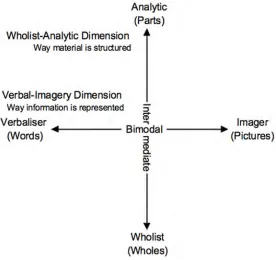
Between 1940s and 1980s, many researchers have developed their own theories and instruments to assess cognitive styles. This led to the development of a large number and a wide variety of cognitive style labels, theories and models. Riding and Cheema (1991) grouped the cognitive dimensions into two principal cognitive dimensions: the wholist-analytic (WA) and the verbal-imagery (VI) style dimensions. The two dimensions of cognitive styles are illustrated in Figure 1. While the vertical axis represents WA dimension, the horizontal axis represents the VI dimension of cognitive style.
Wholist-Analytic Dimensions of Cognitive Styles: The wholist-analytic (WA) dimension of cognitive styles describes the habitual way in which people think about, view and structure information in wholes or parts. The concept of WA emerged from the work of Pask’s (1976) holists-serialists dimension of cognitive styles, and that of Witkin’s field dependence-independence cognitive styles (Witkin & Goodenough, 1981; Witkin, et al., 1977). The WA dimension of cognitive styles affects the ways in which individuals learn and organize information. Based on their position on the WA dimension, as illustrated in Figure 1 by the vertical axis, people can be classified as wholists, analytics, or intermediates. Some of the characteristics of wholists, analytics and intermediates are outlined below.
Wholists tend to see a situation as a whole ‘picture’ (Riding, 1997), to retain a global or overall view of the information, and to view ideas as complete wholes. Wholists can have a balanced view and see situations in their overall context. They are better at structuring and analyzing, and benefit more than analytics from external mediation, and from structuring in problem solving and learning. Analytics see a situation as a collection of parts and focus on one or two aspects of the situation at a time. They learn and structure information or concepts in parts and analyze a situation and apprehend ideas in the parts. They are good at seeing similarities, detecting differences, and providing their own structuring in intellectual activity. Intermediates lie between the mean position of wholists and analytics. They tend to have a range of both the wholist and analytic characteristics.
Verbal–Imagery (VI) Dimension of Cognitive Styles: The verbal-imagery (VI) dimension of cognitive styles describes an individual’s tendency to process information either in words (verbal) or mental pictures (verbal mode of representation and thinking) (Riding & Cheema, 1991). If a person reads a novel, he or she can represent the actions and scenes in terms of word associations or by constructing a mental picture of what is read. Based on the position on the VI dimension, as illustrated in Figure 1 by the horizontal axis, people can be classified as verbalisers, imagers or bimodals. Some of the characteristics of verbalisers, imagers and bimodals are outlined below.
[image:3.612.56.332.72.332.2]Verbalisers are individuals who think in terms of words and consider the information they read, see or listen to, in words or verbal associations. They prefer and perform best on verbal tasks, tend to have a good verbal memory, and are verbally articulate and fluent compared with imagers. Imagers are individuals who think in terms of mental pictures. When they read or listen, they retain the information in mental pictures either of the representations of the information itself or of associations with it. They are good at writing, and at working with visual, spatial and pictorial information. They perform best on concrete, descriptive, and imaginable tasks, and find concrete and readily visualized information easier than semantically and acoustically complex details. Bimodals fall in between the extremes of verbaliser and imager, and tend to have the
and Technology copyright © 2013 (American Society for Information Science and Technology)
characteristics of both. That is, individuals who score in the middle range of the verbal-imager dimension are deemed to be bimodal.
In this study, Riding and Cheema’s (1991) framework of cognitive styles was adapted and Riding’s (1991) Cognitive Styles Analysis (CSA) test was used to measure participants’ cognitive styles. The CSA test was specifically chosen based on the following arguments:
• The CSA test is relatively new compared to the Embedded Figure Test (Thurstone, 1944) or the Verbaliser-Visualiser Questionnaire (Richardson, 1977);
• The CSA test has been shown to have good reliability and validity by a good number of studies that have used the test (examples includes: Ford, Eaglestone, Madden, & Whittle, 2009; Ford, Miller, & Moss, 2001; Frias-Martinez, Chen, & Liu, 2008);
• CSA assesses both ends of the style dimensions (i.e. WA and VI cognitive style dimensions); and
• CSA test is a computer-administered test, which often makes it more attractive to participants and also makes data collection easier for researchers.
Current studies exploring relationships between Web search and cognitive styles
A number of studies have been conducted to explore cognitive styles among different information and Web users. During web searching, field-dependent (wholist) users were found utilizing only basic search option combined with author/title/periodical (Frias-Martinez, et al., 2008). Intermediate users utilized both basic and advance options with author/title/periodical, and word and phrase search options. On the other hand, field-independent (analytic) users utilized the basic search option as the main search option and relied more on author/title/periodical than on word or phrase. The study also indicated that intermediate users and verbalisers have positive perceptions towards the Brunel library catalogue. The authors believed that such positive perception may be the reason why intermediate users and verbalisers completed the tasks in effective ways, as indicated by less time spent and fewer transactions completed.
Kim and Allen (2002) studied the impact of differences in users’ cognition and search tasks on Web search activities and outcomes. Their study was designed to address how individual cognitive characteristics, such as cognitive ability, cognitive style, and problem-solving style, interact with task differences to influence Web searching behaviour and outcomes. Of the studies examining the influence of users’ individual differences on their Web searching, a current model that attempted to model users’ cognitive styles and different search strategies is that of Ford, Eaglestone, Madden, & Whittle (2009), which is illustrated in Figure 2. The study found significant correlations between the experienced male analytic verbaliser and the perceived success in two of the five search tasks. Based on the findings of the study, a ‘sensitising’ conceptual model depicting possible influence of cognitive styles, search experience and gender on searchers’ search transformation strategies, was proposed (Figure 2).
Although, the model (Figure 2) provided substantial information about Web searching, how different variables are linked and related is, not clearly indicated. The model was described as
[image:4.612.57.450.430.673.2]and Technology copyright © 2013 (American Society for Information Science and Technology)
‘sensitising’, as it was based on the authors’ understanding of searching behavior. The concept of ‘individual difference’ is too abstract and broad to be used and considered with a small cluster of variables. The study suggested a number of points to be considered for future research: (1) more accurate and reliable measures of relevant variables to be included; (2) better identification of appropriate variables may help to understand the situation; and (3) there is a need to model complex non-linear relationships between variables to understand highly complex information behavior.
In addition to the shortcomings identified by the authors, Ford, et al’ (2009) model had two main limitations. Firstly, the model did not indicate clearly how different components of the model, such as cognitive styles and search strategies, are linked. Secondly, the model included only a small portion of Web search behavior, such as word-oriented and phrase-oriented query transformations and browsing. The Web search aspects of the model included only low-level components, such as experience of search success. The model failed to include high-level components of Web search behavior, such as query reformulation and navigational styles.
The review of the above study and their limitations shows that there are limited studies that have modeled the inter-relationships between users’ cognitive styles and their Web searching. In our research, we aim to overcome these limitations and research gaps. Based on the results from empirical analyses and observations, the current study presents a novel model that depicts the relationships between users’ cognitive styles and their Web search behavior.
Research Aims and Questions
Research Aims
While the overall goal of the study was to develop an enhanced Web search model that integrates a greater understanding of how cognitive styles affect Web searching, this research is intended to serve three main purposes.
The first purpose was to investigate what characterizes Web searching. The review of the related work indicated that users show different search patterns while searching information on the Web. This research further investigates the characteristics of Web search behaviors and search patterns users adopt in order to search information on the Web to achieve their information needs.
The second purpose of the study was to explore more aspects of the relationships between cognitive styles and Web search behavior. Limited studies have explored the relationships between users’ Web search behavior and their cognitive styles.
The third purpose of the study was to develop a model of Web search behavior that recognizes and integrates users’ cognitive styles. Limited studies have developed Web search models that support users’ cognitive styles.
Research Questions
The fundamental research question underpinning the study was:
What are the relationships between users’ cognitive styles and their Web search behavior?
While this research question remains the main focus, the following three sub research questions corresponding to the three purposes of the study were framed and addressed in this research:
i. What characterizes Web searching?
ii. How are these characteristics of Web search behavior affected by users’ cognitive styles?
iii. How to model the interrelationships between users’ cognitive styles and their Web search behavior?
To achieve the aims of the study, a user study was conducted. The study adopted a mixed method approach that used several data collection strategies and data analyses techniques.
Research Design
Participants
and Technology copyright © 2013 (American Society for Information Science and Technology)
Initially, sixty-five (65) responses were received either by phone or email return. Efforts were made to include equal number of males and females across different age groups and occupations (student, academic or professional staff); this was done following the responses from the prospective participants prior to participation in the study.
The research sample size was chosen based on the prevailing research practice in user studies. Many user study researchers tended to use a small group of participants, fewer than 70 participants (in studies: Ford, et al., 2001; Ford, Miller, & Moss, 2005a, 2005b; Hölscher & Strube, 2000; Lazonder, Biemans, & Wopereis, 2000; Moss & Hale, 1999; Spink & Dee, 2007; Spink, Park, & Koshman, 2006).
Search Task
As illustrated in Table 1, three types of search tasks were developed: Factual, Exploratory and Abstract. The search tasks were designed with different levels of difficulty and complexity. The main aim of choosing different task complexity was to suit participants with different search experience and skills. Previous studies reported that fact-finding tasks are of easy level compared to other types (eg: Gwizdka, 2008). However, participants’ perception of task complexity do differ before and after the task completion (Kim, 2006). In this study, it was assumed that the factual task has the least complexity, the exploratory task was more complex and required a higher level of search experience than for the factual task, while the abstract task presented relatively more abstract and complex scenarios compared to the factual and exploratory tasks.
The factual task is a fact-finding search task, such as finding three laws on child safety while travelling in vehicles. It was assumed that the factual task has the least complexity, in that the participants were asked to identify any three rules on child restrain while travelling in vehicles in Austin, Texas, which required them to use basic searching skills. The exploratory task is more open-ended. There are no specific answers to such task type unlike the factual task. It was assumed that the exploratory task was more complex and required a higher level of search experience than for the factual task, in that the participants were asked to search for more information on various topics, such as place (Solukhumbu in Nepal), illness (symptoms of high-altitude illness) and safety measures (preventions of high-altitude illness).
In an abstract task, the information need is abstract and a concrete, direct solution may not exist. The abstract search task is more open-ended than the exploratory task. The abstract task presented relatively more abstract and complex scenarios compared to the factual and exploratory tasks. The participants needed to organize and structure their search terms carefully by using a more advanced level of search skills and problem solving skills. They needed to find relevant information (that is, articles, images and videos) about the Bermuda Triangle mystery, and its effect on the travellers in the region. The results specifically on the relationships between the nature of the search tasks and users’ search behavior was presented in a conference paper (Kinley, Tjondronegoro, Partridge, & Edwards, 2012b).
Data Collection
This research required a quiet environment, so an individual meeting with the prospective participant for the study participation was scheduled as per the participant’s availability. Study participation was carried out individually at a different time for each participant to ensure that they were not disturbed from their normal duties.
First, each participant was briefed with the participant guidelines. Each participant was asked to complete a consent form. It was important that each participant understood the ethical issues and the conduct of the study. Next, participants were asked to complete a pre-Web search questionnaire and undergo a cognitive style test. Following the cognitive style test, each study participant was assigned the same three sets of search tasks. For the search task, each participant was provided with a laptop with Factual Task You have recently moved to Austin, Texas, The
U.S., and would like to know the relevant laws passed by the Texas State government regarding child safety while travelling in vehicles. Identify three such rules.
Exploratory Task You, with your two friends, are planning a trek for one week in Solukhumbu in Nepal. The trekking will occur next month. You are told that tourists trekking in the place may get high-altitude illness. You decide that you should know more about the place, and the symptoms, seriousness and prevention of high-altitude sickness.
Abstract Task You recently heard about the Bermuda Triangle mystery, and you are curious and want to know more about it. So you want to search any relevant information(articles, images and videos) about it and what effect it has on the travellers in the region.
and Technology copyright © 2013 (American Society for Information Science and Technology)
Internet access. Although the participants were never stopped while performing their search tasks, it was recommended that they spend between 10 and 15 minutes on each search task. During the Web search experiment, in order to break a hierarchical level of task complexity, the exploratory task of second level complexity was issued first to the participants, followed by the factual and abstract tasks. All participants completed the set of three search tasks in the same order.
This study used a multiple data collection instruments, including the cognitive style analysis test, Web search session logs and think-aloud. User’s demographic information was collected using a pre-search questionnaire. A detailed description of data collection can be found in Kinley (2013).
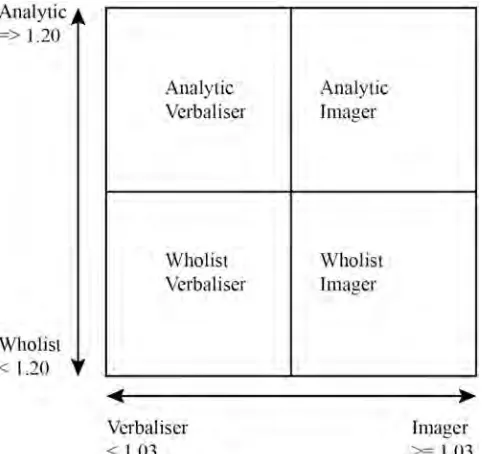
Cognitive Style Analysis: Riding’s (1991) Cognitive Style Analysis (CSA) test was used to measure participants’ wholist-analytic and verbal-imagery cognitive styles (Riding & Cheema, 1991). The CSA is a computer presented test. It indicates the position of an individual on each of the fundamental style dimensions by means of a ratio. The ratios typically range from 0.4 through to 4.0 with a central value around 1.0. The two fundamental dimensions of cognitive styles are both continual, but for descriptive convenience, the dimensions may be divided into groups by dividing the population on each dimension into two groups. The cut-off points of the ratios on each dimension are given in Figure 3. Based on the CSA test, participants were classified as wholist or analytic and verbaliser or imager.
Think-Aloud Protocols: A highly effective method of reading cognitive thinking of a user is to ask him or her to verbalize what he or she is thinking. This method is known as think-aloud or protocol analysis. It is used as data collection and analysis mainly to understand the thoughts of users while they are performing some assigned tasks (Ericsson & Simon, 1993). In this research, participants’ cognitive thinking was collected through a think-aloud method. They were asked to think-aloud their thinking, actions and emotions as they interact with the Web search engine while completing their search tasks. The data was manually entered into a log file and then transcribed to create observation records.
Web Search Session Logs: This study used Web search session logs to examine the interactions between the participants and the search engines. A standard search log file format with the following fields, similar to those of Jansen (2006), was adopted (see Table 2):
• User Identification: A unique number used to identify a participant
• Date: The date of the interaction
• The Time: The duration of the interaction
• The URL: The URL of the Web site visited
[image:7.612.55.296.69.296.2]• Search Terms: The query terms as entered by the user
Figure 3: CSA Map (Dichotomous Classifications – two groups)
User_ID Date Time URL Search Terms
40 03/02/10 14:00 www..google.com.au
Bermuda Triangle + effects it has on travellers in the region
40 03/02/10 14:00 www..google.com.au Bermuda Triangle + effects on travellers
40 03/02/10 14:02 www..google.com.au hypoxia and prevention
40 03/02/10 14:03 www..google.com.au hypoxia
[image:7.612.63.556.597.699.2]and Technology copyright © 2013 (American Society for Information Science and Technology)
Participants’ Web interactions, including think-aloud and Web search session logs, were captured by using a monitoring program, Camtasia Studio software (TechSmith, 2009). The output of the program is a video record that can be played and replayed at any time for transcription and analysis.
Data Analysis
This study implemented a mixed methods approach, involving both qualitative and quantitative data analyses. Combining both the qualitative and quantitative research methods in a single study can provide insights into different levels or units of analysis (Tashakkori & Teddlie, 1998).
Qualitative Analysis: The qualitative data collected through think-aloud and Web search session logs were transcribed, coded and analyzed using elements of content analysis (Julien, 1996; Schamber, 2000) and protocol analysis (Ericsson & Simon, 1993). The captured user-Web interactions for each participant were played and replayed several times to create 1) Search session logs, and 2) participant observation records.
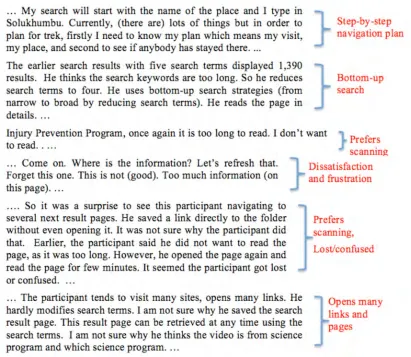
Once participants’ search session logs and think-aloud protocols were transcribed to form data compilation records, the records were thoroughly examined for qualitative content analysis. Open coding, a process of “breaking down, examining, comparing, conceptualizing and categorizing data” (Strauss & Corbin, 1990, p. 61), was utilized to code the data. This process generated new concepts, which were later put together to make sense of the data. Figure 8 (in Appendix A) is an example of open coding extracted from a participant’s transcribed data records, a combination of the participant’s think-aloud data and associated search session logs. The figure illustrates only certain segments from the participant’s transcribed data records that were coded.
Quantitative Analysis: The quantitative analysis focused on the data collected through the CSA test results, questionnaire, Web search session logs and the quantified data. The quantitative data was analyzed statistically using SPSS (statistical package for social science) tool version 18. A series of statistical analyses were conducted to analyze the quantitative data of the study, involving both the basic frequency tabulations and advanced methods.
A Chi-square for independence tests was performed to determine whether there was a significant difference between the frequencies in each query reformulation type. That is, a Chi-square test was used to check whether there was any difference in participants’ query reformulations across five types. A Pearson correlation r was carried out to investigate correlations (1) within the independent variables, (2) between dependent variables across different independent variables, and (3) between independent variables and dependent variables. A series of one-way Analysis of Variance (ANOVA) were also conducted in order to determine the effects of participants’ cognitive styles on their query reformulation behavior.
Results
Demographic
A total of 50 participants comprising students, academics and professional staff from the Queensland University of Technology participated in the study. Out of 50 participants, 26 were males, accounting for 52 % of the study sample, and 24 were females (48%). 50% of them were students, 28% staff, while 22% of them were both a student and staff at the university.
58% of the participant populations were aged between 26 and 35 years of age. Three participants were under 20 years of age; 10 participants between 20 and 25 years; 5 between 36 and 45 years; two between 46 and 55 years of age; and one participant over 56 years of age. The study benefited by including participants from different age groups; it was therefore not focused on a particular age group, but rather on users of all ages.
and Technology copyright © 2013 (American Society for Information Science and Technology)
Cognitive StylesOn the basis of their scores from Riding’s (1991) Cognitive Styles Analysis (CSA) test, the participants were classified as wholist or analytic on the WA dimensions and verbaliser or imager on the VI dimensions of cognitive style. Users’ scoring below 1.20 on the WA scale were classified as Wholist and those scoring 1.20 or above as Analytic. Users scoring below 1.03 on the VI scale were classified as Verbaliser and those scoring 1.03 or above as Imager.
Table 3 illustrates the distribution of participants according to their cognitive styles on the WA and VI dimensions. Of the 50 participants, 23 were classified as having a wholist cognitive style, while 27 participants were identified as analytic. As illustrated in the last row in Table 3, 24 participants were verbal users and remaining 26 participants imagers.
Web Search Behavior
The findings about Web search behavior, which emerged from the qualitative and quantitative analyses, showed four key aspects:
• Information Searching Strategies, based on how a user performs information searching;
• Query Reformulation Behavior, based on how users formulate and reformulate their queries during Web searching;
• Web Navigation Styles, based on how users navigate during Web searching; and
• Information Processing Approaches, based on how they view and process search results or retrieved result pages. While the data about the participants’ information searching strategy, navigational behavior and information processing approaches were analyzed qualitatively; their query reformulation behavior was analyzed statistically.
The key results of the research are presented through discussions of the three research questions framed for the research.
RQ1: What characterizes Web searching?
The review of the related studies and the study data show that there are four characteristics of Web searching: information searching strategies, query reformulation behavior, Web navigational styles, and information processing approaches. As illustrated in Figure 4, the four aspects of Web search behavior are interconnected. Users in this research go through each of these aspects while searching information on the Web. The
order in which they search does not mater.
Information Searching Strategies (ISS): ISS refer to participants’ behavior while locating information on the Web, and how they approach information searching. Based on the outcome of the open coding themes derived from the participants’ data records, participants were categorized as having top-down, bottom-up, or mixed searching strategies. (An example of open coding is illustrated in Figure 8 in Appendix A.)
[image:9.612.314.558.428.669.2]Top-down search approach is defined as a search strategy where users search for a general topic and then gradually
Figure 4: Four Aspects of Web Search Behavior
Cognitive Styles Verbaliser Imager Total
Wholist 11 12 23
Analytic 13 14 27
Total 24 26 50
[image:9.612.63.293.579.652.2]and Technology copyright © 2013 (American Society for Information Science and Technology)
search for specific information. During the Web search, a group of participants were found searching for general information using fewer search terms. For example, a participant (Participant ID 2) retrieved a huge amount of results, about 382,000, with a query ‘Solukhumbu’. The participant then refined the search query to retrieve more specific information by adding some keywords, for example, ‘Solukhumbu altitude’, which retrieved about 96,300 search results; these search terms were used as qualifying factors for the query.
In contrast to that of a top-down approach, in a bottom-up approach users first search for specific information and then move to a more general search. They also scrolled down the results until they found the required information, or they reduced search terms, which acted as the criterion to increase search results on a general topic.
Of the 50 participants, 42% of them seemed to prefer a top-down approach in which they first searched for a general topic by using fewer search terms and then gradually searched for specific information by adding more search terms; these search terms were used to filter out the search results. 36% of them searched in a bottom-up approach, where they first searched on a specific subject and later on more generic topics, while 22% of them adopted both top-down and bottom-up approaches. Query Reformulation Behavior: Five reformulation categories were constructed based on the common and different search terms used in two successive queries: New, Add, Remove, Replace, and Repeat. Detailed definitions of each of these queries reformulation classifications with examples are illustrated in (Kinley, Tjondronegoro, Partridge, & Edwards, 2012a; Kinley, et al., 2012b).
A Chi-square test confirmed a significant difference in participants’ query reformulation behavior. This indicated that the frequencies of queries in the five categories differed significantly. Furthermore, a Pearson correlation analysis indicated a significant association between Add, Remove and Replace query reformulations at a significance level of p<0.01. This showed that if participants added some search terms (Add), they also tended to remove (Remove) and replace (Replace) some search terms in their queries, and vice versa.
Web Navigation Styles: There are two main approaches to locating information on the Web: users either use queries or navigate the Web pages to search relevant information. The quality of the search results depends on the quality of the user’s navigation. Navigation refers to a browsing behavior in which the user accesses the content by following a series of links or pages. In this study, several measures were adopted. These include quantitative measures such as page visits and button clicks and qualitative measures that are assessable though the analysis of think-aloud, observation participatory memos and qualitative search sessions. Open coding was used to code the qualitative data (an example of open coding is illustrated in Figure 8 in Appendix A).
Participants’ Web navigational styles were categorized into sporadic and structured. Sporadic navigational style refers to those behaviors in which participants performed an unstructured navigation during Web searching. Structured navigation style refers to those behaviors where systematic steps were followed during the course of Web navigation.
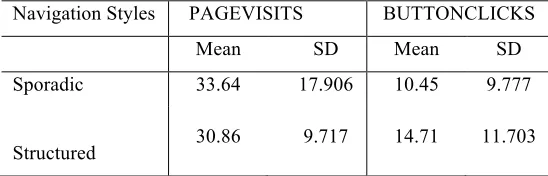
Participants, who followed sporadic navigations, tended to formulate their query, scan the first few search result descriptions, click the ‘next’ button of the search engine, then navigate back and reformulate their query. As illustrated in Table 4, in general they visited relatively more Web pages than structured navigators.
Alternatively, some users navigated in a structured manner while locating information on the Web. They seemed to formulate their query carefully, opened fewer pages and read the pages in detail. They often opened the search result page in the same windows to focus on a single task/topic, and navigated back to the search result page to either reformulate their queries or open another search result page. This could be the main reason why, as illustrated in Table 4, on average the structured navigators clicked a relatively higher number of navigation buttons than their sporadic peers. This indicates that future Web search engines need more navigational buttons.
[image:10.612.53.327.602.690.2]Information Processing Approaches (IPA): IPA refers to strategies adopted by users to view, select and process information during Web searching. Examining participants’ IPA allows us to draw some general conclusions about how the users locate the information on the Web. In this research, based on the analysis of 50 participants’ Web search behavior, inferred from the qualitative analyses of Web search session logs and think-aloud protocols through open coding (see Figure 8 in Appendix A), three categories of IPA were identified: scanning, reading and mixed. Intrinsic factors and criteria, such as whether the participants were
Table 4: Mean and Standard Deviation (SD) of PAGEVISITS and BUTTONCLICKS by Sporadic and Structured navigators
Navigation Styles PAGEVISITS BUTTONCLICKS
Mean SD Mean SD
Sporadic 33.64 17.906 10.45 9.777
and Technology copyright © 2013 (American Society for Information Science and Technology)
spending relatively more time on viewing a result page or not, were considered and coded to identify participants’ information processing behavior. We also considered users’ curser movement to detect whether the users are looking/reading or scanning.
Scanning refers to browsing behavior, where a user scans a result page for general information. In such a case, it is assumed that the user is more likely to search quickly, make quick switch between topics, tabs and windows, and open relatively more result pages because he or she is not sure if he or she will be confronted with the needed information or not. During the Web search experiment, some participants were found formulating and reformulating their queries more often. They scanned the search result descriptions and then reformulated their queries. They seldom opened search result pages and when they did they opened them in separate browser tabs or windows and scanned them.
In contrast to scanning, reading refers to comprehensive searching, where a user reads a page in detail; such acts are characterized by a longer time spent on reading a page and by a smaller number of pages being visited in a given period. In the current study, some participants were found processing information by reading. They were found reading pages in detail and spent relatively longer time to understand the content of the page. They visited a relatively fewer number of pages and spent a relatively longer time on a single page. They often opened links and pages in the same window, which indicated that they preferred to read a single page and accomplish one task at a given time.
There were also a few users who viewed search result pages by both scanning and reading. They flipped from one page to another but sometimes read the result page in detail. They would scan the search result pages until they found something interesting or eye catching and would then read that in detail.
In general, users have a tendency to either scan the result pages or read them in detail. These types of browsing behaviors potentially have some implications for Web site design; the results shed some light for the future of Web information systems developments. Such findings may help information system developers and designers provide adaptive support to information users. Search engines can provide a series of keyword recommendations with a very brief description for each search result so that searchers who prefer scanning can scan them quickly and open only the relevant result page. On the other hand, a longer result description with more information can be provided to searchers who prefer reading.
RQ2: How are the characteristics of Web search behavior affected by users’ cognitive styles?
Participants’ Web search behaviors were investigated through their information searching strategies, query reformulation behavior, Web navigational styles and information processing approaches. Both the qualitative analysis and statistical quantitative analyses showed effects of participants’ cognitive styles on their Web search behavior; these are briefly described below.
• Effects of Cognitive Style on Information Searching Strategies: Participants’ information searching strategies (ISS) were categorized as being top-down, bottom-up, or mixed. From the analysis of the qualitative data, the participants’ cognitive style was found to have a greater impact on their ISS.
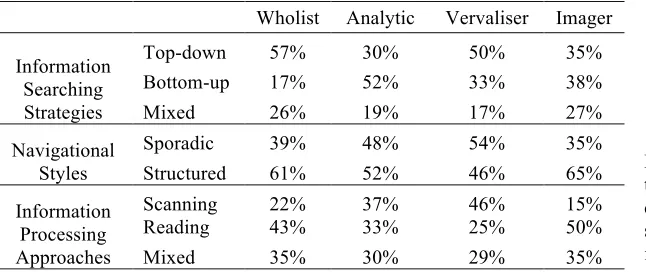
Table 5 illustrates the distribution of participants in each cognitive style category of the WA and VI dimensions by their ISS. The table shows that:
• On the WA dimensions of cognitive style, more than half of the study participants with wholist cognitive style (57%) showed a top-down search approach to searching.
• More than half of the study participants with analytic cognitive style (52%) demonstrated a bottom-up approach.
• On the VI dimension of cognitive styles, half of the verbalisers (50%) exhibited top-down search behavior, while 38% of the imagers followed bottom-up search methods. Figure 5 further illustrates an overview of the associations between participants’ cognitive styles and their Web search strategies. As illustrated by the red arrow in Figure 5, wholists and verbalisers, in general, tended to display a top-down Wholist Analytic Vervaliser Imager
Information Searching Strategies
Top-down 57% 30% 50% 35%
Bottom-up 17% 52% 33% 38%
Mixed 26% 19% 17% 27%
Navigational Styles
Sporadic 39% 48% 54% 35%
Structured 61% 52% 46% 65%
Information Processing Approaches
Scanning 22% 37% 46% 15%
Reading 43% 33% 25% 50%
[image:11.612.66.389.575.712.2]Mixed 35% 30% 29% 35%
and Technology copyright © 2013 (American Society for Information Science and Technology)
searching behavior. While formulating queries, the wholists and verbalisers were found to submit a relatively longer succeeding query than the preceding query. The additional search terms in the succeeding query narrowed down the search results. This finding supported previous studies (Ford & Chen, 2001; Pask, 1976), which reported that holists (i.e., wholists) tended to adopt a top-down approach to learning, while serialists (i.e., analytics) tended to adopt a bottom-up approach.
On the other hand, analytics and imagers, in general, tended to utilize a bottom-up approach while searching information on the Web. In Figure 5, the blue arrow illustrates the paths followed by analytics and imagers. They tended to use a longer query in the beginning and then gradually reduced the search terms in order to retrieve relevant information from the Web.
In general, the research finding suggests users’ cognitive styles influence their information searching strategies. The manner in which users displayed information searching varied among users of certain cognitive styles. This finding has some implications for future search engine developments and system usability research in the provision of assistance with users’ search strategies, these are discussed in the later sections of this paper.
Effects of Cognitive Style on Query Reformulation Behavior: Query reformulation behavior was one of the important aspects of Web search behavior. Based on the commonality and difference in search terms used in two successive queries, participants’ query reformulations were categorized into five types: New, Add, Replace, Remove and Repeat.
On the WA dimension of cognitive styles, wholists were found to utilize higher number of New and Repeat queries than their analytic peers; they seemed to lack query reformulation skills because new and repeated queries may not have retrieved more relevant information than it would have occurred if they had used other queries, such as Add, Remove and Replace. On the other hand, analytics tended to prefer Add, Remove and Replace; they modified the existing queries by adding, removing or replacing some search terms.
On the VI dimension, verbalisers were found to utilize Add, Remove and Replace queries more than their imager peers. Add, Remove and Replace queries demand higher levels of keyword searching than New or Repeat. They tended to use Add, Remove and Replace query reformulations as they think in terms of words and consider the information they read, see or listen in terms of words (Riding & Cheema, 1991). On the other hand, imagers preferred New and Repeat queries. Imagers think in terms of “mental pictures” (Riding, 1997). Therefore, they seemed to search with the same query (Repeat) on different search engines, such as Google Web, Google images and Google videos.
To find significant differences among the users of different cognitive styles in their query reformulation behaviour (in terms of five types of queries), a series of One-way ANOVA were performed. The tests show a significant difference among wholists and analytics in their Remove query reformulation behaviour, F (1, 48) = 4.103, p< 0.05, which indicated that the wholists and analytics performed Remove query reformulations differently.
Effects of Cognitive Style on Web Navigational Styles: The effects of participants’ cognitive styles on their Web navigational behavior were determined by analyses of both qualitative and quantitative data. Participants were categorized as having either sporadic or structured navigations.
[image:12.612.52.550.66.274.2]On the WA dimensions of cognitive styles, both wholists and analytics in general tended to prefer structured navigations. However, analytics tended to visit more Web pages and clicked more navigation buttons (back button, next button, forward button, home button) than their wholist peers. One of the reasons for analytics using links and buttons more frequently seemed to be that they feel comfortable when “jumping from one point to another” (Chen & Macredie, 2002).
and Technology copyright © 2013 (American Society for Information Science and Technology)
On the VI dimension of cognitive style, verbalisers in general preferred sporadic navigations: 54% of them navigated in a sporadic manner (see Table 5). They tended to open many links and pages, and used ‘back’ and ‘homepage’ buttons more frequently. They were also found to be impatient with their searches as they frequently scanned the result pages, which seemed to make them confused. They reported disappointment and frustration with their search results. On the other hand, imagers followed structured navigational styles while searching information on the Web: 65% of them adopted a structured navigation (see Table 5), in which they visited relatively fewer links but to read them in detail. They seemed to be more organized with their Web searching than their verbaliser peers.
The variation in Web navigation behavior among the information searchers with different cognitive styles has implications. Website designers and developers can use the findings from this study to provide effective Web page design and navigation menu systems for users of different cognitive styles.
Effects of Cognitive Style on Information Processing Approaches: Based on the qualitative analyses of Web search session logs and think-aloud protocols, this research broadly identified three categories of information processing approaches: scanning, reading and mixed.
On the WA dimension of cognitive styles, a majority of the wholists preferred reading: 43% of them preferred reading, 22% adopted scanning, and 35% of them employed both reading and scanning (see Table 5). On the other hand, 37% of the analytics preferred scanning, while 33% of them preferred reading. In general, analytics seemed to prefer scanning. Similar results were found in a previous work; Wood, et al. (1996) reported analytics accessing more screens, spending less time per screen and using a greater number of new terms.
On the VI dimension of cognitive styles, verbalisers in general tended to prefer scanning (46%) than reading (25%). They scanned through the search result descriptions and result pages to find relevant information. On the contrary, imagers seemed to prefer reading: 50% of the imagers adopted reading while only 15% of them were found adopting scanning as their means to process information. It is believed that imagers, who think in terms of “mental pictures” (Riding, 1997), preferred reading because they required more information in order to construct the “mental pictures” to make sense of the information retrieved. This may be compared to building a model; the developer needs to know the attributes and the elements that constitute it.
Figure 6 summarizes the overview of the participants’ information processing approaches. In the figure, the blue arrow illustrates the path followed by verbalisers and analytics; the red, the path followed by wholists and imagers. This figure clearly shows that analytics and verbalisers followed scanning, while wholists and imagers tended to prefer reading.
RQ3: How to model the interrelationships between users’ cognitive styles and their Web search behavior?
Based on the empirical findings of the research from the analyses of qualitative and quantitative data gathered through the CSA test and Web search session logs, questionnaire and think-aloud, a model of associations between users’ cognitive styles and their Web search behavior was developed.
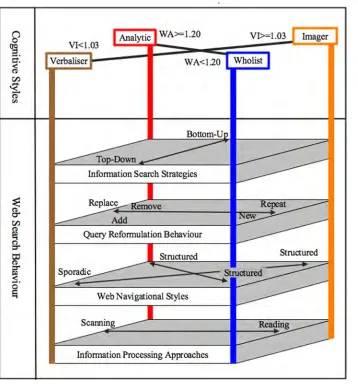
Figure 7 illustrates the proposed model that depicts associations between users’ cognitive styles and their Web search behavior, examined through information searching strategies, query reformulations, Web navigations and information processing behavior. The model presents the overall themes that emerged from the study as discussed in the previous sections.
This new model consists of two major components: users’ cognitive styles and Web search behavior.
Users’ Cognitive Styles: Users’ cognitive style was found to affect their Web search behavior. Users with a certain cognitive style group followed a particular Web search behavior, while other types of cognitive styles displayed different search behavior.
[image:13.612.54.414.571.712.2]and Technology copyright © 2013 (American Society for Information Science and Technology)
the blue line, represents Wholists on the WA dimensions of cognitive style. The brown pillar represents Verbalisers; the orange, represents Imagers on the VI dimensions of cognitive styles. The two dimensions of cognitive styles are independent of each other.
While the first component of the model shows both how users’ cognitive styles are measured and derived, and their position within the model, the actual influence of users’ cognitive styles is illustrated in the second part of the model.
Web Search Behavior: Users perform information searches to retrieve relevant information, driven by their personal and task oriented information needs. During user–Web search interactions, users utilize different searching skills, queries, navigation styles and information processing approaches in order to find relevant information.
Users’ Web search behaviors are displayed through information searching strategies, query reformulation behavior, Web navigational styles and information processing approaches. These components form layers in the model. Each component of the model is further grouped into different sub-categories: for example, users’ queries are categorized into five types, New, Add, Remove, Repeat and Replace. As a result, the model represents a larger and more holistic view of users’ Web search behaviors. This aspect of the model makes it different from the user models presented in the previous section and previous studies (e.g., Ford, et al., 2009; Knight & Spink, 2008).
[image:14.612.129.487.68.452.2]As illustrated in the model, users with a particular cognitive style group, tended to display or follow certain Web search patterns. For example, verbalisers tend to follow a sporadic navigational style while imagers show structured navigational behavior. Similarly, verbalisers and analytics process information by scanning, while wholists and imagers preferred reading.
and Technology copyright © 2013 (American Society for Information Science and Technology)
The model provides novel information into users’ Web search behavior and cognitive styles. This model has several implications both for existing theories and for practice, such as suggesting some elements of dependencies within the Web searching, which may help to provide clues for enhanced user-interface development and user study research. These implications are discussed in the next section.
Discussions and implications
The proposed model extends Ford, et al.’ (2009) model and its limitations by including high-level components of Web searching, such as query reformulation behavior, and by establishing strong inter-relationships between users’ cognitive styles and their Web search behavior.
This study, and particularly the model illustrated in Figure 7, is the first of it’s kind. Users’ Web search behaviors were explored through information search strategies, query reformulation behavior, Web navigational behavior and information processing approaches. The results from the analyses of users’ Web search behavior and their cognitive styles, provided valuable information and knowledge on how users with different cognitive styles search information on the Web.
Two key research findings emerged from this research:
Users’ cognitive styles influenced their Web search behavior. Their Web search behaviors were characterized by information searching strategies, query reformulation behavior, Web navigational styles and information processing approaches.
Fundamental relationships were evident between users’ cognitive styles and their Web search behaviors, and these relationships can be illustrated through modeling Web search behavior. A new model, providing novel insight into users’ Web search behavior and their cognitive styles, was developed and illustrated in Figure 7.
The research has demonstrated the inter-relationships between users’ Web search behavior and their cognitive styles. This research provides a framework for researchers, information system designers, academics, educators and trainers, and librarians who want to better understand how users perform information searching, in order to help and support their retrieval of required information. The study’s key findings have implications for extending existing information behavior theories and for practitioners.
Implications for existing Information Behavior Theory: The research extends information behavior theory through extensive exploration of the various aspects of Web searching. Several data collection instruments were utilized to capture maximum possible data, and several data analysis techniques were utilized to make sense of the data and to inform the findings of the study.
This study contributes to IB research by investigating user–Web search interactions through analysis of users’ information searching strategies, query reformulation behavior, Web navigational styles and information processing approaches. The key findings of the study led to the development of a model of associations between users cognitive styles and their Web search behavior. The theory and the model developed in this study can be used as a theoretical framework for future work that appears to extend information behavior and human-computer interactions theories.
Implications for Practitioners: The research results revealed several significant practical implications for research, academics, educators and librarians, and information systems developers. Understanding the cognitive aspects of information searching to improve user interface, and the performance of the information system, are important directions for research and development.
This study is important for academics, educators, and trainers. They can utilize the findings to better understand how their clients, such as students, perform their daily information searching. Such people would be able to understand the influence of cognitive styles on the users’ information searching experience. Academics and educators would be in a better position to support students’ learning about effective information retrieval. Information managers and librarians could also utilize the study’s findings to guide and support clients’ online information searching.
Search terms and queries transform a user’s information need into machine language that is understandable by an information system. Therefore, understanding how a user with a particular cognitive style performs query reformulations can help IS designers improve user interface efficiency. Understanding how a user search on Web search engines can help the search engine designers to improve the effectiveness of the search engines’ performance and provide assistance to the user in finding the information.
and Technology copyright © 2013 (American Society for Information Science and Technology)
search pattern of a user, search engines will be able to provide query suggestions and personalized search interface for better information searching.
Conclusion
The investigation of users’ cognitive styles and their Web search behavior has helped to better understand how users with different cognitive style perform Web search interactions. This research investigated how 50 participants perform their Web searches. Participants’ Web search behaviors were explored through information searching strategies, Web navigational styles, query reformulation behavior and information processing approaches. Participants’ cognitive styles were assessed by using Riding’s (1991) CSA test.
Based on the implicit observations during the Web searching experiment, three types of information searching strategies were identified: top-down, bottom-up, and mixed. Wholists and verbalisers followed a top-down search approach while searching information on the Web. They searched for general information and then gradually searched for specific information. On the other hand, analytics and imagers preferred a bottom-up approach while performing Web searches, searching for specific information by using a relatively higher number of search terms in their succeeding query, compared to their previous preceding query.
Participants’ search queries were categorized into New, Add, Remove, Replace and Repeat. A significant difference was found among wholists and analytics in the manner they executed Remove query reformulations. Verbalisers executed a higher number of Add, Remove, and Replace query reformulations than their imagery peers. They tended to use language better than imagers used it. On the contrary, imagery participants seemed to lack linguistic expression to modify their queries and use of search terms. It may be due to this reason that they submitted a higher number of New and Repeat queries to complete three search tasks.
During Web navigation, two types of navigational styles were identified, sporadic and structured. While most of the users, that is, the wholists, analytics and imagers, tended to follow a structured navigation approach, verbalisers seemed to move in a sporadic manner while navigating on the Web. Verbalisers were found to be impatient with their search as they frequently scanned the result pages, which seemed to make them confused.
With regard to the information processing approach, wholists in general seemed to prefer reading, while analytics tended to process information through scanning. Verbalisers in general preferred scanning. They scanned through the search result descriptions and result pages to see if these contained the relevant information or not. On the other hand, the majority of imagers preferred to view or access information through reading. They were found reading result pages in detail, spending enough time to understand the content of the pages.
Based on the empirical results that emerged from the analyses of qualitative and quantitative data, a model of associations between users’ cognitive styles and their Web search behavior was developed. This model provides insights for information science researchers, information system designers, academics, educators, trainers, and librarians who want to better understand how users perform information searching on the Web so that they can continue to help these users.
Limitations and Future Work
In the current study, the participants’ cognitive styles were measured by Riding’s (1991) CSA test. Some authors (Parkinson, Mullally, & Redmond, 2004) raised some issues with regard to the CSA test’s reliability and validity. In future work, there is a need to consider other instruments to assess users’ cognitive styles, such as the Group Embedded Figure Test (GEGT), developed by Witkin, et al (1971). It is also acknowledged that cognitive styles also include other dimensions beyond wholist-analytic and verbal-imagery dimensions. Many instruments have been developed to investigate individual cognitive styles. The cognitive style analysis (CSA) test, used in this paper, is just one of the tools to assess cognitive styles.
During Web searching, participants were assigned three pre-designed search tasks. Assigned search tasks might have limited the participant’s information needs. Their information need was limited to what was required to perform the assigned search tasks, rather than being given a choice to search their own personal information need. In future, there is a need to expand the study by including open search tasks by asking participants to find solutions to their own identified information problems. The search tasks then can be categorized into different types based on the complexity level of the tasks.
and Technology copyright © 2013 (American Society for Information Science and Technology)
ReferencesAllinson, C., & Hayes, J. (1996). The Cognitive Style Index: A Measure of Intuition-Analysis for Organizational Research. Journal of Management Studies, 33(1), 119-135.
Belkin, N. (1996). Intelligent Information Retrieval: Whose Intelligence? ISI, 96, 25-31.
Borlund, P., & Schneider, J. W. (2010). Reconsideration of the simulated work task situation: A context instrument for evaluation of information retrieval interaction. In Proceedings of the Proceedings of the third symposium on Information interaction in context (pp. 155-164): ACM.
Chen, S., & Liu, X. (2009). Mining students' learning patterns and performance in Web-based instruction: A cognitive style approach. Interactive Learning Environments, 19(2), 179-192.
Chen, S., & Macredie, R. (2002). Cognitive styles and hypermedia navigation: Development of a learning model. Journal of the American Society for Information Science and Technology, 53(1), 3-15.
Ellis, D. (1993). Modeling the Information Seeking Patterns of Academic Users: A Grounded Theory Approach. Library Quarterly, 63, 469-486.
Ericsson, K., & Simon, H. (1993). Protocol Analysis : Verbal Reports as Data. Cambridge, Mass: MIT Press
Felder, R., & Spurlin, J. (2005). Applications, Reliability and Validity of the Index of Learning Styles. International Journal of Engineering Education, 21(1), 103-112.
Fischer, G. (2001). User modeling in human-computer interaction. User modeling and user-adapted interaction, 11(1), 65-86. Ford, N. (2004). Towards a Model of Learning for Educational Informatics. Journal of Documentation; Bradford, 60,
183-225.
Ford, N., & Chen, S. (2001). Matching/Mismatching Revisited: An Empirical Study of Learning and Teaching Styles. British Journal of Educational Technology, 32(1), 5-22.
Ford, N., Eaglestone, B., Madden, A., & Whittle, M. (2009). Web Searching by the “general public”: An Individual Differences Perspective. Journal of Documentation, 65(4), 632-667.
Ford, N., Miller, D., & Moss, N. (2001). The Role of Individual Differences in Internet Searching: An Empirical Study. Journal of the American Society for Information Science and Technology, 52(12), 1049–1066.
Ford, N., Miller, D., & Moss, N. (2005a). Web Search Strategies and Human Individual Differences: A Combined Analysis. Journal of the American Society for Information Science and Technology, 56(7), 757-764.
Ford, N., Miller, D., & Moss, N. (2005b). Web Search Strategies and Human Individual Differences: Cognitive and Demographic Factors, Internet Attitudes, and Approaches. Journal of the American Society for Information Science and Technology, 56(7), 741-756.
Frias-Martinez, E., Chen, S. Y., & Liu, X. (2008). Investigation of behavior and perception of digital library users: A cognitive style perspective. International Journal of Information Management, 28(5), 355-365.
Frias-Martinez, E., Magoulas, G., Chen, S., & Macredie, R. (2005). Modeling human behavior in user-adaptive systems: Recent advances using soft computing techniques. Expert Systems with Applications, 29(2), 320-329.
Gwizdka, J. (2008). Revisiting search task difficulty: Behavioral and individual difference measures. Proceedings of the American Society for Information Science and Technology, 45(1), 1-12.
Hölscher, C., & Strube, G. (2000). Web Search Behavior of Internet Experts and Newbies. Computer Networks, 33(1-6), 337-346.
Hudson, L. (1968). Contrary Imaginations: A Psychological Study of the English Schoolboy. Pelican: Penguin Books Ltd. Ingwersen, P. (1996). Cognitive Perspectives of Information Retrieval Interaction: Elements of a Cognitive IR Theory.
Journal of Documentation, 52(1), 3-50.
Jansen, B. J. (2006). Search Log Analysis: What it is, What's been done, How to do it. Library and Information Science Research, 28(3), 407-432.
Julien, H. (1996). A Content Analysis of the Recent Information Needs and Uses Literature. Library & Information Science Research, 18(1), 53-65.
Kim, J. (2006). Task as a predictable indicator for information seeking behavior on the Web. Ph.D., Rutgers University, New Brunswick.
Kim, K.-S., & Allen, B. (2002). Cognitive and Task Influences on Web Searching Behavior. Journal of the American Society for Information Science and Technology, 53(2), 109-119.
Kinley, K. (2013). Towards Modelling Web Search Behaviour: Integrating Users’ Cognitive Styles Unpublished PhD thesis, Queensland University of Technology, Brisbane Australia.