0022-538X/08/$08.00⫹0 doi:10.1128/JVI.00787-08
Copyright © 2008, American Society for Microbiology. All Rights Reserved.
Identification of a Conserved RNA Replication Element (
cre
) within
the 3D
pol
-Coding Sequence of Hepatoviruses
䌤
Yan Yang,
1†‡ MinKyung Yi,
1‡ David J. Evans,
2Peter Simmonds,
3and Stanley M. Lemon
1*
Center for Hepatitis Research, Institute for Human Infections and Immunity, and the Department of Microbiology and Immunology, University of Texas Medical Branch, Galveston, Texas 77555-10731; Department of Biological Sciences, University of Warwick,
Coventry CV4 7AL, United Kingdom2; and Virus Evolution Group, Centre for Infectious Diseases, University of Edinburgh,
Summerhall, Edinburgh EH9 1QH, United Kingdom3
Received 12 April 2008/Accepted 29 July 2008
Internally located, cis-acting RNA replication elements (cre) have been identified within the genomes of viruses representing each of the major picornavirus genera (Enterovirus,Rhinovirus,Aphthovirus, and Cardio-virus) exceptHepatovirus. Previous efforts to identify a stem-loop structure withcrefunction in hepatitis A virus (HAV), the type species of this genus, by phylogenetic analyses or thermodynamic predictions have not succeeded. However, a region of markedly suppressed synonymous codon variability was identified in align-ments of HAV sequences near the 5ⴕ end of the 3Dpol
-coding sequence of HAV, consistent with noncoding constraints imposed by an underlying RNA secondary structure. Subsequent MFOLD predictions identified a 110-nucleotide (nt) complex stem-loop in this region with a typical AAACA/Gcre motif in its top loop. A potentially homologous RNA structure was identified in this region of the avian encephalitis virus genome, despite little nucleotide sequence relatedness between it and HAV. Mutations that disrupted secondary RNA structure or the AAACA/G motif, without altering the amino acid sequence of 3Dpol
, ablated replication of a subgenomic HAV replicon in transfected human hepatoma cells. Replication competence could be rescued by reinsertion of the native 110-nt stem-loop structure (but not an abbreviated 45-nt stem-loop) upstream of the HAV coding sequence in the replicon. These results suggest that this stem-loop is functionally similar tocre
elements of other picornaviruses and likely involved in templating VPg uridylylation as in other picornaviruses, despite its significantly larger size and lower free folding energy.
Hepatitis A virus (HAV), a member of the family Picorna-viridae, is a common etiological agent of acute hepatitis in humans. Several characteristics of HAV distinguish it from other picornaviruses, justifying its classification within a sepa-rate genus in this family, the genusHepatovirus(10). First, the primary sequence of the positive-sense, single-stranded RNA genome of HAV shares little homology with that of other picornaviruses. Avian encephalitis virus (AEV) is the only ex-ception to this statement, as it bears considerable sequence relatedness to HAV and has been tentatively classified as the second member of this genus. Details of the organization and function of the HAV polyprotein also differ in several respects from the typical LP1P2P3 organization found in other picor-naviruses (10). The amino-terminal capsid protein, VP4, is remarkably small, lacks an N-terminal consensus myristoyl-ation signal, and appears to have an alternative function in viral assembly compared to the VP4 proteins of other picor-naviruses (24). The largest capsid protein, VP1, also contains a unique C-terminal extension that appears to function in pen-tamer assembly (3). Congruent with this evidence for a unique assembly pathway for the viral particle, the thermal stability of
the HAV virion far exceeds that of other picornaviruses (7, 20). HAV also lacks a 2A proteinase, and unlike other picornavi-ruses, the primary proteolytic cleavage of the viral polyprotein at the 2A/2B junction is mediated by the only proteinase ex-pressed by the virus, 3Cpro(18). HAV also demonstrates
sev-eral unique biological attributes. Strongly hepatotropic in vivo and restricted in its host range to humans, chimpanzees, and certain New World primates, wild-type (wt) HAV replicates very poorly in cultured cells, demonstrating a protracted rep-lication cycle and typically no evidence of a cytopathic effect in infected cells (10). Recent evidence suggests that the 3A pro-tein of HAV is specifically directed to the outer mitochondrial membrane (28), rather than membranes of the endoplasmic reticulum, as is the case with other picornaviruses, possibly contributing to the low efficiency of replication that typifies this virus.
Despite these striking distinguishing characteristics, HAV shares many features in common with other picornaviruses, particularly in terms of its overall genome organization and apparent replication strategy (10). Like the genomes of other picornaviruses, the HAV genome contains a lengthy 5⬘ un-translated region (5⬘ UTR), followed by the single long open reading frame encoding the polyprotein, a short 3⬘UTR, and a 3⬘-polyadenylated tail. The 5⬘UTR lacks a 5⬘-terminal m7G
cap structure and in genomic RNA is covalently linked to a small virus-encoded peptide (3B or VPg) (27). The internal ribosome entry site (IRES) located within the 5⬘UTR directs the cap-independent translation of the polyprotein, which is cotranslationally processed by the 3Cproproteinase to produce
structural proteins that comprise the viral capsid and
nonstruc-* Corresponding author. Mailing address: Center for Hepatitis Re-search, 4.104 Blocker Medical Research Bldg., University of Texas Medical Branch, 301 University Blvd., Galveston, TX 77555-1073. Phone: (409) 747-7048. Fax: (409) 747-7030. E-mail: smlemon@utmb .edu.
† Present address: University of Texas M. D. Anderson Cancer Center, Houston, TX.
‡ These authors contributed equally to this work. 䌤Published ahead of print on 6 August 2008.
10118
on November 8, 2019 by guest
http://jvi.asm.org/
tural proteins involved in replication of the viral genome (2). Like other picornaviruses, genome replication is a two-stage process, with the input RNA genome first transcribed to pro-duce antisense RNA, which then functions as template for the synthesis of positive-sense progeny genomes (10). 3Dpol, the
RNA-dependent RNA polymerase and catalytic core of the vi-ral replicase, directs the synthesis of both positive- and nega-tive-strand RNA. Although far less well studied than poliovirus (PV), the synthesis of HAV RNA is thought to be primed by VPg-pUpU, the product of 3Dpol-mediated uridylylation
of VPg.
The genomes of all picornaviruses contain RNA replication signals within both the 5⬘- and 3⬘-terminal domains. However, the genomes of many other picornaviruses also have been found to contain internally located stem-loop structures that are essential for viral RNA synthesis. First recognized within the capsid coding region of human rhinovirus 14 (HRV-14), its function in viral RNA replication in vivo could not be comple-mented intrans, leading to its designation as acis-acting rep-lication element (cre) (12). The ability of thecre to support viral RNA synthesis is dependent upon both specific RNA structure and certain nucleotides within the loop region (14, 16, 25, 29). On the other hand, it is independent of its position within the genome and of whether its sequence is translated into protein (12). Similar RNA elements have subsequently been identified within the P1 sequence of cardioviruses, the 2C-coding region of PV, the 2A-coding sequence of HRV-2, and the 5⬘UTR of an aphthovirus (4, 5, 9, 11).
Studies by Paul and colleagues (14, 16, 17) have shown that the PVcrefunctions as the template for VPg (3B) uridylylation through a “slide-back” mechanism catalyzed by 3Dpolin
asso-ciation with 3CD. The uridylylation of VPg, possibly in the context of 3AB, leads to the production of VPg-pUpU, which serves as the protein primer for new RNA synthesis (8, 15). Extensive mutagenesis of the HRV-14 and PVcrerevealed a critical conserved AAACA/G motif in the 5⬘half of the loop sequence that is essential forcre function (29). Similar con-served AAACA motifs are present within the loops of thecre elements of other picornaviruses and are important for RNA replication (17, 31). Evidence suggests that acreis likely to be present in all picornaviruses but at different positions within the genome in different picornaviruses and with substantial variation in primary nucleotide sequences. To date, however, searches for such an element in the HAV genome have not been productive.
Internal base pairing that creates stem-loops and other RNA structures places constraints on sequence variability in bases required for structure formation. In the hepatitis C virus (HCV) genome, this constraint is manifested by a marked suppression of synonymous codon variability within several evolutionarily conserved stem-loops in the core and NS5B-coding regions that have demonstrated roles in viral replication (13, 26, 32). Discrete RNA structures such as thecre in the coding region of human enteroviruses (HEVs) and other vi-ruses that lack other large-scale RNA secondary structures (22) should also create characteristic suppression of synony-mous site variability (SSSV), similar to that observed in HCV. Here, we describe the use of independent phylogenetic and thermodynamic methods to scan HAV sequences for covariant sites and associated RNA secondary structures, leading to the
prediction of a conserved stem-loop structure within RNA encoding the 3Dpol RNA-dependent RNA polymerase. We
confirmed the functional importance of this structure by mu-tagenesis and reverse molecular genetics. We show that this RNA element shares several common features with other pi-cornaviruscreelements but is unique in both size and location.
MATERIALS AND METHODS
Nucleotide sequences.The following sequences of human and simian HAV were used for analysis of variability at synonymous sites and for RNA structure determination: NC_001489, DQ646426, AB258387, AB020567, HPAACG, AB020566, AB020564, AB020565, AB020568, AB020569, AF314208, HPACG, AB300205, AF512536, AF357222, AF485328, HAVCOMPL, HPA18F, AY644670, AY644676, HAVRNAHFS, EF207320, EF406357, EF406359, SHVAGM27, AJ299464, AY974170, and HEA299464. Sequences showing⬍1% sequence divergence from other published sequences were excluded from anal-ysis. The following nonidentical sequences for AEV were also analyzed for RNA secondary structure: NC_003990, AJ225173, AY517471, and AY275539. Align-ments of HAV and AEV sequences were carried out by identification and alignment of conserved amino acid sequence motifs in the coding region and automated alignment of intervening regions using ClustalW with default settings. Alignments of HEV species A and B viruses corresponded to those used in previous analyses (23).
Analysis of SSSV.Synonymous sequence variability was determined by mea-surement of mean pairwise distances at each codon position in the open reading frames of hepatoviruses and enteroviruses. Variability at each codon was calcu-lated using the program Sequence Scan in the Simmonic sequence editor (21). Mean pairwise synonymous variability was restricted to aligned codons where the translated amino acid was the same. Each pairwise value was normalized by dividing by the degeneracy of the codon, with normalization factors for twofold degenerate sites of 0.5, for threefold degenerate sites of 0.6666, for fourfold degenerate sites of 0.75, and for sixfold degenerate sites of 0.8333. This takes into account the different sequence distances achievable at maximally diverged sites. Variability at each codon position was averaged over a sliding window of 35 codons.
RNA secondary structure prediction.Base pairing in the region of the genome showing SSSV was predicted using MFOLD using default settings through the web interface at http://www.bioinfo.rpi.edu/applications/mfold. PFOLD analysis used the web interface at http://www.daimi.au.dk/⬃compbio/rnafold/. All pro-grams were run with default settings. Thermodynamic structure predictions were carried out using the program ZIPFOLD on the MFOLD server. Minimum folding energies (MFEs) of native HAV and HEV-B sequences were compared with the mean values generated for 50 control sequences in which sequence order had been scrambled using an algorithm (NDR) that preserves the dinu-cleotide frequencies of the native sequence, implemented in the Simmonic se-quence editor package. MFE differences (MFEDs) were calculated as MFED (%) ⫽ [(MFEnative/MFEscrambled) ⫺ 1] ⫻ 100, where MFEnative and
MFEscrambledare the MFEs of native sequences and mean MFEs of the 50
sequence order-randomized controls, respectively.
Plasmids.The contribution of RNA structures to replication of the HAV genome was assessed by creating mutations within pHAVLuc, which contains the cDNA of a replication-competent, subgenomic RNA replicon, HAVLuc, in which an in-frame fusion of the firefly luciferase coding sequence replaces all but the 5⬘150 and 3⬘39 nucleotides (nt) of the P1 region of the HM175/18f genome (30). pHAVLuc-⌬3D is a related replication-incompetent mutant of pHAVLuc, which contains a single base substitution creating a premature termination codon within the 3Dpolsequence; it is referred to here simply as⌬3D. Mutations
disrupting the native RNA sequence of the 3Dpol
-coding region were introduced by QuikChange site-directed mutagenesis (Stratagene). The following oligonu-cleotides were used for construction of mutations: for MutA, GTTCAATGAA TGTCGTGTCGAAGACCCTTTTTAGAAAGAGTC (⫹) and GACTCTTTC TAAAAAGGGTCTTCGACACGACATTCATTGAAC (⫺); for MutB, GCTT TTTAGAAAAAGTCCAATCTACCATCACATTGATAAAAC (⫹), and GTT TTATCAATGTGATGGTAGATTGGACTTTTTCTAAAAAGC (⫺); and for MutC, GTTCAATGAATGTGGTCTCCAAGACGCTTTTTAGAAAGAGTC (⫹) and GACTCTTTCTAAAAAGCGTCTTGGAGACCACATTCATT GAAC (⫺).
To construct HAV replicons with reinsertions of the putative wt and mutated cresequences immediately downstream of the luciferase coding sequence, the SacI site (nt 3006 in the HM175/18f sequence [7, 33]), which was used to fuse the luciferase sequence to sequence encoding the C terminus of VP1 in pHAVLuc,
on November 8, 2019 by guest
http://jvi.asm.org/
was eliminated by mutating T3006to G (silent base change) to create pHAVLuc_
v.2. A new SacI site was then placed at the 3⬘end of the full-lengthcresequence by introducing C6071G and A6076C mutations to create pHAVLuc_v.3. The
sequence between nt 3010 and 5955 (HM175/18f sequence) was deleted by QuikChange mutagenesis to fuse the full-lengthcresequence in frame to the 3⬘ end of the luciferase sequence in pHAVLuc_v.3, resulting in p⌬HAVLuc_v.3. Next, pHAVLuc was digested with SacI (nt 3006 in the HM175/18f sequence) and XhoI (nt 7013), and the small fragment was ligated into the SacI/XhoI sites in⌬HAVLuc_v.3 to create pwt/wt. A similar strategy was used to construct pMutA/MutA, containing two mutatedcreelements derived from MutA, and pwt/MutA and pMutA/wt. For construction of ps-cre/wt and ps-cre/MutA, the 45-nt s-cre RNA segment was introduced into pHAVLuc and pMutA by QuikChange site-directed mutagenesis using the oligonucleotides GTTCAATG GAGCTCTAAGCTTATAAATGGGACTCTTTCTAAAAAGCGTTTTGGA GACCACATTCATGGTACCCAATTTGGACTTTCC (⫹) and GTTCAATG GAGCTCTAAGCTTATAAATGGGACTCTTTCTAAAAAGCGTTTTGGA GACCACATTCATGGTACCCAATTTGGACTTTCC (⫺). All plasmid regions subjected to PCR mutagenesis were sequenced to ensure that no adventitious mutations were introduced.
In vitro RNA transcription.To produce replicon RNA transcripts, plasmids were linearized at the unique XmaI restriction site located at the 3⬘end of the HAV sequence (30). RNA transcripts were synthesized by T7 polymerase-me-diated transcription (T7 MEGAscript; Ambion). The integrity and yield of the transcribed RNAs were determined by agarose gel electrophoresis.
Cell culture.Huh7 human hepatoma cells were grown in Dulbecco’s modified Eagle’s medium (Gibco/BRL) with 10% fetal bovine serum.
HAV RNA replication assay.Huh7 cells were transfected with replicon RNA transcripts. Briefly, 5⫻106
cells were electroporated with 10g of RNA using a GenePulser II electroporation apparatus (Bio-Rad) with the pulse controller unit set at 1,400 V and 25F and maximum resistance. The cells were subse-quently seeded into a 12-well plate and cultured in Dulbecco’s modified Eagle’s medium with 10% fetal bovine serum at 37°C until processing for luciferase assays. Cell lysates were harvested by the addition of 100l of passive lysis buffer (Promega) to each well and stored at⫺20°C until assayed for enzymatic activity. Luciferase activity was quantified using the luciferase assay system (Promega) as described by the supplier, with results determined using a TD-20/20 luminometer (Turner Designs).
RESULTS
Prediction of an RNA structure within the N-terminal re-gion of the HAV 3Dpol-coding sequence.To investigate whether the RNA secondary structure of a previously definedcrein the 2C region of HEVs (5) could be identified by suppression of variability at synonymous sites, alignments of complete coding sequences of species A and B isolates were scanned for vari-ability at each codon (Fig. 1A). Synonymous site varivari-ability was extremely high throughout the coding sequences of both vi-ruses, except for a short region in 2C. The area of maximum SSSV coincided precisely with the previously reported stem-loop forming thecre(Fig. 1A). The analysis was repeated using 28 complete coding sequences of human and simian HAV variants (after identical or near-identical sequences, including sequences of multiple HM175 strain variants, had been re-moved) (Fig. 1B). Although both the nucleotide and inferred amino acid sequence diversity within HAV was substantially lower than that observed within HEV species, a single discrete region of SSSV was observed at the start of the 3Dpol-coding
sequence (Fig. 1B).
To investigate whether the 5⬘ end of the 3Dpol-coding
se-quence contained RNA secondary structure that would ac-count for the observed SSSV, sequences from each of the HAV sequences between positions 5501 and 6500 (HAV po-sitions are numbered according to the wt HM175 virus se-quence, NC_001489, unless otherwise noted) were analyzed by MFOLD to derive minimum free energy predicted structures
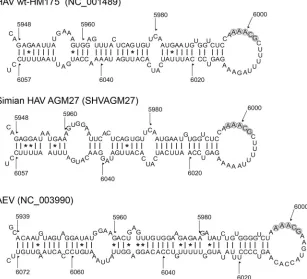
(Fig. 2). A conserved stem-loop was predicted for the se-quences between positions 5948 and 6057, whereas base pair-ings either side of the stem-loop were variable in different strains of HAV (data not shown). Despite several nucleotide substitutions, sequences of the more divergent simian HAV strains also formed an RNA structure that was similar in pair-ing and shape to the human HAV structure (Fig. 2). PFOLD predicted the same consensus secondary structure using the alignment of human and simian HAV sequences (data not shown).
The existence of thermodynamically favored RNA second-ary structure formation in thecreregion of HEVs and a region of suppressed synonymous variability in HAV sequences was investigated by comparison of MFEs of native sequences with those of sequence order-randomized controls (Table 1). HEV-B sequences showed high MFED values (⫹23% for the 100-base fragment that included the cre), consistent with a major contribution of sequence order to the secondary struc-ture in this region. However, MFEs for native and scrambled HAV sequences were approximately the same (MFEDs of⫺1 to⫺2%). Possible reasons for the absence of detectable sta-bility differences between native sequence of HAV and con-trols are discussed below.
Although substantially larger, the predicted stem-loop struc-ture in the HAV 3Dpolregion showed several features that are
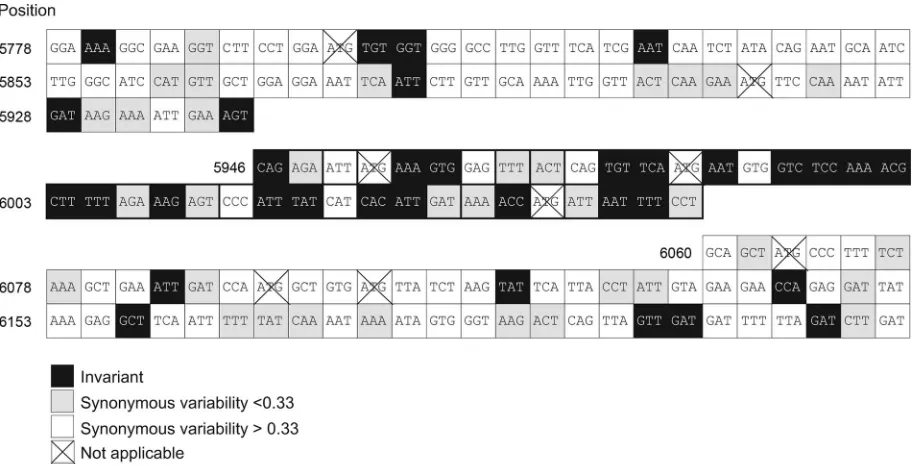
common tocreelements present in other picornavirus genera. These include a large open top loop (18 bases, larger than the 14 bases in HRV-14, HRV-2, and HEV [4, 5, 12] and 15 bases in foot-and-mouth disease virus [11]), as well as the presence of the AAACA/G motif in the 5⬘half of the loop that has been shown to play a templating role in uridylylation of VPg (16, 29). Importantly, the region of predicted internal base pairing showed a higher frequency of invariant or minimally variable codons than did flanking regions (Fig. 3). For the 35 codons in the stem-loop for which there are potential synonymous alter-natives, 20 were invariant (57%) and nine showed variability of ⬍0.33 (26%). These frequencies are significantly higher than variability in flanking regions (14 invariant, 25 minimally vari-able from a total of 107 codons; 13% and 23%, respectively, P⬍0.0000013 by the2test). Importantly, the codons
com-prising the AAACA/G motif and adjacent sequence within the 5⬘ half of the loop segment were absolutely invariant in their sequence (Fig. 3).
To further investigate the phylogenetic conservation of the 3Dpolstem-loop in HAV, we examined sequences from the
dis-tantly related AEV. AEV is tentatively classified within the genus Hepatovirus, but recent work has revealed that its IRES structure differs significantly from that of HAV and is actually closer to that of HCV (1). This and other considerations have prompted a reconsideration of its taxonomic classification. The lack of se-quence diversity in published complete genome sese-quences of AEV precluded a meaningful analysis of SSSV for this virus. However, while coding sequences from AEV are highly divergent from those of HAV, a defensible alignment of HAV and AEV sequences was possible in the region of the genome around the start of the 3Dpol-coding sequence (Fig. 4). MFOLD analysis of
the region homologous to positions 5501 to 6500 of HAV dem-onstrated a stem-loop structure in a position equivalent to that in HAV, in the virtual absence of nucleotide sequence similarity between viruses (Fig. 2). Although the actual pairings in the stem
on November 8, 2019 by guest
http://jvi.asm.org/
differed considerably between HAV and AEV, the AEV struc-ture formed a very similar unpaired terminal loop of 16 bases, with the AAACG sequence placed in a position homologous to that in the HAV loop.
RNA structure within the 3Dpol
-coding region is essential for efficient HAV RNA replication.To assess whether the pu-tative stem-loop structure identified within the hepatovirus 3Dpol-coding region has functional importance, possibly
equiv-FIG. 1. Scans searching for SSSV in the coding region of the nucleotide sequences of HEVs and human hepatoviruses. (A) SSSV scan of HEV species A and B sequences. The inset graph shows a defined region of SSSV on a largerxscale, with the region of known RNA base pairing associated with the enteroviruscresuperimposed (gray shading, positions 4436 to 4496 in the POL3L27 sequence). (B) Similar SSSV scan of the human HAV sequence. Nucleotide positions are numbered according to the wt HM175 virus sequence (NC_001489).
on November 8, 2019 by guest
http://jvi.asm.org/
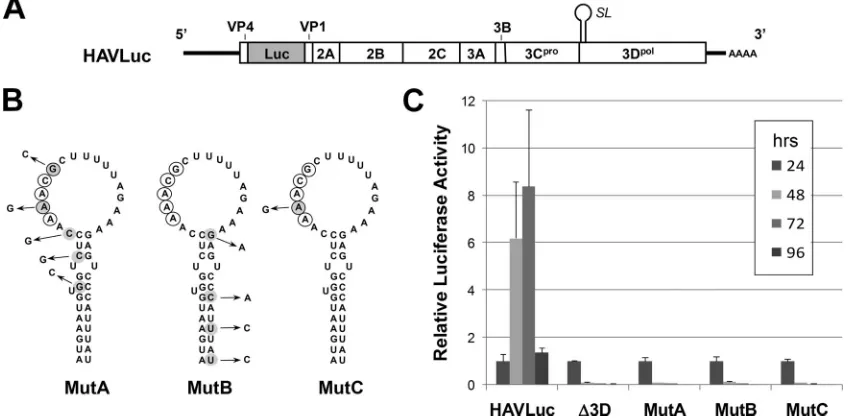
alent to that of thecreof other picornaviruses, we constructed two mutants (MutA and MutB) within the background of a replication-competent, subgenomic RNA replicon, HAVLuc, in which an in-frame fusion of the firefly luciferase coding sequence replaces most of the P1, capsid coding region of the genome of a rapidly replicating, cell culture-adapted variant of HAV (Fig. 5A) (30). To create MutA, we introduced five silent, third-base mutations in the 5⬘ half of the stem-loop, including two that disrupted predicted base pairs near the top of the stem and two within the AAACG sequence in the loop (Fig. 5B). MutB contained four silent mutations within the 3⬘ sequence of the upper part of the stem (Fig. 5B). Thus, the multiple nucleotide substitutions created in these mutants dis-rupt the AAACG/A motif and/or predicted base pairing within the helix, without altering the amino acid sequence of the 3DpolRNA-dependent RNA polymerase. The MFOLD
algo-rithm predicts that the mutations in either of these mutants
significantly disrupt the RNA structure predicted within this segment of the wt genome (data not shown).
To evaluate the impact of these mutations on HAV RNA replication, we transcribed RNA in vitro from both wt and mutant constructs and transfected these RNAs into human hepatoma (Huh7) cells that support HAV replication. As a negative control, we also transfected Huh7 cells with a related, replication-defective RNA, HAVLuc-⌬3D (hereafter referred to as⌬3D), in which translation of 3Dpol is prematurely
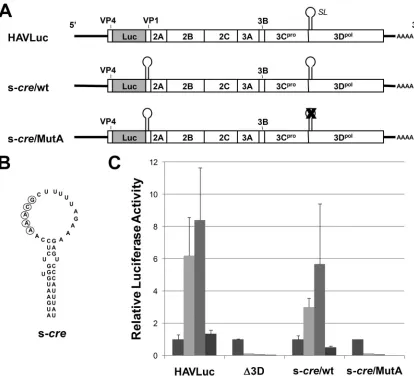
ter-minated (30). Transfection of this RNA leads to an initial burst of luciferase expression, detectable at 24 h posttransfection, but no subsequent increase in luciferase activity at 48 or 72 h. This early luciferase expression represents translation of the input RNA, which is degraded following transfection. In con-trast, the replication-competent wt RNA (HAVLuc), while generating a similar level of luciferase activity at 24 h, shows a sustained, almost 10-fold increase at later time points (Fig. 5C). Interestingly, although none of the nucleotide substitu-tions that we engineered into MutA or MutB altered the amino acid sequence of the polyprotein, both RNAs behaved like the 3Dpolmutant, generating luciferase only at 24 h and with little
[image:5.585.140.447.72.351.2]or no luciferase activity detectable at 48 or 72 h posttransfec-tion. The similar levels of luciferase activity generated by the mutants and the wt HAVLuc at 24 h posttransfection suggest that the nucleotide substitutions engineered into MutA and MutB do not reduce the efficiency with which the HAV IRES directs the translation of the polyprotein in these RNAs. How-ever, the lack of a subsequent increase in luciferase expression in cells transfected with either mutant indicates that these nucleotide substitutions are severely detrimental to HAV
FIG. 2. Consensus MFOLD predicted RNA structures for human and simian HAVs and AEV in the 3Dpol-coding region showing significant SSSV. Numbering for each structure corresponds to that for human HAV (NC_001489).
TABLE 1. MFEs of sequences flanking the HAV versus HEV-Bcrea
cre region
Position (bp) Length (bp)
MFE MFED (%) Beginning End Midpoint Native Control HAV 5952 6051 6002 100 ⫺15.4 ⫺15.7 ⫺1.9
5855 6151 6003 300 ⫺56.7 ⫺57.2 ⫺0.9 HEV-B 4401 4500 4451 100 ⫺22.8 ⫺18.6 22.6 4305 4604 4455 300 ⫺71.8 ⫺67.2 6.8
aComparison of MFEs of 100- and 200-nt segments centered on thecrein the
human HAV and HEV-B genomes with those of sequence order-scrambled controls. The MFED quantifies the contribution of sequence order to RNA secondary structure.
on November 8, 2019 by guest
http://jvi.asm.org/
[image:5.585.45.283.626.692.2]RNA replication. Since the amino acid sequences of the polyproteins of MutA and MutB were unchanged from those of the wt genome, these results suggest that the predicted RNA structure in the 3Dpol-coding sequence is critically
important for HAV RNA replication and that it may in fact function as acre.
To further evaluate this possibility, we created a third mu-tant, MutC, containing only a single base alteration, A5999to G
(Fig. 5B). This mutation does not alter the MFOLD-predicted secondary structure in this region of the genome, nor the amino acid sequence of 3Dpol, but changes the AAACG
se-quence to AGACG, thus knocking out the AAACA/G motif. Since the second adenosine in this motif is critically important to the slide-back mechanism underlying the 3Dpol-mediated
uridylylation of VPg (16, 17), this mutation would be expected to be lethal to replication, if in fact the predicted stem-loop functions as acre. Consistent with this hypothesis, the MutC
RNA also failed to replicate following transfection into Huh7 cells (Fig. 5C).
Functional rescue of MutA by the full-length but not a short, 45-nt RNA element.An interesting characteristic of the picor-naviruscre is its ability to function in supporting viral RNA replication in a manner that is independent of its position within the genome (5, 12). We thus attempted to rescue the replication competence of MutA by inserting the entire 110-nt stem-loop sequence (Fig. 6A, f-cre, nt 5946 to 6059) down-stream of the HAV coding sequence, at unique restriction sites engineered into MutA between the stop codon terminating translation of 3Dpol and the 3⬘ UTR. This replicon RNA
showed no evidence of replication following transfection into Huh7 cells (data not shown). However, since an RNA pseudoknot has been proposed previously to form around the junction of the 3Dpol-coding sequence and the 3⬘UTR (6), it
[image:6.585.64.521.68.301.2]is likely that the insertion of the f-cresequence at this position
FIG. 3. Distribution of synonymous site variability among codons forming the 3Dpolstem-loop and flanking sequences of HAV. The 38 codons contributing to the complex stem-loop structure shown in Fig. 2 (nt 5946 to 6059) are separated from flanking codons in the center of the figure.
FIG. 4. Alignment of nucleotide sequences based on inferred amino acid sequences of human and simian HAVs and of AEV. Nucleotides within the 3Dpolstem-loops of HAV and AEV are shown in bold, with bases within the stem regions of the structure shown in inverse. The AAACA/G motif in the loop region (AAACG in HAV) is boxed. Sequences used are those shown in Fig. 2.
on November 8, 2019 by guest
http://jvi.asm.org/
may have interfered with the formation of tertiary RNA struc-tures near the 3⬘end of the genome that are otherwise critical for RNA replication.
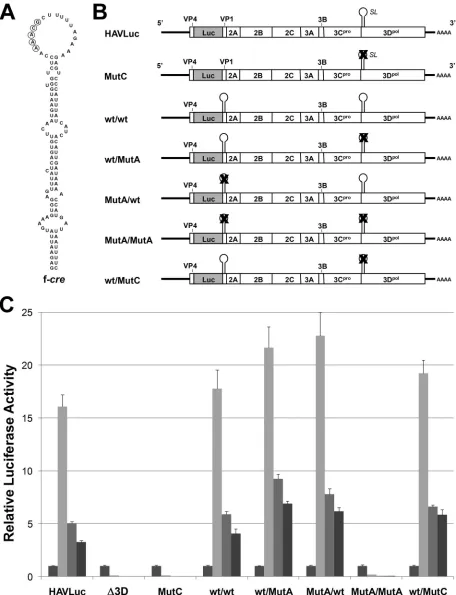
We next attempted to rescue the replication competence of MutA by inserting the f-cresequence (Fig. 6A) immediately downstream of the luciferase sequence, fused in frame with and upstream of the residual VP1 coding sequence in HAVLuc (Fig. 6B, wt/MutA). To control for the possible loss of repli-cation efficiency due to the insertion of this added sequence, we created a parallel construct containing the native wt stem-loop sequence within the 3Dpol-coding region, in addition to
the inserted stem-loop sequence fused to the luciferase coding region (wt/wt). Although the additional sequence (38 amino acids) inserted into the luciferase-⌬VP1 fusion resulted in an apparent reduction in the specific activity of the reporter en-zyme (data not shown), increases in luciferase activity between 24 and 72 h posttransfection indicated that the reinsertion of the stem-loop upstream of the HAV coding sequence had restored replication competence to the wt/MutA construct (Fig. 6C). The presence of two wt stem-loops in the wt/wt construct did not interfere with replication, while the wt/MutA construct replicated at least as efficiently as did HAVLuc. Insertion of a mutated stem-loop (same mutations as in MutA, Fig. 5) at the upstream position did not impede replication of the wt RNA (Fig. 6C, MutA/wt) but was unable to restore replication competence to MutA (Fig. 6C, MutA/MutA). Sim-ilarly, the insertion of a wt stem-loop in the upstream position of the MutC construct rescued RNA replication (Fig. 6C, pare MutC and wt/MutC). Since the MutC mutation is com-prised of only a single nucleotide substitution within the loop
sequence (Fig. 5B), the native stem-loop presumably retains its structure and possibly its protein-binding activities in wt/MutC. Despite this, the replication phenotype of wt/MutC was indis-tinguishable from that of HAVLuc or wt/wt, indicating that these redundant stem-loops neither compete with each other for limited amounts of essential binding proteins nor otherwise impede RNA synthesis. Taken together, these data show that the wt stem-loop structure is capable of supporting viral RNA replication when placed within the genome at a location sev-eral thousand nucleotides upstream of its native location, con-sistent with the location-independent nature ofcre elements identified previously in other picornaviruses.
The f-cresequence inserted in wt/MutA (Fig. 6A) is substan-tially longer than the minimal 33-nt rhinovirus cre sequence that we previously found to be sufficient for efficient replication of HRV-14 RNA (29). Thus, it was of interest to determine if the entire 110-nt f-cresequence is required for replication of HAV RNA. To address this question, we constructed an ad-ditional mutant, s-cre/MutA (Fig. 7A), in which a 45-nt seg-ment representing the HAV f-creloop sequence and the ad-jacent 12-bp upper helical segment containing a 2-nt internal loop and 1-nt bulge (Fig. 7B, s-cre, nt 5982 to 6026) was inserted in frame between the luciferase and residual VP1 sequences of MutA.cresequences of this length are capable of rescuing replication of other HRV-14 cre mutants and also support 3Dpol-mediated uridylylation of VPg in cell-free
reac-tions (29). This mutant failed to replicate following transfec-tion into Huh7 cells (Fig. 7C, s-cre/MutA). The lack of repli-cation competence could not be attributed to the addition of the s-cresequence upstream of the HAV coding sequence, as
FIG. 5. (A) Organization of the subgenomic HAV luciferase replicon, HAVLuc, showing the position of the predicted RNA stem-loop (SL) in the 3Dpol-coding sequence. Most of the HM175/18f P1 sequence (all but that encoding the small putative VP4 protein of HAV and the 3⬘39 nt of the VP1 coding sequence) is replaced with an in-frame insertion of the luciferase (Luc) sequence (30). pHAVLuc-⌬3D (⌬3D) is a related, replication-incompetent replicon containing a single base change that causes premature termination of 3Dpoltranslation. (B) Mutational analysis of the predicted stem-loop in the 3Dpol-coding region. Silent mutations were introduced into the upper stem and loop sequences of the putative stem-loop in MutA, MutB, and MutC, as indicated. Bases contributing to the AAACA/G motif within the wt loop sequence are circled. (C) Relative luciferase activity expressed by Huh7 cells transfected with HAVLuc,⌬3D, MutA, and MutB RNAs. Relative luciferase activities are shown at 24, 48, 72, and 96 h posttransfection, normalized in each case to the luciferase activity at 24 h. Luciferase values decrease substantially by 96 h posttransfection due to cellular toxicity associated with HAV RNA replication. The results are the averages of three independent cultures of transfected cells; error bars indicate the standard deviations. Similar results were obtained in multiple independent experiments.
on November 8, 2019 by guest
http://jvi.asm.org/
[image:7.585.80.507.72.281.2]FIG. 6. Replication competence is rescued by reinsertion of the 3Dpolstem-loop fused downstream of the luciferase sequence in the MutA replicon. (A) The full-length, wt 110-nt f-cresequence inserted downstream of the luciferase sequence in the constructs shown in panel B. (B) Schematic showing the insertion of the wt f-crestem-loop downstream of the luciferase sequence in the wt/wt, wt/MutA, and wt/MutC replicons. MutA/wt and MutA/MutA contain a similarly inserted, mutated f-cresequence (mutations identical to MutA as in Fig. 5B) in the background of HAVLuc and MutA, respectively. (C) Relative luciferase activities expressed by HAVLuc, ⌬3D, MutC (Fig. 5), wt/wt, wt/MutA, MutA/wt, MutA/MutA, and wt/MutC at 24, 48, 84, and 106 h (left to right, respectively, within each set of bars) post-transfection of Huh7 cells. The results shown are the averages of nine independent cultures of transfected cells; error bars indicate the standard deviations.
10125
on November 8, 2019 by guest
the insertion was well tolerated in the background of HAVLuc (Fig. 7C, s-cre/wt). Although further studies were not under-taken, these data indicate that HAV RNA replication requires a substantially lengthiercrethan does that of other picornavi-ruses, possibly as long as the entire f-cresequence (Fig. 6A). This may be related to the relatively low free folding energy of the HAVcrecompared to that of other picornaviruscre stem-loop structures, as discussed below.
DISCUSSION
Conserved internal stem-loop structures that function as templates for the uridylylation of VPg and that are thus essen-tial for RNA replication have been identified previously in representative viruses from most of the major pathogenic pi-cornavirus genera. Such acreelement has not, however, been identified previously within the genome of hepatoviruses. Pre-vious studies have shown that the sequence spanning the VP4 to 2A coding regions of HAV can be deleted without loss of
RNA replication competence, indicating that there is not an essentialcreelement residing within the P1 sequence of HAV. Thus, it was of interest to find a large, stable RNA structure existing within the P3 segment encoding the viral RNA-depen-dent RNA polymerase, 3Dpol. This structure conforms to the
general requirements of a picornaviruscreelement, including an AAACA/G motif appropriately placed within the top loop and a location-independent function essential for viral RNA replication that requires preservation of both RNA secondary structure and sequence within the loop (5, 12, 17, 29). The AAACA/G motif is particularly important forcrefunction, as tandem adenosine residues within it template the uridylyation of VPg by a slide-back mechanism (16, 17, 29). Thus, the fact of the ablation of the critical second adenosine residue within the motif in MutC is particularly informative. This single base change altered neither MFOLD-predicted secondary structure nor amino acid sequence within 3Dpol but nonetheless
[image:9.585.83.497.67.443.2]com-pletely eliminated replication of the HAVLuc replicon (Fig. 5C). Further biochemical studies will be required to confirm a
FIG. 7. An abbreviated 45-ntcresequence (s-cre) is incapable of rescuing the replication competence of MutA. (A) Schematic showing in-frame insertion of the 45-nt s-cresequence between the luciferase and residual VP1 coding sequence in the background HAVLuc (s-cre/wt) or MutA (s-cre/MutA). (B) The 45-nt s-cre sequence inserted within the constructs shown in panel A. (C) Relative luciferase activities expressed by HAVLuc,⌬3D, s-cre/wt, and s-cre/MutA at 24, 48, 72, and 96 h post-transfection of Huh7 cells (bars are shaded as in Fig. 5C). See the legend to Fig. 5C for details.
on November 8, 2019 by guest
http://jvi.asm.org/
role in VPg uridylylation for this novel HAV stem-loop struc-ture.
Thus, taken together, our experimental data strongly suggest that the conserved RNA structure that we have identified near the 5⬘end of the 3Dpol-coding sequence is in fact the HAVcre.
Importantly, it appears to be present in all hepatoviruses, in-cluding both human and simian HAVs, as well as the distantly related avian virus AEV (Fig. 2). However, in contrast to other recognized picornaviruscreelements, such as the enterovirus and rhinoviruscreelements, it is a significantly larger structure. The minimal functional HRV-14crerequires no more than a top loop of 14 nt extending from a helical segment of only 9 bp in order to support RNA replication in vivo or VPg uridylyla-tion in cell-free reacuridylyla-tions (29). Thus, only 33 nt of sequence is required to support RNA replication. In contrast, the structure that we identified in the HAV 3Dpol-coding region is 110 nt in
length and contains a top loop of 18 nt with a much lengthier stem segment comprising 35 bp, interrupted by four internal loops and two 1-nt bulges (Fig. 2). The high-resolution nuclear magnetic resonance structure of the HRV-14creindicates that the 14-nt loop segment adopts a specific fold that derives stability from base stacking interactions (25). It is not possible to predict whether a similar structure might be adopted by the larger loop segment of the HAVcre. While further studies will be needed to determine the minimal functional HAV cre, a 45-nt segment containing the top loop and immediately adja-cent 12-bp helical segment was inadequate to support HAV RNA replication (Fig. 7). To some extent, this may reflect the low free energy on folding associated with this RNA structure and the low G⫹C content of hepatovirus/AEV genome se-quences (38% and 42%, respectively).
We identified this RNA structure by combined phylogenetic and thermodynamic predictive strategies. We first identified a region within the protein coding sequence of the HAV genome that displayed marked suppression of synonymous variability among codons (Fig. 1B). Since a similar SSSV scan of HEV species revealed a unique low-variability signal that aligned precisely with the previously identified enterovirus cre (Fig. 1A), the low synonymous site variability signature identified within the hepatovirus genome may be similarly indicative of an equivalent cre element. This low synonymous variation within base-paired regions of thecreelements arises from the need to conserve nucleotide sequence in order to maintain both regional RNA secondary structure and the amino acid sequence of the protein encoded by the RNA. MFOLD anal-yses of the region identified by the SSSV scan revealed a large stem-loop structure that is conserved across members of the genusHepatovirusand led to the mutational analysis described above. Interestingly, the HAVcrewas “invisible” using stan-dard MFOLD folding free energy scanning. There was no detectable difference between the folding free energy of the HAV coding segment containing thecreand that of sequence content order-scrambled controls (Table 1), even though it was not difficult to identify the enteroviruscrewith this method. Both MFEs (per base) and the arithmetical difference between the MFEs of native and scrambled control sequences (MFEDs) are much lower for 100- and 300-nt segments centered on the HAV than for the HEV species Bcre.
The reasons underlying these differences in the HAVcreand the cre elements of other picornaviruses are not clear. One
consideration is that there may be specific differences between functional RNA structures in viral genomes with different G⫹C contents and that the HAV cremay have to be larger (compared to the G⫹C-rich enterovirus and rhinovirus cre elements) because of a larger proportion of A:U pairings within the duplex region of the A⫹U-rich HAV structure. Twenty-five of the 35 bp in thecresequence of HAV are either A:U or G:U (Fig. 2). However, only four of the nine base pairs in the minimal HRV-14creare G:C pairings (29), compared to 5 of 12 in the top part of the stem in the HAV s-cresequence that was not capable of supporting RNA replication (Fig. 7). This region of the HRV-14 and PVcreappears to be important for recognition by 3CD and 3Dpol, which is important in
es-tablishing the complex that leads to uridylylation of VPg (19). The fact that acreappears to exist within the HAV genome, as shown here, suggests that the general scheme of VPg uridyly-lation resulting in the protein primer for RNA synthesis that has been established for PV most likely holds true for HAV as well. However, there are likely to be important differences in the details of this process, given the remarkably different size and folding free energy of the HAVcrestem-loop structure as revealed in the studies described here, the apparent targeting of the HAV 3A (and likely 3AB) protein to mitochondrial rather than endoplasmic reticulum membranes, and differ-ences in the biophysical properties of the VPg protein of HAV from those of other picornaviruses (27, 28).
Whatever the basis may be for the longer cre loop and overall greater size of the HAVcre, the identification of this essential replication element enhances our understanding of the molecular virology of HAV, an important but relatively ignored human pathogen. Like almost all other aspects of this fascinating virus, the HAVcreshows both significant similari-ties and substantial important differences in comparison to related aspects of other well-studied picornavirus genera.
ACKNOWLEDGMENTS
We are grateful for expert assistance provided by Yinghong Ma and Jeremy Yates.
This work was supported in part by a grant from the National Institutes of Health, U19-AI40035. Yan Yang was supported by a McLaughlin Postdoctoral Fellowship.
REFERENCES
1.Bakhshesh, M., E. Groppelli, M. M. Willcocks, E. Royall, G. J. Belsham, and L. O. Roberts.2008. The picornavirus avian encephalomyelitis virus pos-sesses a hepatitis C virus-like internal ribosome entry site element. J. Virol.
82:1993–2003.
2.Brown, E. A., S. P. Day, R. W. Jansen, and S. M. Lemon.1991. The 5⬘
nontranslated region of hepatitis A virus: secondary structure and elements required for translation in vitro. J. Virol.65:5828–5838.
3.Cohen, L., D. Benichou, and A. Martin.2002. Analysis of deletion mutants indicates that the 2A polypeptide of hepatitis A virus participates in virion morphogenesis. J. Virol.76:7495–7505.
4.Gerber, K., E. Wimmer, and A. V. Paul.2001. Biochemical and genetic studies of the initiation of human rhinovirus 2 RNA replication: identifica-tion of acis-replicating element in the coding sequence of 2Apro. J. Virol.
75:10979–10990.
5.Goodfellow, I., Y. Chaudhry, A. Richardson, J. Meredith, J. W. Almond, W. Barclay, and D. J. Evans.2000. Identification of acis-acting replication element within the poliovirus coding region. J. Virol.74:4590–4600. 6.Kusov, Y., M. Weitz, G. Dollenmeier, V. Gauss-Muller, and G. Siegl.1996.
RNA-protein interactions at the 3⬘end of the hepatitis A virus RNA. J. Vi-rol.70:1890–1897.
7.Lemon, S. M., P. C. Murphy, P. A. Shields, L.-H. Ping, S. M. Feinstone, T. Cromeans, and R. W. Jansen. 1991. Antigenic and genetic variation in cytopathic hepatitis A virus variants arising during persistent infection: evi-dence for genetic recombination. J. Virol.65:2056–2065.
on November 8, 2019 by guest
http://jvi.asm.org/
8.Liu, Y., D. Franco, A. V. Paul, and E. Wimmer.2007. Tyrosine 3 of poliovirus terminal peptide VPg(3B) has an essential function in RNA replication in the context of its precursor protein, 3AB. J. Virol.81:5669–5684. 9.Lobert, P. E., N. Escriou, J. Ruelle, and T. Michiels.1999. A coding RNA
sequence acts as a replication signal in cardioviruses. Proc. Natl. Acad. Sci. USA96:11560–11565.
10.Martin, A., and S. M. Lemon.2002. The molecular biology of hepatitis A virus, p. 23–50.InJ.-H. Ou (ed.), Hepatitis viruses. Kluwer Academic Pub-lishers, Norwell, MA.
11.Mason, P. W., S. V. Bezborodova, and T. M. Henry.2002. Identification and characterization of acis-acting replication element (cre) adjacent to the internal ribosome entry site of foot-and-mouth disease virus. J. Virol.76:
9686–9694.
12.McKnight, K. L., and S. M. Lemon.1998. The rhinovirus type 14 genome contains an internally located RNA structure that is required for viral rep-lication. RNA.4:1569–1584.
13.McMullan, L. K., A. Grakoui, M. J. Evans, K. Mihalik, M. Puig, A. D. Branch, S. M. Feinstone, and C. M. Rice.2007. Evidence for a functional RNA element in the hepatitis C virus core gene. Proc. Natl. Acad. Sci. USA
104:2879–2884.
14.Paul, A. V., E. Rieder, D. W. Kim, J. H. Van Boom, and E. Wimmer.2000. Identification of an RNA hairpin in poliovirus RNA that serves as the primary template in the in vitro uridylylation of VPg. J. Virol.74:10359– 10370.
15.Paul, A. V., J. H. Van Boom, D. Filippov, and E. Wimmer.1998. Protein-primed RNA synthesis by purified poliovirus RNA polymerase. Nature393:
280–284.
16.Paul, A. V., J. Yin, J. Mugavero, E. Rieder, Y. Liu, and E. Wimmer.2003. A “slide-back” mechanism for the initiation of protein-primed RNA synthesis by the RNA polymerase of poliovirus. J. Biol. Chem.278:43951–43960. 17.Rieder, E., A. V. Paul, D. W. Kim, J. H. van Boom, and E. Wimmer.2000.
Genetic and biochemical studies of polioviruscis-acting replication element crein relation to VPg uridylylation. J. Virol.74:10371–10380.
18.Schultheiss, T., Y. Y. Kusov, and V. Gauss-Mu¨ller.1994. Proteinase 3C of hepatitis A virus (HAV) cleaves the HAV polyprotein P2–P3 at all sites including VP1/2A and 2A/2B. Virology198:275–281.
19.Shen, M., Q. Wang, Y. Yang, H. B. Pathak, J. J. Arnold, C. Castro, S. M. Lemon, and C. E. Cameron.2007. Human rhinovirus type 14 gain-of-func-tion mutants for oriI utilizagain-of-func-tion define residues of 3C(D) and 3Dpol that contribute to assembly and stability of the picornavirus VPg uridylylation complex. J. Virol.81:12485–12495.
20.Siegl, G., M. Weitz, and G. Kronauer.1984. Stability of hepatitis A virus. Intervirology22:218–226.
21.Simmonds, P., I. Karakasiliotis, D. Bailey, Y. Chaudhry, D. J. Evans, and I. G. Goodfellow.2008. Bioinformatic and functional analysis of RNA
sec-ondary structure elements among different genera of human and animal caliciviruses. Nucleic Acids Res. doi:10.1093/nar/gkn096.
22.Simmonds, P., A. Tuplin, and D. J. Evans.2004. Detection of genome-scale ordered RNA structure (GORS) in genomes of positive-stranded RNA viruses: implications for virus evolution and host persistence. RNA10:1337– 1351.
23.Simmonds, P., and J. Welch.2006. Frequency and dynamics of recombina-tion within different species of human enteroviruses. J. Virol.80:483–493. 24.Tesar, M., X.-Y. Jia, D. F. Summers, and E. Ehrenfeld.1993. Analysis of a
potential myristoylation site in hepatitis A virus capsid protein VP4. Virology
194:616–626.
25.Thiviyanathan, V., Y. Yang, K. Kaluarachchi, R. Rijnbrand, D. G. Goren-stein, and S. M. Lemon.2004. High-resolution structure of a picornaviral internal cis-acting RNA replication element (cre). Proc. Natl. Acad. Sci. USA101:12688–12693.
26.Tuplin, A., D. J. Evans, and P. Simmonds.2004. Detailed mapping of RNA secondary structures in core and NS5B-encoding region sequences of hep-atitis C virus by RNase cleavage and novel bioinformatic prediction methods. J. Gen. Virol.85:3037–3047.
27.Weitz, M., B. M. Baroudy, W. L. Maloy, J. R. Ticehurst, and R. H. Purcell.
1986. Detection of a genome-linked protein (VPg) of hepatitis A virus and its comparison with other picornaviral VPgs. J. Virol.60:124–130. 28.Yang, Y., Y. Liang, L. Qu, Z. Chen, M. Yi, K. Li, and S. M. Lemon.2007.
Disruption of innate immunity due to mitochondrial targeting of a picorna-viral protease precursor. Proc. Natl. Acad. Sci. USA104:7253–7258. 29.Yang, Y., R. Rijnbrand, K. L. McKnight, E. Wimmer, A. Paul, A. Martin,
and S. M. Lemon.2002. Sequence requirements for viral RNA replication and VPg uridylylation directed by the internalcis-acting replication element (cre) of human rhinovirus type 14. J. Virol.76:7485–7494.
30.Yi, M., and S. M. Lemon.2002. Replication of subgenomic hepatitis A virus RNAs expressing firefly luciferase is enhanced by mutations associated with adaptation of virus to growth in cultured cells. J. Virol.76:1171–1180. 31.Yin, J., A. V. Paul, E. Wimmer, and E. Rieder.2003. Functional dissection of
a polioviruscis-acting replication element [PV-cre(2C)]: analysis of single-and dual-creviral genomes and proteins that bind specifically to PV-cre RNA. J. Virol.77:5152–5166.
32.You, S., D. D. Stump, A. D. Branch, and C. M. Rice.2004. Acis-acting replication element in the sequence encoding the NS5B RNA-dependent RNA polymerase is required for hepatitis C virus RNA replication. J. Virol.
78:1352–1366.
33.Zhang, H. C., S. F. Chao, L. H. Ping, K. Grace, B. Clarke, and S. M. Lemon.
1995. An infectious cDNA clone of a cytopathic hepatitis A virus: genomic regions associated with rapid replication and cytopathic effect. Virology
212:686–697.