communication
.
White Rose Research Online URL for this paper:
http://eprints.whiterose.ac.uk/108835/
Version: Submitted Version
Article:
Hafeez, M and Elmirghani, JMH (2012) Analysis of dynamic spectrum leasing for coded
Bi-directional communication. IEEE Journal on Selected Areas in Communications, 30 (8).
pp. 1500-1512. ISSN 0733-8716
https://doi.org/10.1109/JSAC.2012.120918
[email protected] https://eprints.whiterose.ac.uk/ Reuse
Unless indicated otherwise, fulltext items are protected by copyright with all rights reserved. The copyright exception in section 29 of the Copyright, Designs and Patents Act 1988 allows the making of a single copy solely for the purpose of non-commercial research or private study within the limits of fair dealing. The publisher or other rights-holder may allow further reproduction and re-use of this version - refer to the White Rose Research Online record for this item. Where records identify the publisher as the copyright holder, users can verify any specific terms of use on the publisher’s website.
Takedown
If you consider content in White Rose Research Online to be in breach of UK law, please notify us by
Analysis of Dynamic Spectrum Leasing for Coded
Bi-Directional Communication
Maryam Hafeez & J. M. H. Elmirghani
School of Electronic and Electrical Engineering, University of Leeds, U.K.
email:{elmh, j.m.h.elmirghani}@leeds.ac.uk
Abstract—In this paper, we aim to present a cooperative relaying based two way wireless communication scheme which can provide both spectral and energy efficiency in future wireless networks. To this end, we propose a novel network coding based Dynamic Spectrum Leasing (DSL) technique in which the cognitive secondary users cooperatively relay the primary data for two-way primary communication. In exchange for the relaying services, the primary grants exclusive access to the secondary users for their own activity. We model the random geometry of the ad hoc secondary users using a Poisson point process. We devise a game theoretic framework for the division of leasing time between the primary cooperation and secondary activity phases. We demonstrate that under these considerations and employing network coding, DSL can improve the number of bits that are successfully transmitted by 54% as compared to un-coded direct two way primary communication. Also the energy costs of the proposed DSL scheme are more than 10 times lower. Employing DSL also enables the cognitive users to get reasonable time for their own transmission after increasing the primary spectral and energy efficiency.
Index Terms—Dynamic Spectrum Leasing, Nash Bargaining, Cog-nitive Radio, Cooperative Relaying, Network Geometry.
I. INTRODUCTION
Cognitive Radios (CRs) are envisioned to be a possible solution to the problem ofspectrum scarcitythat has emerged as a result of stringent spectrum allocations and under-utilization of the in-use spectrum [1]. This inefficient utilization/allocation of bandwidth causes the spectrum extinction and introduces difficulties in deploying new wireless networks and enhancing the capacity of the existing ones. CRs co-exist with licensed networks and enable optimum utilization of their spectrum across both geographical and temporal domains [2]. This dynamic exploitation of the spectral resources of the legacy (primary) network is allowed for the CRs as long as they do not interfere with the primary network operations.
Apart from solutions like CR networks to improve the spectral utilization in existing wireless networks, theenergy costsof future wireless systems has become a serious concern. This is due to the fact that the current energy consumption trends indicate that if the communication systems continue to develop and spread at the same pace as today’s, a significant portion of the total energy production of any country would be needed to meet the requirements of future communication systems [3], [4]. At this juncture, an ideal future wireless system would; 1) maximize the utilization of the existing bandwidth, 2) minimize the power consumption while supporting a high quality of communication. Dynamic Spectrum Leasing (DSL) [5] has been suggested as one of the many different approaches [2] to realize CR network operation. In DSL, the primary network willingly leases the spec-trum to the CRs, also called the secondary users. The secondary
users cooperatively relay the primary data to its destination during a part of the leased time. These relaying services of CRs are the incentive for the primary network to lease the spectrum to the CR network. The secondary nodes offer these services to the primary in order to get some share in the primary owned spectrum for their own activity as a reimbursement to its relaying services.
In this paper, we propose a network coding (NC) [6] based DSL scheme in which the CRs assist the primary network in two-way communication and enhance its data transmission at low energy costs. So far, DSL has not been investigated as a tool for two way communication providing greater spectral and energy efficiency as compared to direct communication. For an accurate analysis and quantification of the viability of DSL, the division of leasing time between the cooperative relaying and secondary activity duration is very important since both primary and secondary wish to maximize their share of exclusive spectral access time. In most of the existing studies, the decision on this division is influenced more by the primary users. Moreover, it is of prime importance that the random geometry of the ad hoc secondary nodes present in the network is analyzed since the relaying performance is directly dependent on the inter node distances between the CRs and the primary nodes. Unfortunately, most of the studies do not consider the exact geometry and its effects on DSL performance.
In this paper, we have modeled one way communication using DSL considering the geometry of the ad hoc CR network. Moti-vated by the potential gains of DSL, in this work we model two way DSL communication to attain spectral and energy efficiency considering the random geometry of the CR nodes present in the network.The main contributions of this paper are:
1) We consider a realistic network topology for both primary and secondary networks for topological considerations and the efficient selection of the cooperation areas. In this paper, we formulate a geometry based framework for the analysis of DSL and subsequent cooperation-area selection mechanism. These considerations help us demonstrate that successful data transmission can be increased while main-taining the quality of service (QoS) of primary communi-cation by leasing the spectrum to CR nodes that are at a spatially suitable location.
2) We use a primitive network coding and relaying technique to realize and enhance the two-way communication rate between two primary nodes present in the network with the help of relaying services of the CRs. A simple scheme that we use in our work is proposed in [7] and is as follows. Suppose two nodes N1 and N2 want to send packets D1
and D2 to each other respectively using a relay node. In
slot, N1 transmits its data to the wireless relay. Similarly, N2 also transmits its data to the relay in the second slot.
The relay performs simple symbol level XOR operation to combine the two packets as follows.
D=D1⊕D2. (1)
The combined packet is transmitted to both the nodes simultaneously in the third slot. Having knowledge of their own packet, each node can extract the packet sent by the other node to it. Without network coding, the two packets take four time slots to get to their destinations using the relays. With network coding, the same has been achieved in three time slots.
In our work, we extend this network coding and relaying technique for DSL communication which has not been done so far. We propose that a set of cooperating secondary nodes perform NC to facilitate two-way communication between the two primary sources. The time slot saved by using NC is used such that geographically suitable relays facilitate the communication between the primary nodes for a longer time hence attaining greater throughput.
3) In order to ensure fairness and mutual satisfaction, it is important to divide the leasing time in a way that both primary and CRs agree to their respective share of time for spectral access. In previous studies [5],[8], this division has been influenced more by the decision of the primary network that needs to be aware of the channel state informa-tion (CSI) of the secondary network to make the decision. The secondary network needs to observe the primary action and only decides in reaction to primary decision. Unlike previous studies, we propose a mutual agreement based division in our work that provides proportional fairness. Also, the primary is not required to have CSI knowledge of the secondary transmitter-receiver pairs. Out of the total DSL operational time, from 25% to 35% of the time is reserved for exclusive CRN communication which is otherwise dormant.
Due to the appropriate geometrical relay selection, intel-ligent division of leasing time and application of network coding, our analysis of DSL shows that there is up to 54% improvement in the number of bits successfully exchanged between the two primary nodes during the same time as compared to direct two-way communication between the two primary nodes.
4) As mentioned earlier, the energy requirements of the design of any communication system has become a key concern due to the rapid growth in energy consumption. This motivates us to formally carry out the modeling and analysis of the energy efficiency of leasing for two-way communi-cation to measure its viability as an effective low power communication infrastructure for future wireless networks. Our results indicate that the proposed DSL scheme can be more than 10 times more energy efficient as compared to the dedicated primary link.
To follow a systematic approach, we discuss the state of the art DSL based approaches in Section II. The network setup that we consider to model network coding based DSL is layed out in Sec. III. In Sec. IV we formalize the average capacity of the primary to primary and DSL based two-way communication that
satisfies the network QoS requirements considering the random geometry of the ad hoc CR network involved in DSL. Further in the section, we study the problem of division of the leasing time between different phases of DSL using a game theoretic framework. We formulate a Nash Bargaining game in which both the primary and the secondary bargain over their share of time and try to maximize it. The equilibrium time division and average capacity analysis is used in Sec. V to evaluate the performance of DSL. After the throughput modeling and analysis of DSL, we model and study the energy efficiency of DSL in Sec. VI. Performance gains in terms of the throughput and energy are shown and discussed in detail in Section V and VI. We finally conclude our work in Section VII. It is important to mention that we intentially exclude studying and comparing our scheme with only two-way relaying without DSL (or without any reimbursement mechanism for the secondary users). Such a scheme would essentially mean that dedicated wireless nodes are available in the network willing to spend their battery for the primary node without any remuneration, which is not the focus of this paper. Here we propose and compare a method of cooperation between a licensed and a few unlicensed spectrum users in a way that the cooperation leads to spectral and energy efficiency for both types of users.
II. PREVIOUSWORK
Our work addresses three research areas in wireless commu-nications (specifically CRNs); exploiting cooperative diversity, characterization of spectral leasing models and energy efficiency of the architecture. Energy efficiency has been explored in the context of cognitive radios by using adaptive modulation tech-niques [9] and optimal transmission duration estimation [10] in order to achieve power/bandwidth efficiency. The studies regarding the energy efficiency of CRNs mostly consider a generic scenario where spectrum sensing is employed.
An overview of various possible ways of exploiting cooperative diversity in cognitive radio networks has been suggested in [11]. The existing literature on dynamic spectrum leasing can be characterized into three main types; 1) in which the incentive for leasing is based on monetary rewards, [12]-[13], 2) where leasing is allowed as long as the interference from the CRs is below an ‘interference cap’ [14]-[15], 3) where the incentive for leasing is based on service rewards [5], [8], [16], which is the model on which this study is based. For the first two types, numerous literary contributions exist, however, its survey is out of the scope of this paper. Our focus is based on the third framework which was first explored by [5] where an analytical study of service based DSL for one way communication is provided and cooperative diversity of the secondary relays has been exploited. In [8] the same framework is carried forward and applied in an ARQ based model where a portion of the retransmission slot is leased by the legacy network to the relays for their traffic in exchange for cooperative retransmission by the relays. In [16], the authors consider an infrastructured hierarchical spectrum leasing approach. In their work, they consider multiple primary nodes that select their respective individual relays for cooperation. However, these studies do not consider DSL communication with a geometric modeling of the network.
!
"
!
"
!
"
!
"
!
"
!
"
!
" !"
!
"
θ/2
θ/2
PR1 PR2
ǫ
rp
!
"
Stx
[image:4.612.76.261.46.215.2]Srx
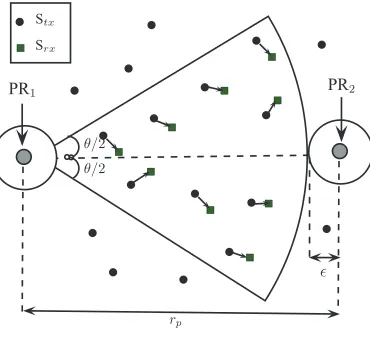
Figure 1. Network Geometry
that are aware of the messages of both the terminals. [7] and [17] are the fundamental works that introduced the concept and performance bounds of network coding. A detailed overview of various network coding based techniques can be found in [6]. However, to the best of our knowledge, this technique has not been explored in the context of DSL.
A comprehensive survey in [18] addresses the application of different games to model dynamic spectrum sharing. Previously, in [5], [16], a linear search based algorithm followed by a Stack-elberg game was proposed to divide the leasing time between the primary and secondary activities. However, it does not cater for mutual agreement on leasing time division if 1) primary chooses a selfish time distribution as the leader and 2) the secondary in turn plays suboptimal strategy to hurt the interest of the primary in successive realizations of the game. Nash bargaining has been used for solving various problems of resource allocation in wireless networks e.g., [19] and it is shown to attain a Pareto optimal solution that specifically discourages selfish behavior in the network. However, it has not been exploited to model leasing time division for two way primary communication by any previous study.
To the best of our knowledge, none of the above mentioned studies consider network coding for two way DSL communica-tion. The game theoretic modeling and setup of DSL such that the spectral and energy efficiency of the communication is improved as compared to direct transmission is our novel contribution.
III. SYSTEMMODEL
We consider a legacy network consisting a pair of primary nodes that communicate with each other in half duplex mode. Along with the primary network, the collocated cognitive sec-ondary users also form a wireless ad hoc network.
A. Physical Model
We consider one of the primary source node, sayP R1 located
at the origin. The second primary source node, P R2 is located
at a fixed distance rP from the origin. Each primary source communicates to the other primary node at a fixed transmit power
Ptfor a duration T.
In order to quantify the geometry of the collocated cognitive radios, we consider secondary nodes that constitute an infinite Stationary/homogeneous Poisson point process (PPP)Φ[20] with intensity λ, in terms of the number of nodes per unit area. Considering that the secondary nodes form a homogeneous PPP, the CR nodes are uniformly distributed in space. For the purpose of relaying, the primary nodes select a sector, sec(rP, θ), of radius
rP and angle θ. Inspired by maximum forward progress based relaying strategies [21], the cognitive nodes lying within this sector become the potential DSL relays. Here, we also consider a small disk of radius ǫ from which CRs are not selected for cooperative relaying. This constraint ensures that CRs lying very close to any one of the primary nodes do not participate in cooperation because their distance from the respective primary receiver will be nearly equal to the direct link distance. Hence, a significant gain in transmission rate cannot be obtained using these relays due to the path loss incurred. The area of the cooperation sector is given asAc= θ2 (rP−ǫ)2−ǫ2 where
θ∈[0, π] ;ǫ≥1.
The selected relays also form a PPP Φr ⊂ Φ with a total number of nodesk=λ|Ac|. A graphical illustration of the oper-ational network geometry is given in Fig. 1. The secondary nodes form a bipolar transmitter-receiver structure. Once spectrum is leased to the secondary transmitters Stx for their own activity, they transmit to their respective receivers Srx located at a fixed distance r0 from the respective transmitters. As shown in [22],
such network model is simple and easy to follow, Also it is shown that it is easily extendible to nearest neighbor model where the receiver of a particular transmitter is assumed to be its nearest neighbor relaxing the fixed distancer0 assumption.
We consider a wireless channel that suffers from path loss and fading. For a distance r between any two nodes, the channel between them can be expressed asahl(r)[23] where the fading power gain h between any two nodes is an independent and identical (i.i.d.) exponentially distributed random variable with unit mean.a is a frequency dependent constant. For the sake of simplicity, we consider it to be unity throughout the discussion.
l(r) = min(1, r−α) is the distance dependent path loss upper bounded by unity for source-destination pairs located very close to each other. Also,α≥2is the path loss exponent. The noise at the receiver front end is considered to be additive white Gaussian with powerσ2.
B. MAC Model
During direct two way communication, each primary node transmits at a power Pt achieving a rate RP P for a time T. In DSL, the primary network aims to achieve the same two-way transmission rateRP P during time2T using lesser transmit power.
1) Selection of Cooperating CR relays : In DSL, the primary signals its willingness to lease the spectrum to the secondary relays over a control channel. We assume that secondary nodes employ listening on the control channel. This beacon contains the durationT = 2T and angleθ of lease. The CRs are assumed to be aware of their location with respect to the primary transmitter and receiver. On the reception of the leasing beacon (containing
Pt Transmit Power of the primary Ps Transmit Power of the secondary rP Distance between two primary users Φ Point process of the secondary users
T = 2T Total time for DSL θ Angle of cooperation
λ Density of secondary users ǫ Protective disk radius
Ac Area of cooperation h Rayleigh faded channel coefficient r0 Distance between two secondary users α Path loss coefficient
σ2 Power of AWGN at receiver front qsp Success probability of secondary to primary communication qps Success probability of primary to secondary communication tsp Time reserved for secondary to primary communication
tss Time reserved for secondary to secondary communication tps Time reserved for primary to secondary communication nP P No. of successfully transmitted bits in direct communication nDSL No. of successfully transmitted bits in DSL communication
Table I SYMBOLS USED
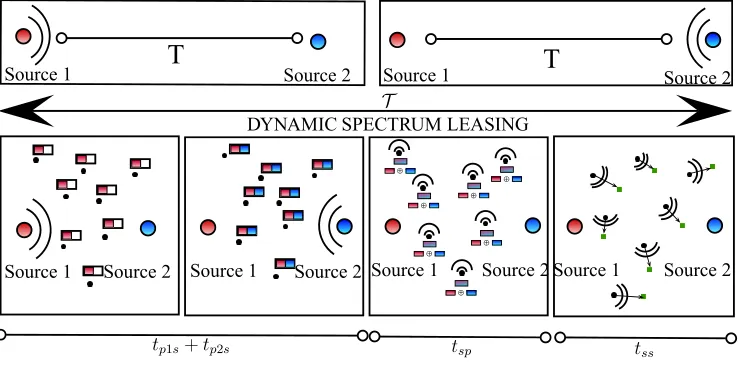
2) Communication in DSL mode: Beacon enabled signaling is adopted for DSL to initiate and agree on leasing parameters. Spectrum leasing for timeT = 2T takes place in the following three phases (also see Fig. 2).
• Each primary source transmits its data to be relayed to its
receiver to the secondary nodes lying in the cooperation region for a time tp1s and tp2s at a rate Rp1s and Rp2s respectively. During this phase, the transmit power of the primary sources isPˆt< Pt. Such low power communication exploits the geometric selection of cooperating nodes in the vicinity of both primary users and maintains low energy costs.
• The cooperating secondary nodes perform network coding
to combine the two primary signals as in eq. 1. The coded data D is then transmitted at the physical layer to both the primary nodes by forming a distributed antenna array employing Distributed Space Time Coding (DSTC)1. At the physical layer, this transmission is done at a rate Rsp and powerPs< Ptfor a duration tsp such that
tp1s+tp2s+tsp<T
• Finally, for the remaining time, the secondary nodes gain an
exclusive access to the channel. During this time tss, they transmit to their respective receiver at a rateRSS and power
Ps. This time is the fare that the primary network has to pay for the relaying services of the secondary nodes.
3) Bargaining game: During the process of leasing, the most crucial factor is the division of leasing time between the above three phases. It is important that each operational element of the network gets enough share of time to meet its transmis-sion throughput requirements. To ensure such time divitransmis-sion, we formulate a network level game where each of the player, i.e., primary network (player 1) and the secondary network (player 2) engage themselves in the arbitration for the time division over a control channel. In our case, the primary user initiates the leasing process. In response, the secondary users determine their demand and adopt a strategy according to the primary offer. If the offer is acceptable, the game is concluded and leasing is successful. If the CRs want to bargain further, another round of offer and respective response is played. In case the negotiations are unsuccessful, the game ends and the leasing is not done. It is further assumed that the CRs form a homogeneous network in terms of the hardware platform and leasing time demand and they do not show malicious
1Ideal orthogonal codes are considered here where the details of DSTC
codebook and operational parameters can be found in [5],[24].
behavior. We will come back to such division of time in Section IV-B.
C. Assumptions
For simplicity and tractability of the analysis, we assume that the primary and secondary network are aware of the CSI within their respective networks. A practical implemetation of such information exchange can be found in [25]. Also, both the primary and secondary are assumed to be aware of the average fading characteristics of their link with each other (phase I:
P R1,2 toStx and phase II:Stx toP R1,2). These characteristics
are assumed to remain constant over a significant number of transmission blocks due to quasi-static geometry and slow fading in the channel. The CRs are aware of their location with respect to the primary transmitter and receiver. Moreover, the primary and the secondary users are considered to be in perfect time synchronization with each other. Cost effective methodologies for implementing time synchronization in ad hoc networks have been suggested in [26] hence encouraging us to propose a time sharing based communication scheme. The control beacon signal by the primary user to initiate spectrum leasing can be used for synchronization between the primary and the secondary nodes. Most of the important symbols used in the paper have been gathered in tab. I.
IV. GEOMETRICANALYSIS OFDYNAMICSPECTRUM
LEASING
In order to accurately model DSL, we carry out a detailed anal-ysis of its performance determinants like average link capacities and time division in the discussion to follow. Our determination of the DSL transmission rate and time is strictly driven by the actual CR densities and inter-node distances following a Poisson geometry.
A. Average Link CapacitiesRP P,Rp1s,Rp2s,Rsp andRSS
In conventional two-way communication, the data transmission rate Rbetween each primary source destination pair is given by
R = log2(1 +SNR) (b/s/Hz), (2)
where signal to noise ratio (SNR) measured at the receiver is Pthpl(rP)
σ2 and hp is the channel power gain between the source and the destination, Pt is the transmit power and l(rP) is the distance dependent path loss2between the nodes. Note that since
2Due to the assumption that there is no transmitter withinǫ≥1distance from
bothPtxandPrx,l(rP)is assumed to be r1α P
⊆±↔→≈ ⊆±↔→≈ ⊆±↔→≈ ⊆±↔→≈ ⊆±↔→≈ ⊆±↔→≈
[
⊆±↔→≈ ⊆±↔→≈
[ [
[ [
[ [
⊆±↔→≈ ⊆±↔→≈ ⊆±↔→≈ ⊆±↔→≈
⊂
⊂
⇐⋅∈⇔⇑⊂ ⇑∇⊄⋅⇑⇓⊂⋅∇
⇐∩⇓⋅⇑ ⊆∠⇔⇑⊂∈⊄ ⇔⇓⊆⋅∧
←
°↑⌡←°↑ ←↑° ←↑↑
[image:6.612.119.488.51.236.2]⊂
Figure 2. Direct communication and Dynamic Spectrum Leasing
the distance between the two nodes is fixed and we consider the channel gain hp to be symmetric, it is safely assumed that the communication rate from P R1 toP R2, is the same as the
transmission rate from P R2 toP R1. In practical networks, the
primary maintains a certain QoS for its communication. Here we define this QoS ρ-outage rate, RQoS, as the largest rate of transmission R such that the outage probability on this link is less than ρ.
Lemma 1. The ρ-outage rate, RP P, for the link (P R1,P R2) is given as
RP P = log2
h
1−Ptl(rP) σ2
ln (1−ρ)i (b/s/Hz), (3)
Proof: According to eq. 2, the instantaneous data transmis-sion rate from P R1 to P R2 depends upon the channel gain hp between the source and the destination. However, to maintain the transmission quality of the link, i.e.,R≥RQoS, we calculate the probability of outage on this link. Mathematically
pout = Pr{log2(1 +SNR)< RQoS},
= Pr
hp< 2RQoS−1
σ2
Ptl(rP)
,
Using the exponential distribution of the channel power gain, the
ρ-outage probability becomes
ρ = 1−exp
− 2RQoS−1
σ2 Ptl(rP)
.
The transmission rate RP P achieved between a typical primary source-destination pair for a given quality of service constraintρ
is
RP P = log2
1−
P
tl(rP)
σ2
ln(1−ρ)
, (4)
which is the rate that satisfies the primary QoS (pout< ρ). When the spectrum is leased to the secondary users, the cooperative link performance is dictated by the cooperative ca-pacity. As mentioned earlier, nodes centered only in the effective area of communication, Ac, are considered for cooperation.
The cooperative capacity depends upon the transmission rates
Rp1s, Rp2s and Rsp achieved in the first two leasing phases. It is important to mention that the overall performance of the cooperative communication link will be bounded by the minimum transmission rate of all the relays during the first phase. For simplicity of analysis, we consider that the relay at the maximum distance from the primary transmitter will result in the worst rate performance. We bound the rate by the worst case performance by considering the distance between and primary transmitter,P R1,2,
and the relay node to be maximum. Also, assuming the point processΦto be stationary, theaverage worst rateRp1sfromP R1 to its farthest relay is equal to the rate Rp2s from P R2 to the relay at the farthest distance from itconsidering a static geometry and average channel effects. Hence we denote the minimum rate of the first phase as Rps.
The effective DSL capacityRDSL is then given as [27],
RDSL = min{qpsRps, qspRsp} (b/s/Hz) (5)
where, qps andqsp are the probabilities that the communication in the first phase at rateRpsand in the second phase at rateRsp are successful.
Lemma 2. The average transmission rate from any primary transmitter P R1,2 to the farthest secondary relay, Rps, is given
as
Rps = log2
1 +
1−exp(−λθ
2(rP−ǫ)2)
(rP−ǫ)−C
α
ˆ
Pt σ2
(b/s/Hz)
(6)
Proof:At any secondary relayiat a distanceri, the achieved communication rate is,
Rpsi = log2
"
1 +Pˆthpsil(ri)
σ2
#
, (7)
wherehpsi is the channel gain between P R1,2 and the arbitrary
relay i and l(ri) is the path loss and Pˆt≪ Pt is the transmit power. The average rate Rpsi at any typical relay can be found
the distance betweenP R1,2 and the relay node to be maximum.
The average distance3E[rn]from a node to its farthest neighbor within a sector with angle θ and radius rP i.e., sec(rP, θ) in a 2-dimensional PPP can be found out on the same lines as in [28] to be
E[rn] =
(rP−ǫ)−C
1−exp−λθ2(rP−ǫ)
2 (8)
where C = p π
2λθexp
−λθ
2(rP−ǫ) 2
erfi
q
λθ
2 (rP−ǫ)
and erfi(x) is the imaginary error function such that,
erfi(x) =√2 π
x
t=0
exp −t2
dt.
Using the above relation, the rate of transmission fromP R1,2to
the farthest neighbor (n=k) can be found. Jensen’s inequality can be applied to find the average value of the transmission rate using the fact that E[hpsn] = 1
4. From eq. 8, the average path
loss can be calculated if the secondary node density and the area of cooperation are known. Hence, as stated before, assuming the stationarity of the point processΦ, the average rate of the furthest relay in the first phaseR¯psis upper bounded by,
Rps≤log2
1 +
1−exp−λθ2(rP −ǫ)
2
(rP−ǫ)−C
α ˆ Pt σ2
. (9)
and the other relays can achieve a better rate than eq. 9. In the second phase of cooperation, the selected secondary relays form a k antenna array and perform DSTC to send the data to the receiver with a rate Rsp. The primary data is relayed by the set of CRs located towards the center of the sector of cooperation. Such geometric considerations allow us to assume that the same rateRsp is achieved between the relay set of CRs and both the primary nodes.
The rate of communication when DSTC is employed for multi-ple relay transmission to a common destination has been evaluated in [5], [29], [24]. In the context of the geometric modeling of dynamic spectrum leasing, we use the DSTC communication rate and determine its mean value considering the geometric parameters.
Lemma 3. The average transmission rate, Rsp, when k
sec-ondary relays, i.e., k ∈ Φr form an antenna array, where
secondary relayi is located at a distance ˆri fromP R1 orP R2 is given by
Rsp = log2
h
1 + λθPs σ2
(
rP−ǫ)2−α−ǫ2−α
2−α
i
(b/s/Hz),
(10) where, the secondary transmits with a powerPs,the channel gain
betweenStx andP R1,2 ishspi.
Proof: The rate of the DSTC communication with k relay nodes is given as,
Rsp= log2
"
1 + X
i∈Φr
Pshspil(ˆri)
σ2
#
.
3Due to the stationarity of the point process, we safely assume that the distance
rncan be measured while considering the primary transmitter to be at the origin. 4Log functions are considered to be convex and Jensen’s inequality which is
only applicable to convex functions is used to bound the communication rate in eq.7. Throughout the rest of the paper, Jensen’s inequality is applied on convex functions.
Similar to the previous discussion, we again apply Jensen’s inequality to find the average secondary to primary transmission rate Rsp. In this case, the aggregate contribution to the received power due to the channel gains and the distances of all the relays P
i∈Φr hspi
ˆ
rα
i from the primary receiver can be calculated using
Campbell’s theorem for stationary Poisson point process [20]. In our case, the region of interest is the two dimensional area bounded by the sector of radiusrP−2ǫand angleθ in radians. Using the Campbell’s theorem for this area, the expectation results in
E
" X
i∈Φr
hspi
ˆ rα i # =λθ (r
P−ǫ)2−α−ǫ2−α
2−α
.
Using the above value for E
h P
i∈Φr hspi
ˆ
rα i
i
, the average rate comes out to be as in eq. 10.
In the third phase of spectrum leasing, the secondary transmit-ters of the cooperation region communicate with their respective receivers. We consider a bi-polar model of the secondary source-destination pairs [30] as shown in Fig. 1. We are interested in knowing the average transmission capacity of the(Stx,Srx)link, RSS. In this case, all the secondary transmitters in the cooperation region simultaneously communicate with their receivers in order to utilize the leased bandwidth for their own transmission. In this phase, similar to the direct communication, we consider a realistic situation under which the secondary network also operates under a fixed QoS constraint ρs.
Lemma 4. The average ρs-outage rate, RSS, for the link
(Stxi,Srxi), where the channel gain between the source i and
its destinationhssi is exponential, the transmit power isPs and
the distance between them isr0 is given as
RSS = log2
1−
l(r0) σ2 Ps+κ1
ln (1−ρs)
(b/s/Hz) ,
(11) whereκ1 is the average aggregate interference.
Proof: The Signal to Interference plus Noise Ratio (SINR) at the secondary receiver can be quantified as,
SINR= Pshssil(r0)
σ2+P
j∈ΦrPshssjl(rj)
where,hssj is the channel gain between the secondary transmitter j causing interference at Srxi at a distance rj. The aggregate
interference at any receiver is denoted asI=P
j∈Φrhssjl(rj).
Followed by the proof of lemma 1, the transmission rate achieved between a typical secondary source-destination pair for a given quality of service constraintρscan be stated. However, here we are interested in the average rate. From Jensen’s inequality, the average ρs-outage rateRSS is
RSS ≥ log2
"
1− σ2l(r0) Ps +E[I]
!
ln(1−ρs)
#
. (12)
rate RSS, it is essential to first quantify the average amount of interference,
E[I] =E
X
j∈Φr
hssjl(rj)
.
Using the definition of Laplace Transform and taking expectation over both the point process and fading in the above integral,
Eexp−sI = EΦ
Y
j∈Φr
Eh
h
exp(−shjl(rj))
i
.
From the definition of probability generating functional [20], the integral takes the form,
Eexp−sI=exp(−Eh[
Rd(1−exp(−shl(r)))λdx]). (13)
Cumulants of a probability distribution can be defined in terms of the moment generation function (MGF)
κn = d n
dsnln E
expsI|s=0. (14)
We use eq. 13 and the definition in eq. 14 to find the cumulants of interference ford-dimensional network as
κn =−λEh
h
n
R2∩sec(θ,(rp−ǫ))
r−αnexp(shr−α)drd−1dr
.
(15) For any positive value of n, eq. 15 evaluated at s = 0 gives the nth cumulant κ
n of the interference distribution. The first cumulant of the distribution for a two dimensional network, i.e.,
d= 2, can be calculated as,
κ1=E[I] =λθ (rP−ǫ) 2−α
−ǫ2−α
2−α
!
. (16)
The average aggregate interference can be used to determine the ρs-outage rate following eq. 12. It is worth mentioning here that the average interference calculated using the first cumulant results in the same equation as for the average aggregate signal coming from various secondary relays to the primary receiver in phase II. Hence cumulant based approach is an alternative way of calculating the aggregate signal from spatially distributed transmitters under Rayleigh faded channel.
After computing the individual link transmission rates, we are interested in knowing the overall transmission rate achieved in the DSL operational mode. We assume that a decode and forward type single hop relaying mechanism is used in the cooperation phase. The effective DSL capacity RDSL is then given as eq. 5. The probability of successful DSL transmission
(psuc= 1−pout)is dependent upon the probability of successful
P R1andP R2 toStx(phase I) andStxtoP R1 andP R2(phase
II) transmission. These probabilities can be denoted asqpsandqsp respectively as in eq. 5. In order to ensure successful transmission and get the same outage capacity via the cooperative link, pout in both the phases of DSL should be less than or equal to the maximum acceptable outage ρ, of the direct primary link. For the first phase, the probability qps = Pr
Rps> RP P can be expressed as,
qps=exp
−2RP P −1r α nσ2
ˆ Pt
. (17)
As in eq. 9, the average value of this probability can be estimated using eq. 8 depending upon the cooperation area and user density. Similarly, the probability of successful transmission in the cooperative relaying phaseqsp can be written as
qsp=Pr
X >2RP P −1σ
2
Ps
, (18)
whereX =P
i∈Φr hspi
ˆ
rα
i follows the same distribution as that of
interference in eq. 11. By the definition of Chebyshev’s bound, the above inequality can be approximated to
Pr X >
2RP P −1
σ2 Ps
≤ κ2
2RP P −1
σ2 Ps −κ1
2.
(19) Utilizing the fact that cumulants of the interference are related to the parameters of the distribution asκ1=E[I]andκ2=Var[I],
the probabilityqps takes the form,
qsp=
λθ(rP−ǫ)2−2α−(ǫ)2−2α
2−2α
2RP P −1
σ2 Ps −λθ
(
rP−ǫ)2−α−(ǫ)2−α
2−α
2, (20)
whereκ1 andκ2 can be found using 15.
B. Division of Leasing Time between Phase I, II and III
The most critical factor in the operation of spectrum leasing is the optimal division of the total leased time T between the time tp1s, tp2s , tsp and tss reserved for the primary and secondary communication. Since our geometrical evaluation of the achievable rate from both primary transmitters to the sec-ondary relays is shown to be bounded by equal average minimum transmission rate Rps, we denote tp1s = tp2s = tps. The goal of the primary node is to ensure that its time-rate product of communication tpsRDSL and tspRDSL at a certain ρ-outage probability is maximized i.e.,tpsRDSL> T RP P by maximizing the time tps and tsp for which the primary sources 1 and 2 transmit the data to be relayed to the cooperating secondary nodes respectively and the time for which the CRs relay the data to the primary nodes after applying network coding.
The goal of the secondary nodes is to maximize their share in time so that they get reimbursed for their network coding and cooperative relaying services by getting maximum time tss to communicate with Srx at a target rate RSS. However, the secondary network must cooperate in relaying primary data for a timetsp long enough so that the primary network can increase its throughput while maintaining its communication standards. Longtps,tsp versus a very small fraction oftss will discourage the secondary to cooperate while prolongedtss will degrade the performance of the legacy network in terms of its bandwidth efficiency. Hence an intelligent division of time is very crucial for the operation of the network.
considering only the average rate values and equal transmit powers for all DSL phases. The Nash bargaining framework is employed to model a situation in which the players negotiate for their agreement on a particular point out of a set of joint feasible payoffs G. In a two player Nash Bargaining game,
G ≡ {g= (g1, g2) :gi=fi(S), i= 1,2;S∈S1×S2}, where the functions fi(.) represent the individual utilities of the two players. S is the strategy of the ith player from the strategy profile Si. In Nash Bargaining, in case the negotiations render unsuccessful, the outcome of the game becomesG0= (g01, g02).
It is a fixed vector known as the disagreement vector where
g01, g02are the utilities of the two players in case of disagreement.
The whole bargaining problem can be described conveniently by the pair(G, g0). A pair of payoffs(g∗
1, g
∗
2)is a Nash Bargaining
solution if it solves the following optimization problem
maxg1,g2(g1−g01) (g2−g02), (21)
subject to (g1, g2) ∈ G
(g1, g2) ≥ G0 .
If the set G is compact and convex, and there exists at least one g ∈ G such that g > g0, then the unique solution to the
bargaining problem(G, g0)corresponds to the unique solution of the optimization problem [19],[31] .
In our case, the primary transmitter is the first player whose utility is directly dependent upon the transmission time tps and cooperation timetspand increases as it increases. For simplicity, we define the utility of the primary and the secondary node as;
f1(t) =
(
tps phase1
tsp phase2
and f2(t) = tss (22)
respectively5, where2t
ps+tsp+tss=T .
The time demand of each player i.e,.tpsandtspfor the primary node and tss for the secondary node are the strategies chosen from their respective strategy profiles. In this case, the fraction of leased time should be large enough to ensure that the time-rate product of broadcast phasetpsRpsand the cooperation phase
tspRsp is greater than the direct communication time T and rate RP P product. During the second sub-interval, a secondary node must have enough time to at least overcome its cooperation cost cPst0sp given its average transmission rate RSS. Here c measures the bits transmitted per Watt of power consumed. Hence, the disagreement vector of our Nash Bargaining game becomes RP PT
qpsRps, RP PT qspRsp,
cPst0sp RSS
whereg01 is the joint utility
of the first two phases RP PT qpsRps and
RP PT
qspRsp andg02 is cPst0sp
RSS .
Lemma 5. The optimal proportion of time for cooperative relaying is a solution to the following maximization problem
max (log (tps−t0ps) + log (tsp−t0sp) + log (tss−t0ss)), (23)
subject to tpsqpsRps = tspqspRsp T = 2tps+tsp+tss .
where the disagreement vector is
(t0ps, t0sp, t0ss)=
RP PT qpsRps,
RP PT qspRsp,
cPst0sp RSS
.
5from eqs. 22, the compactness and convexity ofGis straightforward.
Proof: The first constraint ensures a division of time such that equal time rate product is attained in the first and the second phase. This results in a unique time fraction for which both primary source nodes can receive the coded data at equal transmission rate. The second constraint ensures that the time fractions reserved for each phase do not exceed the time required in ordinary two-way communication.
From the definition of Nash Bargaining solution, the time divi-sion problem for a 2-player game can be written in a logarithmic form. Such representation of the maximization problem ensures proportional fairness of the solution for both the players. The corresponding Lagrangian for the above optimization problem can be written as follows
L(tps,tsp,λ1,λ2)= log (tps−t0ps)+ log (tsp−t0sp)
+ log (tss−t0ss)+λ1 tpsqpsRps−tspqspRsp
+λ2(T −2tps−tsp−tss) (24)
We simplify the Lagrangian by eliminatingtss and replacing it bytss =T −2tps−tsp. The maximization problem can be solved by using the Karush-Kuhn-Tucker (KKT) first order necessary conditions [21],
δL δtps
= 1
tps−t0ps+
2 2tps−T+t0ss+tsp
+λ1(qpsRps)−2λ2= 0.
(25)
δL δtsp
= 1
tsp−t0sp+
1
tsp−T+t0ss+2tps
−λ1(qspRsp)−λ2= 0
(26)
and
λ1 tpsqpsRps−tspqspRsp
= 0, λ1≥0, λ(T −2tps−tsp−tss) = 0, λ2≥0.
Here we assume that λ2 = 0. From the definition of the Nash
Bargaining problem there exists a vectorSsuch that the optimal
value of the optimization problem is strictly positive. From the constraint on the operational rate-time product, it can be seen thattps= tspqqspRsp
psRps . Using this relation to solve forλ1 by using
simple algebra, we get a quadratic equation intspas given in eq. 27.
Using eq. 27, the values of tps and tss can be obtained. It is important to mention that only positive root of eq. 27 is considered because it maximizes the utilities of all three phases for both players. As a consequence of the first constraint in 23, the effective number of bits that get transmitted to both the primary sources in DSL is tpsRps or equivalentlytspRsp.
V. ANALYTICEVALUATION OFDSL
t2
sp
3 +6qspRsp qpsRps
+2t0ss−t0ps−qqpsRps
spRspt0ps− T
−4t0ps+t0spqqspRsp psRps −T
tsp
+t0pst0sp
q
psRps qspRsp + 2
−t0spt0ss+t0pst0ssqqpsRps spRsp+T
t0sp+t0psqqpsRps spRsp
= 0 (27)
0 10 20 30 40
10−6 10−4 10−2 100 102
SNR (dB)
Rate (bits/s/Hz) RPP
Rsp
Rps
Simulation λ=0.1
λ=0.05
[image:10.612.74.458.103.295.2]λ=0.5
Figure 3. Transmission rates in direct and DSL communication, rP = 10,
θ=π
2 ǫ= 1,Pt= 1,Pˆt= 0.2,Ps= 0.2.
is generated. The transmission rate at the receiver for each spatial instance of the network is averaged for 104 different channel
coefficients. This process is in turn repeated for104 realizations
of Poisson distributed CR network with intensity λ. Secondary network communication under interference considerations is also studied in a similar fashion. All the simulations are carried out in MATLAB.
A. Transmission Rates
Firstly, we study the average achievable transmission rates under both the normal and leasing mode of network operation as shown in Fig. 3. The rate under direct primary communication at a transmit powerPtincreases with improving channel conditions. Here, the reliability in terms of the probability of success(psuc)of direct communication is assumed to be90%. The outage capacity for such quality of service,RP P, defines the target capacity for communication in the primary network,RQoS, for all operational modes i.e., direct and DSL. Under identical channel realizations, a demand for higher service quality (smallerρ) straightforwardly results in lower RP P. The rate when P R2 transmits toP R1, is
the same as achieved whenP R1transmits toP R2due to similar
average channel characteristics and constant link distance. For the capacity analysis of DSL, we study the average achievable transmission rates in the three phases of leasing. The capacity of the primary to secondary communication in the first phase is strongly dependent upon the number of secondary nodes present in the area of cooperation. As mentioned earlier, in our analysis, we consider the lower bound to this rate by considering the average transmission rate between the primary transmitter and the furthest relay. In Fig. 3, the rate from one primary source to the furthest CR node is shown. The same rate is achieved by the other primary source. For very low secondary density, e.g.,
0 10 20 30 40
10−3 10−2 10−1 100
SNR (dB) R S
S
(bits/s/Hz)
[image:10.612.331.543.107.292.2]λ=0.05 λ=0.1 λ=0.5 Simulation
Figure 4. Communication rate duringStx-Srxtransmission,r0= 1,ρs= 0.1,
Ps= 0.2.
λ ≪ 0.05, the probability of finding a neighbor in the region of cooperation is extremely low. For this reason, the capacity analysis for very sparse secondary network is not possible since the transmission rates fromP R1,2to the CRs are nearly zero.For
higherλ, it can be seen from Fig. 3 that the average transmission rate Rps is greater than direct communication at lower transmit powerPˆt. This phenomenon is a consequence of such cooperation region selection that relays are located in a close proximity to bothP R1 andP R2. Hence greater rate at lower transmit power
is attained due to shorter distance between the relay and P R1.
However, if the number of secondary users increases in the cooperation region, the average distance between the transmitter
P R1,2 and the farthest node increases which follows from the
average distance quantification in eq. 8. Hence Rps decreases whenλincreases (lower line in Fig.3). However, the cooperative relaying rate Rsp increases with increasing relay density due to the diversity gain (upper line in Fig.3). Increasingλincreases the number of cooperating nodes, consequently, the rateRsp≫RP P for increasing values ofλ.
We now show that the ρs-outage communication rate RSS also increases with improving SINR values in Fig. 4 however, it is interference limited in higher SNR regions (here the desired QoS of the secondary network in terms of the outage probability
ρs is 10−1). This is a consequence of the improved signal strength at the receiver. However, as the density of the secondary nodes increases, the average transmission rate decreases due to the increased interference. It is clear that increasing the outage constraint from10−1to10−2, causes the average rate to decrease
because the decoding threshold atSrxis raised. Hence, a graph-ical illustration of this result is intentionally skipped.
5 10 15 20 25 30 35 40 0.5
0.55 0.6 0.65 0.7 0.75
SNR (dB)
Time (sec)
λ=0.1 λ=0.05 tps
t
[image:11.612.332.540.43.225.2]ss
Figure 5. Nash Bargaining based division ofT = 2T = 2between the1st
and 3rd
DSL phase,λ= 0.5.
3. The practical simulation results are indicated by the solid lines running over the analytic results (analytic results are indicated by lines with markers). It can be seen that the practical simulations closely match the analytic evaluation results. It validates our analytic formulation of DSL and the simplifying assumptions and bounds used for the simplification of the analysis. The practical simulation results of RSS are also shown in Fig. 4. It is to be noted that the rest of the results are based upon the communication rates of direct and DSL communication, which we have shown to be in close agreement with each other. Therefore, the practical simulations of the remaining results are skipped for the sake of brevity. Similarly, smaller sector sizes reduce the number of effective relays in the cooperation region and greater transmit powers enhance the communication rates in all phases. Hence, these parametric variations and their detailed study is intentionally skipped.
B. Division of Leasing Time
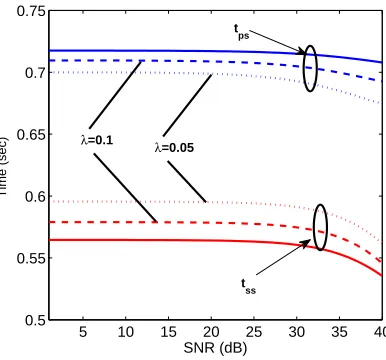
After analyzing the transmission rates, we now study the equilibrium division of leasing time between the three phases of DSL. Fig. 5. shows the proportion of time allocated for the first and last phase. It can be seen that under all signal propagation conditions, the time required for the first phase is the highest. This is because as seen in the previous discussion (Fig.3), Rps is the lowest of all other DSL rates. In order to maximize the gain in primary data transmission, tps is higher in order to meet the condition , tpsqpsRps > T RP P,. At higher CR densities, the time required by the CRs in the first phase also increases due to lower achievable transmission rate. In total
2tps time is spent in the first phase by both the primary sources in transmitting their data to the secondaries. On the other side, sinceRsp> RP P, Rps, the second phase is allocated lesser time. It can be seen in Fig. 6. However, the division of the time is such thattpsRps=tspRsp> T RP P. For sparse CR network, the time
tsp is greater as the number of relays are fewer. The difference
∆tbetween the minimum time required by the CRs in the second phase (t0sp) and the time division output of the bargaining game (tsp) is also shown in the fig. 6. Positive values of∆tshow that
0 10 20 30 40
10−5 10−4 10−3 10−2 10−1
SNR (dB) t sp
(sec)
0 20 40 0
0.02 0.04 0.06
SNR (dB)
∆
t=t
sp
−t0sp
(sec)
tsp
t0sp
λ = 0.05
λ = 0.05
λ = 0.1
Figure 6. Reserved time for the second phase,λ= 0.5.
the bargaining solution provides enough flexibility to incorporate the practical time required for network coding and distributed STC is considered.
The time reserved for secondary activitytss in the third phase is also shown (Fig. 5). To compensate for their energy costs in the second phase and deteriorated rate performance due to interference in the third phase, the CRs are given a reasonably high time for their activity specifically at low CR densities. It is important to emphasize again that at densities much lower than 0.05, the transmission rates become so low that successful bargaining can not be established for a fair time division. Hence, analysis of lowerλvalues is not possible.
In Fig. 7, we show the increase in the time-rate product achieved by using DSL under a geometric and Nash Bargaining setup. The results indicate that DSL provides significant gain in the number of bits that are successfully transmitted in DSL as compared to the number of bits (2T RP P) in direct two way communication. This happens because the geometric vicinity and network coding services of the CR nodes provide higher transmission rates. Such enhanced performance is attained only when enough incentive is available for the secondary nodes to cooperate with the primary network. It can be seen that very high CR node densities, the first phase rateRpsgets down nearly equal to RP P. As a result, the bargaining game only results in such division that the time demands of all the players are merely satisfied. However, when the secondary network is sparse, the gains in the time rate product are up to 54%. Hence DSL under sparse secondary network maximizes the number of bits communicated successfully between the two primary networks.
VI. ENERGYEFFICIENCY OFDYNAMICSPECTRUMLEASING
In this section, we define and quantify the energy efficiency (EE) of the spectrum leasing model for cognitive radio networks. We define energy efficiency as the number of bits transmitted successfully across the channel per unit of energy consumed, given as,
EE= nB
[image:11.612.64.257.45.225.2]10 15 20 25 30 35 40 0
0.1 0.2 0.3 0.4 0.5 0.6 0.7
SNR (dB)
Time−Rate Product (bits/Hz)
2TRPP
tpsRpsλ=0.05
tpsRpsλ=0.1
TpsRpsλ=0.5
10 20 30 40
10−4 10−3 10−2 10−1 100
SNR (dB)
[image:12.612.327.542.43.229.2]Time−Rate Product (bits/Hz)
Figure 7. Time-Rate Product of un-coded Direct vs. NC based DSL based two way communication.Pt= 1,Pˆt= 0.5,Ps= 0.2.
wherenB is the number of bits transmitted successfully andJ is the energy consumed in Joules.
Theorem 1. The energy efficiency of a licensed primary network employing direct communication EEP P and while employing
DSL,EEDSL in terms of the number of successfully transmitted
bits per unit energy can be given as
EEP P =
nP P
T Pt
, and EEDSL=
nDSL
2tpsPˆt+Pstspk (29)
respectively, wherenP P is the number of successfully transmitted bits in direct communication,nDSLare the successfully transmit-ted bits over the cooperative link.
Proof: The number of bits successfully transmitted in the transmission duration of the direct two way linknP P is given as [23];
nP P = 2RP PT, (30)
whereRP P follows from the result in lemma 1.
In case the primary decides to lease the spectrum, the number of bits successfully transmitted in spectrum leasing are given as
nDSL= 2tpsqpsRps=tspqspRsp, (31)
where, Rps and Rsp have been determined in eqs. 9 and 10, respectively6.
The total energy consumed during direct two way commu-nication is 2T Pt and that during DSL based cooperation is
2tpsPˆt+Pstspk where the first term accounts for the energy consumed inP R1,2 toStx communication during the first DSL phase for a time tps and the later for the energy consumption when k secondary transmitters cooperatively relay the data to
P R1,2for a duration equal to the leased timetsp.
Now, we look at the trends of the energy efficiency established above for direct and DSL communication. We are interested in knowing whether the improved time rate products of DSL as seen
6Here we focus on the cost of attaining the higher throughput in DSL and do
not consider the additional implementation costs of DSTC and network coding at the CR and primary transmitters respectively.
0 10 20 30 40
10−5 10−4 10−3 10−2 10−1 100
SNR (dB)
Energy Efficiency EE (bits/Joule/Hz)
EEDSL
EEdir ∆ E
op λ = 0.05
λ = 0.1
Figure 8. Energy Efficiency of Direct vs. DSL transmission,λ= 0.5.
in Fig. 7, come with high energy costs or DSL is also efficient on the energy front.
It is clearly evident that the energy efficiency of DSL is greater than that of direct communication for smaller values of λ (see Fig. 8). This is because the transmit power of the primary and secondary in DSL mode is low. The selection of relays which are geographically closer to both P R1 and P R2 help in achieving
the same transmission rate in lesser time and hence lesser power. Also, the cooperative relaying based diversity benefits significantly increase the throughput at the primary receiver while maintaining a low transmit power. Asλincreases, the EE of DSL decreases mainly due to two reasons;
1) The throughput of the cooperative DSL communication decreases as the average primary to secondary rateRps de-creases with increasingλ(see Fig. 3). The energy consumed in the first phase of DSL grows as the primary to secondary link operation timetpsincreases.
2) Also, in the second phase of DSL, aggregate transmit energy is higher due to increased number of relays. It can be seen that the bargaining based leasing time division results in significantly more energy efficient communication via DSL as compared to direct communication when the secondary network is relatively sparse (i.e., λ = 0.05). Moreover, the difference∆Eopbetween the energy efficiency of direct and DSL based communication is also shown n the figure. The positive values of ∆Eop indicate the available margin of miscellaneous circuitry and implementation energy costs. A future study that extends the DSL operation presented in this paper by discussing a specific hardware platform of the CRs and PUs may benefit from the indicated energy margins and compare their operational system energy efficiency against these results.
VII. CONCLUSION
[image:12.612.57.267.45.226.2]propose a Nash Bargaining based division of leasing time between various phases of DSL so that all the entities of the network maximize their utilities. Geometry based selection of cooperating CR nodes and intelligent division of time enables up to 54% more bits to be successfully transmitted between the two primary sources at more than 10 times lower energy cost. These gains are attained only when the secondary network is relatively sparse. Hence network coding aided DSL under geometry and intelligent time division is a promising technique for future spectral and energy efficient two way wireless communication.
REFERENCES
[1] F. Force, “Report of the spectrum efficiency working group,” Federal Communications Commision, Technical Report, pp. 02–155, 2002. [2] A. Goldsmith, S. Jafar, I. Maric, and S. Srinivasa, “Breaking spectrum
gridlock with cognitive radios: An information theoretic perspective,” Pro-ceedings of the IEEE, vol. 97, no. 5, pp. 894 –914, may. 2009.
[3] L. Feeney and M. Nilsson, “Investigating the energy consumption of a wireless network interface in an ad hoc networking environment,” in
INFOCOM 2001. Twentieth Annual Joint Conference of the IEEE Computer and Communications Societies. Proceedings. IEEE, vol. 3. IEEE, 2002, pp. 1548–1557.
[4] K. Christensen, C. Gunaratne, B. Nordman, and A. George, “The next frontier for communications networks: power management,”Computer Com-munications, vol. 27, no. 18, pp. 1758–1770, 2004.
[5] O. Simeone, I. Stanojev, S. Savazzi, Y. Bar-Ness, U. Spagnolini, and R. Pickholtz, “Spectrum leasing to cooperating secondary ad hoc networks,”
IEEE Journal on Selected Areas in Communications, vol. 26, no. 1, pp. 203 –213, jan. 2008.
[6] C. Fragouli and E. Soljanin,Network coding fundamentals. Now Publishers Inc., 2007, vol. 2, no. 1.
[7] P. Larsson, N. Johansson, and K. Sunell, “Coded bi-directional relaying,” in Vehicular Technology Conference, 2006. VTC 2006-Spring. IEEE 63rd, vol. 2. IEEE, 2006, pp. 851–855.
[8] I. Stanojev, O. Simeone, U. Spagnolini, Y. Bar-Ness, and R. Pickholtz, “An auction-based incentive mechanism for non-altruistic cooperative arq via spectrum-leasing,” in , IEEE Global Telecommunications Conference, GLOBECOM 2009., nov. 2009, pp. 1 –6.
[9] D. Grace, J. Chen, T. Jiang, and P. Mitchell, “Using cognitive radio to deliver green communications,”Cognitive Radio Oriented Wireless Networks and Communications, 2009. CROWNCOM ’09. 4th International Conference on, pp. 1 –6, jun. 2009.
[10] L. Li, X. Zhou, H. Xu, G. Li, D. Wang, and A. Soong, “Energy-efficient transmission in cognitive radio networks,”7th IEEE Consumer Communi-cations and Networking Conference (CCNC), 2010, pp. 1 –5, jan. 2010. [11] Q. Zhang, J. Jia, and J. Zhang, “Cooperative relay to improve diversity in
cognitive radio networks,”Communications Magazine, IEEE, vol. 47, no. 2, pp. 111 –117, 2009.
[12] L. Duan, J. Huang, and B. Shou, “Competition with dynamic spectrum leasing,” IEEE Symposium on New Frontiers in Dynamic Spectrum 2010, pp. 1 –11, apr. 2010.
[13] J. Jia and Q. Zhang, “Competitions and dynamics of duopoly wireless service providers in dynamic spectrum market,” in Proceedings of the 9th ACM International Symposium on Mobile Ad Hoc Networking and Computing MobiHoc, 2008, pp. 313–322.
[14] J. Huang, R. Berry, and M. Honig, “Auction-based spectrum sharing,”
Mobile Networks and Applications, vol. 11, no. 3, p. 418, 2006.
[15] S. Jayaweera, G. Vazquez-Vilar, and C. Mosquera, “Dynamic spectrum leasing: A new paradigm for spectrum sharing in cognitive radio networks,”
IEEE Transactions on Vehicular Technology, vol. 59, no. 5, pp. 2328 –2339, jun. 2010.
[16] Y. Yi, J. Zhang, Q. Zhang, T. Jiang, and J. Zhang, “Cooperative Communication-Aware Spectrum Leasing in Cognitive Radio Networks,” inIEEE Symposium on New Frontiers in Dynamic Spectrum, 2010. IEEE, 2010, pp. 1–11.
[17] S. Kim, P. Mitran, and V. Tarokh, “Performance bounds for bidirectional coded cooperation protocols,” Information Theory, IEEE Transactions on, vol. 54, no. 11, pp. 5235–5241, 2008.
[18] Z. Ji and K. Liu, “Cognitive radios for dynamic spectrum access - dynamic spectrum sharing: A game theoretical overview,” IEEE Communications Magazine, vol. 45, no. 5, pp. 88 –94, may. 2007.
[19] H. Yaiche, R. Mazumdar, and C. Rosenberg, “A game theoretic framework for bandwidth allocation and pricing in broadband networks,” IEEE/ACM Transactions onNetworking, vol. 8, no. 5, pp. 667 –678, oct. 2000.
[20] D. Stoyan, W. Kendall, J. Mecke, and L. Ruschendorf,Stochastic geometry and its applications. Wiley Chichester, 1995.
[21] M. Zorzi and R. Rao, “Geographic random forwarding (geraf) for ad hoc and sensor networks: multihop performance,” Mobile Computing, IEEE Transactions on, vol. 2, no. 4, pp. 337 – 348, oct.-dec. 2003.
[22] F. Baccelli and B. Blaszczyszyn,Stochastic Geometry and Wireless Networks Vol. I and II. NOW, 2009.
[23] A. Goldsmith,Wireless communications. Cambridge Univ Pr, 2005. [24] J. Laneman and G. Wornell, “Distributed space-time-coded protocols for
exploiting cooperative diversity in wireless networks,”IEEE Transactions on Information Theory, vol. 49, no. 10, pp. 2415 – 2425, oct. 2003. [25] R. Etkin, A. Parekh, and D. Tse, “Spectrum sharing for unlicensed bands,”
Selected Areas in Communications, IEEE Journal on, vol. 25, no. 3, pp. 517 –528, april 2007.
[26] A. Goldsmith and S. Wicker, “Design challenges for energy-constrained ad hoc wireless networks,”Wireless Communications, IEEE, vol. 9, no. 4, pp. 8 – 27, aug. 2002.
[27] A. Host-Madsen and J. Zhang, “Capacity bounds and power allocation for wireless relay channels,”IEEE Transactions on Information Theory, vol. 51, no. 6, pp. 2020–2040, 2005.
[28] M. Haenggi, “On distances in uniformly random networks,”IEEE Transac-tions on Information Theory, vol. 51, no. 10, pp. 3584–3586, 2005. [29] T. Elkourdi and O. Simeone, “An information-theoretic view of spectrum
leasing via secondary cooperation,” IEEE International Conference on Communications (ICC), 2010, pp. 1 –6, may. 2010.
[30] F. Baccelli and B. Blaszczyszyn,Stochastic Geometry and Wireless Net-works, Part I: Theory. Now Publishers Inc, 2009.
[31] J. Nash Jr, “The bargaining problem,”Econometrica: Journal of the Econo-metric Society, vol. 18, no. 2, pp. 155–162, 1950.