White Rose Research Online URL for this paper: http://eprints.whiterose.ac.uk/110188/
Version: Published Version
Book Section:
Grillo, Nino orcid.org/0000-0002-8224-365X (2012) Local and Universal. In: Bianchi, Valentina and Chesi, Cristiano, (eds.) Enjoy Linguistics! CISCL Press , Siena , pp. 234-245.
[email protected] https://eprints.whiterose.ac.uk/
Reuse
Items deposited in White Rose Research Online are protected by copyright, with all rights reserved unless indicated otherwise. They may be downloaded and/or printed for private study, or other acts as permitted by national copyright laws. The publisher or other rights holders may allow further reproduction and re-use of the full text version. This is indicated by the licence information on the White Rose Research Online record for the item.
Takedown
If you consider content in White Rose Research Online to be in breach of UK law, please notify us by
Local and Universal
*
NINO GRILLO
Centro de Linguística da Universidade Nova de Lisboa [email protected]
Cuetos and Mitchell 1988, and much subsequent work, report that speakers of different languages differ in Relative Clause attachment preferences in complex NPs. These findings challenged universal theories of processing and in particular the universality of locality in parsing. In this paper, I argue that asymmetries in attachment preference stem from a previously unnoticed grammatical distinction: the availability of Pseudo Relatives. Drawing on previous data and novel results, I conclude that Locality is a genuine universal principle of processing.
To Luigi, A small contribution to a beautiful theory of locality
1. Introduction
Relativized Minimality (Rizzi 1990, 2004, Starke 2001, Grillo 2008) has clear homologues in the psycholinguistic literature, where principles of locality have been shown to regulate both structure building and filler-gap processes (Right Attachment, Kimball 1973; Late Closure, Frazier 1979; Minimal Chain Principle, De Vincenzi 1991; Recency, Gibson 1991; Merge Right, Phillips 1996).
Yet, this picture is not exempt from problems: there is one domain of research in which locality has been claimed not to apply universally. Cuetos and Mitchell (1988) and much subsequent work show that speakers of different languages differ in Relative Clause attachment preferences in complex NP of the form NP1 P NP2: Low Attachment (LA) is found in English (but also Romanian and Basque a.o.), cf. (1a), and High Attachment (HA) in Spanish (and Italian, Dutch, Japanese a.o.),2 cf. (1b).
*
Acknowledgements: The results presented in this paper are part of the project “Syntactic and lexical factors in processing complexity”, funded by the Fundação para a Ciência e a Tecnologia with the research grant PTDC/CLE-LIN/114212/2009 awarded to Nino Grillo. Much of the material presented here is part of a collective effort involving especially João Costa and Bruno Fernandes and is discussed in more detail in Grillo and Costa (2012), Grillo, Fernandes and Costa (submitted). For extensive comments and suggestions and for help with stats, thanks to Andrea Santi. Thanks to Keir Moulton for letting me know that the structures I had discovered were called Pseudo relatives and for pointing me to the relevant literature. For comments, suggestions and help with judgments/literature on PRs in different languages thanks to: Klaus Abels, Boban Arsenijević, Petra Augurzky, Rajesh Bhatt, Janet Dean Fodor, Berit Gehrke,Yosef Grodzinsky, Gueorgui Hristovsky, Axiotis Kechagias, Hans van de Koot, Maria do Carmo Lourenço-Gomes, Donka Mangatcheva, Ad Neeleman, Colin Phillips, Anca Sevcenco, Junko Shimoyama, Natalia Slioussar, Giorgos Spathas, Mina Sugimura, Margarida Tomaz, Larraitz Zubeldia.
2
(1) a. I saw the son1 of the man2 that EC2 was running
b. Vi al hijo1 del hombre2 que EC1 corría
This variation across languages is accompanied by variation across syntactic structures within the same language. Hemforth et al. (submitted), for example, show that Spanish speakers demonstrate LA preference with complex NPs in subject position, e.g. in (2b):
(2) a. Alguien disparó contra la criada1 de la actriz2 que EC1 estaba en el balcón.
Someone shot the maid of the actress that was on the balcony b. La criada1 de la actriz2 que EC2 estaba en el balcón es rubia.
The maid of the actress that EC was-sitting on the balcony is blonde
These findings, which are at odds with the otherwise uniform Local Attachment preference found for other structures in the same languages (e.g. PPs, Phillips & Gibson 1997), led to question the universality of locality in processing and, as a consequence, of the very existence of universal principles of parsing. These doubts, in turn, raise important theoretical problems with respect to a theory of language acquisition. With reference to acquisition, Fodor (1998) pointed out that:
The whole explanatory project (based on the hypothesis) that the processing mechanism is fully innate and applies differently to different languages only to the extent that their grammars differ) is in peril because of the discovery that Late Closure3 is not universal.
This situation is made even more problematic by the observation that attachment preferences and frequency of attachment do not correlate in an obvious way (Gibson, Schütze & Salomon, 1996; Augurzky, 2006 for discussion).
Several syntactic (type of P, position of complex NP, Nominal vs. Clausal context) and prosodic (length of RC, lengthening of tonic syllable in NP2, duration of prosodic breaks) factors have been shown to influence attachment, and several accounts have been proposed to explain this variation (e.g. the Tuning Hypothesis, Brysbaert & Mitchell 1996; Construal, Gilboy et al. 1995, Frazier & Clifton 1996; Predicate Proximity, Gibson et al. 1996; Anaphoric Binding, Hemforth et al. 1998, 2000b,a, Konieczny & Hemforth 2000; Implicit Prosody, Fodor 1998a,b; and much related work). The literature on the topic is extremely
(2000); Brysbaert & Mitchell (1996); Carreiras & Clifton (1993, 1999); De Vincenzi & Job (1993, 1995); Gilboy, Sopena, Clifton & Frazier (1995); Gibson, Pearlmutter, Canseco-Gonzalez & Hickok (1996); Gibson, Pearlmutter & Torrens (1999); Gibson & Schütze (1999); Phillips & Gibson (1997); Kamide & Mitchell (1997); Hemforth, Konieczny, Scheepers & Strube (1998); Hemforth, Konieczny & Scheepers (2000b,a); Hemforth, Konieczny, Seelig & Walter (2000c); Konieczny, Hemforth, Scheepers & Strube (1997); Konieczny & Hemforth (2000); Miyamoto (1999); Miyamoto, Nakamura & Takahashi (2005); Fodor (1998a,b, 2002); Fernández (2003); M.Fernández, Bradley, Igoa & Teira (2003); Fernández, Fodor, de Almeida, Bradley & Quinn (2003); Fern_andez & Bradley (2004a); Lourenço-Gomes (2005); Maia, Costa, Fernández & Lourenço-Gomes (2004); Maia & Maia (2001); Maia et al. (2004); Desmet, Brysbaert & Baecke (2002); Augurzky (2005); Lovrić (2003); Sekerina (1997, 2004); Sekerina, Petrova & Fernández (2003); Fraga, García-Orza & Acuña (2005); Wijnen (1998, 2004), among many others.
3Late Closure
vast and it’s beyond the scope and the goals of the present paper to present it and discuss it. Excellent reviews can be found in Fernandez (2003) and Augurzky (2006).4
The main aim of this paper is to offer a solution to this problem. The solution stems form the recognition of a previously unnoticed grammatical distinction between the languages and structures under consideration: the availability of Pseudo Relatives. In section 2 I briefly discuss some core properties that distinguish Pseudo Relatives (PR) from genuine Relative Clauses. In section 3 I propose that the availability of PRs (combined with Minimal Attachment) accounts for the observed variation in parsing preferences both across languages and syntactic structures. In the remainder of section 3, I provide evidence for the proposed account based on both previous results and novel experimental findings from the Psycholinguistics Lab at CLUNL (Grillo & Costa 2012; Grillo, Fernandes & Costa 2012).
2. Not all Cs are created equal
A standard assumption in the literature on RC attachment is that 1(a) and 1(b) are equivalent and both two way ambiguous, i.e. that English that and Spanish (or Italian/French/Dutch) que/che/qui/die are essentially equal in their function. Assuming identity at the grammatical level necessarily puts all the burden of explanation of the existing variation on the parser, and generates the problems mentioned above for a theory of universals in parsing.
Importantly, however, this assumption is wrong: the syntactic properties of English that are not the same as those of Italian che or Spanish que. In fact, despite their obvious similarities, a careful analysis will reveal that the Italian and the Spanish Cs are also not equal to each other. The English 1(a) is two-way ambiguous in that the RC introduced by that can be attached both to NP1 and NP2. The Spanish “counterpart” 1(b), however, is three-way ambiguous: as in the English sentence, que can introduce a RC attaching either to NP1 or NP2, but in addition, que can also introduce a Pseudo Relative which attaches to V and obligatorily takes NP1 as its subject.5
2.1 Pseudo Relatives
Pseudo Relatives and RCs are string identical, yet their syntactic and semantic properties differ drastically.
(4) a. Ho visto [SCGianni [che correva]] / He visto a Juan que corria / J’ai vu Jean
qui courait
b. *I saw John that ran c. I saw John running
Semantically, RCs denote individuals, and PRs propositions. Syntactically, the differences are extremely clear, among others:
4
Several accounts have been proposed to explain the asymmetries, e.g. the Tuning Hypothesis (Brysbaert & Mitchell 1996), Construal (Gilboy et al. 1995; Frazier & Clifton 1996), Predicate Proximity (Gibson et al. 1996), Anaphoric Binding (Hemforth et al. 1998, 2000b,a; Konieczny & Hemforth 2000), Implicit Prosody (Fodor 1998a,b).
5
i. PRs, but obviously not RCs, are only available with embedded subjects (*Ho visto Gianni che Maria baciava EC / I saw Gianni that Maria kissed EC); ii. PRs are subject to strict restrictions in Tense and Aspect restrictions: if I
perceive an event, that event has to happen/unfold within the same temporal window of the perception. Therefore PRs have to match the Tense expressed in the matrix verb (5a,b) and have to occur in the imperfective form; the perfective would describe a completed event, which is not compatible with direct perception (compare also the use of gerundive in English, Spanish, Brazilian Portuguese and many other languages):
(5) a. *Ho visto Gianni che correrà / I saw that Gianni that will run b. *Ho visto Gianni che è corso a casa / I saw Gianni that ran home
iii. PR occur with che/que/qui but not with genuine Relative Pronouns (*Ho visto Gianni il quale correva), which are restricted to RCs; PRs, but not RCs are available with proper names.
Several analyses of PRs have been proposed; importantly, they all recognize the fundamental difference between RCs and PRs.6
For concreteness, I will assume Cinque’s (1995) analysis throughout. Cinque proposes a Small Clause (SC) account of PRs (parallel to Declerck’s 1981 tripartite analysis of Small Clauses), which, among other things, offers a straightforward explanation of the ability of PRs to appear in all contexts in which SCs appear. I will assume this to be correct for Italian; however, the availability of PRs across languages, and often across speakers (e.g. in European Portuguese), varies considerably.
In the environment of perceptual verbs, PRs behave just like Small Clauses: they project as complements and are interpreted as propositions, i.e. direct perception of an event is reported: I saw an event of John running. Direct perception is the fundamental distinction between (3a) and Ho visto che Gianni correva / I saw that John ran; the latter can be inferred (from e.g. seeing John all sweaty), while the former can only be used when the event of John running was actually perceived. The same interpretive difference emerges in the English Acc-ing constructions, as the translations to the examples above clearly show.
The examples in (6) illustrate the different structural properties of the RC (a) and PR reading (b): crucially for us, in 6(a) the main verb takes a DP as its complement and the RC modifies that DP; at the interpretive level this is mapped as the perception of an entity/individual having certain additional restrictions specified in the RC. In 6(b), on the other hand, the matrix verb takes the whole Pseudo Relative Small Clause as its complement, and the DP is the subject of that clause; at the semantic level, we are reporting the perception of an event.
(6) a. RC reading
Ho [V’ visto [DPNP1 il ragazzo [CP che t correva]]
b. PR reading
Ho [V’ visto [SC [DP1 il ragazzo ][CP che correva]]
6
This distinction, which at first sight and in the context of a simple DP might appear minimal, reveals its importance once we consider complex DPs.
(7) a. RC reading, Low Attachment
I [V’ saw [DP1 [NP1 the son] [PP of [DP2 the doctor [CP that ran]]]]]
b. RC reading, High Attachment
I [V’ saw [DP1 the [NP1 [N’ son [N’ [PP of [DP2 the doctor]] [CP that ran]]]]]
c. PR reading: DP1 only accessible subject
I [V’ saw [SC [DP1 the son [PP of [DP2 the doctor]]] [CP that ran]]
When the matrix verb takes an NP as its subject, the che clause is projected as a RC, and the parser has to choose whether to attach the RC to the first or the second NP (7a,b). However, when the matrix verb takes a SC as its complement, as in 7(c), the ambiguity is gone and the only possible subject for the embedded verb is DP1.
In what follows I will argue that when a PR is available, it will be preferred over an RC reading, and that this explains the variation in attachment preferences, both across languages and across structures.
3. Variable Syntax, Uniform Parsing
The main claim of this paper is that variation in Attachment Preferences, both across languages and syntactic structures, reduces to the availability of PRs: when PRs are projected, the verb takes the whole Small Clause, and not DP1 as an argument (or adjunct). In this situation, DP2 is not an accessible subject for the Small Clause: this gives the “illusion” of High Attachment, but actually, no preference is at stake here: DP1 is the only grammatical option.
The main question therefore is: how does the parser decide between an RC and PR reading of a che clause? I propose the following:
(8) PR first Hypothesis: When PRs are available, everything else being equal, they will be preferred over RCs because of Minimal Attachment.7
The rationale behind (8) is that PRs are less complex than RCs, both syntactically and semantically (in terms of the relative complexity of the semantic representation associated with each). We know on independent grounds (garden path effects) that RC readings are strongly dispreferred by the parser when an alternative subject–verb composition is available (the horse raced past the barn fell). Notice that the goal of the present study is to establish that certain parsing preferences are universal. Their characterization and origin, as Minimal Attachment or otherwise, is not essential to this goal. What’s relevant to the present point is that some principle akin to Minimal Attachment seems to be at stake: much like in other ambiguous strings, restrictive relatives are not the
7Minimal Attachment
preferred parse in the absence of a context supporting the relevant presupposition. The choice of characterizing this principle of economy as operating over the depth of syntactic structures or over the relative complexity of presuppositions would seem to lead to the same results: both characterizations would favor a Small Clause reading here.
(9) Predictions: The hypothesis in (8) is easily falsifiable since it makes several strong predictions, a few of which are listed below:
1. High Attachment preferences will emerge whenever PRs are available; 2. Universal Low Attachment preferences will be observed with genuine
restrictive RCs, i.e. when PRs are not available;
3. High Attachment preferences will also be observed in any context allowing an ambiguity between a reduced RC and a correlate of PR interpretation, e.g. the Acc-ing construction in English (I saw the son of the doctor (that was) running), Prepositional Infinitive Constructions in Portuguese (PIC, Raposo 1989: Vi o filho do medico a correr).
In the remainder of this paper, I show that these predictions are corroborated by both previous findings and novel experimental results.
3.1 Explaining variation across languages
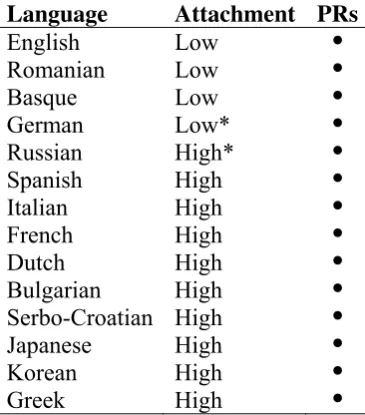
As shown in Table 1, with the exception of Russian, there is an almost perfect correspondence between the availability of PRs and Attachment Preferences:
Language Attachment PRs
English Low •
Romanian Low •
Basque Low •
German Low* •
Russian High* •
Spanish High •
Italian High •
French High •
Dutch High •
Bulgarian High •
Serbo-Croatian High •
Japanese High •
Korean High •
[image:7.595.206.389.404.612.2]Greek High •
Table 1: Attachment Preferences and PR availability
need to proceed to a more detailed study of previous results, one that takes into account the fine structural and semantic properties of the stimuli used. Secondly, notice that the literature on German produced contrasting results: traditionally, German is treated as High Attachment preference language, based on the work of Hemforth et al. (1998, 2000a,b); Konieczny & Hemforth (2000); more recently, however, Augurzky (2005) obtained a consistent Low Attachment preference in a series of online and offline experiments, and concluded, also on the basis of ERP results, that German is a Low Attachment Language. This contrast allows me to introduce a note of caution, which also applies to Russian: while PRs are widely attested in a variety of environments in certain languages, e.g. in Italian, their availability in other languages (e.g. Portuguese, and to a minor extent Greek) is subject to great variation, both regional, generational and often what appears to be purely individual.8
In order to strengthen these results, in-depth comparative work must be conducted, taking into account the various factors involved in the availability of PRs,. This is especially true given that, even in those rare cases in which we do have access to the sentence stimuli used in the experiments conducted so far on attachment preferences, we still don’t know what kind of fillers were used by the authors. This is particularly important in the light of what was said above (note 7) about syntactic priming. Yet, while we can’t take this generalization at face value, it’s hard not to be struck by the strength of the prediction and the variety of languages it correctly applies to.
3.2 Explaining variation across syntactic structures
As mentioned above, several authors have shown that the characteristic asymmetry in attachment preferences disappears in certain specific syntactic environments, i.e. speakers of HA languages, such as Spanish, display Low Attachment preference in those environments. A short selection of such environments is listed below (ex. 9-12):
(9) SUBJECTS (Hemforth et al. submitted)
a. The maid of the actress (that was) sitting on the balcony is blonde b. La criada de la actriz que estaba sentada en el balcón es rubia
(10) NOMINALS9 (Gibson et al. 1996)
a. The lamp near the painting of the house (that was) damaged by the flood b. La lámpara cerca de la pintura de la casa que fue dañada en la
inundacíon
8
A second related issue is the following: some of the factors considered here might play a role even in languages that do not allow for PRs; e.g. when parsing a sentence starting with I saw the boy…, the parser will have to make a choice between two possible continuation at the boy – i.e., syntactically the parser will have the option to project the NP as the object of V or as the subject of a SC, the latter being the object of V; semantically, between the perceptual report of an entity or an event. The sentence, in fact, might continue as I saw the boy running or I saw the boy you mentioned yesterday. To clarify this issue, we are currently comparing attachment preferences with Verbs (and Nouns) that take/don’t take SCs as complement in English.
9
(11) TYPE OF P (De Vincenzi & Job 1993)
a.Qualcuno ha sparato alla governante con l’attrice che stava seduta al balcone
b. Someone shot the maid with the actress (that was) sitting on the balcony
(12) UNAMBIGUOUS RELATIVE PRONOUNS (Fernandez 2003, p.31) Vi al hijo del medico el cual estaba en el balcón
I saw the son of the doctor whorel-pro was on the balcony
Crucially, what these contexts have in common is their inability to introduce propositions, i.e. PRs are not available in any of these environments, and LA is correctly predicted. That the PR reading is not available in these contexts is well illustrated by the English version of the examples 10 and 12, in which we have to add a “that was: even in the absence of the complementizer, the following string “sitting on the balcony” is still interpreted as a reduced relative clause (a generally dispreferred interpretation) and not as a Small Clause of the Acc-ing type.
Notice that this pattern does not simply follow from position (subject vs. object) or category (N vs. V). As it will be shown below, what drives attachment preferences is the availability of PRs, i.e. the presence of a context capable to introduce propositions. Manipulating this property of the contexts changes this state of affairs, often quite dramatically:
(13) PRCOMPATIBLE SUBJECTS
a. The maids of the actresses (*that were) running is quite an event b. La criada de la actriz que corre es un evento
(14) PR COMPATIBLE NOMINALS
L’immagine del figlio del medico che corre è davvero bella The picture of the son of the doctor running is very beautiful
The che clause in (14), despite being embedded in a nominal, is ambiguous between a PR and RC reading: this is due to the fact that picture of NPs can introduce events. Even more to the point, in (13), due to the semantic and agreement properties of the matrix predicate is an event, the RC reading becomes agrammatical, and PR/SC is the only available interpretation despite it being embedded within a subject. Importantly, the experimental works cited above didn’t make use of these special contexts.
Summing up, once the availability of PRs is taken into account, previous (often conflicting or confusing) results from the experimental literature on attachment preferences are amenable to a uniform explanation: as predicted, High Attachment is observed in a given language only in contexts that allow for a PR reading, whereas in all genuine RC contexts, Low Attachment preference prevails.
3.3 Novel experimental evidence
type of RC, i.e. position of extraction (subject-object), type of Verb or Nominal (event vs. state) and position of the complex NP (Center Embedding vs. Right Branching)10. The results, reported in Grillo and Costa (2012), consistently support the present hypothesis: a significant difference was observed between the PR and no-PR conditions; in particular, HA preference was observed in all conditions allowing for a PR reading of the che clause, whereas LA preferences emerged in all conditions in which the availability of PRs was excluded on grammatical grounds.
In a third experiment (reported in Grillo, Fernandes and Costa in preparation), we tested Prepositional Infinitive Constructions in Portuguese, a structure that has very similar properties to PRs (cf. Raposo 1989; Cinque 1995) when it appears in eventive contexts (e.g.: O João viu o filho do medico a correr / John saw the son of the doctor running), and which can, or has to, be interpreted as a reduced relative clause in certain environments (e.g. in the contexts of verbs or nominals introducing a state: O João vive com o filho do medico a correr / John lives with the son of the doctor running). Once again, the results obtained show a very clear HA preference (72.9% HA) in the PR condition (although it might be more precise to call it Small Clause condition or PIC condition in this case) and LA preference in the no-PR condition (37.8% HA).
4. Final remarks
The finding that speakers of different languages demonstrate different attachment preferences for RCs in complex NP contexts raised a serious problem for a universal theory of processing, a complicated riddle for the otherwise strong generalization for locality in parsing and, as a consequence, very serious issues for a theory of language acquisition.
The problems raised by these asymmetries, of course, only stand insofar as the languages and constructions under scrutiny are uniform from a structural point of view. A ubiquitous assumption in the literature on attachment preferences is that this is indeed the case. I have shown that this assumption is wrong: some languages (Spanish, Italian, Dutch…) allow for a Pseudo Relative reading of the relevant string (NP P NP C), while in others (English, German, Romanian) this string can only be interpreted as a genuine Relative Clause.
I have also argued that this grammatical difference can account for attachment preference asymmetries both across languages and across syntactic structures. The hypothesis I’ve entertained is that when a PR reading is available, it will be preferred over the RC reading for Minimal Attachment, the latter reading being more complex in terms of syntactic structure and amount of presupposition required.
Since when PRs are projected, attachment to NP1 is the only grammatical option, the hypothesis predicts that HA preferences will obtain when they are available. The hypothesis also predicts that LA preferences will be observed whenever we are dealing with genuine RCs, i.e. when PRs are not available.
Drawing from both previous and novel experimental results, I have shown that this is indeed the case: the availability of PRs allows us to predict attachment preferences both across languages and across structures. These results strengthen the idea that locality is a universal principle of processing and more generally support a theory of processing as a set of universal, innate principles.
10
References
Augurzky, P. (2005). Attaching Relative Clauses in German: The Role of Implicit and Explicit Prosody in Sentence Processing. Ph.D. thesis University of Leipzig.
Auwera, J. (1985). The predicate relatives of French perception verbs. In A. Bolkstein, C. de Groot, & J. Mackenzie (Eds.), Predicates and terms in functional grammar (pp. 219-234). Dordrecht: Foris.
Brito, A. M. (1995). Sobre algumas construções pseudorelativas em Português. Línguas e Literaturas, 12 (23-54).
Brysbaert, M., & Mitchell, D. (1996). Modifier attachment in sentence parsing: Evidence from Dutch. Quarterly Journal of Experimental Psychology, 49A, (664-695).
Burzio, L. (1981). Intransitive verbs and Italian auxiliaries. Ph.D. thesis MIT Cambridge, MA. Burzio, L. (1986). Italian syntax: A Government and Binding approach. Dordrecht: D. Reidel. Carreiras, M., & Clifton, C. (1993). Relative clause interpretation preferences in Spanish and
English. Language and Speech, 36, 353-372.
Carreiras, M., & Clifton, C. (1999). Another word on parsing relative clauses: Eye-tracking evidence from Spanish and English. Memory and Cognition, 27, 826-833.
Cinque, G. (1992). The Pseudo-Relative and Acc-ing constructions after verbs of perception. In University of Venice Working Papers in Linguistics. Università di Venezia.
Côté, M.H. (1999). Quantification existentielle sur des événements et structure des pseudorelatives. In F. Corblin, C. Dobrovie-Sorin, & J.-M. Marandin (Eds.), Empirical issues in formal syntax and semantics 2 (pp. 169-190). The Hague: Thesus.
Cuetos, F., & Mitchell, D. C. (1988). Cross-linguistic differences in parsing. Cognition, 30, 73-105.
De Vincenzi, M., & Job, R. (1993). Some observations on the universality of the late closure strategy. Journal of Psycholinguistic Research, 22, 189-206.
De Vincenzi, M., & Job, R. (1995). An investigation of late closure: The role of syntax, thematic structure, and pragmatics in initial interpretation. Journal of Experimental Psychology: Learning, Memory, and Cognition, 21, 1303-1321.
Declerck, R. (1981). On the role of progressive aspect in nonfinite perception verb complements. Glossa, 15, 83-113.
Declerck, R. (1982). The triple origin of perception verb complements. Linguistic Analysis, 10, 1-26.
Desmet, T., Brysbaert, M., & Baecke, C. D. (2002). The correspondence between sentence production and corpus frequencies in modifier attachment. Quarterly Journal of Experimental Psychology, 5A, 879-896.
Fernández, E. (2003). Bilingual sentence processing: Relative clause attachment in English and Spanish. Amsterdam: John Benjamins.
Fernández, E., & Bradley, D. (2004a). Exploring the prosody of the RC attachment construction in English and Spanish. Poster presented at the 17th Annual CUNY Conference on Human Sentence Processing, College Park, MD, March 25-27.
Fernández, E. M., Fodor, J., de Almeida, R., Bradley, D., & Quinn, D. (2003). Relative clause attachment in Canadian French: Prosodic boundary or f0- matching? Poster presented at the 16th Annual CUNY Conference on Human Sentence Processing, Cambridge, MA, March 27-29.
Fernández, E.M., Bradley, D., Igoa, J., & Teira, C. (2003). Prosodic phrasing in the RC-attachment ambiguity: Effects of language, RC-length, and position. Paper presented at the 9th Annual Conference on Architectures and Mechanisms for Language Processing (AMLaP), Glasgow, UK, August 25-27.
Fodor, J. (2002). Prosodic disambiguation in silent reading. In M. Hirotani (Ed.), Proceedings of the North East Linguistic Society. GSLA, University of Massachusetts, Amherst.
Fodor, J. D. (1998a). Learning to Parse? Journal of Psycholinguistic Research, 27, 285-319. Fodor, J. D. (1998b). Parsing to Learn? Journal of Psycholinguistic Research, 27, 285-319.
Fraga, I., Garc__a-Orza, J., & Acu~na, J. (2005). La desambiguación de oraciones de relativo en Gallego: nueva evidencia de adjunción alta en lenguas romances. Psicologica, 26, 243-260. Frazier, L. (1978). On comprehending sentences: Syntactic parsing strategies. Ph.D. thesis
University of Connecticut.
Frazier, L., & Clifton, C. (1996). Construal. Cambridge, MA: MIT Press.
Gibson, E., Pearlmutter, N., Canseco-Gonzalez, E., & Hickok, G. (1996). Recency preference in the human sentence processing mechanism. Cognition, 59, 23-59.
Gibson, E., Pearlmutter, N., & Torrens, V. (1999). Recency and lexical preferences in Spanish. Memory & Cognition, 27, 603-611. 10.3758/BF03211554.
Gibson, E., & Schütze, C. (1999). Disambiguation preferences in noun phrase conjunction do not mirror corpus frequency. Journal of Memory and Language, 40, 263-279.
Gilboy, E., Sopena, J., Clifton, C., & Frazier, L. (1995). Argument structure and association preferences in Spanish and English complex NPs. Cognition, 54, 131-167.
Graffi, G. (1980). Su alcune costruzioni pseudorelative. Rivista di Grammatica Generativa, 5, 115-139.
Guasti, M. (1988). La pseudorelative et les phénomenènes d'accord. Rivista di Grammatica Generativa, 13, 35-57.
Guasti, M. (1992). Progressive in the complements of perception verbs. In Bonomi, Casalegno, & Zwarts (Eds.), Proceedings of the Gargano Conference on Perceptual Reports".
Guasti, M. (1993). Causatives and perception verbs: a comparative study. Torino: Rosenberg and Sellier.
Hemforth, B., Fernández, S., Clifton, C., Frazier, L., Konieczny, L., & Walter, M. (submitted). Relative clause attachment in German, English, Spanish and French: Effects of position and length. Unpublished ms.
Hemforth, B., Konieczny, L., & Scheepers, C. (2000a). Modifier attachment: Relative clauses and coordinations. In B. Hemforth, & L. Konieczny (Eds.), German Sentence Processing (pp. 161-186). Dordrecht: Kluwer.
Hemforth, B., Konieczny, L., & Scheepers, C. (2000b). Syntactic attachment and anaphor resolution: Two sides of relative clause attachment. In M. Crocker, M. Pickering, & C. Clifton (Eds.), Architectures and Mechanisms for Language Processing (pp. 259-281). Cambridge, UK: Cambridge University Press.
Hemforth, B., Konieczny, L., Scheepers, C., & Strube, G. (1998). Syntactic ambiguity resolution in German. In D. Hillert (Ed.), Syntax and Semantics: A cross-linguistic perspective (pp. 293-312). San Diego: Academic 14 Press.
Hemforth, B., Konieczny, L., Seelig, H., & Walter, M. (2000c). Case matching and relative clause attachment in German. Journal of Psycholinguistic Research, 29, 81-88.
Kamide, Y., & Mitchell, D. (1997). Relative clause attachment: Nondeterminism in Japanese parsing. Journal of Psycholinguistic Research, 26, 247-254.
Kayne, R. (1981). Binding, quantifiers, clitics and control. In F. Heny (Ed.), Binding and Filtering (pp. 87-102). London: Croom Helm.
Kimball, J. (1973). Seven principles of surface structure parsing in natural language. Cognition, 2, 15-47.
Koenig, J.-P., & Lambrecht, K. (1999). French relative clauses as secondary predicates: A case study in construction theory. Unpublished ms. Communication préesentée au 2e Colloque de Syntaxe et Smantique de Paris, 17 Octobre 1999.
Konieczny, L., & Hemforth, B. (2000). Modifier attachment in German. In A. Kennedy, R. Radach, D. Heller, & J. Pynte (Eds.), Reading as a Perceptual Process (pp. 517-526). Oxford, UK: Elsevier.
Konieczny, L., Hemforth, B., Scheepers, C., & Strube, G. (1997). The role of lexical heads in parsing: Evidence from German. Language and Cognitive Processes, 12, 307-348.
Koopman, H., & Sportiche, D. (2010). The que/qui alternation: New analytical directions. Ms. UCLA.
Labelle, M. (1996). Remarques sur les verbes de perception et la sous-catégorisation. Recherches Linguistiques de Vincennes, 25, 83-106.
Lourenço-Gomes, M. d. C. (2005). Efeito do comprimento do constituinte na interpretação final de orações relativas estruturalmente ambíguas: Um estudo baseado na Hipótese da Prosódia Implícita. Master's thesis FL/UFRJ Brasil.
Lovrić, N. (2003). Implicit prosody in silent reading: Relative clause attachment in Croatian. Ph.D. thesis City University of New York.
Maia, M., Costa, A., Fern_andez, E., & Lourenço-Gomes, M. (2004). A compreensão de orações relativas ambíguas em Português Brasileiro e Europeu: Um estudo comparativo. Revista da Abalin, III, 11-39.
McCawley, J. D. (1981). The syntax and semantics of English relative clauses. Lingua, 53, 99-149.
Mitchell, D. C., & Brysbaert, M. (1998). Challenges to recent theories of crosslinguistic variation in parsing: Evidence from Dutch. In D. Hillert (Ed.), Sentence Processing: A Crosslinguistic Perspective (pp. 313-335). San Diego, CA: Academic Press.
Mitchell, D. C., Brysbaert, M., & Swanepoel, S. (2000). Modifier attachment in Dutch: Testing aspects of Construal Theory. In D. H. A. Kennedy, R. Radach, & J. Pynte (Eds.), Reading as a Perceptual Process (pp. 493-516). Oxford, UK: Elsevier.
Mitchell, D. C., & Cuetos, F. (1991). Challenges to recent theories of language differences in parsing: Evidence from Dutch. In C. Smith (Ed.), Sentence Processing: A crosslinguistic perspective (pp. 1-12). University of Austin, TX: Center for Cognitive Science.
Miyamoto, E. (1999). Relative clause processing in Brazilian Portuguese and in Japanese. Ph.D. thesis MIT Cambridge, MA. Miyamoto, E., Nakamura, M., & Takahashi, S. (2005). Processing relative
clauses in Japanese with two attachment sites. In Proceedings of the 34th Annual Meeting of the North Eastern Linguistics Society.
Phillips, C. (1996). Order and Structure. Ph.D. thesis MIT.
Phillips, C., & Gibson, E. (1997). The strength of the local attachment preference. Journal of Psycholinguistic Research, 26, 323-346.
Radford, A. (1975). Pseudo-relatives and the unity of subject-raising. Archivum Linguisticum, 6, 32-64.
Rafel, J. (1999). Complex Small Clauses. Ph.D. thesis Universitát Autonoma de Barcelona. Raposo, E. (1989). Prepositional Infinitival Constructions in European Portuguese. In J. Osvaldo,
& K. J. Safir (Eds.), The Null Subject Parameter (pp. 277-305). Kluwer.
Rizzi, L. (1992). Direct perception, government and thematic sharing. In Bonomi, Casalegno, & Zwarts (Eds.), Proceedings of the Gargano Conference on Perceptual Reports.
Rizzi, L. (1990). Relativized Minimality. Linguistic Inquiry Monograph 16. Cambridge: MA, MIT Press.
Rizzi, L. (2004). Locality and the Left Periphery. In Structure and beyond, ed. Adriana Belletti, chapter 7, (pp. 223–251). New York: Oxford
University Press.
Rizzi, L. (2006). On the form of Chains: Criterial positions and ECP effects. In Wh-movement: Moving on, ed. Lisa Cheng and Norbert Corver, chapter 5, (pp. 97–134). Cambridge, MA: MIT Press.
Rizzi, L. and Shlonsky. U. (2007). Strategies of Subject Extraction. In Interfaces + Recursion = Language? Sauerland and Gärtner (eds.), (pp. 115−160), Berlin, New York: Mouton de Gruyter.
Sekerina, I. (1997). The Late Closure Principle vs. the Balance Principle: Evidence from on-line processing of ambiguous Russian sentences. In P. Costa (Ed.), The Proceedings of the Second European Conference on Formal Description of Slavic Languages. University of Potsdam, Germany.
Sekerina, I. (2004). Cross-linguistic variation in gender use as a parsing constraint: Dutch vs. Russian. Paper presented at the 13th Annual Meeting Formal Description of Slavic Languages, 13 FASL, Columbia, February 24-29.
Sekerina, I., Petrova, K., & Fernández, E. (2003). Relative clause attachment in Bulgarian. Paper presented at the 12th Annual Meeting Formal Description of Slavic Languages, 12 FASL, Ottawa, May 9-11.
Taraldsen, T. (1981). The theoretical implications of a class of marked extraction. Theory of Markedness in Generative Grammar. Pisa: Scuola Normale Superiore.
Wijnen, F. (1998). Dutch relative clauses in two- and three-site contexts. Poster presented at the 11th Annual CUNY Conference on Human Language Processing, New Brunswick, NJ, March 19-21.