This is a repository copy of
Temporal dynamics of aquatic communities and implications
for pond conservation
.
White Rose Research Online URL for this paper:
http://eprints.whiterose.ac.uk/74903/
Article:
Hassall, C, Hollinshead, J and Hull, A (2012) Temporal dynamics of aquatic communities
and implications for pond conservation. Biodiversity and Conservation, 21 (3). 829 - 852 .
ISSN 0960-3115
https://doi.org/10.1007/s10531-011-0223-9
[email protected] https://eprints.whiterose.ac.uk/
Reuse See Attached
Takedown
If you consider content in White Rose Research Online to be in breach of UK law, please notify us by
1
Temporal dynamics of aquatic communities and
implications for pond conservation, Hassall et al (2012) -
SELF-ARCHIVED COPY
This document is the final, reviewed, and revised version of the manuscript
Temporal dynamics of aquatic communities and implications for pond
conservation
Biodiversity and Conservation. It
does not include final modifications made during typesetting or copy-editing
by the Biodiversity and Conservation publishing team. This document was
archived in line with the self-archiving policies of the journal Biodiversity and
Conservation, which can be found here:
http://www.springer.com/open+access/authors+rights?SGWID=0-176704-12-683201-0
The version of record can be found at the following address:
http://link.springer.com/article/10.1007%2Fs10531-011-0223-9
The paper should be cited as:
HASSALL, C., HOLLINSHEAD, J. & HULL, A. 2012. Temporal dynamics of aquatic
communities and implications for pond conservation.
Biodiversity and
2
Running head
: "Temporal variation in pond conservation value"
Title:
Temporal dynamics of aquatic communities and implications for pond conservation
Authors: Christopher Hassall1, James Hollinshead2, Andrew Hull2
Address: 1Department of Biology, Carleton University, 1125 Colonel By Drive, Ottawa, K1S 5B6, Canada, 2School of Humanities and Social Science, Liverpool John Moores University, 68 Hope St, Liverpool, L1 9HW, UK.
Corresponding author: Christopher Hassall Telephone: 00 1 520 2600 (ext. 3866) Fax: 00 1 613 520 3539
3 ABSTRACT
Conservation through the protection of particular habitats is predicated on the assumption that the conservation value of those habitats is stable. We test this assumption for ponds by investigating temporal variation in macroinvertebrate and macrophyte communities over a 10-year period in northwest England. We surveyed 51 ponds in northern England in 1995/6 and again in 2006,
identifying all macrophytes (167 species) and all macroinvertebrates (221 species, excluding Diptera) to species. The alpha-diversity, beta-diversity and conservation value of these ponds were
compared between surveys. We find that invertebrate species richness increased from an average of 29.5 species to 39.8 species between surveys. Invertebrate gamma-diversity also increased between the two surveys from 181 species to 201 species. However, this increase in diversity was accompanied by a decrease in beta-diversity. Plant alpha-, beta- and gamma-diversity remained approximately constant between the two periods. However, increased proportions of grass species and a complete loss of charophytes suggests that the communities are undergoing succession. Conservation value was not correlated between sampling periods in either plants or invertebrates. This was confirmed by comparing ponds that had been disturbed with those that had no history of disturbance to demonstrate that levels of correlation between surveys were approximately equal in each group of ponds. This study has three important conservation implications: (i) a pond with high diversity or high conservation value may not remain that way and so it is unwise to base pond conservation measures upon protecting currently-speciose habitats; (ii) maximising pond gamma-diversity requires a combination of late and early succession ponds, especially for invertebrates; and (iii) invertebrate and plant communities in ponds may require different management strategies if succession occurs at varying rates in the two groups.
4 INTRODUCTION
Moss (1998, pp 473-4) gives five root causes for the vulnerability of freshwaters to damage by humankind: (i) negative associations on the part of the public, (ii) the use of freshwaters as receptors or transporters of waste, (iii) replacement of natural wetlands by artificial reservoirs to store
valuable water, (iv) the value to be gained in terms of additional fertile land by draining, and (v) mismanagement. While progress has been made in communicating the value of natural wetlands, ponds suffer from the additional problem of perceived insignificance based on the small physical dimensions and apparently limited biodiversity. Research over the past 20 years has sought to overturn this perception by highlighting the high biodiversity, landscape ecological role and ecosystem services that ponds provide.
Ponds have been shown to contain a greater proportion of the regional biodiversity than other types of wetlands including lakes, ditches, rivers and streams (Biggs et al. 2005; Williams et al. 2004) and this pattern has been shown to hold for agricultural landscapes across Europe (Davies et al. 2008). As well as having a greater diversity of flora and fauna, ponds also contain a greater proportion of rare species (Williams et al. 2004) and a greater proportion of unique species (Davies et al. 2008) than other freshwater bodies. Ponds in the landscape cannot truly be considered independent of
T
describe this meta-habitat (Boothby 1997). This degree of connectivity in the pondscape acts in three complementary ways to facilitate metapopulation persist F
(Fortuna et al. 2006), and are explicitly recognised as such in Article 10 of the EU Habitats Directive. Such stepping stone habitats help to improve the permeability of the landscape for aquatic and semi-aquatic organisms. Second, the semi-independent nature of individual ponds means that environmental perturbations such as pollution and disease are restricted in effect compared to freshwaters with larger catchments such as rivers (Biggs et al. 2005). Third, ponds act as refugia for biodiversity such that, should a population of a given species in one pond become extinct, there are more populations close at hand to recolonise that habitat (Sherratt et al. 1999). This network of ponds contributes substantially to ecosystems services, including the retention of floodwater (Wanielista and Yousef 1993), the deposition of organic pollutants (Hawkins and Schofield 2003) and the sequestration of carbon (Downing et al. 2008).
5
Previous studies of turnover in ponds have tended to focus on a relatively small number of taxa. Briers and Warren (2000) studied two Notonecta sp. (Hemiptera) at 68 ponds over 3 consecutive years and found variability in habitat quality affected patch occupancy. Moore (1991) studied the pattern of community assembly by observing breeding behaviour by adult Odonata (which may not be an accurate method of predicting the aquatic residents (Raebel et al. 2010)) at 20 newly-created woodland ponds over 27 years, describing a transition between pioneer and climax odonate communities. Cottenie and De Meester (2003) investigated zooplankton communities in a very highly connected cluster of 34 ponds over 3 consecutive years, and found that environmental variables, particularly turbidity, varied between years and influenced diversity. The same link between biotic diversity and environmental variables was seen in a survey of seasonal variation in three French ponds (Angélibert et al. 2004). The composition of beetle communities at 18 ponds was shown to vary between years, with the age of the pond exerting the largest influence on community variability (Fairchild et al. 2000). Where the full invertebrate community has been studied, this has sometimes been only within a limited number of habitats, such as Macan's (1977) study of the invertebrate fauna of a single pond over 20 years.
However, a small number of recent studies have considered entire communities across a number of habitats. Jeffries (1994) studied the effects of drought on a system of 29 temporary ponds, each with an area of 1m2, by comparing invertebrate community data before the drought with data from after the drought. Jeffries found that patch extinction rates were high in all species, but that temporary pond species colonised faster than permanent pond species. These studies suggest that inter-annual variations in the environment can cause substantial variations in community structure. In a later study, Jeffries surveyed annually the invertebrate (Jeffries 2011) and plant (Jeffries 2008) communities in a series of 30 small (1m2), newly-created, temporary ponds over a very small area (<500m2) for 10 years. Both invertebrate and plant metacommunities were influenced
deterministically by patterns of inundation, leading to large variations between ponds even over such a small spatial scale. Chase (2007) created 20 mesocosms varying in volume between 20 litres and 1,140 litres. These showed considerable variation in amphibian, macroinvertebrate and plant communities, even across a small spatial scale. When a drought treatment was applied to half of the mesocosms, community structure showed convergence which Chase attributed to the filtering out of those species that could not tolerate drought conditions.
6
conservation strategies at pond and pondscape levels. We discuss our findings in light of attempts to conserve ponds and their communities.
METHODS Field surveys
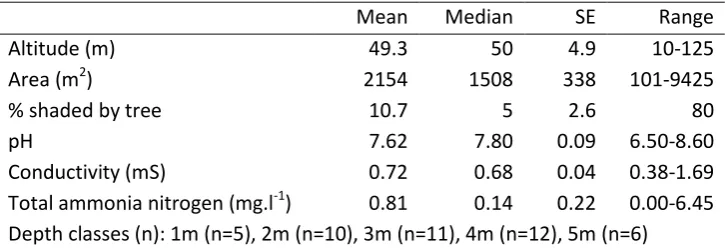
The faunal and floral communities of 51 ponds in northern England were characterised (Figure 1, see Table 1 for a summary of pond characteristics for 44 of those ponds for which physical parameters were measured). We provide further details of the pondscape elsewhere (Hassall et al. 2011). This region is low-lying and used extensively for agriculture with relatively low levels of human
habitation. Cheshire (2,343 Km2) contains 20,546 mapped lentic water bodies of less than 2ha, though in some areas, up to 30% of ponds present may be unmapped (Hollinshead, unpublished data). The number of ponds holding standing water is estimated to be well in excess of 17,500 (Boothby 1997). The county overlies a glacial outwash plain of boulder clays, separating the hills of North Wales to the west from the Peak District of Derbyshire to the east, and is predominantly rural. Pastoral agriculture dominates, resulting in a mosaic of mainly small fields, hedgerows and patchy woodland. Pond density aside, the area may be considered representative of North West European pastoral lowlands. The vast majority of ponds in the Cheshire landscape are anthropogenic in origin, with the most numerous being marl pit ponds. Marl pits persisted in the landscape in the period before the advent of piped water in fields as watering holes for stock. This was a secondary benefit, their primary purpose being the extraction of marl, a base rich glacial clay deposit. The practice in Cheshire dates back to the medieval period occurring with varying intensity, but particularly during the 1790s under the spur of increases in food crop prices. By the 1840s the practice was in rapid decline due to cheaper alternatives and increasing labour costs. The marl pit ponds included in the 2006 re-survey can be identified with confidence in the early editions of the Ordnance Survey County Series 1:10560 map (available as GeoTIFF image files, Landmark Information Group Limited, 2010).
Each of the 51 ponds was surveyed in 1995 or 1996 and again in 2006 for both invertebrates and plants. Twenty-eight ponds were surveyed between 25 May and 22 July 1995, with 23 more ponds surveyed between 26 May and 19 July 1996. All ponds were then resurveyed between 15 May and 24 June 2006. Benthic substrate was either clay (n=23) or silt/soil (n=28). All ponds were within 500m of neighbouring ponds or wetlands. Fourteen ponds were confirmed to contain fish and six were known to have dried up at least once in the past. Water chemistry measurements, including pH, conductivity and nitrogen concentrations, were taken for all ponds during the second survey.
7
banks. According to consultations with land owners, no other management of the ponds themselves took place, though management of the immediately surrounding terrestrial landscape has changed considerably in some cases.
The presence and absence of invertebrate species was recorded using standardised sampling methods. Pond nets with 1mm mesh were used to collect invertebrates using travelling kick-sweeps within the main water body. Kick sweeps were carried out in all identified microhabitats, usually over bare substrate, within the leaf litter and in submerged vegetation. Only larger
macroinvertebrates that can be caught by a 1mm mesh net were included in the study (a species list of plants and invertebrates can be found in Appendices A and B). In addition, animals were collected through the scraping of rocks and logs that were either submerged or were found within the
perimeter set by the maximum winter water level. Damp poolside areas were surveyed by creating a depression and netting the resulting puddles. The rationale behind the sampling was to continue surveying until no further species were found (Eyre et al. 1986). All plants present in the pond up to the winter high water level were recorded to species. The data used in this study were the presence or absence of each species during the surveys. The same methods were employed by the same surveyor in all surveys to account as far as possible for variations in recording.
Data analysis
Alpha-diversity (species richness) was calculated separately for invertebrates and plants for each of the ponds. Beta-diversity was calculated for each of the ponds in the initial survey using the betasim
method as recommended by Koleff et al. (2003; see that paper for a review of beta-diversity metrics). This value was the mean betasim for each pond compared with each other pond.
Beta-diversity was also calculated between time periods for the same ponds. Gamma-Beta-diversity was calculated for the invertebrates and plants separately. The Community Conservation Index (CCI, Chadd and Extence 2004), was used to assess the conservation value of the invertebrate
communities, and Species Rarity Index (SRI, based on methods in Williams et al. 2004) was
calculated as an equivalent measure for plants. The CCI involves the assignment of a Conservation Score to a range of species based on their relative rarity (see Appendix 2 in Chadd and Extence 2004). These scores are averaged for each site and then multiplied by a Community Score which is based either on the greatest CS (the method used in this analysis) or Biological Monitoring Working Party (BMWP) scores for that site. SRI uses a similar method to allocate Species Rarity Scores to each species which are then averaged for each site to give the SRI.
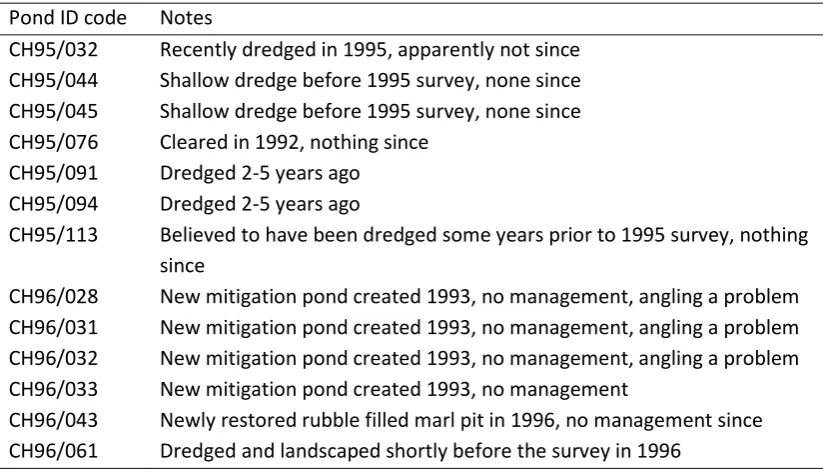
Due to issues with non-normality of the data, non-parametric statistics were used. Alpha-diversity, beta-diversity, and conservation value (CCI or SRI) were compared between surveys using paired Wilcoxon signed-rank tests. The spatial and temporal beta-diversity were also compared using paired Wilcoxon signed-rank tests. Spearman's rank correlations were employed to test for consistency in alpha-diversity, beta-diversity and conservation value (CCI or SRI) between surveys. To evaluate the contributions of disturbances between surveys (see Table 2a) compared to the natural evolution of the ponds communities in the absence of disturbance, these analyses were carried out on both the total pond dataset (n=51) and the subset of ponds for which there was no evidence of disturbance (n=36). To evaluate the contributions made by different taxa to the
8
within each order of plants and invertebrates were tallied. All analyses were carried out using R (R Development Core Team 2006) R (Oskanen et al. 2007). The statistical significance of the results should be interpreted in light of the number of tests performed. We performed 22 statistical tests and a conservative correction for this would involve multiplying the p-values by 22. Significance is therefore unequivocal when p<0.0023. We also present test statistics for all tests so that effect sizes are clear in all cases.
RESULTS General results
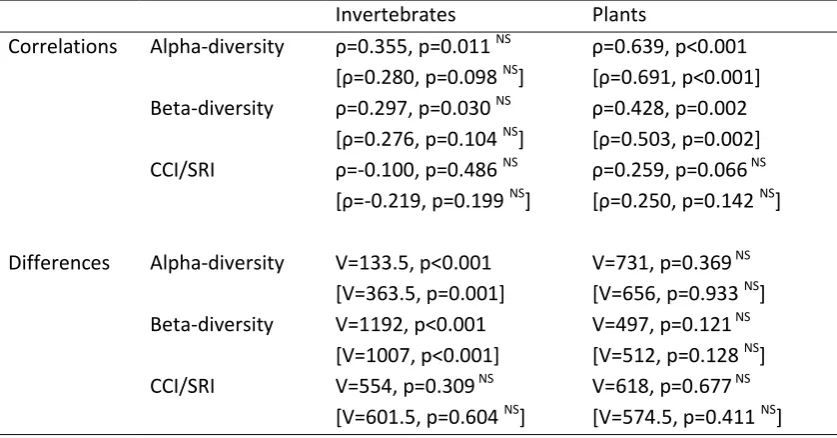
The two surveys recorded 167 species of plants and 221 species of invertebrates. Plant gamma-diversity was 149 in 1995/6 and 142 in 2006, while invertebrate gamma-gamma-diversity was 181 in 1995/6 and 201 in 2006 (Figure 2C). The distribution of these species across taxonomic groups can be seen in Figure 3. The results of Wilcoxon signed-ranks tests and Spearman's rank correlations did not differ qualitatively between the full dataset and the subset of undisturbed ponds (Table 3) so only the full dataset is discussed.
Plant communities
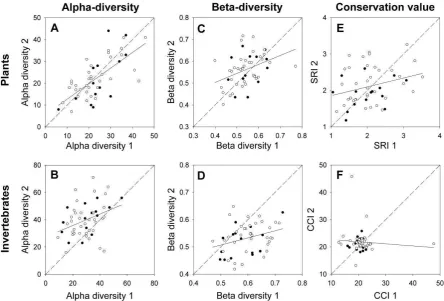
Alpha-diversity in plant communities was strongly correlated between the two sampling periods (Figure 4A), although there is only a weak correlation between the two surveys in beta-diversity (Figure 4C, statistics are in Table 3). The species rarity index (SRI) for the first survey was not significantly correlated with that of the second (Figure 4E). Paired Wilcoxon signed-ranks tests showed that there was no significant difference between ponds in alpha-diversity, beta-diversity or SRI between the two surveys. Mean species richness was 23.5 (±1.3 SE) in 1995/6 and 22.3 (±1.3) in 2006. However, these measures of overall species richness disguise the fact that there were
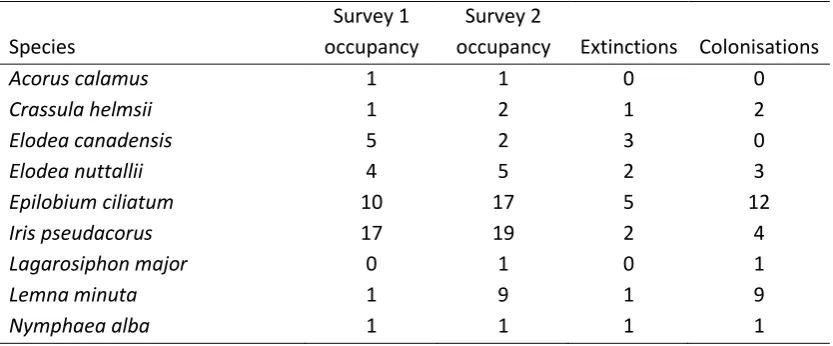
community changes between surveys (Figure 3A). Most notably, all three charophytes (Chara vulgaris var. papillata, Chara vulgaris var. vulgaris and Nitella flexilis), plants of conservation importance in the UK, were lost from the four ponds in which they were found in the first survey. This loss was accompanied by a net loss in Asteridae, including three of four Callitriche sp. and both Bidens sp. This decline was balanced in terms of species numbers by an increase in the number of grass (Poales) species. The beta-diversity between surveys of the same ponds was significantly lower than the spatial beta-diversity within either of the two surveys (first survey: V=1325, p<0.001, second survey: V=1316, p<0.001; Figure 2B). Nine species of plants that are considered alien to the region were identified (Table 4). There was no general trend in the occupancy of these species, although Epilobium ciliatum and Lemna minuta colonised 12 and 9 ponds, respectively, in between surveys.
Invertebrate communities
9
increased in diversity without losing any species (Figure 3B). In addition, there was a high degree of turnover with a net increase in species richness in insect orders, particularly the Coleoptera,
Hemiptera, Odonata and Trichoptera. As with the botanical data, the beta-diversity between surveys of the same ponds was significantly lower than the spatial beta-diversity within either of the two surveys (first survey: V=1254, p<0.001, second survey: V=1076, p<0.001; Figure 2B). Temporal beta-diversity was significantly higher in invertebrates than in plants (V=208, p<0.001).
DISCUSSION
We provide a detailed comparison of invertebrate and plant communities sampled 10 years apart which sheds light on the temporal dynamics of a pond landscape. In particular we highlight contrasting patterns between the invertebrate and botanical communities of the ponds that were studied (summarised in Figure 4). Botanical communities appear to be relatively stable, with ponds that were recorded as more diverse in the first survey tending to remain more diverse in the second. Plant gamma-diversity shows a marginal decrease between the two periods. Alpha-diversity of invertebrates, on the other hand, is weakly correlated between time periods and shows a marked rise between surveys. This corresponds to a higher temporal beta-diversity than in plants and an increase in gamma-diversity. However, accompanying this rise in diversity is a decline in beta-diversity suggesting that the ponds are becoming more similar across the landscape. These patterns hold both for older marl pit ponds that have existed since the late 18th Century and that might be expected to have stable communities, as well as for ponds created since 1990.
The lack of clear variation between plant communities in the two surveys may be due to either (i) a slower pattern of succession towards a climax community, or (ii) the presence of a stable, climax community prior to the first survey. Rates of initial colonisation can be very quick (Barnes 1983) so we may already have observed a climax community in the first survey, although few studies have followed large numbers of ponds for any length of time. However, one piece of evidence against this is the presence (and subsequent loss) of charophytes, of which Nitella flexilis is rated as Nationally Scarce, from four survey ponds. These species readily colonise early successional ponds but may be excluded by competition as succession continues (Wade 1990). The increase in grasses (Poales) suggests succession towards terrestrial habitats in these wetlands is still underway.
The majority of the increase in gamma-diversity in invertebrates was due to the immigration of active dispersers such as beetles, damselflies, dragonflies and true bugs (Figure 3B). This pattern suggests that the species pool contained within the network of ponds that were the focus of this study (our gamma diversity) is more susceptible to colonisation by winged, mobile species from the regional species pool. Diptera, which were not included in this analysis due to issues with
identification of larvae, often also feature as early colonisers (Barnes 1983). Relatively few of the species that colonised between surveys were passive dispersers, although freshwater snails
10
the basis of the presence of H. caraboides could, in this case at least, result in wasted conservation resources.
Variability between pond communities tends to be higher than for other water body types (Davies et al. 2008; Williams et al. 2004). We provide the first quantification of variation in both plant and invertebrate communities within individual ponds over time, which provides an additional
dimension to pond diversity. The issue of succession is of particular importance in dynamic habitats of limited area such as ponds, where natural succession may be rapid and conspicuous. Succession rate is determined by the rate of autochthonous production and the rate of input and deposition of allochthonous material. Ponds are among the most productive habitat on earth, as demonstrated by their high rates of carbon sequestration (Downing et al. 2008). This makes them particularly
vulnerable to loss through succession, which results from what has been termed "benign neglect" on the part of landowners and managers (Boothby and Hull 1997). The turnover that we observed suggests that some groups of species (e.g. grasses) become more prevalent at later stages of succession but that this comes at the cost of other species (e.g. charophytes). The replacement of one group by another leads to a stable diversity with higher species turnover. Late-succession ponds likely contain species that are not present in mid- or early-succession ponds, as demonstrated by the turnover in species. As a result, the maintenance of ponds through dredging of sediment, cropping of vegetation or fencing of banks may not benefit landscape-level biodiversity. Instead, to manage for maximal gamma-diversity ponds should be permitted to undergo succession to grassland, but new ponds must be created to maintain the continuum of successional states. Recent successes with pond creation schemes are beginning to inform this practice (Williams et al. 2008), where earlier efforts were largely without a rigorous scientific basis (Williams et al. 1999).
While individual ponds interact strongly at a local level with surrounding terrestrial habitat, the catchments of these water bodies tend to be relatively small. This has two implications for the physicochemical characteristics of the water body. First, a disturbance (e.g. pollution, invasive species) event of a given size occurring within the catchment will have a greater effect within smaller catchments as there will be less additional input to buffer against the change. Second, the
11
Pond conservation is a major issue across Europe due to the lack of legislative protection afforded to this neglected habitat (Céréghino et al. 2008). We highlight the value of a well-studied pondscape in northern England which may be considered representative of much of pastoral lowland Europe. Previous studies have highlighted the contribution that ponds make to landscape biodiversity but have largely neglected temporal variation (Jeffries 2005). We provide a comprehensive description of invertebrate and plant communities sampled 10 years apart and demonstrate that biodiversity and conservation value are not consistent over time, whether or not there is disturbance. It is intended that the recurrent re-survey of the 51 ponds continue forming the basis of an on-going longitudinal study of temporal and spatial variation in of biodiversity. Furthermore, the extent of this temporal variation in communities varies between plants and invertebrates. If the goal in pond conservation is to maximise gamma-diversity, this can only be achieved by taking into account the constantly changing nature of the pondscape.
ACKNOWLEGEMENTS
The Pond Life Project was funded by the Life Programme of the European Union and a consortium of partners, including Cheshire County Council, with Warrington and Vale Royal Borough Councils. We are indebted to the skill and knowledge of Jonathan Guest who carried out the pond surveys. CH was supported by a Government of Canada Postdoctoral Research Fellowship and an Ontario Ministry of Research and Innovation Fellowship.
REFERENCES
Angélibert S, Marty P, Céréghino R and Giani N (2004) Seasonal variations in the physical and chemical characteristics of ponds: implications for biodiversity conservation. Aquatic Conservation: Marine and Freshwater Ecosystems 14: 439-456.
A “ R V I N O B T IBEM
tool for the rapid assessment of biodiversity in ponds from Switzerland. Part 1. Index development. Limnetica 29: 93-104.
Barnes LE (1983) The colonisation of ball-clay ponds by macroinvertebrates and macrophytes. Freshwater Biology 13: 561-578.
Biggs J, Williams P, Whitfield M, Nicolet P and Weatherby A (2005) 15 years of pond assessment in Britain: results and lessons learned from the work of Pond Conservation. Aquatic Conservation: Marine and Freshwater Ecosystems 15: 693-714.
Boothby J (1997) Pond conservation: towards a delineation of pondscape. Aquatic Conservation: Marine and Freshwater Ecosystems 7: 127-132.
Boothby J and Hull AP (1997) A census of ponds in Cheshire, North West England. Aquatic Conservation: Marine and Freshwater Ecosystems 7: 75-79.
Briers RA and Warren PH (2000) Population turnover and habitat dynamics in Notonecta (Hemiptera: Notonectidae) metapopulations. Oecologia 123: 216-222.
Céréghino R, Biggs J, Oertli B and Declerck S (2008) The ecology of European ponds: defining the characteristics of a neglected freshwater habitat. Hydrobiologia 597: 1-6.
Chadd R and Extence C (2004) The conservation of freshwater macroinvertebrate populations: a community-based classification scheme. Aquatic Conservation: Marine and Freshwater Ecosystems 14: 597-624.
12
Cottenie K and De Meester L (2003) Connectivity and cladoceran species richness in a metacommunity of shallow lakes. Freshwater Biology 48: 823-832.
Davies B, Biggs J, Williams P, Whitfield M, Nicolet P, Sear D, Bray S and Maund S (2008) Comparative biodiversity of aquatic habitats in the European agricultural landscape. Agriculture, Ecosystems & Environment 125: 1-8.
Downing JA, Cole JJ, Middelburg JJ, Striegel RG, Duarte CM, Kortelainen P, Prairie YT and Laube KA (2008) Sediment organic carbon burial in agriculturally eutrophic impoundments over the last century. Global Biogeochemical Cycles 22: GB1018.
Eyre MD, Ball SG and Foster GN (1986) An initial classification of the habitats of aquatic Coleoptera in north-east England. Journal of Applied Ecology 23: 841-852.
Fairchild GW, Faulds AM and Matta JF (2000) Beetle assemblages in ponds: effects of habitat and site age. Freshwater Biology 44: 523-534.
Fortuna MA, Gómez-Rodríguez C and Bascompte J (2006) Spatial network structure and amphibian persistence in stochastic environments. Proceedings of the Royal Society: Series B (Biological Sciences) 273: 1429-1434.
Hassall C, Hollinshead J and Hull A (2011) Environmental correlates of plant and invertebrate species richness in ponds. Biodiversity and Conservation 20: 3189-3222.
Hassall C, Hollinshead J and Hull A (accepted) Environmental correlates of plant and invertebrate species richness in ponds. Biodiversity and Conservation.
Hawkins J and Schofield D (2003) Scoping the potential for farm ponds to provide environmental benefits. IGER, North Wyke.
I N A “ R V O B T IBEM
tool for the rapid assessment of biodiversity in ponds from Switzerland. Part 2. Method description and examples of application. Limnetica 29: 105-120.
Indermuehle N, Oertli B, Menetrey N and Sager L (2004) An overview of methods potentially suitable for pond biodiversity assessment. Archives des Sciences 57: 131-140.
Jeffries MJ (1994) Invertebrate communities and turnover in wetland ponds affected by drought. Freshwater Biology 32: 603-612.
Jeffries MJ (2005) Small ponds and big landscapes: the challenge of invertebrate spatial and
temporal dynamics for European pond conservation. Aquatic Conservation: Marine and Freshwater Ecosystems 15: 541-547.
Jeffries MJ (2008) The spatial and temporal heterogeneity of macrophyte communities in thirty small, temporary ponds over a period of ten years. Ecography 31: 765-775.
Jeffries MJ (2011) The temporal dynamics of temporary pond macroinvertebrate communities over a 10-year period. Hydrobiologia 661: 391-405.
Koleff P, Gaston KJ and Lennon JJ (2003) Measuring beta diversity for presence-absence data. Journal of Animal Ecology 72: 367-382.
Macan TT (1977) A twenty-year study of the fauna in the vegetation of a moorland fishpond. Archiv für Hydrobiologie 81: 1-24.
Menetrey N, Sager L, Lachavanne JB and Oertli B (2005) Looking for metrics to assess the trophic state of ponds. Macroinvertebrates and amphibians. Aquatic Conservation: Marine and Freshwater Ecosystems 15: 653-664.
Moore NW (1991) A 27 year study on small ponds at Woodwalton Fen, Cambridgeshire, United Kingdom. Odonatologica 20: 203-231.
13
Oertli B, Joye DA, Castella E, Juge R, Lehmann A and Lachavanne J-B (2005) PLOCH: a standardized method for sampling and assessing the biodiversity in ponds. Aquatic Conservation: Marine and Freshwater Ecosystems 15: 665-679.
Oskanen J, Kindt R, Legendre P, O'Hara B and Stevens MHM (2007) vegan: Community ecology package, R package version 1.8-8. http://cran.r-project.org/,
http://r-forge.r-project.org/projects/vegan/.
R Development Core Team 2006. R: A language and environment for statistical computing. R Foundation for Statistical Computing, Vienna, Austria.
Raebel EM, Merckx T, Riordan P, Macdonald DW and Thompson DJ (2010) The dragonfly delusion: why it is essential to sample exuviae to avoid biased surveys. Journal of Insect Conservation 14: 523-533.
Sherratt TN, Thomas CJ, Conrad KF, Willson KH and Harvey IF (1999) Landscape approaches in ecotoxicology. Aspects of Applied Biology, pp. 227-234. The Association of Applied Biologists, Warwick.
Wade PM (1990) The colonisation of disturbed freshwater habitats by Characeae. Folia Geobotanica 25: 275-278.
Wanielista MP and Yousef YA (1993) Stormwater Management. Wiley, Oxford.
Williams P, Biggs J, Whitfield M, Thorne A, Bryant S, Fox G and Nicolet P (1999) The Pond Book: A Guide to the Management and Creation of Ponds. Ponds Conservation Trust, Oxford.
Williams P, Whitfield M and Biggs J (2008) How can we make new ponds biodiverse? A case study monitored over 7 years. Hydrobiologia 597: 137-148.
14 TABLES
Table 1 Summary statistics for 44 ponds.
Mean Median SE Range
Altitude (m) 49.3 50 4.9 10-125
Area (m2) 2154 1508 338 101-9425
% shaded by tree 10.7 5 2.6 80
pH 7.62 7.80 0.09 6.50-8.60
[image:15.595.104.467.102.227.2]15 Table 2a Details of ponds modified between surveys
Pond ID code Notes
CH95/014 Created 1990, fish introduced since 1995 CH95/021 Some in-filled
CH95/026 Recent signs of dredging, similar successional stage to 1995 when kept open as watering point
CH95/039 Dredged and enlarged slightly
CH95/043 New lobe dredged in 2000 to create habitat for Hydrochara caraboides, now deteriorated
CH95/072 Drain installed to regulate size
CH95/099 Land drains directed into pond increased depth substantially CH96/018 Partly in-filled
CH96/035 Bank re-grade, possibly dredged since 1996
CH96/044 Was subject to pollution incident some years before 2006 survey, banks may have been re-graded.
CH96/049 Marginal scrub clearance and bank re-grade 2005/6. CH96/058 Drained and partly in-filled
CH96/059 Partly dredged 1996, since extensively modified and dredged CH96/077 Dredged completely in 1994, fish being introduced shortly after CH95/073 Created 1989, by amalgamation of two marl pits, partially drained
Table 2b Details of ponds unmodified between surveys Pond ID code Notes
CH95/032 Recently dredged in 1995, apparently not since CH95/044 Shallow dredge before 1995 survey, none since CH95/045 Shallow dredge before 1995 survey, none since CH95/076 Cleared in 1992, nothing since
CH95/091 Dredged 2-5 years ago CH95/094 Dredged 2-5 years ago
CH95/113 Believed to have been dredged some years prior to 1995 survey, nothing since
CH96/028 New mitigation pond created 1993, no management, angling a problem CH96/031 New mitigation pond created 1993, no management, angling a problem CH96/032 New mitigation pond created 1993, no management, angling a problem CH96/033 New mitigation pond created 1993, no management
[image:16.595.72.486.83.388.2] [image:16.595.72.484.412.650.2]16
Table 3 Results of statistical analysis (Spearman rank correlations and paired Wilcoxon signed rank tests) investigating variation in diversity between 51 ponds across two sampling periods (1995/6 and 2006). NS indicates non-significant statistical test results at a -level to account for multiple
Values for the subset of undisturbed ponds (n=36) are given in square brackets. Invertebrates Plants
Correlations Alpha-diversity =0.355, p=0.011 NS =0.280, p=0.098 NS]
=0.639, p<0.001 =0.691, p<0.001] Beta-diversity , p=0.030 NS
=0.276, p=0.104 NS]
, p=0.002 =0.503, p=0.002] CCI/SRI -0.100, p=0.486 NS
=-0.219, p=0.199 NS]
, p=0.066 NS =0.250, p=0.142 NS]
Differences Alpha-diversity V=133.5, p<0.001 [V=363.5, p=0.001]
V=731, p=0.369 NS [V=656, p=0.933 NS] Beta-diversity V=1192, p<0.001
[V=1007, p<0.001]
V=497, p=0.121 NS [V=512, p=0.128 NS] CCI/SRI V=554, p=0.309 NS
[V=601.5, p=0.604 NS]
[image:17.595.68.487.134.353.2]17
Table 4 Change in occurrence between surveys in nine alien plant species.
Species
Survey 1 occupancy
Survey 2
occupancy Extinctions Colonisations
Acorus calamus 1 1 0 0
Crassula helmsii 1 2 1 2
Elodea canadensis 5 2 3 0
Elodea nuttallii 4 5 2 3
Epilobium ciliatum 10 17 5 12
Iris pseudacorus 17 19 2 4
Lagarosiphon major 0 1 0 1
Lemna minuta 1 9 1 9
[image:18.595.72.489.87.260.2]18 Figures
19
Figure 2 Variation in (A) alpha-, (B) beta- and (C) gamma-diversity of invertebrates (black bars) and plants (grey bars) between two surveys carried out on the same 51 ponds in 1995/ “
[image:20.595.77.471.102.266.2]20
[image:21.595.71.525.62.630.2]21
[image:22.595.74.519.72.373.2]