This is a repository copy of
Geographic routing resilient to location errors
.
White Rose Research Online URL for this paper:
http://eprints.whiterose.ac.uk/83165/
Version: Accepted Version
Article:
Popescu, AM, Salman, N and Kemp, AH (2013) Geographic routing resilient to location
errors. IEEE Wireless Communications Letters, 2 (2). 203 - 206. ISSN 2162-2337
https://doi.org/10.1109/WCL.2013.011713.120849
[email protected] https://eprints.whiterose.ac.uk/
Reuse
Unless indicated otherwise, fulltext items are protected by copyright with all rights reserved. The copyright exception in section 29 of the Copyright, Designs and Patents Act 1988 allows the making of a single copy solely for the purpose of non-commercial research or private study within the limits of fair dealing. The publisher or other rights-holder may allow further reproduction and re-use of this version - refer to the White Rose Research Online record for this item. Where records identify the publisher as the copyright holder, users can verify any specific terms of use on the publisher’s website.
Takedown
If you consider content in White Rose Research Online to be in breach of UK law, please notify us by
Geographic Routing resilient to Location Errors
Ana Maria Popescu, Naveed Salman, Andrew H. Kemp,
School of Electronic and Electrical Engineering, University of Leeds, UK, LS29JT
{elamp, elns, a.h.kemp}@leeds.ac.uk
Abstract—Geographic routing is an attractive option for large scale wireless sensor networks (WSNs) because of its low over-head and energy expenditure, but is inefficient in realistic local-ization conditions. Positioning systems are inevitably imprecise because of inexact range measurements and location errors lead to poor performance of geographic routing in terms of packet delivery ratio (PDR) and energy efficiency. This paper proposes a novel, low-complexity, error-resilient geographic routing method, named conditioned mean square error ratio (CMSER) routing, intended to efficiently make use of existing network information and to successfully route packets when localization is inaccurate. Next hop selection is based on the largest distance to destination (minimizing the number of forwarding hops) and on the smallest estimated error figure associated with the measured neighbor coordinates. It is found that CMSER outperforms other basic greedy forwarding techniques employed by algorithms such as most forward within range (MFR), maximum expectation progress (MEP) and least expected distance (LED). Simulation results show that the throughput for CMSER is higher than for other methods, additionally it also reduces the energy wasted on lost packets by keeping their routing paths short.
Index Terms—geographic routing algorithm, position based routing, resilience to location errors, wireless sensor networks
I. INTRODUCTION
The necessity for energy efficient solutions in wireless sensor networks (WSNs) has materialized in the investigation of geographic routing algorithms for large scale applications [1]. However, the main requirement of position based routing algorithms, that of accurate location knowledge, is an ideal-istic assumption for their design. Localization solutions have inherent error and, while some are more precise than others, they are typically too expensive to be employed in networks with a large number of nodes. Without the capacity to cope with location inaccuracy, geographic routing algorithms are inefficient in terms of throughput and energy consumption alike [1].
Geographic routing with imprecise location measurements has been investigated by research literature in an attempt to im-prove its resilience to location errors by increasing the packet delivery ratio (PDR) and minimizing energy consumption [2-6]. Three of the available forwarding techniques stand out [3-5], having different approaches. While [3] and [4] focus on increasing the throughput and make use of the notion of maximum advance towards the destination, proposed by the most forward within range (MFR) routing in [7], [5] aims to optimize power consumption. MFR is considered an energy efficient forwarding strategy when using a fixed transmission power because it minimizes the hop count [3]. However, if the transmission power is adjustable, a different distance metric is needed [5].
The maximum expectation within transmission range (MER) proposed in [3] considers the error probability when making forwarding decisions, determines the goodness of routing candidates and penalizes those whose inaccurate loca-tion can lead to packet failure. The routing decision requires knowledge about the furthest neighbor from the transmitting node, but also of the probability that its actual coordinates are within the transmission range (R). It then dismisses those forwarding options with either excessive distance or possibility of backward progress and is prone to choosing the node situated midway between the relays. MER does not cope well with large errors (31.5% of R). [4] uses the objective func-tion named maximum expectafunc-tion progress (MEP) for posi-tive advance, while backward progress is differently treated. MEP penalizes neighbors only for excessive distance and the protocol can therefore manage larger location errors. The forwarding technique in [4] is used for further improvement by our geographic routing proposal.
thus reducing the overall power consumption of the network. The paper is structured as follows: Section 2 describes the assumed mathematical error model. Section 3 presents the in-vestigated routing algorithms and the novel proposal. Section 4 consists in the evaluation of the algorithms through MATLAB simulations. The conclusions are presented in section 5.
II. ERRORMODEL
Network nodes are localized through positioning techniques such as time-of-arrival (ToA) or received signal strength (RSS) [8, 9]. Because the localization process is not accurate, nodes receive the neighbor coordinates with a certain error. Similarly with [3-5], it is considered that the location errors are inde-pendent Gaussian random variables and that the error variance of each node is different. Let there be a relay node Si, with
i = 1, . . . , I, where I is the number of transmitting nodes along a routing path. LetFj be a forwarding candidate ofSi,
with j = 1, . . . , J, where J is the number of neighbors of
Si with positive progress to destinationD. In the two
dimen-sional plane, Si andFj have the real coordinates Si(xi, yi)
and Fj(xj, yj) and the estimated locations S
′
i(ˆxi,yˆi) and
Fj′(ˆxj,yˆj), wherexˆi =xi+Wi,yˆi=yi+Wi,xˆj=xj+Wj
and yˆj = yj+Wj. Wi ∼ N 0, σ2i
and Wj ∼ N 0, σ2j
are Gaussian random variables with zero mean with standard deviation σi andσj. For each node, it is considered that the
error variance is equal on the xand y axes. The probability density function of the measured distancedˆij between 2 nodes
(S′iandF
′
j) follows a Rice distribution
fdˆij
= dˆij
σ2 ij ! exp − ˆ dij 2
+d2
ij
2σ2
ij
I0
ˆ
dijdij
σ2
ij
! . (1)
The estimated distance dˆij is a circularly normal random
variable with non-zero mean (2) and dij is the accurate
distance between Si andFj (3).
ˆ
dij =
q
(ˆxi−xˆj)
2
+ (ˆyi−yˆj)
2
(2)
dij =
q
(xi−xj)
2
+ (yi−yj)
2
(3)
I0 is the modified Bessel function of the first kind and order
zero and σ2
ij = σ
2
i +σ
2
j. The mean (expectation) of the
estimated distance dˆij is
Edˆij
=σij
r π
2L12 − d2
ij
2σ2
ij
!
, (4)
where L1
2(x)denotes the Laguerre polynomial (5) and I1 is
the modified Bessel function of the first kind and first order.
L1
2(x) = exp x
2
h
(1−x)I0
−x
2
−xI1
−x
2
i
(5)
The variance of the estimated distancedˆij is
V ardˆij
= 2σ2
ij+d
2 ij− πσ2 ij 2 ! L2 1 2 − d 2 ij
2σ2
ij
! . (6)
III. ROUTINGALGORITHM
Location errors have a significant impact on geographic routing performance. In this section we briefly discuss a few forwarding techniques employed by [3-7] and propose a novel routing algorithm to address the presence of location errors. The aim is to minimize the effect of inherent positioning errors on the network throughput, when nodes use a fixed transmission power. To be able to analyze strictly the forward-ing techniques, it is assumed that the communication is not affected by the environment.
According to a simple forwarding algorithm like MFR, when a nodeSihas to choose among the available forwarding
candidates with positive advance, the next hopFj will be the
one closest to the destinationD, so the node with the largest distance dij. However, as underlined in [3], it is likely that
the furthest node fromSi will also be the nearest to the edge
of R. Because all choices are made based on the estimated distances, the transmission is susceptible to failure and energy wastage. If a statistical error characteristic associated with the measured location of each node (a mean and error variance) is known and communicated along with the coordinates, then the forwarding decision can make use of this data.
The objective functions of MER and MEP compute the expectation of a successful transmission forFj, based on their
statistical error characteristics. To determine the neighbor with the highest expectation withinR, both MER and MEP policies use statistics related to point and area coverage, similar to those used in target destruction applications within circular areas. Thus, the probability of the real coordinates of a node to be found within a circle centered at its estimated coordinates is detected. MEP’s decision is based on the measured progress toD, expressed asPij, and on the probability of nodeFj to
be out of the R of Si having an “excessive” real distance.
The neighbor goodness is determined by calculating their probability to be found within a circular area of a radiusMij
(7), whereMij represents the random variable of the Rayleigh
cumulative distribution function. MEP is used in our algorithm proposal, but the mathematical approach is different.
Mij=R+σij−dˆij. (7)
We propose that Si first calculates the mean square error
(MSE) associated with allFj with
M SEij =E
ˆ
dij−dij
2
=Edˆij
2
−2dijE
ˆ
dij
+d2
ij,
(8) where Edˆij
is calculated with (4) and Edˆij
2
is calcu-lated as follows:
Edˆij
2
=E(ˆx2
i −2ˆxixˆj+ ˆx
2
j) +E(ˆy
2
i −2ˆyiyˆj+ ˆy
2
j) (9)
Using the second moments in (9), i.e. E(ˆx2
i) = x
2
i +σ
2
i,
E(ˆy2
i) =y
2
i +σ
2
i,E(ˆx
2
j) =x
2
j +σ
2
j andE(ˆy
2
j) =y
2
j +σ
2
j,
we obtain (10)
Edˆij
2
= 2σ2
i + 2σ
2
j+x
2
i +x
2
j+y
2
i +y
2
j−2xixj−2yiyj.
(10) The actual distance dij is not available as the accurate
estimated coordinates instead. The next step is to calculate the mean square error ratio (MSER) associated with each forwarding candidate Fj and to detect the best choice as
follows:
M SERij =M SEij/dˆij. (11)
Fj=argmin (M SERij) (12)
By choosing the neighbor Fj with the minimum value for
MSER (12), a balance is obtained between the shortest dis-tance to D and the smallest error of the next hop. In the special case of 2 forwarding options equally far from Si, the
next hop will be the node with the smallest error. If the error characteristics are the same, the next hop will be the furthest one from Si. So,Fj is chosen depending on the scale of the
error in comparison with the distance.
The algorithm can be further improved by considering that
Fj, although optimal from the MSE point of view, can still be
close to the edge ofR,especially when few routing options are available. The routing selection can be refined by considering a condition similar to that of MEP, but redefined as follows: that the squared difference between R and the estimated distance to the neighbor node should be greater than the variance of the erroneous distance (13). The quadratic form is used to have the same unit of measurement. The inequality in (13) contains the variance of the erroneous distance (6) instead of the standard deviation of each of the nodes (sender and receiver) as in MEP, because the entire algorithm is based on considering the distance between nodes as a random variable. We call this the CMSER algorithm.
R−dˆij
2
> V ardˆij
. (13)
For a complete comparison and a more appropriate evalu-ation, the basic forwarding ideas of MEP and LED are used in our study, but with alterations: MEP is simulated with the expression in (13) instead of that in (7), while LED is now based on the maximum Edˆij
used to determine the Fj
closest to D, instead of that used for the Fj closest to a
predetermined energy-optimal forwarding position.
IV. SIMULATIONRESULTS
We analyze, via MATLAB simulation, the PDR of the forwarding methods referred to as MFR, LED, MEP, MSER and CMSER, when the nodes are erroneously localized with
σi, σj∈ [0, σmax]. Nodes are randomly distributed over a
network area of 200m2
. Several scenarios are studied, as described in table 1, where SE random sensing events take place. Each source sends 1 packet of 1024 bits in the network. The probability of correctly receiving any packet within R
is 1, and 0 outside R. Performance is studied for different network densities (when the number of nodes N is varied), for different values of the maximum standard deviation of errors (σmax) or different R. Each scenario consists of a
network distribution with accurate node coordinates, where packet forwarding is made with MFR, and a number of η
distributions with inaccurate locations (ηbeing the number of iterations), where the errors have been modeled as in section 2. The figures are obtained through averaging over η.
Table I SIMULATIONSCENARIOS
Scenario N R(m) σmax(m) (% ofR) η SE
1 50-650 40 8 (20%) 500 50
2 350 40 4-20 (10-50%) 100 50
3 200 10-100 5 (50-5%) 300 30
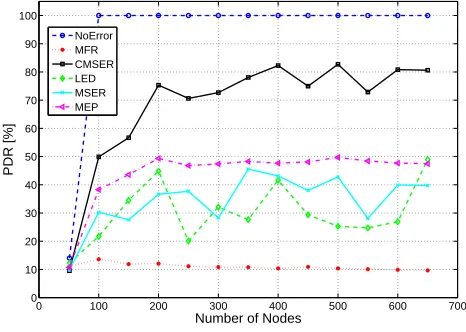
Fig. 1 presents the forwarding performance for different network densities. For an optimal density of more than 200 network nodes, CMSER has a PDR between 70% to 80%. The MFR performs worst with approximately 10% PDR for all network densities. MSER and LED have a similar throughput with PDR values between 20% and 50%. We do notice however that MSER slightly increases its performance for denser networks, above 350 nodes. Looking strictly at MEP we notice an obvious improvement over the other methods, with a parallel behavior to that of CMSER for over 200 nodes, but with a PDR of 50%. Fig. 2 is provided for clarity of view and as a support for the reliability of our simulations. For 500 iterations, it is with a 95% confidence level that the true value of the PDR is in the confidence interval.
0 100 200 300 400 500 600 700
0 10 20 30 40 50 60 70 80 90 100
Number of Nodes
PDR [%]
[image:4.612.314.547.321.487.2]NoError MFR CMSER LED MSER MEP
Figure 1. Routing performance for Scenario 1
200 300 400
0 10 20 30 40 50 60 70 80 90 100
Number of nodes
PDR (%)
[image:4.612.313.546.526.692.2]NoError CMSER MEP MSER LED MFR
Figure 2. PDR bar chart with confidence intervals
Looking at the PDR when σmax is increased (Fig. 3), the
perfor-mance degradation is that of LED, which for large errors behaves worse than MFR. In this scenario with an optimal network density, MSER outperforms LED, but this is mainly because of LED’s severe degradation. MEP has the second best performance maintaining a PDR of above 50% only for errors with σmax up to 10% of R. CMSER is the best forwarding
method here because its performance has the least abrupt degradation slope with the increase of errors. Although the
PDR for CMSER drops below 50% when σmax is higher
than 45% of R, it still maintains a significantly superior performance than for the other methods.
10 15 20 25 30 35 40 45 50
0 10 20 30 40 50 60 70 80 90 100
Maximum standard deviation of location errors (% of R)
PDR (%)
[image:5.612.52.284.203.365.2]NoError MFR CMSER LED MSER MEP
Figure 3. Routing performance for Scenario 2
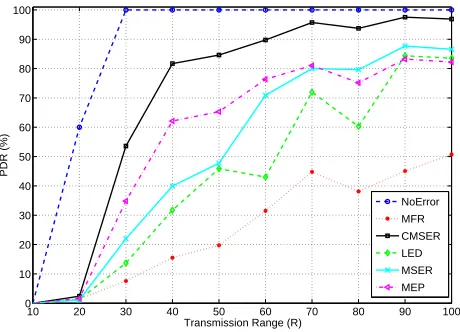
Varying the R (Fig. 4) within a reasonably dense network increases the potential forwarding options for each node. With more neighbors to choose from, the throughput also increases. ForR≤20, all the considered forwarding methods fail to find neighbors to forward to and the routing fails. While forR >30
CMSER increases its throughput progressively from 60% to almost 100% PDR, none of the other algorithms perform as well. The PDR curve for MFR remains detached below the rest of the algorithms for all values of R.
10 20 30 40 50 60 70 80 90 100
0 10 20 30 40 50 60 70 80 90 100
Transmission Range (R)
PDR (%)
NoError MFR CMSER LED MSER MEP
Figure 4. Routing performance for Scenario 3
For scenario 1 we investigate the hop count of the lost packets. Our simulations show path length directly influences the energy consumed without results, which leads to a shorter
network lifetime. For a network size less than 200 nodes CMSER has the highest average hop count per lost packet of all the routing methods. For more than 200 nodes, MSER and CMSER have similar hop count for the lost packets, higher than MFR, but lower than LED and MEP. By choosing different forwarding candidates than MFR, with less progress to D, the length of the CMSER paths is slightly increased. This confirms the tradeoff which CMSER has between the PDR and the hop count. However, if we take into consideration the total number of packets lost by each routing algorithm and their number of hops until the moment of loss, CMSER is the least energy wasteful ensuring the longest network lifetime.
V. CONCLUSIONS
Making geographic routing algorithms resilient to location error is imperative as this type of routing is energy efficient and very suitable to large scale networks. This paper proposes a novel routing algorithm, CMSER, whose performance in terms of throughput is considerably better when compared to other basic greedy routing techniques such as those employed by MFR, MSER, MEP and LED. The MATLAB simulations used in this study refer to three scenarios in which the PDR is analyzed under different network sizes, error characteristics and communication ranges. All results confirm that CMSER outperforms other algorithms when the network objective is to increase packet delivery. Overall energy costs are also kept down to a minimum. CMSER makes use of the notion of maximum progress to destination, but gives more importance to the probability of success when coordinates are affected by location error. As a consequence, the energy spent on lost routing packets is considerably decreased. While the paths of the received packets of CMSER may be longer, the routes of the lost packets are kept short, being surpassed only by MFR, which does not cope with location error at all.
REFERENCES
[1] A. M. Popescu, I. G. Tudorache, A. H. Kemp, Surveying Position Based Routing Protocols for Wireless Sensor and Ad-hoc Networks, Interna-tional Journal of Communication Networks and Information Security 4 (1) (2012)
[2] Y. Kong, Y. Kwon, J. Shin, G. Park, Localization and dynamic link de-tection for geographic routing in non-line-of-sight (NLOS) environments, EURASIP Journal on Wireless Communications and Networking (2011) [3] S. Kwon, N.B. Shroff, Geographic routing in the presence of location
errors, Computer Networks 50 (2006) 2902-2917
[4] R. Marin-Perez, P.M. Ruiz, Effective Geographic Routing in Wireless Networks with Inaccurate Location Information, In Proceedings of the 10th International conference on Ad-hoc, mobile, and wireless networks (ADHOC-NOW’11), Hannes Frey, Xu Li, and Stefan Ruehrup (Eds.). Springer-Verlag, Berlin, Heidelberg, 1-14.
[5] B. Peng, A.H. Kemp, Energy-efficient geographic routing in the presence of location errors, Computer Networks 55 (2011) 856-872
[6] A. M. Popescu, N. Salman, A. H. Kemp, Energy Consumption of Geographic Routing with Realistic Localization, IET Networks 1 (3) (2012) 126-135
[7] H. Takagi, L. Kleinrock, Optimal transmission range for randomly dis-tributed packet radio terminals, IEEE Transactions on Communications 32 (3) (1984) 246-257
[8] N. Salman, H. K. Maheshwari, A. H. Kemp, M. Ghogho, Effects of anchor placement on mean-CRB for localization, The 10th IFIP Annual Mediterranean Ad Hoc Networking Workshop (Med-Hoc-Net) (2011) 115-118
[image:5.612.54.284.515.681.2]