R E S E A R C H A R T I C L E
Open Access
Do bisphosphonates affect bone healing? A
meta-analysis of randomized controlled trials
Deting Xue, Fangcai Li, Gang Chen, Shigui Yan and Zhijun Pan
*Abstract
Background:Whether bisphosphonates affect indirect bone healing is still unclear.
Method:We carried out a comprehensive search strategy. Only randomized controlled trials were included. Two reviewers independently assessed methodological qualities and extracted outcome data. Analysis was performed with RevMan 5.2.
Results:Eight eligible randomized controlled trials with 2,508 patients were included. Meta-analysis results showed that no statistically significant differences were founded in indirect bone healing in short time (within 3 months) (relative risk (RR) 1.40, relative the control group; 95% CI 0.36 to 5.49) and in long-term (more than 12 months) postoperation (RR 1.0; 95% CI 0.98 to 1.02) between bisphosphonates infusion groups and control groups. There were no statistically significant differences of indirect bone healing between early and delay bisphosphonates administration groups. Bisphosphonates infusion after lumbar infusion surgery could promote bone healing and shorten fusion time in 6 months postoperation (RR 1.35; 95% CI 1.11 to 1.66).
Conclusion:There was no clinically detectable delay to fracture healing via external callus formation following bisphosphonates treatment. Considering the benefit aspects of bisphosphonates for osteoporosis treatment, we recommend bisphosphonates infusion after fracture fixation surgery and lumbar fusion surgery.
Keywords:Bisphosphonates, Indirect bone healing, Lumbar fusion, Randomized controlled trials, Meta-analysis
Introduction
There are two kinds of drugs which affect bone remold-ing, anabolic and anti-catabolic drugs. Anabolic drugs influence the osteoblasts and increase osteogenesis [1]. However, the high costs of anabolic drugs limit their wide applications. So most countries recommend anti-catabolic drugs as the first line drugs for treating osteo-porosis, especially bisphosphonates [2]. Bisphosphonates have an inhibitory effect on osteoclastic bone resorption. So they have been used in diseases with increased bone turnover, such as osteoporosis, Paget's disease, and meta-static bone diseases [3-5]. In theory, bisphosphonates in-hibit osteoclast-mediated bone resorption which would prevent bone loss and improve bone strength [6,7]. But treating patients with bisphosphonates during bone heal-ing is controversial because osteoclasts are important for remodeling callus into cortical bone [8]. Several studies
have addressed the effects of bisphosphonates on indirect bone healing. The results are inconsistent. Lenehan et al. [4] found that ethane-1-hydroxy-1,1-diphosphonate inhib-ited indirect fracture healing in a dose-dependent manner in mature beagle dogs. In a prospective study, Kim et al. found that bisphosphonates did not affect intertrochan-teric indirect fracture healing [3]. A randomized study of 32 postmenopausal women with Colles' fractures showed that the clodronate increased mineralization of callus [5]. So shall we use bisphosphonates for the patients with osteoporotic fractures or spinal fusion?
In order to summarize available randomized control tri-als and make this issue clear, we performed a meta-analysis of available randomized evidence to evaluate whether bisphosphonates affect bone healing.
Methods and materials
We searched Medline (1966–May 2013), Embase (1980– May 2013), Science Citation Index (1981–May 2013), Cochrane Central Register of Controlled Trials (CENTRAL), * Correspondence:[email protected]
Department of Orthopaedics, 2nd Affiliated Hospital, School of Medicine, Zhejiang University, #88 Jiefang Road, Hangzhou 310009, China
© 2014 Xue et al.; licensee BioMed Central Ltd. This is an Open Access article distributed under the terms of the Creative Commons Attribution License (http://creativecommons.org/licenses/by/4.0), which permits unrestricted use, distribution, and reproduction in any medium, provided the original work is properly credited. The Creative Commons Public Domain Dedication waiver (http://creativecommons.org/publicdomain/zero/1.0/) applies to the data made available in this article, unless otherwise stated.
(Netherlands) 2000 [7] T-score≤2 500 mg calcium vs. placebo + 500 mg calcium
fracture functional outcome fracture healing
Adolphson et al. (Sweden) 2000 [5]
F 16/16 62 Displaced Colles' fracture; postmenopausal women
400 mg clodronate vs. placebo
48 h after fracture
Did not provide BMD, function
Harding et al. (Sweden) 2011 [14]
M and F 25/21 48.9 Patients with osteoarthritis or deformity of knee; age between 35–65 years old
4 mg zoledronic acid vs. 9 mg/mL sodium chloride
4 weeks postoperation
Consolidation of about two-thirds of the osteotomy
gap by radiographic examination
Time to healing; BMD
Nagahama et al. (Japan) 2011 [12]
M and F 19/17 68.9 Candidated for single-level PLIF; BMD was less than 70% of the young adult mean value
35 mg/week alendronate vs. 1μg/day alfacalcidol
Just postoperation
Bridging bone formation through the cage by
CT scan
BMD, bone union
Colon-Emeric et al. (USA, Norway, Belgium, Canada) 2011 [13]
M and F 1,065/1,062 Not reported
Patients within 90 days of hip fracture repair
5 mg zoledronic acid vs. placebo
Within 90 days postoperation
Clinical symptoms: without persistent pain, bear weight Radiographic examination
Fracture healing
Kim et al. (Korea) 2012 [3]
M and F 90/0 76.1 Patients with intertrochanteric fracture; BMD <−2.5
35 mg/week risedronate + 1,200 mg/day calcium + 800 IU/day cholecalciferol
2 weeks vs. 1 month vs. 3 months after operation
At least two cortices bridging at the fracture site
Fracture healing, function
Gong et al. (Korea) 2012 [15]
F 60/0 66.5 Distal radial fractures treated with plate fixation;
BMD <−2.5
70 mg/week alendronate 2 weeks vs. 3 months after
operation
Bridging by trabeculae or osseous bone in at least one cortex as seen on anteroposterior
radiographs and one as seen on lateral radiographs
Fracture healing, function; complication
Li et al. (China) 2012 [16]
M and F 41/41 63.73 Patients undergoing TLIF 5 mg zoledronic acid + calcium 1000 mg/day + vitamin D 400 IU/day vs.
placebo + calcium 1000 mg/day + vitamin
D 400 IU/day
3 days postoperation
Bridging bony trabeculation through the cage by CT scan
Interbody fusion rate; function; biochemical
assessment
and
Research
2014,
9
:45
Page
2
o
f
and Cochrane Database of Systematic Reviews (Cochrane Library, Issue 1, 2013) for randomized clinical trials that evaluated the effect of bisphosphonates on bone healing. We also searched unpublished trials and those in progress using clinical trials repositories, including the National Institute of Health (May 2013), the National Research Register (May 2013), and Current Controlled Trials (May 2013). The following terms were used: ‘bisphosphonates’, ‘indirect bone healing,’ and ‘bone formation’. Searches were not restricted by year of publication or language. Ref-erence lists of all included studies were scanned to identify additional potentially relevant studies. Two reviewers in-dependently screened the titles and abstracts of identified papers, and full text copies of all potentially relevant stud-ies were obtained.
Study selection and outcomes
We included studies if they were randomized trials of bisphosphonates affecting fracture healing, regardless of the doses and duration of drugs used. No language re-strictions were applied. We excluded studies that were not peer-reviewed randomized controlled trials, stud-ies included patients with diseases that affecting bone mineral density (BMD) or bone metabolism, such as
renal or adrenal insufficiency, diabetes, and any his-tory of taking any medication known to affect BMD, such as corticosteroids.
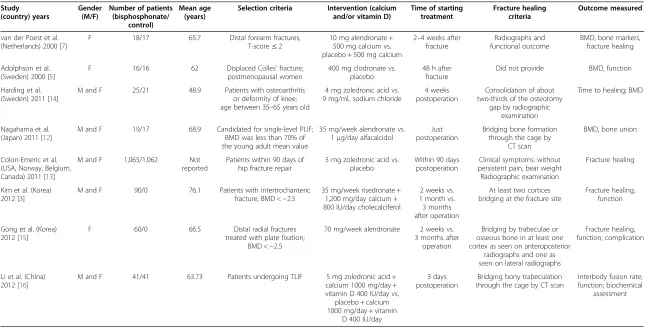
Bone healing criteria: all of the study used radiographic examination to evaluate bone healing, but one study [5] did not provide bone healing criteria. The detailed criteria were shown in Table 1.
We defined that evaluated indirect bone healing within 3 months as short time and more than 6 months as long term.
Delayed fracture union was defined as one or more clinical symptoms (pain, inability to ambulate, and gait disorder) at least 6 weeks after surgical repair plus radio-graphic findings. Fracture nonunion was defined as in-complete bony bridging through cages in lumbar spine in 12 months postoperation or no cortices bridging at the fracture site in more than 8 months postoperation.
The primary outcome was the indirect bone healing time and fracture nonunion.
Data extraction
Two reviewers independently extracted the data infor-mation of trial characteristics, patient data, outcome mea-sures, and study quality using a standardized protocol and
Figure 1Selection of study.
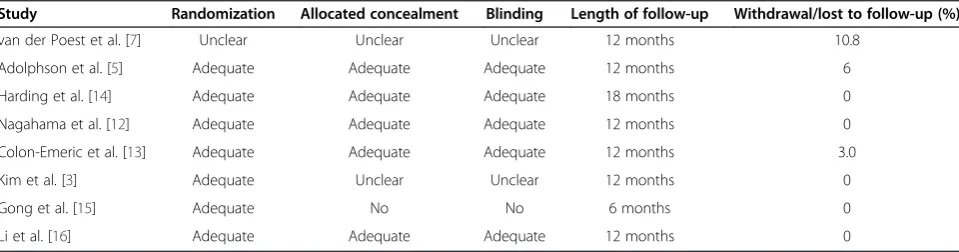
Table 2 Quality assessment of included studies
Study Randomization Allocated concealment Blinding Length of follow-up Withdrawal/lost to follow-up (%)
van der Poest et al. [7] Unclear Unclear Unclear 12 months 10.8
Adolphson et al. [5] Adequate Adequate Adequate 12 months 6
Harding et al. [14] Adequate Adequate Adequate 18 months 0
Nagahama et al. [12] Adequate Adequate Adequate 12 months 0
Colon-Emeric et al. [13] Adequate Adequate Adequate 12 months 3.0
Kim et al. [3] Adequate Unclear Unclear 12 months 0
Gong et al. [15] Adequate No No 6 months 0
Li et al. [16] Adequate Adequate Adequate 12 months 0
Xueet al. Journal of Orthopaedic Surgery and Research2014,9:45 Page 3 of 7
reporting document. Disagreements were resolved by con-sensus. To quantify the level of agreement between re-viewers, a κ statistic was calculated. The κ statistic is a chance-corrected proportional index, with values ranging from +1 (perfect agreement) to −1 (complete disagree-ment). Information extracted included personal informa-tion, methodology, details on interventions, and reported outcomes.
Study quality assessment
We assessed the methods of every study according to Cochrane Handbook for Systematic Reviews of Interven-tions, including reporting of randomization method, al-location concealment, blinding of outcome assessment, and completeness of follow-up.
Statistical analysis
The meta-analysis was done according to the Cochrane Collaboration and the Quality of Reporting of Meta-analyses guidelines (QUOROM) [9] with standard soft-ware (Review manager (RevMan), version 5.2, Cochrane collaboration) [10]. Heterogeneity was assessed withI2 sta-tistics [11].I2is the proportion of total variation observed between the trials attributable to differences between trials rather than sampling error (chance). Relative risk (RR) was used as the summary statistic to perform statistical ana-lysis of dichotomous variables. A fixed effect model was used for calculations of summary estimates and their 95% CI. However, when the heterogeneity was significant, a random effects model was used.
Results
We identified 916 potentially relevant publications. Eight trials [3,5,7,12-16] met the predefined inclusion criteria and were included in our meta-analysis (Figure 1). The eight trails included 2,508 patients (Table 1). Calcium supplement was used in three trials [3,7,16]. Three trials [5,7,15] included patients with distal radial fractures; two trials [3,13] included patients with posterior lumbar interbody fusion. Two trials [13,15] included patients with hip fracture; one trial [14] included patients with tibial osteotomy.
Six trials [5,7,12-15] compared bisphosphonate with placebo for indirect bone healing; two trials [3,15] com-pared different timing of postoperative administrating bisphosphonate on indirect bone healing.
After adjustment for the agreement between reviewers, the κcoefficient on the agreement of the included stud-ies was 0.91 (95% confidence interval 0.82 to 0.94), suggest-ing good agreement between reviewers in data extraction. On the basis of quality assessment, five trials were deemed to be at low risks of bias and the remainder to be at high risks (Table 2).
Evaluation of bone healing in short term (within 3 months)
This result was based on two studies [12,14] (138 partici-pants). Because the examinations of bone healing at 3 months postoperation were heterogeneous among the included trials, we used a random effects model. The pooled RR was 1.40; 95% CI (0.36, 5.49). This result was not statistically significant (P= 0.63) (Figure 2).
Figure 2Evaluation of bone healing in short term.
Evaluation of bone healing in long term (more than 6 months)
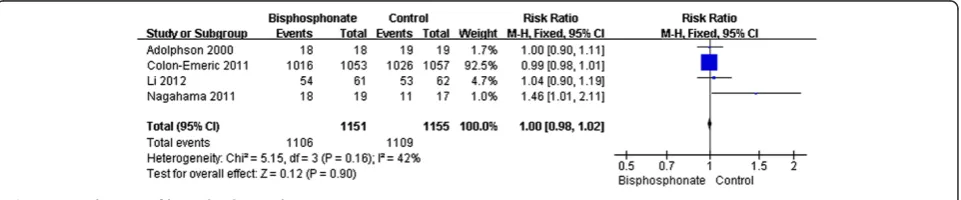
This result was based on four studies [5,12,13,16] (2,306 participants). The test for homogeneity showed that results were consistent across trials (P= 0.16, I2= 42%). The pooled RR was 1.0; 95% CI (0.98, 1.02). This result was not statistically significant (P= 0.90) (Figure 3).
Delay bone healing or nonunion of fractures between administrating bisphosphonate groups and control groups
Four trials [7,12,13,16] reported delay bone healing or nonunion of fractures (2,265 participants). The test for homogeneity showed that results were consistent across trials (P= 0.21, I2= 34%). The pooled RR was 0.8; 95% CI (0.38, 1.69). This result was not statistically significant (P= 0.55) (Figure 4).
The timing of zoledronic acid infusion on bone healing Two trials [3,15] compared early (within 1 month of post-operation) and delay (after 1 month of postpost-operation) zoledronic acid infusion on bone healing. The test for homogeneity showed that results were consistent across trials (P= 0.38, I2= 0%). Meta-analysis showed that the pooled RR was −0.20; 95% CI (−1.03, 0.63). This result was not statistically significant (P= 0.64) (Figure 5).
Evaluation of bisphosphonate on lumbar fusion
Two studies [12,17] reported zoledronic acid infusion on lumbar fusion. The test for homogeneity showed that results were consistent across trials (P= 0.54, I2= 0%) in 6 months postoperation but inconsistent across trials (P= 0.11, I2= 61%) at 12 months postoperation. Meta-analysis showed that the pooled RR was 1.35; 95% CI
(1.11, 1.66) at 6 months postoperation. This result was sta-tistically significant (P= 0.003). But the pooled RR was 2.80; 95% CI (0.41, 19.24) in 12 months postoperation. This result was not statistically significant (P= 0.30).
Discussion
The main objective of this meta-analysis was to assess whether bisphosphonates affect indirect bone healing. Because in lumbar fusion surgery, bone formation oc-curs via intramembranous ossification due to the rela-tively stable construct supporting the fusion site, so our analysis included spinal fusion. Meta-analysis results showed that no statistically significant differences were found in short- and long-term postoperation between two groups. The delay indirect bone healing or fracture nonunion was also not significant differences between two groups. The timing of bisphosphonates infusion did not affect indirect bone healing. In subgroup analysis, we found that bisphosphonate-treated groups had statis-tically significant higher lumbar infusion rate at 6 months postoperation.
It is still unclear whether bisphosphonates therapy af-fects indirect bone healing. Several animal studies have demonstrated that bisphosphonates treatment after sur-gery would increase callus formation, delay callus re-modeling, but without influencing the strength of healed bone or bone healing [16-18]. Van der Poest [7] evalu-ated whether alendronate prevented bone loss in distal radius after Colles' fractures. The BMD of distal radius increased significantly at 3 and 6 months compared with that of the control group. There were no significant dif-ferences of anatomic and functional outcomes between the alendronate group and control group after 1 year follow-up. In a high tibial osteotomy study, Harding et al.
Figure 4Delay bone healing or nonunion of fractures between administrating bisphosphonate groups and control groups.
Figure 5Evaluation of early and delay zoledronic acid infusion on bone healing.
Xueet al. Journal of Orthopaedic Surgery and Research2014,9:45 Page 5 of 7
versy. In an animal study, Amanat et al. [19] found that delayed infusion of zoledronic acid increased more callus volume compared to both saline and infusion of zoledro-nic acid immediately at the time of the fracture. However, our analysis results found that the timing of infusion bisphosphonate did not affect fracture healing. This was consistent with Colon-Emeric's report [13]. One possible reason may be that both included studies involved lous bone fractures. The spacious environment for cancel-lous new bone formation is large enough, so the bone remodeling process which suppressed by a reduction in the resorption process by bisphosphonate was not so im-portant [15]. But the compact bones are different. Fracture bone debris needs to be absorbed to allow space for new bone formation [20]. Another reason may be that the dose of bisphosphonates for treating osteoporosis is sufficient for affecting bone healing in animal but insufficient for human.
It is interesting that bisphosphonates affect lumbar fusion in 6 months after operation in our study. The consistency across both studies was very well (I2= 0%). This may be due to the enough spacious environment for osteogenesis without absorption process after decompres-sion of the intervetebral discs. So bisphosphonates may have particular advantages for shortening intervetebral fu-sion in osteoporosis patients.
Our meta-analysis also showed that bisphosphonates did not delay indirect bone healing. Several studies have shown that the existence of a previous osteoporotic fracture conferred an approximately twofold higher risks of subsequent osteoporotic fracture [21]. So more and more authors recommended pharmacological inter-vention after first osteoporotic fracture to increase BMD and reduce the risks of subsequent fractures [22,23]. Health Outcomes and Reduced Incidence with Zoledronic Acid Once Yearly Recurrent Fracture Trial (HORIZON) showed that administration of zoledronic acid to patients with low-energy hip fractures would reduce the risk of subsequent vertebral or nonvertebral fractures [24].
Our meta-analysis had several limitations. Firstly, our results are subject to limitations inherent to any meta-analysis based on pooling of data from different trials with different doses of drugs, duration, fracture sites, and pa-tient groups. Secondly, the reporting may be influenced by expectations of the investigators and patients. The surgical technique of doctors may also influence the healing re-sults. Finally, the number of the included studies and par-ticipants were relatively small.
Competing interests
The authors declare that they have no competing interests.
Authors' contributions
The design of the study and preparation of the manuscript were done by DX and ZP. DX, FL, and GC assisted in the study processes, data collections, and preparations. SY and ZP assisted in the manuscript preparation. All authors read and approved the final manuscript.
Acknowledgement
This work was supported by a grant from the National Natural Science Foundation of China (No. 81271973 and No. 81201397), the Zhejiang Provincial Natural Science Foundation of China (No. Y2090283), and Zhejiang medical and health science and technology plan project (No. 2011ZDA011). Received: 23 February 2014 Accepted: 23 May 2014
Published: 5 June 2014
References
1. Esbrit P, Alcaraz MJ:Current perspectives on parathyroid hormone (PTH) and PTH-related protein (PTHrP) as bone anabolic therapies.Biochem Pharmacol2013,85:1417–1423.
2. De Sanctis V, Soliman AT, Elsedfy H, Yassin M, Canatan D, Kilinc Y, Sobti P, Skordis N, Karimi M, Raiola G, Galati MC, Bedair E, Fiscina B, El Kholy M: Osteoporosis in thalassemia major: an update and the I-CET 2013 recommendations for surveillance and treatment.Pediatr Endocrinol Rev
2013,11:167–180.
3. Kim TY, Ha YC, Kang BJ, Lee YK, Koo KH:Does early administration of bisphosphonate affect fracture healing in patients with intertrochanteric fractures?J Bone Joint Surg Br2012,94:956–960.
4. Lenehan TM, Balligand M, Nunamaker DM, Wood FE Jr:Effect of EHDP on fracture healing in dogs.J Orthop Res1985,3:499–507.
5. Adolphson P, Abbaszadegan H, Boden H, Salemyr M, Henriques T: Clodronate increases mineralization of callus after Colles’fracture: a randomized, double-blind, placebo-controlled, prospective trial in 32 patients.Acta Orthop Scand2000,71:195–200.
6. Watkins MP, Norris JY, Grimston SK, Zhang X, Phipps RJ, Ebetino FH, Civitelli R: Bisphosphonates improve trabecular bone mass and normalize cortical thickness in ovariectomized, osteoblast connexin43 deficient mice.Bone
2012,51:787–794.
7. van der Poest CE, Patka P, Vandormael K, Haarman H, Lips P:The effect of alendronate on bone mass after distal forearm fracture.J Bone Miner Res
2000,15:586–593.
8. Schindeler A, McDonald MM, Bokko P, Little DG:Bone remodeling during fracture repair: the cellular picture.Semin Cell Dev Biol2008,19:459–466. 9. Moher D, Cook DJ, Eastwood S, Olkin I, Rennie D, Stroup DF:Improving
the quality of reports of meta-analyses of randomised controlled trials: the QUOROM statement. Quality of Reporting of Meta-analyses.Lancet
1999,354:1896–1900.
10. Bradburn M, Deeks J, Altman D:Sbe24: metan—an alternative meta-analysis command.Stata Technical Bull Reprints1998,8:86–100.
11. Galbraith RF:A note on graphical presentation of estimated odds ratios from several clinical trials.Stat Med1988,7:889–894.
12. Nagahama K, Kanayama M, Togawa D, Hashimoto T, Minami A:Does alendronate disturb the healing process of posterior lumbar interbody fusion? A prospective randomized trial.J Neurosurg Spine
2011,14:500–507.
14. Harding AK AWD, Geijer M, Toksvig-Larsen S, Tagil M:A single bisphosphonate infusion does not accelerate fracture healing in high tibial osteotomies.
Acta Orthop2011,82:465–470.
15. Gong HS, Song CH, Lee YH, Rhee SH, Lee HJ, Baek GH:Early initiation of bisphosphonate does not affect healing and outcomes of volar plate fixation of osteoporotic distal radial fractures.J Bone Joint Surg Am2012, 94:1729–1736.
16. Li C, Wang HR, Li XL, Zhou XG, Dong J:The relation between zoledronic acid infusion and interbody fusion in patients undergoing transforaminal lumbar interbody fusion surgery.Acta Neurochir (Wien)2012,154:731–738. 17. Manabe T, Mori S, Mashiba T, Cao Y, Kaji Y, Iwata K, Komatsubara S,
Yamamoto T, Seki A, Norimatsu H:Eel calcitonin (elcatonin) suppressed callus remodeling but did not interfere with fracture healing in the femoral fracture model of cynomolgus monkeys.J Bone Miner Metab
2009,27:295–302.
18. Cao Y, Mori S, Mashiba T, Westmore MS, Ma L, Sato M, Akiyama T, Shi L, Komatsubara S, Miyamoto K, Norimatsu H:Raloxifene, estrogen, and alendronate affect the processes of fracture repair differently in ovariectomized rats.J Bone Miner Res2002,17:2237–2246.
19. Amanat N, McDonald M, Godfrey C, Bilston L, Little D:Optimal timing of a single dose of zoledronic acid to increase strength in rat fracture repair.
J Bone Miner Res2007,22:867–876.
20. Einhorn TA:The cell and molecular biology of fracture healing.Clin Orthop Relat Res1998, S7–S21.
21. Klotzbuecher CM, Ross PD, Landsman PB, Abbott TA 3rd, Berger M:Patients with prior fractures have an increased risk of future fractures: a summary of the literature and statistical synthesis.J Bone Miner Res2000,15:721–739. 22. Warriner AH, Saag KG:Osteoporosis diagnosis and medical treatment.
Orthop Clin North Am2013,44:125–135.
23. Orcel P, Funck-Brentano T:Medical management following an osteoporotic fracture.Orthop Traumatol Surg Res2011,97:860–869.
24. Eriksen EF, Lyles KW, Colon-Emeric CS, Pieper CF, Magaziner JS, Adachi JD, Hyldstrup L, Recknor C, Nordsletten L, Lavecchia C, Hu H, Boonen S, Mesenbrink P:Antifracture efficacy and reduction of mortality in relation to timing of the first dose of zoledronic acid after hip fracture.J Bone Miner Res
2009,24:1308–1313.
doi:10.1186/1749-799X-9-45
Cite this article as:Xueet al.:Do bisphosphonates affect bone healing? A meta-analysis of randomized controlled trials.Journal of Orthopaedic Surgery and Research20149:45.
Submit your next manuscript to BioMed Central and take full advantage of:
• Convenient online submission
• Thorough peer review
• No space constraints or color figure charges
• Immediate publication on acceptance
• Inclusion in PubMed, CAS, Scopus and Google Scholar
• Research which is freely available for redistribution
Submit your manuscript at www.biomedcentral.com/submit
Xueet al. Journal of Orthopaedic Surgery and Research2014,9:45 Page 7 of 7