This is a repository copy of
Context aware detection and tracking
.
White Rose Research Online URL for this paper:
http://eprints.whiterose.ac.uk/83875/
Version: Accepted Version
Proceedings Paper:
Tavanai, A, Sridhar, M, Gu, F et al. (2 more authors) (2014) Context aware detection and
tracking. In: Proceedings - International Conference on Pattern Recognition. 2014 22nd
International Conference on Pattern Recognition (ICPR), 24-28 Aug 2014, Stockholm.
IEEE , 2197 - 2202. ISBN 9781479952083
https://doi.org/10.1109/ICPR.2014.382
[email protected] https://eprints.whiterose.ac.uk/ Reuse
Unless indicated otherwise, fulltext items are protected by copyright with all rights reserved. The copyright exception in section 29 of the Copyright, Designs and Patents Act 1988 allows the making of a single copy solely for the purpose of non-commercial research or private study within the limits of fair dealing. The publisher or other rights-holder may allow further reproduction and re-use of this version - refer to the White Rose Research Online record for this item. Where records identify the publisher as the copyright holder, users can verify any specific terms of use on the publisher’s website.
Takedown
If you consider content in White Rose Research Online to be in breach of UK law, please notify us by
Context Aware Detection and Tracking
Aryana Tavanai, Muralikrishna Sridhar, Feng Gu, Anthony G. Cohn and David C. Hogg
School of Computing, University of LeedsLeeds, LS29JT, United Kingdom
{fy06at,scms,f.gu,a.g.cohn,d.c.hogg}@leeds.ac.uk
Abstract—This paper presents a novel approach to incorporate multiple contextual factors into a tracking process, for the pur-pose of reducing false positive detections. While much previous work has focused on improving object detection on static images using context, these have not been integrated into the tracking process. Our hypothesis is that a significant improvement can result from the use of context in dynamically influencing the linking of object detections, during the tracking process. To verify this hypothesis, we augment a state of the art dynamic program-ming based tracker with contextual information by reformulating the maximum a posteriori (MAP) estimation formulation. This formulation introduces contextual factors that first of all augment detection strengths and secondly provides temporal context. We allow both these types of factors to contribute organically to the linking process by learning the relative contribution of each of these factors jointly during a gradient decent based optimi-sation process. Our experiments demonstrate that the proposed approach contributes to a significantly superior performance on a recent challenging video dataset, which captures complex scenes with a wide range of object types and diverse backgrounds.
I. INTRODUCTION
An important aspect of scene understanding is to detect and track objects, so that they may be used to model the behaviour of individual objects and their interactions in a scene. However, the task of obtaining correct detections often tends to come at the cost of a significant number of false positives, adding considerable noise to the subsequent tracking process.
This work is based on our premise that these false positives tend to be both spatially and temporally out of context. For example, spatially out-of-context false positives tend to be inconsistent with respect to the scene geometry in terms of its size or position, or may lack a distinct object-like-profile with respect to their immediate background. Temporally out-of-context false positives tend to be inconsistent with their immediate temporal neighbourhood.
Previous work has focussed on solely using spatial con-text during detection and temporal concon-text during tracking respectively. Many detection based approaches have shown that the incorporation of spatial contextual information can significantly reduce the number of false positives. These approaches [1], [2] have concentrated on improving object detections by using different types of features such as gradient, colour and texture to represent objects, while also modelling the generic objectness cues [3]. Recent research [4], [5] has also demonstrated the advantage of using surface and view point as contexts. On the other hand, tracking in [6], [7] conceives the task as a separate procedure for linking the resulting detections and they incorporate temporal context to improve tracking performance.
Our work incorporates both spatial and temporal context into the tracking process. This way we simultaneously reduce false positives that are both spatially and temporally out-of-context. The proposed approach is evaluated on a publicly available challenging dataset consisting of 300 videos. These videos depict interactions between objects, most of them involving persons who perform common verbs in diverse and complex backgrounds. Our experimental results demonstrate that we can obtain tracks with a significant drop in the number of false positives, while only minimally reducing the number of true positives.
We organise the paper as follows. In Sec. II we briefly provide a literature survey on relevant research. We present the formulation of our approach in Sec. III. Our datasets and experiments are described in Sec. V. We conclude the paper with a summary and a description of future work in Sec. VI.
II. RELATEDWORK
Graphical models such as Markov random fields (MRF) and conditional random fields (CRF) have been used to in-clude information about pixels surrounding a scanning-window detection and thus include the contextual information. The authors in [8] and [9] build a representation of context from low level features and use them to facilitate object detection. The authors in [10] propose textons that model shape and texture in a CRF to segment an image into semantic categories by exploiting context. Another approach is to combine both local and global contexts in a hierarchical field framework [11].
A related approach [12] obtains a 2D scene gist by computing global statistics of an image to capture the gist, providing the context of an object. Semantic scene context for object detection is exploited in [13] where object and scene categorisations are integrated. Spatial and co-occurrence relations between objects are used as contexts in [14] and [15].
Geometric scene structure such as surface and viewpoint have been shown to provide good object contexts. The authors in [5] integrate a multi-view object representation (using class specific deformable templates) as a likelihood with spatial fea-tures – surface, viewpoint and temporal feafea-tures – foreground probability maps, local object trajectory predictions, as prior probabilities. Another approach is to model factors such as the interdependence of objects, surface and camera viewpoint and to use them in a iterative fashion in order to refine each other [4]. In recent work [16] combines various types of contexts for object detection within images.
or filtering the tracks post tracking, rather than influencing the linking during the tracking process itself. For example, the authors in [17] focus on “filtering” tracks using contextual information such as a viewpoint filter, foreground filter and trajectory-like filter. A few exceptions to this trend can be seen in [18], where the authors incorporate object-level spatio-temporal relationships as context using a MRF to improve tracking. Another such example is [19] which aims at improv-ing trackimprov-ing in videos usimprov-ing events as context.
However, there exists a significant gap between research on the role of context in object detection and their combination with temporal context within the tracking process for video analysis. We show that the simultaneous incorporation of appearance, geometric and temporal context can significantly improve the outcome of tracking.
III. PROBLEMFORMULATION
We consider a video which is a time series of images
I={I1, ..., It, ..., IN
}; we would like to interpret them with a non-overlapping set of tracksΓ. Each trackT ⊆Γis in turn composed of a temporally contiguous sequence of windows (detections), where the window Xt
is one such at time t. For each window Xt
we extract a set of local features Lt , the details of which are elaborated in the next section. For a given t, let Xt be the set of context windows e.g. sky and groundplane. The set of all features of all the windows in a track T are denoted by L and X is the set of all context windows for the trackT, i.e{x:x∈ Xt,1
≤t≤N}. We formulate the task of context aware tracking as finding the optimal set of tracks Γˆ that maximizes the following product of joint probability distributions P(T, LT,X,Θ).
ˆ
Γ = arg max
Γ
Y
T∈Γ
P(T, LT,X,Θ)
We expand the joint probability distribution P(T, LT,X,Θ) as follows.
P(T, LT,X,Θ)≈
Y
t Xt∈T
P(Xt, Lt
|Xt, Xt−1:t−2, Lt−1,Θ)
≈Y
t Xt∈T
P(Xt,Lt|Xt
,Θapp,Θspt)P(Xt,Lt|Xt,Xt−1:t−2,Lt−1,Θtem)
The first term P(Xt, Lt
|Xt,Θ
app,Θspt) leads to a static understanding of the scene for a particular frame t, where both appearance of objects and their spatial relations with their context is captured. We factorize this term as follows.
P(Xt, Lt
|Xt,Θ
app,Θspt) =P(Lt|Xt,Θapp)P(Xt|Xt,Θspt)
The likelihoodP(Lt
|Xt,Θ
app)models object appearance in terms of the probability of a feature vector Lt
corresponding to a windowXt and an appearance model Θ
app. The second probabilityP(Xt
|X,Θspt)models spatial context in terms of the probability of a window Xt given a set of windows
Xt that form the spatial context of Xt using a model of spatial relationshipsΘspt.
The second term P(Xt, Lt
|Xt, Xt−1:t−2, Lt−1,Θ
tem) leads to adynamic understanding of the scenein terms of the relationship between an object and its temporal context i.e. between the objects corresponding to the previous two frames that are in the same track.
In the following paragraphs, we expand each of these terms that correspond to static and dynamic scene contexts respectively.
A. Object Appearance
We model the likelihood P(Lt
|Xt,Θ
app) for object ap-pearance in terms of class specific features and scene appear-ance context as explained below.
P(Lt
|Xt,Θ
app) = P(Lthog|X t,Θ
hog)P(Xt|Θar)
| {z }
class specific features
P(Ltcc|X t
,Θcc)P(Lted|X t
,Θed)P(Ltss|X t
,Θss)
| {z }
scene appearance context
1)Class Specific Features: We primarily use HOG fea-tures for representing the appearances of object classes and obtain trained part based models [20] for each ob-ject class. Another class specific feature is aspect ratio, which is useful since objects tend to have characteristic aspect ratios depending on the object class they belong to – people are more vertical and cars are more horizontal. Thus, a probability is computed with respect to HOG fea-tures P(Lt
hog|X t,Θ
hog) = 1/z2exp(ΘhogD(Xt)) using the Boltzmann distribution1 on the corresponding detection score
D(Xt)
. We model the probability with respect to aspect ratio
P(Xt
|Θar) = N χ(a(Xt),Θar)
in terms of a Gaussian distribution.
2)Scene Appearance Context: One of the indicators of the presence of an object is its distinctiveness from its scene context. Three recently introduced measures [3] of an object’s distinctiveness from its scene context are colour contrast, edge density and superpixel straddling. As we found the original measures in this work computationally expensive, we employ robust alternatives of these measures by defining an interior ring RI(Xt) and an exterior ring RE(Xt) with respect to the window Xt. The outer ring serves as an immediate context that can be compared to the inner ring. Using ap-propriate features in the inner and outer ring respectively, we express the likelihood for scene appearance context in terms of three probabilities corresponding to colour contrast
P(Lt
cc|Xt,Θcc), edge densityP(Lted|Xt,Θed)and superpixel straddlingP(Lt
ss|Xt,Θss)as follows.
Objects tend to have a different appearance (colour distri-bution) to their immediate background contexts. The colour contrast probability P(Lt
cc|Xt,Θcc) expresses the degree of discrepancy between the LAB histograms h(·) in the inner ring RI(Xt) of a window Xt to another in the outer ring
RE(Xt).
1The probability ofx is defined by assigning it to energyE(x), which
is converted into a probability using the Boltzmann distribution P(x) =
exp(−E(x)) P
P(Ltcc|X t
,Θcc) = 1
z3exp(−Θccχ
−2(h(
RI(Xt), h(RE(Xt)))
It is expected that objects tend to have well defined boundaries, characterised by the presence of areas of high edge densities near their enclosing bounding boxes. The edge den-sity probability P(Lt
ed|X t,Θ
ed) is expressed in terms of the degree of edge density in the inner ringRI(Xt). Accordingly, we count the number of pixelspfor which the binary edgemap
Ied(p)obtained using the Canny detector gives a value of one within the inner ring RI(Xt). Then we normalize this count by the perimeterkRI(Xt)k of this ring.
P(Lt
ed|Xt,Θed) = 1
z4
exp− ΘedkRI(X
t)
k P
p∈RI(Xt)Ied(p)
Superpixels straddling measures the extent to which the superpixels of the image within a detection bounding box straddle the bounding box, as the superpixels have the property that even though they over segment an object, they preserve object boundaries. That is, most pixels in a superpixel belong to the same object and hence do not tend to straddle these boundaries, or the corresponding bounding boxes. For each superpixel s obtained with the segmentation scale Θss, we express superpixel straddling probability P(Lt
ss|Xt,Θss) in terms of the sums of the ratio of the area RI(Xt, s)∪Xt in the interior ring RI(Xt, s) to the area in the exterior ring
RE(Xt, s)∪Xt, across the set of superpixels s ∈ SP(Xt) for the detectionXt.
P(Lt
ss|Xt,Θss)= 1
z5
exp−Θss
X
s∈SP(Xt)
RI(Xt, s)∪Xt
RE(Xt, s)∪Xt
B. Spatial Context
The locations of objects are naturally constrained to spe-cific surfaces, and their sizes are constrained by the dis-tance from the camera. Therefore, we model the likelihood
P(Xt
|Xt,Θ
spt) for spatial context in terms of a scene geo-metric context2. Hence, we use surface and viewpoint as scene geometric context and obtain the corresponding likelihoods
P(Xt
|X′,Θsf)andP(Xt|X
′′
,Θvp)as follows.
P(Xt|Xt
,Θspt) =P(Xt|X
′
,Θsf)P(Xt|X
′′
,Θvp)
1)Surface: To obtain the approximate 3D surface orien-tations in the image, we apply the method of [22], which produces confidence maps for three main classes: ground, vertical, and sky. The objects under consideration in our dataset primarily lie on the ground. Hence P(Xt
|X′
,Θsf) represents the spatial relationship betweenXt
and the window of the ground plane X′ and is computed in terms of the average of ground surface probabilitiesG(p)across all pixels
p∈S(Xt, X′
)whereS provides the set of all shared pixels betweenXt andX′
.
P(Xt
|X′,Θsf) = 1
z2
exp−ΘsfkS(X t, X′
)k
P
p∈S(Xt,X′)G(p)
2In [21] we incorporate another spatial context, specifically event context,
which is obtained in terms of the spatial relationship between people and objects for a given event typecarry.
2)Viewpoint: In order to model the view point likelihood
P(Xt
|X′′,Θvp), we obtain the depthd(Xt)of a windowXt using a pre-defined homography mapping, which we assume to be constant for all the videos3. We estimate a windowX′′
based on the expected size of Xt
at the depth d(Xt) in the image plane. The view point likelihood is then modelled in terms of a Gaussian distribution over a ratio of the estimated height h′(X′′)and the observed heighth(Xt)
.
P(Xt
|X′′,Θvp) =N
h′(X′′) h(Xt),Θvp
C. Temporal Context
The temporal context is simply the temporal neighbourhood of each detection with respect to the track. We factorize the temporal context term
P(Xt, Lt
|Xt, Xt−1:t−2, Lt−1,Θ
tem)as follows.
P(Xt, Lt
|Xt, Xt−1:t−2, Lt−1,Θ
tem) =
P(Xt
|Xt−1:t−2,Θmcont)P(Lt|Lt−1,Θacont)
The first probabilityP(Xt
|Xt−1:t−2,Θ
mcont)models tem-poral context in terms of motion continuity i.e. the probability of a window Xt given two previous windows Xt−1:t−2.
We model motion continuity in terms of the similarity in magnitude and directions between the displacement vectors
v1 = −−−−−−→bn−2bn−1 and v2 = −−−−→bn−1bn corresponding to the bounding boxesbof the windows in three consecutive frames of a track, Xt−2, Xt−1 and Xt respectively. We model the motion continuity likelihood as:
P(Xt
|Xt−1:t−2,Θ
mcont)= 1
z7
exp-Θp(
v1·v2
kv1kkv2k
+
√v
1·v2
kv1k+kv2k
)-1
The second probabilityP(Lt
|Lt−1,Θ
acont)models tempo-ral context in terms of appearance continuity i.e. the probability of a window’s appearance featuresLtgiven that of a previous window i.e.Lt−1. We model appearance continuity in terms of
chi-squared similarity between the LAB histograms ht lab and
ht−lab1 of two windowsX t
andXt−1 in consecutive frames of
a track, respectively. Therefore we compute colour continuity as:
P(Lt
|Lt−1,Θ
acont) = 1
z6
exp −Θcχ−2(htlab, ht−
1
lab)
.
IV. GRADIENTDESCENTOPTIMISATION
LetΓ(Θ)ˆ be an optimal track hypothesis returned by the tracker, with respect to a weight vectorΘ, whereΘdefines the contribution of each type of contextual features to the optimal tracks. Given a set of tracks ΓGT in the ground truth, the objective of parameter learning is to search for the optimal
ˆ
Θ that gives minimum error between the hypothesised track
ˆ
Γ(Θ)and the ground truth trackΓGT. In other words,
ˆ
Θ = arg min
Θ D(ˆΓ(Θ),ΓGT)
3We have observed that the camera viewpoint parameters are similar for
whereDis a function that measures the divergence between a set of tracks and the ground truth for a video, defined between two sets of tracksΓandΓ′ as
D(Γ,Γ′) = X T∈Γ:6∃T′∈Γ′
:T=H(T′)
kV ol(T)k −X
T′∈Γ′:∃T∈Γ :T=H(T′)
∩(V ol(T), V ol(H(T)))
whereH : Γ′
→Γis the optimal assignment betweenΓ′ toΓ, computed using bipartite matching [23] based on the overlap of their respective volumes. The volume of a track is computed from the three dimensional tube traced by its bounding box through time. The first term measures the sum of volumes of tracks inΓ, none of which are assigned to any track inΓ′by the assignmentH. The second term measures the sum of volume intersections between pairs of tracksT ∈ΓandT′
∈Γ′, such that the trackT′ is assigned to trackT byH.
We apply a basic gradient descent based optimisation process with line search [24] to find the best solution Θˆ. Accordingly, we define J(Θ) = D(Γ(Θ),ΓGT) as the cri-terion function, andΘ(1)the initial weight vector with some arbitrary values. At each step, we compute the gradient vector
∇J(Θ(k)), and the next valueΘ(k+1)is obtained by moving some distance toward the steepest direction, i.e. along the negative of gradient. The update process can be defined as
Θ(k+ 1) = Θ(k)−η(k)∇J(Θ(k))
where η(·) is the learning rate, a positive scalar factor that reflects to the degree of change at each step. The processes repeats until the termination condition is satisfied, that is,
|η(k)∇J(Θ(k))| < λ, where λ is a predefined threshold for the purpose of convergence.
V. EXPERIMENTS
In the following, we first describe the dataset and experi-mental setups. We then present a quantitative evaluation fol-lowed by a qualitative explanation using image sequences that convey the success and limitations of the proposed approach.
A. Dataset and Experimental Setup
We evaluated the proposed approach using the year-one (Y1) corpus produced by DARPA for the Minds Eye program [25], which consists of 300 videos. These videos are provided at 30 frames per second and range between 40 to 1500 frames, with an average of 438 frames and a resolution of1280×720
pixels. They depict interactions between a variety of objects, most of them involving people who perform common verbs such as approaching and exchanging. Human-annotated tracks for people and cars have been publicly made available by Stanford University. We used these human-annotated tracks as ground truth to evaluate and compare the tracking perfor-mances obtained using the proposed approach with that of the baseline tracker. Before we evaluate our tracker, we ran-domly sample 10 videos from which we learn the parameters
Θar,Θcc,Θed,Θss,Θvp. We then remove these videos from the dataset and henceforth, refer to the rest of the videos as our dataset for the purpose of evaluation.
We first ran an “off the shelf” object detector [20] for the car and person class with a low non-maximum suppression threshold, generating around 50 detections per frame per class
0 0.05 0.1 0.15 0.2 0.25 0.3
Comparison of baseline, weighted combination and individual features
Baseline Weighted Combination Surface Aspect Ratio
Colour Contrast Edge Density Superpixels Straddling Depth
Length Path Coherence Colour Continuity
F
1
S
co
re
(a) F1 Score
0 0.5 1 1.5 2 2.5 3 3.5
4 4.5
A
v
e
ra
g
e
#
F
a
ls
e
P
o
si
ti
ve
s
(b) False Positives
0 0.05 0.1 0.15 0.2 0.25 0.3
A
v
e
ra
g
e
#
T
ru
e
P
o
s
it
iv
e
s
[image:5.595.314.562.54.288.2](c) True Positives
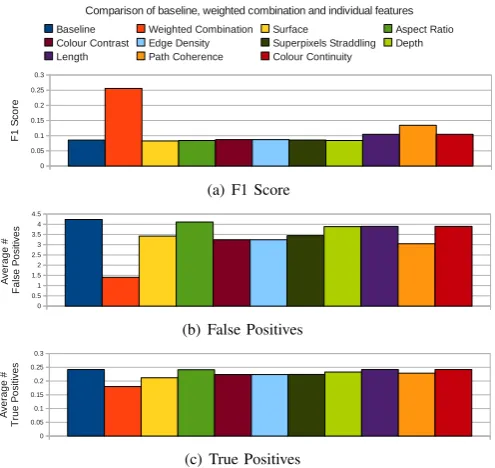
Fig. 1. The results of the baseline, weighted combination and for each of the contextual features are shown. The chart (a) shows the F1 score, (b) the average false positives and (c) average true positives across all videos.
for each video in the entire dataset. Then, we adopted a five-fold video based cross validation scheme for evaluation where we partitioned the videos into 5 random folds. We trained the proposedcontext aware trackerusing the scheme described in Sec. IV where we trained on each of the folds and applied this tracker on the rest of the corresponding four folds for testing. To the mentioned detections, we also applied an “off the shelf” state of the art tracker [26] to serve as a baseline against which we compare our performance using our approach.
We use a standard F1 score as a scoring criterion to evaluate and compare the performance of the proposed tracker with that of the baseline tracker. More specifically, the F1 score for tracking is obtained by first computing an optimal assignment between human-annotated tracks and automatic tracks based on the extent that they overlap. The overlap between the tracks is computed as the volume of their intersection divided by the union of the volumes between the two sets of tracks. The optimal assignment is computed using bipartite matching [23] and we consider only those assignments whose overlap is more than50%. The optimal assignment between the human-annotated tracks and the automatic tracks is used to compute the F1 scores.
B. Quantitative Evaluation
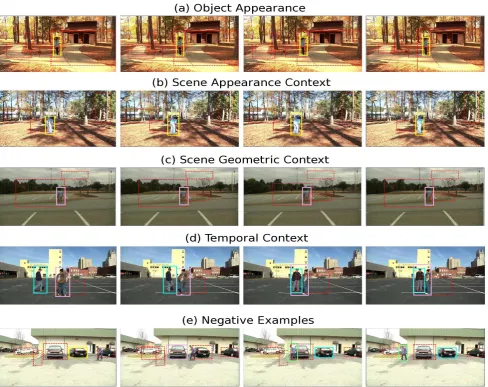
Fig. 2. This figure illustrates the qualitative performance of the proposed framework by presenting a set of continuous images for positive cases in each feature type in (a)–(d) while also providing negative examples in (e). Each row of images consists of a set of tracks which are represented by two types of bounding boxes, namely solid and dotted. The set of all bounding boxes represent the original tracks while the solid and dotted tracks represent the tracks accepted and rejected by our framework respectively.
averaged across the test videos in five folds and across two classes for which ground truth is available - persons and cars.
From Fig. 1(a) it can be concluded that the proposed approach of incorporating contexts into tracking improves the overall F1 scores by 0.17, with respect to the baseline tracker. Moreover, Fig. 1(b) and 1(c) show that while the proposed approach significantly reduces the average number of false positives by 2.82, the average number of true pos-itives decreases minimally. We can also conclude that the learned-weighted combination of contextual features achieves a significantly superior performance in terms of F1 scores and average FP over each of these features only when they are used individually. We have observed that if each of the contextual features were to be used separately in a preprocessing step to filter out detections, altogether, they tend to remove most of the true positives. However, their weighted combination is successful in retaining most of the true positives, removing only a minimal amount (0.07). The next section provides a qualitative explanation for the minimum decrease in true positives.
C. Qualitative Evaluation
the person track has been correctly retained. By considering the movement of the bounding box in Fig. 2 (d), it can be observed that it is rejected on the basis of a lack of continuity in motion and appearance.
While the overall performance of the context aware tracker is significantly superior to the baseline and to using each feature separately, there is however a small 0.07 decrease in the average number of true positives. An analysis of test videos where there is a decrease in true positives suggests that there are certaincharacteristic videos, and where this decrease tends to occur due to certaintypical reasons. The two main reasons that we have identified are as follows. First, we have observed that due to the object interactions that are present in these videos, sometimes the appearance and motion features tend to change substantially during inter-object occlusions. Under such circumstances, the coherence measures of motion and appearance tend to give low scores. Fig. 2(e) illustrates such a case, where a person occludes a car affecting its appearance profile, resulting in the loss of a potential true positive. The second reason is where one of the objects acts as a vertical surface for another, causing it to appear as though the base of the bounding box of the latter object is on a vertical surface. This can have an effect of reducing the surface scores, thus removing a potential true positive.
VI. SUMMARY ANDFUTUREWORK
In this work, we have considered four types of context -object appearance context, scene geometric context, scene ap-pearance context and temporal context. We have incorporated these four factors into the tracking process by means of a MAP formulation. This formulation introduces contextual factors that first of all augment detection strengths and secondly pro-vide temporal context. We allow both these types of factors to contribute organically to the linking process by optimizing the relative contribution of each of these factors jointly during the parameter learning phase. The results presented in this paper use a state of the art tracker and show that by using a weighted combination of contextual information the performance of the original tracker is improved. We believe that the same approach can be applied to other trackers in order to improve their performance, although this requires further analysis. A qualitative examination of results clearly demonstrates the role of each of the contextual factors in improving the performance of tracking.
Several issues remain to be explored in the future. In this work, we have used three simple surface classes as spatial scene contexts. In the future we plan to include a more fine grained interpretation of the scene in terms of categories such as road and grass. Also, we plan to model the spatial relations between the objects as context. We believe that this would further improve the performance of our approach by addressing the problems discussed above. We are currently exploring the incorporation of event context into the tracking process [21].
ACKNOWLEDGMENT
The financial support of DARPA Mind’s Eye project VIGIL (W911NF-10-C-0083) and the EU projects RACE (FP7-ICT-287752) and STRANDS (FP7-ICT-600623) is gratefully ac-knowledged.
REFERENCES
[1] B. Wu and R. Nevatia, “Optimizing discrimination-efficiency tradeoff in integrating heterogeneous local features for object detection.” inCVPR, 2008.
[2] F. Han, Y. Shan, H. Sawhney, and R. Kumar, “Discovering class specific composite features through discriminative sampling with Swendsen-Wang Cut,”CVPR, 2008.
[3] B. Alexe, T. Deselaers, and V. Ferrari, “What is an object?” IEEE Computer Vision and Pattern Recognition (CVPR), 2010.
[4] D. Hoiem, A. A. Efros, and M. Hebert, “Putting objects in perspective,”
International Journal on Computer Vision, vol. 80, no. 1, pp. 3–15, Oct. 2008.
[5] X. Liu, L. Lin, S. Yan, H. Jin, and W. Tao, “Integrating spatio-temporal context with multiview representation for object recognition in visual surveillance,”Circuits and Systems for Video Technology,, vol. 21, no. 4, pp. 393 –407, april 2011.
[6] H. Yang, L. Shao, F. Zheng, L. Wang, and Z. Song, “Recent advances and trends in visual tracking: A review.” Neurocomputing, vol. 74, no. 18, pp. 3823–3831, 2011.
[7] A. Yilmaz, O. Javed, and M. Shah, “Object tracking: A survey,”ACM Comput. Surv., vol. 38, no. 4, Dec. 2006.
[8] A. Torralba, “Contextual Priming for Object Detection,”International Journal on Computer Vision, vol. 53, no. 2, pp. 169–191, Jul. 2003. [9] L. Wolf and S. Bileschi, “A critical view of context,” International
Journal on Computer Vision, vol. 69, no. 2, pp. 251–261, Aug. 2006. [10] J. Shotton, J. Winn, C. Rother, and A. Criminisi, “Textonboost: Joint
appearance, shape and context modeling for multi-class object,” in
ECCV, 2006, pp. 1–15.
[11] S. Kumar and M. Hebert, “A hierarchical field framework for unified context-based classification,” inICCV, 2005, pp. 1284–1291. [12] A. Torralba, A. Oliva, and W. T. Freeman, “Object recognition by scene
alignment,”Journal of Vision, 2007.
[13] L.-J. Li and L. Fei-Fei, “What, where and who? classifying events by scene and object recognition,” inIEEE, oct. 2007, pp. 1 –8.
[14] C. Galleguillos, A. Rabinovich, and S. Belongie, “Object categorization using co-occurrence, location and appearance,” inCVPR, june 2008, pp. 1–8.
[15] G. Heitz and D. Koller, “Learning Spatial Context: Using Stuff to Find Things,” inECCV. Springer, 2008, vol. 5302, ch. 4, pp. 30–43. [16] S. K. Divvala, D. Hoiem, J. H. Hays, A. A. Efros, and M. Hebert, “An
empirical study of context in object detection,” inCVPR, June 2009. [17] S. Stalder, H. Grabner, and L. Van Gool, “Cascaded confidence filtering
for improved tracking-by-detection,” inECCV. Springer, 2010, pp. 369–382.
[18] Y. Li and R. Nevatia, “Key object driven multi-category object recogni-tion, localization and tracking using spatio-temporal context,” inECCV. Springer, 2008, pp. 409–422.
[19] A. Barbu, A. Michaux, S. Narayanaswamy, and J. M. Siskind, “Simul-taneous object detection, tracking, and event recognition,”CoRR, vol. abs/1204.2741, 2012.
[20] P. F. Felzenszwalb, R. B. Girshick, D. A. McAllester, and D. Ramanan, “Object detection with discriminatively trained part-based models,”
PAMI, vol. 32, no. 9, pp. 1627–1645, 2010.
[21] A. Tavanai, M. Sridhar, F. Gu, A. Cohn, and D. Hogg, “Carried object detection and tracking using geometric shape models and spatio-temporal consistency,” inComputer Vision Systems, ser. LNCS. Springer, 2013, vol. 7963, pp. 223–233.
[22] D. Hoiem, A. A. Efros, and M. Hebert, “Geometric context from a single image,” inIn ICCV, 2005, pp. 654–661.
[23] H. W. Kuhn, “The hungarian method for the assignment problem,”
Naval Research Logistics (NRL), vol. 52, no. 1, pp. 7–21, 2005. [24] R. O. Duda, P. E. Hart, and D. G. Stork,Pattern Classification, 2nd ed.
Wiley-Interscience, Nov. 2001.
[25] DARPA. (2011) Mind’s eye challenge http://www.visint.org/. [Online]. Available: http://www.visint.org/