APPLICATION OF VALUE STREAM MAPPING IN CABLE
INDUSTRY
MOHD ZULHILMI BIN ISMAIL
B050810291
UNIVERSITI TEKNIKAL MALAYSIA MELAKA
APPLICATION OF VALUE STREAM MAPPING (VSM) IN CABLE
INDUSTRY
This report submitted in accordance with requirement of the Universiti Teknikal Malaysia Melaka (UTeM) for the Bachelor Degree of Manufacturing Engineering
(Manufacturing Management) (Hons.)
by
MOHD ZULHILMI BIN ISMAIL
B050810291
860419-30-5023
UNIVERSITI TEKNIKAL MALAYSIA MELAKA
BORANG PENGESAHAN STATUS LAPORAN PROJEK SARJANA MUDA
TAJUK: Application of Value Stream Mapping (VSM) In Cable Industry
SESI PENGAJIAN: 2011/12 Semester 2
Saya MOHD ZULHILMI BIN ISMAIL
mengaku membenarkan Laporan PSM ini disimpan di Perpustakaan Universiti Teknikal Malaysia Melaka (UTeM) dengan syarat-syarat kegunaan seperti berikut:
1. Laporan PSM adalah hak milik Universiti Teknikal Malaysia Melaka dan penulis. 2. Perpustakaan Universiti Teknikal Malaysia Melaka dibenarkan membuat salinan
untuk tujuan pengajian sahaja dengan izin penulis.
3. Perpustakaan dibenarkan membuat salinan laporan PSM ini sebagai bahan pertukaran antara institusi pengajian tinggi.
4. **Sila tandakan (√)
SULIT
TERHAD
TIDAK TERHAD
(Mengandungi maklumat yang berdarjah keselamatan atau kepentingan Malaysiasebagaimana yang termaktub dalam AKTA RAHSIA RASMI 1972)
(Mengandungi maklumat TERHAD yang telah ditentukan oleh organisasi/badan di mana penyelidikan dijalankan)
Alamat Tetap:
No 7, Lorong Bukit Beruang Utama 5
Taman Bukit Beruang Utama,
75450 Melaka
Tarikh: _________________________
Disahkan oleh:
Cop Rasmi:
Tarikh: _______________________
DECLARATION
I hereby, declared this report entitled “Application of Value Stream Mapping (VSM) in Cable Industry” is the results of my own research except as cited in references.
Signature : ……….
Author‟s Name : MOHD ZULHILMI BIN ISMAIL
APPROVAL
This report is submitted to the Faculty of Manufacturing Engineering of UTeM as a partial fulfillment of the requirements for the degree of Bachelor of Manufacturing Engineering (Manufacturing Management) (Hons.). The member of the supervisory is as follow:
ABSTRAK
ABSTRACT
DEDICATION
TABLE OF CONTENT
Abstrak i
Abstract ii
Table of Content iii
List of Tables v
List of Figures vi
List of Abbreviations, Symbol and Nomenclature vii
CHAPTER 1 INTRODUCTION 1
1.1 Background 1
1.2 Problem Statement 2
1.3 Objective 2
1.4 Scope 3
1.5 Project Outline 3
1.5.1 Introduction 3
1.5.2 Literature Review 3
1.5.3 Methodology 4
1.5.4 Data Analysis 4
1.5.5 Result 4
1.5.6 Discussion and Conclusion 5
CHAPTER 2: LITERATURE REVIEW 6
2.2 Leans Principles 7
2.2.1 Identify Value 7
2.2.2 Map the Value Stream 8
2.2.3 Create Flow by Eliminating Waste 8
2.2.4 Establish Pull 8
2.2.5 Pursue Perfection 8
2.3 Lean Manufacturing Tools and Techniques 9
2.3.1 Just- In-Time (JIT) 9
2.3.2 Continuous Improvement 10
2.3.3 Standardization of Work 10
2.3.4 Total Productive Maintenance 11
2.3.5 Cellular Manufacturing 12
2.3.6 Other Waste Reduction Techniques 12
2.4 Value Stream Mapping (VSM) 13
2.4.1 Value Stream Mapping Step 14
2.4.2 Mapping the Current State Value Stream 14
2.4.3 Mapping the Future State Value Stream 16
2.5 Simulation in support of VSM 17
2.6 Summary Research of Case Study 18
CHAPTER 3: METHODOLOGY 21
3.1 Project Planning 21
3.2 Background study 25
3.3 Define Problem Statement 25
3.4 Objective and Scope 25
3.5 Literature Review 26
3.6 Determine Methodology 26
3.7 Create the Gantt chart 26
3.8 Data Gathering 29
3.9 Data analysis 29
3.11 Analyze Current State Value Stream Mapping using Simulation 29
3.12 Future map Value stream mapping 29
3.13 Discussion and Conclusion 29
CHAPTER 4: RESULT AND DISCUSSION 30
4.1 Product Family Selecting 30
4.2 Product Description 31
4.3 Manufacturing Operations 31
4.4 Facilities Layout and Basic Operations 32
4.3 Data Collection 34
4.3.1 Cycle Time (C/T) 34
4.3.2 Changeover Time (C/O) 35
4.3.3 Uptime 35
4.3.4 Customer Demand 35
4..3.5 Production Flow Process 35
4.3.5.1 Rewinding Process 36
4.3.5.2 Stranding Process 37
4.3.5.3 Insulating 38
4.3.5.4 Copper Tapping 38
4.3.5.5 Laying-up Process 39
4.3.5.6 Amouring Process 40
4.3.5.7 Sheating Process 40
4.4 Current State Value Stream Mapping 41
4.5 Analysis of the Current State Map 42
4.5.1 Calculation of Takt Time 43
4.6 Machine Changeover Time and Process Cycle Time 45 4.7 Identify the non Value Added and Value Added activity 46
4.8 Root cause analysis 47
4.8.2 Changeover Time 50
4.9 Suggestion of Current State Value Stream Mapping 52
4.10 Suggestions for improving the operating time effectiveness 51
4.10.1 Improving Machine Downtime 51
4.10.2 Improving Changeover Time 56
4.9.3 Improving Misplaced Machine Tool 60
CHAPTER 5:.CONCLUSION AND RECOMMENDATION 62
REFERENCE 64
LIST OF TABLES
2.1 Typical Value Stream Metric 14
2.2 Summary of Case study 17
3.1 Gantt chart for PSM 1 26
3.2 Gantt chart for PSM 2 27
4.2 Machine Downtime Causes Frequency 48
4.3 Downtime Causes 5 Why Analysis. 49
4.4 Problem that caused the increased changeover time 51
LIST OF FIGURES
2.1 Steps of Leans Thinking Principles 6
2.2 Formula for Takt time 10
2.3 Current Value Stream Map 14
2.4 Future Value Stream Map 15
3.1 Project Flow Chart 22
3.2 Value Stream Mapping Project Flow Chart 23
4.1 Factory layout 33
4.2 Process Flow for 3 cores 11kv 36
4.3 Raw Material before Rewinding 36
4.4 Drum before Stranding 37
4.5 Stranding Machine 37
4.6 Insulating Process 38
4.7 Copper Tapping Process 39
4.8 Lay up Process 39
4.10 Current State Value Stream Mapping 41
4.11 Value Added vs. Non-Value Added time in the current state mapping 42.
4.12 Cycle time for each process 43
4.13 Graph Cycle Time per Takt Time 44
4.14 Graph Changeover Time and Cycle Time 45
4.15 Bottleneck of the Process Cycle 46
4.16 Ishikawa Diagram Machine Breakdown 48
4.17 Ishikawa Diagram for Changeover Time 50
LIST OF ABBREVIATIONS, SYMBOLS AND
NOMENCLATURE
VSM - Value Stream Mapping
CVSM - Current state Value Stream Mapping FVSM - Future state Value Stream Mapping PSM - Projek Sarjana Muda
JIT - Just In Time
1
CHAPTER 1
INTRODUCTION
1.0 Background
2 lean future state. Implementation of the future state requires the focused application of lean tools such as cell design, one piece flow, pull production, changeover reduction, kaizen events and standard operations. The objective of Value Stream Mapping is to identify and prioritize the steps needed to move to the future state design for a single product family as rapidly as possible, using a cross functional team from all the areas involved, as well as dedicated improvement facilitators.
1.2 Problem Statement
With the modern manufacturers trying to strive for lean in order to reduce inventory, production lead time, direct labor, indirect labor, space requirements, quality costs and material costs. Common waste found in the factory cannot be identified because not use the tool that can show the entire process for the product in the factory. Among the methods available to detect the waste to show the actual course of a process in the factory from customer request to return to customer back covering all aspects such as suppliers, the process of going in the factory and shipped. Value stream mapping (VSM) is the method to visual the representing flow information and material in the production of product that included the delivery time. This method can be used as monitor to review the production line processes from the beginning to the shipping process.
1.3 Objective
The objective of this project is to identify the where is the waste based on the value stream mapping method.
The objective of the study is:
3 b) Analyze current state mapping to identify the wastes and bottleneck that occur in
production processes
c) Propose future state value stream mapping (FVSM) for improvement.
1.4 Scope
This research was created in three parts, identify the current state at the production and analyze the current state map to determine the existence of wastes for non value added value added activities along the production flow of the company Then, the research focus on creating the future state map as the way to overcome the problems found in the current state map.
1.5 Project Outline
This section shows the organization of chapter that need to be complete during PSM 1 and PSM 2. PSM 1 only cover on the theory of research, while for psm 2 will proceed the research practically. Table show the organization of the chapter for both PSM 1 and PSM 2.
1.5.1 Introduction
Introduction of the project conducted which is background, problem statement, objective, scope and project outlines.
1.5.2 Literature Review
4 concept and method of value stream mapping, it may enhance the progress of this project.
1.5.3 Methodology
Methodology contain the procedure to conduct the research during PSM. This chapter included the planing of the research, flowchart, and the souurces of data. Methodology can be devided by into 2 parts which are general methodology and specific methodology for value stream mapping.
1.5.4 Data Analysis
Data analysis has been collected in the production processes. The current state map is shown in this chapter.
1.5.5 Result
The result is stressing the significance and implementation of the finding of the project. The suggestion for future state value stream mapping show in this chapter. This part shows the expected result achieve the objective or not.
1.5.6 Discussion and Conclusion
5
CHAPTER 2
LITERATURE REVIEW
In this chapter, some background and basic knowledge of value stream mapping will be reviewed. Besides that, this chapter will be describing topics that related to value stream mapping analysis and measurement methods. Some of previous research and studies were included in this chapter to support the development of ideas of value stream mapping concept and design.
2.1 Lean Production
6 Shook (2004) notify the lean production is a system for organizing and managing product development, operations, suppliers, and customer relations that requires reducing the 8 wastes to make products with fewer defects to achieve customer demand, compared with the previous system of mass production.
2.2 Leans Principles
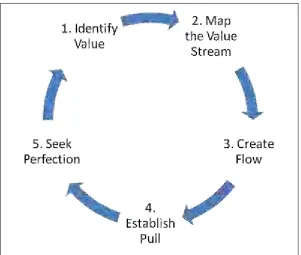
There are five overriding principles to Lean. The figure 2.1 shows the step of lean thinking principles.
Figure 2.1: Step of Leans Thinking Principles (Womack & Jones, 1996).
2.2.1 Identify Value
[image:21.612.178.479.275.530.2]7 activities. Define value precisely from the perspective of the end customer, in terms of a specific product, with specific capabilities, offered at a specific price and time. As Taiichi Ohno (1988), one of the creators of the Toyota Production system put it, all industrial thinking must begin by differentiating value for the customer, from muda – the Japanese term for waste.
2.2.2 Map the Value Stream
The Value Stream is the entire set of activities across all parts of the organization involved in jointly delivering the product or service. This represents the end-to-end process that delivers the value to the customer. Once you understand what your customer wants the next step is to identify how you are delivering that to them. Identifying the value stream almost always exposes enormous amounts of waste in the form of unnecessary steps, backtracking, and scrap, as the throughput travels from department to department and from company to company (Womack & Jones, 1996).
2.2.3 Create Flow by Eliminating Waste
Making steps flow means working on each design, order, and product continuously from beginning to end so that there is no waiting, downtime, or waste, within or between the steps. Eliminating this waste ensures that your product or service “flows” to the customer without any interruption, detour or waiting. (Womack & Jones, 1996)
2.2.4 Establish Pull
8
2.2.5 Pursue Perfection
Creating flow and pull starts with radically reorganizing individual process steps, but the gains become truly significant as the entire steps link together. As this happens more and more layers of waste become visible and the process continues towards the theoretical end point of perfection, where every asset and every action adds value for the end customer with the ultimate goal of achieving Zero defects. Create a culture of continuousimprovement. It is more about culture and attitudes than management Lean-tools (Womack & Jones, 1996).
2.3 Lean Manufacturing Tools and Techniques
Lean manufacturing is based on continuous finding and removal of the wastes. Value is defined from the customer‟s point of view. The tools in lean manufacturing aim to identify and remove wastes from the system continuously. Below is the several of lean tool and technique.
2.3.1 Just- In-Time (JIT)
9 process. The final assembly line goes to the preceding process and pulls or withdraws the necessary parts in the necessary quantity at the necessary time (Monden, 1998). The process goes on as each process pulls tile needed parts from the preceding process further up stream. A kanban is used to manage these shipments. Kanban is an information system that is used to control tile number of parts to be produced in every process (Monden, 1998). The most common types of kanbans are the withdrawal kanban, which specifies the quantity that the succeeding process should pull from the preceding process, and the production kanban, which specifies the quantity to be produced by the preceding process (Monden, 1998).
2.3.2 Continuous Improvement
Continuous improvement is another fundamental principle of lean manufacturing. Kaizen which is the Japanese word for a continuous endeavor for perfection has become popular in the west as a paramount concept behind good management. Kaizen is a systematic approach to gradual, orderly, continuous improvement. In manufacturing settings improvements can take place in many forms such as reduction of inventory, and reduction of defective parts. One of the most effective tools of continuous improvement is 5S, which is the basis for an effective lean company. 5S is a first, modular step toward serious waste reduction. 5S consists of the Japanese words Seiri (Sort). Seiton (Straighten). Seiso (Sweep and Clean). Seiketsu (Systemize). and Shitsuke (Standardize). The underlying concept behind 5S is to look for waste and then to try to eliminate it. Waste could be in the form of scrap, defects, excess raw material. Unneeded items, old broken tools, and obsolete jigs and fixtures (Monden, 1998).
2.3.3 Standardization of Work