BORANG PENGESAHAN STATUS TESIS
JUDUL: AET SHIPPING CREW SCHEDULING SERVICES SESI PENGAJIAN: 2007/2008
Saya PUTRI NOR ASHIQIN BT MD BAKRI mengaku membenarkan tesis (pSMl8~BftaIDekteF F&lsafilft) ini disimpan di Perpustakaan Fakulti Teknologi Maklumat dan Komunikasi dengan syarat-syarat kegunaan seperti berikut:
1. Tesis dan projek adalah hakmilik Universiti Teknikal Malaysia Melaka.
2. Perpustakaan Fakulti Teknologi Maklumat dan Komunikasi dibenarkan membuat salinan untuk tujuan pengajian sahaja.
3. Perpustakaan Fakulti Teknologi Maklumat dan Komunikasi dibenarkan membuat salinan tesis ini sebagai bahan pertukaran antara institusi pengajian tinggi.
4.
** Sila tandakan
(I)_ _ _ SULIT (Mengandungi maklumat yang berdarjah keselamatan atau kepentingan Malaysia seperti yang termaktub di dalam AKTA RAHSIA RASMII972)
_~_TERHAD
/ TIDAK TERHAD
(TANDAT ANGAN PENULIS) Alamat tetap: No. 22,Jln Nova US/91. Subang Bestari Seksyen US,
40150 Shah Alam Tarikh: 18 June 2008
(Mengandungi maklumat
TERHAD
yang telah ditentukan oleh organisasi/badan di mana penyelidikan dijalankan)(TANDATANGAN PENYELIA)
fl"\
rIoPci
~n..{g.\nzml
Nama Penyelia
AET SHIPPING CREW SCHEDULING SERVICES
(AETSCSS)
PUTRI NOR ASHIQIN MD BAKRI
This report is submitted in partial fulfillment of the requirements for the Bachelor of Computer Science (Software Development)
FACUL TY OF INFORMATION AND COMMUNICATION TECHNOLOGY
UNIVERISITI TEKNIKAL MALA YSIA MELAKA
DECLARATION
I hereby declare that this project report entitled
AET SIllPPING CREW SCHEDULING SERVICES
is written by me and is my own effort and that no part has been plagiarized
without citations.
STUDENT: _ _
~
. Date:cA/oc;.(o0
SUPERVISOR:
(pUTRI NOR
1rIN
B : : r
~=~
Date:0QjOG(og
(MR
MOHD
SANDSI BIN AZMI)111
ACKNOWLEDGEMENTS
First of all, Alhamdulillah, praise to Allah S. W.T. for the successful completion
of my PSM. Among the many, first I would like to thank my supervisor, Mr.Mohd
Sanusi Bin Azmi for his advice and guidance for me to complete this project
successfully.
Moreover, I would like to thank all that been involved during the development of
this project. I also would like to thanks my beloved parents for their support and
motivation throughout the project. Also for my family members and my colleagues who
continuously supporting me since before I began this final year project.
LastIy,I am deeply grateful to my evaluators for this thesis, En Suhaizan b.
Sulong, Head of the Department of Software Development, Universiti Teknikal
Malaysia Melaka, for his detailed and constructive comments, and for his important
iv
ABSTRACT
v
ABSTRAK
VI
TABLE OF CONTENTS
CHAPTER SUBJECT PAGE
DECLARA TION II
ACKNOWLEDGEMENT III
ABSTRACT IV
ABSTRAK V
LIST OF TABLES x
LIST OF FIGURES xiii
LIST OF ABBREVIATIONS xv
LIST OF ATTACHMENTS xvi
CHAPTER I INTRODUCTION
1.1 Project Background
1.2 Problem Statement 3
1.3 Objective 4
1.4 Scope 4
1.5 Project Significance 8
1.6 Expected Output 8
vii
CHAPTER II LITERA TURE REVIEW AND METHODOLOGY
2.1
Introductionto
2.2
Facts and Findings11
2.2.1
Domain11
2.2.2
Existing System11
2.2.3
Techniques14
2.3
Project Methodology15
2.4
Project Requirements19
2.4.1
Software Requirement19
2.4.2
Hardware Requirement20
2.4.3
Other Requirement21
2.5
Project Schedule and Milestones21
2.6
Conclusion23
CHAPTER III ANALYSIS
3.1
Introduction24
3.2
Problem Analysis25
3.3
Requirement Analysis28
3.3.1
Data Requirement28
3.3.2
Functional Requirement32
3.3.3
Non-Functional Requirement35
3.3.4
Other Requirement37
viii
CHAPTER IV DESIGN
4.1 Introduction 41
4.2 High-Level Design 41
4.2.1 System Architecture 42
4.2.2 User Interface Design 44
4.2.3 Database Design 52
4.3 Detailed Design 58
4.3.1 Software Design 59
4.3.2 Physical Database Design 59
4.4 Conclusion 64
CHAPTER V IMPLEMENTATION
5.1 Introduction 65
5.2 Software Development Environment Setup 66
5.3 Software Configuration Management 67
5.3.1 Configuration Management Setup 67
5.3.2 Version Control Procedure 69
5.4 Implementation Status 69
5.5 Conclusion 71
CHAPTER VI TESTING
6.1 Introduction 72
6.2 Test Plan 73
6.2.1 Test Organization 73
6.2.2 Test Environment 74
6.2.3 Test Schedule 75
CHAPTER V11
6.3.1 Classes of tests 76
6.4 Test Design 77
6.4.1 Test Description 78
6.4.2 Test Data 82
6.5 Test Result and Analysis 83
6.6 Conclusion 84
PROJECT CONCLUSION
7.1 Observation on Weaknesses and Strengths 85 7.2 Proposition for Improvement 85
7.3 Contribution 86
7.4 Conclusion 87
REFERENCES
BIBLIOGRAPHY
APPENDICES
88
89
90
x
LIST OF TABLES
TABLE TITLE PAGE
1.1 SOFTWARE SCOPE
6
1.2
HARDWARE SCOPE7
2.1
SUMMARY OF THE EXISTING WEBSITES14
2.2
SCOPE OF USER16
2.3
WORKFLOW OF SDLC18
2.4
TABLE OF SOFTWARE REQUIREM ENT19
2.5
HARDWARE REQUIREMENT FOR DEVELOPER20
2.6
HARDWARE REQUIREMENT FOR USER20
2.7
HARDWARE REQUIREMENT FOR TESTING21
2.8
OTHER REQUIREMENT21
2.9
PROJECT MILESTONE 223.1
DATA DICTIONARY CREW PERSONAL DETAILS (TBL_CREWPERSONAL)29
3.2
DATA DICTIONARY LEAVE ENTITLEMENT (TABLE NAME: TBL_LEAVE)30
3.3
DATA DICTIONARY SCHEDULE(TABLE NAME: TBL_SCHEDULE)30
3.4
DATA DICTIONARY VESSEL(TABLE NAME: TBL_ VESSEL)31
3.5
DATA DICTIONARY RANK(TABLE NAME: TBL_RANK)31
3.6
DATA DICTIONARY PORT(TABLE NAME: TBL_PORT)31
3.7
FUNCTIONAL REQUIREMENT33
3.8
CODING STANDARD35
3.9
PERFORMANCE AND THROUGHPUT SYSTEMIC QUALITIES35
3.10
INTEGRITY SYSTEMIC QUALITIES36
3.11
SECURITY SYSTEMIC QUALITIES36
3.12
USABILITY SYSTEMIC QUALITIES36
3.13
REUSABILITY SYSTEMIC QUALITIES37
3.14
SOFTWARE REQUIREMENT TO BUILD SYSTEM37
3.15
HARDWARE REQUIREMENTS39
3.16
NETWORK REQUIREMENT40
4.1
AETSCSS INPUT DESIGN FOR LOGIN INTERFACE46
4.2
AETSCSS INPUT DESIGN FOR CREW REGISTRATION INTERFACE48
4.3
AETSCSS INPUT DESIGN FOR LEAVE-ENTITLEMENT INTERFACE50
4.4
AETSCSS INPUT DESIGN FOR CHANGE PASSWORD INTERFACE51
4.5
OUTPUT DESIGN52
4.6
DATA DICTIONARY CREW PERSONAL DETAILS (TBL_CREWPERSONAL)55
XI
4.8
DATA DICTIONARY RANK(TABLE NAME: TBL_RANK)56
4.9
DATA DICTIONARY SCHEDULE(TABLE NAME: TBL_SCHEDULE)57
4.10
DATA DICTIONARY VESSEL(TABLE NAME: TBL_ VESSEL)57
4.11
DATA DICTIONARY PORT(TABLE NAME: TBL_PORT)57
4.12
METHOD OPERATION FOR LOGIN59
4.13
METHOD OPERATION FOR REGISTER CREW60
4.14
METHOD OPERATION FOR DELETE CREW61
4.15
METHOD OPERATION FOR EDIT CREW61
4.16
METHOD OPERATION FOR SEARCH FARMER62
5.1
DEVELOPMENT ENVIRONMENT FOR AETSCSS SYSTEM68
5.2
AETSCSS NUMBERING OF PRODUCT VERSION69
5.3
IMPLEMENTATION STATUS OF EACH MODULE70
6.1
ROLES AND RESPONSIBILITIES OF INDIVIDUAL INVOLVED IN TESTING74
6.2
AETSCSS TESTING TEST SCHEDULE75
6.3
LOGIN TESTING DESCRIPTION78
6.4
ADD NEW USER TEST DESCRIPTION78
6.5
DELETE USER TEST DESCRIPTION79
6.6
UPDATE PROFILE TEST DESCRIPTION79
6.7
ADD NEW RANK TEST DESCRIPTION79
6.8
DELETE RANK TEST DESCRIPTION80
6.9
UPDATE RANK TEST DESCRIPTION80
6.10
ADD VESSEL TEST DESCRIPTION80
6.11
DELETE VESSEL TEST DESCRIPTION81
6.12
UPDATE VESSEL TEST DESCRIPTION81
6.13
ADD SCHEDULE TEST DESCRIPTION81
6.14
UPDATE SCHEDULE TEST DESCRIPTION82
6.15
DELETE SCHEDULE TEST DESCRIPTION82
XII
LIST OF FIGURES
DIAGRAM TITLE PAGE
2.1 SCREENSHOT OF AET REGISTRATION FORM 12
2.2 SCREENSHOT OF DRoASTER SYSTEM 13
3.1 FLOWCHART OF CURRENT SYSTEM 26
3.2 USE CASE DIAGRAM OF AETSCSS 34
4.1 SYSTEM ARCHITECTURE OF AETSCSS BASED ON 3-TIER ARCHITECTURE 42
4.2 AETSCSS CLASS DIAGRAM 44
4.3 NAVIGATION DESIGN AETSCSS FOR ADMINISTRATOR 45
4.4 NA VIGA TION DESIGN AETSCSS FOR CREW 46
4.5 LOGIN INTERFACE 47
4.6 CREW REGISTRATION INTERFACE 49
4.7 LEAVE-ENTITLEMENT INTERFACE 50
4.8 LOGICAL DATABASE DESIGN FORAETSCSS 54
5.1 THE DEPLOYMENT DIAGRAM OF AETSCSS 66
5.2 THE SEQUENCE OF INSTALLATION TOOLS FOR AETSCSS 68
Al MANAGE CREW PROFILE USE CASE SCENARIO (ADMIN) 90
A2 VIEW RECORD USE CASE SCENARIO 90
A3 MANAGE CREW SALARY USE CASE SCENARIO 91
A4 MANAGE CREW LEAVES USE CASE SCENARIO 91
A5 MANAGE CREW AVAILABILITY USE CASE SCENARIO 92
A6 MANAGE CREW REPORT USE CASE SCENARIO (ADMIN) 92
81 ADDCREW SEQUENCE DIAGRAM 93
82 SEARCH CREW SEQUENCE DIAGRAM 94
83 VIEW CREW SEQUENCE DIAGRAM 95
84 LOGIN SEQUENCE DIAGRAM 96
85 EDIT CREW SEQUENCE DIAGRAM 97
JSP CSS DBMS DOL ER ERD FTMK HTML AETSCSS JSP OOADM RUP SCM SDLC JavaDB SSADM UML UTeM XML
LST OF ABBREVIATIONS
Java Server Pages
Cascading Style Sheets
Database management System
Data definition language
Entity Relationship
Entity Relationship Diagram
Fakulti Teknologi Maklumat dan Komunikasi
Hypertext Markup Language
AET Shipping Crew Scheduling Services
Java Server Pages
Object Oriented Analysis and Design Method
Rational Unified Process
Software configuration management
Software Development Life Cycle
Java Database
Data Flow Diagram
Unified Modeling Language
Universiti Teknikal Malaysia, Melaka
Extensible Markup Language
LIST OF ATTACHMENT
ATTACHMENT TITLE
A Gantt Chart
B Use Case Scenario
C Sequence Diagram
PAGE
113
91
94
CHAPTER I
INTRODUCTION
This chapter will explain project background, problem statements, objectives, scopes,
project significance, and conclusion of the proposed system.
1.1 Project Background
Currently, America Eagle Tanker (AET) uses the conventional way to record the
crew manning scheduling for their company. AET plans to convert this two system with
an integrated system. This new system will provide significantly richer functionality
than is currently conventional way.
In addition, the goal for this next generation Shipping Crew Scheduling Services
(SCSS) is to provide America Eagle Tanker (AET) with a spirited benefit with respect to
the other shipping companies in the operational efficiencies and effectiveness of crew
manning management.
In fact, shipping industry carried over 90% of world trade. Therefore, their ships
2
been built in regulate to help the industry to deal and schedule their crew better.
In arrange to help the industry of shipping goes more efficiently, I concerned to build a
system which called as AET Shipping Crew Scheduling Services ( AETSCSS ).This
system is built for the vessel crew and for the administrator to control the scheduling of
the crew, to manage their leaves, and this scheduling is according to their professions.
The crew can view the latest schedule of ship and when are their duties.
Moreover, this system will help the administrator to decrease the supervision and
management hassle and focus their time to provide quality scheduling services.
Management activities are to manage the flow of activities includes crew registration,
crew leaves, crew income and etc.
The proposed AETSCSS is a mixture best in class application suite consisting of
Macromedia Dreamweaver 8 for interface, JavaDB database application for data storage
and Java for the custom modules consisting of data entry, allowances calculation when
onboard and etc.
AETSCSS is developed purposely used to change the conventional way system.
The conventional way is filling the form for confirmation of their leaves and before get
onto the ship. Therefore the records of crew or employee will not be saved and it might
lose for some cases the data are irretrievable. This problem can affect the management
system to preserve the security of the data and this handbook system also does not have
any back up recovery data. So that I have learnt that by apply good services that can help
the business process in America Eagle Tanker (AET) become manageable and
3
1.2 Problem Statement
This web based AETSCSS is a totally new progress in recording and scheduling
the crew manning. The development of this software is taken further on after studying
few problems as affirmed below.
1.2.1 System not scalable
• The current conventional ways are unable to cope with the current business
needs and its future demands in terms of provision of planning the scheduling,
tracking the previous data and reports.
• Requires more staff to handle data entry operations and manually generate
reports.
1.2.2 Conventional way system
• America Eagle Tanker (AET) uses the conventional way to record the crew
manning scheduling for their company.
• There is no facility available to have specific reports. The manual specific of
reports takes a substantial amount of effort.
• Application form is used for crew registration, crew leaves and crew
arrangement might give difficulties to find out some data.
• Probability of lost the information and big time is consumed to find the data.
4
1.3 Objectives
1.3.1 To build system of crew scheduling services
• This system is developed in order to manage crew schedule.
• To give more flexibility services to the administrator and as it can be access
through the server.
1.3.2 To make less complexity during uses the system.
• This system can make crew scheduling services become more user friendly and
can help administrator to manage crew schedule and become more structured and
orderly.
• Administration can decrease the organization and managing hassle and
contribute their time providing excellence scheduling services.
• To decrease the time wasted to record and schedule their event manually.
• Reduce the number of staff used to assemble and manage all the records.
1.4 Scope
5
1.4.1 Scope of user
• Administrator
The administrator is usually responsible for organize or manage all management
in the company.
• Crew
Crew will used this system for viewing their schedule and personal details.
1.4.2 Scope of the system module
These are the modules to develop the AETSCSS. Each module will have its own
function. The module is listed as below:
• Registration Module
This module is for Administrator to register new crew and save their personal
details.
• Leave-Entitlement Module
This module is for Admin to manage crew leaves.
• Schedule
Schedule module IS used for admin and crew to view schedule according to
vessel and date.
• Crew Module
Crew only can view their personal details with their leaves, salary, schedule and
6
1.4.3 Constraints
• This application will not make any payroll for crew's salary, dealing with
medical management, making arrangement with travel agent.
• This system also is not an automated schedule. Administrator only assigning
them to the vessel according by date and their availability.
1.4.4 Scope of platform
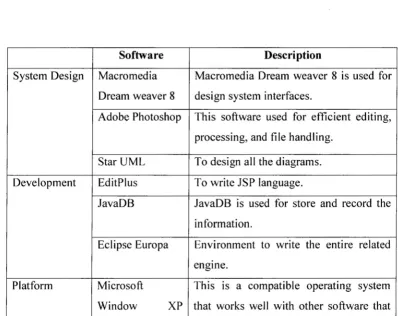
The platform used to develop AETSCSS need to used several software, hard
ware and network requirement. The scope is listed as below:
[image:21.597.146.545.410.726.2]• Software
Table 1.1: Software Scope
Software Description
System Design Macromedia Macromedia Dream weaver 8 is used for
Dream weaver 8 design system interfaces.
Adobe Photoshop This software used for efficient editing,
processing, and file handling.
Star UML To design all the diagrams.
Development EditPlus To write lSP language.
lavaDB lavaDB is used for store and record the
information.
Eclipse Europa Environment to write the entire related
engine.
Platform Microsoft This is a compatible operating system
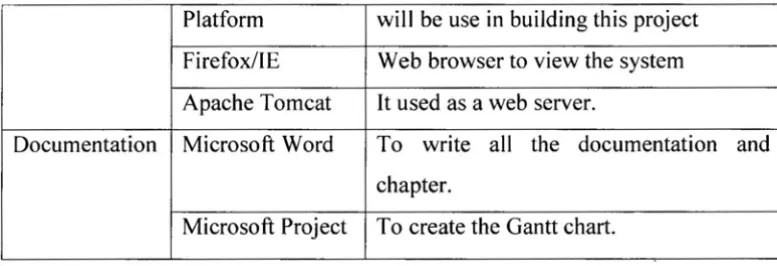
7
Platform will be use in building this project
Firefox/IE Web browser to view the system
Apache Tomcat It used as a web server.
Documentation Microsoft Word To write all the documentation and
chapter.
[image:22.598.156.545.101.234.2]Microsoft Project To create the Gantt chart.
Table 1.2: Hardware Scope
Tools Specifications Minimum tool specifications Total
PC/Laptop Intel(R) Pentium(R) Processor 1.73 GHz 1
RAM 1 GS DDR 1 1
Hard disk 80 GS or higher 1
Input devices(if PC) Mouse and keyboard 1
Output devices(if PC) Monitor 1
8
1.5 Project Significance
AETSCSS will be a replacement of the current routine for crew manning
scheduling that used handbook system and this new technique is valuable to the staff and
crew especially where it can shorten the process of scheduling will be more efficiently
and professionally.
The number of staff used can be decrease because all the associated data from
administrator and shipping crew approach directly from the database. The required of
several staff for handle the scheduling by using the conventional way will not happened
during the used of the new system. Therefore, in these new scheduling services, the
needed staff is only t or 2.Then the remaining staff will be used for other works
management. For that reason, the new management of the company will raise the
business profit.
Hence, advantages from this project are the understanding and ability to develop
the skills in programming language and deal with time management. This project might
be a fine start in approaching a new systematic method of arrangement.
1.6 Expected Output
This project is expected to be a web-based application which is AETSCSS which
will help to administer the process of crew manning scheduling in shipping company in
more organized methods. [t is predictable to minimize the load and to give more time
9
1.7 Conclusion
This chapter briefly makes clear what is AETSCSS is all concerning. The
prologue of AETSCSS is affirmed together with the project's objectives, scopes, project
significance plus the expected output from this project.
This project is proposed to be specifically developed for the use of America
Eagle Tanker (AET). The scheduling for crew manning is very important in this
company as they use it regularly in managing their crew. This system will probably
make managing and scheduling of crew in shipping industry become simple,
well-organized and systematic.
The next chapter would be specifying on the literature review and project