Replication Fidelity
Everett Clinton Smith,a,bJames Brett Case,b,cHervé Blanc,dOfer Isakov,eNoam Shomron,eMarco Vignuzzi,dMark R. Denisona,b,c
Department of Pediatrics,athe Elizabeth B. Lamb Center for Pediatric Research,band Department of Pathology, Microbiology and Immunology,cVanderbilt University Medical Center, Vanderbilt University, Nashville, Tennessee, USA; Viral Populations and Pathogenesis Unit, Institut Pasteur, Centre National de la Recherche Scientifique UMR 3569, Paris, Franced; Sackler Faculty of Medicine, Tel Aviv University, Tel Aviv, Israele
ABSTRACT
Coronaviruses (CoVs) are unique in encoding a 3
=
¡
5
=
exoribonuclease within nonstructural protein 14 (nsp14-ExoN) that is
required for high-fidelity replication, likely via proofreading. nsp14 associates with the CoV RNA-dependent RNA polymerase
(nsp12-RdRp), and nsp14-ExoN activity is enhanced by binding nsp10, a small nonenzymatic protein. However, it is not known
whether nsp10 functions in the regulation of CoV replication fidelity. To test this, we engineered single and double alanine
sub-stitution mutations into the genome of murine hepatitis virus (MHV-A59) containing ExoN activity [ExoN(
ⴙ
)] at positions
within nsp10 known to disrupt the nsp10-nsp14 interaction
in vitro
. We show that an nsp10 mutant, R80A/E82A-ExoN(
ⴙ
), was
five to ten times more sensitive to treatment with the RNA mutagen 5-fluorouracil (5-FU) than wild-type (WT)-ExoN(
ⴙ
),
sug-gestive of decreased replication fidelity. This decreased-fidelity phenotype was confirmed using two additional nucleoside
ana-logs, 5-azacytidine and ribavirin. R80A/E82A-ExoN(
ⴙ
) reached a peak titer similar to and demonstrated RNA synthesis kinetics
comparable to those seen with WT-ExoN(
ⴙ
). No change in 5-FU sensitivity was observed for R80A/E82A-ExoN(
ⴚ
) relative to
MHV-ExoN(
ⴚ
), indicating that the decreased-fidelity phenotype of R80A/E82A-ExoN(
ⴚ
) is linked to the presence of ExoN
ac-tivity. Our results demonstrate that nsp10 is important for CoV replication fidelity and support the hypothesis that nsp10
func-tions to regulate nsp14-ExoN activity during virus replication.
IMPORTANCE
The adaptive capacity of CoVs, as well as all other RNA viruses, is partially attributed to the presence of extensive population
genetic diversity. However, decreased fidelity is detrimental to CoV replication and virulence; mutant CoVs with decreased
repli-cation fidelity are attenuated and more sensitive to inhibition by RNA mutagens. Thus, identifying the viral protein
determi-nants of CoV fidelity is important for understanding CoV replication, pathogenesis, and virulence. In this report, we show that
nsp10, a small, nonenzymatic viral protein, contributes to CoV replication fidelity. Our data support the hypothesis that CoVs
have evolved multiple proteins, in addition to nsp14-ExoN, that are responsible for maintaining the integrity of the largest
known RNA genomes.
V
iral adaptation is driven by selection and genetic bottlenecks
present within the host and during transmission. It is the error
rate (fidelity) of the viral replicase that generates the genetic
diver-sity that is subjected to selection. At the core of all RNA virus
replicases, with the exception of retroviruses, is the
RNA-depen-dent RNA polymerase (RdRp). Research performed with
numer-ous RNA viruses, including foot-and-mouth disease virus (
1–3
),
poliovirus (
4–10
), chikungunya virus (
11
,
12
), influenza virus
(
13
), coxsackievirus B3 (
14
,
15
), and human enterovirus 71 (
16–
18
), has demonstrated that mutations within the viral RdRp can
either increase or decrease replicase fidelity. In the vast majority of
cases, alterations in replication fidelity result in decreased viral
fitness and attenuation of virulence (reviewed in reference
19
).
Also, viruses with altered replication fidelity have potential
thera-peutic value as live attenuated vaccines (
5
,
9
,
20
,
21
). Together,
these observations underscore the need to elucidate the
contribu-tions of individual protein-protein interaccontribu-tions and
virus-en-coded enzymes to replicase fidelity.
The coronavirus (CoV) replicase is more complex than that of
many other RNA viruses due to their large 27-to-32-kb genomes
(
19
,
22
) and the presence of multiple RNA-modifying activities
(
23
). In addition to encoding RdRp activity within nonstructural
protein 12 (nsp12-RdRp), CoVs encode 3
=
¡
5
=
exoribonuclease
(ExoN) activity within nsp14 (
23
,
24
). Biochemical studies have
shown that ExoN is capable of removing 3
=
mismatches (
25
), and
inactivation of ExoN activity decreases the fidelity of the CoV
replicase by up to 20-fold in tissue culture and
in vivo
(
21
,
26
,
27
).
Viruses lacking ExoN activity [ExoN(
⫺
)] have increased
suscep-tibility to lethal mutagenesis in the presence of RNA mutagens
(
28
) compared to wild-type (WT) viruses containing ExoN
activ-ity [ExoN(
⫹
)]. Thus, all available bioinformatic, biochemical,
and virological data support the conclusion that CoVs have
evolved proofreading capacity. Attempts to reconstitute the CoV
replicase using recombinant proteins have been impeded by the
Received15 January 2015 Accepted2 April 2015 Accepted manuscript posted online8 April 2015
CitationSmith EC, Case JB, Blanc H, Isakov O, Shomron N, Vignuzzi M, Denison MR. 2015. Mutations in coronavirus nonstructural protein 10 decrease virus replication fidelity. J Virol 89:6418 –6426.doi:10.1128/JVI.00110-15.
Editor:S. Perlman
Address correspondence to Mark R. Denison, [email protected].
Copyright © 2015, American Society for Microbiology. All Rights Reserved.
doi:10.1128/JVI.00110-15
on November 7, 2019 by guest
http://jvi.asm.org/
abolish the enhancement of ExoN activity (
25
,
33
). In addition to
enhancing ExoN activity, nsp10 is an allosteric regulator of nsp16,
a 2
=
-O-methyltransferase (2
=
-OMT) involved in capping of CoV
RNA and evasion of host interferon (IFN)-stimulated genes (
34–
38
). Targeted mutagenesis studies also have implicated nsp10 as a
critical regulator of CoV RNA synthesis (
39
) and proteolytic
pro-cessing by the nsp5 viral protease (
40
). These studies indicated
that nsp10 is an essential component of the CoV replicase that
directly interacts with nsp14 and affects ExoN activity
in vitro
.
However, it is not known whether nsp10 affects the fidelity of the
CoV replicase or whether nsp10 affects the activity of nsp14-ExoN
during virus replication.
Here we show that mutations in murine hepatitis virus
(MHV-A59) nsp10, at positions previously demonstrated to disrupt
nsp10-nsp14 interactions
in vitro
, decrease CoV replication
fidel-ity. The nsp10 R80A/E82A-ExoN(
⫹
) double mutant has
in-creased sensitivity to the base and nucleoside analogs
5-fluorou-racil (5-FU), 5-azacytidine (AZA), and ribavirin (RBV) compared
to WT-ExoN(
⫹
), indicative of decreased fidelity. When the nsp10
R80A/E82A substitutions were introduced into MHV-ExoN(
⫺
),
there was no increase in 5-FU sensitivity beyond that of
MHV-ExoN(
⫺
). Our results demonstrate that mutations in nsp10
de-crease CoV fidelity and support the hypothesis that
nsp10-medi-ated fidelity is dependent on intact ExoN activity. Our results are
consistent with recent biochemical studies (
25
,
32
) and support a
model in which CoVs use multiple nonstructural proteins,
includ-ing nsp10, nsp12, and nsp14, to faithfully replicate their large RNA
genomes.
MATERIALS AND METHODS
Cell culture.DBT-9 (delayed brain tumor, murine astrocytoma clone 9) cells (41) were maintained in Dulbecco’s modified Eagle’s medium (DMEM; Gibco) supplemented with 10% fetal bovine serum (FBS; Invit-rogen), 100 U/ml penicillin and streptomycin (Gibco), 10 mM HEPES, and 0.25g/ml amphotericin B (Corning). Baby hamster kidney (BHK) cells stably expressing the MHV receptor (BHK-R [42]) were maintained in the same medium but supplemented with 0.8 mg/ml of G418 (Mediat-ech).
Site-directed mutagenesis.To reduce the number of downstream se-quencing reactions, a region of the MHV E fragment (positions 2106 to 2982) containing nsp10 was subcloned into pCR-2.1-TOPO TA vector (Invitrogen) according to the manufacturer’s instructions. Twenty-five nanograms of template was used to introduce the point mutations within nsp10. QuikChange (Stratagene) site-directed mutagenesis was per-formed according to the manufacturer’s protocol. The nsp16 D130A mu-tant was generated similarly, except mutagenesis was performed using the F fragment. Each plasmid was sequenced (Genhunter Corporation, Nash-ville, TN) to ensure that only the intended mutations were present. Once confirmed, the fragment containing nsp10 was excised from TOPO using
following modifications in a total reaction volume of 50l: 7.5l of 3 mM GTP, 25l 2⫻NTP/cap, 5l of 10⫻reaction buffer, 7.5l of template, and 5l of the enzyme mix. The reaction was modified in order to effi-ciently generate longer transcripts at 40.5°C for 30 min, 37°C for 1 h, 40.5°C for 30 min, 37°C for 30 min, and 40.5°C for 30 min. Transcript for the N gene was generated using water instead of the 3 mM GTP. Fifty microliters of the transcription reaction and 25l of N transcript were electroporated (Bio-Rad GenePulser Xcell) into 6⫻107BHK-R cells and
added to T-75 flasks seeded with DBT-9 cells. Cells were grown at 37°C, and flasks containing virus were frozen when cytopathic effect (CPE) was present throughout the flask. Flasks were thawed, and debris was pelleted at 4,000⫻g(Sorvall RC 3B Plus; HA-6000A rotor) for 10 min at 4°C. The supernatant was then divided into aliquots and considered passage 0 (P0) stock. The virus titer was determined by a plaque assay using DBT-9 cells as described previously (26).
Propagation and confirmation of recombinant viruses. Subconflu-ent DBT-9 cells were infected at a multiplicity of infection (MOI) of 0.01 PFU/cell to generate P1 stocks. Virus was harvested as described above. To ensure that the recovered viruses contained only the intended mutations, RNA was harvested from DBT-9 cells infected with P0 stock using TRIzol (Ambion). The RNA was purified according to the manufacturer’s proto-col and reverse transcribed (RT) using SuperScript III (Invitrogen) as described previously (28). For all viruses, the entire nsp10 coding region was sequenced to ensure the absence of additional mutations. The P0 stocks of both N40A/R80A-ExoN(⫹) and R80A/E82A-ExoN(⫹) were se-quenced across the entire genome to ensure that no other mutations had arisen during recovery. For full-genome sequencing, 12 overlapping ⬃3-kb cDNA amplicons were generated using 2l of RT product in a total reaction volume of 50l containing 100 ng each of forward and reverse primers, 5l of 10⫻reaction buffer, 1l of 10 mM (each) deoxy-nucleoside triphosphates (dNTPs), and 0.5l (5 U/l) of high-fidelity Easy A polymerase (Agilent). PCR was performed using a Bio-Rad C1000 Touch Thermal Cycler as follows: for step 1, 95°C for 2 min; for step 2, 95°C for 30 s; for step 3, 58°C for 30 s; for step 4, 72°C for 3.5 min; and for step 5, 72°C for 7 min. Steps 2 through 4 were repeated 30 times. All primers generated single bands and were column purified using a Wizard SV Gel and PCR cleanup system (Promega). The nucleotide sequences of the amplicon and sequencing primers are available upon request.
Base and nucleoside analog sensitivity studies.5-Fluorouracil (5-FU), 5-azacytidine (AZA), and ribavirin (RBV) were purchased from Sig-ma; stock solutions were made in dimethyl sulfoxide (DMSO) at 200 mM, water at 50 mM, and water at 200 mM, respectively. Sensitivity studies were performed at the indicated concentration(s) of base or nucleoside analog for both low (0.01 PFU/cell)- and high (1 PFU/cell)-MOI infec-tions, as described previously (28). For 5-FU sensitivity experiments at 37°C and 40°C, cells were shifted to the appropriate temperature once the treatment was added back postinfection. We have demonstrated that 5-FU and RBV exhibit minimal cellular toxicity in DBT-9 cells at concen-trations up to 400M (28). The cytotoxicity of AZA and RBV, at concen-trations up to 50M, was determined using CellTiter-Glo (Promega) according to the manufacturer’s instructions. Briefly, DBT-9 cells were
on November 7, 2019 by guest
http://jvi.asm.org/
seeded into an opaque tissue-culture-grade 96-well plate approximately 18 h prior to the addition of AZA or RBV. Cells were then incubated with AZA or RBV at the indicated concentrations for 24 h, and cell viability was determined.
Replication curves and RNA synthesis kinetics.Viral replication ki-netics were determined at both a high MOI (1 PFU/cell) and a low MOI (0.01 PFU/cell) as described previously (26). Supernatant (300l) was collected at the indicated time points, and the virus titer was determined by a plaque assay. Kinetics of genomic and subgenomic RNA synthesis at an MOI of 1 PFU/cell, with or without 5-FU treatment, were determined by two-step real-time quantitative RT-PCR (qRT-PCR) (28) using RNA harvested at the times indicated. RNA extraction with TRIzol and RT reactions were performed as described above. Primers used to detect genomic (nsp10) and subgenomic (N) RNA, as well as GAPDH (glycer-aldehyde-3-phosphate dehydrogenase), have been previously reported (28,39). The region of nsp10 used to quantify genomic RNA levels does not overlap the mutations introduced within nsp10. Reactions and data analysis were performed as described previously (28) with modifications: the RT product was diluted 1:200, the values determined for duplicate wells of each sample were averaged into one value to minimize well-to-well variation, and data were normalized relative to GAPDH using the threshold cycle (2⫺⌬CT) method.
IFN-sensitivity assay.Subconfluent monolayers of DBT-9 cells in 24-well plates were pretreated with either 100 U/ml or 500 U/ml of mouse beta interferon (IFN-) (PBL Assay Science, Piscataway, NJ) for 18 h prior to infection. The pretreatment reaction mixture was removed, and mono-layers were inoculated with the indicated virus at an MOI of 1 PFU/cell for 45 min at 37°C. The inoculum was removed, and fresh DMEM was added to each well. The supernatant was harvested at 12 h postinfection, and the virus titer was determined by a plaque assay.
Statistical analysis.Statistical tests were applied where noted using GraphPad Prism 6 (La Jolla, CA) software. Significance is denoted (*,P⬍
0.05; **,P⬍0.01; ***,P⬍0.0001) and was determined using the test described in the figure legend. In some cases, data were normalized to untreated controls; this was also performed using GraphPad Prism 6. The number of replicate samples is denoted within each figure legend.
RESULTS
Effect of mutations in nsp10 on virus sensitivity to
5-fluoroura-cil (5-FU).
To test the role of nsp10 in fidelity, we engineered
mutations coding for alanine substitutions into the infectious
clone of MHV-A59 (
42
) at conserved amino acid positions
re-ported to disrupt the severe acute respiratory syndrome
(SARS)-CoV nsp10-nsp14 interaction
in vitro
: G69A, N40A, R80A (H80 in
SARS-CoV), and E82A (D82 in SARS-CoV) (
Fig. 1
). With the
exception of the G69A mutation, all nsp10 mutations permitted
virus recovery; earlier attempts by another group to recover G69A
were also unsuccessful (
39
). We previously demonstrated that the
base analog 5-FU is incorporated into the CoV genome by
nsp12-RdRp during viral replication, resulting in increased genomic
mu-tations (
28
). Incorporation of 5-FU is increased in low-fidelity
viruses lacking ExoN activity [ExoN(
⫺
)], indicating that virus
sensitivity to 5-FU treatment can be used to test for decreases in
replication fidelity. We compared the replication of the single
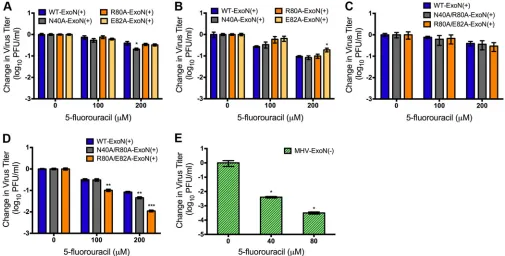
al-anine substitution mutants N40A, R80A, and E82A to that of
WT-ExoN(
⫹
) in the presence and absence of 5-FU. All three mutant
viruses exhibited 5-FU sensitivity phenotypes similar to that of the
WT-ExoN(
⫹
) virus at both an MOI of 1 PFU/cell and an MOI of
0.01 PFU/cell (
Fig. 2A
and
B
). 5-FU exhibited no toxicity in
DBT-9 cells at concentrations up to 400
M (
28
).
Because formation of a stable nsp10-nsp14 complex likely
in-volves multiple surface-exposed residues, substitution at one
po-sition might not be sufficient to alter nsp10-nsp14 interactions
during virus infection. Thus, we introduced the alanine double
substitutions N40A/R80A and R80A/E82A within nsp10. We then
tested whether the alanine double substitutions N40A/R80A and
R80A/E82A affected virus sensitivity to 5-FU treatment. No
in-creased sensitivity was detected during infection at an MOI of 1
PFU/cell (
Fig. 2C
). Infection at a higher MOI could mask a subtle
increase in 5-FU sensitivity due to the capacity of the population
to tolerate or complement mutations. Thus, we examined the
sen-sitivity of N40A/R80A-ExoN(
⫹
) and R80A/E82A-ExoN(
⫹
) to
5-FU treatment at a low MOI (0.01 PFU/cell). Both
N40A/R80A-ExoN(
⫹
) and R80A/E82A-ExoN(
⫹
) demonstrated increased
sensitivity to 5-FU treatment compared to WT-ExoN(
⫹
) (
Fig.
2D
). The 5-FU sensitivity of R80A/E82A-ExoN(
⫹
) was
concen-tration dependent across the range tested, while
N40A/R80A-ExoN(
⫹
) demonstrated a subtle increase in sensitivity only at 200
M 5-FU. Because of this, we focused primarily on the R80A/
E82A-ExoN(
⫹
) virus for subsequent experiments. These data
FIG 1Alignment of nsp10 and modeled structure. (A) The MHV-A59 genome is shown. Selected examples of nsp’s are highlighted: nsp10 (orange), nsp14 (blue) (ExoN domain, solid; N7-MT domain, hatched), and nsp16-2=-OMT (purple). Abbreviations: RdRp, RNA-dependent RNA polymerase; ExoN, 3=¡5= exori-bonuclease; N7-MT, N7-methyltransferase; 2=-OMT, 2=-O-methyltransferase. (B) MHV-A59 nsp10 was modeled using Phyre2(58). A high (⬎90%)-confidence model was obtained using the structure of SARS-CoV nsp10 (57). A surface representation is shown, with mutated nsp10 residues shown in orange. The image was generated using PyMOL (59). (C) Alignment of nsp10 from MHV-A59 (GenBank accession no.AY910861), SARS-CoV (GenBank accession no.AY278741), and Middle East respiratory syndrome (MERS)-CoV (GenBank accession no.JX869059). Identities are denoted by shaded boxes, while similarities are denoted by white boxes. Mutations made during this study that resulted in viable virus are denoted by an asterisk.
on November 7, 2019 by guest
http://jvi.asm.org/
demonstrate that mutations in nsp10 increase 5-FU sensitivity,
consistent with decreased replication fidelity. Our data also
indi-cate that the impact of nsp10 mutations on fidelity is less than that
seen after inactivation of ExoN activity (
28
), as the titer of
MHV-ExoN(
⫺
) was decreased by almost 4 log
10following treatment
with 80
M 5-FU (
Fig. 2E
).
R80A/E82A-ExoN(
ⴙ
) shows increased sensitivity to
nucleo-side analogs AZA and RBV.
To confirm that the observed 5-FU
sensitivity was a result of decreased fidelity, we tested whether
R80A/E82A-ExoN(
⫹
) was sensitive to the nucleoside analogs
5-azacytidine (AZA) and ribavirin (RBV). AZA and RBV have
been shown to induce mutagenesis of RNA virus genomes, most
recently for influenza virus (
43
). We examined the sensitivity of
R80A/E82A-ExoN(
⫹
) to AZA and RBV during infection at a low
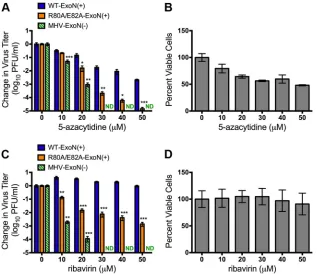
MOI (0.01 PFU/cell). Both MHV-ExoN(
⫺
) and
R80A/E82A-ExoN(
⫹
) showed increased sensitivity to AZA compared with
WT-ExoN(
⫹
) at concentrations at and above 20
M (
Fig. 3A
).
R80A/E82A-ExoN(
⫹
) was between 10-fold and 100-fold more
sensitive to AZA treatment than WT-ExoN(
⫹
). MHV-ExoN(
⫺
)
was undetectable by plaque assay at concentrations above 20
M,
consistent with the strong mutator phenotype. Since AZA also
inhibited WT-ExoN(
⫹
) replication and exhibited cellular toxicity
(
Fig. 3B
), we examined the sensitivity of all three viruses to the
guanosine analog RBV. We previously showed that
MHV-ExoN(
⫺
), but not WT-ExoN(
⫹
), is sensitive to treatment with
RBV (
28
). Consistent with our previous data, RBV showed
mini-mal cytotoxicity at concentrations up to 50
M and had no effect
on the WT-ExoN(
⫹
) titer (
Fig. 3C
and
D
). MHV-ExoN(
⫺
) was
undetectable by plaque assay at RBV concentrations above 20
M,
and R80A/E82A-ExoN(
⫹
) was more than 100-fold more sensitive
to RBV treatment than WT-ExoN(
⫹
) at higher concentrations.
These results indicate that the R80A/E82A substitutions in nsp10
decrease CoV replication fidelity to levels between those seen with
WT-ExoN(
⫹
) and MHV-ExoN(
⫺
).
Replication and RNA synthesis kinetics of the
R80A/E82A-ExoN(
ⴙ
) mutant.
To determine the impact of these mutations
during infection, we examined the replication kinetics of R80A/
E82A-ExoN(
⫹
) compared to those of WT-ExoN(
⫹
) and
MHV-ExoN(
⫺
). R80A/E82A-ExoN(
⫹
) replication kinetics were similar
to those seen with WT-ExoN(
⫹
) during infection at an MOI of 1
and 0.01 PFU/cell (
Fig. 4A
and
B
), though the virus titers were
lower than those of WT-ExoN(
⫹
) at early time points. No
enzy-matic activity has been reported or predicted for nsp10. However,
mutations in MHV-A59 nsp10 have been reported to impact viral
RNA synthesis (
39
). We therefore measured genomic and
sub-genomic RNA levels of the R80A/E82A-ExoN(
⫹
) mutant during
infection at an MOI of 1 PFU/cell using two-step qRT-PCR.
Genomic and subgenomic RNA levels were normalized to the
en-dogenous GAPDH control and were measured in both the
pres-ence and the abspres-ence of 5-FU treatment. WT-ExoN(
⫹
) and
R80A/E82A-ExoN(
⫹
) demonstrated similar RNA synthesis
ki-netics, and RNA accumulation was not affected by 5-FU treatment
(
Fig. 4C
and
D
). On the basis of these data, we conclude that the
increased 5-FU sensitivity of R80A/E82A-ExoN(
⫹
) is not due to
impairment of viral RNA synthesis.
R80A/E82A-ExoN(
ⴙ
) does not have increased sensitivity to
IFN-

.
In addition to stimulation of nsp14-ExoN activity,
nsp10 binding to nsp16 is required for SARS-CoV nsp16 –2
=
-FIG 2Virus sensitivity to 5-FU treatment. DBT-9 cells were pretreated with the indicated concentration of 5-FU and infected with the indicated virus at an MOI of 1 PFU/cell (A and C) or 0.01 PFU/cell (B, D, and E). Virus supernatants were harvested at 12 h postinfection (MOI⫽1) or 24 h postinfection (MOI⫽0.01), and the virus titer was determined by a plaque assay. For each virus, titers were normalized to values obtained from DMSO-treated samples using Prism 6. Data are presented as means⫾standard errors of the means (SEM). Statistical significance compared to WT-ExoN(⫹) or MHV-ExoN(⫺) (panel E) is denoted (*,P⬍
0.05; **,P⬍0.01; ***,P⬍0.0001) and was determined using one-way analysis of variance (ANOVA) with Dunnett’spost hoctest for multiple comparisons (n⫽
4 to 7).
on November 7, 2019 by guest
http://jvi.asm.org/
[image:4.585.39.544.67.323.2]OMT activity (
38
,
44
). Both MHV-A59 and SARS-CoV lacking
2
=
-OMT activity display increased sensitivity to exogenous
in-terferon beta (IFN-

) treatment due to increased recognition
by host interferon-stimulated genes (
34–36
). Because of the
dual functions of nsp10, we tested whether
R80A/E82A-ExoN(
⫹
) displayed increased sensitivity to IFN-

. As a
posi-tive control, we engineered and recovered MHV-A59 with an
alanine substitution mutation in nsp16 (nsp16 D130A). This
mutation abolishes SARS-CoV 2
=
-OMT activity and renders
both MHV-A59 and SARS-CoV sensitive to exogenous IFN-

treatment (
34
,
36
). Following IFN-

treatment, the nsp16
D130A virus titer was reduced by approximately 5 log
10(
Fig.
5
). In contrast, titers of both WT-ExoN(
⫹
) and
R80A/E82A-ExoN(
⫹
) were reduced by approximately 1 log
10. These results
demonstrate that the R80A/E82A substitutions in nsp10 do not
significantly impact 2
=
-OMT activity as measured by sensitivity
to IFN-

treatment.
R80A and E82A substitutions do not enhance the sensitivity
of MHV-ExoN(
ⴚ
) to 5-FU treatment.
If the phenotype of
R80A/E82A-ExoN(
⫹
) resulted from alterations in the
nsp10-nsp14 interaction, as demonstrated by previous biochemical
studies (
25
,
32
), then introduction of these mutations into the
MHV-ExoN(
⫺
) background should not increase 5-FU
sensi-tivity beyond that of MHV-ExoN(
⫺
). To test this, we
exam-ined the sensitivity of R80A/E82A-ExoN(
⫺
) and
MHV-ExoN(
⫺
) to 5-FU treatment at a low MOI (0.01 PFU/cell), as
described above. The R80A/E82A substitutions within nsp10
did not result in increased sensitivity to 5-FU treatment (
Fig. 6
)
compared to that of MHV-ExoN(
⫺
), consistent with the
ob-servation that nsp10 functions as a stimulatory factor for
nsp14-ExoN (
25
,
32
). Our data indicate that the
decreased-fidelity phenotype of R80A/E82A-ExoN(
⫹
) is dependent upon
the presence of intact ExoN activity.
The 5-FU sensitivity of R80A/E82A-ExoN(
ⴙ
) is increased at
40°C.
The mechanism by which nsp10 stimulates nsp14-ExoN
activity is unknown. On the basis of our results and previous
bio-chemical studies (
25
,
32
), we hypothesized that nsp10 functions to
stabilize nsp14 or regulate association of nsp14 with other
com-ponents of the replication complex. To test this hypothesis, we
sought to stress protein-protein interactions by increasing the
temperature at which we performed the 5-FU sensitivity
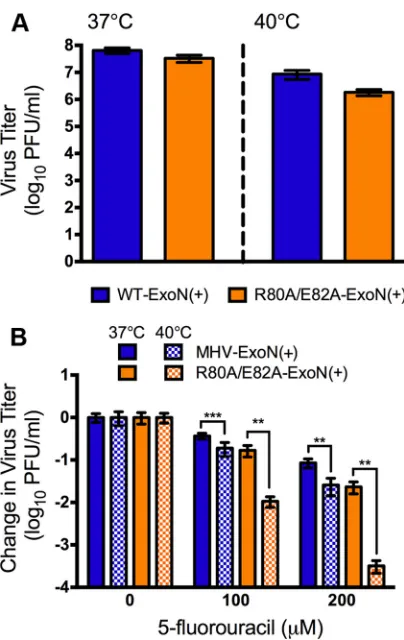
experi-ments. In the absence of 5-FU, the titers of both WT-ExoN(
⫹
)
and R80A/E82A-ExoN(
⫹
) decreased by approximately 1 log
10during infection at 40°C compared to 37°C (
Fig. 7A
), indicating
that R80A/E82A-ExoN(
⫹
) was not temperature sensitive.
Fol-lowing treatment with either 100
M or 200
M 5-FU at 40°C, the
titer of WT-ExoN(
⫹
) decreased by only 2-fold to 3-fold relative to
treatment at 37°C (
Fig. 7B
). In contrast to WT-ExoN(
⫹
) results,
the R80A/E82A-ExoN(
⫹
) virus titer was decreased by almost
100-fold in the presence of 200
M 5-FU (
Fig. 7B
). Combined, our
data suggest that the R80A/E82A mutations in nsp10 disrupt
pro-tein-protein interactions, potentially, those between nsp10 and
nsp14, that are necessary for CoV replication fidelity.
FIG 3Virus sensitivity to the nucleoside analogs AZA and RBV. (A) DBT-9 cells were pretreated with the indicated concentration of AZA and infected with the indicated virus at an MOI of 0.01 PFU/cell. Virus supernatants were harvested at 24 h postinfection, and the virus titer was determined by a plaque assay. Virus titers were normalized to values obtained from vehicle-treated samples using Prism 6. Data are presented as means⫾SEM. Statistical significance compared to WT-ExoN(⫹) is denoted (*,P⬍0.05; **,P⬍0.01; ***,P⬍0.0001) and was determined using one-way ANOVA with Dunnett’spost hoctest for multiple comparisons (n⫽6). (B) The cytotoxicity of AZA during a 24-h treatment is shown and was determined using CellTiter-Glo (means⫾SEM;n⫽3). (C) The experiment was performed as described for panel A, except with RBV. ND, not detected. (D) The cytotoxicity of RBV during a 24-h treatment is shown and was
determined using CellTiter-Glo (means⫾SEM;n⫽3).
on November 7, 2019 by guest
http://jvi.asm.org/
[image:5.585.135.452.66.340.2]DISCUSSION
Recent data demonstrate that multiple CoV nsp’s are required for
processive RNA replication (
32
) and that nsp10 interacts with this
complex. Combined with data from previous studies showing the
capacity of nsp10 to enhance nsp14-ExoN activity (
25
,
32
) and the
involvement of nsp10 in CoV RNA synthesis (
39
), these data
sug-gest that nsp10 is a core component of the CoV replicase. Here we
show that R80A and E82A mutations within nsp10, positions
pre-viously shown to disrupt the SARS-CoV nsp10-nsp14 interaction
in vitro
, led to decreased replication fidelity (
Fig. 2
and
3
). During
the course of our study, Bouvet et al. reported an extensive panel
of SARS-CoV nsp10 mutations that disrupt the nsp10-nsp14
in-teraction (
33
). Only two mutations, K43A and Y96F, could be
recovered, but the authors observed no increase in virus sensitivity
to 5-FU treatment. These data are consistent with the phenotype
of our single nsp10 mutants (
Fig. 2
) and suggest that single point
mutations within nsp10 might not be sufficient to disrupt the
nsp10-nsp14 interaction during virus replication. This is in
con-FIG 4Virus replication and RNA synthesis kinetics. (A and B) DBT-9 cells were infected with the indicated virus at an MOI of 1 PFU/cell (A) or 0.01 PFU/cell (B), and 300l of supernatant was collected at the indicated time points. The virus titer was determined by a plaque assay. (C and D) Kinetics of genomic (C) and subgenomic (D) RNA synthesis, with or without 5-FU treatment at an MOI of 1 PFU/cell, were determined by two-step real-time qRT-PCR using RNA harvested at the times indicated. Data were normalized to GAPDH using the 2⫺⌬CTmethod. Data are presented as means⫾SD for triplicate samples.
FIG 5Virus sensitivity to exogenous interferon beta (IFN-) treatment. DBT-9 cells were pretreated with either 100 or 500 U/ml of IFN-for 18 h and infected with the indicated virus at an MOI of 1 PFU/cell. Virus supernatant was harvested at 12 h postinfection, and the virus titer was determined by a plaque assay. Data are presented as means⫾SEM (n⫽4).
FIG 65-FU sensitivity of R80A/E82A-ExoN(⫺) compared to MHV-ExoN(⫺). DBT-9 cells were pretreated with the indicated concentration of 5-FU and infected at an MOI of 0.01 PFU/cell. Supernatants were harvested at 24 h postinfection, and the virus titer was determined by a plaque assay. Data are presented as means⫾ SEM. There was no statistically significant difference between R80A/E82A-ExoN(⫺) and MHV-ExoN(⫺) at each concentration as determined by a two-tailed unpairedttest (n⫽4).
on November 7, 2019 by guest
http://jvi.asm.org/
[image:6.585.137.450.66.312.2] [image:6.585.61.269.487.674.2] [image:6.585.318.522.514.656.2]trast with results of studies performed using transiently
trans-fected and recombinant nsp10 and nsp14 (
25
,
33
), in which single
point mutations were capable of disrupting nsp10-nsp14
interac-tions. However, the differences between these previous studies
and ours are probably due to the absence of other CoV replicase
proteins. Replicase stability is likely determined by a network of
protein-protein interactions involving the surfaces of multiple
CoV nsp’s (
45–47
). Thus, a slight decrease in the strength of the
nsp10-nsp14 interaction might be compensated for by other
pro-tein-protein interactions.
Our data support the hypothesis that the phenotype of R80A/
E82A-ExoN(
⫹
) is due to modulation of ExoN activity. R80A/
E82A-ExoN(
⫹
) displayed RNA synthesis kinetics similar to those
of WT-ExoN(
⫹
) (
Fig. 4
) and did not exhibit increased IFN-

sensitivity compared to WT-ExoN(
⫹
) (
Fig. 5
), indicating that the
R80A and E82A substitutions do not impact nsp16 –2
=
-OMT
ac-tivity. Most importantly, introduction of the R80A and E82A
sub-stitutions into the genome of MHV-A59 lacking ExoN activity
[R80A/E82A-ExoN(
⫺
)] did not further increase virus sensitivity
to 5-FU treatment (
Fig. 6
) compared to that seen with
MHV-ExoN(
⫺
). By analogy to
Escherichia coli
DNA polymerase III (Pol
III), nsp10 could function by stabilizing nsp14-ExoN, by
enhanc-ing removal of 3
=
terminal mismatches during virus replication, or
by driving the association of nsp14 with other replicase
compo-nents. The DNA Pol III holoenzyme contains at least 17 subunits,
and the catalytic site is composed of a heterotrimeric polymerase
core with polymerase (
␣
), exonuclease (
ε
), and
subunits
(re-cently reviewed in reference
48
). The
subunit is a small
8-to-9-kDa protein that has no known enzymatic function but has been
shown to enhance the proofreading activity of
ε
by 2-fold to 4-fold
(
49
,
50
) and to stabilize
ε
under thermal inactivation conditions
(
51
,
52
). However,
ε
is not dependent upon the presence of the
subunit (
49
,
51
,
53
,
54
). Both the N7-MT and ExoN activities of
nsp14 were first reported independently of nsp10 (
24
,
55
),
dem-onstrating that nsp10 is not a requirement for nsp14 enzymatic
activity. This is in contrast to the SARS-CoV nsp10-nsp16
inter-action, in which binding of nsp10 to nsp16 is required for nsp16 –
2
=
-OMT activity (
37
,
38
,
56
). The affinity of nsp14 for RNA has
not been reported; however, the presence of two zinc finger (ZnF)
domains within nsp10, coupled with the capacity of nsp10 to bind
RNA, suggests that nsp10 could recruit nsp14 to RNA (
57
). nsp10
has not been reported to enhance nsp14 –N7-MT activity (
44
);
however, the interaction of nsp10 with nsp14 could conceivably
dictate whether or not nsp14 functions primarily in viral RNA
capping, fidelity, or other uncharacterized functions.
The
⬃
100-fold increase in 5-FU sensitivity observed for R80A/
E82A-ExoN(
⫹
) at 40°C indicates that fidelity is likely further
de-creased at elevated temperature (
Fig. 7
). Because nsp10 is required
for CoV replication, it is unlikely that the phenotype observed at
40°C is due to temperature-dependent misfolding of nsp10. This
interpretation is supported by the lack of temperature sensitivity
of R80A/E82A-ExoN(
⫹
) compared to WT-ExoN(
⫹
) at 40°C
(
Fig. 7A
). Elevated temperature could be further disrupting nsp14
association with nsp10, thus either exerting a direct effect on
nsp14-ExoN activity or affecting the rate at which nsp14 is
asso-ciating with the replicase complex. Additionally, this phenotype
could be due to destabilization of nsp14 in the absence of nsp10.
The development of reagents to examine and detect nsp14
expres-sion in tissue culture will be critical in resolving these important
issues.
The results of our studies identify nsp10 as a determinant of
CoV replication fidelity and support a model in which CoVs use
multiple nonstructural proteins to faithfully replicate their large
RNA genomes. Our data also indicate that the mechanism by
which CoVs regulate their fidelity might be similar to that of
DNA-based organisms. nsp7, nsp8, nsp12, and nsp13 could
rep-resent the minimal unit for RNA synthesis, while nsp10, nsp12,
and nsp14 would be the primary determinants of replication
fi-delity. The ability to test these functions in replicating virus and to
recapitulate this putative complex biochemically will be critical
for a mechanistic understanding of CoV replication.
ACKNOWLEDGMENTS
We thank Nicole Sexton for critical review of the manuscript and Xiaotao Lu for technical assistance. We are grateful to members of the Denison laboratory and to Craig Cameron at Penn State University for helpful discussions.
This work was supported by United States Public Health Service awards
FIG 7Virus sensitivity to 5-FU treatment at elevated temperature. (A) Virus titers following replication at an MOI of 0.01 PFU/cell at either 37°C or 40°C in the absence of 5-FU are shown. R80A/E82A-ExoN(⫹) virus titers were not statistically different from WT-ExoN(⫹) virus titers at either temperature as determined by a two-tailed unpairedttest (n⫽6). (B) Virus sensitivity to 5-FU treatment at either 37°C or 40°C is shown. DBT-9 cells were pretreated with the indicated concentration of 5-FU and then infected at an MOI of 0.01 PFU/cell. DMEM containing DMSO or 5-FU was added back, and cells were incubated at either 37°C or 40°C. At 24 h postinfection, the supernatant was harvested and the virus titer was determined by a plaque assay. Data are pre-sented as means⫾SEM. The statistical significance of the results of compari-sons of the virus titer at 37°C to that at 40°C was determined (*,P⬍0.05; **,
P⬍0.01; ***,P⬍0.0001) using a two-tailed unpairedttest (n⫽6).
on November 7, 2019 by guest
http://jvi.asm.org/
[image:7.585.62.264.62.382.2]in vitro and virulence in vivo. Antiviral Res100:1–7.http://dx.doi.org/10 .1016/j.antiviral.2013.07.008.
3.Zeng J, Wang H, Xie X, Li C, Zhou G, Yang D, Yu L.2014. Ribavirin-resistant variants of foot-and-mouth disease virus: the effect of restricted quasispecies diversity on viral virulence. J Virol88:4008 – 4020.http://dx .doi.org/10.1128/JVI.03594-13.
4.Vignuzzi M, Stone JK, Arnold JJ, Cameron CE, Andino R. 2006. Quasispecies diversity determines pathogenesis through cooperative in-teractions in a viral population. Nature439:344 –348.http://dx.doi.org/10 .1038/nature04388.
5.Vignuzzi M, Wendt E, Andino R.2008. Engineering attenuated virus vaccines by controlling replication fidelity. Nat Med14:154 –161.http: //dx.doi.org/10.1038/nm1726.
6.Pfeiffer JK, Kirkegaard K.2003. A single mutation in poliovirus RNA-dependent RNA polymerase confers resistance to mutagenic nucleotide analogs via increased fidelity. Proc Natl Acad Sci U S A100:7289 –7294. http://dx.doi.org/10.1073/pnas.1232294100.
7.Arnold JJ, Vignuzzi M, Stone JK, Andino R, Cameron CE.2005. Remote site control of an active site fidelity checkpoint in a viral RNA-dependent RNA polymerase. J Biol Chem280:25706 –25716.http://dx.doi.org/10 .1074/jbc.M503444200.
8.Liu X, Yang X, Lee CA, Moustafa IM, Smidansky ED, Lum D, Arnold JJ, Cameron CE, Boehr DD.2013. Vaccine-derived mutation in motif D of poliovirus RNA-dependent RNA polymerase lowers nucleotide incor-poration fidelity. J Biol Chem 288:32753–32765. http://dx.doi.org/10 .1074/jbc.M113.484428.
9.Weeks SA, Lee CA, Zhao Y, Smidansky ED, August A, Arnold JJ, Cameron CE.2012. A polymerase mechanism-based strategy for viral attenuation and vaccine development. J Biol Chem 287:31618 –31622. http://dx.doi.org/10.1074/jbc.C112.401471.
10. Korboukh VK, Lee CA, Acevedo A, Vignuzzi M, Xiao Y, Arnold JJ, Hemperly S, Graci JD, August A, Andino R, Cameron CE.2014. RNA virus population diversity, an optimum for maximal fitness and virulence. J Biol Chem289:29531– 29544.http://dx.doi.org/10.1074/jbc.M114.592303.
11. Coffey LL, Beeharry Y, Borderia AV, Blanc H, Vignuzzi M. 2011. Arbovirus high fidelity variant loses fitness in mosquitoes and mice. Proc Natl Acad Sci U S A108:16038 –16043.http://dx.doi.org/10.1073/pnas .1111650108.
12. Rozen-Gagnon K, Stapleford KA, Mongelli V, Blanc H, Failloux A-B, Saleh M-C, Vignuzzi M.2014. Alphavirus mutator variants present host-specific defects and attenuation in Mammalian and insect models. PLoS Pathog10:
e1003877.http://dx.doi.org/10.1371/journal.ppat.1003877.
13. Cheung PPH, Watson SJ, Choy K-T, Fun Sia S, Wong DDY, Poon LLM, Kellam P, Guan Y, Malik Peiris JS, Yen H-L.2014. Generation and characterization of influenza A viruses with altered polymerase fidelity. Nat Commun5:4794.http://dx.doi.org/10.1038/ncomms5794. 14. Gnädig NF, Beaucourt S, Campagnola G, Bordería AV, Sanz-Ramos M,
Gong P, Blanc H, Peersen OB, Vignuzzi M.2012. Coxsackievirus B3 mutator strains are attenuated in vivo. Proc Natl Acad Sci U S A109:
E2294 –E2303.http://dx.doi.org/10.1073/pnas.1204022109.
15. Campagnola G, McDonald S, Beaucourt S, Vignuzzi M, Peersen OB.
2015. Structure-function relationships underlying the replication fidelity of viral RNA-dependent RNA polymerases. J Virol89:275–286.http://dx .doi.org/10.1128/JVI.01574-14.
16. Sadeghipour S, McMinn PC.2013. A study of the virulence in mice of high copying fidelity variants of human enterovirus 71. Virus Res176:
265–272.http://dx.doi.org/10.1016/j.virusres.2013.06.019.
17. Sadeghipour S, Bek EJ, McMinn PC.2013. Ribavirin-resistant mutants
1826.http://dx.doi.org/10.1038/nm.2972.
22. Gorbalenya AE, Enjuanes L, Ziebuhr J, Snijder EJ.2006. Nidovirales: evolving the largest RNA virus genome. Virus Res117:17–37.http://dx .doi.org/10.1016/j.virusres.2006.01.017.
23. Snijder EJ, Bredenbeek PJ, Dobbe JC, Thiel V, Ziebuhr J, Poon LLM, Guan Y, Rozanov M, Spaan WJM, Gorbalenya AE.2003. Unique and conserved features of genome and proteome of SARS-coronavirus, an early split-off from the coronavirus group 2 lineage. J Mol Biol331:991– 1004.http://dx.doi.org/10.1016/S0022-2836(03)00865-9.
24. Minskaia E, Hertzig T, Gorbalenya AE, Campanacci V, Cambillau C, Canard B, Ziebuhr J.2006. Discovery of an RNA virus 3⬙¡5⬙ exoribonu-clease that is critically involved in coronavirus RNA synthesis. Proc Natl Acad Sci U S A103:5108 –5113.http://dx.doi.org/10.1073/pnas.0508200103. 25. Bouvet M, Imbert I, Subissi L, Gluais L, Canard B, Decroly E.2012. RNA 3=-end mismatch excision by the severe acute respiratory syndrome coronavirus nonstructural protein nsp10/nsp14 exoribonuclease com-plex. Proc Natl Acad Sci U S A109:9372–9377.http://dx.doi.org/10.1073 /pnas.1201130109.
26. Eckerle LD, Lu X, Sperry SM, Choi L, Denison MR.2007. High fidelity of murine hepatitis virus replication is decreased in nsp14 exoribonuclease mu-tants. J Virol81:12135–12144.http://dx.doi.org/10.1128/JVI.01296-07. 27. Eckerle LD, Becker MM, Halpin RA, Li K, Venter E, Lu X, Scherbakova
S, Graham RL, Baric RS, Stockwell TB, Spiro DJ, Denison MR.2010. Infidelity of SARS-CoV Nsp14-exonuclease mutant virus replication is revealed by complete genome sequencing. PLoS Pathog6:e1000896.http: //dx.doi.org/10.1371/journal.ppat.1000896.
28. Smith EC, Blanc H, Vignuzzi M, Denison MR.2013. Coronaviruses lacking exoribonuclease activity are susceptible to lethal mutagenesis: ev-idence for proofreading and potential therapeutics. PLoS Pathog
9:e1003565.http://dx.doi.org/10.1371/journal.ppat.1003565.
29. te Velthuis AJW, Arnold JJ, Cameron CE, van den Worm SHE, Snijder EJ.2010. The RNA polymerase activity of SARS-coronavirus nsp12 is primer dependent. Nucleic Acids Res38:203–214.http://dx.doi.org/10 .1093/nar/gkp904.
30. Ahn D-G, Choi J-K, Taylor DR, Oh J-W.2012. Biochemical character-ization of a recombinant SARS coronavirus nsp12 RNA-dependent RNA polymerase capable of copying viral RNA templates. Arch Virol157:2095– 2104.http://dx.doi.org/10.1007/s00705-012-1404-x.
31. Cheng A, Zhang W, Xie Y, Jiang W, Arnold E, Sarafianos SG, Ding J.
2005. Expression, purification, and characterization of SARS coronavirus RNA polymerase. Virology335:165–176.http://dx.doi.org/10.1016/j.virol .2005.02.017.
32. Subissi L, Posthuma CC, Collet A, Zevenhoven-Dobbe JC, Gorbalenya AE, Decroly E, Snijder EJ, Canard B, Imbert I.2014. One severe acute respira-tory syndrome coronavirus protein complex integrates processive RNA poly-merase and exonuclease activities. Proc Natl Acad Sci U S A111:E3900 – E3909.http://dx.doi.org/10.1073/pnas.1323705111.
33. Bouvet M, Lugari A, Posthuma CC, Zevenhoven JC, Bernard S, Betzi S, Imbert I, Canard B, Guillemot J-C, Lécine P, Pfefferle S, Drosten C, Snijder EJ, Decroly E, Morelli X.2014. Coronavirus Nsp10, a critical co-factor for activation of multiple replicative enzymes. J Biol Chem289:
25783–25796.http://dx.doi.org/10.1074/jbc.M114.577353.
34. Daffis S, Szretter KJ, Schriewer J, Li J, Youn S, Errett J, Lin T-Y, Schneller S, Züst R, Dong H, Thiel V, Sen GC, Fensterl V, Klimstra WB, Pierson TC, Buller RM, Gale M, Shi P-Y, Diamond MS.2010. 2=-O methylation of the viral mRNA cap evades host restriction by IFIT family members. Nature468:452– 456.http://dx.doi.org/10.1038/nature09489. 35. Züst R, Cervantes-Barragan L, Habjan M, Maier R, Neuman BW,
on November 7, 2019 by guest
http://jvi.asm.org/
Ziebuhr J, Szretter KJ, Baker SC, Barchet W, Diamond MS, Siddell SG, Ludewig B, Thiel V.2011. Ribose 2=-O-methylation provides a molecular signature for the distinction of self and non-self mRNA dependent on the RNA sensor Mda5. Nat Immunol12:137–143.http://dx.doi.org/10.1038 /ni.1979.
36. Menachery VD, Yount BL, Josset L, Gralinski LE, Scobey T, Agniho-thram S, Katze MG, Baric RS. 2014. Attenuation and restoration of severe acute respiratory syndrome coronavirus mutant lacking 2= -o-methyltransferase activity. J Virol 88:4251– 4264. http://dx.doi.org/10 .1128/JVI.03571-13.
37. Decroly E, Debarnot C, Ferron F, Bouvet M, Coutard B, Imbert I, Gluais L, Papageorgiou N, Sharff A, Bricogne G, Ortiz-Lombardia M, Lescar J, Canard B.2011. Crystal structure and functional analysis of the SARS-coronavirus RNA cap 2=-O-methyltransferase nsp10/ nsp16 complex. PLoS Pathog7:e1002059. http://dx.doi.org/10.1371 /journal.ppat.1002059.
38. Chen Y, Su C, Ke M, Jin X, Xu L, Zhang Z, Wu A, Sun Y, Yang Z, Tien P, Ahola T, Liang Y, Liu X, Guo D.2011. Biochemical and structural insights into the mechanisms of SARS coronavirus RNA ribose 2= -O-methylation by nsp16/nsp10 protein complex. PLoS Pathog7:e1002294. http://dx.doi.org/10.1371/journal.ppat.1002294.
39. Donaldson EF, Sims AC, Graham RL, Denison MR, Baric RS.2007. Murine hepatitis virus replicase protein nsp10 is a critical regulator of viral RNA synthesis. J Virol81:6356 – 6368.http://dx.doi.org/10.1128 /JVI.02805-06.
40. Donaldson EF, Graham RL, Sims AC, Denison MR, Baric RS.2007. Analysis of murine hepatitis virus strain A59 temperature-sensitive mu-tant TS-LA6 suggests that nsp10 plays a critical role in polyprotein pro-cessing. J Virol81:7086 –7098.http://dx.doi.org/10.1128/JVI.00049-07. 41. Chen W, Baric RS.1996. Molecular anatomy of mouse hepatitis virus
persistence: coevolution of increased host cell resistance and virus viru-lence. J Virol70:3947–3960. 8648732.
42. Yount B, Denison MR, Weiss SR, Baric RS.2002. Systematic assembly of a full-length infectious cDNA of mouse hepatitis virus strain A59. J Virol
76:11065–11078.http://dx.doi.org/10.1128/JVI.76.21.11065-11078.2002. 43. Pauly MD, Lauring AS.2015. Effective lethal mutagenesis of influenza virus by three nucleoside analogs. J Virol89:3584 –3597.http://dx.doi.org /10.1128/JVI.03483-14.
44. Bouvet M, Debarnot C, Imbert I, Selisko B, Snijder EJ, Canard B, Decroly E.2010. In vitro reconstitution of SARS-coronavirus mRNA cap methylation. PLoS Pathog6:e1000863.http://dx.doi.org/10.1371/journal .ppat.1000863.
45. von Brunn A, Teepe C, Simpson JC, Pepperkok R, Friedel CC, Zimmer R, Roberts R, Baric R, Haas J.2007. Analysis of intraviral protein-protein interactions of the SARS coronavirus ORFeome. PLoS One2:e459.http: //dx.doi.org/10.1371/journal.pone.0000459.
46. Imbert I, Snijder EJ, Dimitrova M, Guillemot J-C, Lécine P, Canard B.
2008. The SARS-coronavirus PLnc domain of nsp3 as a replication/ transcription scaffolding protein. Virus Res133:136 –148.http://dx.doi .org/10.1016/j.virusres.2007.11.017.
47. Pan J, Peng X, Gao Y, Li Z, Lu X, Chen Y, Ishaq M, Liu D, Dediego ML,
Enjuanes L, Guo D.2008. Genome-wide analysis of protein-protein inter-actions and involvement of viral proteins in SARS-CoV replication. PLoS One
3:e3299.http://dx.doi.org/10.1371/journal.pone.0003299.
48. Johansson E, Dixon N.2013. Replicative DNA polymerases. Cold Spring Harb Perspect Biol5:pii⫽a012799.http://dx.doi.org/10.1101/cshperspect .a012799.
49. Studwell-Vaughan PS, O’Donnell M.1993. DNA polymerase III acces-sory proteins. V. Theta encoded by holE. J Biol Chem268:11785–11791. 50. Perrino FW, Harvey S, McNeill SM.1999. Two functional domains of
theεsubunit of DNA polymerase III. Biochemistry38:16001–16009.http: //dx.doi.org/10.1021/bi991429⫹.
51. Taft-Benz SA, Schaaper RM.2004. The theta subunit of Escherichia coli DNA polymerase III: a role in stabilizing the epsilon proofreading subunit. J Bacteriol186:2774 –2780.http://dx.doi.org/10.1128/JB.186.9.2774-2780 .2004.
52. Hamdan S, Bulloch EM, Thompson PR, Beck JL, Yang JY, Crowther JA, Lilley PE, Carr PD, Ollis DL, Brown SE, Dixon NE.2002. Hydrolysis of the 5=-p-nitrophenyl ester of TMP by the proofreading exonuclease (ε) subunit of Escherichia coli DNA polymerase III. Biochemistry41:5266 – 5275.http://dx.doi.org/10.1021/bi0159480.
53. Scheuermann RH, Echols H.1984. A separate editing exonuclease for DNA replication: the epsilon subunit of Escherichia coli DNA polymerase III holoenzyme. Proc Natl Acad Sci U S A81:7747–7751.http://dx.doi.org /10.1073/pnas.81.24.7747.
54. Scheuermann R, Tam S, Burgers PM, Lu C, Echols H.1983. Identifi-cation of the epsilon-subunit of Escherichia coli DNA polymerase III ho-loenzyme as the dnaQ gene product: a fidelity subunit for DNA replica-tion. Proc Natl Acad Sci U S A80:7085–7089.http://dx.doi.org/10.1073 /pnas.80.23.7085.
55. Chen Y, Cai H, Pan J, Xiang N, Tien P, Ahola T, Guo D. 2009. Functional screen reveals SARS coronavirus nonstructural protein nsp14 as a novel cap N7 methyltransferase. Proc Natl Acad Sci U S A106:3484 – 3489.http://dx.doi.org/10.1073/pnas.0808790106.
56. Lugari A, Betzi S, Decroly E, Bonnaud E, Hermant A, Guillemot JC, Debarnot C, Borg JP, Bouvet M, Canard B, Morelli X, Lecine P.2010. Molecular mapping of the RNA cap 2=-O-methyltransferase activation interface between severe acute respiratory syndrome coronavirus nsp10 and nsp16. J Biol Chem285:33230 –33241.http://dx.doi.org/10.1074/jbc .M110.120014.
57. Joseph JS, Saikatendu KS, Subramanian V, Neuman BW, Brooun A, Griffith M, Moy K, Yadav MK, Velasquez J, Buchmeier MJ, Stevens RC, Kuhn P.2006. Crystal structure of nonstructural protein 10 from the severe acute respiratory syndrome coronavirus reveals a novel fold with two zinc-binding motifs. J Virol80:7894 –7901.http://dx.doi.org/10.1128 /JVI.00467-06.
58. Kelley LA, Sternberg MJE.2009. Protein structure prediction on the Web: a case study using the Phyre server. Nat Protoc4:363–371.http://dx .doi.org/10.1038/nprot.2009.2.
59. Schrodinger LLC.2010. The PyMOL Molecular Graphics System, Ver-sion 1.3r1. Schrodinger LLC, Cambridge, MA.
on November 7, 2019 by guest
http://jvi.asm.org/