TECHNICAL UNIVERSITY MALAYSIA MALACCA
Analysis Of The Influence Of Electrical Discharge
Machine Die Sinking Parameters On Material
Removal Rate Of Mild Steel
Thesis submitted in accordance with the requirements of the Technical University
Malaysia Malacca for the Degree of Bachelor of Engineering (Honors)
Manufacturing (Process)
By
Ahmad Syirwan Adli Bin Hamzah
UTeM Library (Pind.1/2005)
SULIT
TERHAD
TIDAK TERHAD
(Mengandungi maklumat yang berdarjah keselamatan atau kepentingan Malaysia yang termaktub di dalam AKTA RAHSIA RASMI 1972)
(Mengandungi maklumat TERHAD yang telah ditentukan oleh organisasi/badan di mana penyelidikan dijalankan)
(TANDATANGAN PENULIS) Alamat Tetap:
30A JALAN APOLLO TIMUR 96000 SIBU SARAWAK Tarikh: _______________________ Disahkan oleh: (TANDATANGAN PENYELIA) Cop Rasmi: Tarikh: _______________________
* Tesis dimaksudkan sebagai tesis bagi Ijazah Doktor Falsafah dan Sarjana secara penyelidikan, atau BORANG PENGESAHAN STATUS TESIS*
UNIVERSITI TEKNIKAL MALAYSIA MELAKA
JUDUL:
SESI PENGAJIAN:
Saya _____________________________________________________________________
mengaku membenarkan tesis (PSM/Sarjana/Doktor Falsafah) ini disimpan di Perpustakaan Universiti Teknikal Malaysia Melaka (UteM) dengan syarat-syarat kegunaan seperti berikut:
1. Tesis adalah hak milik Universiti Teknikal Malaysia Melaka.
2. Perpustakaan Kolej Universiti Teknikal Kebangsaan Malaysia dibenarkan membuat salinan untuk tujuan pengajian sahaja.
3. Perpustakaan dibenarkan membuat salinan tesis ini sebagai bahan pertukaran antara institusi pengajian tinggi.
4. **Sila tandakan (√)
AHMAD SYIRWAN ADLI BIN HAMZAH
√
DECLARATION
I hereby, declare this thesis entitled
“Analysis Of The Influence Of Electrical Discharge Machine Die Sinking Parameters On Material Removal Rate Of Mild Steel” is the results of my own research except
as cited in the reference.
ABSTRACT
DEDICATION
ACKNOWLEDGEMENTS
TABLE OF CONTENTS
Abstract………i
Dedication………...ii
Acknowledgements………...iii
Table of Contents………...iv
List of Figures………...vii
List of Tables………...ix
List of Abbreviation………x
1. INTRODUCTION
1.1 Background………...1
1.2 Problem Statement………2
1.3 Objectives……….3
1.4 Scope of Project………3
2. LITERATURE REVIEW
2.1 Introduction………...4
2.2 Machine………5
2.3 Electrode………...5
2.4 Tools and Its Properties
2.4.1 Graphite……….6
2.4.2 Copper………6-7
2.4.3 Copper Tungsten………7-8
2.4.4 Aluminum……….8
2.5 Dielectric Fluid………..………8-9
2.6 Material Removal Rate………9-11
2.7 Height Gauge………..11
2.9 SODICK LN2 / LQ Series………..12
2.9.1 Polarity, PL………...13
2.9.2 Electric Discharge Peak Current, IP……….13
2.9.3 Servo Voltage, SV………...13-14
2.9.4 Main Supply Voltage, V……….………..14
2.9.5 Servo Speed, S….……….15
2.9.6 Jump Speed, JS……….16
2.10 Tool Offset……….17
2.11 Principal Working of EDM Die Sinking………..17-18
2.11.1 Physical Process……….18-20
3. METHODOLOGY
3.1 Introduction……….21
3.2 Design of Experiment
3.2.1 Phase 1: Define the Objective of Study...…...21
3.2.2 Phase 2: Develop the Cause-effect Diagram………....22
3.2.3 Phase 3: Develop an experimental Array………...22-23
3.2.4 Phase 4: Analysis of DOE………24
3.3 Process Planning
3.3.1 Machine………...24
3.3.2 Fixture………..25
3.3.3 Tool Selection………..25
4.3.2 Analysis of Variance (ANOVA)……….40-41
4.3.2 Mathematical Model………...42
5. DISCUSSION
5.1 Machining………..43-45
5.2 Step of Analysis MRR………...45-47
5.3 Validation of Equation………48
6. CONCLUSION………...………49
REFERENCES………..………50-51
APPENDICES
Appendix A Minitab Output for Significant and Not significant
Appendix B Minitab Output for ANOVA
Appendix C Programming Code output by machine
LIST OF FIGURES
2.1
Material removing by EDM
5
2.2
The appearance of copper
7
2.3
The aluminum metal appearance
8
2.4
The voltage time diagram
10
2.5
Height gauge
11
2.6
Vise as clamping in machining
12
2.7
The characteristic of high SV and low setting SV
14
2.8
The process of how material is removed
18
2.9
Electrode and workpiece is energized
18
2.10
The ionized created
19
2.11
The spark giving heat to melt the work piece
19
2.12
The implosion of spark
19
2.13
The material is removed away from workpiece
20
3.1
The cause-effect diagram
22
3.2
Flow chart process planning
24
3.3
The dimension of electrode
25
3.4
The calibration gauge check sheet for height gauge
26
3.5
The result check sheet for checking dimensional electrode
26
3.6
The check sheet for result after machining
27
4.1
The graph significant and not significant of combination factors
33
4.2
The pareto chart effect of combination factors
34
4.3
The graph mean of MRR versus Factors
35
4.4
The factor interaction graph
36
4.5
The graph of reduced model
37
4.7
The cube plot of three significant factors
39
4.8
The residual plots of MRR
41
4.9
The output of coefficient value for coded and uncoded unit
42
5.1
The header conditions that created by machine
44
LIST OF TABLE
2.1
Characteristic and properties of three type natural graphite
6
2.2
Servo voltage parameter
13
2.3
Servo speed characteristic
15
2.4
The characteristic voltage limit
15
2.5
Second digit of JS
16
2.6
First digit of JS
16
3.1
Design layout
23
3.2
Parameter setting
28
4.1
Design matrix of DOE with full factorial of five factors
30
4.2
The result obtain from the experiment
31
LIST OF ABBREVIATION
ANOVA
-
Analysis of Variance
CNC
-
Computer Numerical Control
DOE
-
Design of Experiment
EDM
-
Electrical Discharge Machine
IP
-
Electric Discharge Peak Current
JS
-
Jump Speed
MRR
-
Material Removal Rate
S
-
Servo Speed
SV
-
Servo Voltage
CHAPTER 1
INTRODUCTION
1.1
Background
Electrical discharge machining is a new technology adopted in advanced machining process to remove the material part using electrode as cutting tool. The tool materials that are commonly used are copper and graphite due to its wear resistance. There are also other type of materials that can be used but not widely such as copper tungsten, aluminum, tellurium copper, brass and tungsten carbide. The main factor for choosing the electrode depends on good electrical conductivities. The choice of electrode will firstly base on how easy the electrode can be machined to get the desired shape. Second the electrode is chosen on it based own mechanical properties that can long lasting of it wear mechanical properties. It means that the electrode having lower melting point the tool wear rate will increase.
The working principle of EDM is to produce and generating spark and hence to remove the material. The simplest way to understand the spark generating is the same like the car lead acid batteries. It has a cathode and an anode. Connect one end of the anode with a wire and the cathode end is free. By using wire that connected at anode touch it to the cathode the spark will produce. After the spark has been produce by the car lead acid there will be some amount of the end is been removed. Where the anode is representing the electrode and the cathode is represent for the work material. That is the basic EDM principle working. EDM does not need any mechanical force to remove the material but it needs only the impulse of voltage and ampere to remove the part material.
1.2
Problem Statement
Electrical discharge machining (EDM) has been used effectively in the machining of hard, high strength and temperature resistant materials. Material is removed by means of rapid and repetitive spark discharges across the gap between the cutting tool and the work piece. In EDM, it is most important to select machining parameter for achieving optimal machining. Usually, the desired machining parameters are determined based on experience or handbook values. However this dose not ensures that the selected machining parameter result in optimal or near optimal machining performance for that particular electrical discharge machining and environment. To solve this task in the present study, the Design of Experiment (DOE) method is used as an efficient approach to determine the optimal machining parameters in the electrical discharge machining process.
The electrical discharge machining removes work piece by an electrical erosion process. The variations in the machining parameters such as the polarity, servo speed, voltage, jump speed, peak current and servo voltage are greatly affect the machining performance.
1.3
Objective
The objectives of this project are:
I. To determine the material removal rate (MRR) of mild steel using graphite.
II. To find the most significant electrical discharge machining parameter that influences the MRR.
1.4
Scope of Project
1. Understand the EDM Die Sinking process.
2. Machining implementation of mild steel with graphite electrode. 3. Determine MRR with different machining parameter.
CHAPTER 2
LITERATURE REVIEW
2.1
Introduction
Machine has a broad term to describe; machine is always describing as equipment that helping man to done operation. Another term of describing machine is a device that transmits energy to perform some task. Machine can also be described as a man slave. Why it is call as a man slave? It is because the machine is operating by mans instruction to complete the men task.
Machine has three basic categories. First categories machine is computer numerical control (CNC) type machine. The second category is manual type machine and a third category is semi automatic machine.
In manufacturing, machine is like a brother to the engineers and technician. Machine is helping people to give high production. Machine that is popular among the engineers is the machine that based on removal rates. This is because in producing part it always comes from raw material then it comes a product. Some kind of machine that based on removal rates is electro discharged machine (EDM), turning machine and lathe machine. These are common machine in production.
2.2
Machine
Electro Discharge Machine is a process of machining that is using spark to remove the material as shown in figure2.1. Figure2.1 shows the tool is not contacting the workpiece to remove the material. The contact is happen between the dielectric to produced spark. The spark can be control by length of the gap. The spark also can be control with the current and the voltage of the EDM.
Figure2.1: Material removing by EDM
2.3
Electrode
Electrode is one of the important components in EDM die sinking. Electrode is work as cutting tool. In machining process the cutting tool is need to be selected to get the better result when machining. The electrode must have its own criteria to be use in EDM machining. Firstly the electrode must be good conductivity of electrical and heat. Next, the electrode must be easily machined to reduce the tooling cost. The electrode must be highly wear rates so that the electrode will be long life. Tool is also choose to there hardly decomposition too the other material. In early stage the electrode is choose based on try and error to choose the material type.
2.4
Tools and Its Properties
2.4.1
Graphite
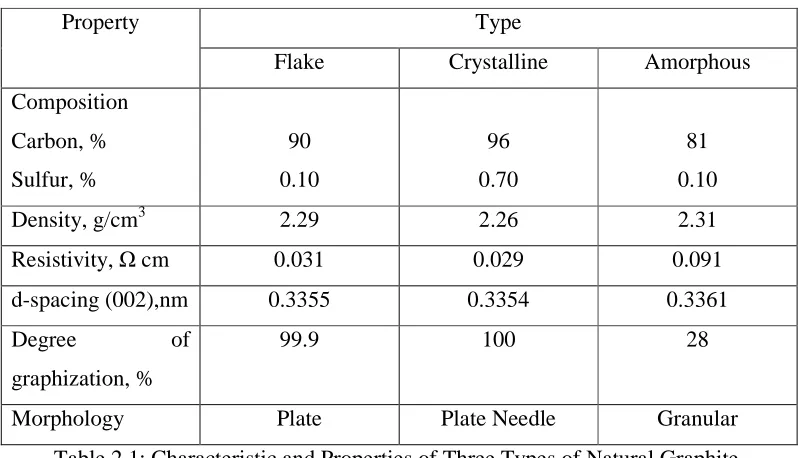
Graphite is come from Greek word “graphein” it means to write. Graphite has low density (2.1 -2.3 g/cm3) and it depend the graphite type. Graphite is optically opaque even in extremely thin sections. The material of graphite is unaffected by weather. Graphite has thermal and electrical conductivity and it has low coefficient of friction.
Type Property
Flake Crystalline Amorphous Composition Carbon, % Sulfur, % 90 0.10 96 0.70 81 0.10 Density, g/cm3 2.29 2.26 2.31 Resistivity, Ω cm 0.031 0.029 0.091 d-spacing (002),nm 0.3355 0.3354 0.3361 Degree of
graphization, %
99.9 100 28
[image:20.612.113.512.297.526.2]Morphology Plate Plate Needle Granular Table 2.1: Characteristic and Properties of Three Types of Natural Graphite. (Handbook of Carbon, Graphite, Diamond and Fullerenes, Hugh O. Pierson)
2.4.2 Copper
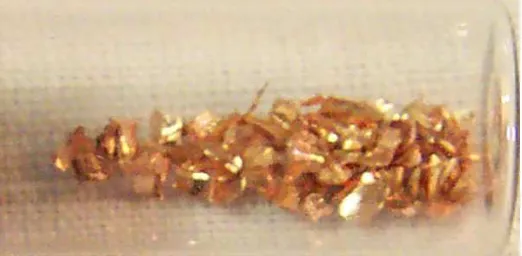
melting point is 1084.62ºC. Copper are widely use in electrical industry. Copper are also used in the household product and also in structural engineering.
Figure 2.2: The appearance of cuprum/copper.
2.4.3 Copper Tungsten
Copper tungsten sintered materials are manufactured with different copper contents, from 20% up to 70%, depending on the use to which they are put. The method of manufacture depends on the percentage of tungsten present. Materials with large percentages of tungsten (around 80%) are generally made by the impregnation process, where it is advantageous to use a coarse grain tungsten powder to decrease arc erosion. For percentages of the order of 60%, liquid phase sintering is more appropriate, and for materials with less tungsten, powder mixtures without a liquid phase are sintered together.
For larger contact forces, the static welding limit of copper-tungsten (60/40) is very much higher than for any other material of this type, although at low contact forces the hardness of the material produces very small metallic contact areas, resulting in high contact resistance and low welding limit.
2.4.4 Aluminum
[image:22.612.197.429.315.438.2]Aluminum is a group of chemical elements. The symbol for aluminum is Al. Aluminum has atomic number 13. It is ductile and poor metal group. Aluminum atomic mass is 26.9815386 g/mol. Aluminum melting point is 2519ºC. Aluminum appearance is in silvery color. See figure2.3 for looking the aluminum appearance.
Figure 2.3: The aluminum metal appearance.
2.5
Dielectric Fluid
dangerous gasses are produced with kerosene while the process is done between the electrode and workpiece.
Dielectric functionally works as insulator until the potential is sufficiently high. It also works as a flushing medium and carry away the debris in the gap and lastly it is a cooling medium. (Kalpakjian, 2000)
2.6
Material Removing Rate MRR
There are three ways of expressing the MRR by the equation and each equation is showing the different unit.
t M
MRR= ---equation 1
M= mass workpiece before machining – mass workpiece after machining t = machining time
The second equation is:
Electrode area (in2) x Depth of cut (in) / Time of cut (min) ---equation 2
The third equation is:
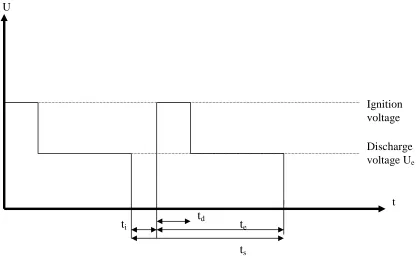
MRR=Fc. Ie. Ue. ts / (ts + ti )---equation 3
Figure2.4: Voltage – Time diagram
In figure 2.4 show that the symbol (ts) is known as the pulse duration whiles the time interval between is switching the generator on and off for the next pulse is the pulse interval (ti). Time delay, (td) are the periods of time during the voltage remain at the value of the ignition voltage while the current stays at zero.
There are three cases that will influence most in the MRR. First is in the workpiece. Second, is in the gap between electrode and workpiece and third is in the electrode.
In the workpiece MRR is influenced by the thermal conductivity of the workpiece. Copper for example has a low melting point but it also has a low MRR as it is a good conductor a heat. On the other hand steel has a high MP but a low
Thermal conductivity hence has a higher MRR.
In the gap; Particles in the work gap will contribute significantly to slowing down the MRR.
U
t Ignition voltage
t
dt
st
et
i