CONTRIBUTION OF SCHOOL ADMINISTRATORS TO TEACHING
ENHANCEMENT OF STUDENTS’ ACADEMIC PERFORMANCE IN SECONDARY SCHOOLS IN KENYA:
AN EMPIRICAL STUDY ACROSS SECONDARY
1
Elizabeth Gloria Anindo Wanyama,
1,2
Department of Educational Management and Foundations, Maseno University, Kenya
3
Department of Curriculum and
ARTICLE INFO ABSTRACT
School administrators are mandated to enhance students’
instructional supervision, teacher motivation, teaching learning resources and physical facilities. In Emuhaya and Vihiga Sub Counties performance had been below mean grade C+. From the years 2009 to 2013, Emuhaya and Vihiga
(26%) and 2104 (15%) respectively lower, compared to neighbouring Hamisi and Sabatia Sub Counties’ with 3913 (28%) and 4275 (31%) candidates respectively. The contribution of School Administrators
unknown. The objective of this study was to determine the contribution of Administrators to teaching learning resources in enhancement of students’ academic performance. Th
Conceptual Framework in which the independent variables were Administrators’ contribution to teaching learning resources and the dependent variable, Students’ Academic Performance. The study found that Administrators’ contribution t
significant (Adjusted R2 = 0.343) and thus enhanced students’ academic performance by 34.3%. The study concluded that school Administrators’ contribution to Teaching Learning Resources was significan
administrators should increase their contribution to Teaching further students’ academic performance.
Copyright © 2018, Elizabeth Gloria Anindo Wanyama permits unrestricted use, distribution, and reproduction
INTRODUCTION
The desire for quality education for the development for all Kenyans is one of the major objectives of secondary education. Quality education has over the years been measured by the quality of teachers, pupil teacher ratios, pupil text book ratios and pupils’ cognitive achievement in the form of examination results (Amphiah, Kwaah, Yiboe andAbabiah, 2013). In line with this, School Administrators contribute to students’ academic performance through instructional supervision and teacher motivation, authorizing expenditure on and ensuring that teaching learning resources and physical facilities place, with the aim of achieving good results. In addition, School Administrators participate in classroom instruction, school discipline and are custodians of public funds received from stakeholders. Studies have shown that quality education is often indicated by levels of students’
*Corresponding author: Enose M W Simatwa
Department of Educational Management and Foundations, Maseno University, Kenya.
ISSN: 0975-833X
Article History:
Received 29th December, 2017
Received in revised form 29th January, 2018
Accepted 12th February, 2018
Published online 30th March, 2018
Citation: Elizabeth Gloria Anindo Wanyama, Enose M W Simatwa
learning resources in enhancement of students’ academic performance in secondary schools in kenya: emuhaya and vihiga sub-counties”, International Journal of Current Research
Key words:
Contribution, School Administrator, Teaching-learning resources, Students’ Academics,
Performance, Secondary Schools, Emuhaya, Vihiga Sub counties, Kenya.
RESEARCH ARTICLE
CONTRIBUTION OF SCHOOL ADMINISTRATORS TO TEACHING-LEARNING RESOURCES IN
ENHANCEMENT OF STUDENTS’ ACADEMIC PERFORMANCE IN SECONDARY SCHOOLS IN KENYA:
AN EMPIRICAL STUDY ACROSS SECONDARY SCHOOLS OF EMUHAYA AND VIHIGA SUB
Elizabeth Gloria Anindo Wanyama,
*2Enose M W Simatwa
and
3Tony O. Okwach
Department of Educational Management and Foundations, Maseno University, Kenya
Department of Curriculum and Instruction, Kaimosi Friends’ University College, Kenya
ABSTRACT
School administrators are mandated to enhance students’ academic performance by use of instructional supervision, teacher motivation, teaching learning resources and physical facilities. In Emuhaya and Vihiga Sub Counties performance had been below mean grade C+. From the years 2009 to 2013, Emuhaya and Vihiga Sub Counties’ candidates who scored C+ and above were 3535 (26%) and 2104 (15%) respectively lower, compared to neighbouring Hamisi and Sabatia Sub Counties’ with 3913 (28%) and 4275 (31%) candidates respectively. The contribution of School Administrators to teaching learning resources in enhancement of students academic performance was unknown. The objective of this study was to determine the contribution of Administrators to teaching learning resources in enhancement of students’ academic performance. Th
Conceptual Framework in which the independent variables were Administrators’ contribution to teaching learning resources and the dependent variable, Students’ Academic Performance. The study found that Administrators’ contribution to teaching Learning Resources was moderate, positive and significant (Adjusted R2 = 0.343) and thus enhanced students’ academic performance by 34.3%. The study concluded that school Administrators’ contribution to Teaching Learning Resources was significant and enhanced students’ academic performance. The study recommended that school administrators should increase their contribution to Teaching -Learning Resources in order to enhance further students’ academic performance.
ia Anindo Wanyama et al. This is an open access article distributed under the Creative in any medium, provided the original work is properly cited.
The desire for quality education for the development for all Kenyans is one of the major objectives of secondary education. Quality education has over the years been measured by the quality of teachers, pupil teacher ratios, pupil text book ratios ls’ cognitive achievement in the form of examination Ababiah, 2013). In line with this, School Administrators contribute to students’ academic performance through instructional supervision and teacher motivation, authorizing expenditure on and ensuring that teaching learning resources and physical facilities are in place, with the aim of achieving good results. In addition, School Administrators participate in classroom instruction, school discipline and are custodians of public funds received from stakeholders. Studies have shown that quality education
Department of Educational Management and Foundations, Maseno
cognitive achievement or by a school’s characteristics such as conditions of the school’s buildings and adequacy of teaching learning materials (Fuller, 2006). School Administrators’ contribution to education is one determinant of quality education since they are designated as internal quality assurance officers in schools (Ministry of Education, 2004).Owing to the challenges that faced the Directorate of Inspections, Principals were designated as Quality Assurance and Standards Officers in schools being en
of instructional supervision. The Government has established Quality Assurance and Standards’ Departments, provides trained teachers and funds Free Secondary Education in all schools to attain quality education (Republic of Kenya, 200 Despite all these measures in place Emuhaya and Vihiga Sub Counties have not been able to realize quality grades. Parents are not obtaining their returns to investments. Tuition fund that is meant to assist in procurement of teaching learning resources has not has helped much, since students are asked to buy exercise books (Ahawo, 2010). Further, a look at most new students’ admission letters showed that they were required
International Journal of Current Research
Vol. 10, Issue, 03, pp.67302-67314, March, 2018
Enose M W Simatwa. and Tony O. Okwach, 2018. “Contribution of school administrators to teaching
learning resources in enhancement of students’ academic performance in secondary schools in kenya: An empirical study across se
International Journal of Current Research, 10, (04), 67302-67314.
LEARNING RESOURCES IN
ENHANCEMENT OF STUDENTS’ ACADEMIC PERFORMANCE IN SECONDARY SCHOOLS IN KENYA:
SCHOOLS OF EMUHAYA AND VIHIGA SUB-COUNTIES
Tony O. Okwach
Department of Educational Management and Foundations, Maseno University, Kenya
Friends’ University College, Kenya
academic performance by use of instructional supervision, teacher motivation, teaching learning resources and physical facilities. In Emuhaya and Vihiga Sub Counties performance had been below mean grade C+. From the years
Sub Counties’ candidates who scored C+ and above were 3535 (26%) and 2104 (15%) respectively lower, compared to neighbouring Hamisi and Sabatia Sub-Counties’ with 3913 (28%) and 4275 (31%) candidates respectively. The contribution of School
to teaching learning resources in enhancement of students academic performance was unknown. The objective of this study was to determine the contribution of Administrators to teaching learning resources in enhancement of students’ academic performance. The study was guided by a Conceptual Framework in which the independent variables were Administrators’ contribution to teaching learning resources and the dependent variable, Students’ Academic Performance. The study o teaching Learning Resources was moderate, positive and significant (Adjusted R2 = 0.343) and thus enhanced students’ academic performance by 34.3%. The study concluded that school Administrators’ contribution to Teaching Learning Resources was t and enhanced students’ academic performance. The study recommended that school Learning Resources in order to enhance
Creative Commons Attribution License, which
cognitive achievement or by a school’s characteristics such as conditions of the school’s buildings and adequacy of teaching learning materials (Fuller, 2006). School Administrators’ contribution to education is one determinant of quality hey are designated as internal quality assurance officers in schools (Ministry of Education, 2004).Owing to the challenges that faced the Directorate of Inspections, Principals were designated as Quality Assurance and Standards Officers in schools being entrusted with the task of instructional supervision. The Government has established Quality Assurance and Standards’ Departments, provides trained teachers and funds Free Secondary Education in all schools to attain quality education (Republic of Kenya, 2008). Despite all these measures in place Emuhaya and Vihiga Sub Counties have not been able to realize quality grades. Parents are not obtaining their returns to investments. Tuition fund that is meant to assist in procurement of teaching learning has not has helped much, since students are asked to buy exercise books (Ahawo, 2010). Further, a look at most new students’ admission letters showed that they were required
INTERNATIONAL JOURNAL OF CURRENT RESEARCH
to bring along several 200 page exercise books, a realm of photocopy papers and a set book. In their study on the contribution of stakeholders to provision of teaching learning resources in enhancement of girl academic achievement in Siaya County, Ahawo and Simatwa (2015) interviews with Heads of Department revealed that different schools varied greatly in the instructional materials they had. In the study, principals contributed past papers and revision materials. The study found out that the Principals contribution was high with an overall mean rating of 4.15 and 3.8 for parents. This contribution had its origin in prudent management of resources bestowed to them. Therefore, the present study attempted to determine School Administrators’ contribution to teaching learning resources with regard to authorization of actual expenditure on textbooks among other resources, and ensuring their use. Similarly, the Ahawo and Simatwa (2015) study narrowed itself to girls’ schools in Siaya County. The present study was done in all the 58 secondary schools in Emuhaya and Vihiga Sub - Counties. Quality as measured by the state of infrastructure namely construction of classrooms, head teachers’ housing, laboratories among other factors, has not been realized (Ampiah, Kwaaah, Yiboe andAbabia, 2013). School infrastructure influences quality of education hence students’ performance. In Ghana, the working and living environment of teachers and students is below expectation (Akyeampong, 2003).
In many counties schools lack basic amenities such as piped water, electricity, staffrooms and toilets. Housing is a major issue for nearly all teachers, with only 30% of them being housed by 2003. In Kenya, the Ministry of Education identified critical shortage of permanent classrooms, existing school infrastructure in poor conditions, poor maintenance, poor water system and sanitation which in a way affect learner performance (Ahawo, Simatwa andAyieko, 2015). In their study on Stakeholders contribution to infrastructure development in enhancement of girls’ academic achievement in Kenya, Ahawo et al. (2015) found out that parents, principals and Boards of Management contributed to school infrastructure. The principals’ mean of 3.13 ratings were higher than the teachers’ of 2.93. Principals are the custodians of contribution made by stakeholders to the schools. The study recommended that the Kenyan Government through the Ministry of Education to insist on infrastructural facilities before a new school is registered, and that all stakeholders be encouraged to increase their contribution to infrastructure development so as to meet the threshold in enhancement of academic performance. Therefore, the present study attempted to establish School Administrators’ actual expenditure on physical facilities, since they are the custodians of funds received in schools. The study derived responses from Principals, Deputy Principals, Heads of Department and Chairpersons of Board of Managements.
Research Objective
The research objective was to determine the contribution of School Administrators to teaching- learning resources in enhancement of students’ academic performance.
Synthesis of literature on contribution of school administrators to teaching- learning resources in the enhancement of students’ academic performance
The Ministry of Education underscores the importance of teaching learning resources in secondary schools by putting
their purchase under Tuition Fund (Republic of Kenya, 2008). In their study on the contribution of stakeholders to provision of teaching learning resources in enhancement of girl academic achievement in Siaya County, Ahawo and Simatwa (2015) interviews with Heads of Department revealed that different schools varied greatly in the instructional materials they had. In the study, principals contributed past papers, and revision materials. Like this study, they used descriptive research design of the survey type because it helps establish opinions, attitudes and knowledge about phenomena. The study population was 20 head teachers, 20 deputy heads teachers, 20 heads of examinations, 20 Church Sponsors, among others. The study found out that the Principals contribution was high with an overall mean rating of 4.15 and 3.8 for parents. This contribution has its origin in prudent management of resources bestowed to them. Therefore, the present study attempted to determine School Administrators’ contributions to teaching learning resources with regard to authorization of actual expenditure and ensuring use of these resources. Similarly, the study narrowed itself to girl schools. The present study was done in all the 58 schools in Emuhaya and Vihiga Sub - Counties.
While studying factors influencing academic performance in Mixed Day Secondary schools in Kisumu East, Ahawo (2010) reported that 80% of Heads of Department reported that schools lacked most laboratory equipment, chemicals and specimens. Similarly, 100% of them reported that heads teachers were not providing enough stationery. They attributed this shortage to their head teachers’ reluctance to purchase the required materials. Heads of Department maintained that head teachers were not providing enough exercise books and sometimes students were being forced to buy them especially graph books (Ahawo, 2010). This study did not establish the contribution of School Administrators to teaching learning resources in regard to funds allocation and ensuring that they are actually purchased and used, creating a need for this study. The study population used was32 head teachers, 32 heads of Examinations, 1045 Form 4 students in 10 out of 32 sampled schools. Over and above these respondents, the present study sought responses from the 58 Deputy Principals and 58 Heads of Department. In addition the opinion of 58 Chairmen Board of Management in 58 secondary schools in Emuhaya and Vihiga Sub Counties was sought. Ahawo (2010) recommended that head teachers to prioritize the provision of laboratory equipment since they play a vital role in the performance of learners in Kenya Certificate of Secondary Education Examinations.
Secondary Education examinations. While the study used ex-post facto research design, the present study used descriptive design of the survey type. Her study population included 46 head teachers, 564 teachers, 1 Sub county Education Officer with sample sizes of 15, 200 and 1 Sub County Education Officer respectively. The present study in addition sought responses from Deputy Principals, Heads of Department and Chairmen of Board of Management on School Administrators’ contribution to teaching learning resources. Musungu, (2007) observed that involvement of head teachers in the provision of learning materials such as maps atlases, cookers, sewing machines, helped to improve performance by 15%.
There is no mention of School Administrators’ contribution to teaching learning materials by way of funds allocation and expenditure in the realization of quality grades, a gap this study hoped to address. Public expenditure on education is aimed at achieving quality as one of the sixth Education for All Goals (UNESCO, 2005). This report found out that the provision of more textbooks, reduction in class size; among other factors have positive impact on learner achievement. Obtaining quality grades in examinations and subsequent training to all Kenyans is fundamental to the success of the Government’s overall strategy (Republic of Kenya, 2012). Teaching/ learning resources are therefore essential in this matter at all levels of education worldwide. Oguntunse, Awe and Ajayi (2013), concluded that availability and adequacy of teaching learning resources promoted the effectiveness of schools as these are the basic things that can trigger good academic performance of students.
The study which was on the empirical nexus between teaching learning resources and academic performance in mathematics among Pre- University students in the Ile-Ife South –West, Nigeria, recommended that Government and Private Institutions to provide enough teaching learning aids to students’ in order to enhance academic performance. Examples of such resources include; textbooks, computers, Lab equipment, exercise books, photocopying paper, instructional materials such as chalk, maps, charts. A study in Thailand indicated that textbooks were positively related to achievement (Fuller, 2006). While assessing the impact of textbooks on students’ performance; Huneman (1984) as cited in Ahawo, (2010) concluded that textbooks had important effect on students’ performance all over Philippines.
In their study on determinants of academic performance in Kenya Certificate of Secondary Education Examinations in public secondary schools in Kiambu County Kenya, Mwangi and Nyagah (2013) recommended that the board of management should equip the school laboratories and libraries and put up teachers houses. While studying school based factors influencing students’ performance in public secondary schools in Lari District Kenya, Macharia (2012), found out that lack of adequate teaching learning resources, and physical facilities such as classrooms, libraries and science laboratories enabled students not to perform better in Kenya Certificate of Secondary Education Examinations. The study was conducted in 29 secondary schools. She recommended that Ministry of Education should consider increasing the provision of teaching learning materials in order to improve performance. She did not study the contribution of School Administrators with regard to actual expenditure on textbooks since Tuition Funds are given by the Ministry of Education, creating a need for this study.
Conceptual Framework
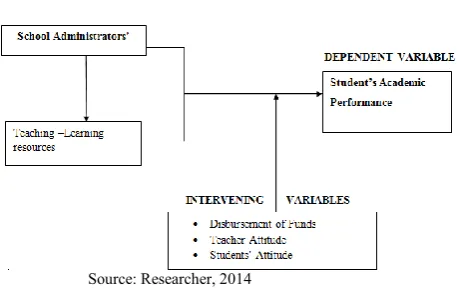
A Conceptual Framework that guided this study is according to Frankeal and Wallen (2001), a mental or visual picture that a researcher develops to show relationships between and among concepts or variables (Figure 1). In the wake of emphasis on schools’ performance in national examinations, a lot of focus is directed towards the mean grade C+ and above, leaving other areas of management unattended. Yet aspects of management among other things involve relating resources to the objectives (Paisley, 1993, as cited in Commonwealth of Learning and the Southern African Development Community of Education, 2000). The study attempted to examine how Administrators-independent variables - (Hunt and Ellis, 2004) contribute to students’ academic performance. Independent variables are characteristics that probably ‘cause’ or influence or affect outcome (Creswell, 2003), whereas dependent variables are those that depend on the independent, are the outcomes or results of the influence of the independent variable. Students’ academic performance is dependent on School Administrators’ contribution to teaching learning resources.
The independent variables were computed against outcomes such as Kenya Certificate of Secondary Education Examinations mean Scores. Contribution to Teaching / Learning resources was measured by authorization of and cash expenditure on textbooks, meals and renovation and construction of buildings. Similarly, the presence of, or absence of physical facilities such as laboratories and libraries was examined. Studies by Moses (2012), Ahawo and Simatwa (2015), Musungu, (2007), Owoeye and Yara (2011), and Ayeni (2011) indicated that Administrators’ contribution to Teaching learning resources enhanced students’ academic performance. Further, it has been indicated by Khan and Iqbal (2012), Ihuoma (2008), Doane (2008), and Ahawo, et al (2015) that Administrators’ contribution to physical facilities enhances students’ academic performance.
INDEPENDENT VARIABLES
[image:3.595.308.539.504.652.2]Source: Researcher, 2014
Figure 1. A Conceptual Framework showing School dministrators’ Contribution to Students’ Academic Performance
in Secondary Schools in Emuhaya and VihigaSub –Counties
MATERIALS AND METHODS
students. Saturated sampling technique was used to sample Principals, Deputy Principals, Chairpersons of the Boards, Heads of Departments, and Quality Assurance and Standards Officers. Questionnaire, Observation Checklists, Document Analysis Guide, Interview Schedules, were used to collect data on Administrators’ contributions. Face and content validity of research instruments were determined by experts in Educational Administration. Reliability of questionnaire was determined by piloting in 6 schools and a coefficient of 0.7 at p- value of 0.05 was set. Quantitative data was analyzed using frequency counts, means, percentages and regression analysis. Qualitative data was analyzed for content in emergent themes and sub themes.
RESULTS
Demographic Characteristics of Respondents
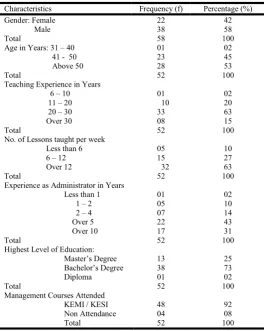
Demographic characteristics of School Administrators in Emuhaya and Vihiga Sub Counties as reported by Principals (n=52) were as follows:
[image:4.595.80.513.341.410.2]From Table 2 it can be observed that 30 (58%) of School Administrators were male whereas 22 (42%) were female, with 28 (53 %) being aged above 50 years. This implies that the gender parity had not been realized in secondary school administration, with majority retiring in the next 10 years. However, 23 (45%) of the Administrators were aged between 41 – 50 years with only 1 (2%) aged below 40 years. Further, 33 (63%) Administrators had teaching experience of between 21 – 30 years, implying that they had been in the teaching profession for some time to understand how schools run. Similarly, 10 (20%) Administrators had a teaching experience of between 11 – 20 years, while 8 (16%) have a teaching experience of over 30 years meaning that they had matured in the profession. Concerning one’s experience as an Administrator, 22 (43%) reported that they had over 5 years of experience in Leadership, while 17 (31%) had over 10 years. Only 7 (14%) had an experience of between 2 – 4 years. Job experience is defined as length of experience in a given occupation (Mac Daniel, Schmidt and Hunter, 1988). Studies have shown correlation between job experience and job performance to be positive. In the context of Rice (2010), experience matters, but more is not always better.
Table 1. Candidates who retained Grade C+ & Above, Vihiga County, 2009 – 201
Years Sub County 2009 2010 2011 2012 2013 Totals
Nos % Nos % Nos % Nos % Nos % Nos %
Vihiga Emuhaya Hamisi Sabatia
321 15 537 25 632 30 652 30
378 15 645 26 743 30 702 28
443 15 75426 829 28 900 31
433 16 840 27 847 26 957 38
529 16 759 23 862 27 1084 33
2104 15 3535 26 3913 28 4275 31
Totals 2142 100 2468 100 2926 100 3077 100 3234 100 13827 100
Source: Vihiga County Director of Education Office (2014)
Table 2. Demographic Characteristics of Secondary School Administrators
Characteristics Frequency (f) Percentage (%)
Gender: Female Male Total
Age in Years: 31 – 40 41 - 50 Above 50 Total
Teaching Experience in Years 6 – 10 11 – 20 20 – 30 Over 30 Total
No. of Lessons taught per week Less than 6 6 – 12 Over 12 Total
Experience as Administrator in Years Less than 1 1 – 2 2 – 4 Over 5 Over 10 Total
Highest Level of Education: Master’s Degree Bachelor’s Degree Diploma Total
Management Courses Attended KEMI / KESI Non Attendance Total
22 38 58 01 23 28 52
01 10
33 08 52
05 15 32
52
01 05 07 22 17 52
13 38 01 52
48 04 52
42 58 100
02 45 53 100
02 20 63 15 100
10 27 63 100
02 10 14 43 31 100
25 73 02 100
92 08 100 Source: Field Data, 2016
[image:4.595.165.430.450.782.2]The impact of experience is strongest during the first few years of principals’ leadership during which everyone wants to commit more funds on school activities, after that marginal returns diminish. As concerns the Number of lessons taught per week, 32 (63%) of the Administrators reported that they taught over 12 lessons per week. This is in keeping with TSC policy on Curriculum Instruction that ensures that School Administrators are in touch with what goes on in the classroom. Further, 15 (28%) of the Administrators indicated that they taught between 6 – 12 lessons a week, whereas 5 (10%) taught less than 6 lessons a week. In terms of the highest level of education attained, majority (73%) of Administrators had a bachelors’ degree while 13(26%) and 1 (2%) had Masters’ degree and a Diploma respectively. In so far as attendance of Management Courses was concerned, 40 (76%) School Administrators had attended Management Courses. This implies that majority of School Administrators are endowed with management skills gained from these training. Table 2 is important to this study in that it gives credibility of respondents used. Characteristics such as age show maturity levels of Administrators, Gender shows that information was obtained from both male and female. Gender of respondents indicates that leadership in schools is held by both male and females implying that both sexes are contributing to students’ academic performance. Contribution by female Administrators is mainly channeled to girls’ schools, whereas contribution made by male administrators is mainly channeled to both mixed and boys’ schools. However, women remain strongly underrepresented in Senior school headship (Fuller, 2017). Although there are changes in the number of women holding senior leadership positions in secondary schools, a man teacher has a greater chance of being a head than a woman (Coleman, 2005). Women are favored as heads in all girls’ schools. Becoming a woman head of a co-ed or boys’ schools was comparatively difficulty. With most of the School Administrators being above 41 years, it is expected that they are mature and credible enough to give trusted responses that can be relied on. Those below 41 years still have expectations in life. With 68% of the Administrators having a teaching experience of over 20 years, they understand what teachers are expected to do especially as concerns preparation of teachers’ professional records. Therefore, such Administrators are bound to be knowledgeable enough to supervise teachers under them.
It is the policy that the principal must teach a number of lessons. As noted over 90% of Administrators teach between 6 – 12 lessons a week. This enables them understand the kind of teaching learning resources needed for proper curriculum implementation. They have a taste of what goes on in the classroom and prepare, use and maintain teachers’ professional records such as Students’ Progress Records. Head teachers should have manageable teaching loads so as to deal with paperwork in the offices (Sherrington, 2013). Workloads for Principals can have detrimental effects on the quality of teaching, the support they can offer to colleagues, and their health. Overloaded principals would be incapable of effectively carrying out their core work of administration (Ingvarson, Kleinhenz, Beavis, Barwick, Carthy andWilkison, 2005). Experience is what you gain when you are in the field (Nandwah, 2011). Having been in the school system long enough both as teachers and leaders, Administrators are capable of evaluating themselves better in terms of supervising staff under them. This experience enables them to understand what motivates and demotivates teachers within these schools,
the essence of providing the necessary adequate Teaching learning resources, and ultimately proving adequate space to house these essential materials. Work experience is related to job performance (Quinones, et al. 1995).
With 73% of the Administrators having a Bachelor’s degree, it is expected that they have a deeper understanding of what needs to be acquired in so far as Curriculum teaching learning materials are concerned, how to interact with and supervise teachers for the sake of enhancing students’ academic performance. Higher education plays an important lesson in enhancing personal achievement in one’s career. Higher college graduates contribute more than others to social wellbeing in terms of efficiency (Baum and Payer, 2005). A knowledgeable, honest and satisfied teacher will command respect and produce hard working, efficient and honest citizens (Shah, 2007). With knowledge acquired in school management, Administrators are expected to buy the right Instructional materials for curriculum implementation, build classrooms and other physical facilities to provide space for students, do classroom visitations to monitor, motivate and inspire teachers to enhance students’ academic performance. KESI was a product of the Mungai Report of 1978. Currently KESI has been transformed into KEMI which offers In-service training to Principals, Deputy Principals and Heads of Department in schools, but does not prepare teachers aspiring to be Principals. Courses are offered in 2 weeks (April, August and December) which seems to be too short (Nandwah, 2011).
School Data
This raises concern given that School Administrators are the custodians of school resources bestowed upon them to utilize in the enhancement of students’ academic performance. The outcome of stakeholders’ investment in education is evidenced in students’ academic performance.
[image:6.595.207.392.83.175.2]Poor results often cast aspersion on the kind of Administration in place, hence the need for this study to find out the efforts of Administrators’ contribution in enhancing students’ academic performance.
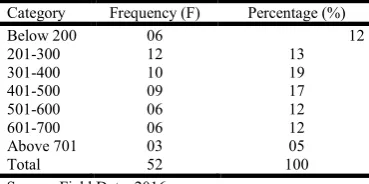
Table 3. Students’ Population
Category Frequency (F) Percentage (%)
Below 200 06 12
201-300 12 13
301-400 10 19
401-500 09 17
501-600 06 12
601-700 06 12
Above 701 03 05
Total 52 100
[image:6.595.169.431.212.303.2]Source: Field Data, 2016
Table 4. School Mean Scores of Students’ Academic Performance in K.C.S.E 2016
School’s Performance Index Frequency (f) Percentage (%) 1.00-2.00
2.01-3.00 3.01-4.00 4.01-5.0 5.01-6.00 6.01-7.00 7.01-8.00 8.01-9.00
00 11 25 08 04 03 00 01
[image:6.595.76.530.341.441.2]00 21 48 15 08 06 00 02 Source: Emuhaya and Vihiga Sub County Offices, 2017
Table 5. Administrators’ Expenditure on Teaching Learning Resources, From 2013 – 2016
Administrators’ Contribution to Teaching /Learning Resources (Kshs in Millions –value addition) Frequency (f) Percentage (%) Less than1.5
1.51 – 3.00 3.01 – 4.50 4.51 – 6.00 6.01 – 7.50 7.51 – 9.00 9.01 – 10.50 10.51 – 12.00 T0TALS
00 11 09 09 07 06 08 02 52
00 21 17 17 13 12 15 04 99 Source: Field Data, 2017
[image:6.595.61.539.501.535.2]Key: Kshs – Kenya shillings
Table 6. Regression Analysis of Administrators’ Contribution to Teaching Learning Resources in the enhancement of students’ academic performance (n = 52)
Model R R Square Adjusted R
Square
Std. Error of the Estimate
Change Statistics
R Square Change F Change df1 df2 Sig. F Change
1 .597 .356 .343 1.01233 .356 27.634 1 50 .000
Table 7. ANOVA of Administrators’ Contribution to Teaching / Learning Resources in the enhancement of students’ academic performance
Model Sum of Squares Df Mean Square F Sig.
1 Regression 28.319 1 28.319 27.634 .000
Residual 51.240 50 1.025
Total 79.560 51
Table 8. Linear Regression Analysis of Administrators’ contribution to Teaching Learning Resources in the enhancement of Students’ Academic performance (n = 52)
Model Unstandardized Coefficients Standardized Coefficients T Sig.
B Std. Error Beta
1 (Constant) -2.485 1.219 -2.039 .047
Teacher learning resources (value addition) 1.803 .343 .597 5.257 .000
Regression Equation obtained from Table 4.15 is: Y =β0 + β1X1 + ∑
Students’ Academic Performance = -2.485 + 1.803x.
Research Question
The research question responded to was: What is the contribution of School Administrators to Teaching Learning Resources in the enhancement of students’ academic performance? To confirm the Contribution of School Administrators’ to Teaching Learning Resources, Administrators’ ratings on actual expenditure on Laboratory Chemicals and Equipment, Textbooks and Exercise Books, Stationery, Maps, Charts and other teaching Aids were computed. The results were as shown in Table 5. From Table 5 it can be seen that 11 (21%) Administrators contributed between 1.51 – 3.00 million Kenya Shillings towards expenditure on Teaching/ Learning Resources namely Text books, Laboratory Chemicals and Equipment among others. Further, 9 (17%) Administrators contributed between 3.01 – 4.50 million on Teaching Learning Resources with a similar number 9 (17%) spending between 4.51 – 6.00 million on the same. While 7(13%) Administrators committed and spent between 7.51 – 9.00 millions on purchase of Teaching Learning Resources, another 8 (15%) Administrators contributed between 9.01- 10.50 million Kenya Shillings towards the same. Only 2 (4%) School Administrators spent between 10.52 – 12.00 million on Teaching Learning Aids. To establish the contribution of School Administrators to Teaching Learning Resources in the enhancement of Students’ Academic performance, Administrators ‘contributions to teaching –learning resources were regressed against students’ performance.
The results were as shown in Table 6. From Table 6 it can be noted that there was a strong, positive and significant relationship between Administrators’ contribution to teaching learning resources and students’ academic performance (r = .597, p < 0.05).Further, it can be noted that Administrators’ contribution to teaching learning resources accounted for 34.3% of students’ academic performance as signified by the Adjusted R2 of .343. This means that when Administrators purchased textbooks, laboratory chemicals and equipment among other teaching learning resources, teachers get motivated to use these resources to improve performance. Administrators’ contribution is adding value as signified by adjusted R square .343. This means that Administrators’ Contribution had an influence on Students’ Academic Performance. Administrators’ efforts of authorizing expenditure and ensuring that teaching learning resources are provided for curriculum implementation has a positive impact on Students’ Academic performance. This contribution supports earlier survey which showed that the 2 Sub Counties contributed 41% candidates out of the total University intake of 13847 candidates within Vihiga County. This could be attributed to Administrators’ contribution to teaching learning resources. To determine the Administrators’ Contribution to Teaching Learning Resources was a significant predictor of Students’ Academic Performance, ANOVA was computed and the results as shown in Table 7.
From Table 7 it can be observed that Administrators’ contribution to Teaching Learning resources was a statistically significant predictor of Students’ Academic performance, F(1, 50) = 27.634, p = .000, R2 = .356. Conversely, Document Analysis on school expenditure on textbooks, exercise books, and stationery revealed that there was a positive weak relationship between the Principals’ contribution to textbooks and the actual amount spent on them (r=074, N=52 P>.05).
Principals’ Contribution to actual expenditure on Laboratory Chemicals and Equipment was also a positive weak relationship (r=.208, N=52 P = .05). Principals contribution to actual expenditure on Teaching Learning Aids was also a positive weak relationship (r = .226, N = 52, p> .05). The study further sought to establish the actual contribution of Administrators’ to teaching –learning resources. A linear regression Analysis was computed as shown in Table 8. It can be observed that Administrators’ contribution to Teaching / Learning Resources influenced students’ academic performance. For every one unit increase in Administrators’ contribution to teaching learning resources, it increased students’ academic performance by 1.803 units as signified by the coefficient of 1.803. Any teaching learning aids, laboratory chemicals and equipment, text books and exercise books that the Administrators procured, it increased students’ academic performance by 1.803 units.
DISCUSSION
The variation in expenditure can be explained by the varied amount of capitation received from the Ministry of Education based on students’ population in the individual schools. Free Secondary Education Fund commits Kshs.3902 per student per year for purchase of Exercise books among other Teaching Learning Resources. Therefore, schools with high population are bound to receive more money to spend. This is further confirmed by Moses (2012) who recommended that more learning resources be provided in the schools in Tarabu State, Nigeria since they contributed significantly to students’ academic achievement in science subjects. Moses (2012) study focused on the learning resources provision in the 3 science subjects, and he did not assess the contribution of School Administrators in so far as the amount of cash authorized and spent on these learning resources. This finding agrees with Musau (2015) study on School based factors influencing students’ performance in Kenya Certificate of Secondary Education Examinations in Masinga Sub – County, Machakos, Kenya. In his study, which focused on the provision of Teaching Learning materials, Musau (2015) concluded that Principals provided teachers with text books and other materials in order to ensure optimum curriculum delivery hence enhance learner performance.
(2016) confined his study on Geography as a subject. This study encompassed all teaching learning resources namely maps, charts, textbooks and mathematical models used in all subjects in the schools. As supported by Murithi (2015), Principals’ Instructional Leadership involves providing text books and other teaching learning materials because good performance is attributed to adequacy of teaching learning resources. In his study, 60% of the Principals reported that they provided Teaching Learning Resources, which as pointed out by Adewale (2014b) as cited in Murithi (2015), that teaching and learning materials are determinants of quality education. Further, Oguntunse, et al (2013), concluded that availability and adequacy of teaching learning resources promoted the effectiveness of schools as these are the basic things that can trigger good academic performance of students. The study which was on the empirical nexus between teaching learning resources and academic performance in mathematics among Pre- - University students in the Ile-Ife South –West, Nigeria, recommended that Government and Private Institutions to provide enough teaching learning aids to students’ in order to enhance academic performance. This is being done by the Government of Kenya as evidenced through Free Secondary Education Fund where purchase of Teaching learning resources is put under Tuition Fund. For the year 2018 the Ministry of Education has committed Kenya Shillings 4702 per student towards the purchase of teaching learning materials and examinations (Ministry of Education, 2017). Moreover, some schools receive teaching learning donated by well-wishers which was not factored in this study. While the Government of Kenya is providing funds for the procurement of Teaching Learning resources, it is not clear whether Administrators are using the same cash prudently to purchase the same. The present study has found out that contribution by Administrators was signified by the R of 59.7.
Teaching learning resources are essential in the provision of quality education at all levels of education worldwide. Examples of such resources in the study included; textbooks, exercise books, laboratory chemicals and equipment, stationery and teaching learning aids. Public expenditure on education in most countries is aimed at achieving quality as one of the 6 Education For All Goals (UNESCO, 2005). In this report, provision of more textbooks, reduction in class size, among other factors have positive impact on learner achievement. The provision of quality education and training to all Kenyans is fundamental to the success of the government overall strategy (Republic of Kenya, 2012). The principal’s involvement in the provision of teaching learning materials such as maps, atlases, cookers and sewing machines was confirmed by Musungu (2007). However, Musungu (2007) study did not examine how much effort in terms of cash expenditure the principals put in to acquire these resources, a focus of this study. Textbooks provide the first reading experience to many learners and can be used as teaching aid on concrete experiences to promote child centered learning (Odhiambo, 2000 as cited in Olendo, 2008). Adequate textbooks and tuition equipment contributed 15% to students’ results in Kenya Certificate of Secondary Education Examinations. However, Olendo (2008) study did not verify from the principals the total amount of school fund committed to and spent on these text books and equipment as it is the case in this study. In a study in the Philippines by Huneman (1984) in Eshiwani (1993) to assess the impact of textbooks on students’ performance, it was concluded that an increase in the number of textbooks had an important effect on students’ performance all over the Philippines. A study in
Thailand also showed that textbooks were positively related to achievement (Fuller, 2006). Therefore, the Ministry of Education underscores the importance of textbooks by putting their purchase under tuition fund (Free Secondary Education) to be used by Administrators. Textbooks are useful in further reading ahead to encourage completion of syllabus. In addition, Hallack (1990) as cited in Adoyo (2013) observed that textbooks are the instructional device par excellence and are central to teaching. In Less Developed Countries they often constitute 85% of recurrent expenditure of teaching materials. Students spend from 70 – 95% of classroom time using textbooks and teachers base more than 70% of their instructional decisions on them (Buhere, 2016). Text books are central to schooling at all levels. They provide the only source of information for students as well as the course of the study for the subject (Owoeye andYara, 2011).
Students note down what is learnt in exercise books. In a study by Ahawo (2010), 60% of Heads of Department maintained that head teachers were not providing enough exercise books and sometimes students were forced to buy especially graph books. In this study it was observed from Focus Group Discussion with students that new students were advised in their joining instructions to come with exercise books which were then renewed upon being filled up. During the years 2013 – 2016 Administrators in Emuhaya and Vihiga Sub- Counties spend on average KSh.3.07 Million to purchase Textbooks and Exercise books. Lack of adequate laboratory chemicals and equipment negates academic performance since students did not do practicals and were only meeting some apparatus during the national exams. In one study, 80% of Heads of Department reported that schools lacked most lab equipment, chemicals and specimen attributing this shortage to their heads who they noted were reluctant to purchase the required facilities (Ahawo, 2010). Ahawo recommended that heads should prioritize the provision of laboratory equipment since they play a vital role in the performance of learners in Kenya Certificate of Secondary Education Examinations especially in science subjects. Ahawo (2010) study did not examine the efforts made by the Administrators to ensure that they authorized and spent cash on the purchase of these resources, which was achieved in the present study. During the years 2013 – 2016 Administrators in Emuhaya and Vihiga Sub- Counties spent on average KShs.1.66 Million to purchase Laboratory Chemicals and Equipment. Teaching learning aids allow students to get the correct concepts of the topic being taught. Examples of teaching aids under this study include maps, charts and mathematical models. Stationery such as photocopying papers allowed improved performance because with these papers students are exposed to many examinations. However, the study found out from Focus Group Discussion with students that students were encouraged to carry their own realm of photocopying papers yearly to boost the school supply.
computers and printers. Principals’ contribution to these resources was high with a mean rating of 4.15. This contribution has its origin in prudent management of the resources bestowed to them. The mean ratings of the principals were significantly different from that of the teachers, t (1776) = 2.355, p = 0.19 meaning that the mean rating of principals was higher (M = 3.00, sd = 1.669), than the mean ratings of the teachers, (M = 2.83, sd = 1.469). However, Ahawo and Simatwa (2015) did not explore the contribution of the Principals in so far as authorizing expenditure on and ensuring that Teaching Learning Resources are actually bought for use to enhance learner performance. The study focused on the contribution of stakeholders namely the principals among others, in the enhancement of girls’ academic achievement. This study interviewed Administrators on their budgetary allocation to and actual expenditure on Teaching Learning Resources. It found out that on average Administrators in the 2 Sub Counties committed and spent Kenya Shillings 4.74 Million on the purchase of Teaching Learning Resources between years 2013 – 2016. In the opinion of Savasci and Tomul (2013) while studying the relationship between Educational resources of schools and academic achievement in Elementary Schools in Burda Province in Turkey, concluded that classroom size does not have an effect on academic achievement. Rather presence of Laboratory Chemicals and Equipment, Teaching Materials, Library Books among other resources did. Presence of the resources is not enough. They could have been donated.
The study did not communicate how much in terms of expenditures the Principals incurred in order to obtain these resources. In agreement, Ong’amo, Ondigi and Omariba (2012), in their study on effect of utilization of Biology teaching and learning resources on students’ academic performance in secondary schools in Siaya District, Kenya, recommended that basic teaching resources should be made available by the head teachers. They considered that this is not being done as reported by 104 (90%) of the head teachers in the study when asked about the adequacy level of teaching learning resources in their schools. The study focused on Biology subject, making it narrow and limited in so far provision of Teaching Learning Resources are concerned. Although the Government has considered giving Special Funds such as Laboratory Equipment Fund, for purchase of basic teaching learning resources, not all schools are being considered. Interview findings with the Heads of Department revealed Principals contribute enormously to teaching learning resources in secondary schools. Heads of Department explained thus, “Principals reach out to stakeholders namely sponsors, donors, well-wishers and politicians to solicit for text books, laboratory chemicals and equipment, computers, revision materials and other teaching aids.” This assertion was supported by one Sub County Quality Assurance Standards Officer who said: “we expect Principals to use Tuition Fund given by the Ministry of Education to purchase textbooks, exercise books, writing materials, and teaching learning aids. As for course books we advise them to stick to one publisher” he added. Deputy Principals also weighed in thus: “our Principals ensure that they buy revision materials such as examination past papers, maps, charts, among others, when attending annual principals’ workshops.” Chairpersons of Boards of Management also stated that they make personal contribution in form of either computers, textbooks, or photocopy papers. “Yes we are normally invited for school functions such as ‘Book Harvest’ and are encouraged to donate
any teaching learning materials to support what is budgeted for. ‘Cases abound where Principals solicit for Laboratory Equipment Fund from the Ministry of Education in order to stock their laboratories.
However, Focus Group Discussion with Students reported differently. Students said thus: ‘we buy exercise books, class readers, set books, and realms of photocopy papers before we get admitted to schools.” Exercise books are replaced when they get filled up, but initially a student must buy them. Conversely, evidence from Document Analysis Guide showed that between years 2013 and 2016 School Administrators in Emuhaya and Vihiga Sub – Counties contributed on average Kenya Shillings 5.82 million on the purchase of teaching learning resources, with text and exercise books taking 3.07 Million Kenya Shillings. Contribution of Administrators to teaching learning resources was not by chance as it was evidenced by the 1: 3 text book to student ratio seen in the libraries, and with the ‘Book harvest’ functions the Administrators initiated in schools. Available textbooks had rubber stamps bearing the names and addresses of the donors meaning that Administrators had made efforts of finding assistance from well-wishers with regard to donation of teaching learning resources. This finding agreed with the findings of other researchers who found out that Administrators’ contributions to Teaching Learning Resources enhances students’ Academic Performance. This study further went ahead to quantify the actual contribution of Administrators to teaching learning resources in the enhancement of students’ academic performance.
Conclusion
Administrators’ contribution to Teaching Learning Resources was significant and enhanced students’ academic performance.
Recommendations
The Ministry of Education should consider offering all secondary schools Laboratory Infrastructure Funds to ensure all schools procure laboratory equipment and chemicals by extension. Free Secondary Tuition Funds should be increased to schools to enable Administrators purchase Teaching learning Resources. A follow up exercise should be initiated to check school inventory records to ascertain if teaching learning resources are actually being purchased and used.
REFERENCES
Ahawo, H.A. and Simatwa, E.M.W. 2015. Contribution of Stakeholders to Provision of Teaching /Learning Resources in enhancement of girls’ academic achievement in Kenya: A Case Study of Siaya County. Greener Journal of
Educational Research, Vol. 5(4): 176-198, August 2015.
Ahawo, H.A., Simatwa, E.M.W. and Ayieko, J.Y. 2015. Stakeholders’ Contribution to Infrastructure Development in Enhancement of Girls Academic Achievement in Kenya. A Case Study of Siaya County, Kenya. Greener Journals
of Educational Research. ISSN: 2276-7789 ICV: 6.05 Vol.
5 (3): 098-119, July 2015.
/T-Anth//Auth-13-0-000-11-Abst.pdf/Auth-13-1-033-11-630-Ekundayo%20H- T/Anth-Ekundayo % 20HT.Tt.pdf.
Ajileye, E.O. and Ikegwuru, B. 2011. Financial resource management capacity of public secondary schools’ administration in Ondo State, Nigeria. Journal of
Education and Social Research Vol.1 (4).
Akyeampong, A. (2003). Review of Secondary Education in Ghana. Accra: World Bank.
Amphiah, J.G., Kwaah, C., Yiboe, K.S. and Ababia, B.T. 2013. Improving quality basic education in Ghana: Prospects and challenges of the school performance improvement plan. World Bank 2004 Report for Ghana. World Bank.
Arne, D. 2009. If our 95000 schools each had a great principal, this thing would take care of itself. Education leadership:
An agenda for school improvement. Washington D.C: The
Wallace Foundation.
Asiyai, R. 2012. Assessing school facilities in public schools in Delta State, Nigeria. African Research Review. Retrieved on 25/6/2013 from www.ujul.info/index.pup/a/frrev/article /view/77054.
Ayeni, J.A. 2011. An Assessment of Principals’ supervisory roles for quality assurance in secondary schools in Ondo State: Nigeria. World Journal of Education Vol. 2 No. 1. Ayeni, J.A. 2012. Improving school community partnership for
sustainable
Barasa, C. 2015. Influence of Teacher motivational strategies in students’ improved academic performance in Day Secondary Schools. A case of Trans Nzoia West District, Kenya. University of Nairobi Repository.
Bash, J. et al., 1990. Effective Schools. From theory to Practice. An intervention model and its outcomes.
Jerusalem. New publishing Ltd. High Reliability school. Bennell, P. and Ntagaramba, J. 2008. Teacher motivation and
incentives in Rwanda: A situational analysis and
recommended priority actions. Retrieved on 22.8.2012
from htpp//:www.rencp.org/wp-content/uploads/20.10/06/ Teacher- Motivation-and-Incentives-in Rwanda-08-doc. Beynon, S. 1997. Physical facilities for education. What
planners need to know. Paris. UNESCO. International
Institute for Educational Planning,
Bolt, L. 2004.Targeting quality education in Kenya in the face of univerzaling access. Nairobi: NORRAG News. Kenyatta University, p.49-50
Booker, I. 2008. Measuring school effectiveness in Memphis. Mathematical policy Research Inc. 600 Maryland AV, SW Suite 550 Washington D.C.
Borg, M.P. and Gall, M. 2007. Educational research: An
introduction. 5thEdition. New York; Longman.
Bruggencate, G. 2009. Enterprising school management leads to more effective schools. Enterprising school/management leads more-effective schools. Retrieved on 15/6/03/11 from http: // esciencenews.cou/articles/2009/03/11.
Buhere, K. (2016). Why textbooks matter in education. The
Standard, Wednesday, March 9th p. 14 Nairobi: The
Standard Group Centre.
Chabari, E.B. 2010. Challenges facing implementation of free secondary education in public secondary schools in Kangundo District, Kenya. A master of education thesis. Chuka University College.
Chelimo, P.C. 2010. The effectiveness of boards of governors in curriculum implementation in secondary schools in Keiyo District, Kenya. Thesis submitted in partial fulfillment of the requirements for the award of Master of
Philosophy degree in educational management. School of Education. Moi University.
Cohen, L. and Manion, L. 1997. Research methods. Heads of
Department in education. London U.K: Croom Helm Ltd.
Commonwealth of Learning and the Southern African Development Community Ministries of Education 2000.
Financial management in schools, Retrieved on 20/7/2012
from http;//people learn homestead.com/M.Ed. Home/Management/Financial- Management-In-Schools- pdf.
Doane, I. 2008. Relationship between school facilities and students’ academic achievement. A master’s research project presented to the Faculty of the College of Education. Ohio University.
Dodd, A. 2006. Investigating the effective use of resources in secondary schools. Research. Report 799 November. Department of Education and skills.
Ekundayo, H.T. 2010b. Administering secondary schools in Nigeria for quality output in the 21stCentury: The principals’ challenge. European Journal of Educational
Studies.Vol.2 (3) 2010. Ozean Publication
Ekundayo, H.T. 2010a. Principals’ Leadership behavior as a determinant of effectiveness of Secondary schools in Nigeria. European Journal of Educational Studies, Vol.2
(1) 2010 Ozean Publication.
Eshiwani, G. 1993. Education in Kenya since Independence. Nairobi: EAEP.
Fraenkel, J.R. and Wallen, N.E. 2000. How to design and
evaluate research in education. San Francisco: The
McGraw Hill Companies, Inc.
Francis, B. 2012. Enhancing quality education in Nigeria Unity schools through effective supervision in a changing environment. Journal of Education and Vocational
Research.Vol.3 No.10 p.332.
Fuller, B. 2006. Raising School Quality in developing countries. What investments boost learning. Review of
Educational Research. Vol. 57, 3:255-92.World Bank.
Washington DC: USA.
Gall, M.D. Borg, W. and Gall, J.P. 1996. Educational
research: An Introduction. New York: Longman
Publishers.
Gatonye, G. 2014. Shock of three million pupils repeating classes yearly. The Standard January, 5th2014 p. 12. Nairobi: The Standard Group Centre.
Geiger, P.E. 2002. Deferred school maintenance creates natural crisis. School Business Affairs Vol. 68(1): 43.
Grima, G. 2008. What is quality education?
TIMESOFMALTA.COM
Gupta, M.A., and Vohra, N. 2010. Measuring effectiveness of schools in India: A multiple stakeholder
framework.e-Journal of Organizational learning aid leadership Vol. 8 No. 2.
Hall, P.A. 2005. Voices from the field. The Principal’s presence and supervision to improve teaching. Leadership
for learning.SDL Letter Vol. 17 No. 2..
Ihuoma, P.A. 2008. The need for effective facility management in schools in Nigeria. New York Science Journal, Vol. 1(2): 10-21 Issue 1554-0200.
Ingvarson, L; Kleinhenz, E.; Beavis, A; Barwick, H; Carthy,I., andWilkison, J. 2005. Secondary school teacher workload study report. Australian Council for Educational Research. Javeed, S. M., Majoka, S., andIqbal, M. 2011. Principals’
Pakistan. International Journal of Contemporary Research
in Business Vol. 3(1):10-39.
Jins, V. 2011. Can you measure management effectiveness?
Share market school Become a smart investor.
Kathuri, N.J., and Pals, D.A. 1993. Introduction to educational
research. Education Media Centre. Njoro: Egerton
University Press.
Khan, P., andIqbal, M. 2012, July. Role of physical facilities in teaching learning process. Interdisciplinary Journal of
Contemporary Research in Business. Vol. 4 No. 3
Pakistan: Sarhas University of Science and Information Technology. Peshawa, Khyber Pukhtankhwa.
King, B.W. 2006. Relationship of principal’s leadership behavior to academic achievement and school improvement efforts. Retrieved on 26/7/2012 from http; //drum;ib;und/edu/bitstream/1903/3836/1/um.umd. 681.pdf Kiriyama, I. Maphoca and Maperenganya B. 2012. The
influence of learners participation in co-curricular activities on academic performance: An assessment of
educators perspectives. Kamla Raj.
Kothari, C.R. 1993. Research Methodology: Methods. Heads
of Department and techniques. Bangladesh. India. Wishwa
Prakudhau.
Koul, L. 1988. Methodology of educational research. SHIMLA: Vikas Publishing House PVT Ltd.
Lackney, J.A. and Picus, L.O. 2012. School facilities: Overview maintenance and modernization of. Retrieved on 9/11/2012 from http://education.stateuniversity.com p. 2394 /school. facilities html.
Lin, C.H. 1999. A study of principals leadership style and school effectiveness in selected public secondary schools in New Jersey. Dissertation submitted in partial fulfillment of the requirements for the degree of Doctor of Education. Seton Hall University.
Louise, K. S., Leithwood, K. Walstrom, K.L. and Anderson, S. 2010. Learning from leadership: Investigating links to improved student learning. Education Leadership: An
agenda for school improvement. Washington D.C: The
Wallace Foundation
Luthans, F. 1998. Successful vs effective real managers. Lincoln: University of Nebraska: Academy of management
executives Vol. 2(2):127-132.
Lydia, M.L. and Nasongo, J.W. 2009. Role of the head teacher in academic achievement of secondary schools in Vihiga District. Current Research Journal of Social Sciences 1(3) 88- 92 2009.Maxwell Scientific Organization.
MacGowen, R.S. 2007, Dec. The impact of school facilities on students’ achievement attendance behavior, completion rate and teacher turnover in selected Texas High Schools. A dissertation submitted to the office of Graduate studies of Texas in partial fulfillment of requirement for the degree of Doctor of philosophy.
Macharia M. W. 2012. School based factors influencing students’ performance in Kenya Certificate of Secondary Education in public Secondary Schools in Lari District Kenya. University of Nairobi: Department of Educational Administration and planning.
Macharia, D.M. 2012. Factors influencing the implementation of safety standards in secondary schools in LimuruDistrict, Kiambu County, Kenya. A project report submitted in partial fulfillment of the requirements for the award of Masters of Arts in Project Planning and Management of the University of Nairobi.
Maina, S.B. 2014.Why syllabus is set for change. The Daily
Nation, Tuesday March, 18th 2014 p. 9 Nairobi: Nation
Media Group Limited.
Masika, B.W. and Simatwa, E.M.W. 2010. Contribution of the Quaker Church to management of public schools in Bungoma East District, Kenya. Analytical Assessment.
International Research Journal, Vol. 1(11): 624-636.
Maxfield, R.C. 2009. The empowering principal: Leadership behaviors needed by effective principals as identified by emerging leaders and principals. International Journal of
Teacher Leadership, Vol.2 (2. 1934 -9726.
Mbiti, D.M. 1974. Foundations of school administration. Nairobi: Oxford University Press.
McDaniel M.A. Schmidt, F.I.and Hunter J.E. 1988, Job experience correlates of Job performance. Journal of
Applied Psychology, Vol. 73. No. 22, 327 – 350.
Michira, M. 2014. Alarm as millions waste away after Kenya Certificate of Secondary Education Examinations. exams.
The Standard, Thursday, March 6th 2014.p6.Nairobi: The
Standard Group Centre.
Ministry of Education ST. 2004. Report on the Task Force on implementation of the primary education. Nairobi. Government Printer.
Ministry of Education, 2017. Guidelines on Implementation of Free Day Secondary school Education Capitation to Schools. Author
Moses, J.A.N. 2012. Relationship between learning resources and students’ academic achievement in science subjects in Tarabu State Senior Schools. African Journal Online, Vol.
20. No. 1
Motsamai, J.M., Jacobs, L. andde West, C. 2011. Policy and practice: Financial management in schools in the
Mafeteng District of Lesotho. Bloemfontein, South Africa
9300: KamlaRaj.
Mugenda, M.O. and Mugenda, G.A. 2003. Research methods .Heads of Department: Qualitative and Quantitative
Approaches. Nairobi: Acts Press.
Mulkeen, A. 2010. Teachers in Anglophone Africa: Issues in
teacher supply, training and management. The World
Bank, Washington D.C. The International Bank for Reconstruction and Development.
Munguti, S. (2016).Learning Resources and Students’ academic performance in Geography in Makueni County, Kenya. Unpublished Doctor of Philosophy. – Curriculum Studies. University of Nairobi.
Musau, J.K 2015. School based factors influencing Students’ performance at KCSE in Masinga Sub County, Machakos, Kenya. Unpublished master of education research project, University of Nairobi Repository.
Musungu, L.L. 2007. Role of the head teachers in academic achievement in secondary schools in Vihiga District, Kenya. Unpublished Master of Education Thesis in Educational Administration. Maseno University.
Mwaura, M.M 2012. Impact of church sponsorship on the management of secondary schools in Thika West and Gatundu North Districts in Kiambu County, Kenyatta University Institutional Repository. Retrieved on 20/8/2012 from http://ir.library.ku.ac-ke/ir/haudle/123456789/3648. Nandwah, I. 2011. Preparation and development of public
secondary school principals in Kenya. The Aga Khan University Institute of Education Development Tanzania:
International Journal of Humanities and Social Science Vol. 1 No. 9