UNIVERSITI TEKNIKAL MALAYSIA MELAKA
PRELIMINARY STUDY ON ELASTIC PROFILE OF MIX
COCONUT FIBRE AND POLYESTER RESIN AS COMPOSITE
FIBRE SUBSTITUTION
This report submitted in accordance with requirement of the Universiti Teknikal Malaysia Melaka (UTeM) for the Bachelor of Mechanical Engineering Technology
(Maintenance Technology) With Honours
by
NOOR HAYA BT IBRAHIM
B071310360
910908025930
DECLARATION
I hereby, declared this report entitled ―Preliminary Study on Elastic Profile of Mix Coconut Fibre and Polyester Resin as Composite Fibre Substitute‖ is the results of my
own research except as cited in references.
Signature :……….
Author’s Name : NOOR HAYA BT IBRAHIM
APPROVAL
This report is submitted to the Faculty of Engineering Technology of UTeM as a partial fulfillment of the requirements for Bachelor of Mechanical Engineering Technology (Maintenance Technology) With Honours. The member of the supervisory is as follow:
i
ABSTRAK
ii
ABSTRACT
iii
DEDICATION
iv
ACKNOWLEDGEMENT
v
TABLE OF CONTENT
PAGE
ABSTRAK i
ABSTRACT ii
DEDICATION iii
ACKNOWLEDGEMENT iv
TABLE OF CONTENT v-vii
LIST OF TABLES vii-viii
LIST OF FIGURES ix-x
LIST ABBREVIATIONS, SYMBOLS AND NOMENCLATURES xi
CHAPTER 1: INTRODUCTION
1.1 Natural Fibre 1-2
1.2 Problem Statement 2-3
1.3 Objective 4
1.4 Scopes 4
CHAPTER 2: LITERATURE REVIEW
2.1 Introduction 5
2.2 Comparison Natural Fibre and Synthetic Fibre 5-7
2.3 Natural Fibre Classification 8
2.3.1 Animal Fibre 8
2.3.2 Cellulose 9-13
2.3.3 Mineral 13-14
2.4 Coconut Fibre 14-18
2.5 Polyester Resin 19-20
2.6 Modulus Elasticity 21-24
vi
2.7.1 Sample Simulation 25
2.8 Molding 25-26
2.8.1 Lay-Up Molding Technique 26
CHAPTER 3: METHODOLOGY
3.1 Introduction 27
3.2 Flow Chart 27-28
3.3 Material Selection 30
3.3.1 Fibre and Resin Preparation 30-33
3.3.2 Molding Preparation 34-35
3.4 Sample Composition 35-37
3.4.1 Percentage and Weight Calculation 37-38
3.4.2 Sample Preparation 38-41
3.5 Testing 42-43
3.6 Failure Code Based on ASTM D3039 43-44
3.6.1 Modulus of Elasticity 44-46
CHAPTER 4: RESULT AND DISCUSSION
4.0 Introduction 47
4.1 Effect of composition of coconut fibre reinforced by 47-48 Polyester resin on the sample that fabricated
4.1.1 Effected of curing time on sample fabrication 48-51 4.1.2 Effect of fabricated mold on sample fabrication 51-53 4.2 Effect of the modulus of elasticity on different composition 53-54
Of coconut fibre reinforced with polyester resin
4.2.1 Analysis of modulus elasticity of long coconut fibre 55-58 Reinforced by polyester resin
4.2.2 Analysis of modulus elasticity of short coconut fibre 58-62 Reinforced by polyester resin
vii CHAPTER 5: CONCLUSION & RECOMMENDATION
5.0 Conclusion 64-65
5.1 Recommendation 66
RREFERENCES 67-76
APPENDICES
Appendix A 77-81
viii
LIST OF TABLES
TABLE TITLE PAGE
2.1 Mechanical Properties of Coconut Fibre 15
(Bujang et al 2007)
2.2 Application of Coconut Fibre with Different 17-18 Researcher (Ali.M.,2010)
2.4 Polyester properties (Hamead., A et al 2014) 20
3.1 Percentage of the Sample 36-37
4.1 Average curing time 49
ix
LIST OF FIGURE
FIGURE TITLE PAGE
2.1 Sisal Leaf (Oladele et al 2014) 10
2.2 Wood Fibre (Mahzabin.M.S et al 2013) 11
2.3 Mechanical Mechanical processing for 12
Bamboo Fibre
Sources: (http://www.fibre2fashion.com/)
2.4 Two type of producing coconut fibre 13
(S.N.Monteiro et al, 2005)
2.5 Type of Asbestos fibre 14
(Borre & Deboosere, 2016)
2.6 Coconut, coconut tree and coconut fibre 16
(Ali. M., 2010)
2.7 Longitudinal and cross-section of a Fibre cell 16 (Ali. M., 2010)
2.8 Elongation of the sample 22
2.9 Example graph stress-strain 23
2.10 Hand Lay-Up Technique (Pothamsetty., 2016) 26
3.1 General Flow Chart 28
3.2 Arrangement of Polyester Resin and Coconut 31 Fibre by layer in one composition sample
3.3 Outer husk coconut and coconut fibre 31
3.4 Long Fibre 32
3.6 Short Fibre 32
3.7 Different type of fibre orientation 33
(Ashik.K.P et al. 2015)
x
3.9 Isometric view of mold 34
3.10 Mold after Fabrication 35
3.11 Example 100% polyester resin sample 37
3.12 Example of 100% coconut fibre 38
3.13 Simulation test by using solid work software 39
3.14 Mold release wax 40
3.15 Lay-up the resin and fibre layer by layer 40
3.16 Top layer of the mold 41
3.17 Sample after 8 hour cured 41
3.18 Sample clamp with fixture 42
3.19 Universal testing machine 43
3.20 Tensile test failure according ASTM D3039 44
3.21 Failure code 44
4.1 Sample curing time for 100% polyester 49 4.2 Graph of 65% composition completely cure 51 and not completely cure
4.3 Sink mark sample and perfect sample 52 4.4 Simulation view for sink mark on the sample 53 4.5 Sample calculation Young Modulus from slope 54 4.6 Bar graph the average modulus of elasticity for 56 long fibre sample
4.7 Graph 45% coconut fibre in higher modulus of 58 elasticity
4.8 Bar graph the average modulus of elasticity for 60 short fibre sample
4.9 Graph 40% coconut fibre in higher modulus of 61 elasticity
xi
LIST ABBREVIATIONS, SYMBOLS AND
NOMENCLATURES
GPa - Gigapascal
MPa - Megpascal
g/cm3 - Gram Per Cubic Meter
ASTM - American Society for Testing and Material PET - Polyethylene Terephthalate
μm - Micrometer
mm - Millimeter
kg/m3 - Kilogram per meter cube PEEK - Polyetheretherketone PPS - Polyphenylene Sulfone
E - Modulus Young
- Stress
F - Force
A - Cross sectional Area
- Strain
∆ - Change of Length
- Length
LGM - Lateral Gage Middle AGM - Angle Gage Middle XGM - Multimode Gage Middle LIT - Lateral inside Grip/Tab Top GAT - Gage at Grip Top
LAT - Lateral at Grip Top
MEKP - Methyl-ethyl-ketone peroxide
1
CHAPTER 1
INTRODUCTION
1.1 Natural fibre
Natural fibre is fibre that produced mostly by plant and animal. Basically, natural fibre produced in a filament form and will be spun produce a rope or thread. According to Sapthagiri et, al (2010) stated that a fibre is a material which produces in a long filament within range 10 microns. The utilization of the natural fibre has many advantages toward the product that produce in industrial and also an environment. Besides that, natural fibre is easily available and easy to obtain less harmful to nature and also the material that can renewable. According to Satsivi &Ramesh, 2013 stated that there are has some advantage of using natural fibre compared to glass fibre such as natural fibre have low density, and also are recyclable and biodegradable. Numerous natural fibres traditionally employed in weaving, sacking, and ropes present various potentials to be used as reinforcement element in composite.
2 application due to its offer an economical and environmental advantage (Bujang, et al (2007).
Natural fibre can be classified into an animal fibre, cellulose fibre, and mineral fibre. The type of animal fibre is silk, wool, and hair while the example type of cellulose fibre is bast, seed, fruit, and wood. Lastly mineral fibre only has one type namely asbestos. Every type of fibre has different mechanical properties and appearance. Natural fibre is produced by a variety form and size depends on the user. For example, sometimes natural fibre produced in powder, long fibre, and short fibre. The application of natural fibre is usually produced ropes, mats, carpet, and also sometimes used for production yarn (Sen et al 2011). According to Onuegbu et, al (2013) reported that the application of natural fibre reinforced composite is usually used in a variety of engineering application in different fields such as in aerospace, oil and gas process industries and it proved efficient and economical for used.
Based on the research about natural fibre it can conclude that in the production of composite resources at present, a combination of elements used must have the most friendly technology, where it can effect low rate pollution for long term duration. This research also focused on the coconut fibre by mixing polyester resin with a different ratio of each sample by using molding technique. The sample then will test by using universal testing machine tensile test.
1.2 Problem statement
3 the utilization of natural fibre waste. According to Monteiro, et al, 2005 stated that this is can be achieved through the understanding of natural fibre as recyclable material, which could be used in the different application, ranging from creation reinforcement element for the composite material.
The application that can apply to re-use the waste of coconut fibre is can produce the product, for example, the bicycle helmet. Normally the outer shell of the helmet is produced from PET (Polyethylene terephthalate). PET is in plastic classification. This is also can reduce the use of plastic that can cause the pollution. Plastic is the non-biodegradable material. According to Web.H.K., et al (2012) reported that waste of plastic is the cause of the pollution that can cause the several hazardous and every piece of plastic can lead animal life threatened.
4 1.3 Objective
From the background and problem statement that have been stated, the objective of this research are:
1. To develop new composite with the addition of biodegradable waste.
2. To test and compare the new develop composite in order to obtain the best in range value of modulus of elasticity between long and short fibre.
1.4 Scopes
In order to achieve the objectives, several scopes have been determined.
1. Developing the new composite by using the coconut fibre as reinforced material with polyester resin by using molding technique
2. Testing the sample by using the universal testing machine tensile test according to ASTM D3039 to find the modulus of elasticity.
3. Comparing the highest modulus of elasticity from the ratio of mixture coconut fibre and polyester resin between long and short fibre.
5
CHAPTER 2
LITERATURE REVIEW
2.1 Introduction
This literature review chapter will explain about two type of fibre that widely used nowadays that can provide to the industrial product. There are two types of fibre that exists, such as natural fiber and synthetic fibre. All information about fibre is analyzed through journal, previous thesis, reference book and article from the internet. This chapter includes the overview about polyester resin that used to mix with coconut fiber.
2.2 Comparison natural fiber and Synthetic fibre
6 has a diameter generally within 10 microns and the ratio of length to diameter starting from thousand to infinity. So it proved that fibre can produce in many size and shape based on suitability of the product. There are two types of fibre that are often used, which is natural fiber and synthetic fiber.
Most of the natural fibre is a based on plant and also can easily to find and available throughout the world. The use of natural fibre in the product diversity has many advantages on product, humans and the environment. According to M.Sakthivei &S.Ramesh (2013), stated that the advantages of using natural fibre are environment-friendly, sustainable energy, low density, can easily be obtained and also are recyclable and biodegradable. Natural fibre is divided into three types which are mineral, animal, and cellulose. Usually, there are has a different in each fibre based on their appearance and their surface such as certain fibre has a smooth surface and certain fibre has a rough surface. According to T.Sen et, al (2011) reported that natural fibre usually in employed in weaving, sacking and ropes present various potentials to be used as reinforcement element in composites. Natural fibre usually used for reinforcement in composite because of their own advantage in mechanical properties. According to M.Sakthivei &S.Ramesh (2013), stated that natural fibre is renewable raw material and have relatively high strength, high stiffness and also low density and it allow to producing composite and that combined good mechanical properties with a low specific mass.
7 surface. The differentiation between synthetic fibre and natural fibre is the yarn the natural fibre more curly than synthetic fibre. There are two techniques to make sure the synthetic fibre more curly, one is to pass the yarn between two heated gears which can impart a permanent crimp to the yarn, the second is to produce the synthetic filaments from two different polymers passing out of a common hole, or die (C.B.Weinberger, 1996).
8 2.3 Natural fibre classification
The utilization of natural fibre is more increased nowadays due to having many advantages as mention earlier. There is several type of natural fibre that used in the industry to produce a product and each type of natural fibre possesses distinctive characteristics. Natural fibre is a material that continues filament and is in discrete elongated shape, same with a thread. The example of natural fibre is based on animal, cellulose and mineral.
2.3.1 Animal fibre
Animal fibre is under the natural fibre classification that produces from an animal. Animal fibre can obtain from a certain animal such as goat, sheep, camels, horse and cattle. The fibre that categorized under the animal fibre is wool and silk. The application of a wool fibre is usually can produce a textile for example coat and cloth. The surface of the product that produces from a wool fibre is curly and soft. According to D.B Shakyawar et al (2013) reported that the product that produces from animal fibre has some unique quality in term of fineness, softness and shining compared to the others fibre.
9 2.3.2 Cellulose
Cellulose fibre or vegetable fibre is the basic structure material that contains in the most plant and can be found from various natural plant-based resources. Cellulose fibre is employed in the manufactured of paper and textile, and dietary fibre is an important component of human nutrition. There have several type of cellulose fibre such as bast, leaf, seed, fruitwood, and stalk. According to D.Chandremohan & K.Marimuthu, (2011) reported that cellulose fibre serves in the manufacture of paper and cloth.
Bast fibre also knows as skin fibre is a gathered from the skin or bast which includes the stem of their particular plant. Bast fibre also divides into several types such as jute. Jute is the fibre that is removed from the strip of the stem. The small fiber, 5mm are gotten by successively retting in water, beating, stripping the fiber from the core of drying and a single jute fiber is a three-dimensional composite created mainly cellulose, hemicelluloses, and lignin with a minor measure of protein, extractive and inorganic (T.Sen & H.N.Jagannatha Reddy, 2011.
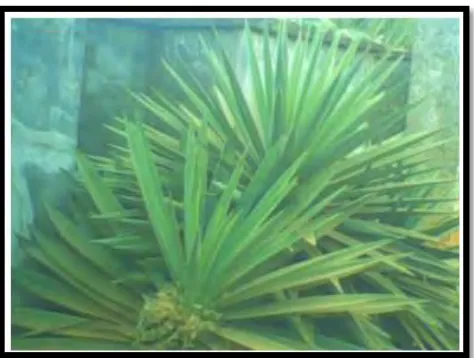
10 Figure 2.1 Figure Sisal leaf Oladele et all 2014
Seed fibre is originated and collected from seeds or seed cases and acquired from a seed of the plant species. The example of seed fibre is cotton. Cotton constitutes the most used textile fibre in the world due the fibre properties and low cost. According to M. Sfiligoj Smole et al (2013) stated that seed fibre is consist of comprising of unicellular seed hairs of the bolls of the cotton plant that when Cotton organic product blasts when developed, uncovering a group of filaments with the length from 25 to 60 mm and widths fluctuating somewhere around 12 and 45 μm..The other characteristic of cotton fibre is comfortable Soft hand and good absorbency. The application of cotton is most used as apparel and also can produce home fashion. The example the cotton fibre can produce the apparel such as jackets and sweaters.