Najam Perwaiz
A Thesis Submitted for the Degree of PhD
at the
University of St Andrews
1975
Full metadata for this item is available in
St Andrews Research Repository
at:
http://research-repository.st-andrews.ac.uk/
Please use this identifier to cite or link to this item:
http://hdl.handle.net/10023/13413
N. Perwaiz
1
An Extensible System |
for
The Automatic Translation j
? of a
INFORMATION TO ALL USERS
The quality of this reproduction is dependent upon the quality of the copy submitted.
In the unlikely event that the author did not send a com plete manuscript and there are missing pages, these will be noted. Also, if material had to be removed,
a note will indicate the deletion.
uest
ProQuest 10167248
Published by ProQuest LLO (2017). Copyright of the Dissertation is held by the Author.
All rights reserved.
This work is protected against unauthorized copying under Title 17, United States C ode Microform Edition © ProQuest LLO.
ProQuest LLO.
789 East Eisenhower Parkway P.Q. Box 1346
I
I
?I
I
■j
This thesis is dedicated to
my parents, and to. my teachers
for their training enabled me to produce this work.
:
ÎI
linguistics. A survey of the current techniques in the fields of syntax analysis and semantic synthesis is given.
V. .■ An extensible automatic translator has been described which
can be used for the automatic translation of a class of '
programming languages.
A, , The automatic translator consists of two major parts :
' the syntax analyser and the semantic synthesizer. The syntax
f ^
;> V 'if ',' analyser is a generalised version of LL(K) parsers, the
theoretical study of which has already been published by Lewis
Tr and Stearns and also by Rosenkrantz and Stearns. It accepts
• ’ f yt :: 'Î
Y Ir" \
■■
,. >■ • •-1
'■ Y
■ ‘■n. ' ^
;grammar of a given language in a modified version of the Backus Normal Form (MBNF) and parses the source language :---statements in a top down, left to right process without ever
J
backing up. \
The semantic synthesizer is a table driven system which is called by the parser and performs semantic synthesis as . the parsing proceeds. The semantics of a programming language
V is specified in the form of semantic productions. These are
", • used by the translator to construct semantic tables.
The system is implemented in SN0B0L4 (SPITBOL version 2.0) on an Il^M 360/44 and its description is supported by various examples. The automatic translator is an extensible system
J and SN0B0L4, the implementation language appears as its subset.
It can be used to introduce look ahead in the parser, so that backup can be avoided. It can also be used to introduce new r .facilities in the semantic synthesizer.
(Ph.D.) at the University of St. Andrews have been fulfilled by the
department of Computational Science, University of St# Andrews for providing me the opportunity to do this work and his guidance throughout this project*
I think I will be foregoing the most pleasant duty of my postgraduate years, if I do not thank my supervisor Michael Weatherill for his help and support throughout
this project* Without his encouragement, excellent
supervision, advice and healthy criticism this work would not have been possible* I would particularly like to thank him for his many weekends spent on reading early drafts of this thesis*
I also thank Prof* J,W*P* Mulder, head of the department of linguistics. University of St* Andrews for his useful
critical comments, and I thank Mr. U.A* Turner and Dr* R. Fisher for their valuable comments. I also acknowledge the help
given to me by Dr. R* Erskine, the computing manager by
allowing my "hands on the machine"* j
I
linguistics. A survey of the current techniques in the fields of syntax analysis and semantic synthesis is given. An extensible automatic translator has been described which
can be used for the automatic translation of a class of programming languages.
The automatic translator consists of two major parts ; the syntax analyser and the semantic synthesizer. The syntax analyser is a generalised version of LL(K) parsers, the
theoretical study of which has already been published by Lewis and Stearns and also by Rosenkrantz and Stearns. It accepts grammar of a given language in a modified version of the Backus Normal Form (MBNF) and parses the source language statements in a top down, left to right process without ever backing up.
The semantic synthesizer is a table driven system which is called by the parser and performs semantic synthesis as the parsing proceeds. The semantics of a programming language is specified in the form of semantic productions. These are used by the translator to construct semantic tables.
1.1 PROJECT SURVEY... ... . 1
1.2 SYNOPTIC V m f OP TRESIS ... . 8
1.3 CONDITIONAL EXPRESSIONS AND OTHER NOTATION .. 11
2. ON THE SYNTACTIC DESCRIPTION AND PARSING PROGRAIITING LANGUAGES ... 19
2.1 INTRODUCTION ... 19
2.2 PHRASE STRUCTURE GRAMMARS... 22
2.5 PARSING TECHNIQUES ... 50
2*4 BOTTOM-UP TECHNIQUES ... 51
2.5 TOP DOWN TECHNIQUES ... 57
2*6 COMMENTS ABOUT PARSING TECHNIQUES... 59
5. GENERALISED LL(k) PARSERS ... 44
5.1 INTRODUCTION... 44
5.2 RECOGNITION OP LL(k) GRAATÎARS... 44
5.5 DESCRIPTION OP THE PUSHDOWN MACHINE ... 47
5.4 GENERALIZED LL(k) GRAMMARS... 52
5.5 ON THE PRACTICAL ALGORITHM OF GENERALISED LL(k) GRAM^TARS ... 55
3.6 KETASYNTACTIC LANGUAGE... 54
5.7 EFFICIENCY CONSIDERATION ... 58
4.12 PAR SING ALGORITHM ... 81
4.2 LEFT RECURSION... ... ... 94
4.21 GENERAL CONSIDERATION... ...94
4.22 PRACTICAL CONSIDERATION ... 96
4.3 IMPmiEieATION OP LEFT RECURSION ... 97
4 3.1 BASIC PHILOSOPHY... 97
4 .5 2 n - ALGORITHM ... . ... ... 100
4.33 SOPT] PROBLEM’S WITH u-ALGORITHM... 102
4 .3 4 ALGORITHM... ...103
4.35 Y - ALGORITHM ... IO3 5. METASEiAANTIC LANGUAGE... ...105
5.1 INTRODUCTION .... 105
5 .2 SURVEY ... 105
5 .3 METASEMANTIC LANGUAGE (MSEAL) ... ..Ill 5.4 DATA OBJECTS, IDENTIFIERS AND SELECTORS 113 5.5 THE ENVIRONMENT AND THE CODE FIELDS ,,..*....117
5.6 ACTION FIELD... 121
5.61 STACK STATEkiENTS ' ... ....122
5.62 QUE STATEMENTS ... ....124
5.63 TABLE STATEMENTS... 125
5.64 ASSIGHTNT STATEMENTS .... 127
5.65 MISCELLANEOUS STATEMENTS ... 129
I 5.66 TRANSFER OF CONTROL STATEMENTS ... 131
5.67 SEAS ... 132 ! 5.7 OVERALL STRATEGY ... ...13&
6.3 RECOGNITION OF EL'ÎVIRONÎ'ENT EXPRESSIONS ... 156
6.4 OVERALL STRUCTURE ... 158
6.5 HIERARCHY LUTEIN ENVIROmTElfT FIELD ...I63 6 .6 PROCESSING OF SOURCE STATEMENTS... . I65 6.7 DATA OBJECTS ... ... 168
7. EXTENSIBILITY IN M T L ... ... 190
7 .1 EXTENSIBILITY ... ... ... 190
7.2 MTL AND EXTENSIBILITY ... ... 193
7 .3 IMPLEi'IENTATION OF EXTENSION PROGRAMS...199
8. PATE - PROCESSING OF ARITHMETIC AND TEXTUAL EXPRESSIONS ... ... 219
8.1 INTRODUCTION... ... ... 219
8.2 FUNDA^jENTALS ... . . ... 221
8 .3 ARITHMETIC STATEMENTS... 223
8.4 MISGELLAITIDUS STATEMEÎTTS... 224
8 .6 IMPLEMENTATION... 226
I 8 .7 CONTROL CARDS ... ...•• 238
9. CONCLUSION... ... 241
APPENDIX I ... ... . 247
SOME FACTS ABOUT LL(k) GRAMMARS ... . 247
EXCLUSION OF LEFT RECURSION 25%
APPENDIX I I ... ... 253
CROSS REFERENCE ... . 253
1.1 PROJECT
SURVEY:-This project in its final form evolved from an attempt to develop an English
I
4
1
%
I
like programming language for school and
other non-specialist students. This language was to be called "Processing of Arithmetic
and Textual Expressions" (PATE). After the implementation of the text processing
facilities of the PATE processor (described in full in chapter 8), it was felt that for most of the sophisticated developments of such a language, an automatic mechanism based on some formal grammar was desirable. This could then be used for implementing
I and testing the different features of PATE.i
I The investigation of this topic bore
interesting results and forms the bulk of the work described in this thesis.
syntactic properties, and the transformational properties of the structures are referred
to as semantic properties.
For example the set of all representations of programs in a specific programming
language is called its syntax. The
representation of the effect of executing the programs in a programming language is called the semantics of the programming language.
It is convenient to have a formal method for representing the syntactic and the semantic properties of classes of programming languages.
The notations in which the syntax and the
semantics are defined are known as metasyntactic and metasemantic languages respectively. A
combination of the two is called a metalanguage. We want to use the metalanguage as a vehicle
for constructing programming language !
these two types of programs only. Other sorts of software e.g. assemblers to which the term has been applied may present
different problems. 1
I
f
Initially all translators were written in |
assembler language. Although all types of time and space optimizations are possible in assembler language programming, since it
is rather cumbersome, experience shows that Q
all the code does not get due care.
Recently there has been a big trend towards
writing translators in high level programming §
languages. We believe this is a step forward and contend that by selecting a suitable
high level language for implementation, similar and perhaps even better results can be obtained w i t h .considerably less programming effort.
I
I
The general subject of interest in this %
dissertation is "programming linguistics" which we consider to be a science concerning
the design and specification of programming
primarily interested in tlie problem of automatic translator translation. We define automatic translator translation loosely as the process of using a computer
to perform some stages of the work involved in writing a translator. The program which performs this task is called an automatic translator. It has two parts :
the syntax analyzer and the semantic synthesizer.
For the purposes of this research such a ‘system has been implemented in SN0B0L4
[gRISWORLD 7o] (SPITBOL version) [ DEWAR 7l] .
Some special purpose high level programming languages have previously been designed for writing systems programs. A class of these
languages with special facilities for
compiler writing is called compiler compilers. An ideal compiler compiler is one which has
formal syntax and semantics as its input and whose output consists of a compiler written
that this ideal has not been reached. A compiler compiler normally acts as a high level language in which other compilers are written and at least parts of it reside in the core as an integral part of the -compiler. Some compiler compilers have embedded in them some automatic syntax analysis mechanism, hence automating this part of the task.
Our automatic translator is a high level problem oriented language, the problem being to write translators for programming
languages. One belief fundamental to our work is that the context free grammars
(defined in chapter 2) can continue to be used in a natural and convenient way as a basis for the specification of significant portions of the syntax and translation of programming languages. Furthermore we
find that a well designed contex free grammar makes a concise, readable and useful
syntactic reference for a language from
The automatic translator being described is a table driven system. The syntax and the semantics of a given programming
language are read and internal tables constructed from the information thus acquired. A mechanism has been provided for semantic extensibility (explained in chapter 7). Different extension programs can be written in SN0B0L4 and they are compiled at the execution time of the automatic translator. These programs
provide extra information to the translator.
During the development stages of a
translation system for a language, the grammar would be read and the tables constructed
before the source language statements are read for each run. However a fully debugged system will have the tables embedded.
Each source statement is read and processed individually. The syntax analyzer recognizes it and as soon as a sufficient amount of
I
information is available the semantic I*
Jl
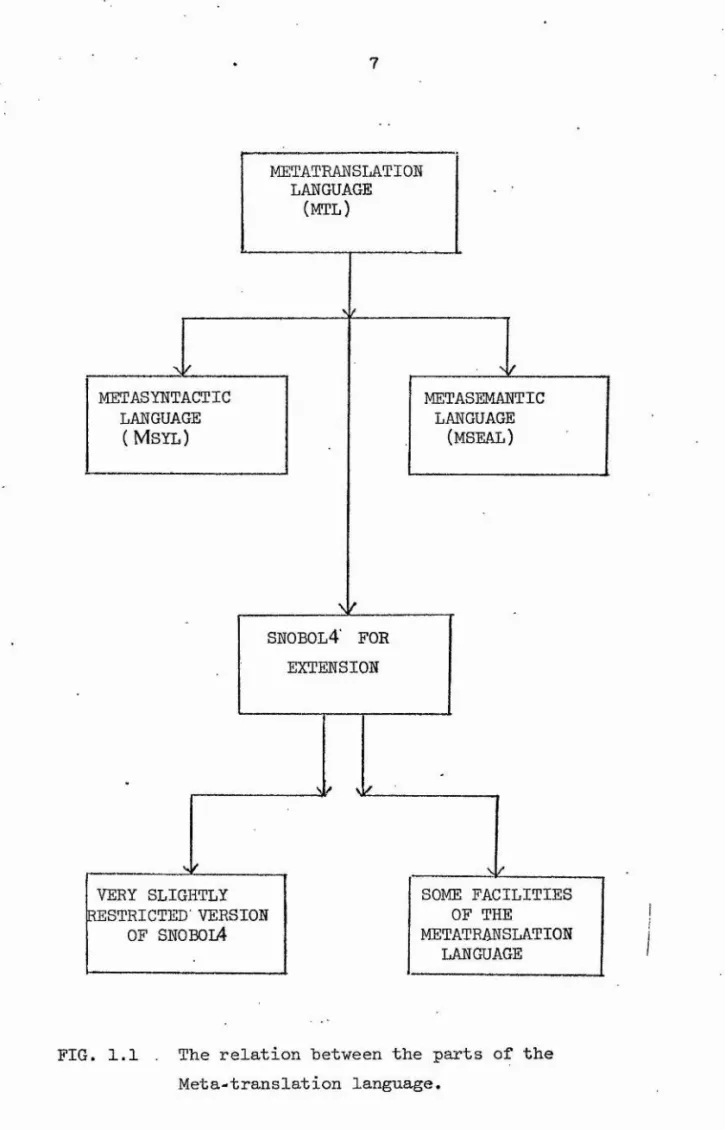
METASYNTACTIC METASEMANTIC
LANGUAGE LANGUAGE
( Ms y l) (MSEAL)
SN0B0L4 FOE
sf /
VERY SLIGHTLY RESTRICTED' VERSION
OF SN0B0L4
SOME FACILITIES OF THE
METATRANSLATION LANGUAGE
study Chomsky's classification of grammars, particularly the context free grammars and survey methods of analysing context free
grammars. i
1
I
r-tI
In the third chapter we describe the metasyntactic language for our parser. This is a modified version of Backus Normal Form (MBNF) which includes left
recursive productions. Techniques are described to improve the efficiency of
the parser and to reduce the length of look ahead. It is also shown how look ahead can be introduced and scanning of the source
text controlled by using SN0B0L4 extension
programs. '
I
We do not consider context free grammars in general any further and are mainly
interested in a generalised version of #
Lewis and Stearns' [LEWIS 68] LL(k) grammars. These form a fairly large
subset of context free grammars which can |
be parsed without back-up. '
#
J----The parser uses a syntax graph and a syntax analysis stack. Starting from the root of the syntax graph, it traverses different nodes following predefined hierarchically ordered paths without ever backing up and recognizes the source language symbols in the process.
Our metasemantic language (MSEAL) is explained in the fifth chapter. Each production of MSEAL consists of three fields ; environment field, action field and code field.
The environment field is used to determine the instant at which the particular semantic production is to be used.
The action field consists of a sequence of statements specifying actions to be taken when the environment field is recognized in processing source text. High level commands
have been provided to facilitate the i
data structures.
Extra power is provided by the code field. The user can specify a codestring in this
field. On meeting certain commands in the action field the corresponding code field is executed and code generated.
The implementation of MSEAL is discussed next. Using the semantic statements,
tables are constructed. As the recognition of a source statement proceeds, these tables are checked and at an appropriate stage
some semantic statement executed.
'To provide extra power for the complete, translation system (MTL), it has been designed to be semantically extensible,
SN0BQL4, the implementation language for j the MTL processor, appears as a subset of | MTL. Methods have been provided to use SN0B0L4 for specifying both the syntax
between MTL and SN0B0L4.
The description and implementation of the extension mechanism is given in the seventh chapter of this thesis.
In the next chapter we discuss the programming language PATE. It had its basis in SNAP [BARNETT 69] and is a
language for arts students. It was
implemented at the start of this project
and for the reasons described in that chapter, it was implemented in FORTRAN IV[IBM 360/370]
Finally, we conclude by discussing the results obtained.
1.3 CONDITIONAL EXPRESSIONS AND OTHER NOTATION.
Greek letters represent terminal strings.
|3| denotes the length of the string 3.
g:n refers to the left-hand n symbols of 3 if |3|) n and to 3 otherwise. The empty string is A . Lower case letters represent
terminals and upper case letters are j
represent either. The node of the syntax
■I
graph representing X (or X or x) is written S
. I
^O D E
^^ODE) '
|
the metasyntactic language are marked by j
■I an asterisk.
I
' I
I4hile BN F is suitable for the representation
of a single context free grammar, a formal #
method to represent sets of such grammars is desirable. It will enable us to discuss
the behaviour of precisely defined sets of #
grammars in the context of our parsing
algorithm. For this purpose we use a {
notation for a conditional expression which -■
r 1
was suggested by that of McCarthy [MCCARTHY q
60] . It not only fulfils the above
■I
requirement but also specifies the order g
%
in which different productions may be Q
recognised, and hence reveals certain features of the recognition algorithm.
The source language statement is considered as a sentence of a context free language whose
grammar is written in BNF -and which’ is being recognised by a top down left to right process.
;î
Our conditional expression is written as I
follows;
I
( 1 - 3 - 1 ) C » I n " : n 1 - n " " n ' 1 - n ' ' n . . . I
I
J
^n-l
'^n-l < - l 1»-! ^n-1' ^n-14-1 4-1
i'j4
‘'n-2 l-n-2
4
-2
'4-2
4-2
4
-2
'4-2
4-2
4-2
...^ 0 1 * 0 ^ o '
4
4
4
'4
4
4
The occurrence of the triple has the
effect of returning the value when the
condition C? is found to be satisfied,
C? has the form (a^= 3) and is satisfied if
the substring under consideration, , has
the form 3. Each triple has a level which
C . L is defined below,4
Evaluation of the conditional expression takes place in descending order of level and looking from left to right at each
level. The value V of the whole expression
is the concatenation of •
Ï;
I
is given by the subscript i of the condition Q
(1-3-2)
V p ' V p "
V p "
where the value of
Vn-p
ris the concatenation
of
(1.3.3) ^ n - / -...
In (3) the value of p increases with superscript r; p and t are such that V
consists solely of source language symbols.
may be either or " - » " . In both cases one and only one condition at the current level may be satisfied. The symbol
" implies that the triple is applied
once only, whereas implies that the
triple is applied n times where n / O.
It follows that if no has the form
then exactly one condition must be satisfied at the level i. This notation can be further
generalised by ranking the conditional ^
EXAMPLE 1.3.1
One might wish to specify the following rules about the recognition procedure for the grammars of the form:
(1.3.4) < X > = a
(1.3.5) < x > = <x> aa Gl.l
(a) Find the left recursion
(b) Process (5) the correct number of times, (c) Process (4) and recognise the source
string with the help of already processed productions.
Using (1) these rules can be stated as
(1.3.6) [ (a2=A)“>n=0, n==n+l, ]
for a set of all left recursive grammars of which the above grammar is a member. (For Gl,l
3 ^=aa and 3^ =a).
Suppose aaaaa is a sentence of L (Gl.l) and is to be recognised using (6).^ The cursor is considered to be on the left of the source statement. The condition to be tested first
I
is A ~ A- since 2 is the highest level in!I
(6), any part of the string aaaaa or a
t Reference to a relation inside the current section
satisfied, n is set to 2 and the cursor position
still remains unchanged (step h). IThe condition = 3^)
is attempted ag^in but it can not be satisfied since
can only have the value a. The value of a and the cursor position remain unchanged, Tlie condition (o^ = 3^) is now attempted and satisfied. At this state ^3^ is recognized and the cursor moves to right of the source sentence and
t Since it is not possible to determine whether ( a ~ 3 ) IS satisfied or not, the conventional top down parsers do
not accept left recursion. ’
((^2 ii i^ represented in (6)), So (o^ = A )
is satisfied and n is initialised to 0, but the cursor is still on the left of the source string (step a)»The next condition to be tested is (a^ =3^)*
If we take ot^, to be aa, the condition is satisfied, 4
'
n is set to 1 and the cursor position remains unchanged -Ç;
(step b). The condition (a^ = is tested again,; ||
Since can still have the value aa, it
is
I
the recognition of the source sentence is successfully
completed, (step c) The value of
r
(refer to (3))is
0 1 which is the same as aaaaa. In (2) it is represented by Vn-»n.
Other values in (2) are. = atl)
1.4 A set of productions representing embedded recursion might be written as
(1.4.1)
(«2
= A)~>n= O, (a^ - >> 3^ and n = n + 1,(a = 3) - » 3 3p]
The following is a grammar representing
The only value consisting solely of the |
source language symbols is that of and hence it is the value of V.
1
EXAMPLE 1.3.2
A production containing direct right recursion can be represented as
(1.3.1) [(a^ = 3^) -^3^, (a = 3) -> 3]
For the right recursive grammar
<x> = a <x > l b G1.2 ^
j.a
'
1
3jj^ = a
3
— bEXAMPLE 1.3.3
embeded recursion
< x > = a < x > b | c G1.3 I
In this grammar f
I
CHAPTER II
On the Syntactic description and
Parsing Programming languages
2,1 IMTROnJCTIOH:-.
To make clear the reasons for our choice of context free grammar we begin by
surveying grammatical models which have been used in earlier projects. These
projects fall into two classes - those ,|
where sentences must be generated and those which require recognition of
correct sentences. Existing grammatical theories have helped researchers in
making some progress in the field of machine translation but the net result is far from satisfactory, because either they are not powerful enough or are too difficult to be handled by computers
(see survey articles by Sage [SAGE 67]
and Satterthwait [SATTERTHWAIT
66
] andsee article by Floyd [_ FLOYD 64] ) . The
generative mechanism has been used by researchers [FREDMAN 62, 71 etc] who
I want to use computers as a tool for
' ' ii
I
developed which use grammars both for
recognising input sentences and generating grammatically correct sentences in reply.
PROSE [v i g o r 69 ] is such a system. It
uses Hay’s Dependency grammar [HAYS 64 ] as its grammatical model. However as far as programming languages are concerned
Chomsky's models [CHOMSKY 57] of generative grammars have obtained the widest acceptance.
By this we do not imply that his models are é
sufficient for all further developments in programming languages but we only note that the structure of most of the programming languages so far in existance, either intentionally or unintentionally has been designed so as to fit Chomsky's models.
We will follow Chomsky in describing his generative models. Similar systems to
accept only correct sentences are well known. The simplest model discussed by Chomsky is the finite state grammar. This can be
described in the form of a machine that can be in any one of a finite number of different
internal states. This machine switches from one state to another by producing a certain
as the initial state while another is the final state. Beginning from the initial state, if the machine runs through a sequence of states and reaches the final state, it will generate a sequence of
symbols known as a sentence. The complete set of sentences that can be produced in this way is called a finite state language and the machine is known as a finite state grammar. The recognition of a finite state
language may be performed by a finite automaton which will in general be nondeterministic. It has been proved
[r a b i n a n d SCOTT ss] that every nondeterministic
finite automaton can be represented by some deterministic finite automaton, which we know can always be simulated.
Unfortunately only a small number of programming languages are finite state. Any attempt to construct finite state grammar for others will run into serious difficulties. For example general
bracketed expressions require a context free grammar and the same is true for many
I features of well structured programming Î
2.2 PHRASE STRUCTURE GRAMMARS
Suppose S is the initial symbol and
(2.2.1) IC^(S), IC
2
(S),103
(8
) IC^^S)are its immediate constituents [BLOOMFIELD 33] , derived using rules usually known as
productions.
Let us write (1) as follows
<
2
.2
.2
) S^, S^,---Their immediate constituents will be as follows, although any one of them can be null.
(2.2 .3) IC^(sl), IC2(sj^), 103(81) --- IC^^sl)
103
(82
),102
(23
),103
(83
) ---10
^^83
)ICits !), 13(3!), 103(3!) --- 10^(3!)
If we write the non-null constituents as
(2.2.4) 33, 83, S 3 ---3^
and continue the process we will finally reach
(2.2.5) 33, 83, S 3 --- S"
SO that they do not have any constituents.
If we call the above model a context free grammar, the set of all the representations of S (with subscript and superscript including the start symbol) is known as its vocabulary. All symbols that can not be further broken
down are terminals and rest of the vocabulary is formed by nonterminals. A sentence is a string of terminals which can be derived from S with the productions concerning immediate constituents. The language is the set of all the sentences that can be produced from
Formally a context free grammar is a
quadruple G (V^, V^, S, P ) , where is a
finite set of terminals, V__ a finite set of
nonterminals with
0
~ K ' ^S is the initial symbol and S e P is
a finite set of productions of the form A ~> w
where the left part is A e and the right
part w E V* where V* denotes a string of symbols of V,
A string u is called a sentential form if ct is derivable from the initial symbol S. A sentence is a sentential form consisting
only of terminals. The language L ( G) is a set of all the sentences that can be generated from the grammar "G.
It should be noted that the finite state grammars form a proper subset of the context free- grammar in the sense that every finite state grammar has an equivalent context
free grammar while the converse is not true.
Let G be a grammar. We say that the string X directly produces the string to , written
I (
25
>
i
■J
if X -> W
If X ~> => ....=>
0
) V1
then X =>+ w
If either X => w
1
or X =>+ Ü) ./I
1
then X =>* (Ü 't
If X -> w ... where three dots
represent a string possibly empty.
i
t id
then X FIRST 03 \
If X FIRST
0
)^ FIRST O)^"^ FIRST0
)^"^ j— ---FIRST to. 4
then X FIRST +
0
)1
If either X FIRST 03
or X FIRST + 03
i
1
"t & 5
then X FIRST * 03
Let (jl) = X u y be a sentential form. "I
Then u is called a phrase of the sentential ;!I
form w for a nonterminal U *
4
if
U
S => X Uy and
sf>+u, u is called a simple phrase
1
1
if S => *xuy and u => u.
1
If ü => +
... u...
we say the grammar is recursive in U. |
If + Ü ... it is left recursive;
If U=> + .. .U it is right recursive.
A sentence of a grammar is ambiguous J
if there exist more than one derivations for it. A grammar is ambiguous if it can generate an ambiguous sentence.
"Phrase Structure grammars" is a name given by Chomsky to what the Bloomfieldian
linguists [LYONS 70] originally called the immediate constituent analysis. They are also commonly known as context free grammars
(CFG). These grammars are formally
equivalent [GAIFMAN 65] to Hays [HAYS 64] dependency grammars. Two grammars are equivalent if both produce precisely the same set of sentences with the same
ambiguities. Chomsky provided a formalization of CFG [CHOMSKY 57] and demonstrated that, in spite of being more powerful than finite state grammars in the sense that more languages can be described by this model CFG’s have!
1) A suitable CFG is capable of generating almost all the sentences of English but in many cases fails to generate all
structural descriptions which may result in ambiguous meaning. For instance the sentence "Flying planes may be dangerous” can be generated by a phrase structure grammar but its two quite different
descriptions can not be distinguished by this model of grammar,
2) CFG's do not provide a method to show
semantic relations between different sentences For example there is no way of stating
that if one of the following statements
is true, the validity of the other statement is implied.
a) Yesterday I rode a horse. b) I rode a horse yesterday.
3) The syntax of programming languages can be
,4) When CFG is to be used for syntactic analysis, it is sometimes stored in machine in the form of a syntax tree (or a syntax graph). There are sentences which use common vocabulary and are semantically related but large parts of their syntax trees are separate - hence wastage of space. For example
a) I shall give the girl, a book. b) I shall give a book to the girl.
c) Shall I give a book to the girl?
A transformational grammar as defined by Chomsky assigns to each sentence it . generates, both deep structure and surface structure analysis and systematically
relate the two. Deep "connections" between sentences which cut across the surface
grammar are transformational rules. The 4
phrase structure rules are used to generate underlying strings arid on applying
transformational rules' on these strings we obtain sentences.
Transformational grammars have not been
used much for analysis of programming languages and most of the work concerning them is
confined to using computers as a tool for linguistic research [f r i e dMAN 71] . It is
mainly due to the complexity of transformational rules. It is argued that programming languages do not require the "power" of transformational grammar, since they normally do not posess active, passive, exclamatory and similar interrelated sentences. We note, however, a recent paper describing work at the University of California [d e r e m e r 74] .
The first two points mentioned in connection
with CFG can be accounted for by transformational |
grammars but it is difficult to say anything g
about the last two points, since they have
not been studied in great detail. Attempts J
were made to devise a formal method of representing languages in transformational grammar. Further research was abandoned since the productions required for such a representation grew exceedingly complex.
2.3 PARSING TECHNIQUES
Parsing techniques can be devided into two main categories : bottom up or data directed methods and top down or goal oriented methods. There are parsing methods which do not fall
in any one of these categories, however, most i
of them are very ad hoc and do not form a
model of any significant generality. We quote
Conway's [CON^VAY
6
s] remarks about his parsingtechnique, which requires the construction
of so called no-backup diagrams; |
We therefore will confine our discussion to the two main categories of parsers mentioned above.
I
I
I
"The catch in all this is that a set of
4
no-backup diagrams for a given language is constructed by a process which is neither straightforward nor easy to
-I describe ...".
In this method we analyse the given
language by repeatedly finding the handle è of the current sentential form and
reducing it to a nonterminal B using a production
B -> .
The problem with the bottom-up method is to find the handle and then to know which nonterminal to reduce it to.
out that the space required for the matrix
2
'is very large (of the order of n , where n
I
is the number of symbols in the vocabulary)
2.4 BOTTOM-UP TECHNIQUES:- |
I
1
Wirth and Weber [WIRTH
66
see also 4HASKELL 74] have developed a bottom-up parsing technique for a class of CFG's.
In this class no two productions have the same right hand sides and at most one
so-called precedence relation holds between any two symbols of the vocabulary. This
class is known as simple precedence or (
1
,1
)precedence grammar. The precedence relations are stored in a matrix.
reduces the space requirement. Formal i methods have now been presented to
calculate precedence relations [t4ARTIN
68
]and precedence functions [bell 69}.
However, it is not possible to construct a simple precedence grammar for every CFG and further, it is not possible to derive
precedence functions for all simple precedence grammars.
I
A technique which is similar to the simple precedence technique but requires a
considerably smaller matrix is called operator precedence and the grammars it handles are called operator precedence grammars. This technique has been given this name because terminals of the grammar play the part of operators and nonterminals are treated as operands. The parsing
algorithm used for simple precedence grammars
is applicable except that all relations are ; ÿa
among the terminals only.
Obviously this requires a smaller matrix.
symbols on either side of the deleted handle to find out what it should be
reduced to.
Operator precedence grammars are only a special case of bounded context grammars. Parsing algorithms for bounded context
grammars use a three column table in '
I
addition to the usual space requirement , for holding all the rules of grammar.I
Higher order precedence techniques can parse a bigger subset of CFG then the
simple precedence methods, but these |
methods are normally too demanding on
space. In many cases the space requirements can be reduced to a reasonable limit by
using some ad hoc techniques.
Another difficulty with precedence parsing techniques is that all the right parts of productions must be unique. Attempts to get rid of this restriction led to the development of bounded context grammars.
[PAUL 62 , FLOYD 64 , IRONS 64 , CRIES 7l] |
The construction of tables is always
complex enough but gets even more difficult in certain cases ((m,n) bounded context grammars). Also there is no direct way of finding out whether a grammar is
bounded context or not. Knuth [kNUTH 65 ]
has investigated LR(k) grammars.
A grammar is called LR(k) if, for
V* V
in T , A in N, and P, P in t
G, S =>w^ A w A => A and
(ü
)2
Wg); k = (^2 ^ imply P = P**.Stated informally in terms of parsing, an ;|
LR(k) grammar is context-free grammar such that for any word in its language each production in its derivation can be
identified and its descendants determined with certainty by inspecting the word from
its beginning (left) to the kth symbol beyond the right most descendant.
Knuth points out that almost all unambiguous grammars which can be processed by some ; left to right process are LR(k). In fact!
precedence grammars CT bounded context
Knuth has also shown how one can determine whether a grammar is LR(k) for a given k. The problem of deciding, for a given grammar
G, whether or not there exists a k ^ o
3
such that G is LR(k) , is however undecidable. He has shown a CFG, named by him as LR(k,t) grammar, for which we must back-up by a finite amount. He also points out that the parse time for LR(k) grammars is essentially proportional to the length of the string to be parsed.
Deremer [ DEREMER 69] has given a practical algorithm for parsing LR(k) grammars. The complications involved in constructing a parser for LR(k) grammar vary directly as
the complexity of the grammar and Deremer defined a hierarchy of LR(k) grammars given in the ascending level of complexity by
1 LR(0)
2 SLR(k) t
3 LALR(k) t
4 LR(k)
t Simple LR(k)
I
i
Three different subsets of LR(k) grammars 3
are defined in terms of their parsing algorithms. Deremer has shown that SLR parsers for SLR(k) grammars can parse a large number (if not all) of languages
that can be handled by precedence techniques g
or bounded context grammars.
Knuths LR(k,t) grammars overlap with
i'i
grammars which are LR(k) and are not |
LALR(k) in Deremer's terminology. The
parsing technique for this class of
J
grammars has not been described with the |
same details as given for SLR(k) and LALR(k) "
parsers. Nevertheless one thing is clear; as pointed out by Deremer, it is exceedingly-difficult to construct a parser for this class of grammars.
A biblography on LR(k) grammars appears in a tutorial paper by Aho and Johnson
2.5 TOP D0V7N TECHNIQUES
These techniques work by starting from the initial symbol of the grammar and recognizing a sentence by working
through its productions. In his survey of parsing techniques Floyd [FLOYD 64 1 has mentioned only backup oriented
techniques. However the notion of $
no-backup techniques was in existance long before [k a n n e r 59] the publication
of his paper.
Methods have been described [lIETZKE 64]
to perform top down analysis by scheduling different procedures. The idea is that an appropriate procedure should be called at the appropriate place and every procedure should have a specific task to perform.
These techniques.though adequate for certain languages do not form a general model for any appreciable subset of CFG's.
The Global parsing technique fuNGER 6 8] J
to be available to the parser before parsing
begins. Unger has given various "quick
checks" to be performed to make the parser efficient but many of them are reported not to have been studied in detail.
Lewis and Stearns [LEWIS 68] have defined syntax oriented transductors which perform both syntactic and semantic analysis.
This model, however, has not been used in any compiler so far to the author's
knowledge.
LL Parsers [LEWIS 68, ROSENKRANTZ 69] (discussed in the next chapter) can be considered as the top down counterpart of Knuths LR techniques. The grammars that can be handled by LL parsers are known as LL(k) grammars (defined in the next chapter). An LL (k ) grammar is a
the portion of the input string which has been processed so far plus the next k input symbols determine which production must be used for the nonterminal.
2.6 COMMENTS ABOUT PARSING
TECHNIQUES;-The efficiency of different parsers is notoriously difficult to compare. It is not only dependent on a particular language but also on the manner in which its grammar is written.
It may seem reasonable that in making the above mentioned comparison among different parsers, language should be a constant factor and its grammar in each case be written so as to suit the particular parser. However, no general conclusion can be drawn from such a comparison. Since, for almost any general parsing method known, there are languages (or sentence in languages) which make .it
drastically inefficient. Comparison of
I
different parsers on theoretical grounds
I
many algorithms differ from each other substantially.
Griffiths and Patrick [GRIFFITHS 65]
have made a comparison of parsing techniques and have concluded that top-down parsers are grossly inefficient timewise as
compared to bottom up parsers. Brooker
[BROOKER 67 ] has criticised their conclusion on the grounds that the grammars of a large number of programming languages can be
written so as to make their top-down
parsers efficient. We agree with Brookers remarks and add that a better general purpose parser is one which is efficient for bigger subsets of languages, and for more languages. Hence, a fairly general purpose no-backup parser is better than the backup oriented parser, the reason being that in a backup oriented parser, efficiency will be achieved by writing the grammar so as to minimize
backup while a no-backup parser by definition possesses this property in its extreme form.
to store information produced during the parse of a given sentence. The former in efficiency is common in bottom up parsers where large matrices are needed either for some type of precedence relations or for storing look ahead symbols. The latter inefficiency is usually found in backup oriented parsers where a lot of information is required, in case the parser has to
backup.
Horning and Lalonde [ HORNING 7l] have made an empirical comparison of the time and the space efficiencies of two general classes of bottom up parsing techniques, namely precedence techniques and LR parsers. But due to the reasons given above they do not claim to have reached any definite conclusion about the relative efficiencies of precedence techniques and LR parsers in general. However, they claim
t
that by using Deremer's LALR algorithms and after using various optimizations suggested by him and on including new optimizations we get a parser which is worth considering when selecting a parsing technique for a
compiler.
Ease of use is another important feature t
in parsers, A technique could be quite j
difficult to use if it is capable of
treating only a special class of grammars defined by conditions which are not easy to
state directly. Some parsers are very |
difficult to construct even if it is known that the grammar being treated is suitable for them. Both of these problems are common with bottom up parsers. In this regard a parser which can accept grammar of a given language in some
modified version of BNF can be quite useful. A top down technique is valuable for this purpose and provides a natural way of
constructing internal tables. It has been
used in many such systems [METCALFE 65],
A good parser should also be able to give reasonable syntactic diagnostics, since they are essential for program debugging, no-backup parsers are an asset in this respect.
With these comments we shall attempt to define an ideal parser. The nearer to
this definition the better.
i
An ideal parser for CFG's is one which accepts all grammars written in BNF, requires the minimum possible space necessary to store the parser, and
requires no space for storing specifications i
CHAPTER III
GENERALISED LL(k) PARSER
3.2 RECOGNITION OF LL(k) GRAMMARS;
As defined by Lewis and Stearns [LEWIS 68] a grammar is LL%k) if, for all
3.1 INTRODUCTION
;-This chapter is devoted to the discussion of |
the metasyntactic language. Rules of the metasyntactic language are given and, where necessary, they are explained with the help of examples. It is shown how using some of these rules, the value of k can be reduced. It is also shown that in spite of the fact that Rosenkrantz and Stearns have proved that the left recursive grammars are not LL (k),
this restriction is not valid for our algorithm. The class of grammars defined by the property
that they are accepted by our algorithm therefore constitute an extension of the LL(k) class.
in A in , and p, p' in G, S ==> w^AW^, S=>w^AWg,
A ' > W g A->^W""2
P I
and (wgwg): k = (wg wp : k imply p = p'
Stated informally a grammar is LL(k) if a production and its leftmost descendant can be identified from the symbols to the left of this leftmost descendant and the k symbols which follow (counting the leftmost descendant
terminal as the first symbol).
Before we show that a deterministic pushdown machine can be constructed to recognise the
language generated by a given LL(k) grammar we shall prove a lemma.
Let L be the language generated from an LL(k)
grammar G using nonterminals and terminals
V^, Define as follows: For A in let
L^ be a set of words in V*^ generated by G using
starting symbol A; for A in V^, = {A}
If R is a subset of V*^, let R:k = {w:k| w in R}
LEMMA. If G is LL(k) , then for all A in ,
Ü
3
in V*^; k, and R Ç k satisfying RCH (w^)={wg:kS => } for some in V*^, there exists
at most one production p such that A~>* o)^(p)
and : k =w for some 2 and 3 in V*,T
such that Wgis in R.
J
-
^
PROOF. Suppose that A=>Wg(p), A (p) , f
_ ■>?
and(ùü^w^) :k = (WgW^ : k = w for some Wg, i
p, and p such that w^tk and wg: k are in R
where R g R (w^ ) for some It follows that
there must be w'l and w*! in T such that3 3 S = A , S =4*-aij^A w p w p k = w^: k , and
(üpk ï= w^:k. The last two relations imply [
that ( : k = (w^wp :k = w, and the fact that
p = p follows from the definition of LL(k). Thus there is at most one such p.
¥
y
The importance of this lemma can be stated
f
informally as follows; The definition of :j
LL(k) grammars specifies that for any sequence in the language, a production can be correctly
identified from the sequence w^of symbols to ¥
the left of its first descendant and the k , |
;
symbols which follow. The lemma states that the |
production can also be identified using only the |
k symbols which follow and the set R ) where
R(w^) is the set of all k symbol sequences which can follow the rightmost descendant of that
amount of information that must be remembered about the initial sequence.
3.3 DESCRIPTION OF THE PUSHDOIVN MACHINE.
The finite-state control has enough memory to store an input string of length k or less and to perform such obvious tasks as reading in the first k inputs. The tape symbols are ordered pairs (A,R), where A is an element of
the machine so that if some r + k inputs have been read in, the input string stored in the
finite-state control is w and the top tape symbol is (A,R), then the following are true.
(1) The word w stored in the finite-state control is the string consisting of the
(r + l)-th input through the (r + k)-th input. If the input word only has r + k symbols for k \ k, then w is the last k symbols of the input word. In this latter case, it is convenient to say that k - k blank inputs have been read in after the completion of the input word as indicated by the special end-of*-tape marker. These implicit blanks play the same role as the
I
1
t /
(3) The set R represents R : k, where R is the
I
" H " of Knuth. ^
(2) The symbol A represents the fact that tlie
descendants of an A follow the rth input |
symbol. If A is a terminal symbol, this
“If
means that the (r + l)-th input symbol |
J must be an A. The symbol pair (A,R) or
its replacement is to be popped up as soon as all the descendants of A have been identified.
I
set of all acceptable input sequences
that could follow the descendants of the
1
A. Thus, if is the tape symbol
below (A,R) , then R = R^):k; and
R = {A} if (A,R) is the bottom tape symbol. The machine begins with the single symbol
(S, {A}) on its pushdown tape.
We now describe the machine operations. Initially, the machine reads the first k inputs and stores them as the word w in the finite control. The pushdown tape is initialised with the symbol
read, the operations are as follows;
Case 1. If the top tape symbol is (A,R) and
A is a nonterminal, then R - {
0)3
: k|S=>*^^^Aüj^, where consists of the
first r inputs. Therefore, by the lemma, there is at most one production p that could be applied to A in order to be consistent with w and R. Three subcases follow;
Case la. If there is no such p, the machine rejects the sequence.
Case lb. If p is the production A = > A then the top tape symbol is popped off.
Case Ic. If p has the form A => A,...A for A.
1
m1
in U V^, then the top symbol (A,R)
is replaced by the sequence of symbols (A^, R^)... (A^, R^), where R^ - R and R. _ = (L , R. ) : k for 1 < i < n.i
-1
A^ ' i \Case 2. If the top tape symbol is (A,R) and A is a terminal, there are two subcases:
Case 2a. If w = A w'' for some w"', then the top I
tape symbol is popped off, the next I
in the finite control.
Case 2b. If w does not begin with A, then the sequence is rejected.
Case ,3. If there are no tape symbols on the pushdown tape, then if w = A, the sequence is accepted and otherwise it is rejected.
Although considerable information is encoded in the tape symbols (A,R), this is somewhat less information than is required for general LR(k) recognition. Furthermore, even this R information is needed only when the machine
must choose among words in which are shorter
than k. To verify this, assume that (A,R) is the top tape symbol (i.e. the machine is . looking for a production descendant from A)
and that control word m is the (i.e. that
A aiV o A >-V A OQ
r-4 V
O
r r-4 A
. z X
,-4
r r V o II II II It or.Z) A A A A a X >- CD V/l <-0
O o o o o o O O O O O o
m UJ J DO-jS KN Q> • • tH (A 02 c3 M M
01
0
) X sI
I
H
H-zr 2:
lU LU .
_ j -J
<c <ï
> >
#
3O Z)o -I
LU tu j
<y> . (rr
h“ K %
oc o:
o o I
o o
II II
-J _J o o
o o 2:
o CO CO r-4 ZJ
s: o i|
o > > o LL 1
00 OO w
o o f-4 oc ■;
00 00 o 1
o m r*4 W O oc
X X eg ■i
"T t— r—4 h-. r-4 LU -"<1 W
O r-4 # rM -«• o* •fr **
As an example where R information is necessary, consider the following grammar;
S=> lAlB S => OAOB A —> O A=> 01
EXAMPLE 3.1 B => O
This grammar is L L (3), but after 1 + 3 inputs have been read and w = 010, one cannot
determine which production to apply to A without consulting the corresponding R which will contain either (lo) or {oo} , depending
on which production was applied to S.
3.4 GENERALISED LL( k)
GRAMMAR:-We define a generalised L L ( k) grammar as follows:
A grammar is generalised L L ( k) if, it can be written with the help of the metasyntactic
language described in (3.5) and for all